

If your Google Business Profile is complete and the phone still stays quiet, is the listing the problem, or the plan behind it? Most guides treat local SEO as a checklist of categories, photos, and reviews. That misses the decision that produces customers: which neighbourhoods you serve, and whether a lead from that area is worth the work.
A customer on a Vancouver sidewalk types a service and a place because they want someone close, available, and trustworthy now. The sign on a busy street does the selling before anyone walks in. Online, the profile and the page do that job. A local SEO strategy starts with the service area and ends with leads counted by area, not with a finished listing.
What Local SEO Strategy Means and Why It Matters
A local SEO strategy is the plan for showing up when nearby customers search Google Search and Google Maps for a service. It works like a delivery zone drawn on a map: before menus, drivers or prices, the business decides which streets it can serve well and what a completed order is worth.
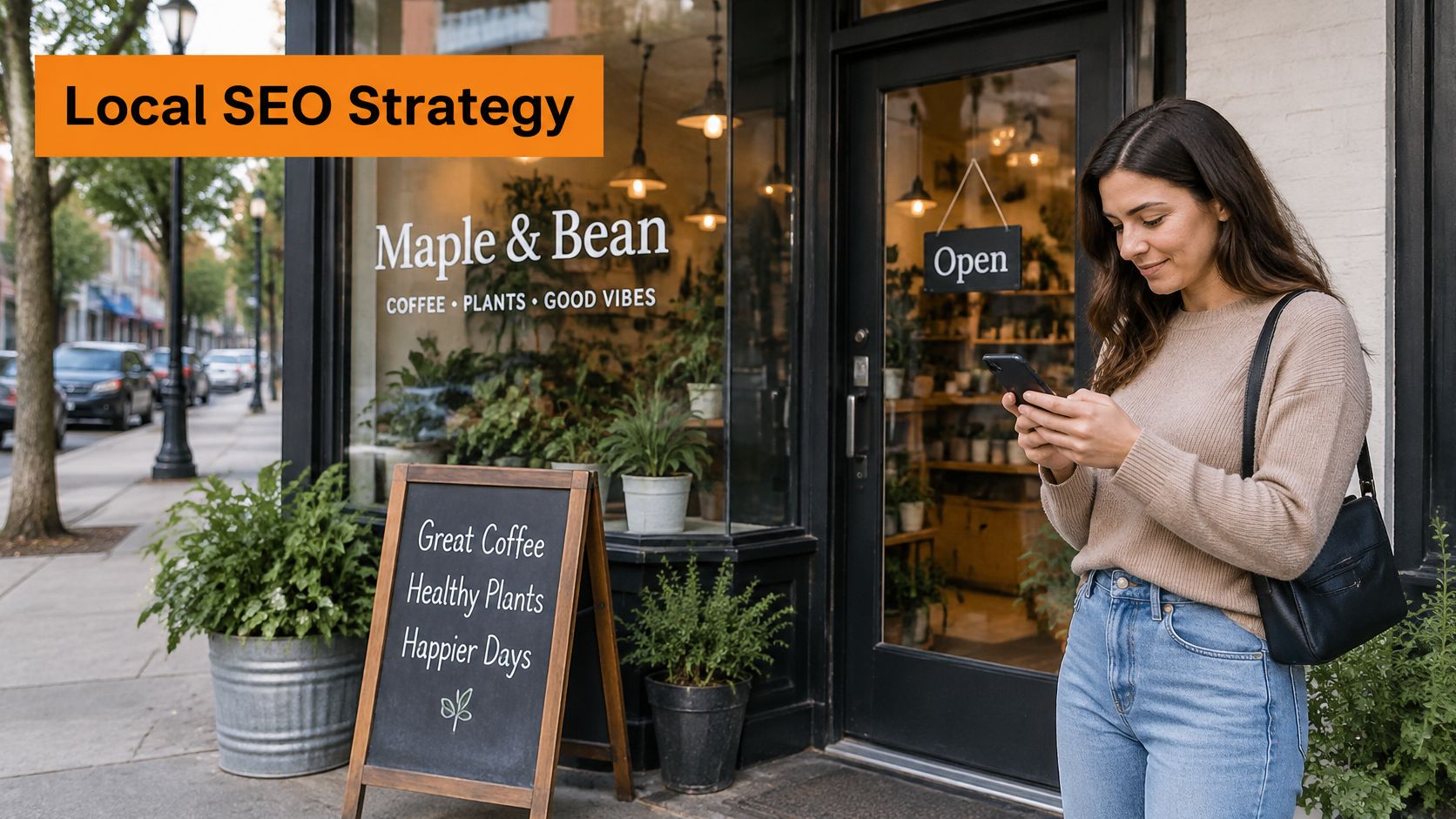
Searches such as "plumber near me" or "physiotherapy in Kitsilano" carry strong intent. The person often wants to book the same day, so a visible, accurate result can turn into a customer before the afternoon is over.
Many local businesses already appear in Google Maps or keep a profile active. Visibility alone is common. The strategy is deciding which areas deserve the effort, which service each area should see, and how calls, forms and direction requests will be credited back to that area.
Strategy versus a pile of tactics
A strategy chooses the areas, services, and customers you will target, what you fix first, and how you will measure results. Tactics such as posting updates or collecting reviews serve that plan. Without the plan, those tasks stay busywork.
National SEO chases broad keywords across a country. A local business also competes on proximity and trust. The closest credible option often wins, even when a distant site has more pages.
A finished profile is an asset. A strategy names the service area, the offer, and the lead you expect from each neighbourhood.
The test is simple: if a lead cannot be traced to an area and a service, the plan is still measuring activity instead of demand.
The Six Components of a Local SEO Strategy
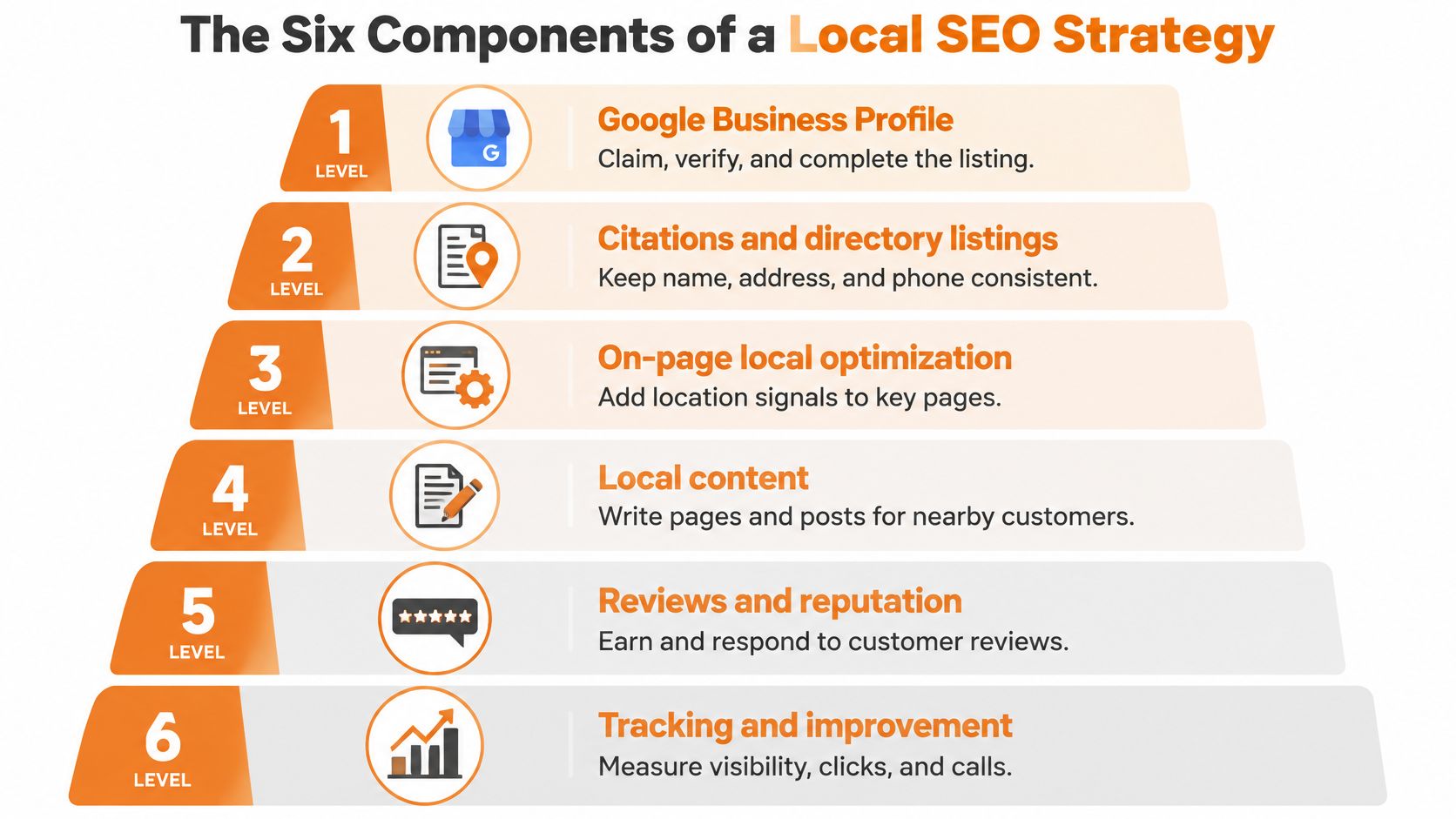
Work in this order. The profile is the hub. The other five parts only help if that hub is accurate.
| Component | What It Covers | Core Check |
|---|---|---|
| Google Business Profile | Primary and secondary categories, hours, services, photos, posts and Q&A | Primary category matches the main service and hours are current |
| Citations and directory listings | Name, address and phone number on directories and industry sites | Business details match exactly on every listing |
| On-page local optimization | Title tags, headings, contact page, structured data and internal links | Each service page names the city or neighbourhood it serves |
| Local content | Location pages, project case studies and neighbourhood guides | Each page holds distinct service information and local proof |
| Reviews and reputation | Review volume, average rating, topics mentioned and owner responses | New reviews receive a response on a regular schedule |
| Local link signals | Local news, chambers of commerce, associations and community sponsorships | Links come from sites the local community actually uses |
The hub
The Google Business Profile is the record customers and Google both read first. Set the primary category to the main service, not a vague industry label. Keep hours, services, and the service area current. Refresh photos and posts so the profile looks lived in, not abandoned. A clear walk-through of Google Business Profile setup is the right first job if the listing is incomplete or claimed by an old email.
Citations are the consistency layer. The name, address, and phone number on the profile, the website, provincial directories, and industry associations should match character for character. "Street" on one listing and "St." on another is a small crack that makes entity matching harder.
Proof on the site, then proof from other people
On-page work is how the website confirms what the profile already says. Each service page should name the city or neighbourhood it serves, offer one clear click-to-call link, and carry Organization or LocalBusiness structured data. A crawlable contact page with the same details closes the loop.
Local content has to differ in substance. A project case study from a real job, or a note about parking and access in one neighbourhood, is useful. A copied paragraph with the city name swapped is not.
Reviews and local links then reinforce the hub. A consistent listing makes reviews easier to trust. Replies show a person is listening, which supports the click. Links from a chamber, a local news piece, or a community sponsor confirm the business belongs in that place. Each part feeds the next. None of them replaces a service area you can cover.
How Local Rankings Work and Where They Stop
Google's stated local-ranking framework weighs relevance, distance, and prominence, as summarised in this comparison of Canadian and US local search. Relevance is how well the listing matches the search. Distance is how far the business is from the person searching. Prominence is the wider recognition that comes from reviews, links, and a clear presence online.
Distance is the factor you cannot write your way out of. A page about a suburb does not move the pin. That is why the service area has to be honest. If you do not receive customers at the address, do not present it as a public storefront. Use the profile's service-area settings and name the communities you cover. A deeper look at how local rankings work helps when map results and the website seem to disagree.
Where the plan stops working
Over-targeting is the usual failure. A business that serves a dispersed part of British Columbia still faces distance limits. Publishing a city page for every nearby municipality, with no crew, no jobs, and no distinct detail, creates thin duplicate content. Those pages rarely earn calls.
A second limit is newer. Early 2025 research on local AI Overviews, published by Whitespark, found an inverse relationship between AI Overviews and local-pack visibility depending on query intent. A stronger map result does not automatically make you the business an AI answer cites. The study is early and comes from an SEO research publisher, so treat it as a working hypothesis. Track both surfaces anyway.
Three assumptions keep wasting time:
- Keyword stuffing lifts the profile. Repeating the city in every field does not change distance, and it makes the listing harder to trust.
- One burst of reviews fixes reputation. A spike without ongoing replies looks managed. Steady volume and specific comments do more.
- One regional page covers every suburb. A single "we serve the Lower Mainland" page cannot prove capacity in each municipality.
Publish a city page only when you have distinct service capacity, local proof, and a way to measure leads from that market.
Build and Launch Your Local SEO Plan
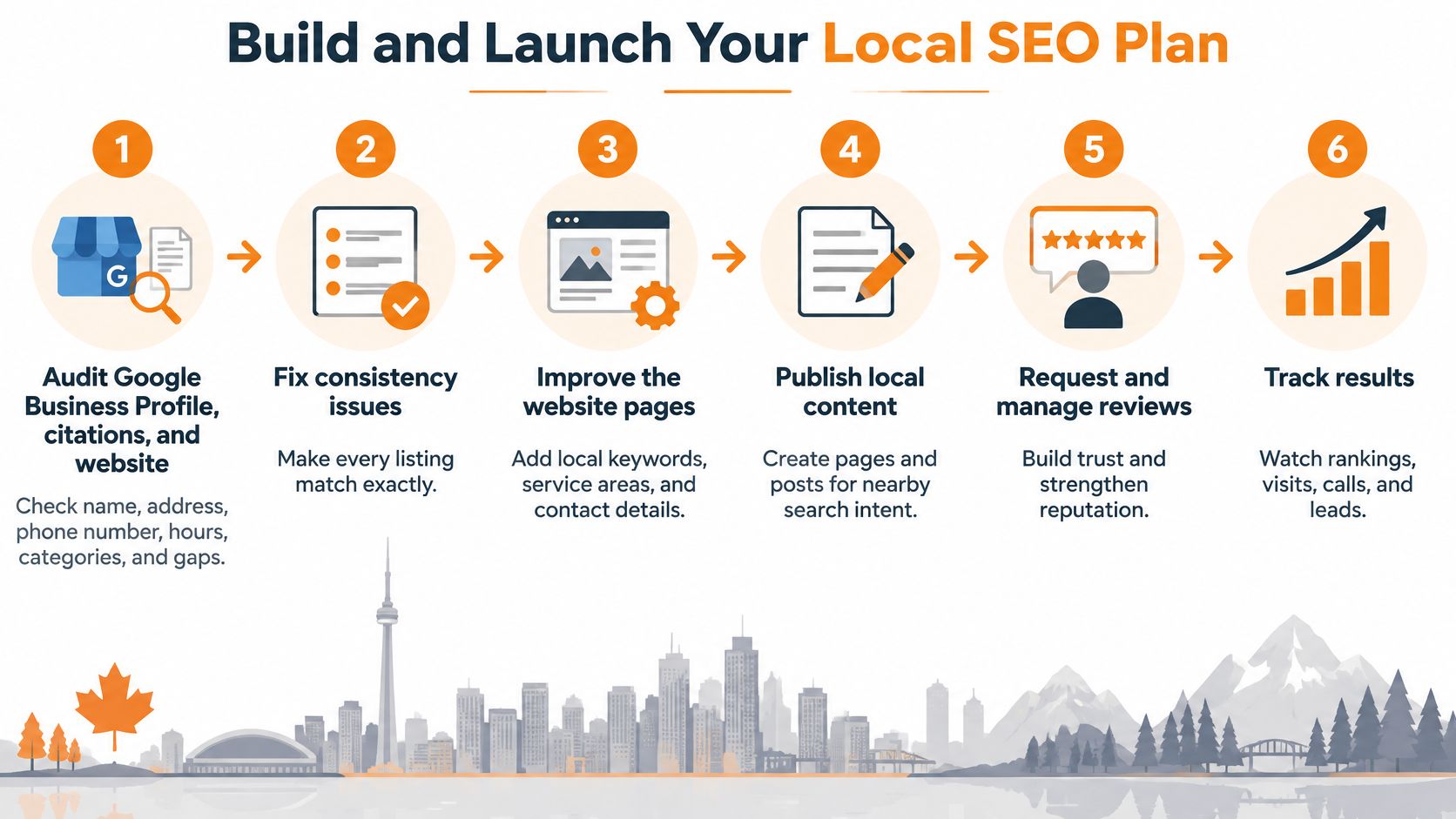
Build the plan as a sequence. Each step has a reason, and most have a slip that undoes it.
- Audit the profile, citations, and website. Check the name, address, phone number, hours, categories, and obvious gaps. Later pages inherit whatever is wrong here, so fix the record before you write anything new. The common slip is leaving the primary category on a broad term such as "contractor" when the business is a roofer.
- Define the service area. List the municipalities and neighbourhoods you serve and have capacity for. If customers do not visit the address, use service-area settings rather than a street address presented as a shopfront.
- Group queries into four intent classes. Sort terms into brand, service-plus-city, near-me, and non-branded discovery. "Kitsilano physio" is not the same job as a bare brand search.
- Decide which locations earn a page. Publish only where you have distinct service information, local proof, and a measurable path to a call or booking. The slip is launching ten city pages before the first one produces a lead.
- Set a review routine. Ask after each completed job, and give one named person the replies. A shared inbox with no owner goes quiet within a month.
- Earn local link signals. Partnerships, sponsorships, and local press are the useful sources. Skip paid link schemes. They do not read as community membership.
- Connect the profile and the site to a CRM or booking tool. Calls, forms, and appointments need a location attached, or you cannot tell which area paid for itself.
We build SEO-optimised local landing pages for the neighbourhoods and delivery terms inside a client's real service area, pair map visibility work with structured data and local links, and run review generation so trust signals keep arriving after launch.
The short video below walks through how a local plan is scoped before any new page goes live.
The first quarter, then a monthly review
Week one: audit the profile, citations, and website, and fix mismatches. Weeks two and three: lock the service area and group the four query classes. Week four: publish or refine the single service and location page with the strongest proof, and turn on a small KPI dashboard.
Review the plan every month. SEO generally needs three to six months to produce the results you want, so a quiet first month is not a reason to add ten more city pages.
Local SEO KPIs That Show Real Business Results
Rankings and map impressions are not revenue. Read the metrics below as signals, then tie them to booked work.
| KPI | Where to Find It | What It Signals |
|---|---|---|
| Profile calls | Google Business Profile insights | Intent to contact the business |
| Direction requests | Google Business Profile insights | Likely in-person visits |
| Website clicks from profile | Google Business Profile insights and analytics | Interest in the site beyond the map listing |
| Booked appointments or qualified leads | CRM or booking system | Revenue potential from local search |
| Rankings by query class | Rank tracking tool | Visibility for brand, service-plus-city and near-me searches |
| Review count and rating trend | Review platforms | Trust and conversion strength |
| Revenue by postal code | CRM with postal code field | Which neighbourhoods are profitable |
| AI mention and referral tracking | Manual checks and analytics referrals | Visibility in conversational answers |
Read intent separately from vanity
A useful report links profile calls, direction requests, website clicks from the profile, booked appointments, and qualified leads to outcomes in the CRM. If you only watch map views, a busy week can hide a week with no jobs. Tracking SEO conversions is the habit that keeps the dashboard honest.
Group the numbers by query class. Brand searches tell you whether existing customers can find you. Service-plus-city searches show demand in a named place. Near-me searches show whether proximity is doing the work. Mixing them into one average hides which intent is growing.
Profit by area, trust, and AI answers
Revenue by postal code is the metric that justifies or kills a location page. If one neighbourhood books profitable jobs and another only produces tyre-kickers, stop feeding the weak page.
Review count and the rating trend are trust indicators for the person about to call, not only inputs for a ranking model. A steady rating with specific comments outperforms a higher score that never gets a reply.
Keep AI visibility on its own line. Note branded mentions, which sources get cited, referral traffic from conversational tools, and calls that arrive after someone describes an AI answer. Do not fold those into map rankings.
Cap the monthly dashboard at eight metrics, the rows in the table above, and compare them with the plan you set. Change the page, the area, or the offer. Do not add a ninth chart to avoid the decision.
Local SEO Strategy in Practice for Real Businesses
The same components land differently once the business type changes. These three sketches are examples of priorities, not measured case results. Our published local SEO results include work for Tree People, which is a different business from the sketches below.
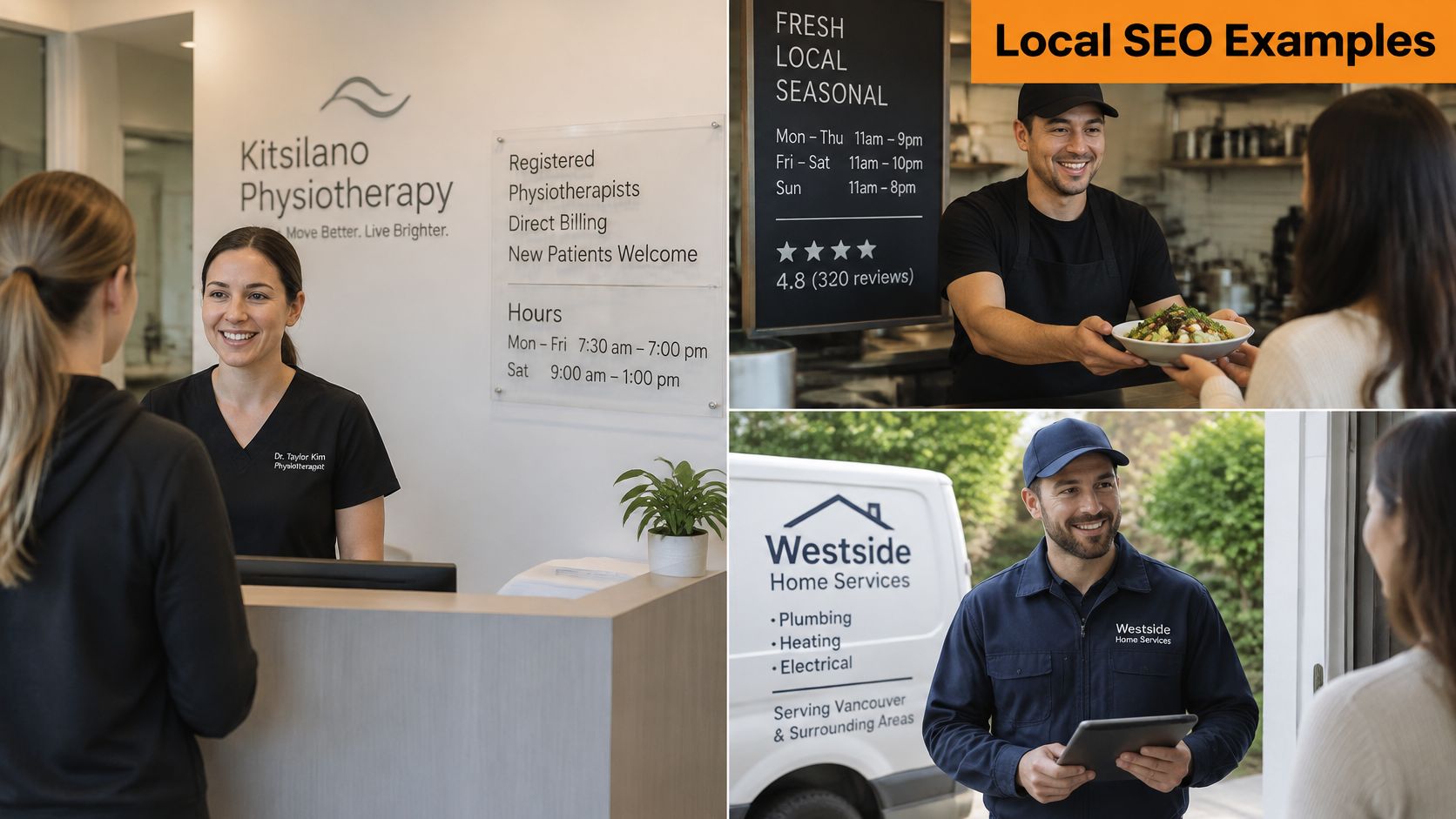
A Kitsilano physiotherapy clinic
Priority: accurate hours, practitioner credentials on the profile, and service pages for named treatments. Ask for a review after each course of care, not after a single visit.
Metric: calls and bookings tracked by postal code, so you can see whether patients live in the area you staff.
Left out: broad keyword pages for neighbouring districts the clinic does not serve. A page for a suburb with no appointments available only creates a frustrated caller.
A mobile HVAC company in Surrey, Burnaby, and the Tri-Cities
Priority: service-area settings instead of a street address, plus a page only for a municipality where a crew is stationed.
Metric: calls, watched more closely than direction requests. Nobody needs driving directions to a van that comes to them.
Left out: a page for every suburb in the region. If you cannot book a job there this week, the page is a promise you will break.
A regulated wellness or cannabis-adjacent business
Priority: location messaging that stays compliant. Licensing details and community partnerships are the local proof. Unsupported health claims are not.
Metric: qualified enquiries that match what you are allowed to offer, not raw traffic from treatment-style queries.
Left out: any treatment claim you cannot evidence. For health, cannabis, CBD, and functional-mushroom businesses, a bold line on a city page can cost trust faster than it earns a click.
If you would not say it at the front desk, do not put it on the location page.
Juiced Digital helps Vancouver and British Columbia businesses turn local search into booked work, with local SEO, map visibility, and conversion tracking tied to the areas you serve. If you want a plan that starts with your real service area and ends with leads you can count, visit Juiced Digital and book a consultation.
