
In 2025, 79% of Canadians said supporting local businesses felt more important than it had the previous year, according to Interac's survey conducted with Léger's online panel. For a BC service business, that makes local discovery worth investing in. But collecting backlinks isn't the same as helping nearby customers find and choose you.
Local SEO link building should earn relevant visibility and qualified enquiries, not just a larger backlink report. Judge each referring domain by the customers it can reach, the business information it corroborates and the leads associated with its placement. A neighbourhood publication that reaches your actual buyers can be a better prospect than a high-scoring website with no connection to your service area.
Which Local Links Are Worth Pursuing in BC
In 2025, 63% of Canadian adults said they were making a conscious effort to shop locally, according to Interac's survey of 1,500 adults. That supports investing in local discovery. It doesn't prove that any particular link will improve rankings.
Start with organisations your customers recognise. A Vancouver contractor, a Kelowna gardening company and a rural service business won't have identical opportunities. Their prospect lists should reflect where they operate and who buys their services.
Local link sources ranked by trust and effort
| Link source | Why it helps | Relevance test | Typical effort |
|---|---|---|---|
| BC news outlets and local journalists | Confirms a real local presence and can earn referral traffic | Covers your city, region or sector | High |
| Chambers of commerce and business associations | Corroborates your local entity | Member page with an editorial profile, not just a listing | Low to medium |
| Municipal and regional tourism or event bodies | Connects your business with places you serve | Event, community or visitor listing with a real link | Medium |
| Universities and colleges | Provides a credible institutional reference | Genuine partnership, research or student resource page | High |
| Trade associations | Establishes topical relevance within your sector | Sector-specific member directory with active pages | Medium |
| Generic directories | Supports citation consistency | Accurate name, address and phone details, treated as supporting information only | Low |
Higher-effort opportunities usually require stronger evidence: original reporting, an established partnership or a useful contribution. The effort is worthwhile when the resulting page reaches a relevant audience, not merely because the publisher has an impressive domain metric.
Directories belong in the supporting layer. Correct listings help customers verify contact information, but repeated submissions shouldn't consume the budget intended for editorial outreach.
Check the page, not just the domain
A university resource page can be useful; an abandoned student blog may not be. A chamber profile that explains your services offers more context than a name buried in an inaccessible member database.
Opportunity test: Would a customer in your service area ever see this page, and does it confirm a real local business offering a service you sell?
How to Build a Prospect List in Six Steps
Build a list you can act on, not an export you'll never open again. The workflow below keeps competitor discovery separate from qualification, so a competitor's questionable backlinks don't become your campaign plan.
Use this visual as a prospecting checklist.
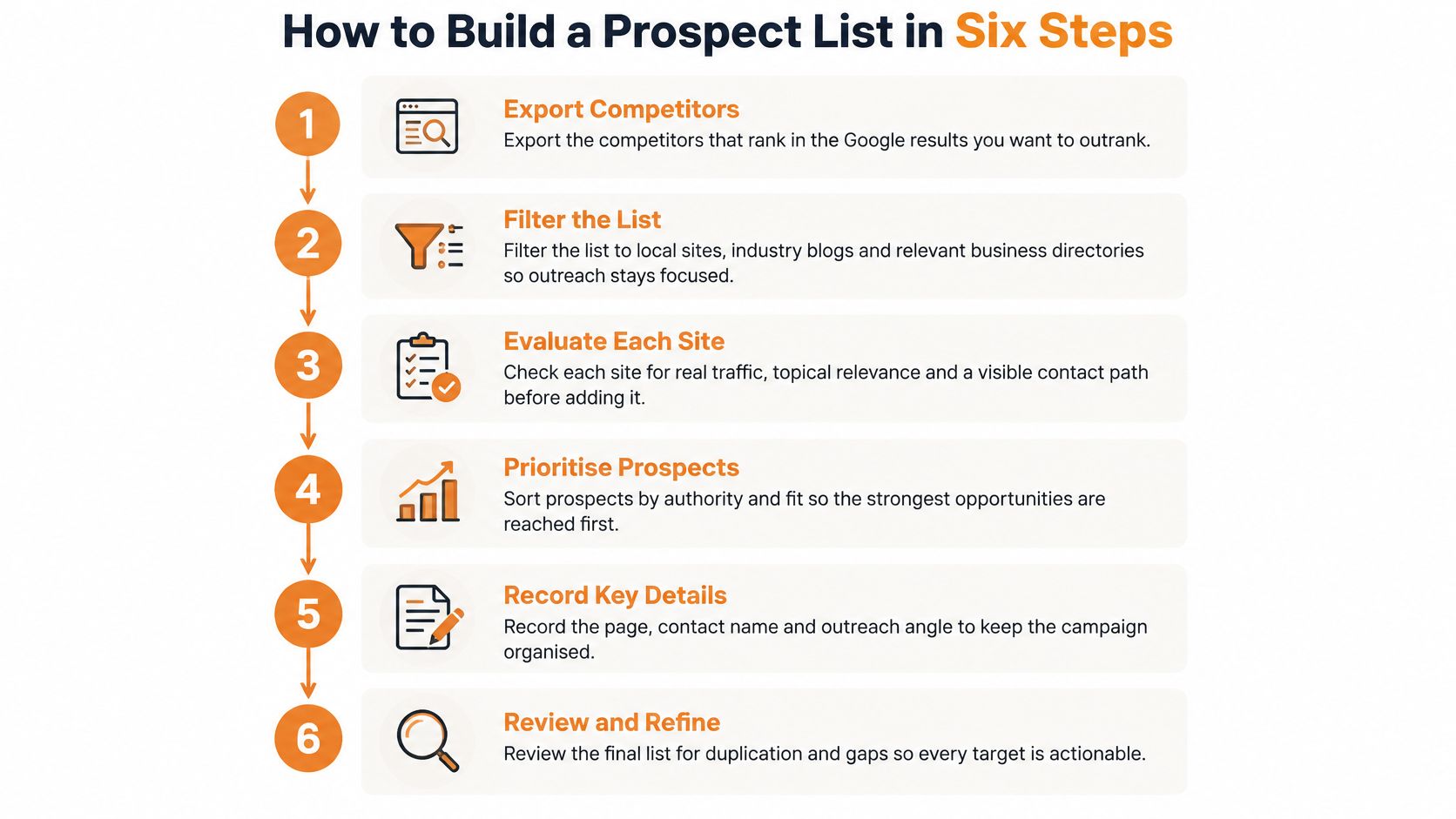
Move from competitors to qualified opportunities
Export the competitors already visible. Search your service-plus-location queries and record businesses appearing in both the Google local pack and organic results. Keep separate groups for different services and municipalities, because the businesses competing in Burnaby may differ from those competing in Richmond.
Use Ahrefs, Semrush or another backlink tool to identify referring domains shared by at least two competitors. Shared placements reveal accessible local relationships, but they aren't automatic endorsements of quality.
Classify before contacting. Sort prospects into BC news outlets, municipal or business associations, chambers, universities, suppliers, complementary businesses and authoritative directories. Give each category an outreach angle rather than sending the same request to everyone.
Open the actual linking pages. Check topical fit, a BC or Canadian audience, indexable content, evidence of readership and sensible outbound links. Traffic estimates are clues, not proof; recent reporting, named contributors and a visible contact path help validate the site.
Match the prospect to something useful. Offer a regional benchmark, expert commentary, a community initiative or a data-led guide. If you can't explain why that publisher's readers need it, don't add the contact to your outreach queue.
Record the placement details. Track the prospective linking page, destination URL, proposed anchor, follow or nofollow status and referring root domain. Add the contact, outreach angle, approval status and next action so another team member can continue the work.
For context, the Canadian SMB SEO benchmark reports median growth of 4.2 referring root domains per month across 112 engagements and suggests 6–12 relevant new domains per quarter as a practical Vancouver planning target. That's a directional benchmark, not a ranking threshold or a substitute for lead measurement.
The accompanying video offers another view of local link-building execution.
A finished list should contain scored, contactable prospects, not duplicate domains and speculative email addresses. Rank them by audience fit, editorial usefulness and commercial relevance, then make the strongest opportunities outreach-ready before expanding the list.
Fix Your Local Entity Before You Earn Links
Conflicting business details make an otherwise useful placement less useful to customers. A publisher can send someone to your website, but it can't fix an outdated phone number or explain which address is current.
The Canadian SEO statistics compilation identifies confusing citation quantity with authority as a central failure mode. Treat citation cleanup as verification work, not evidence that you've earned editorial recognition.
Audit in the order customers verify you
Align the business identity. Check the Google Business Profile, website, business name, primary phone, address or service area and contact information. Represent the business accurately rather than adding keywords to its name.
Correct core Canadian and BC listings. Claim existing profiles before creating replacements. A structured local citation-building process helps distinguish missing listings from duplicates and outdated records.
Validate institutional references. Make sure chamber profiles, association pages and community mentions describe the current business. An old member profile can preserve details you've already corrected elsewhere.
Assign an appropriate destination. Map each opportunity to the service, location or resource page that answers the reader's next question. Don't force an editorial resource link onto a sales page that doesn't support the publisher's reference.
Capture the baseline. Save rankings, qualified calls, direction requests, forms and referring-domain quality before outreach begins. Record website changes alongside link activity so later comparisons have context.
Say a listing shows an old suite number while the website displays a different phone line. That's a substantive mismatch. By contrast, harmless punctuation differences aren't worth prioritising over a disconnected number or a wrong map destination.
Keep cleanup separate from acquisition
Avoid paid ranking links, automated directory blasts, reciprocal-link schemes, repeated exact-match anchors and irrelevant overseas placements. They can make an acquisition report look busy while adding little useful local context and creating review work later.
A legitimate supplier recommendation isn't the same as a manufactured exchange programme. The distinction is whether the reference helps a reader understand a real relationship.
Check the website, Google Business Profile and external listing together: would a customer find the same business name, number and address or service-area information in all of them?
Compliance Checks for Cannabis, CBD and Health Niches
A publisher's willingness to run a claim doesn't make that claim appropriate for your business. In regulated niches, set the review rules before outreach starts, including who can approve the pitch and what happens when an editor requests changes.
Use this checklist to organise review, not to replace legal advice.
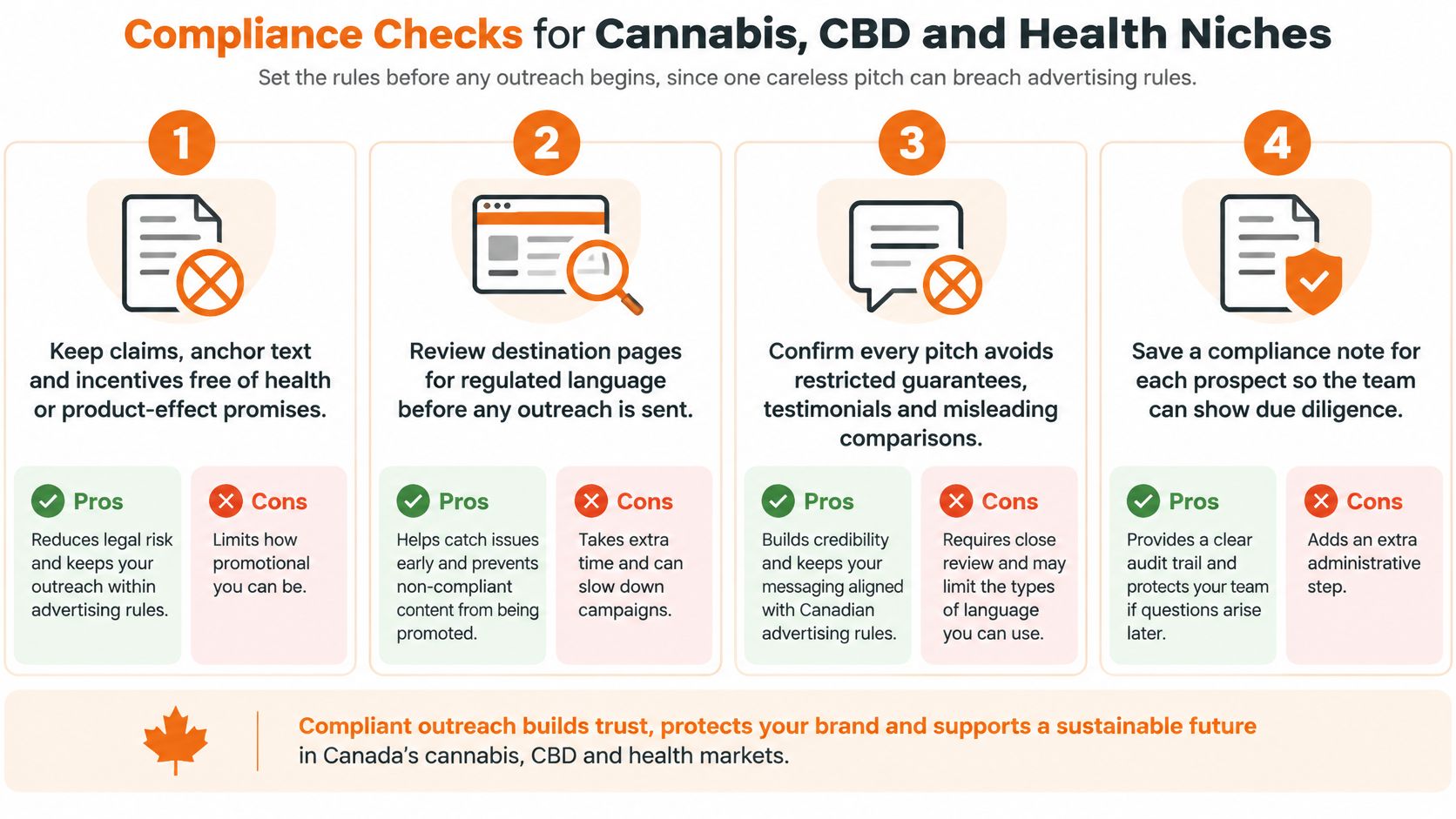
Review the entire path from pitch to landing page
Check claims, anchors and incentives. Flag health promises, product-effect language, guarantees and comparisons for specialist review. A neutral email can still direct readers to a landing page containing language that shouldn't be promoted.
Pause inducements until approved. Don't offer free product, discounts or payment for coverage without appropriate legal review of the arrangement and disclosure. Disclosure alone isn't permission to run an otherwise restricted promotion.
Inspect the publisher's audience. Review age controls where relevant, editorial context and links to sellers. Escalate sites aimed at minors or associated with apparently unlicensed sales rather than treating them as ordinary outreach prospects.
Require documented sign-off. Have a compliance reviewer approve the pitch and its destination page. Save the approved version, reviewer and any restrictions in the prospect record.
Do and don't panel for regulated link outreach
| Do | Don't |
|---|---|
| Use neutral descriptive anchors | Chase anchors with product or effect claims |
| Disclose sponsorships | Buy placements for ranking credit |
| Pitch community and research content | Pitch sites that host unlicensed sales |
| Log every approval | Reuse one template across regulated and unregulated clients |
Federal and provincial requirements differ by product, service and jurisdiction. This is a conservative planning checklist, not a statement that every cannabis, CBD or health business operates under identical rules.
Also review substantive edits before publication. Approval of the initial pitch shouldn't automatically approve a new headline, testimonial or product description added later.
When an outlet requests a claim you can't support or approve, decline that wording. Offer a factual alternative describing the business, its location and its services instead of negotiating a softer version of the same promise.
How to Pitch Assets Local Sites Will Link To
Editors link to resources that help readers, not to requests that help your SEO report. The asset matters more than the email. A polished pitch won't rescue a generic article that says nothing specific about the community.
At Juiced Digital, our backlink strategy aims to improve a client's domain authority and trust. For local outreach, that means giving a relevant publisher a defensible reason to reference the business, rather than treating a third-party authority score as the objective.
Choose an asset the publisher can use
- Regional benchmarks: Summarise genuine local observations or properly sourced public information. Explain the collection method, limitations and geography so an editor can judge what the findings mean.
- Expert commentary: Answer a timely question with a clear explanation and a named, qualified spokesperson. Send a usable point of view, not a paragraph about how excellent the business is.
- Community initiatives: Identify the host, beneficiaries, location and practical participation details. Don't manufacture an event solely to obtain sponsor-page links.
- Data-led local guides: Answer a question about seasonal demand, service preparation or a local process. Verify regulatory details against the responsible authority before publication.
A visual can make complex findings easier to reference. Use infographics for SEO when a diagram or comparison improves understanding, and keep the underlying explanation available as readable text.
Make the request easy to assess
Use this outreach order:
- Audience need: Explain why the outlet's readers would care.
- Coverage connection: Reference a relevant article from that publication.
- Single request: Ask for consideration as a source or useful resource.
- Short body: Remove the agency biography, ranking claims and multiple competing calls to action.
As a hypothetical example, a Kelowna yard-care company could publish a spring irrigation cost survey and approach a regional newspaper's home editor. The useful angle would be what homeowners should check before comparing quotes, supported by transparent survey methods, not a demand for a keyword-rich backlink.
If coverage follows, record the actual destination and resulting enquiries. Don't assume every mention will include a link, or that every link will produce a customer.
If the asset would still be useful with no backlink attached, pitch it. If it exists only to obtain one, rework it.
How to Measure Links by Qualified Leads
A new referring domain is an acquisition output. A qualified enquiry is a business outcome. Keep both visible, but don't let the easier metric become the definition of success.
Define qualified lead before reporting: someone seeking a service you offer, within your operating area, with a genuine potential need. Deduplicate repeat contacts and separate job applications, supplier pitches and spam from sales enquiries.
Local link campaign measurement dashboard
| Metric | Question it answers | Where to track | Check cadence |
|---|---|---|---|
| Referring domains added | Is the campaign building new relevant domains? | Backlink tool | Monthly |
| Qualified leads per new domain | Do the placements correspond with business opportunities? | CRM and form data | Monthly |
| Calls and direction requests | Is local customer activity changing? | Google Business Profile performance | Monthly |
| Branded searches | Is awareness growing? | Search Console | Quarterly |
| Rankings across target neighbourhoods | Does visibility hold in each area? | Rank tracking grid | Monthly |
| Anchor and follow mix | Does the profile warrant a risk review? | Backlink tool | Quarterly |
Search Console doesn't establish neighbourhood-level awareness on its own. Likewise, direction requests and call clicks aren't confirmed customers. Treat these as supporting indicators and reconcile them with enquiries recorded by the business.
Calculate the lead-per-domain ratio
Use this operational formula:
Qualified leads from pages linked by new domains ÷ new referring domains acquired in the same reporting period
Label it accurately as a campaign efficiency indicator, not proven link attribution. It includes leads that may have arrived through organic search, existing awareness or another channel. Maintain a separate count of directly attributable referral enquiries where tracking permits.
A practical SEO conversion-tracking setup should connect landing pages, form submissions and call outcomes with CRM qualification. Keep referral information where available, but don't overwrite an original source because a later visit came through search.
Interpret the result before changing the campaign
Annotate each acquisition by neighbourhood, service, destination page and publication date. Compare linked pages against a similar unlinked page where possible, while noting differences in demand, content changes and paid activity.
Correlation doesn't prove causation. A quarterly increase in enquiries may coincide with seasonal demand or better conversion copy, so avoid assigning all improvement to backlinks.
Stop pursuing sources that repeatedly produce irrelevant exposure. Request removal when a placement is misleading, inappropriate or manipulative, not merely because it hasn't generated a tracked lead. Reserve disavow work for a justified manipulative-link issue, not routine pruning of ordinary low-performing links.
Start Your Local Link Audit This Quarter
Make the next quarter a controlled campaign rather than an open-ended acquisition exercise. Choose service-and-location combinations that matter commercially, then build a prospect group for each using the qualification workflow.
For a hypothetical starting scope, you could choose Vancouver drain cleaning, Burnaby emergency plumbing and Richmond water-heater installation. Keep those groups separate so a successful source for one service doesn't conceal poor fit elsewhere.
Give the audit a clear owner and deliverable
- Before outreach: Resolve identity mismatches, verify destination pages and assign compliance review where needed.
- During prospecting: Record why each publisher is relevant, the asset it could use and the person responsible for the next action.
- During pitching: Work from the strongest audience matches, not whichever websites make submission easiest.
- After publication: Confirm the live page, destination and wording, then attach the placement to the measurement record.
Don't launch more assets than your team can maintain. A useful local resource needs an owner who can correct errors, answer editorial questions and update information after publication.
Decide what deserves another quarter
For every source category, record keep, rework or drop beside the qualified-lead-per-domain result. Keep opportunities associated with relevant enquiries; rework useful audience matches when the asset or destination underperforms; drop sources whose audience consistently falls outside your market.
Distinguish an unsuccessful pitch from an unsuccessful placement. No response may mean the timing or editorial angle was wrong. A published feature that attracts unrelated enquiries points to a different problem: audience fit, positioning or an unclear service page.
You don't need a complicated reporting stack to begin. A backlink tool, a CRM or form log, Google Business Profile performance and a shared prospect sheet are enough to organise the audit. Assign the first service-area group today, complete its verification work and put the highest-scoring prospects into an outreach queue with named owners.
Juiced Digital secures backlinks from authoritative, niche-relevant sites and offers local SEO support to connect visibility with qualified enquiries. Visit Juiced Digital to request an audit of your local search presence and discuss which link opportunities deserve priority in your service area.
