

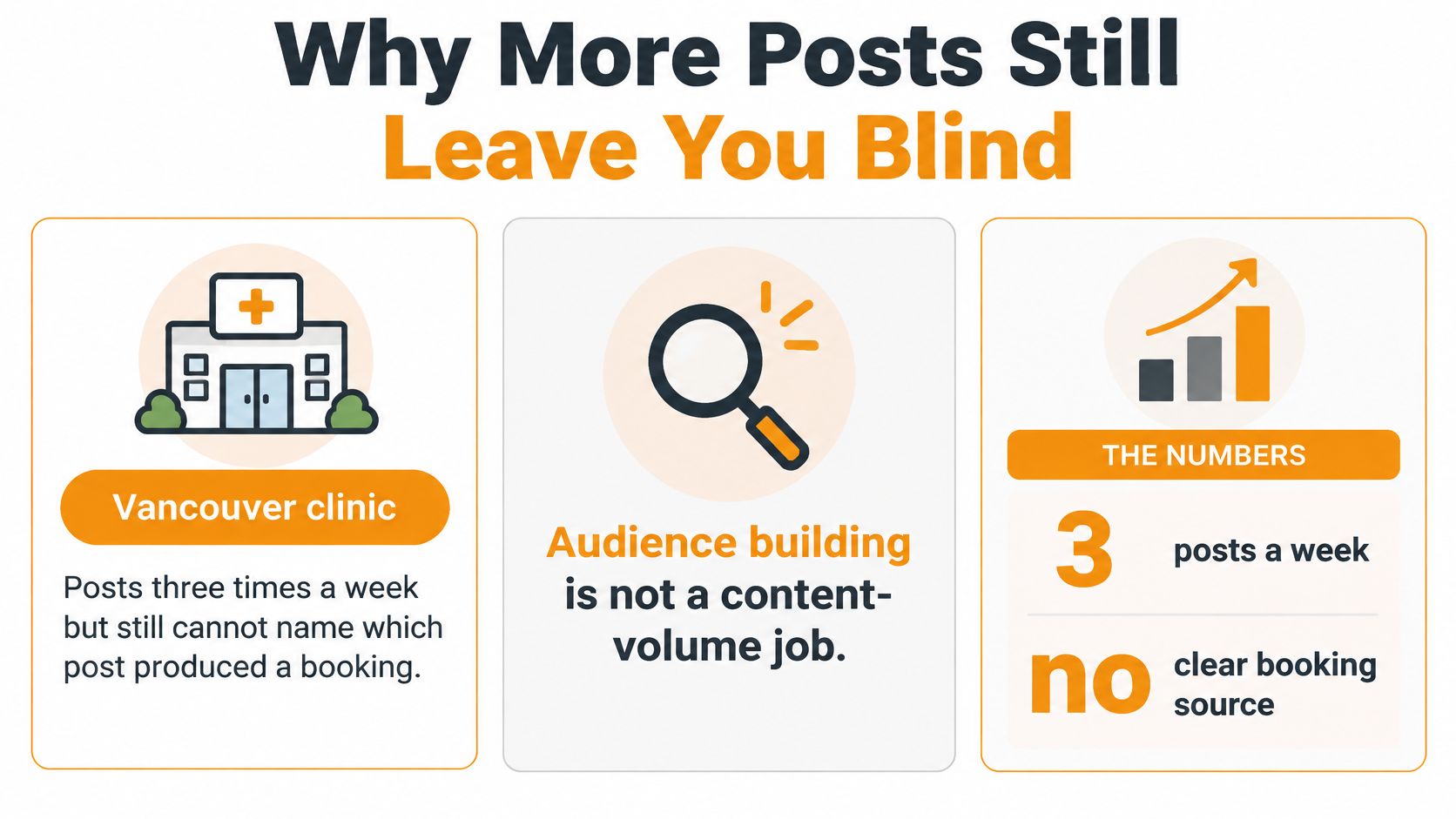
Posting more often isn't an audience building strategy. Say a Vancouver clinic publishes three times a week, gets encouraging comments, and still can't identify which content helped someone book. The team has a production schedule, but it doesn't yet have a reliable way to turn attention into demand.
A useful strategy connects the whole journey: discovery, evaluation, permission, conversion, and return visits. For a small British Columbia marketing team, the priority isn't feeding every platform. It's building a path you can measure before you increase the workload or the spend.
Why More Posts Still Leave You Blind
More content can make an integration problem harder to see. A busy calendar gives everyone something to report, even when nobody can connect the activity to qualified calls, completed orders, or attended appointments.
The Canadian SME picture illustrates the imbalance: a CFIB survey cited in Intuit QuickBooks' small-business survey coverage found that 44% of Canadian SMEs use generative AI, while content creation accounts for 84% of adoption. Those figures describe tool use, not proof that additional content produces commercial results.
AI can help a small team draft faster. It can't decide whether a caller fits your service area, whether a booking became an attended appointment, or whether the customer had already discovered you elsewhere. Someone has to define those outcomes and connect the records.
The clinic scenario makes the missing connection visible.
Define the system before choosing platforms
An audience building system serves one priority segment, defined by geography, need, and buying trigger, through a path that records first-party permission and measures qualified outcomes.
That definition works for BC local services, ecommerce brands selling across North America, and regulated teams working in cannabis, CBD, functional mushrooms, clinics, and wellness. Their purchase journeys differ, but none benefits from counting irrelevant followers as prospective customers.
Write the commercial brief before commissioning creative:
- Choose the outcome you'll defend. Use booked appointments, qualified calls, or first orders. Specify what makes an inquiry qualified, including service fit, location, and genuine buying intent.
- Describe the priority audience. A Burnaby homeowner needing an urgent repair is more actionable than homeowners interested in maintenance. The buying trigger changes the message and the next step.
- Validate the segment. Check BC Stats and Statistics Canada community profiles, then compare that context with customer records, service capacity, and actual inquiries.
Practical rule: If your team can't explain what happens after someone clicks, commission less content and fix the handoff.
A clinic might need clearer appointment eligibility rather than another educational reel. An ecommerce shop might need shipping information before a discount offer. These are purchase barriers, not posting gaps.
Follower growth can remain a diagnostic signal. It won't count as success in this plan.
Pick Channels by the Job They Do
Choose channels by the customer's immediate task, not by how busy your competitors look. Someone searching for an available practitioner needs a different route from someone encountering an unfamiliar product category.
Presence alone doesn't settle that choice: Innovation, Science and Economic Development Canada's digital adoption campaign report found that 65% of Canadian SMEs reported having a website, and 65% of those businesses said their website could take online orders. A website is infrastructure. Its usefulness depends on what the visitor can accomplish.
Channel jobs for a Canadian audience system
| Channel | Job in the journey | Fund it when | Primary metric | Do not use it for |
|---|---|---|---|---|
| Google Business Profile and local SEO | Capture neighbourhood intent | Local services, clinics, delivery areas | Tracked calls, direction requests, location-page forms | Impression bragging |
| Evergreen search content | Own the answer and the next step | Ecommerce and education-heavy offers | Assisted conversions and on-page captures | Daily posting quotas |
| Email or SMS | Keep permission and repeat purchase | A list, checkout, or booking flow exists | Revenue per subscriber and booking rate | Bought or scraped lists |
| Short-form social | Discovery and repeated proof | Products people already discover on social | Site visits, saves, and qualified traffic | Last-click sales credit |
| Reviews and third-party mentions | Trust before the click | Local services and regulated wellness | Review velocity and branded search | Health claims in public replies |
| Paid search or paid social | Scale a proven offer | Conversion tracking is already reliable | Cost per qualified lead | Testing several variables at once |
Fund the handoffs, not just the channels
For local intent, keep Google Business Profile details accurate and give each useful location page specific service information. Don't publish interchangeable neighbourhood pages with only the place name changed. Explain actual coverage, availability, access, and the booking process.
Evergreen content earns its place when customers need help evaluating a decision. A product-use guide should lead to the relevant product or comparison, not strand the reader at the bottom of a blog post.
Email and SMS require a reason to subscribe. Appointment preparation, replenishment reminders, and truly useful updates serve different needs. Don't bundle all subscribers into a generic promotional sequence just because the software makes that easy.
Short-form social lets people sample your expertise or product experience. Give interested viewers a relevant destination rather than sending every post to the homepage. Saves can indicate usefulness, but they don't establish buying intent.
Reviews and third-party mentions help prospective customers evaluate credibility. Ask for honest feedback after a completed experience, and make public replies helpful without exposing private information.
Paid acquisition comes with an immediate cost for weak handoffs. Check the landing page, conversion event, and follow-up process before paying to increase traffic.
Make a deliberate exclusion
Write your audience's geography, need, and buying trigger at the top of the budget sheet. Then fund two channel priorities that match the journey, while maintaining essential supporting infrastructure.
A repair company might prioritise local search and reviews. An education-heavy ecommerce brand might prioritise evergreen content and email. Park optional expansion during the initial rollout so the team can diagnose performance.
Rented reach without a capture point is attention, not an audience.
How to Build and Test the Content System
Publishing a website and maintaining social accounts won't distinguish a brand by themselves. According to Signal49's report on the value of marketing in Canada, more than 90% of Canadian businesses had at least one web presence in 2023, including 78% with websites and 63% with social accounts.
The useful advantage is operational: content that answers a purchase question, leads somewhere relevant, and produces an outcome your team can verify.
Use this workflow to connect planning, production, and testing.
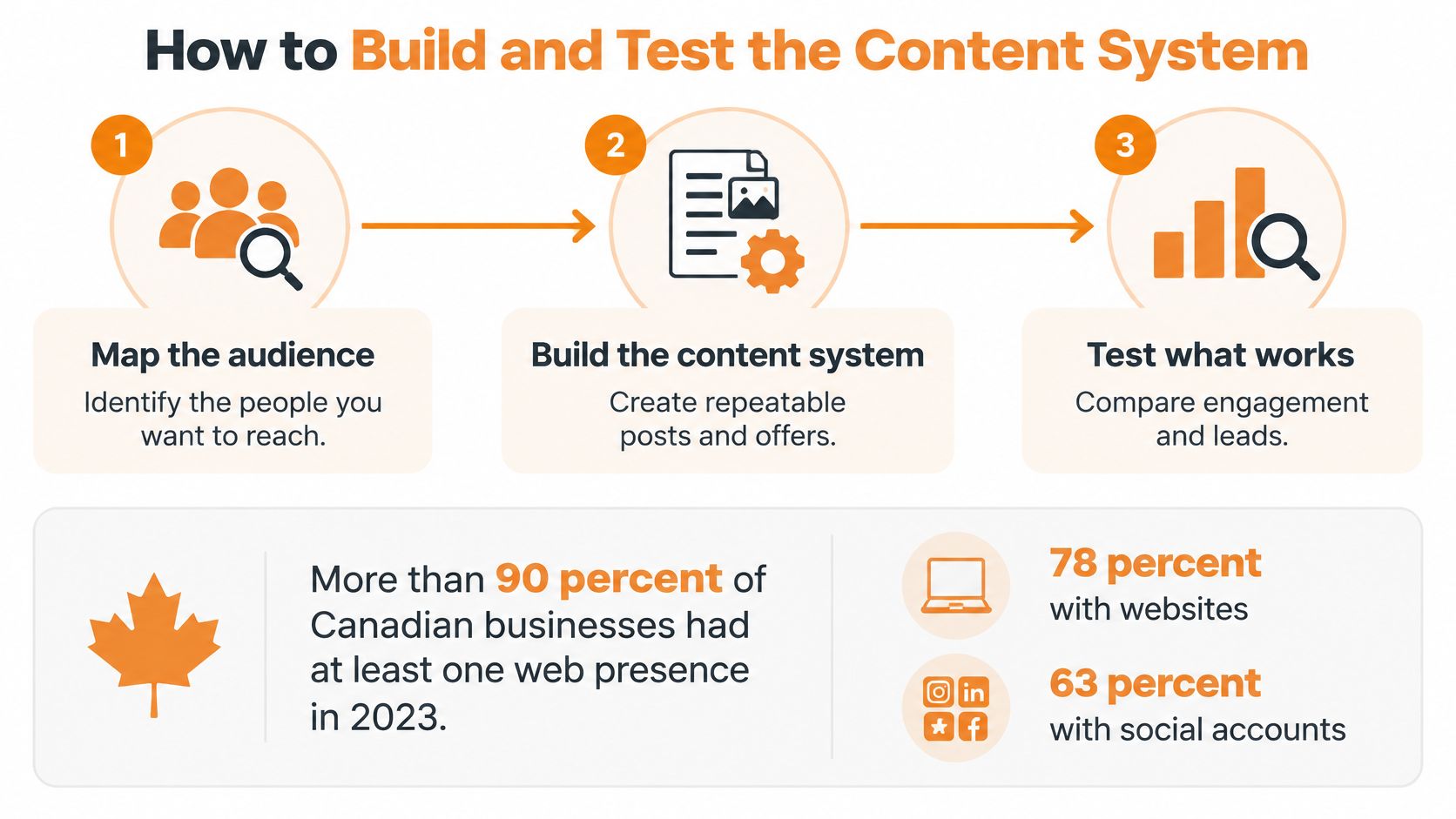
Build around commercial questions
- Choose three content pillars. Use problem education, product-use or service guidance, and evidence or trust. For a wellness brand, sourcing and production methods belong in the trust pillar, not in speculative benefit claims. Our guide to creating content pillars can help organise the topics.
- Assign a segment and journey stage. Write the durable search asset first. A prospective patient evaluating suitability needs different information from an existing patient preparing for an appointment.
- Repurpose with a destination in mind. Turn the asset into platform-native clips, images, or short explanations. On appropriate high-intent pages, offer a relevant email or SMS subscription with clear permission language.
At Juiced Digital, we create and optimise blog content and core landing pages to improve rankings and user engagement. That durable layer deserves editorial attention, not leftover copy after the social calendar is complete.
Test a hypothesis, not a pile of assets
- Use AI for controlled variation. Write one hypothesis, then generate three versions of the same asset. Name a human reviewer who checks claims, offer accuracy, and local details before release.
- Compare against a control. As a practical starting schedule, run a two-week creative test while keeping the audience, destination, and offer stable. Judge qualified conversion rate, but extend the test if there isn't enough qualified activity to support a decision.
- Record the result. Log the hypothesis, control, variant, review owner, qualified outcomes, and decision in a content matrix. An inconclusive test is a legitimate result, not a reason to declare the most-liked version the winner.
For example, test whether explaining appointment eligibility attracts better-fit inquiries than leading with convenience. Don't simultaneously redesign the page and change the booking offer, because you won't know which change mattered.
Use the accompanying video as a discussion prompt when planning the workflow.
Don't increase production until a test submission reaches the right record and the conversion event fires correctly.
Stay Inside the Rules While You Grow
Educational material and promotional promises aren't interchangeable. Ingredients, sourcing, production methods, and appropriately reviewed safety information can help someone understand an offer. Unsupported claims about treating a condition or transforming someone's lifestyle should not enter the publishing queue.
Social commerce makes this distinction commercially important: Statistics Canada's ecommerce analysis indicates that one in two Canadian shoppers has purchased through social media. That's a reason to take discovery seriously, not permission to make stronger claims.
Allowed education versus banned promises
| Allowed education | Banned promise |
|---|---|
| Ingredients and sourcing | Implied cures in captions, landing pages or ad text |
| Production process and quality checks | Unsupported health or lifestyle outcomes |
| Safety context and usage limits in approved wording | Promotions that imply medical benefit |
| Real customer experience, clearly sourced | Fabricated or incentivised reviews |
Treat this comparison as an editorial boundary, not a universal legal clearance. Whether particular wording is permissible depends on the product, authorisations, jurisdiction, audience, and distribution channel. Even factual education can become problematic when the surrounding imagery or wording implies an unsupported outcome.
Give every publication a review owner
A small team needs a manageable approval process, not an informal assumption that someone else checked the copy. Use a compliance risk assessment to identify the areas requiring specialist review.
- Maintain a claims library. Record approved wording, supporting material, permitted context, reviewer, and clearance date. Mark withdrawn language so it doesn't reappear in recycled captions.
- Review new angles. Assign a named person to evaluate implied meaning across copy, visuals, testimonials, and calls to action.
- Check access restrictions. Apply age and jurisdiction controls where the product or service requires them.
- Verify platform eligibility. Review advertising rules before boosting. Website publication doesn't establish ad eligibility.
- Record consent separately. Keep the subscription wording, permission record, and withdrawal status attached to the contact.
This checklist belongs beside the publishing queue.

Don't turn customer feedback into a claim
A customer's words don't automatically become approved advertising copy. Republishing a testimonial can introduce the same unsupported implication as writing the statement yourself. Public review replies also need restraint, particularly when a customer mentions a condition or private treatment details.
Our SEO strategy for a functional mushroom dispensary focused on rapid traffic acquisition, conversion-optimised content, high-impact keyword targeting, and technical site improvements. That combination illustrates a growth workstream, not an exemption from product or platform review.
Sequence the work accordingly: prepare the destination, review the message, then consider distribution. Scaling paid traffic before approval, collecting emails without recorded permission, and publishing unedited AI drafts are avoidable operating failures.
Measure Qualified Demand Not Follower Counts
Audience quality metrics and how often to read them
| Metric | Read it against | Cadence | Attribution note |
|---|---|---|---|
| Cost per qualified lead | Gross margin and close rate | Weekly | Needs a CRM source field, not ad-platform leads alone |
| Booking rate or lead-to-sale rate | Municipality, device, and offer | Monthly cohort | Assisted paths, not last click |
| Revenue per lead | Repeat purchase within 90 days | Monthly | Closed loop from CRM to revenue |
| Capture rate on high-intent pages | Whether every pillar and location page has one consented offer | Weekly | First-party permission, consent logged |
| Review-request completion | Completed jobs or deliveries | Monthly | No incentives that fake reviews |
Ignore audience size until you can judge audience quality. A full appointment calendar with unsuitable inquiries creates administrative work, not necessarily profitable demand.
The Business Development Bank of Canada's marketing-channel guidance reports that 89% of Canadian customers use digital channels to discover new brands. Customers may also compare search results, social posts, reviews, recommendations, and AI-generated answers before contacting you, so a last-click report won't describe the entire decision.
Instrument the journey before evaluating it
Use the opening week to establish the tracking setup, then collect a 90-day baseline. Treat that period as an observation window, not a promise that every channel will mature within it.
- Tag campaign links. Use consistent UTM source, medium, campaign, and content values. Keep a shared naming sheet so staff don't create conflicting labels.
- Track calls carefully. Use call tracking for ads and appropriate website journeys while preserving consistent business identity in local listings. Audit forwarded calls and missed-call handling.
- Make CRM sources auditable. Retain the original acquisition source, campaign details, and a customer-reported discovery field. Don't overwrite the original source after every visit.
- Inspect assisted paths. Use analytics journey reports alongside CRM outcomes. Treat attribution as evidence with gaps, especially across devices and offline interactions.
Define qualification before calculating cost per qualified lead. Our qualified lead generation guidance helps separate genuine opportunity from a completed form.
Calculate booking rate using eligible inquiries, and distinguish booked appointments from attended appointments. For revenue per lead, use a consistent cohort and purchase window so older leads don't appear more valuable merely because they've had longer to buy.
Stop rewarding misleading improvements
Review channel diagnostics weekly and municipality, device, and service cohorts monthly. Segment only as far as the volume supports; tiny cohorts can produce dramatic-looking changes with little decision value.
Budget guardrail: A blank source field is a tracking problem, not evidence that the cheapest-looking channel deserves more money.
Teams commonly fool themselves by adding channels after impressions rise, cutting email because it rarely receives last-click credit, or accepting platform-reported leads without checking sales records. Each mistake favours an easy report over a defensible outcome.
Write the four metrics you'll defend in the monthly recap: cost per qualified lead, booking rate, lead-to-sale rate, and revenue per lead. Give each an owner, denominator, and decision rule before reviewing results.
Commit to the 90-Day Rollout
Start on Monday with a shared delivery sheet, named owners, and the authority to pause work. The calendar should limit competing projects, not create another layer of reporting.
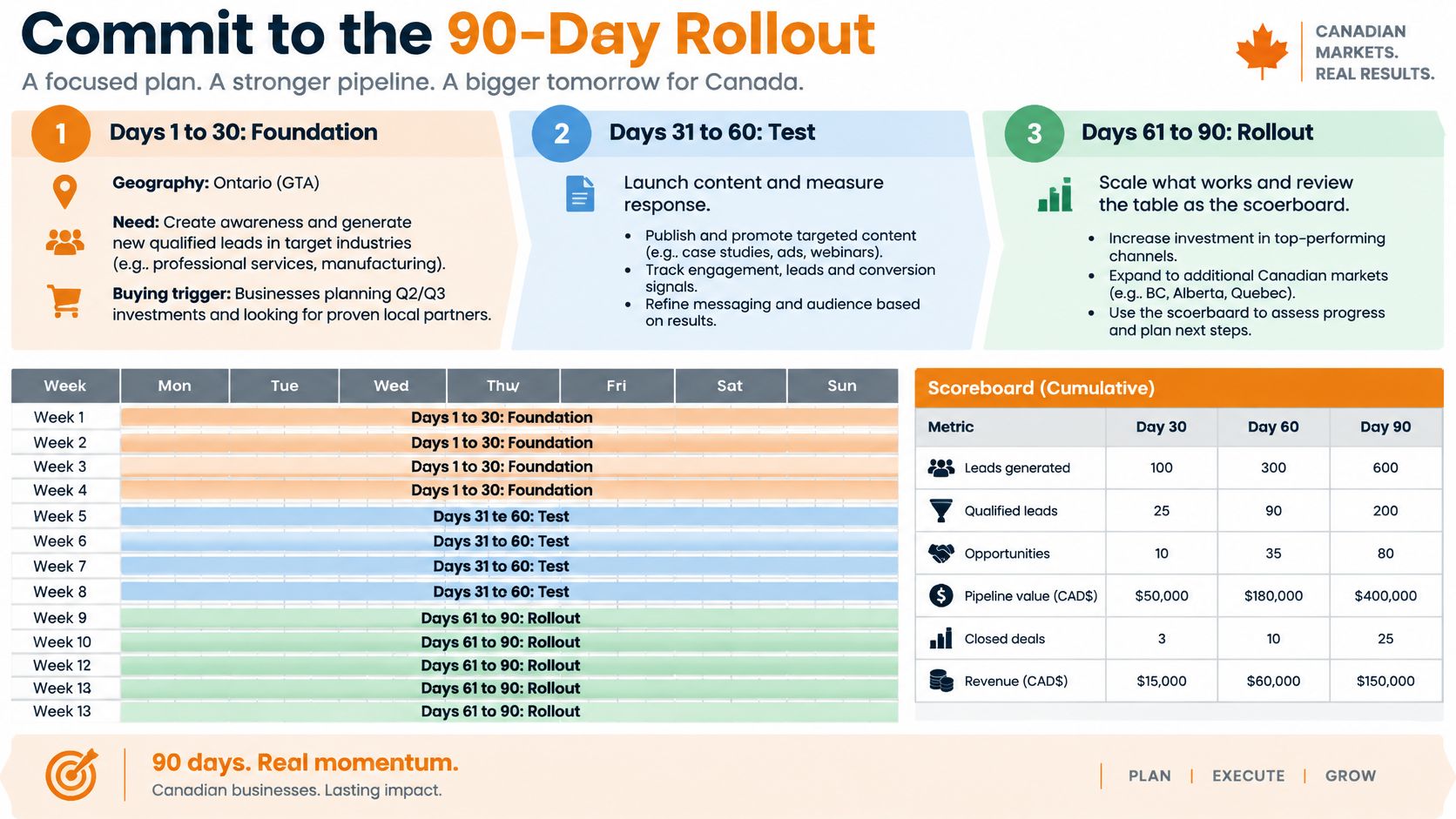
Use the rollout table as an acceptance checklist. A task isn't complete because someone published a page or installed a tag; it's complete when the intended customer action and its record can be verified.
30 60 90 day rollout
| Phase | Ship | Done when | Read |
|---|---|---|---|
| Days 1 to 30 | One segment, tracking, Google Business Profile, core pages, audit | UTM, call tracking and CRM source field live | Baseline set |
| Days 31 to 60 | Pillar assets, capture offer, review-request workflow, controlled creative test | Assets approved, handoffs tested, experiment logged | Capture quality and qualified response |
| Days 61 to 90 | Keep-or-kill decisions, documented winners, revised allocation | Each funded channel has evidence or a stated reason to continue testing | Qualified acquisition cost, booking outcomes, revenue |
Foundation and first proof
During the foundation phase, confirm the segment against community profiles and operational capacity. Repair broken forms, unclear service information, mobile usability problems, and mismatched booking destinations before commissioning broad topic coverage.
Our engagement starts with a full technical and content audit to uncover growth opportunities and quick wins. That's useful sequencing because an otherwise strong campaign can send interested people into an unusable journey.
During the proof phase, launch high-intent assets before expanding the editorial calendar. Keep creative experiments separate from review-request timing tests so staff can identify what changed.
The following timeline provides a visual working calendar.
Our 60-day sprint for a UK CBD client combined high-intent keyword targeting, technical SEO improvements, authority-driven content, high-quality backlinks, and UX enhancements for conversion goals. The relevant lesson is the integrated scope, not an assumption that another business should expect the same timing or results.
Keep the operating documents small
Copy these fields into shared sheets rather than building an elaborate dashboard:
- Weekly diagnostic: Channel, spend, qualified leads, missing source records, operational issue, owner, next action.
- Claims library: Asset, approved wording, supporting evidence, reviewer, clearance date, distribution restrictions.
- Monthly cohort: Acquisition month, municipality, device, service, qualified inquiries, attended bookings, sales, revenue.
- Four-metric recap: Result, comparison period, attribution limitation, decision, accountable owner.
During the final phase, expand the winning treatment rather than changing the audience and offer simultaneously. Pause channels without direct or assisted qualified demand unless there's a documented, time-limited reason to continue.
The audience building strategy is working when the team can explain what to keep, what to stop, and why. If the scoreboard is still blank at day 60, or nobody can staff claims review, bring in outside review before increasing spend.
Juiced Digital offers SEO, paid media, conversion optimisation, and a lead generation package with a clear quarterly roadmap tied to client objectives. Visit Juiced Digital to request an audit of your search visibility and marketing funnel, and identify which tracking, content, or conversion fixes should come before your next budget increase.
