
You're checking the map on your phone between jobs, and a competitor two blocks over is sitting in the three listings above the organic results. Your business isn't. The spot you saw this morning from the office already looks different from the one a customer sees on Commercial Drive.
That's local SEO ranking in practice. It isn't a single position you lock in. It's a moving spot that depends on who is searching, where they stand, and whether your business looks like one clear entity across the web. The only outcomes that pay the rent are a call or a booking.
What Local SEO Ranking Means and Why the Local Pack Matters
A homeowner in Mount Pleasant searches for an emergency plumber and sees three businesses in the Local Pack, the map listings above the organic results. If a Burnaby plumber appears there and earns the call, the visibility has done its job. Local SEO ranking is a business's position for a search tied to a place, shown in Google Maps and the Local Pack. That position can vary with the searcher's location and the search itself.
For a business owner, the Local Pack is like a shop window on a busy street: the listings near the top get noticed first. The three prominent map listings offer limited space, while several plumbers may serve Mount Pleasant, Kitsilano, and the West End. Being listed somewhere online is not the same as being visible where a nearby customer is looking.
The practical challenge is keeping the business recognizable and accurate across directories and other search surfaces. If a name, address, phone number, service area, or category differs between listings, customers and search systems may get mixed signals about which business is which. AI-powered search surfaces also draw on business information from across the web, so consistent details help make the entity easier to identify.
Geographic relevance, proximity, reviews, prominence, and complete business information all affect whether a listing earns attention. A broad claim such as “we serve British Columbia” gives a customer in Kitsilano little to judge. A profile and service page that clearly name the areas served and explain the work offered give people a more useful reason to choose the business. Accuracy matters too: claiming an area the business cannot serve may attract the wrong inquiry.
Measure progress by outcomes, not a single position check from the office. A ranking can look different from a customer's location, and visibility alone does not pay the bills. Track whether the right searches lead to a call or a booking, then check that the details customers see match across directories and search surfaces. The eGumball's California local overview is about California businesses, so it does not establish how many Vancouver businesses compete for Local Pack spots.
The Ranking Factors That Decide Your Local Pack Position
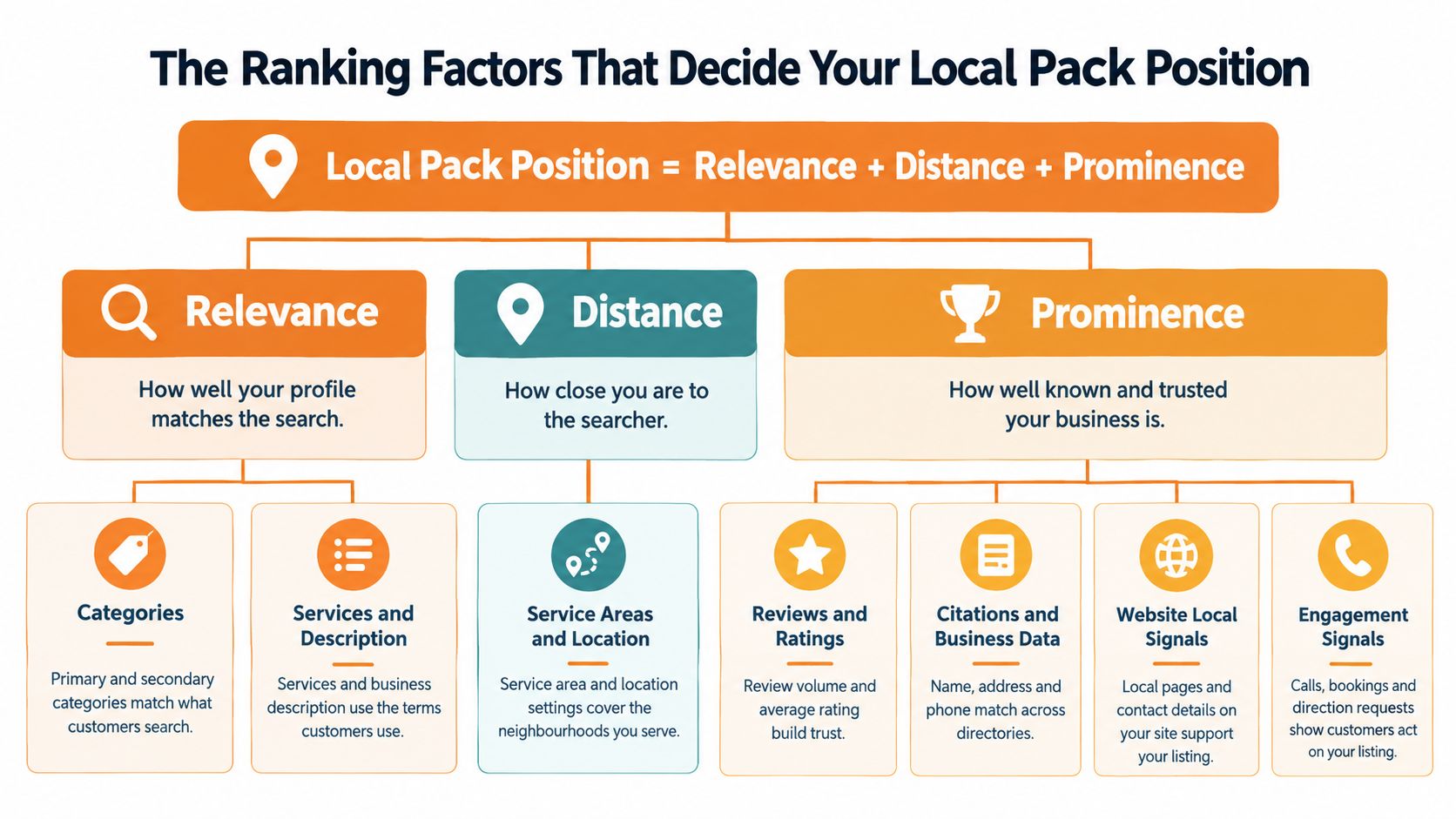
The Local Pack is decided by relevance, distance, and prominence. Most of the work sits in seven factor groups, and Google doesn't publish the exact weights. Google's own explanation of local results is clear on the three variables and quiet on the formula.
| Factor group | What Google reads | Priority | First action |
|---|---|---|---|
| Google Business Profile | Primary and secondary categories, services, hours, photos, service areas | Highest | Set the primary category to the core service and complete every service entry |
| Citations | Name, address and phone consistency across directories | High | Correct mismatched name and phone on the main Canadian directories |
| Reviews | Review count, average rating and recency | High | Start a post-job review request process |
| Local on-page | Pages naming the city, neighbourhood, service and proof | High | Build one page per core service and area served |
| Links and digital PR | Links from local websites, associations and articles | Medium to high | Pursue coverage tied to a Vancouver neighbourhood or B.C. association |
| Behavioural signals | Calls, direction requests, clicks and visits from the profile | Medium | Make the phone number and booking link easy to find |
| Technical | Mobile speed, crawlability, schema and duplicate listings | Medium | Remove duplicate listings and fix mobile errors |
Relevance, distance, and prominence
Relevance is the semantic match between the query and the Google Business Profile. Distance is calculated from the searcher, or from the place named in the query. Prominence is how established the business looks across links, articles, directories, review volume, and ratings.
Distance can't be faked. A business can't reliably compensate for weak proximity with keyword stuffing. Service-area businesses should declare the areas they truly serve and shouldn't invent storefronts. Effort pays on relevance and prominence.
A Kitsilano physiotherapist with Physiotherapist as the primary category will outrank a generic Health Clinic listing for the same query, because the category matches what the searcher typed. A Surrey electrician whose name, address, and phone match across YellowPages.ca and Bing Places builds prominence faster than a competitor whose listings disagree with each other.
How to read the table
Start with the Google Business Profile row. Categories, services, hours, photos, and service areas are the highest-impact edit you can make this week. Then fix citations, reviews, and local on-page pages. Links, behavioural signals, and technical cleanup come after the profile is accurate.
Track rankings from fixed Vancouver-area coordinates. Changing the searcher's location changes the distance component, so one manual check from the office can flatter or frighten you for no real reason.
How Search Intent and Distance Change Who Wins
A search for dentist Kitsilano gives Google a clearer location signal than dentist near me. Intent shapes which businesses qualify, while distance helps determine which of those businesses appear. Results can change across Vancouver, even for the same clinic.
| Query type | Example search | How distance applies | What tends to win |
|---|---|---|---|
| Generic near-me | plumber near me | Searcher's location dominates | A nearby relevant profile with the right category and strong reviews |
| Service plus city | physiotherapist Vancouver | Searcher location still counts, alongside the named city | A profile and page with clear Vancouver relevance |
| Service plus neighbourhood | dentist Kitsilano | The named neighbourhood can tighten distance weighting | A relevant business near Kitsilano |
| Branded | [business name] hours | Distance usually matters less | The business's own verified profile |
| Service-area | emergency locksmith Burnaby | Google considers the search location and declared service area | Businesses that genuinely serve Burnaby |
Two searches, two winners
For dentist Kitsilano, the neighbourhood in the query can make proximity to Kitsilano more important. A dedicated page may help explain that a practice serves the neighbourhood, but it does not guarantee a particular ranking. Google does not disclose the exact weight it gives distance, relevance, and prominence for an individual search.
Search position also depends on where the person is standing. Someone in North Vancouver searching dentist Vancouver may see different results from someone making the same search downtown. A clinic can appear prominently from one location and fall outside the visible results from another.
Check rankings from several locations. One result reflects one searcher's view, not the whole market.
Local search demand makes these distinctions worth accounting for, but the cited WebHill's Canadian local SEO guide does not establish the specific Vancouver usage and search-volume figures previously attached to it. Treat a neighbourhood query and a near-me query as different signals, and assess performance through calls and bookings as well as rank position.
Service-area businesses should list only the municipalities they actually cover, such as Burnaby, New Westminster, or North Vancouver. Creating a fake location to appear closer to searchers can lead to suspension, and it will not change the searcher's location.
Keeping Your Business Data Consistent Everywhere
A Langley HVAC company had a booking widget showing a different phone number than its Google listing, its website footer, and YellowPages.ca. Calls split across two numbers, tracking blamed the wrong source, and the business looked like two entities instead of one. That's the failure mode most category-and-photo advice never mentions.
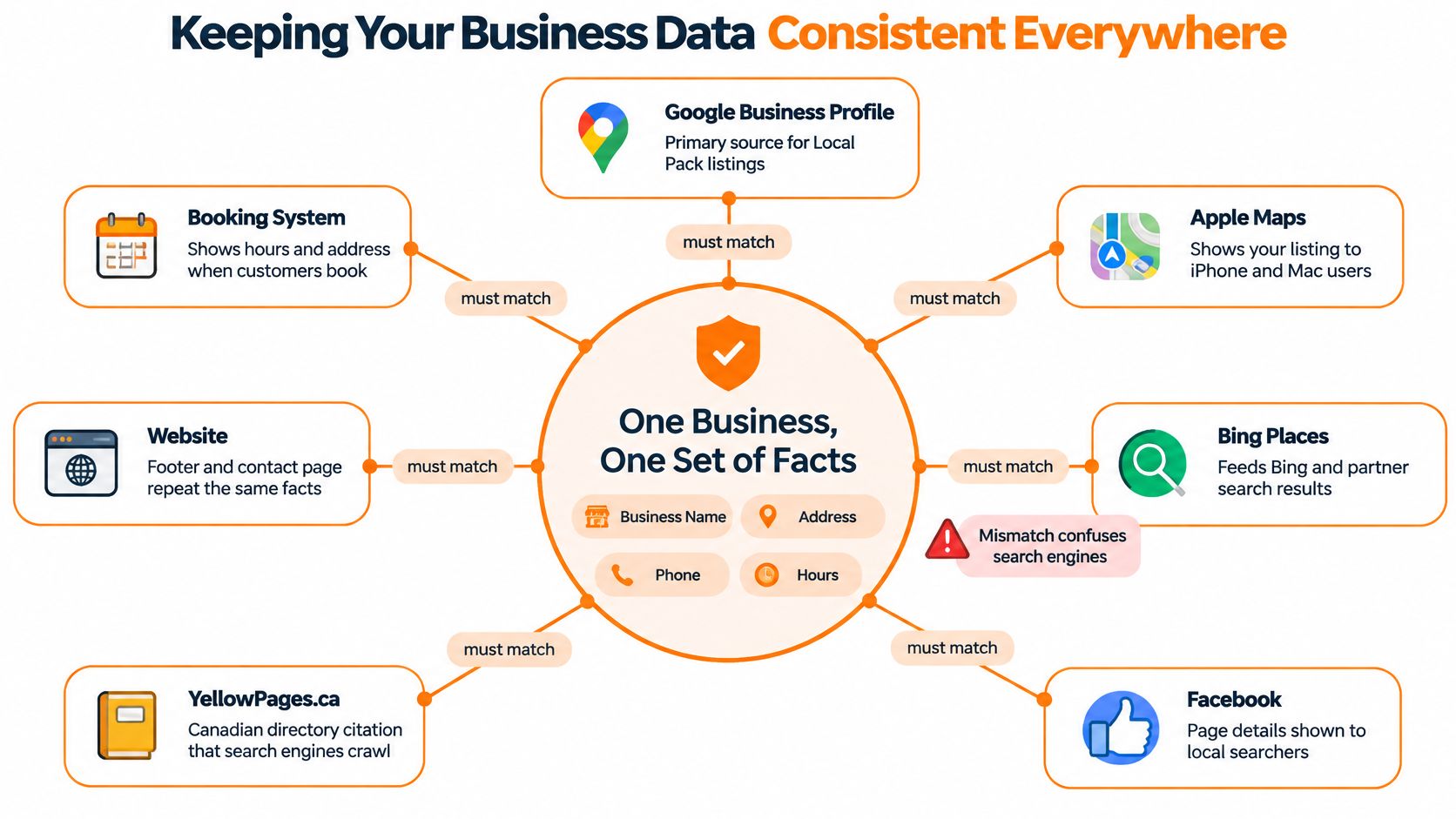
Local SEO ranking is an entity-and-data-consistency problem, not only a profile-tweak problem. Google Business Profile, Apple Maps, Bing Places, Facebook, YellowPages.ca, the website, the booking system, and AI-search surfaces all feed the picture of the business. A recent Canadian local-search guide names those directories among the leading Canadian data sources, and it also notes that Canadian evidence on AI-driven local discovery is still limited.
| Data point | Where it appears | Why a mismatch hurts | Priority |
|---|---|---|---|
| Business name | Google, Apple Maps, Bing Places, Facebook, YellowPages.ca | Splits the entity into duplicates | First |
| Address or service area | Profile, website footer, directories | Weakens distance and area relevance | First |
| Primary phone | Profile, website, booking widget, directories | Breaks call tracking and attribution | First |
| Hours | Profile, website, booking system | Causes lost calls and wrong directions | Second |
| Booking URL | Profile, website, booking system | Sends visitors to dead or outdated pages | Second |
| Regulated-service wording | Website, profile description, directories | Creates compliance and eligibility risk | First for cannabis, CBD and health |
Fix the facts before you chase citation volume
A perfect citation count is less valuable than matching core attributes. Service area, hours, phone number, booking URL, and regulated-service wording are the discrepancies that suppress calls. Minor directories can wait. A practical local citation building pass starts with those six points on the sources that customers and search systems read.
This matters more in British Columbia, where many businesses serve several municipalities or run a service-area model instead of one storefront. "Vancouver" on the profile and "Lower Mainland" on the website is a real conflict, not a style choice.
For cannabis, CBD, health, and wellness businesses, eligibility, location restrictions, and compliance-sensitive claims have to match everywhere, and they must never be overstated. Generic local-SEO advice can make a listing unsafe. If a service isn't allowed at that address, don't write it into the profile to chase a keyword.
The same sources feed AI recommendations. A mismatched phone or an inflated health claim doesn't only confuse the map. It gives an AI system a muddled entity to recommend, or a reason not to recommend you at all.
This short walkthrough shows how one set of facts should look once the main profiles agree.
Earning Reviews and Local Links Without Shortcuts
Reviews are a reputation process and a visibility process at the same time. Google states that review count and positive ratings can improve local ranking, and prominence also draws on websites, links, articles, and directories, as covered in Google's discussion of local visibility. The aim isn't the biggest pile of reviews. It's a credible, geographically relevant prominence graph.
A request process that doesn't look manufactured
- Ask the customer after a completed job, not before the work is done.
- Send one direct review link, so they aren't hunting for the listing.
- Use the same wording for every customer.
- Never offer incentives or script a positive answer.
A steady monthly flow reads as a working business. Forty reviews in one week, all from a single day, can look manufactured. Watch rating distribution and review velocity, not only the average star.
Reply to every review, positive or negative, within a few days. Name the service in plain language, skip private customer details, and don't argue in public. A specific reply is more useful than a copied thank-you.
Prominence that comes from the community
Links and mentions from B.C. associations, chambers of commerce, neighbourhood sites, and local media do more for prominence than a pile of unrelated directory links. A Vancouver contractor who sponsors a Burnaby youth hockey team, and gets that sponsorship reported in a local article, earns a legitimate, geographically relevant link. The article exists because something real happened, not because someone bought a placement.
A structured Google review management routine keeps the asks consistent without turning them into a campaign of incentives.
Fake reviews, paid links with no editorial value, and reciprocal link schemes can lead to suspension or lost rankings. That risk is sharper for regulated sectors such as cannabis and CBD, where a policy problem can take the listing offline entirely. A rank increase without qualified calls isn't a successful outcome anyway.
Measuring Local Ranking by Calls and Bookings
A Vancouver clinic can hold a top-three Local Pack position downtown and still get few bookings from Burnaby. Track where visibility turns into qualified calls and appointments, then use rank to diagnose what may be affecting those results.
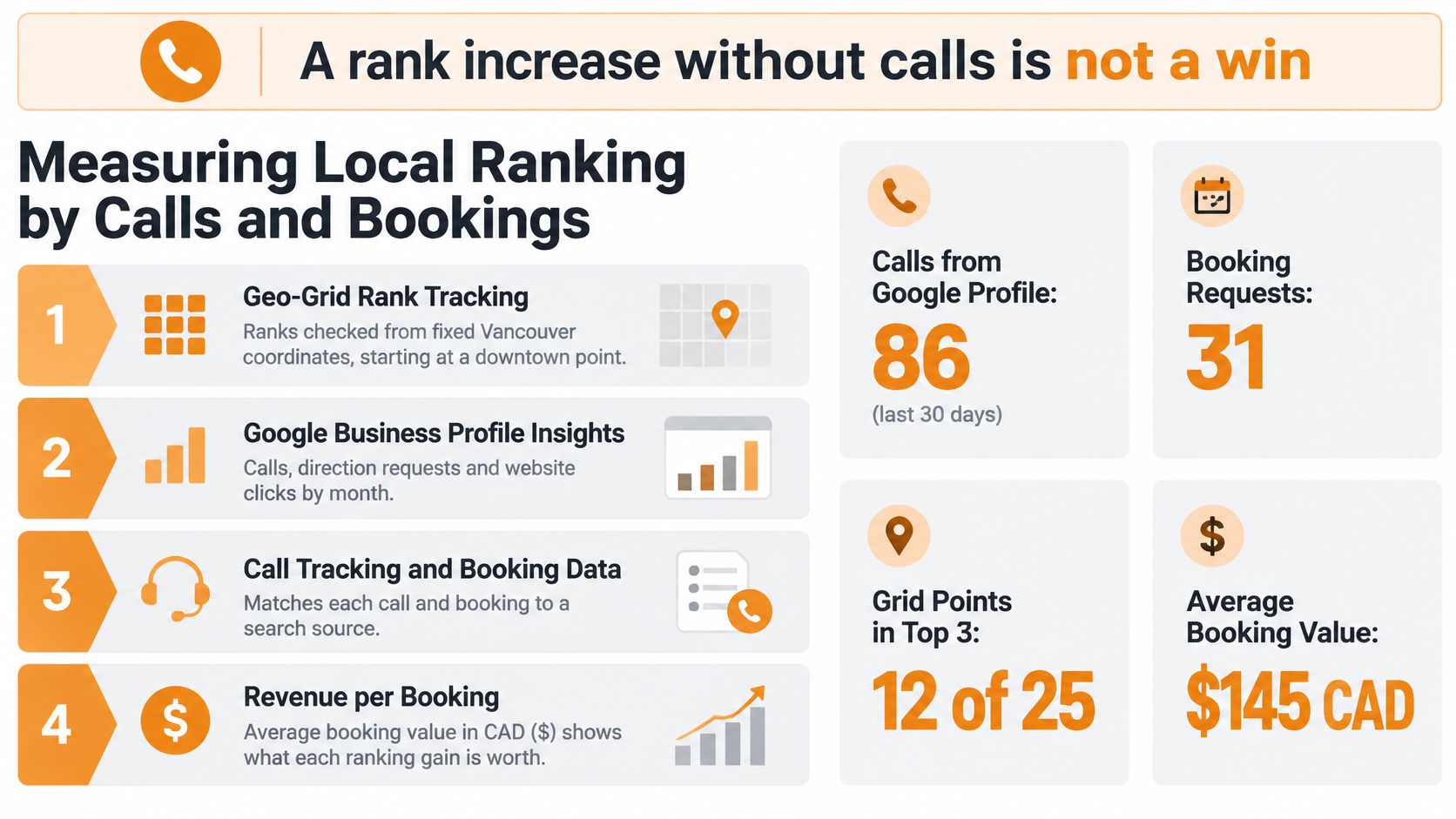
Set a baseline before changing listings or pages. Check fixed points in downtown Vancouver, Burnaby, and Surrey with a geo-grid tracker. A search from your office shows one location's results, not how rankings change across your service area.
Then compare those positions with Google Business Profile calls, direction requests, and website clicks each month. Match enquiries to bookings in your booking system or website analytics, and note whether customers searched for your business by name. These measures connect visibility to outcomes.
| Metric | Where to find it | Useful signal | Watch-out |
|---|---|---|---|
| Local Pack rank at fixed points | Geo-grid rank tracker | Strong positions across relevant service-area locations | One office search can misrepresent coverage |
| Profile calls | Google Business Profile performance | Qualified calls increasing over time | Staff calls can inflate totals |
| Direction requests | Google Business Profile performance | Requests from areas you serve | A local event can create a temporary spike |
| Booking or form leads | Website analytics and booking system | Enquiries that match your services and service area | Spam can inflate form totals |
| Branded searches | Search Console | More searches for your business name | Ads or PR may also drive brand searches |
| Review activity and rating | Google Business Profile reviews | A steady flow of new reviews and a healthy rating | A single-day burst can look unnatural |
When the map and the AI answer don't match
A strong map position does not guarantee an AI recommendation. In a study comparing local-business results cited by Google with results from web-enabled AI systems, overlap varied by business sector: 20.6% for home cleaning, 17.1% for roofing, 11.9% for dentists, 2.5% for auto repair, and 0.1% for IT support (the study). Those figures describe the study's sector-by-sector comparison, not the likelihood that a Canadian business will be recommended.
That gap makes consistent business information important across directories and AI surfaces, but visibility alone is not a business result. If an AI tool recommends your company and the customer later searches your brand, calls, or opens Maps, use call records, direct traffic, branded searches, and an intake-form question to help identify the source. Tracking SEO conversions can help connect those visits and enquiries to booked work.
Review the same measures after 90 days. Judge AI visibility by whether recommendations are accurate and bring qualified calls or bookings, rather than by citation counts or impressions alone.
Start Your 90-Day Local SEO Plan This Month
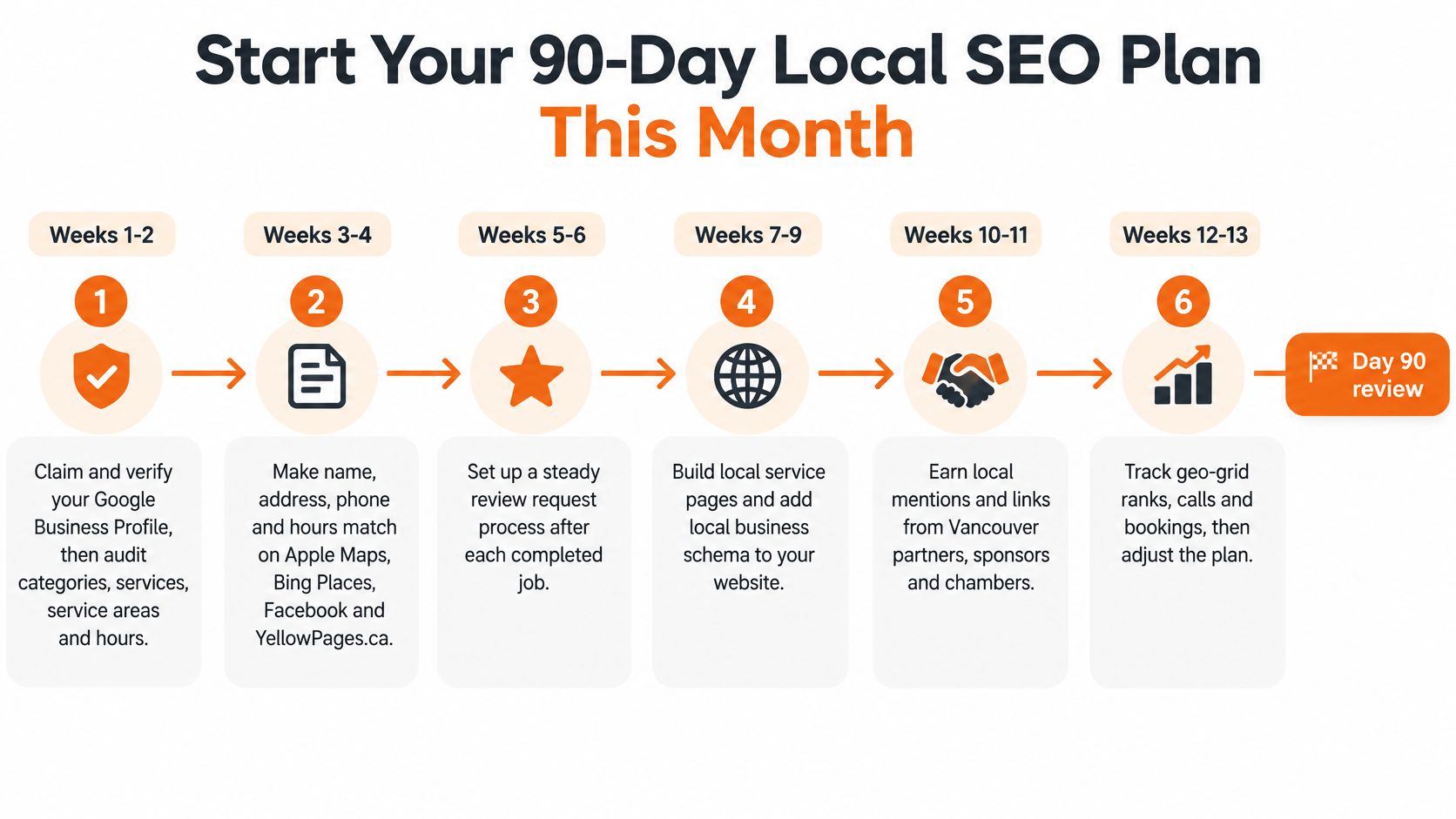
- Weeks 1 and 2. Claim and verify the Google Business Profile if needed. Check categories, services, service areas, and hours against the website. The primary category shapes which searches can surface the listing.
- Weeks 2 to 4. Match the business name, address, and phone across the top five Canadian sources, beginning with the six core data points. Hold off on adding directories until the key listings agree.
- Month 2. Start requesting reviews after completed jobs. Publish a local page for each core service, with genuine project photos and client outcomes. Swapping city names on thin pages gives searchers little reason to choose you.
- Month 2, alongside the pages. Contact local associations and pursue digital PR tied to real community activity. Skip bought link lists.
- Month 3. Track a geo-grid from three Vancouver coordinates. Compare calls, direction requests, and bookings with your starting baseline.
- The decision. Keep and expand the work associated with more qualified calls or bookings. Revise tasks that show no useful change.
For example, a Vancouver plumber could review whether a service area limited to Vancouver matches the places they actually serve, including Burnaby. A Burnaby physiotherapy clinic could build a Metrotown page with accurate treatment details rather than replacing a city name on a generic page. These are planning examples, not guaranteed outcomes. Google does not disclose every factor behind a local ranking, so track leads as well as map positions.
Run the audit in-house if someone can own the profile, directory accuracy, and 90-day results. Bring in outside help when listings are duplicated, the category is incorrect, or regulated wording needs review before publication. Juiced Digital works with Vancouver and British Columbia service businesses on Google Business Profile accuracy, citation consistency, and lead tracking. Book a review through Juiced Digital to assess where calls and bookings are coming from and what to address first.
