
If the biggest advertiser doesn't automatically get the top position, what are you buying with Google Ads? For a Vancouver plumber trying to book service calls or an online retailer selling across Canada, the answer matters more than knowing which button launches a campaign.
How does Google Ads work? You enter an auction for opportunities to reach potential customers, then measure whether those opportunities become worthwhile business. Understanding the connection between targeting, relevance, cost, and customer action helps you make better decisions before you spend.
What Is Google Ads and Why It Matters
A homeowner in Vancouver notices water pooling under the kitchen sink and searches for a local plumber. An advertisement offers help with leaking pipes, names the service area, and leads to a page where the homeowner can request a visit.
That's a useful starting point for understanding Google Ads: a platform businesses use to place advertisements in front of potential customers. In search advertising, the opportunity begins with something the person actively wants to find, rather than an audience profile alone.
The homeowner wants assistance. The plumber wants a suitable booking. Google evaluates whether the advertisement fits that search.
Start with the customer's task
For an illustrative Canadian online retailer, the task might be different. Someone searching for waterproof hiking boots could need product information, available sizes, delivery details, and a straightforward checkout rather than a telephone conversation.
- Local service businesses should think about the path from search to enquiry to booked work.
- E-commerce brands should connect the advertised product to the buying experience.
- Clinics and regulated businesses need to consider whether the service, wording, audience, and destination are appropriate before pursuing traffic.
The important distinction is between buying an opportunity and buying a customer. An advertisement can bring someone to your business, but it can't make an unsuitable offer useful or ensure your team answers the phone.
Treat every campaign as a proposed customer journey, not simply an advertisement.
Google Ads deserves attention because it lets you connect a business offer with an identifiable need. Whether that connection is commercially worthwhile depends on what happens after the person responds.
Before choosing settings, finish this sentence: We want to reach people who need this specific thing, in this specific market, and help them take this specific action. If that answer is vague, the campaign will be difficult to evaluate.
How the Google Ads Auction Works
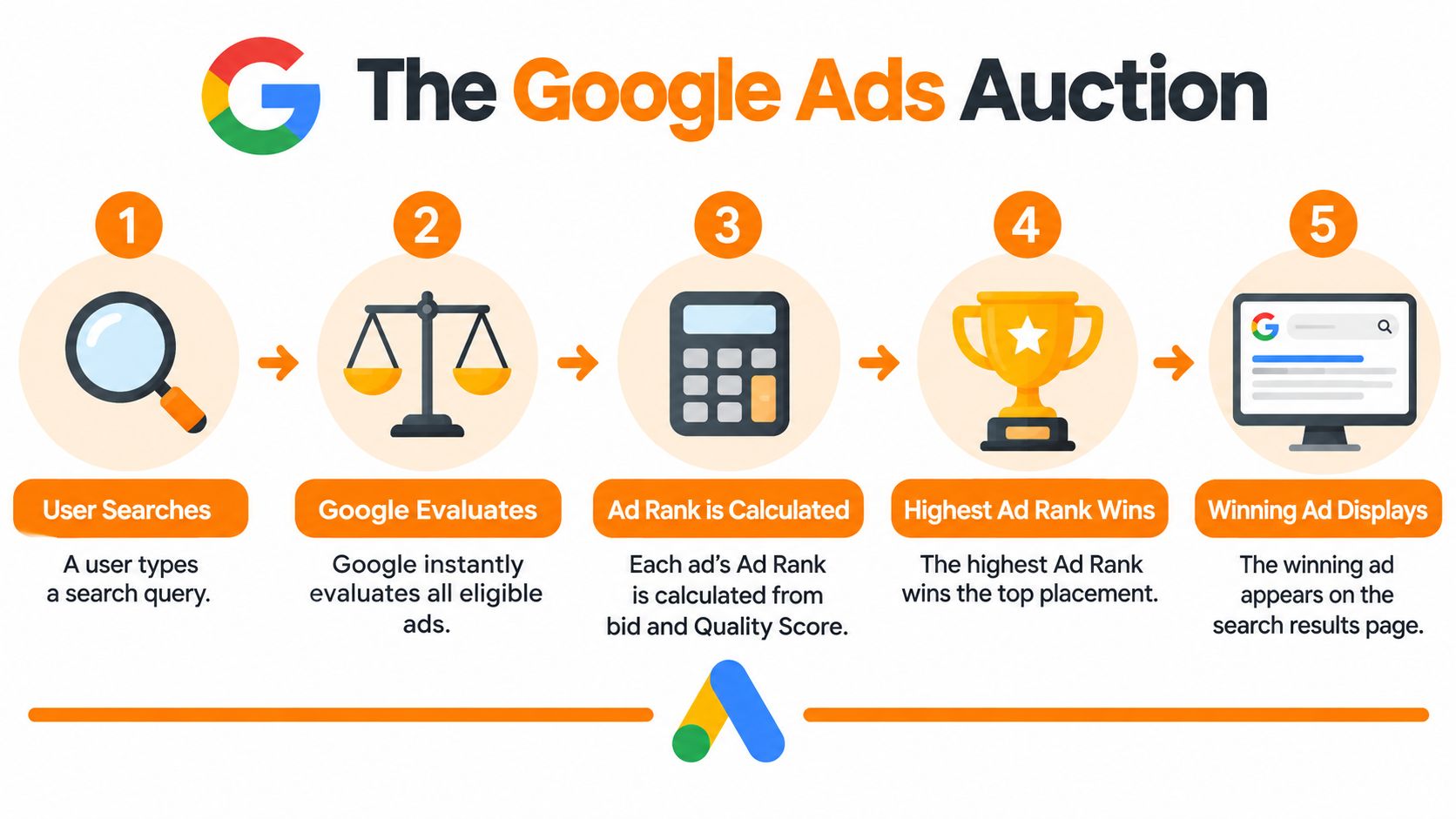
The Google Ads auction isn't a reservation for a permanent position. It happens when a search creates an opportunity to show an advertisement, with eligible advertisers competing for that opportunity.
Before that search occurs, advertisers have already prepared their entries. They've selected keywords, defined targeting such as location and device, established bids or budgets, and supplied advertisements and landing pages.
The following visual provides a simplified overview of that sequence.
Eligibility comes before competition
Consider a hypothetical plumber who serves Vancouver but not the rest of British Columbia. Geographic targeting helps narrow the opportunities the business pursues, instead of treating every plumbing-related search as equally valuable.
Once advertisements are eligible, Google evaluates factors commonly summarised as bid, expected advertising performance, and relevance. The highest bid therefore doesn't automatically guarantee the highest position.
Think of the auction as a selection process with several criteria, not a sale awarded solely to whoever offers the most money. A relevant advertisement and useful destination can influence competitiveness alongside the advertiser's willingness to pay.
- The bid expresses the advertiser's spending parameters.
- Expected performance concerns how the advertisement is likely to perform.
- Relevance and destination quality concern how well the experience fits the searcher's need.
The competitive context is substantial: Canadian internet advertising revenue reached approximately $5.484 billion in 2016, while search and display together represented 88% of that total, according to IAB Canada's internet advertising revenue survey.
For a local advertiser, the practical response isn't to compete against the whole market. It's to define which opportunities deserve participation and prepare a convincing response to those searches.
This video offers another way to follow the auction process.
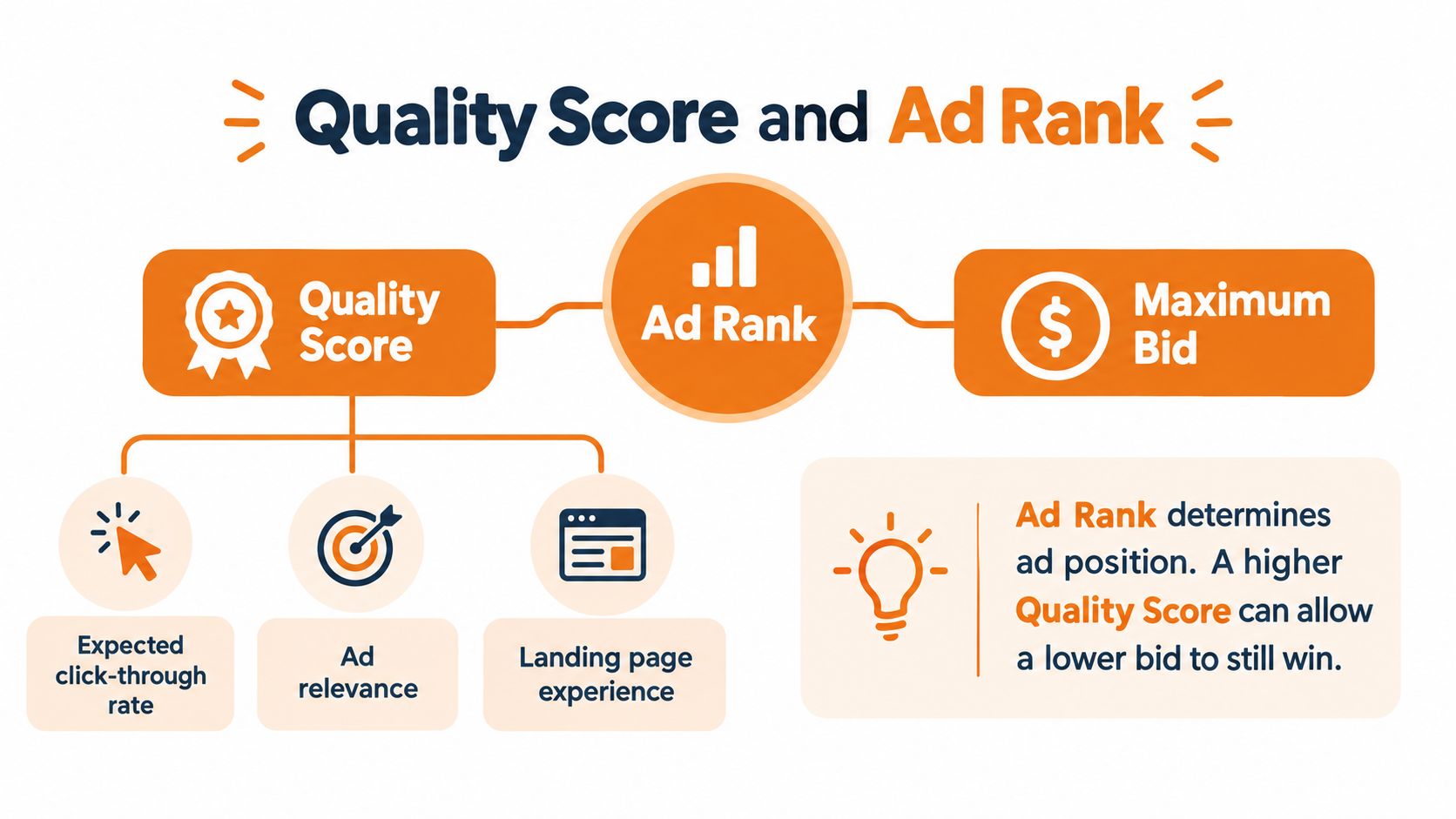
Don't treat the diagram as a complete mathematical specification. In particular, multiplying a displayed Quality Score by a maximum bid isn't a reliable way to calculate your actual auction position.
Quality Score and Ad Rank Explained
Quality Score and Ad Rank are related concepts, but they aren't interchangeable. Quality Score helps you assess quality and relevance. Ad Rank concerns your competitiveness and position in a particular auction.
A useful analogy is a job interview. Paying attention only to the bid would be like selecting a candidate based on a single financial consideration while ignoring whether they can do the work. Fit matters, but a diagnostic assessment isn't the entire hiring decision.
Use quality as a troubleshooting framework
The diagram is a conceptual simplification, not a formula or a promise of lower prices. A more useful working approach is to examine expected click-through rate, ad relevance, and landing-page experience, then identify where the customer's experience becomes less coherent.
Suppose a hypothetical plumbing advertisement focuses on drain cleaning, but the visitor reaches a general renovation page. The business might offer both services, yet the visitor now has to find the promised answer.
| Area to examine | Practical question |
|---|---|
| Expected response | Does the advertisement give the right person a clear reason to respond? |
| Ad relevance | Does the message address the service or product being sought? |
| Landing-page experience | Can visitors understand the offer and take the intended action? |
Improve the connection rather than chasing a score in isolation. Group related services together, write copy specific to those services, and choose destinations that fulfil the advertisement's promise.
For an online retailer, that could mean sending a product-focused visitor to the relevant product or category rather than a broad store introduction. For a clinic, it could mean clearly explaining the advertised appointment type without making unsupported treatment claims.
Better alignment isn't a guarantee of a particular position or cost. It is something you can improve directly, unlike a competitor's next bidding decision.
Use diagnostic information to decide what to investigate. Then judge the change by whether suitable customers find the experience clearer and whether business outcomes improve.
Bidding Strategies and Match Types
Bidding and keyword matching answer different questions. Bidding determines how you pursue an advertising objective; match types influence which searches can be considered relevant to your keywords.
Confusing the two can lead to an expensive mismatch. You might choose a conversion-focused strategy while allowing searches that have little connection to the service you provide.
Use the visual below as a reminder to make those decisions deliberately.

Bidding Strategies at a Glance
| Strategy | Control Level | Best For |
|---|---|---|
| Manual CPC | Direct control over maximum click bids | Advertisers prepared to manage bids closely |
| Maximize Clicks | Automated bidding towards traffic | Campaigns with a deliberate website-visit objective |
| Maximize Conversions | Automated bidding towards recorded conversions | Businesses with meaningful, dependable conversion tracking |
| Target CPA | Automated bidding towards a target acquisition cost | Campaigns with a defined acquisition objective and trustworthy measurement |
A target is an objective, not a guaranteed result. If your recorded conversions include unsuitable enquiries, conversion-focused automation won't resolve that definition for you.
Broad match can consider related searches beyond the keyword's wording. Phrase match provides a more bounded relationship to its meaning, while exact match focuses on the same meaning or intent, not necessarily identical characters.
Negative keywords help exclude unsuitable searches. For an illustrative plumbing campaign, employment-related searches may warrant exclusion if the objective is customer bookings rather than recruitment.
Work backwards from profitable work
Search represented 43% of Canada's digital advertising revenue in 2025, according to IAB Canada's revenue survey. That commercial scale doesn't establish what any individual business should spend.
Separate your media budget from management fees, landing-page work, tracking implementation, and applicable taxes. A small budget can struggle when it's spread across unrelated services or when unsuitable clicks consume the available spend.
Budget rule: Calculate what you can afford to pay for a qualified opportunity before deciding whether a click looks inexpensive.
A useful planning formula is break-even lead cost = average gross profit per new customer × qualified-lead close rate. Set your working target below break-even to leave room for other costs and profit, and include future customer value only when your records support it.
For a fuller budgeting discussion, use this guide to how much Google Ads costs. Judge qualified appointments and completed work, not cheap traffic alone.
Campaign Types and Targeting Options
A campaign type should match the communication task. Someone looking for urgent help needs a different experience from someone comparing products or learning about an unfamiliar service.
Search campaigns address expressed search intent. Display campaigns use visual advertisements across websites, Shopping campaigns support product discovery, and Video campaigns communicate through video, including on YouTube.
Choose the environment before the audience
| Business situation | Campaign type to consider | Decision to resolve first |
|---|---|---|
| A homeowner seeking a plumber | Search | Which services can the business fulfil locally? |
| A shopper comparing physical products | Shopping | Are product details and the purchase experience ready? |
| A brand explaining an unfamiliar offer | Video | What needs to be demonstrated or explained? |
| A business seeking visual exposure | Display | Which audiences and contexts suit the objective? |
Targeting adds boundaries around that choice. Location, device, audience, demographic, and scheduling options should reflect actual customers and operational capacity, with availability depending on campaign settings and eligibility.
For a Vancouver service business, review the service area and call-handling arrangements together. Mobile visitors may need a convenient contact path, but don't exclude other devices because you assume every urgent customer uses a phone.
Automation needs explicit boundaries
Google describes AI Max for Search as using broad match and keywordless technology to identify additional queries in its AI Max support documentation. That changes the advertiser's task from selecting words alone to supervising which additional opportunities are suitable.
For cannabis, CBD, wellness, and healthcare businesses, automation isn't a substitute for platform eligibility checks or legal review. A business being permitted to operate doesn't establish that every product, claim, or advertising approach is permitted.
- Define boundaries: Specify service areas, appropriate language, eligible offers, and meaningful conversion actions.
- Test deliberately: Compare automated expansion with a stable baseline.
- Audit suitability: Inspect available search-term and placement information, exclusions, landing pages, and call quality.
Canadian availability and eligibility for AI-mediated search advertising can change. Don't build a forecast around guaranteed visibility in AI-generated search experiences.
Setting Up Your First Campaign
Before opening the account setup screen, prepare a small campaign brief. Write down the offer, customer, service area, intended action, landing page, and the person responsible for responding to enquiries.
For an illustrative Vancouver plumber, a focused drain-cleaning campaign is easier to interpret than a launch combining every service and location. The point isn't to make the account small forever. It's to make the initial decisions understandable.
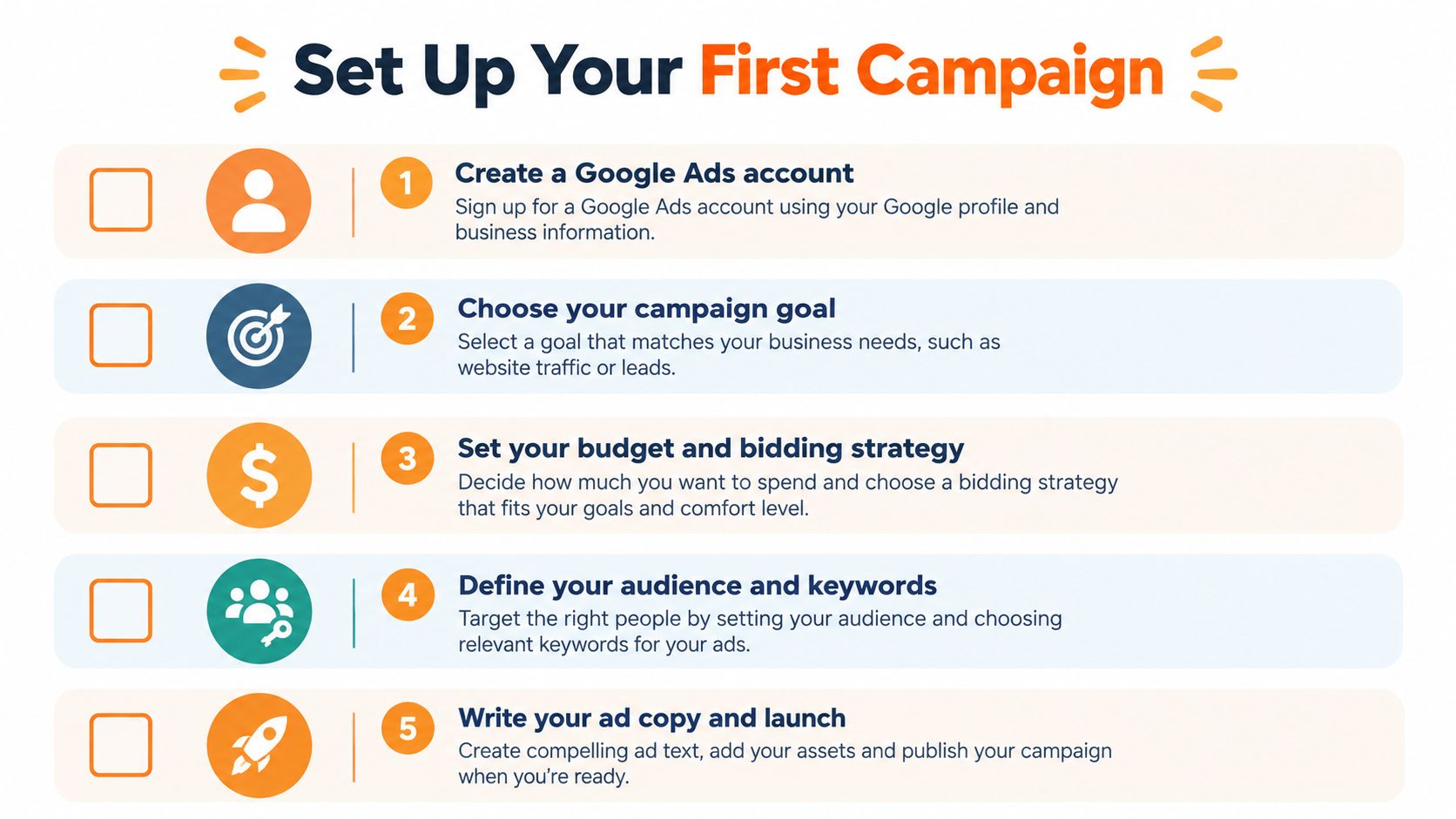
The checklist below summarises the setup sequence.
Prepare the account and measurement
Create the Google Ads account and review billing details, currency, time zone, and access permissions carefully. Confirm who owns the account and who can make spending decisions.
Choose a campaign type that serves the objective, then configure the location, language, budget, bidding approach, and schedule deliberately. Don't accept a setting merely because it appears during onboarding.
Implement conversion tracking before launch. Test the actions that matter, such as an enquiry submission or purchase, and check that repeated page visits don't masquerade as separate business outcomes.
Build a coherent search experience
- Group by customer need: Keep drain-cleaning searches separate from unrelated installation services so each group can support a focused message.
- Choose intentional keywords: Start with terms that describe what customers want to hire or buy, rather than every phrase connected to the industry.
- Prepare exclusions: Consider irrelevant employment, training, or do-it-yourself searches where they don't match your objective.
- Write a truthful offer: Include the service, a verifiable benefit, and a clear next action. Don't advertise availability your team can't fulfil.
A hypothetical headline such as Vancouver Drain Cleaning makes the service clear. Supporting copy can explain the booking process and invite the visitor to request service without inventing credentials, prices, or response promises.
Before launch, complete the journey yourself on both mobile and desktop. Submit the form, check the confirmation, follow the telephone link, and ask the receiving team whether they can identify and handle the enquiry.
For additional preparation, consult this guide to starting pay-per-click advertising. Launch when the customer journey and measurement work, not just when the advertisement is ready.
Measuring Results and Attribution
In the standard search advertising model, you generally pay when someone clicks rather than just when the advertisement appears. That creates a measurable chain from exposure to visit to business outcome, although the click price varies with the opportunity.
The scale of this performance-advertising environment has developed over time: Canadian internet advertising revenue reached $3.525 billion in 2013, according to IAB Canada's Canadian internet advertising revenue survey. For your business, however, the useful question is what spending produces.
Read metrics as a connected chain
| Metric | Meaning | Useful diagnostic question |
|---|---|---|
| Impressions | Recorded advertisement appearances | Are you receiving exposure? |
| Clicks | Recorded advertisement clicks | Are people responding? |
| Click-through rate | Clicks relative to impressions | Does the message attract attention? |
| Cost per click | Advertising spend divided by clicks | What does each visit cost? |
| Conversions | Recorded actions you've defined | Are visitors taking the intended action? |
| Cost per acquisition | Spend divided by recorded acquisitions | Is the recorded outcome affordable? |
Conversion rate expresses conversions relative to the relevant interactions being measured. There isn't a universal good rate that settles profitability, because a form submission, a qualified appointment, and a completed purchase have different value.
Attribution assigns credit, not certainty
A customer may click an advertisement, leave, and return later before buying. Attribution determines how available credit is assigned across measured interactions.
A last-click approach emphasises the final eligible interaction, while data-driven attribution distributes credit using available interaction data. Check which options are available in your account and whether they suit your buying journey.
Measurement caution: An attributed conversion isn't automatically proof that advertising caused an additional sale.
Use Google Ads conversion tracking alongside customer and sales records to distinguish enquiries from commercial outcomes. Keep branded searches separate from non-branded acquisition analysis so existing demand doesn't obscure how you attract new customers.
As a practical review routine, inspect spending and tracking health daily, search relevance and lead quality weekly, and booked revenue and profitability monthly. Adjust that cadence to your sales cycle rather than making major decisions from isolated fluctuations.
Key Takeaways for Your Business
The most useful way to understand Google Ads is as a sequence of business decisions. Decide which customers you can serve, which needs you can answer, what a successful outcome is worth, and how you'll verify that it happened.
For a Vancouver service business, that means looking beyond the advertisement to dispatch coverage, appointment availability, and follow-up. An enquiry has limited value if your team can't turn it into suitable work.
Choose your next action by business model
- Local services: Identify the service with a clear customer need and a reliable booking process. Give that offer a defined service area and an accountable enquiry owner.
- E-commerce: Check product availability, delivery information, returns, and checkout usability before expanding acquisition.
- Regulated businesses: Resolve eligibility, claims, and destination requirements before testing additional reach.
- Marketing teams: Agree on what counts as a qualified outcome so campaign reporting and business reporting answer the same question.
Avoid changing everything at once when results disappoint. Investigate the weakest connection: unsuitable searches, an unclear offer, a difficult landing page, poor enquiry handling, or inaccurate measurement.
Then make a deliberate change and evaluate the relevant outcome. A higher click-through rate doesn't settle a lead-quality problem, just as more form submissions don't establish profitable growth.
Your immediate task is to write a campaign brief your team can act on. Name the offer, audience, boundaries, budget responsibilities, success criteria, and review process. That turns an unfamiliar advertising platform into a testable business activity rather than an open-ended spending commitment.
Juiced Digital offers Google Ads setup and ongoing optimisation, conversion tracking, and landing-page support for local businesses and e-commerce brands. Visit to request a consultation or audit focused on your campaign economics, measurement gaps, and the customer journey from search to sale.
