
The popular advice on how to choose a digital marketing agency usually starts with its portfolio, client list, or pitch deck. Those can show whether an agency has creative range, but they won't tell you whether it can trace a qualified lead to a sale, preserve your access to business-critical data, or keep a campaign inside regulatory boundaries.
That distinction matters for Canadian businesses building an integrated digital operation. In 2023, 51% of Canadian small and medium-sized enterprises had adopted at least one new technology between 2021 and 2023. Business-intelligence technologies led the listed categories, adopted by 33% of SMEs, while IT security and authentication systems and industry-specific business software were each adopted by 17%, according to the federal survey of Canadian SME technology adoption. A marketing partner should understand that environment, not just produce attractive ads or keyword reports.
Rethinking the Agency Selection Process
A polished presentation can make an agency's strategy look coherent before anyone has tested its assumptions. The more useful question is whether the agency can connect your business goals to a working measurement system: analytics, advertising platforms, your customer relationship management system, website performance, and conversion tracking. Without that connection, a rise in traffic may look like progress even when qualified enquiries or sales haven't changed.
Canadian SME adoption data offers a practical reason to look beyond isolated services. The same federal survey found that 59% of SMEs had an online presence in 2023; among those businesses, websites were the most common channel, at 80%, followed by social-media accounts at 68%. For a Vancouver company competing in local search, or an e-commerce brand selling beyond B.C., an agency's value depends in part on whether it can connect those digital touchpoints to commercial outcomes.
Ask what the agency can measure
Creative quality still matters. But a portfolio doesn't establish whether the agency can distinguish a real business result from a convenient platform metric. Ask to see how it defines qualified leads, connects campaign activity to CRM records, and reports revenue attribution. A capable team should be able to explain what its dashboard includes, where the data comes from, and how it handles gaps or duplicate conversions.
Look for evidence of technical work, too. Can the agency show how it audits SEO, checks conversion tracking, and prioritizes recommendations according to commercial impact? Does it explain who administers each platform and what happens to your data and assets if the relationship ends?
Practical rule: Judge the agency by the system it can build and explain, not by the number of channels it can list in a proposal.
Be wary of a pitch centred on social posts, impressions, or keyword rankings without a clear account of how those measures relate to your business. The right selection process tests the agency's ability to plan, measure, and govern its work. Creative is part of the job; it isn't proof that the rest of the job is covered.
Defining Incremental Business Outcomes
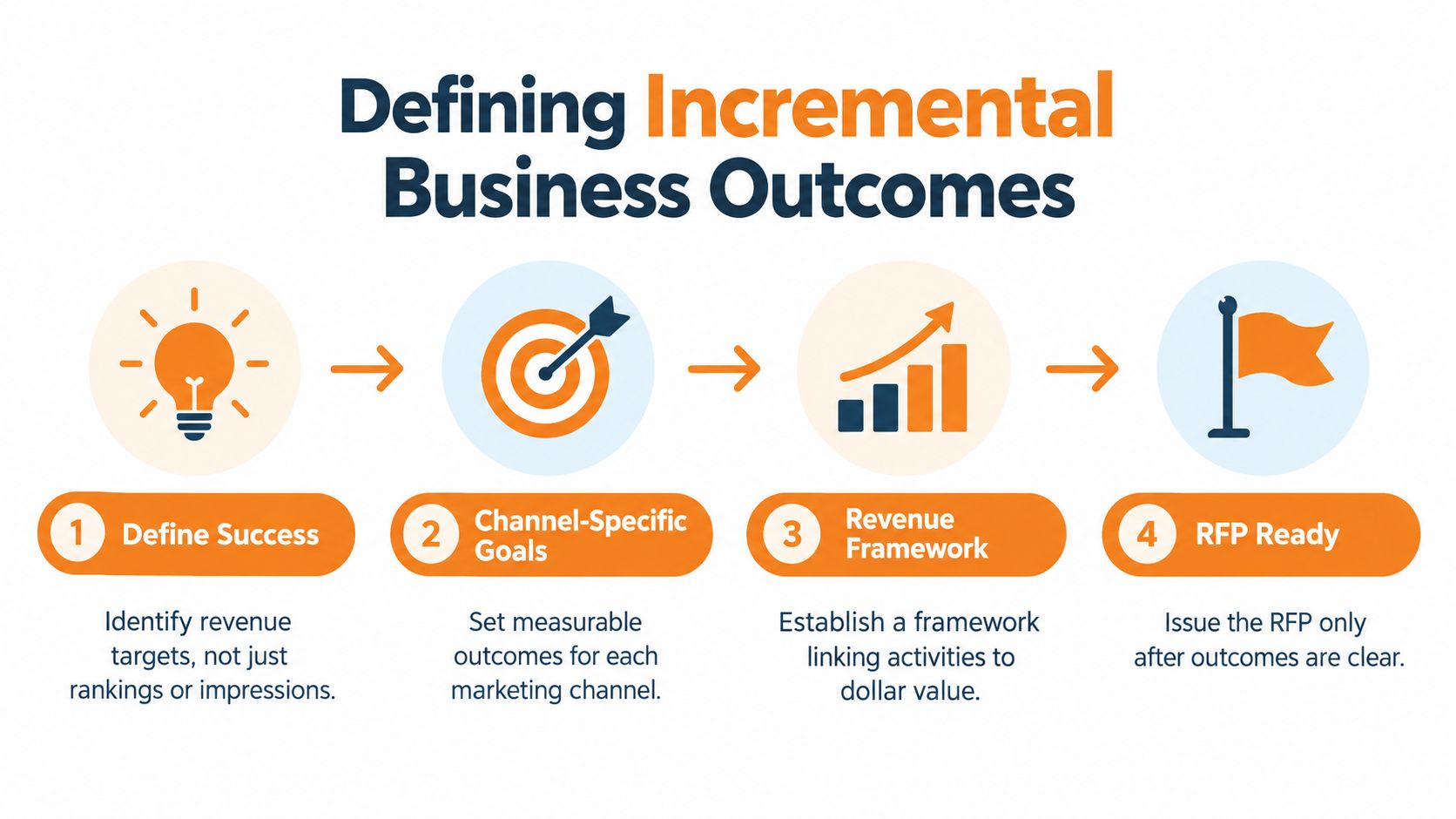
Before requesting proposals, decide what a meaningful result looks like for your business. “More visibility” isn't a complete goal if your commercial need is qualified enquiries, booked appointments, or profitable orders. An agency can deliver more clicks without changing the number or quality of customers you acquire.
Start with a channel-specific baseline. For each channel under consideration, document qualified leads, customer-acquisition cost, conversion rate, revenue, and the attribution window used to connect marketing activity with a sale. Define what qualifies as a lead in operational terms. A form submission may be an initial signal; a sales-qualified opportunity or completed purchase may be the outcome that matters.
Separate activity from business impact
For organic search, require separate reporting for branded and non-branded traffic. Branded searches may reflect existing awareness or demand; non-branded searches can help show whether the agency is reaching people who weren't already looking for your company by name. For local businesses, ask the agency to distinguish local-pack visibility from website sessions. For any channel, ask how it will distinguish lead volume from lead quality.
A useful proposal includes a 90-day test plan with defined events in GA4 or an equivalent analytics platform. Events should match the customer journey, such as form submissions, calls, booked appointments, or e-commerce transactions. The plan should also explain how those events will be reconciled with CRM records and how assisted conversions will be interpreted, rather than automatically credited as incremental sales.
Measurement doubles as a hiring test. Ask the agency to state what it will compare, what information it needs from your team, and what result would change its next decision. If reporting and attribution are central to your evaluation, review Juiced Digital's approach to marketing reporting and analytics as one example of the capabilities to assess.
A metric is useful when it helps you decide what to do next, not merely when it makes a report look busy.
Put the baseline and definitions into the RFP. When every agency responds to the same commercial questions, you can compare their plans on more than persuasive language or projected traffic.
Auditing Technical Controls and Data Ownership
Account ownership shouldn't be treated as a minor contract detail. If an agency controls your advertising accounts, analytics, Search Console, CRM, landing pages, or creative assets, changing providers can become a disruption rather than a straightforward handover. The client should retain administrator access and control of its underlying platforms, even when the agency manages them day to day.
Ask each prospective agency to map the tools it will use, the data each tool receives, and who can access it. Confirm that your business owns or controls the accounts, that billing is transparent, and that your team can export reporting history and retrieve creative files. A custom dashboard can be useful, but it shouldn't be the only place where performance data exists.
Put ownership expectations in writing
Use the comparison below during agency interviews and contract review. Ask the agency to identify any exceptions before work begins, not after a campaign is live.
| Asset Category | Red Flag (Agency Retains) | Best Practice (Client Owns) |
|---|---|---|
| Advertising accounts | The agency is the sole account owner or won't grant client access | Your business owns the accounts and grants the agency appropriate access |
| Analytics and Search Console | Data is available only through a proprietary agency dashboard | Your business retains administrator access and historical data |
| CRM and conversion records | Lead data is held outside your systems without a clear handover process | Your business controls customer records and agrees on documented data flows |
| Landing pages and creative assets | Pages or source files can't be transferred at the end of the contract | Your business can retrieve the assets and maintain operational continuity |
| Reporting and tracking documentation | Measurement setup is undocumented or inaccessible | Your team can inspect events, definitions, and tracking records |
Technical competence also means more than installing tags. Ask to see a sample SEO audit and how the team prioritizes crawl, indexing, content, and conversion issues against your commercial goals. For paid media, confirm how the agency validates conversion actions and reconciles platform data with your CRM. Review its approach to Google Ads conversion tracking as a reference point for the questions you'll want answered.
Avoid an agency that insists on retaining account ownership or treats data access as a favour. The agreement should describe access, ownership, documentation, and the handover process plainly. If the partnership ends, your business should keep its infrastructure, historical records, and ability to appoint another provider without rebuilding the measurement system from scratch.
Evaluating AI Capabilities Beyond the Buzzwords
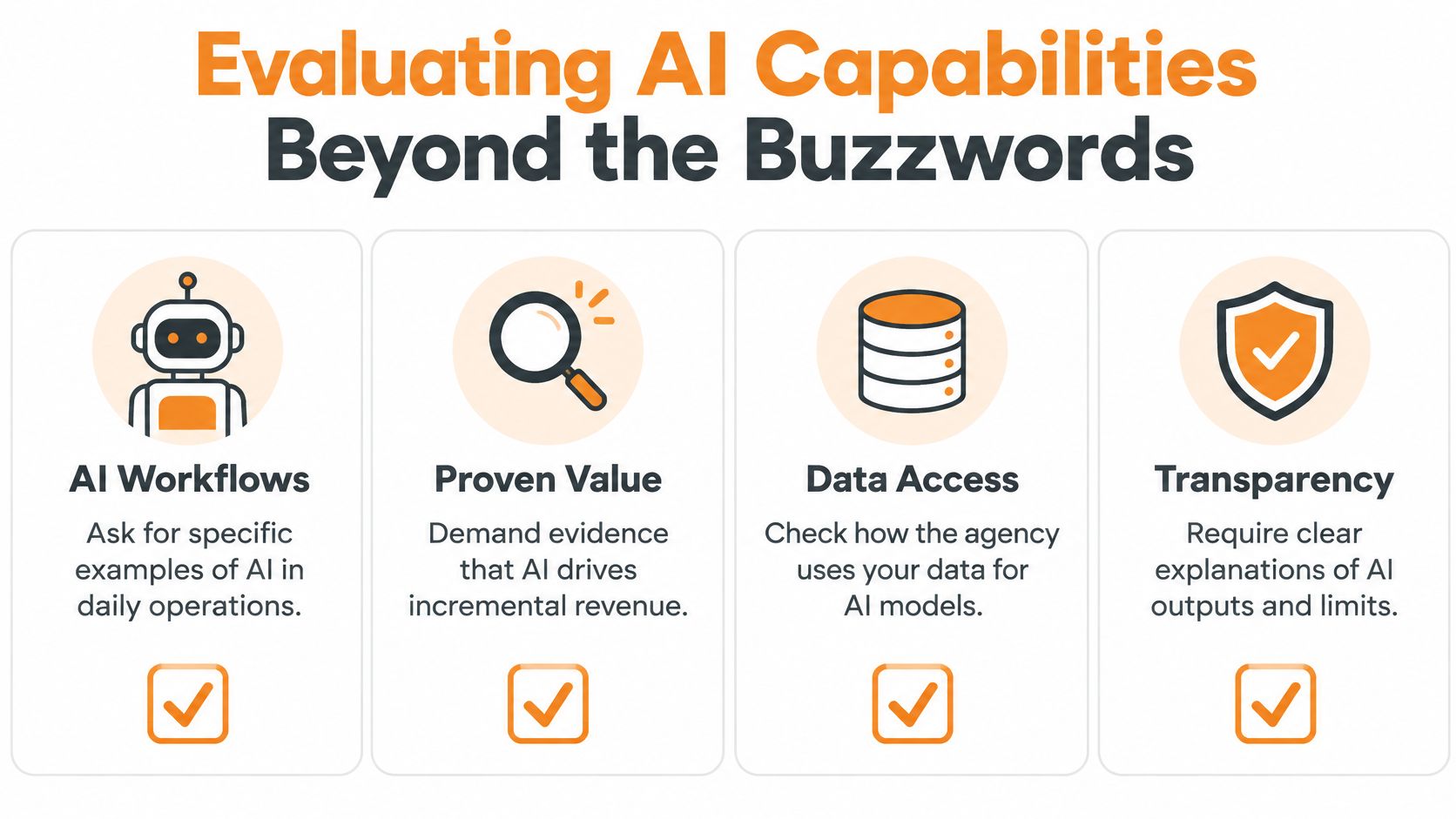
“Uses AI” isn't a useful qualification on its own. An agency might mean it uses a platform's built-in bidding features, automates routine tasks, drafts content with a generative tool, or has built a workflow that can be tested against a conventional process. Those are different things, with different implications for cost, quality, and risk.
Adoption figures are especially sensitive to definitions. Statistics Canada reported that 12.2% of businesses used AI to produce goods or deliver services in 2025, while a Canadian SME study found adoption estimates ranging from 12.2% to 71% depending on how questions were framed and whether embedded software counted. See the Statistics Canada publication on business AI adoption. For an agency buyer, the lesson isn't that every business needs an AI package. It's that a label can conceal very different capabilities.
Compare workflow claims with evidence
Ask the agency to identify precisely where it uses AI: keyword research, content production, paid-media optimization, customer service, analytics, or experimentation. Then ask what a person checks, what client data enters the workflow, and what happens when an output conflicts with your brand or regulatory requirements.
| Agency claim | What to ask for |
|---|---|
| AI-assisted content | The review process, factual checks, and rules for brand or regulated claims |
| AI-driven paid-media optimization | The conversion signals used and how performance is compared with a baseline |
| AI-powered analysis | The inputs, outputs, human interpretation, and decision the analysis informs |
| Proprietary AI strategy | A clear explanation of what is distinct from ordinary platform automation |
The most revealing question is: What evidence would show that this workflow performs better than a conventional process? Ask for a testable hypothesis tied to qualified leads, acquisition cost, conversion rate, or revenue per visitor. Content volume and rankings alone won't establish incremental value.
Statistics Canada also reported that 19.2% of Canadian businesses used AI to produce goods or deliver services in 2026, up from 6.1% in 2024, while 40.0% said AI wasn't relevant to their business. The Statistics Canada report on business AI use is a reminder that adoption isn't a universal requirement. Choose an agency that can explain not only where AI might help, but also when a simpler, lower-cost process is the better choice.
Navigating Compliance in Regulated Industries
For regulated businesses, a campaign that generates attention but breaches advertising rules can create operational and reputational risk. Compliance capability belongs in the selection criteria alongside measurement and data access, especially for companies using email, SMS, lead-generation forms, remarketing, or health-related claims.
Canada's Anti-Spam Legislation came into force in 2014, and enforcement has resulted in more than $3.2 million in administrative monetary penalties. The CRTC says it can investigate businesses that send commercial electronic messages without required consent or install computer programs without consent during commercial activity. Read the CRTC's CASL enforcement information. Ask agencies how they document consent, process unsubscribe requests, retain records, synchronize suppression lists, and approve campaign changes.
Test controls, not assurances
Cannabis, CBD, wellness, and health-related businesses should ask the agency to demonstrate how it turns rules into campaign controls. A statement that the team “understands compliance” is not enough. Give it a product page and ask it to identify prohibited claims, propose suitable copy, and explain how approvals and audience eligibility would be documented.
For cannabis promotion in B.C., only an appropriately licensed party may promote cannabis for sale to adults aged 19 and over. Federal and provincial restrictions also apply to promotion in places where minors may be present, as described in the B.C. government's cannabis advertising and promotion guidance. Health Canada states that cannabis promotion is generally prohibited except in limited circumstances, and its guidance addresses restrictions on false, misleading, or deceptive promotion and therapeutic or disease-treatment claims. Review Health Canada's cannabis advertising prohibitions.
Use an interview exercise to check whether the agency can apply those requirements in practice:
- Audience eligibility: Show how age-gating and placement exclusions work.
- Claims and endorsements: Explain how prohibited claims, testimonials, and endorsements are identified and removed.
- Human review: Document who approves copy, images, schema, and AI-generated variants before publication.
- Escalation: Describe what happens when a platform rejects an ad or a customer withdraws consent.
Don't assume SEO content sits outside the rules, or that an automated check replaces human review. Ask whether publishers, platforms, and subcontractors create residual risk, and who is responsible for addressing it. A documented process for regulated work is a vendor requirement, not a bonus; a compliance risk assessment can help structure the issues to review.
Finalizing the Partnership and Onboarding Roadmap
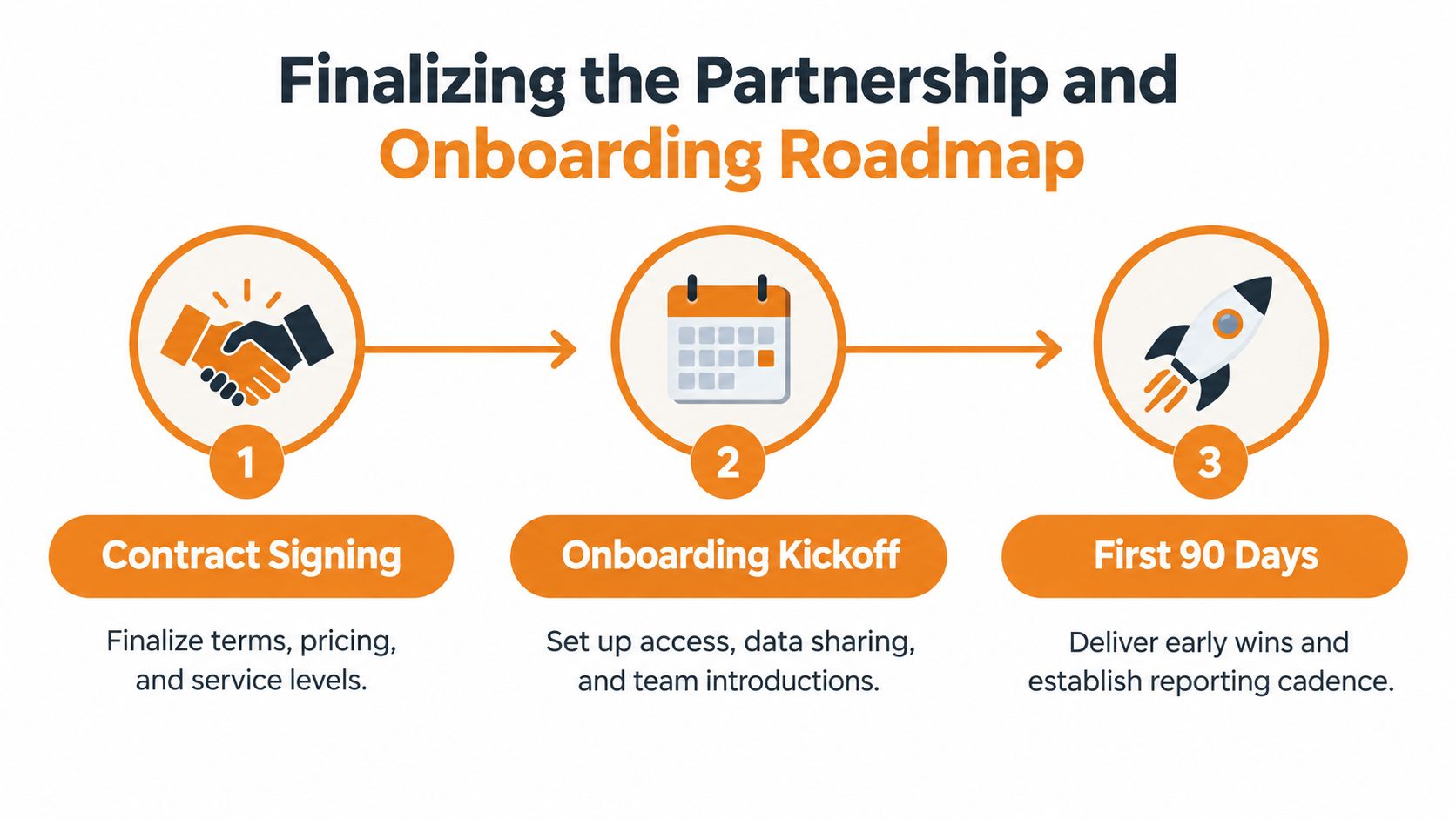
Once an agency has passed your measurement, technical, and compliance checks, the contract should preserve the conditions that made it a credible choice. Spell out scope, responsibilities, access rights, reporting expectations, approval steps, and the process for ending or transferring the work. Don't rely on a verbal assurance that your team will retain access.
A decision matrix helps keep the final choice grounded in evidence. Score each agency against the same requirements, and record what you verified rather than what the sales team promised.
Turn the evaluation into an operating plan
| Decision area | Evidence to request | What to confirm before signing |
|---|---|---|
| Commercial outcomes | Channel baseline and test plan | Definitions for qualified leads, revenue, and attribution |
| Data and infrastructure | Account access and system map | Client ownership, administrator rights, and handover terms |
| AI use | Workflow examples and test hypothesis | Data handling, human review, and performance criteria |
| Compliance | Approval records and campaign controls | Named reviewers, escalation path, and documented sign-off |
| Partnership fit | Communication plan and scope | Decision-makers, meeting cadence, and change process |
Onboarding should start with access and documentation, not a rush to launch campaigns. Agree on who supplies customer and sales data, who validates tracking, how the agency records approvals, and how unresolved issues are escalated. For regulated clients, establish a formal pre-publication compliance review, approval log, and escalation process before any asset goes live.
During the first 90 days, use the agreed test plan to inspect results against the baseline. Ask for cohort-level reporting where it suits the business, channel incrementality tests where they can answer a real question, and reconciliation between campaign events and CRM or sales records. If AI is part of the scope, judge it against the testable hypothesis rather than the novelty of the tools.
Be cautious about long-term lock-in before the agency has demonstrated how it works with your team and data. A clear scope, sensible review points, and transparent terms give both sides room to make informed decisions as the work develops. The right partner won't ask you to trade away access or accountability in exchange for confidence.
Juiced Digital offers SEO, paid media, conversion-rate optimization, digital PR, and compliance-focused marketing for local businesses and e-commerce brands. If you're evaluating an agency and want a practical review of your measurement, growth opportunities, or regulated campaigns, visit Juiced Digital to discuss a consultation or audit.
