
For a Canadian business, a B2B lead can cost roughly CAD $40–$300, depending on industry and channel. But the number that should guide your budget is what you pay for a qualified, compliant lead that becomes a customer, not the sticker price of a form fill.
You're heading into a budget meeting, sales wants more pipeline, and search results offer cost-per-lead figures that seem to describe completely different markets. That's because they often do. A Vancouver contractor, a legal practice and a software company don't compete for the same searches or convert prospects in the same way.
A CAD $40 lead isn't automatically a bargain, just as a more expensive lead isn't automatically worthwhile. Consent, intent, qualification and your team's ability to close all affect what that lead really costs. The practical question is whether a campaign can acquire customers profitably, not whether it can produce inexpensive contact details.
What a Lead Should Actually Cost in 2026
Lead generation cost is often reduced to a simple calculation: advertising spend divided by the number of leads. That's a useful starting point, but it leaves out the work and waste between a click and a paying customer. A prospect may submit a form without understanding the offer, meeting your service area or giving valid consent for follow-up.
For a Vancouver business, separate the funnel into raw leads, qualified leads, sales-ready opportunities and acquired customers. Then track how many prospects move from one stage to the next. If a channel sends plenty of enquiries but few become qualified conversations, its headline CPL is hiding the cost of filtering and follow-up.
Before judging a benchmark, ask what the source counts as a lead, which geography it covers, and whether the figure includes only ad spend or also management, technology and qualification labour. A U.S. median can help with context, but it isn't a promise about Canadian prices. Nor should California paid-search costs be presented as local Vancouver rates.
Practical rule: Set your allowable CPL from the customer economics you can verify, including close rate and gross profit. Treat a market average as a comparison point, not a target.
The lowest CPL can also create the highest cost per acquired customer. Weak consent or low intent wastes sales time, while a stronger qualification process may produce fewer leads that are more likely to buy. That's why the useful planning question isn't “How much does lead generation cost?” It's “How much can we pay at each funnel stage and still acquire the right customers profitably?”
The Six Real Drivers of Lead Cost
A CPL isn't a fixed market price. It's an outcome shaped by choices you can inspect and change.
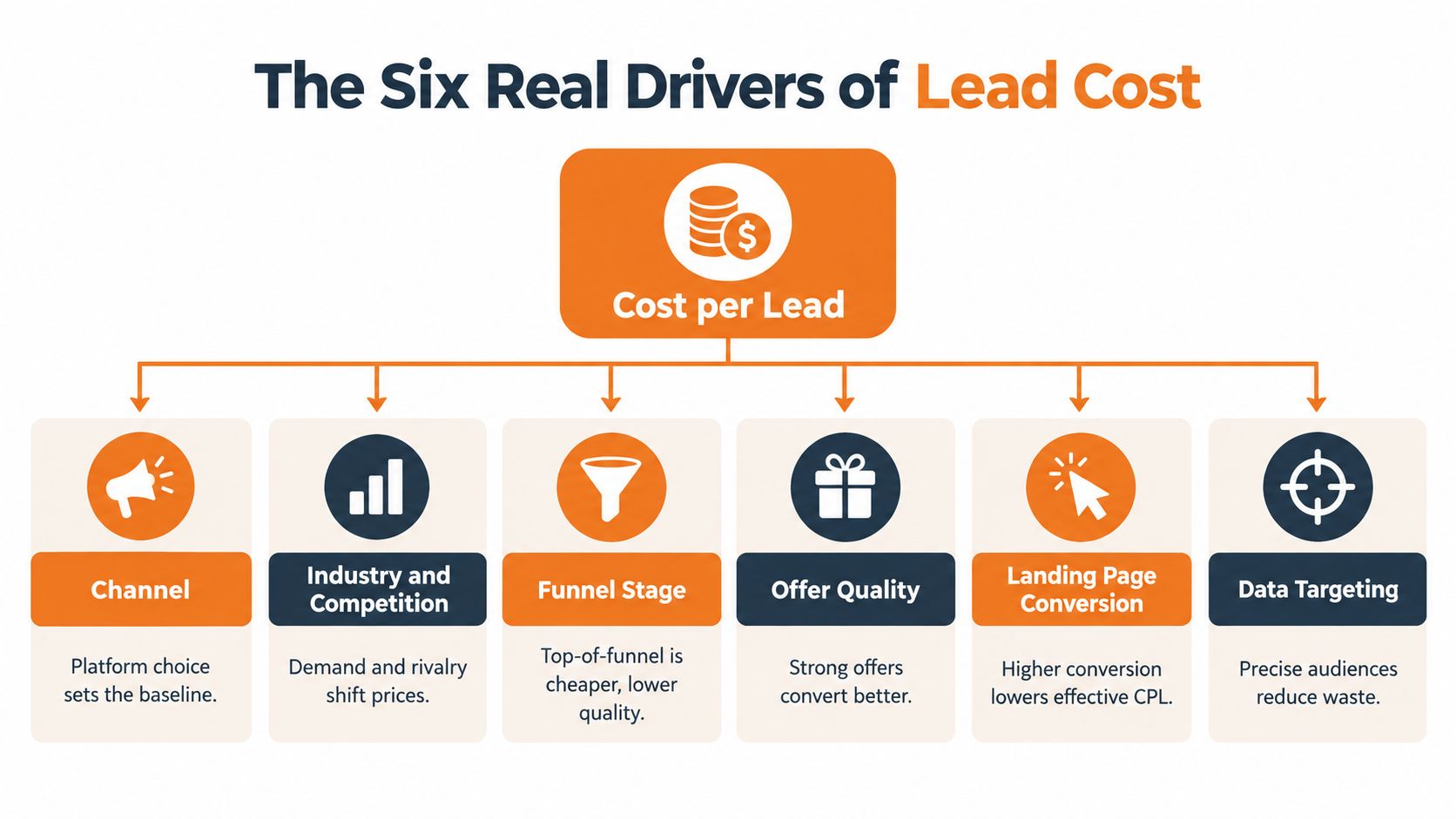
Channel sets the starting point. Search captures people actively looking for a service; other channels may need to create demand or earn attention first. Compare channels on qualified outcomes, not just the volume of clicks or contacts.
Industry and competition move auction prices. Canadian bid estimates reach CAD $33.81 for insurance, CAD $29.06 for financial services and CAD $26.39 for legal services, while beauty and aesthetics and event services have lower estimates of CAD $3.42 and CAD $3.33. These are top-of-page bid estimates, not guaranteed paid CPCs, but they show why high-value categories can face more auction pressure (Canadian keyword bid estimates).
Funnel stage changes what the lead means. A broad enquiry is easier to generate than a confirmed, sales-ready opportunity. If a campaign promises “leads,” ask whether it means submissions, qualified prospects or booked conversations.
Offer quality affects response. A specific, useful offer gives a prospect a clear reason to act. If the offer attracts people who aren't a fit, more form fills won't fix the underlying problem.
Landing-page conversion changes effective CPL. The relationship is direct: for a given CPC, a page that converts a higher share of visitors produces a lower calculated CPL. Test the message, page speed and form friction before concluding that clicks cost too much.
Data targeting determines how much spend is wasted. A tight service area, clear service intent and negative keywords help reduce irrelevant traffic. For a lead-generation programme, Juiced Digital's lead generation marketing services are one option to consider alongside an in-house team or another agency.
Benchmarks by Channel and Industry
A Vancouver contractor comparing agency quotes against a U.S. software benchmark is reading the wrong price list. Benchmarks only mean something when the geography, currency, channel and lead definition match yours, so filter every number through those four criteria before you use it.
Start with the U.S. context. A 2026 search-advertising benchmark reports an all-industry median CPL of $66.69, median CPC of $5.42 and median conversion rate of 8.18%, drawn from 13,474 U.S. campaigns analysed from April 2025 through March 2026 (U.S. search campaign benchmark). Use it for direction. Canadian auction prices are a different market.
For Canadian service businesses, a separate benchmark gives typical Google Search CPCs of CAD $2–$9 and lead conversion rates of 5–9%, which works out to a broad calculated CPL range before lead quality or sales qualification enter the picture. The same source lists industry-specific CPLs, and those become more useful the closer they sit to your business (Canadian paid-search and service-business benchmarks).
| Channel / Vertical | Typical CPL | Typical CPC |
|---|---|---|
| U.S. search, all industries | $66.69 USD median | $5.42 USD median |
| Canadian Google Search, broad service-business range | See calculated range above | CAD $2–$9 |
| Canadian accounting and bookkeeping | CAD $85.71 | Not specified |
| Canadian construction and renovation | CAD $108 | Not specified |
| Canadian roofing | CAD $114 | Not specified |
| Canadian SaaS | CAD $150 | Not specified |
| Canadian auto repair | CAD $43.75 | Not specified |
| California business services, paid search | Approximately $147.03 | $7.92 average |
California is a high-competition U.S. reference point rather than Canadian pricing. That benchmark puts the national business-services average at $104 against a California CPC range of $5.94–$10.70 (California business-services search benchmark).
Read every figure in that table as a form-fill price. These benchmarks count submissions and calls, not signed contracts, so a cheap lead that never closes will cost you more per customer than an expensive lead that does.
Organic search, paid social and display lack directly comparable verified local figures here. Resist filling those gaps with a number borrowed from another currency or lead definition. For Google Ads mechanics and budget planning, Juiced Digital's guide to Google Ads costs covers the auction side.
Simple Formulas and Worked Budget Examples
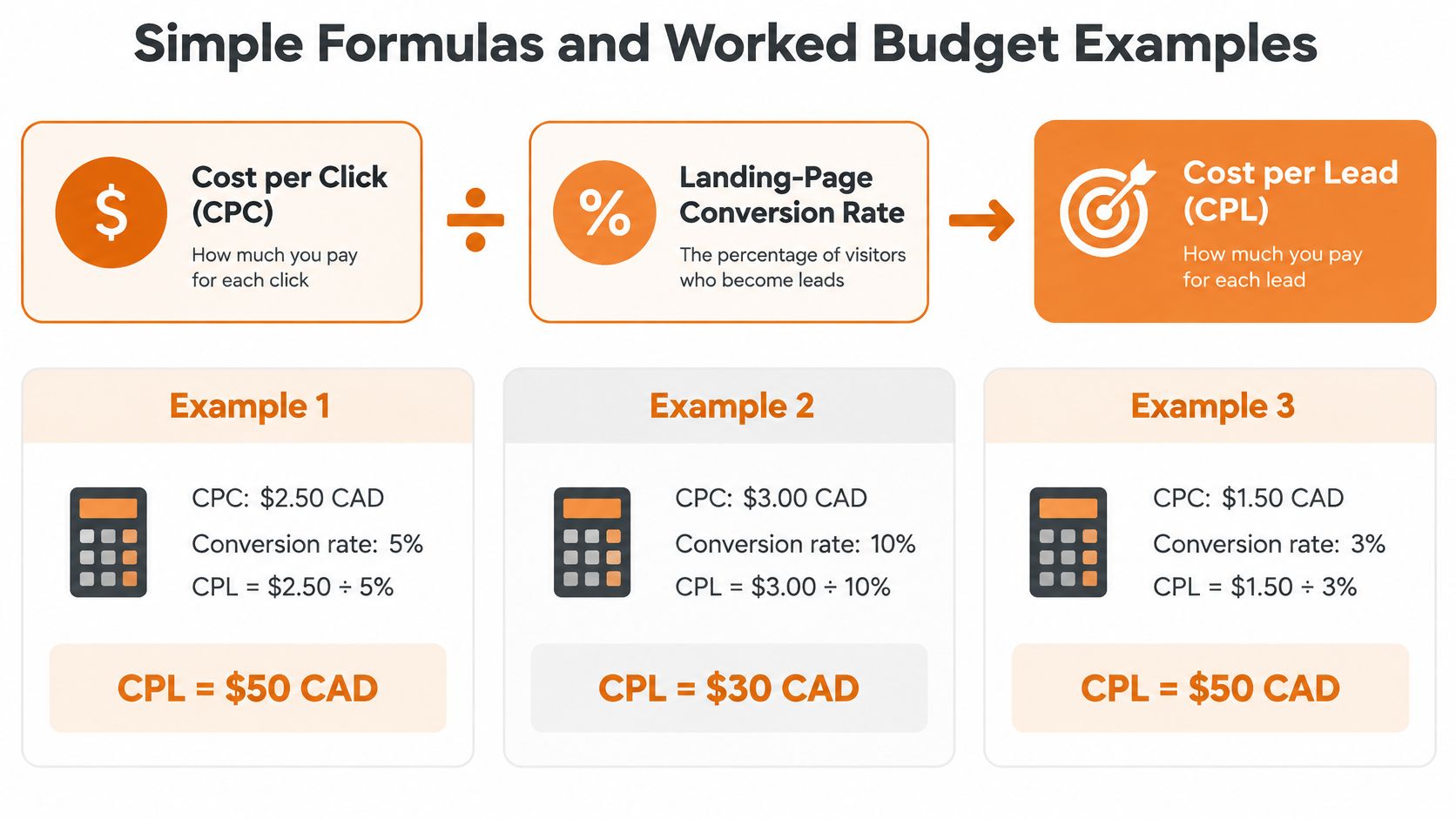
For paid search, start with CPL = CPC ÷ landing-page conversion rate, with the conversion rate written as a decimal. If your CPC is CAD $4 and one in twenty visitors submits a lead form, the math is CAD $4 ÷ 0.05, which gives CAD $80 per lead. Those inputs are an illustration, not a market benchmark, so swap in your own figures before you budget.
Use real benchmarks to test your budget
Using the CAD $2–$9 CPC and 5–9% conversion ranges from the benchmarks above, your planning envelope is roughly CAD $22–$180 per lead. Where your campaign lands inside that envelope depends on your service, location, keywords and page performance.
The CPL figure is only the first step. For an example grounded in a published industry benchmark, roofing leads are listed at CAD $114 CPL, and at a 25% close rate the implied cost per acquired customer is approximately CAD $457. Construction is listed at CAD $108 CPL with a 20% close rate, an estimated CAD $542 per acquired customer. Run your own close rate through the same math before you judge any CPL quote. The close-rate effect on acquisition cost gets a full treatment in the section on why the cheapest lead can cost the most.
Build your own forecast without disguising assumptions
Work through this sequence:
- Estimate clicks: Divide your media budget by your expected CPC.
- Estimate leads: Multiply clicks by your landing-page conversion rate.
- Estimate customers: Multiply leads by your observed close rate.
- Calculate acquisition cost: Divide media spend by the customers acquired.
Here is what that looks like with a hypothetical CAD $3,000 monthly media budget. At a CAD $5 CPC you buy 600 clicks. At a 6% conversion rate, those clicks produce 36 leads at roughly CAD $83 each. If a third of those leads close, the month delivers 12 customers at about CAD $250 per acquisition before any fees. Every input there is a placeholder; the point is the order of operations.
Keep media spend separate from agency fees, page work, tracking and lead handling. If your close rate is not measured yet, label it as an assumption and replace it with CRM data as soon as you have it.
Retainer, Project, and Performance Pricing Compared
The fee model determines what you're paying someone to do, and which results they're incentivised to prioritise. Compare the scope and measurement rules before comparing price.
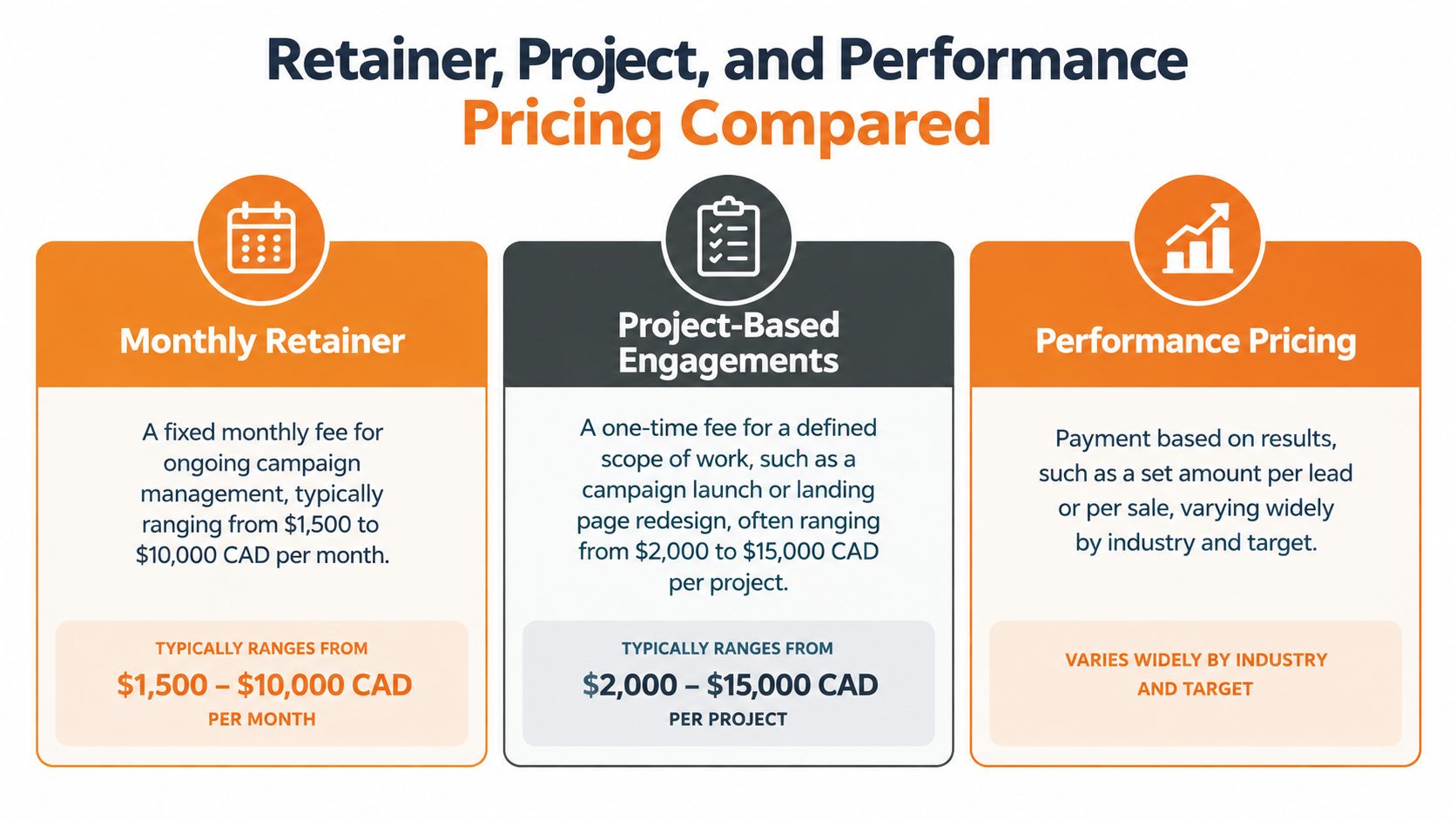
A retainer suits an ongoing programme that needs active management, testing and reporting. It can give the agency room to work beyond a narrow lead quota, but ask what the fee includes: media management, creative, landing-page work, tracking and reporting should be explicit. Confirm whether ad spend is separate.
A project fee works when the deliverable is defined, such as campaign setup, tracking implementation or a landing-page redesign. It's easier to assess against a fixed scope, but it won't necessarily include ongoing optimisation after launch. Agree on handover materials and who owns the accounts and assets.
Performance pricing ties payment to a stated outcome, such as a lead or sale. The apparent alignment can be misleading if the contract counts unqualified submissions, excludes media costs or leaves consent and duplication rules vague. Define what makes a lead billable before the campaign starts.
Ask the provider to show media spend, management fees, production, technology and qualification costs separately. If the proposal combines them, you can't tell what's driving the result.
For a fuller checklist of what can sit inside agency fees, compare the scope with this guide to digital marketing agency pricing. Whatever model you choose, connect the agreed fee to the same funnel stages your sales team uses.
Why the Cheapest Lead Can Cost the Most
A low CPL is only cheap if the lead can be used. Judge spend by cost per acquired customer, after qualification, consent checks, deduplication and the sales time needed to reach a real decision maker.
Take a CAD $40 lead collected without documented consent. Add re-permissioning effort, legal exposure, list cleanup and hours spent chasing contacts who never agreed to hear from you, and it can cost more than a CAD $80 lead that arrives qualified and ready for compliant follow-up. The benchmark scenarios cited earlier make the same point through close rates: the sticker price is only the first line in the math.
Canada's anti-spam framework raises the stakes. Commercial messages need consent or a legally valid form of implied consent, clear sender identification and a working unsubscribe path. A business email published online does not automatically justify unrelated outreach.
This matters most in regulated or sensitive categories such as healthcare, wellness, cannabis and CBD. If a source cannot prove consent, relevance and clean handling, your team may own contacts it should not touch. Buy leads you can use and defend.
Practical Levers That Lower Cost per Lead
Lowering CPL means improving the relationship between what you pay for traffic and how much of that traffic becomes a lead. Work through these levers in order, and judge each by qualified outcomes rather than raw form volume.

Tighten local search intent. Use keywords that specify the service and the area you serve. Add negative keywords for irrelevant searches, then review search terms and remove waste. If irrelevant clicks fall while qualified enquiries hold, keep refining.
Improve the landing page before raising bids. Make the page match the ad, explain the service clearly and make the next action obvious. Test page speed, form length and trust information. A conversion-rate improvement lowers calculated CPL at the same CPC, but confirm the resulting leads remain qualified.
Route and qualify leads promptly. Record which leads sales accepts, which they disqualify and why. Use those reasons to adjust the form, campaign targeting and follow-up process. If low-intent submissions dominate, add useful qualification rather than celebrating a cheaper headline number.
Test creative against a clear hypothesis. Change a specific element, such as the offer or message, and track the effect on qualified leads. Avoid changing targeting, creative and landing-page copy all at once, or you won't know what made the difference.
Use consent-based first-party data. Build follow-up audiences from people who have agreed to hear from you, and keep the permission attached to the data. Don't assume a purchased or publicly visible contact list is an acceptable shortcut.
A simple reporting view can show whether these changes are working. Track CPC, landing-page conversion, CPL, qualified-lead rate, close rate and customer acquisition cost together. If CPL falls while the qualified-lead rate also falls, the campaign may be getting cheaper at the wrong job.
Use the following walkthrough as a prompt for your own review:
The objective isn't to force every campaign to produce the lowest possible CPL. It's to find the combination of targeting, conversion and sales follow-up that brings in customers your business can serve profitably.
Putting It Together and Evaluating Any Agency Proposal
Start with the closest available benchmark for your industry and geography, then calculate what your own close rate and customer economics can support. Keep media, management, compliance and qualification costs visible. When the campaign runs, replace assumptions with CRM outcomes and use qualified leads and acquired customers to judge performance.
A proposal should answer practical questions:
- What counts as a lead? Get the definition in writing, including how duplicates, invalid contacts and out-of-area enquiries are treated.
- What costs are separate? Confirm media spend, creative, landing pages, tracking, software and qualification labour.
- How is quality measured? Ask how the agency receives sales feedback and how campaign reporting connects to qualified and closed opportunities.
- Who owns the work? Clarify access to ad accounts, analytics, landing pages and campaign data.
Be wary of a promise built around an unusually low CPL with no explanation of intent, consent or close-rate assumptions. A credible plan should show its inputs and explain what happens if the lead volume is there but sales quality isn't.
Juiced Digital works with Vancouver businesses and e-commerce brands on paid advertising, SEO and conversion optimisation, with campaign measurement focused on qualified traffic and revenue. If you want to assess your current acquisition costs and identify where the funnel is leaking, visit Juiced Digital to discuss a custom review.
