

You've got a business to run, and a competitor's ad is sitting above your website when you search for the service you sell. You open an ad account, see budget and bidding options, and realise that launching is easy. Knowing whether the clicks will turn into profitable customers is the hard part.
The right way to start pay per click advertising is to build the measurement, targeting, and privacy guardrails before buying traffic. Canada's own media allocation reinforces that search deserves to be treated as a distinct channel: in fiscal year 2023–2024, the Government of Canada spent $8.55 million on search-engine marketing, 22% of its digital media placements, while display received $24.11 million, or 62% (Government of Canada advertising report). That doesn't dictate your budget. It does make one thing clear: paid search, display, and social shouldn't be lumped together and judged by the same measure.
What Pay Per Click Advertising Actually Requires Before You Spend a Dollar
Your first week shouldn't be a race to publish an ad. It should be a quick, disciplined check that you can identify a good lead, reach the right person, and tell what happened after the click. An ad account is not a campaign plan, and a click isn't a business result.
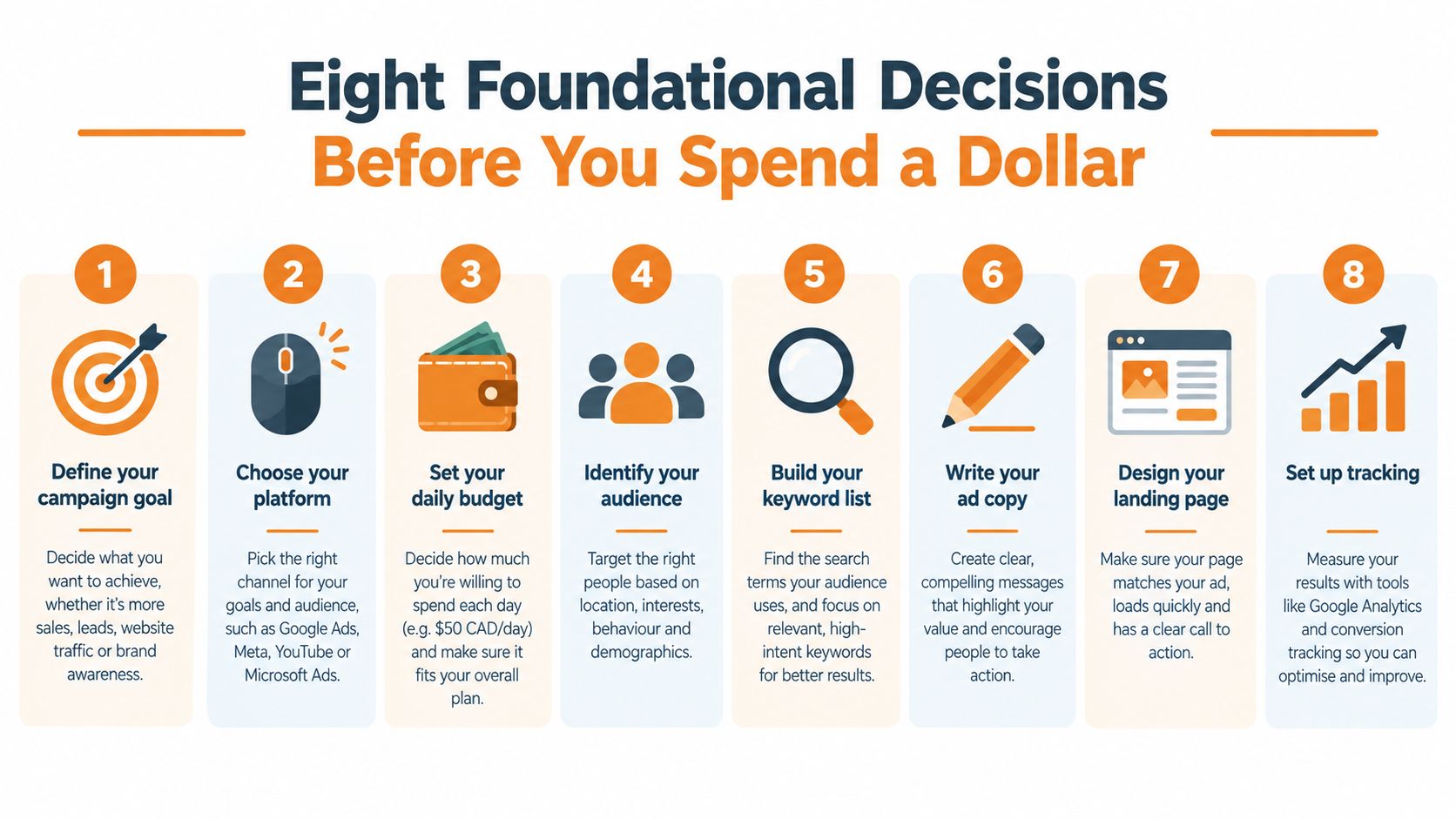
Before launching, make these eight decisions:
Define one primary outcome. Choose the result that matters most, such as qualified service calls, booked consultations, or completed purchases. If you optimise for a form fill but never learn whether the person was qualified, you're teaching the platform to find form-fillers, not customers.
Choose a platform that reaches your buyer. Start with the place where your prospective customer is already searching or spending attention. Don't open accounts on every network just because the buttons are there.
Set a budget you can afford to learn from. Base it on your margins and acquisition economics, not a generic recommendation. Keep enough cash aside to fix tracking, follow up leads, and improve the page if the campaign exposes a weak spot.
Identify the audience and service area. Define who can buy and where you can serve them. For a Vancouver contractor, location settings should exclude places the team can't reach.
Build a focused keyword or audience list. Start with search terms that signal a need you can meet. Broad targeting can buy attention, but it can also spend your budget on people who aren't shopping for your offer.
Write a clear, accurate offer. State what you do and what the customer should do next. Don't promise outcomes you can't substantiate, especially in regulated categories.
Check ad and landing-page readiness. The page must match the ad, work on mobile, identify the business, and make one next step obvious. A polished account can't rescue a confusing page.
Install tracking and connect real outcomes. Track calls, forms, bookings, and sales where appropriate. If your CRM can distinguish qualified leads from poor-fit enquiries, plan how to use those verified outcomes before you launch.
A Vancouver business should also decide what happens to personal information collected through forms, call tracking, or audience tools. Consent and follow-up aren't housekeeping tasks to postpone until a campaign performs. They're part of being ready to advertise.
Pre-flight test: Before launch, submit a test form, make a test call, and confirm the event reaches the right reporting system. If you can't follow that test from click to recorded outcome, don't buy traffic yet.
Choosing Between Google, Microsoft, and Meta for Your First Campaign
Pick the platform based on the moment you're trying to reach, not the platform your competitor happens to use. Search advertising catches existing demand. Social advertising can introduce an offer to people who aren't actively searching. Remarketing can reconnect with people who have already visited, but it depends on having an appropriate, consent-aware audience strategy.
Canadian government advertising history illustrates why platform popularity and campaign fit are different questions. In fiscal year 2020–2021, Google received 86% of government search-engine-marketing expenditure, while Bing received 10% and Apple Search Ads 4% (Government of Canada 2016–2017 advertising report). That historic allocation shows Google's prominence in that public-sector buying context. It doesn't prove Google is automatically the right or only choice for your business.
| Network | Best for first campaign | Typical intent stage | Watch out for |
|---|---|---|---|
| Google Ads | Capturing active searches for local services or products | High intent when people search for a solution | Broad matching and weak negatives can draw irrelevant clicks |
| Microsoft Ads | Testing search demand beyond Google, including relevant B2B audiences | Active search intent | Don't assume another network will produce enough volume without checking actual demand |
| Meta Ads | Showing a product, offer, or service to a defined audience and testing creative | Demand creation, plus remarketing where permitted | Interest can look like intent, but a click doesn't confirm buying readiness |
For a Lower Mainland service business, a tightly scoped Google search campaign is often a more sensible first test than splitting a small budget across all three platforms. The buyer may already be searching for the service and location, so the campaign can focus on matching that demand. Microsoft Ads can be tested later if it reaches additional qualified customers without weakening the main campaign's learning.
A national e-commerce brand has a different choice. Search and product-oriented placements can capture existing demand, while Meta can introduce products through creative and audience testing. Don't divide spend evenly by habit. Give each channel a distinct job, then evaluate it against the same business outcomes.
Regulated cannabis or CBD businesses need an extra filter before choosing a network: advertising policies may restrict the product, claims, audience, or destination page. Check current platform rules before building campaigns. If the offer can't be promoted on a platform as intended, no amount of clever targeting makes that channel a sensible first choice.
Building Keyword Lists and Audience Segments That Match Real Intent
A keyword list is a filter on your budget. If it's too broad, the campaign can pay for searches from people who want information, jobs, or free alternatives instead of the service you sell. If it's too narrow, you may miss qualified demand. Start with distinct intent groups, and give each group ads and a landing page that match what the searcher needs.
For a Vancouver plumber, separate branded searches from non-branded service searches. A structure might include the company name, urgent plumbing help, a specific repair service, and local phrases tied to the areas the business serves. Build negative keywords from irrelevant searches you find in the search-term report. Do not target competitor names by default, as those clicks may be expensive, and the ad and landing page need a clear reason for the visitor to choose you.

A practical starting structure could look like this:
- Branded terms: Searches for your business name, kept separate so you can see how people already looking for you behave.
- High-intent service terms: Queries that describe a service or product the business sells.
- Local phrasing: Searches that include Vancouver, a municipality, or a service-area reference.
- Research and low-fit terms: Review these against actual query data, then exclude terms that don't match your offer.
For a national functional-mushroom e-commerce brand, organise around product types and clear purchase intent, not every ingredient or wellness topic. Keep informational queries separate from shopping-oriented searches. For a CBD retailer, don't assume a keyword strategy can bypass platform restrictions. Check applicable ad policies and avoid unsupported health claims in keywords, ads, and destination pages.
Set geographic targeting to match your actual market. A British Columbia service provider should choose the province or specific municipalities it serves and use presence-based settings where available, rather than treating interest in a location as proof someone is physically there. A national seller can target its eligible markets, but shouldn't assume one campaign structure suits every region.
Longer, more specific searches can help you align the ad with a clear need. For a plain-language explanation of how these searches differ, see Juiced Digital's guide to long-tail keywords. During the first month, review search terms at least weekly, add exclusions, and keep the campaign focused on queries that can plausibly lead to a sale or qualified enquiry.
Writing Ads and Landing Pages That Earn the Click and Convert It
An ad and its landing page are one promise, split across two places. The ad earns attention by matching the search or audience. The page has to deliver on that message without forcing visitors to hunt for the next step.
For responsive search ads, begin with the customer's desired outcome and the language they used to find you. Follow with a specific service, product, or point of difference you can substantiate. End with a direct call to action. Keep the message consistent across headlines and descriptions, and don't try to squeeze unrelated services into one ad group.
Meta copy needs a different rhythm. Lead with the problem or product benefit that matters to the audience, give enough context to make the offer understandable, and pair it with suitable creative. Don't write as if a social viewer is already in buying mode. Make the next step clear and appropriate to their level of awareness.
The landing page should repeat the central offer, explain why the visitor should trust the business, and make the primary action easy to complete on a phone. A local service page might feature service-area details and a call or quote request. An e-commerce page should make the product, key purchase details, and buying action easy to find. Keep secondary options available, but don't let them compete with the main conversion goal.
A useful page check is whether a visitor can quickly answer: What's being offered? Is this business relevant to my needs and location? What do I do next? If the page makes those answers hard to find, fix it before increasing traffic. Juiced Digital's explanation of what a landing page is can help clarify the role of the destination page.
Regulated categories need careful copy review. Cannabis and CBD advertisers should avoid implied or unsupported health claims and confirm platform requirements before launch. Wellness practitioners can still write persuasive ads by focusing on the service, practitioner qualifications, and the next step, without promising a medical outcome the business can't guarantee.
Setting a First-Month Budget You Can Defend
A generic monthly spend recommendation can't tell you whether your campaign is affordable. The useful question is how much you can invest to learn whether the channel can acquire a customer at a cost your business can support.
Work backwards from unit economics. Set the maximum acceptable cost per qualified lead or sale, estimate how often a click might become a lead, and account for the share of leads that become customers. Then compare the resulting acquisition cost with the gross profit from a customer. These are your planning assumptions, not platform guarantees. If you don't know them yet, label them as unknown and use the campaign to gather evidence without spending beyond what you can absorb.
Separate a learning budget from a scaling budget. Learning money buys a controlled test of a clear question, such as whether one service category or landing page attracts better-quality leads. Scaling money follows only after tracking, lead handling, and sales outcomes show that the campaign has a credible path to profitability.
Canadian benchmark figures vary by source and methodology, so don't build your plan around a supposed universal CPC or cost per conversion. One Canadian-focused source gives a directional average search click-through rate of about 6.8%, with top-quartile performance above 11%, but it also cautions that vertical, device mix, geography, and conversion definitions affect results (Canadian PPC benchmarks). Treat those figures as context, not a target your business is entitled to hit.
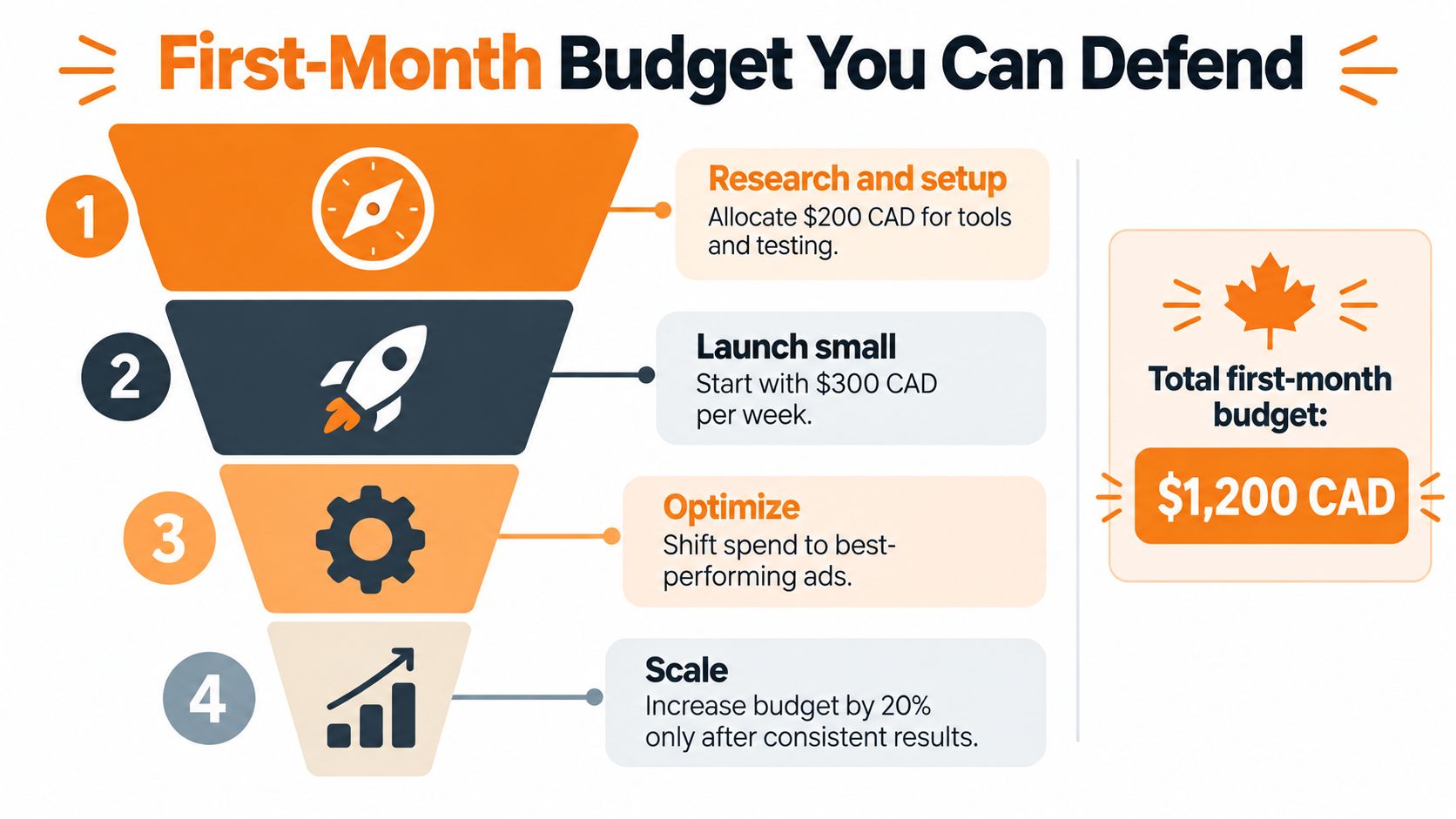
The right budget depends on the decision you need to make, the cost of reaching likely buyers, and whether your team can handle the resulting enquiries. If calls go unanswered or leads wait too long for a response, increasing spend increases the number of missed opportunities. Fix call handling, form routing, and follow-up before increasing the media budget.
For a first campaign, concentrate spend on one primary platform and a small, well-defined test. Add another network only when the first has a stable measurement setup and you can fund a meaningful comparison. Keep platform fees and management costs separate from the media budget, and agree in advance on what evidence would justify continuing, revising, or stopping the test.
Conversion Tracking and Privacy Compliance That Actually Works in Canada
A measurement system should tell you what happened without collecting or retaining more personal information than the business needs. Build around first-party outcomes you control, then use the most privacy-appropriate reporting available when someone declines tracking. That's a better foundation than relying on a remarketing audience to explain whether a campaign is working.
For a local service business, track the actions that reflect genuine commercial interest: phone calls, quote requests, bookings, and eventual sales. Route enquiries into a CRM and record their outcomes, such as qualified, booked, attended, or won. Import only verified CRM results where the platform and your consent process allow it. That lets you judge cost per qualified lead or customer acquisition, rather than celebrating cheap form submissions that never turn into business.
CASL matters when you follow up with commercial electronic messages. The CRTC explains that commercial messages require consent, sender identification, and an unsubscribe mechanism, and that the sender is responsible for proving consent (CRTC's CASL FAQ). Use an affirmative opt-in where required, record the consent source and scope, and keep a suppression process for people who withdraw consent. Don't use a pre-checked box or treat silence as express consent.
A Vancouver business advertising to people in Quebec needs a separate review of its measurement design. Quebec's Law 25 creates specific considerations for technologies used to identify, locate, or profile people, including consent requirements for profiling-related functions (Canadian consent-management guidance). Review tags and audience tools before activation, document each data collection purpose, and seek legal advice where the business's activities or data uses require it.
Use consent-aware analytics and prefer aggregated reporting when a visitor declines optional tracking. Keep marketing measurement distinct from sensitive personal details, and don't upload customer lists or activate behavioural audiences without reviewing the relevant consent, platform, and privacy requirements. A clear Google Ads conversion-tracking setup can support the technical side, but tracking tools don't decide whether a particular data use is lawful.
Optimization, AI Tools, and a Realistic 90-Day Roadmap
Treat the first ninety days as a sequence of decisions, not a promise of results. Validate the measurement first, then improve query quality and the landing page, and only then consider more aggressive automation or expansion.
First 30 days
Check that test calls and forms register correctly, confirm leads reach the right person, and review search terms at least weekly. Add negatives for irrelevant queries, pause obvious mismatches, and compare lead quality alongside cost. Don't change bids, keywords, ads, and landing pages all at once. You won't know what caused the result.
Days 30 to 60
Hold the strongest parts of the campaign steady while testing a focused change, such as a new landing-page message, ad variation, or audience. Record qualified outcomes in the CRM so that the team can distinguish real prospects from low-quality enquiries. If the campaign attracts the wrong leads, fix the query, audience, offer, or qualification process before buying more traffic.
Days 60 to 90
Scale only the parts that produce credible business outcomes. Consider automated bidding after conversion tracking is reliable and there's enough conversion volume for the strategy to learn from. AI can help draft creative variations or surface patterns, but a human should approve claims, brand language, and compliance, particularly in sensitive or regulated categories.
Judge progress by qualified leads, booked appointments, completed purchases, and acquisition cost. Click-through rate can help diagnose an ad, but it doesn't tell you whether the business earned money. If you're considering outside help, ask an agency how it handles conversion tracking, CRM outcomes, Canadian consent requirements, and campaign ownership. Juiced Digital offers paid advertising campaign setup and ongoing optimization, including Google Ads, ad creative, budget planning, and conversion tracking.
Common questions from first-time advertisers
How soon should I expect results? Ads can begin receiving traffic soon after launch, but useful business conclusions take longer. First confirm tracking and lead quality, then evaluate performance against your economics rather than expecting immediate profitability.
What if the leads aren't qualified? Trace the problem from search term or audience to ad, landing page, form, and follow-up. Tighten targeting, state eligibility clearly, add useful qualification questions, and record outcomes in the CRM.
Should I hire an agency or keep it in-house? Keep it in-house if someone can manage the platform, tracking, privacy review, and lead follow-up consistently. Hire help when those responsibilities are competing with core business work, or when your team needs specialist support to build and improve the campaign.
Start with one campaign, a clear outcome, and tracking that respects consent before you spend. Juiced Digital helps Vancouver businesses and Canadian brands plan and optimize paid advertising with measurable ROI in mind. Visit Juiced Digital to discuss a campaign setup or optimization plan.