

Canadian businesses with five or more employees generated $398 billion in e-commerce sales in 2021, according to Statistics Canada. That makes an SEO audit report more than a search-ranking exercise. For a business that depends on online discovery, it's a way to decide which website problems deserve funding and which can wait.
A useful report connects every finding to evidence, an owner, a KPI and a drop point. The drop point is the condition under which further work stops being worth the investment. Without those fields, even an accurate audit can leave a Vancouver service business or e-commerce team with a long backlog and no defensible spending decision.
SEO Audit Report Sections at a Glance
| Report section | Core checks | Sample finding | Evidence to attach |
|---|---|---|---|
| Technical | Crawl status, indexing, robots.txt, XML sitemap, canonicals, Core Web Vitals | Parameter URLs are indexed alongside the preferred service page | Search Console Pages export and crawl file |
| On-page | Titles, meta descriptions, headings, internal links, structured data | Location pages share a generic title that omits their service area | Crawl export with title and H1 columns |
| Content | Topic coverage, thin pages, duplication, search intent | No page answers a relevant neighbourhood delivery query | Search Console query report and page list |
| Backlinks | Referring domains, relevance, anchor text, lost links | Links are concentrated in an unrelated directory | Backlink export with domain and anchor data |
| Local | Google Business Profile, citations, reviews, local pages | Directory phone numbers don't match the business's current number | Profile screenshots and citation audit sheet |
| UX and conversion | Mobile layout, forms, calls to action, trust, checkout | Mobile visitors must scroll past promotional content to find booking | Device screenshots and consented session recordings |
| Analytics | Landing pages, conversion events, consent, call tracking | A successful form submission triggers duplicate conversion events | GA4 event list and tag preview |
| AI search readiness | Entity clarity, accurate structured data, direct answers, citations | Service facts differ between the website and business profile | Side-by-side fact sheet and structured data test output |
These are illustrative findings, not diagnoses of a particular website. In 2025, 90% of Canadian small businesses reported using at least one digital channel, according to CFIB's Your Voice survey of more than 2,400 independent business owners. An audit restricted to website code can therefore miss the profiles, directories and other channels customers use before visiting.
Every row should identify the affected pages or assets, severity, owner and fix. Evidence must let another person reproduce the conclusion: a filtered crawl export, a dated screenshot with device details, or an analytics view with its segment and reporting period preserved. A screenshot without context isn't enough, and a tool's warning label isn't proof of business harm.
Distinguish a gap from a pass
Check an existing report against every row. Mark a category without evidence as not assessed, rather than healthy.
Scope exclusions are acceptable when they're explicit. A local contractor may need a detailed profile review but little product-schema analysis; an international retailer needs the opposite emphasis. Record why a check was excluded, who approved that decision and what would trigger reassessment.
Practical rule: A report is complete when its conclusions can be checked, not when every tool warning has been copied into it.
Technical Checks That Decide Indexing and Speed
Google's technical requirements set the minimum indexing conditions: Googlebot must not be blocked, the page must return an HTTP 200 status, and it must contain indexable content. Meeting those conditions makes a page eligible for indexing. It doesn't guarantee inclusion.
Establish what search engines can access
Test representative URL classes: homepage, service and location pages, products, parameter URLs, redirects and error pages. Compare the crawl result with Search Console URL Inspection, especially where rendered content differs from the initial HTML.
The technical evidence should show both access and performance.

Inspect robots.txt rules, sitemap coverage, canonical destinations and inbound internal links together. A sitemap identifies important URLs, but inclusion doesn't guarantee crawling or indexing. A canonical pointing to a blocked or irrelevant destination needs investigation, not automatic replacement across the site.
Don't use robots.txt as a shortcut for removing indexed duplicates. Blocking crawling can prevent search engines from seeing the signals intended to resolve them. Specify the intended outcome first, then select the appropriate canonical, redirect, indexing or crawl-control treatment.
For implementation troubleshooting, use a documented workflow for fixing crawl errors rather than redirecting every failed URL to the homepage. Preserve useful destinations and allow removed content to return an appropriate error.
Separate field performance from lab diagnostics
The following reference values come from Google's Core Web Vitals guidance: LCP within 2.5 seconds, INP below 200 milliseconds and CLS below 0.1.
| Metric | Good threshold | Typical cause | Template to check first |
|---|---|---|---|
| Largest Contentful Paint | Within the LCP threshold above | Slow server response, oversized hero images | Homepage, service and product templates |
| Interaction to Next Paint | Below the INP threshold above | Heavy JavaScript, third-party tags, long tasks | Product filters, booking and quote forms |
| Cumulative Layout Shift | Below the CLS threshold above | Images, banners or consent widgets without reserved space | Articles, landing pages and embedded-widget templates |
Report field measurements separately from lab tests, and split mobile from desktop. Use PageSpeed Insights diagnostics to investigate causes, not to substitute a simulated score for visitors' experience.
Name the failing template and affected component. Resize a hero image for an LCP issue, investigate long JavaScript tasks for an INP issue, and reserve space for unstable embeds where CLS is the problem. Our technical SEO work includes improving site speed and optimising the mobile experience.
Each issue needs affected URLs, business impact, a developer owner, a validation method and a post-release Search Console check. Record insufficient field data as unavailable, not as a pass.
On-Page and Content Findings With Sample Entries
A missing description and an irrelevant service page aren't equivalent problems. The first may require an editorial adjustment; the second may require a different page purpose, stronger evidence or consolidation.
Use the on-page SEO checks to separate presentation defects from content that doesn't satisfy the visitor's task.
- Titles and descriptions: Flag missing or duplicated titles and descriptions absent from priority service pages. Check actual search appearances before treating truncation as a serious defect.
- Headings: Find missing or repeated H1 text, then assess whether the visible heading clearly identifies the page's purpose.
- Internal discovery: Compare crawl URLs with sitemaps, CMS exports and analytics landing pages to identify orphaned content.
- Intent and usefulness: Check whether visitors can understand the service, compare products or answer their question without leaving.
- Content gaps and accuracy: Investigate neighbourhood demand, missing delivery information and outdated claims on health or regulated-sector pages.
Our on-page process covers metadata, product descriptions, site architecture restructuring, internal linking and load speed. The report should still assign each change separately so an editor doesn't inherit an unspecified development task.
Copyable sample entries
Illustrative location-page finding
| Field | Entry |
|---|---|
| Issue | Location pages use the same generic title |
| Affected URLs | Attach the filtered location-page list |
| Evidence | Crawl export containing URL, title, H1 and indexability |
| Fix | Write distinct titles using the actual service and city |
| Owner | Content lead |
| Priority | High where priority pages have unclear search positioning |
| KPI | Relevant-query clicks and qualified enquiries to those pages |
| Drop point | Don't create separate pages where the business lacks a distinct service proposition |
A hypothetical thin category-page entry should identify the missing buying information, not prescribe an arbitrary word count. For example, add compatibility guidance, selection criteria and accurate availability information where shoppers need them. Assign the category editor, attach the existing page and query evidence, and track progression from the category to relevant products.
An orphaned service-page entry needs a different fix: add contextual links from relevant service hubs and supporting articles. The content lead owns placement, while the SEO reviewer confirms that crawlable links reach the intended page.
One finding should describe one assignable fix. If different people must approve unrelated changes, split the entry.
Adding text to every short page wastes effort. Prioritise pages where missing information prevents a useful decision, and consolidate overlapping pages when separate versions offer no meaningful benefit.
Backlink Profile and Local Listing Checks
Evaluate backlinks before prescribing removal
Count referring domains, then group them by relevance, editorial context and destination. Inspect anchor text alongside the linking pages themselves. A tool's authority or toxicity score can help sort the review queue, but it doesn't establish manipulation.
Investigate sitewide footer links from unrelated websites, commercial directories with no useful audience, and coordinated links from apparently connected sites. Record why the pattern matters and whether the business commissioned it. Don't assume every unfamiliar domain needs removal.
For lost links, inspect both ends. A useful referring page may still exist while its destination now returns an error; recover the intended content or redirect to a genuine replacement.
Illustrative backlink finding: An industry association links to a retired service URL. The developer restores an appropriate destination, the marketing lead requests an editorial update where necessary, and the auditor rechecks the referring page after deployment. The KPI is recovered relevant referral activity and a working destination; the drop point is an unavailable source or no suitable replacement.
Disavow work requires stronger evidence than a noisy export. Reserve it for substantiated manipulative-link concerns that warrant specialist review, especially where a manual action is involved. Otherwise, document and monitor rather than funding speculative cleanup.
Verify the business customers will find
Review Google Business Profile categories, services, hours, photos and service area against the actual operation. Compare the business name, address and phone number across relevant directories, then assess review recency, themes and the business's responses.
Statistics Canada found that 38% of Canadians purchased online from a business specifically because it was Canadian in 2020, according to its Canadian Internet Use Survey release. For a British Columbia business, accurate Canadian identity and contact information deserve attention, without assuming that national preference guarantees a local conversion.
- Sample finding: A profile shows a retired suite number while directories show an outdated phone number.
- Fix and owner: The marketing lead corrects owned listings and submits changes to directory operators.
- Evidence and recheck: Preserve before-and-after screenshots and set a recheck date based on publication status.
- KPI and drop point: Track qualified calls and enquiries. Stop chasing an uneditable, inconsequential listing once reasonable correction routes are exhausted.
Build neighbourhood pages only for areas served. Swapping place names into otherwise identical copy doesn't provide useful local evidence.
UX and Conversion Checks to Include
Search visitors need a workable path from arrival to action. Test that path on real phones as well as browser emulation, including a fresh visit with the consent interface visible.
Arrive and read
Check whether the page introduces the promised service or product immediately. Inspect text wrapping, tap targets, horizontal scrolling and sticky elements that conceal content. Open menus, filters and accordions rather than reviewing a static screenshot alone.
For an illustrative booking page, the primary button might sit below promotional content on a narrow mobile screen. That's a testable friction point, not proof of lost revenue. Attach the viewport details and screenshot, propose a clearer button position, and measure booking starts alongside completed appointments.
Trust and act
Trust elements should resolve specific doubts. Display relevant credentials, accurate contact information and applicable licence or registration details. Health and wellness pages should make it clear who is responsible for the information and avoid unsupported treatment claims.
- Service enquiries: Test click-to-call links, booking availability, field requirements, validation messages and confirmation behaviour.
- Product purchases: Check image loading, variation selection, stock messages, guest checkout and when shipping costs and taxes become visible.
- Failure recovery: Submit incomplete forms, trigger payment errors in a safe test environment and confirm visitors can recover without losing their work.
A developer should own functional defects. A designer or conversion lead can own layout changes, with the business approving wording that affects service expectations.
Evidence standard: Describe what the visitor couldn't do before claiming why they left.
For each finding, record the page, device, browser, reproduction steps and evidence. Use consented session recordings to investigate recurring behaviour, not to infer every visitor's motivation.
Choose a conversion metric suited to the action: form completion rate, qualified calls per organic session or completed purchases. Watch downstream quality as well as button clicks. Moving a call to action can increase clicks without increasing useful enquiries, and removing every form field can leave the sales team without essential qualification information.
Analytics Setup and Measurement Gaps
Verify the measurement setup before using traffic or conversion changes to justify further SEO spending.
| Metric to verify | Where to check | Healthy sign | Common gap |
|---|---|---|---|
| Organic sessions by landing page | GA4 landing page report | Priority pages can be compared with a saved baseline | Blog traffic conceals weak commercial-page performance |
| Conversion events | GA4 key events and tag preview | Each successful action produces its intended event | Duplicate or missing events after a rebuild |
| Local calls and direction clicks | Business Profile performance and call tracking | Interaction reporting is available and attribution limits are documented | Calls can't be attributed reliably |
| Indexed pages and search queries | Search Console Pages and Performance | Priority URLs and relevant queries can be reviewed together | Parameter URLs appear while intended pages are absent |
| Consent and tag coverage | Tag manager preview and banner settings | Tags follow configured consent requirements | Tags fire prematurely or eligible activity is missing |
Save a baseline that can be reproduced
Export the reporting period, landing-page segment, channel definition and event configuration before implementation. Annotate releases, promotions and stock changes so the reviewer doesn't attribute every movement to SEO.
Test successful and unsuccessful submissions. A form event that fires on page load measures exposure, not an enquiry; an event attached to both a submit button and confirmation screen can duplicate the same action.
Use SEO conversion tracking to connect acquisition to meaningful outcomes. Missing campaign UTM tags can confuse channel interpretation, while consent changes can alter reported volumes without an equivalent change in demand.
- Assign ownership: The analytics specialist verifies events and attribution; the business confirms what qualifies as a lead or sale.
- Record checkpoints: Give each fix an implementation check and a later outcome review appropriate to the KPI.
- State limitations: Direction clicks aren't confirmed visits, and phone-link clicks aren't necessarily connected calls.
Don't judge an organic-visibility change immediately after release. Validate deployment promptly, then allow an appropriate observation period based on crawl activity, demand and the amount of usable evidence.
Review qualified organic leads or orders, organic landing-page sessions, and organic lead or purchase conversion rate each month. Read them together: more sessions with weaker qualification may not justify more spending, while stable traffic with better conversion can represent a useful improvement.
AI Search Readiness Checks
A conventional audit can confirm that a page is crawlable without checking whether an AI-generated answer represents the business accurately. AI search readiness asks whether important business facts can be understood, retrieved and cited, and whether that exposure matters commercially.
Use a shared review session to compare answers with approved business facts.

Check accuracy before chasing mentions
- Entity clarity: Compare the business name, location, services and team descriptions across the website, profiles and directories.
- Structured data: Validate markup against visible page content, especially service details, products and availability.
- Credibility: Identify responsible authors and relevant credentials for health and regulated-sector material.
- Answer usefulness: Place a direct, qualified answer beneath a question heading where that format serves the reader.
- Supporting evidence: Link substantive claims to credible original sources rather than unsupported summaries.
- Observed visibility: Save the query, platform, date, answer and cited page for commercially relevant searches.
Record AI answer observations separately from conventional organic rankings. Where identifiable referral traffic exists, evaluate its qualified enquiries and sales; where it doesn't, disclose the measurement gap rather than estimating invisible conversions.
This video provides an additional discussion point for the review.
Fund the work only when the opportunity is credible
41.2% of Canadian businesses said AI investment was not relevant to their operations in Q2 2025, according to Statistics Canada's analysis of business AI use. That finding concerns business investment, not consumer search behaviour, but it's a useful warning against assuming every company needs an AI-focused programme.
Check customer interviews, enquiry sources and relevant answer results before assigning substantial budget. Give a marketing owner responsibility for factual corrections and an SEO owner responsibility for monitoring.
The drop point is a lack of demonstrated audience relevance or measurable exposure risk after the agreed review. Don't promise AI citations, rankings or sales as guaranteed outcomes.
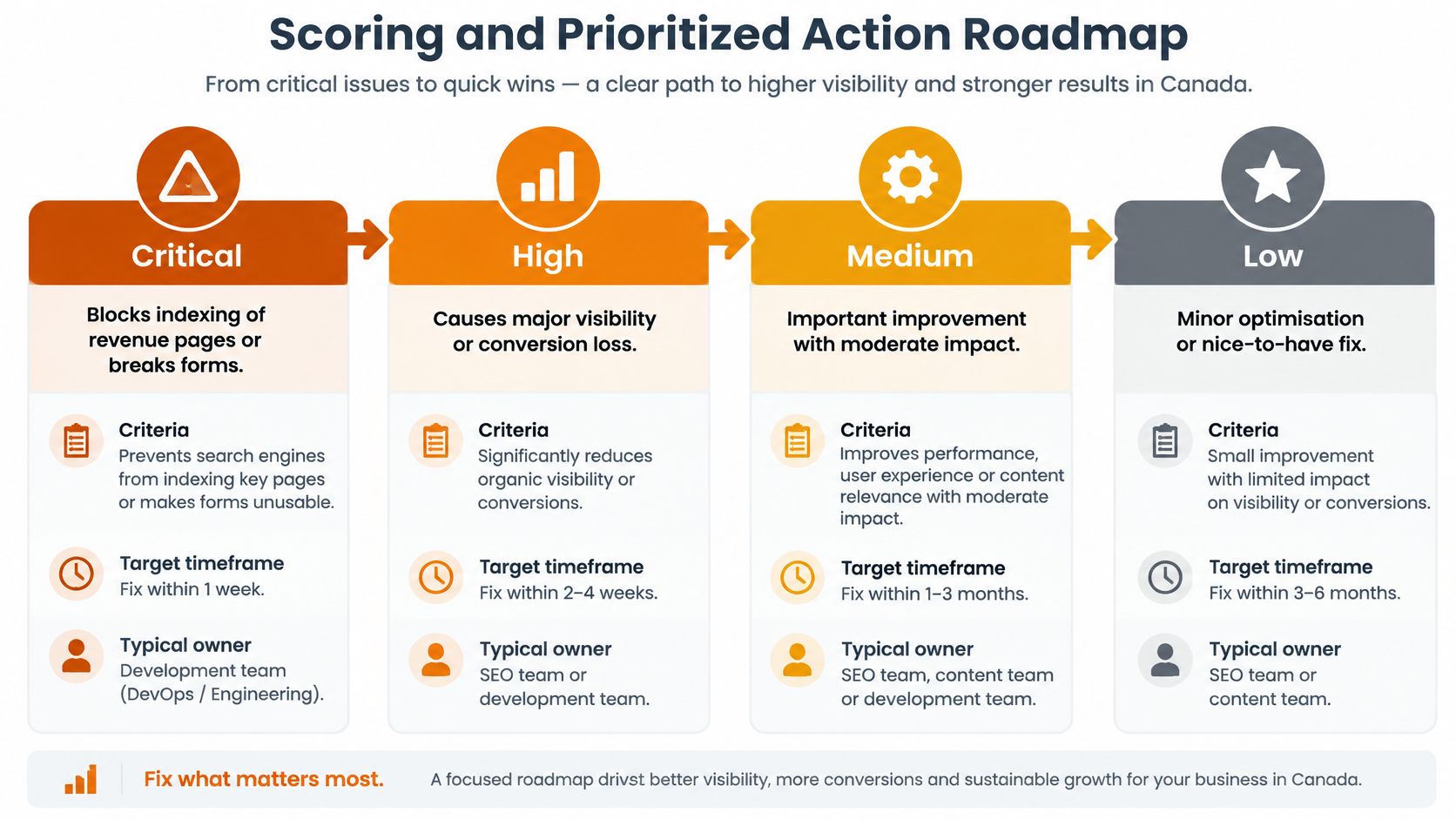
Scoring and Prioritized Action Roadmap
Use the following suggested planning windows, not contractual deadlines or universal SEO standards. Active checkout or lead-capture failures should be triaged immediately rather than left until the end of a scheduling window.
| Priority | Criteria | Target timeframe | Typical owner |
|---|---|---|---|
| Critical | Blocks indexing of revenue pages or breaks forms and checkout | Immediate triage, resolution within the first planning month | Developer |
| High | Causes ranking or conversion loss on priority pages | Next implementation window after critical work | Developer and content lead |
| Medium | Improves visibility on secondary pages | Subsequent planned release | Content or marketing lead |
| Low | Cosmetic or future-facing | Quarterly backlog review | Site owner |
Rank investment, not warning counts
A practical scoring model rates impact and effort on a low-to-high scale, then applies a confidence weight. Divide impact multiplied by confidence by effort. Define the weights in the workbook so different reviewers don't use different assumptions.
For a clearly hypothetical worked example, use impact and effort scores from one to five, with confidence weights of one, two and three for low, medium and high. A canonical correction affecting fourteen parameter URLs might receive impact five, effort one and confidence three, producing a score of fifteen. Those are example scoring inputs, not measured results or a promise of growth.
High confidence requires evidence: the duplicates are equivalent, the preferred destination is appropriate and the implementation can be tested. A canonical change with uncertain page equivalence shouldn't receive the same confidence.
Keep category scores separate. Strong local listings don't compensate for inaccessible product pages, and a single overall health score can conceal that distinction.
The visual roadmap provides a quick reference for the priority hierarchy.
Move from diagnosis to a funding decision
Use audit → score → prioritise → assign → validate as the operating sequence. Dependencies still matter: repair measurement before judging conversion experiments, and resolve access problems before commissioning substantial content work for inaccessible pages.
- Assign: Name an accountable person, implementation effort, approval dependency and target release.
- Validate: Confirm the technical or editorial acceptance criteria, then review the business KPI.
- Drop or re-score: Stop optional work when its likely value no longer covers the required effort.
A drop point can be reached when successive agreed checkpoints show no useful KPI movement after implementation has been verified. Investigate seasonality, measurement gaps and insufficient observation before concluding that the recommendation failed.
Don't restore a broken checkout to test its commercial value, or reverse necessary compliance work because rankings stayed flat. Drop points govern discretionary investment, not essential business functionality.
Sample Report and Funding Decision
Build the report as an exportable spreadsheet or document, with evidence stored in an accessible project folder. A downloadable file is useful only if the business can maintain it after the auditor's presentation.
Start with the header and a complete finding
| Header field | What to record |
|---|---|
| Site | Audited property and relevant subdomains |
| Audit date | Date evidence collection was completed |
| Scope | Included markets, templates, profiles and exclusions |
| Auditor | Responsible reviewer and implementation contact |
| Baseline date | Saved measurement period and comparison method |
The executive summary should name the highest-priority investments, show category-level assessments and distinguish confirmed problems from hypotheses. Avoid filling it with every warning count.
Illustrative finding record
| Field | Example entry |
|---|---|
| ID | TECH-PARAM |
| Category | Technical |
| Affected URLs | Attached list of indexed product parameter variants |
| Finding | Duplicate variants appear alongside preferred product URLs |
| Evidence | Dated Search Console export, URL Inspection results and canonical crawl |
| Impact | Priority product visibility may be split across unintended URLs |
| Priority | High, subject to confirmed equivalence and query evidence |
| Owner | Developer, with SEO approval |
| Fix | Align canonical signals, internal links and sitemap entries with preferred URLs |
| Validation method | Re-crawl, inspect rendered canonicals and review selected canonical destinations |
| KPI | Preferred product URLs receiving relevant search clicks |
| Recheck date | Agreed post-release checkpoint recorded in the project calendar |
| Drop point | Stop additional duplicate-management work when remaining variants show no material exposure or maintenance risk |
Don't automatically add a robots rule to that example. The developer must preserve access to signals needed for consolidation; crawl restrictions require their own rationale and validation.
A separate local finding might identify a missing relevant primary service category in Google Business Profile. The marketing lead verifies eligibility, updates the category and records publication evidence. Its outcome review concerns relevant local enquiries, not merely whether the edit was accepted.
Keep the workbook usable
Create a tab for each report category with identical columns. Add effort, confidence, dependencies, status and drop point to the finding fields, then build a dashboard showing open, closed and overdue work by priority.
Evidence files should use the finding ID so reviewers can move directly from a recommendation to its supporting material. Restrict access appropriately where recordings, enquiries or customer details are involved.
Use separate statuses for implemented, validated, monitoring and closed. A developer finishing a ticket doesn't establish that a business outcome improved.
Approve a focused funding decision
- Select the leading fixes. Choose the highest-value eligible work, favouring critical and high-priority items with manageable effort and strong evidence. Document why competing recommendations weren't funded.
- Confirm owners and baselines. The developer owns the canonical correction, the marketing lead owns the profile correction, and the analytics specialist owns any measurement repair. Save each KPI before release.
- Set an outcome checkpoint. A suggested ninety-day review provides a planning milestone, not a guaranteed results date. Re-run the relevant crawl, Search Console and conversion tests, then close, continue or re-score each item.
Record implementation success separately from commercial success. If the correction works but demand remains unchanged, don't label the deployment defective; reconsider the original impact assumption and the next use of budget.
Our engagement starts with a full technical and content audit to uncover growth opportunities and quick wins. A decision-ready SEO audit report turns that diagnosis into named responsibilities and a clear test of whether further spending is justified.
Juiced Digital offers a complimentary website report card prepared by our marketing team. Visit Juiced Digital to request yours and start identifying the technical, content and conversion issues that deserve a closer funding review.
