
Canadian retail e-commerce revenue reached C$73.7 billion in 2024, according to Statistics Canada's annual retail trade release. For marketers, the useful question isn't how much of that market a broad keyword represents. It's which specific buying needs your business can satisfy profitably, and which searchers you can move towards a purchase, booking or qualified enquiry.
Why Long-Tail Searches Deserve a Plan
A long tail keyword strategy connects specific searches to useful pages and measurable commercial actions. Those searches might include a neighbourhood, delivery condition, booking requirement or product-use question. Specificity matters because it tells you what the visitor needs before you spend money producing content.
The opportunity rests on established online buying behaviour. Statistics Canada's Canadian Internet Use Survey found that 82% of Canadians aged 15 and over living in the provinces shopped online in 2020, up from 77% in 2018. That's historical context, not a forecast, but it supports treating detailed online purchasing needs as a serious content-planning input.
Compare a broad search for physiotherapy with a request for an available appointment in a particular neighbourhood. The latter gives a clinic more information about the service, location and next step the searcher expects. A narrow query isn't automatically valuable, though. Someone researching a product's suitability may need evidence rather than a checkout button.
Practical rule: Specificity is useful only when you can connect the need to an offer, a credible answer and a trackable action.
The trade-off is production discipline. A well-built page can answer a narrow need; near-duplicate pages can compete without giving visitors anything meaningfully different.
Your working outputs should be a classified query list, an intent-to-page map and a 90-day test plan. Together, they connect research, page development, internal linking, compliance and revenue measurement.
The Five-Phase Plan at a Glance
| Phase | Main output | Timeframe |
|---|---|---|
| Research | Classified query list from Search Console, Business Profile and customer language | Weeks 1–2 |
| Cluster | Intent clusters labelled service, problem, comparison, price or purchase | Weeks 3–4 |
| Map | One URL per cluster, plus a list of cannibalisation conflicts | Weeks 3–4 |
| Build and link | Published or revised pages with internal links and compliant calls to action | Month 2 |
| Measure | Qualified-lead rate and revenue per organic session by cluster, against baseline | Month 3 |
Treat this 90-day schedule as a proposed operating plan rather than a promise of ranking results. The dependencies matter more than the dates. A cluster cannot move to mapping until its intent labels are stable, and nothing reaches the build phase until compliance has cleared the claims and calls to action each page will carry.
Build a dedicated page only where intent, geography or offer differs meaningfully. Otherwise, improve the existing destination rather than expanding the URL inventory.
Put commercial ownership beside SEO ownership
The SEO lead can classify queries, but sales or operations must confirm whether the business can fulfil them. An availability-led search is a poor target if the booking team can't offer that availability. A delivery-led query needs an accurate fulfilment policy, not just an optimised title.
Give each pilot cluster an owner for content, compliance, conversion tracking and sales feedback. Capture what counts as a qualified enquiry before launch, including service fit, geographic eligibility and purchasing readiness. In regulated categories, the compliance owner also confirms the call to action is permitted before the page is drafted, which is far cheaper than unpublishing a page that converts well but breaches advertising rules.
This prevents a familiar budget problem: marketing reports more leads while operations reports more unsuitable calls.
Choose a pilot you can actually evaluate
Start with a cluster that has a clear offer, an existing destination worth improving and a short path to a commercial action. Avoid selecting the biggest keyword just because its estimated traffic makes the forecast look impressive.
A cluster requiring a new service, new fulfilment process and new tracking system creates too many simultaneous uncertainties. A focused pilot lets you separate search-demand problems from page problems and operational problems. Pick one where the conversion path already exists and can be measured, such as a booking form, a delivery-zone checker or a quote request, so the Month 3 comparison against baseline produces a defensible revenue figure rather than a traffic screenshot.
Choose the clearest revenue opportunity, not the longest keyword list.
How to Research Long-Tail Queries With Tools and AI
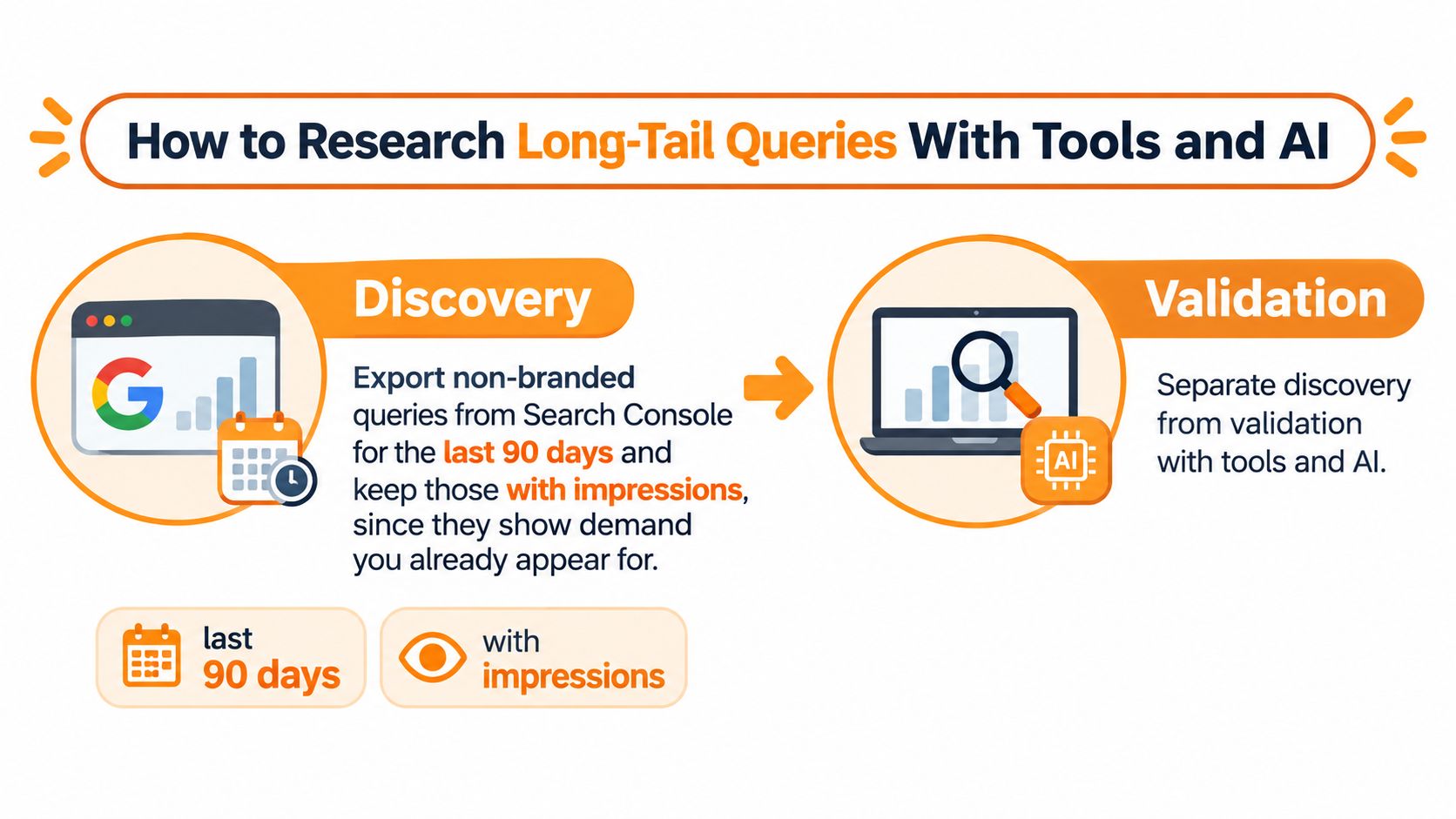
Separate discovery from validation. Discovery collects language; validation checks whether that language represents a relevant need you can serve. AI can accelerate classification, but it can't establish demand merely by generating convincing phrases.
Use this discovery-to-validation sequence to keep those jobs separate.
Collect language before judging keywords
Export Search Console queries. Choose a recent reporting window, filter out brand terms and retain queries with impressions. Export their landing pages too; the common mistake is treating every discovered query as a content gap when an existing page already addresses it.
Pull wording from customer messages, authorised call notes, reviews and live chat logs. Preserve the customer's phrasing in a separate field rather than rewriting everything into internal product terminology, and remove personal information before using an AI tool.
Add geographic and fulfilment modifiers. Explore Vancouver, Burnaby, neighbourhood names, delivery conditions and near-me variations where they match the actual service. Don't manufacture combinations for places the business can't serve, and record which existing page answers each need.
Validate relevance and demand separately
Ask an AI assistant to label intent and propose adjacent questions. Instruct it to preserve original queries and flag ambiguous items, then inspect the search results for suggested variants; a plausible phrase isn't evidence that customers search for it.
Check a keyword tool without letting volume decide everything. Use Google Keyword Planner, Ubersuggest or Semrush to compare demand estimates and competing results. For local and niche terms, prioritise offer fit and observed customer language over a tool's apparent precision.
Maintain a source column for every query. Distinguish Search Console observations, customer wording, autocomplete suggestions and AI-generated hypotheses so nobody later presents an unvalidated suggestion as established demand.
Our keyword research guide provides a practical reference for evaluating intent, relevance, volume and ranking difficulty. The catalogue should cover product, category and informational terms, rather than assuming all valuable demand includes a purchase verb.
At Juiced Digital, our research process targets buyer intent across those categories. For a mushroom chocolate brand, we researched thousands of functional mushroom and chocolate-related terms to identify high-volume, low-competition opportunities. That breadth supports selection; it isn't a reason to publish everything discovered.
Stop discovery when you have enough validated material to distinguish useful clusters. A smaller, traceable catalogue is more defensible than a large export nobody has checked.
How to Cluster Queries and Map Each Intent to a Page
Merge queries when they need the same answer and conversion path. Split them when the expected service, location, eligibility condition or product changes. Topic similarity alone isn't enough: a repair tutorial and an emergency booking request may concern the same equipment but require different experiences.
A visual cluster map makes those distinctions easier to inspect.

Treat the tail as variation, not word count
A University of Alberta analysis summarised in Juiced Digital's explanation of long-tail keywords reported that 90.6% of queries in its dataset appeared only once, while mean query length was 2.4 terms. The practical implication is that rarity can come from wording variation, not just long strings of words.
That supports building an authoritative destination around a coherent need. It doesn't justify creating a URL for every phrase in an export.
| Intent | Example query | Page type | Primary conversion |
|---|---|---|---|
| Service | same-day physiotherapy Vancouver | Service page with neighbourhood and availability details | Booking |
| Problem | water heater leaking at the base | Troubleshooting guide with a clear call option | Phone call |
| Price | emergency plumber cost Surrey | Price guide with CAD ranges and a quote form | Quote request |
| Comparison | web design agency vs freelancer | Side-by-side page with criteria and a verdict | Consultation request |
| Purchase | waterproof hiking boots women size 8 | Category page with size filter and stock status | Purchase |
The page type should reflect search intent, not the format your content team finds easiest to produce. A blog post shouldn't stand between a ready buyer and available stock.
Test the boundary with a real decision
Consider same-day physiotherapy Vancouver and physiotherapist open Saturday Burnaby. They can belong to a booking cluster when the same destination accurately explains both service areas and appointment availability.
Split them when Burnaby requires distinct clinic details, practitioners, hours, or booking inventory. Don't combine them just because both end in an appointment, and don't separate them merely because the place names differ.
Use the video alongside your mapping exercise, then check the proposed destinations against visitors' needs.
Keep these fields in the working sheet: exact query, normalised intent, province or city, language, funnel stage, landing URL, impressions, clicks, leads and revenue. Add a decision note explaining why a cluster was merged, split or deferred.
That note matters when another team member proposes a competing page later. It preserves the reasoning behind the map instead of forcing everyone to reconstruct it.
Local and Regulated Sectors Change the Plan
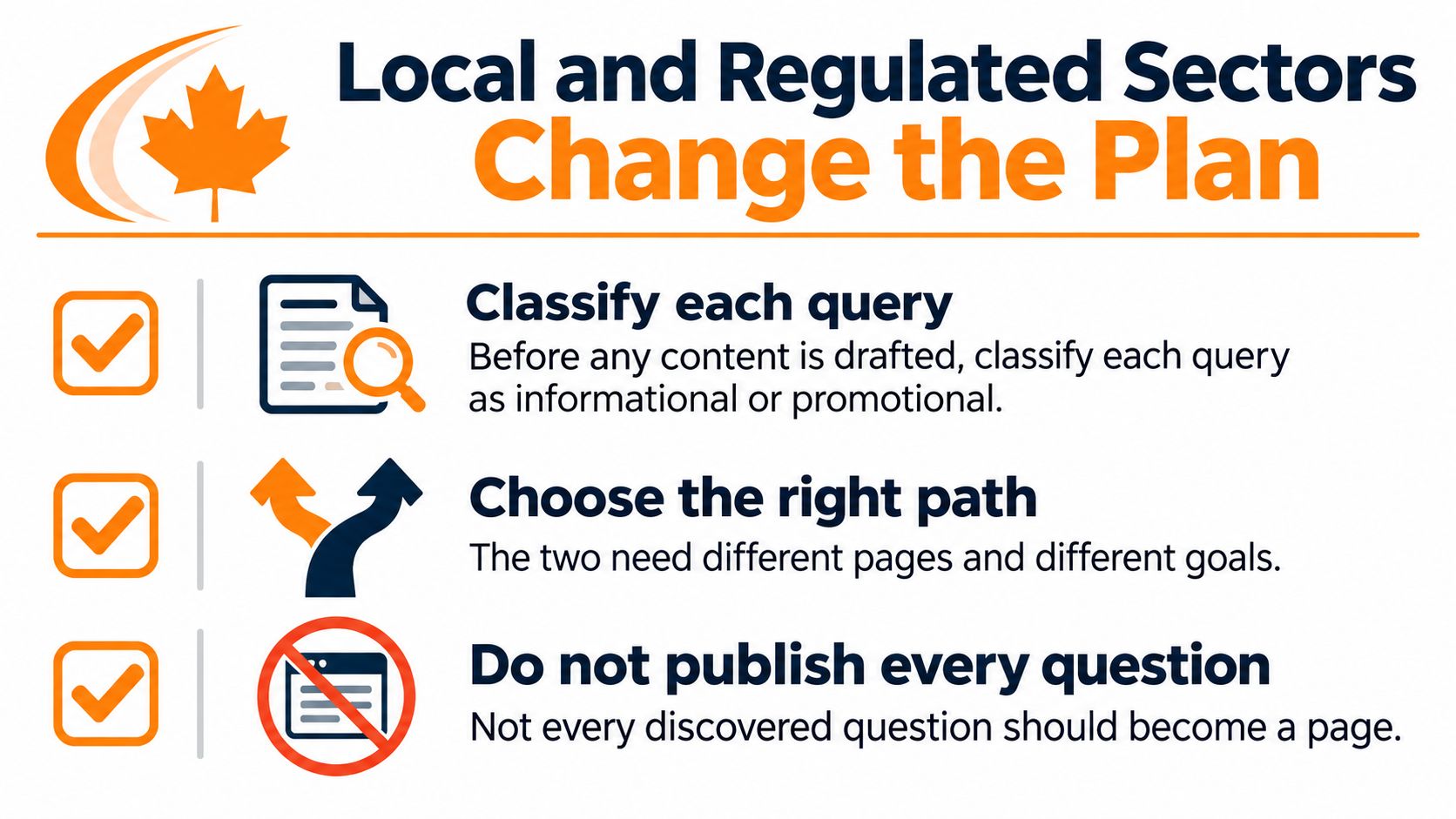
Not every discovered question should become a page. Before drafting, classify the proposed query as informational or promotional and flag any implied health, safety or performance claim. Classification is a review step, not a legal exemption.
For local businesses, operational accuracy comes first. A neighbourhood page needs a genuine reason to exist, such as different delivery conditions, access arrangements or service availability. Match its address, hours and service boundaries to the Google Business Profile and the booking process.
Clear the claim before commissioning the content
Canada's Cannabis Act generally prohibits cannabis promotion except in limited circumstances and prohibits false, misleading or deceptive promotion, including communications likely to create erroneous impressions about characteristics, safety, health effects or health risks. A search query containing an attractive claim doesn't give a marketer permission to repeat it.
Cannabis, CBD and wellness teams should route proposed topics through the appropriate legal or regulatory reviewer before commissioning copy. Platform eligibility also needs a separate check; an advertising permission doesn't automatically make the underlying content lawful.
Use this classification checkpoint before assigning production work.
Maintain an approval record
- Classify the purpose. Record whether the page informs, promotes or combines both, and identify the intended audience.
- Choose defensible subject matter. Consider neutral, source-led explanations of legal definitions, labelling, responsible use and access requirements.
- Inspect implied promises. Remove unsupported therapeutic, safety and potency claims, including claims embedded in questions or testimonials.
- Document accountability. Log the jurisdiction, reviewer, approval status and any conditions attached to publication.
- Review the whole release. Include the proposed URL, title, metadata, images, internal links, calls to action and paid activation.
A neutral answer may address a risky question without adopting its premise, but neutral wording alone doesn't settle compliance. The reviewer must consider the full communication and its context.
Budget safeguard: Don't pay to draft, design and optimise a page whose central proposition hasn't been cleared.
For regulated teams, restraint is a production advantage. A smaller set of approved, maintainable pages is easier to defend and update than broad coverage built around claims the business shouldn't make.
How to Build Pages and Link Them Without Cannibalizing
Run production only on approved clusters. The page map should specify the destination, primary action and supporting evidence before anyone writes a title or adds a navigation link.
Build around the visitor's next decision
Select the strongest appropriate URL. Prefer an existing page that matches the intent and has useful search history, rather than automatically starting again. Check indexability, canonical settings and whether its current purpose conflicts with the proposed cluster.
Put the useful answer on the first screen. For a service page, identify the service, coverage area, availability conditions and next step; where pricing is appropriate and approved, show genuine CAD pricing context rather than an invented starting price.
Integrate variants where they improve comprehension. Use headings, explanatory copy and FAQs to answer related needs naturally. Don't add an FAQ merely to repeat the target phrase, and don't force near-me wording into sentences that sound unnatural.
Write a title and meta description that accurately describe the destination. Include the location where it helps local searchers distinguish the offer, but don't promise availability or outcomes the page can't substantiate.
Connect relevant pages, then inspect overlap
Link from the appropriate hub or category. Use descriptive anchors such as emergency plumber in Surrey rather than click here. Place the link where a visitor would reasonably need that service, not inside a repetitive block of geographic links.
Add lateral links selectively. A price guide can support a related service page, while a troubleshooting guide can offer a relevant call option; neither needs links to every commercial destination on the site.
Investigate competing URLs in Search Console. Filter by the query and inspect the Pages report, then compare each destination's intent, clicks and conversions. Multiple appearing URLs aren't automatically a problem, but repeated switching between interchangeable pages deserves investigation.
The corrective action should follow the diagnosis. Consolidate redundant content and redirect retired URLs to the closest relevant destination. Retarget pages that deserve separate purposes, and update internal links so they consistently support those purposes.
Our guide to avoiding keyword cannibalisation can support that review. Don't merge distinct pages solely because they share a keyword; you could remove a useful destination while trying to tidy a report.
A city-name substitution isn't local relevance. Visitors need accurate coverage, practical details and a credible reason to choose that location's offer.
Use Canadian spelling and regional terminology throughout, and verify that mobile users can reach the call, booking or purchase action without navigating past unrelated content.
Can a visitor confirm the offer, their eligibility and the next step within the first screen?
Confirm Your First Cluster Before You Scale
Measure cluster-level commercial performance, not an isolated ranking. SEO generally requires 3–6 months to produce desired results, so treat the pilot as an early decision point rather than a finished verdict. Record launch dates, substantive changes and tracking failures alongside performance.
Google's Canadian economic impact report identifies online search as an important customer-discovery channel for 83% of Canadian businesses. For a local operator, that makes calls, bookings and direction requests relevant alongside website forms, although those actions don't all represent qualified leads.
| Metric | What it reveals | Action if weak |
|---|---|---|
| Non-branded impressions | Demand reach for the cluster | Add variants and location terms |
| Non-branded clicks | Interest from the search result | Rewrite the title and meta description |
| Qualified-lead rate | Quality of enquiries from organic visits | Tighten the offer and the page's first screen |
| Revenue per organic session | Commercial value of the cluster | Check the conversion path and calls to action |
| Business Profile actions, including calls, bookings and directions | Local conversion path for the cluster | Add call tracking and a booking link |
| Assisted conversions | Role of the page in multi-visit paths | Add tracking before judging the page |
Connect enquiries to outcomes
Define qualified-lead rate as qualified enquiries divided by relevant organic sessions, using consistent inclusion rules. Calculate revenue per organic session from attributable revenue, and label estimates separately when sales haven't closed.
Don't pretend Search Console provides a complete query-to-revenue trail. Use landing-page clusters, analytics and CRM outcomes together, and acknowledge where attribution is incomplete. Business Profile actions may support local demand assessment without being assignable to an exact query.
Track close rate, margin and sales-cycle differences when deciding whether a modest-volume cluster deserves investment. There's no universal conversion count that makes a new page worthwhile.
Test the offer before expanding production
Where advertising is permitted, a tightly scoped paid campaign can test the cluster's wording and landing-page offer. Compare paid and organic conversion rates directionally, not as interchangeable audiences: placement, targeting and visitor mix can differ.
For conversion optimisation, change an isolated element, such as the first-screen offer or booking prompt, and assess qualified enquiries rather than button clicks alone. Keep a change log so the team can explain what happened.
Confirm the cluster with the clearest revenue potential, run the pilot against its pre-launch baseline, and scale only when qualified-lead rate and revenue per organic session justify the next investment.
Juiced Digital combines keyword research, local and e-commerce SEO, paid advertising and conversion optimisation to connect specific search demand with measurable business outcomes. Visit Juiced Digital to request a free consultation or audit and identify a commercially credible, compliance-aware cluster for your first pilot.
