
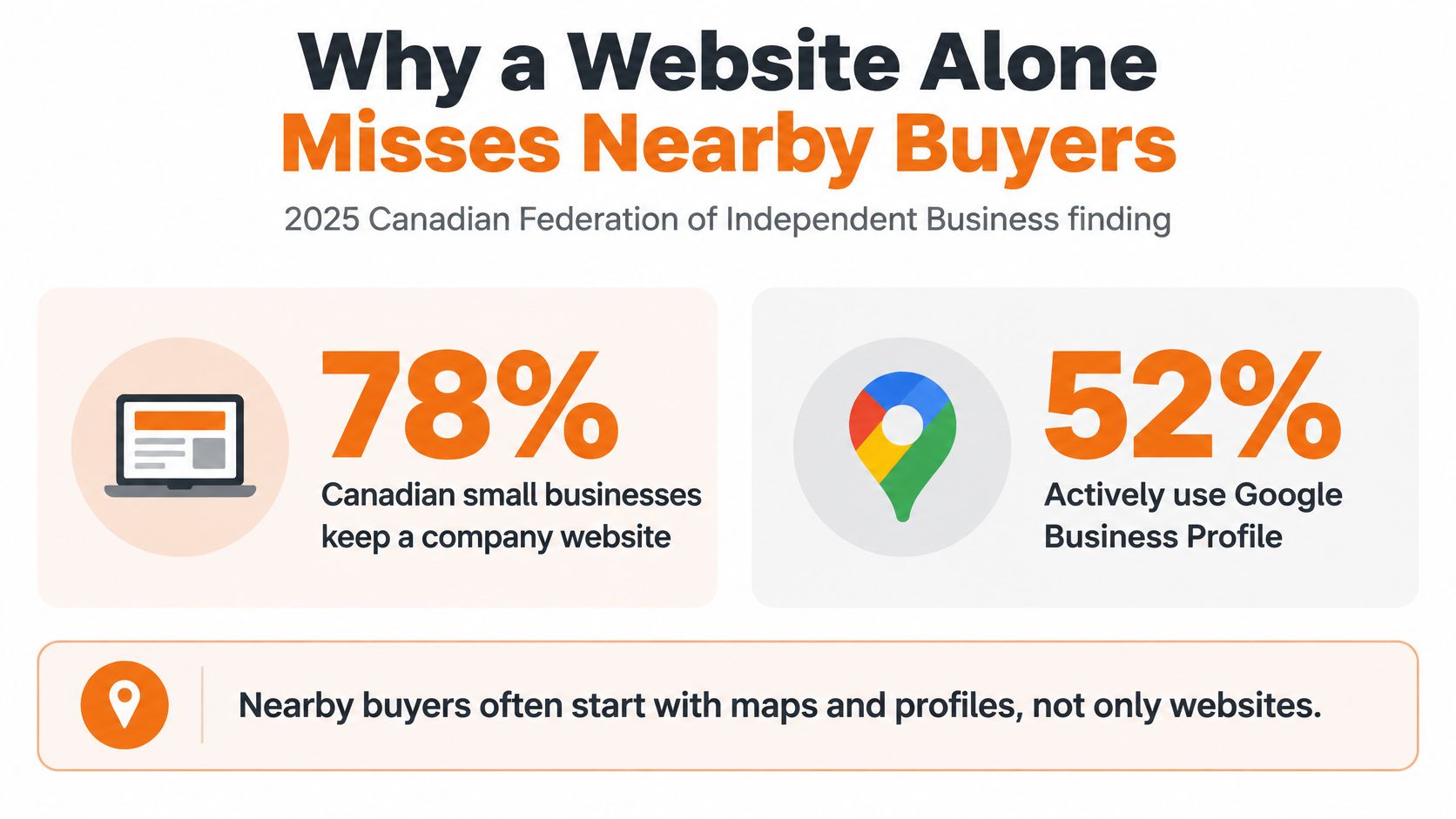
78% of Canadian small businesses maintained a company website in 2025, while only 52% actively used Google Business Profile or Google Maps, according to the Canadian Federation of Independent Business. That gap explains why a good website can sit quiet while a competitor with a plainer site takes the call. Nearby buyers often meet you first on a map listing, a review, or a service page built for their neighbourhood. Local digital marketing services join those pieces into one system judged on qualified leads and booked work, not rankings alone.
Why a Website Alone Misses Nearby Buyers
Say a homeowner in Burnaby searches on a phone for a plumber who can come today. She sees a map pack first, taps a profile with current hours and recent reviews, and calls without ever opening a homepage. A firm with a polished website but an incomplete profile never enters that choice. The website still matters once she clicks through to check services and credibility, but it isn't the front door for every nearby search.
Think of national brand spending as a highway billboard. It creates general awareness at a distance. Local work is closer to the sign on a busy corner, with the right name, hours, phone number, and services visible at the moment someone's ready to act. Local digital marketing services coordinate that corner across search results, maps, ads, reviews, and landing pages so a person searching by neighbourhood, delivery radius, or clinic availability can move to a call, booking, or sale without friction.
What Small Teams Are Really Buying
Most B.C. firms are small, so the owner can't run listings, ads, content, and analytics as separate departments. You're buying coordination and follow through. One person or team keeps the business details consistent, builds pages for real service areas, asks for reviews after real jobs, and connects each click or call to a source you can inspect later.
That coordination also prevents waste. An ad shouldn't send people to a page that omits the advertised service. A profile shouldn't promise Saturday hours the booking calendar doesn't offer. A ranking gain shouldn't count as success if the form is broken on mobile.
Put the next dollar on qualified local demand you can trace to a call or booking, not on a higher position that leaves the phone quiet.
The practical questions are straightforward. Which services and places deserve pages and ads first, which numbers prove revenue, what fee shape fits the work, how do rules change for cannabis, wellness, and ecommerce, and how do you judge an agency before signing? Answer those in order and the programme stays grounded in work you can staff and sell.
The Five Lines Inside a Local Programme
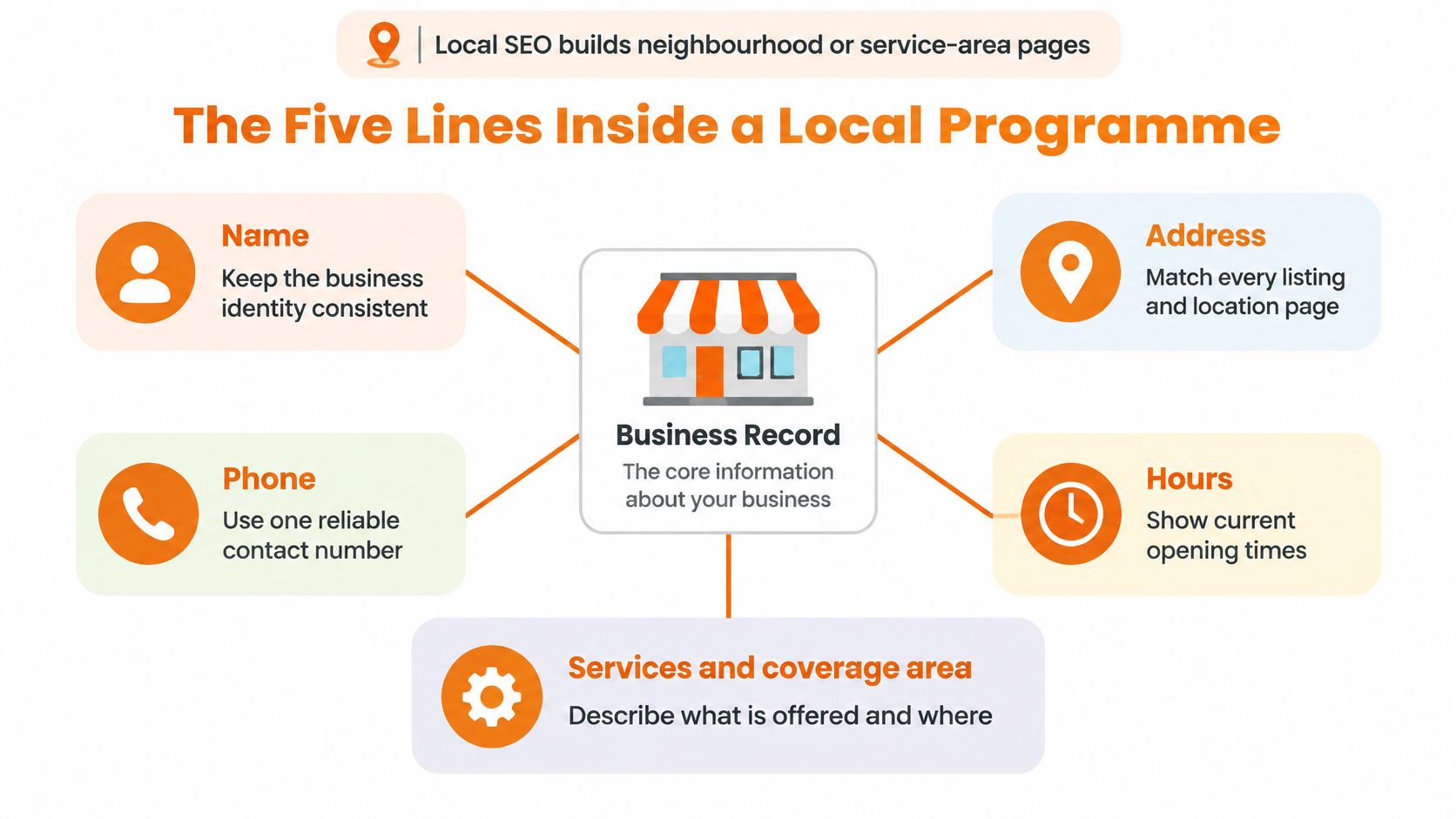
A strong programme has five lines, but they aren't five separate purchases. They share one source of truth business record covering name, address, phone, hours, services, credentials, and coverage area. Every page, listing, ad, and review request should match that record. When lines contradict each other, buyers hesitate and search engines receive mixed signals about what you do and where you do it.
| Service line | Work included | Result it should move |
|---|---|---|
| Local SEO | Service-area pages, on-page SEO, citations, schema | Organic visits and calls for nearby intent |
| Google Business Profile | Categories, services, photos, NAP, reviews | Map-pack views, calls and direction requests |
| Local paid ads | Geo search and maps ads with call tracking | Leads inside the service area within weeks |
| Conversion rate optimization | Landing pages, forms, booking flow | More leads from traffic already arriving |
| Local content and PR | Guides, proof, digital mentions | Trust, links and branded search |
How the Lines Work Together
Local SEO builds neighbourhood or service-area pages around terms people already type, supported by citations and schema that clarify the entity behind the site. Google Business Profile work is the map-pack storefront. Our Google Business Profile optimization includes a complete overhaul of listings, with proper categories, service descriptions, high-quality images, and NAP consistency across directories. That detail matters because a wrong primary category or stale holiday hours can cost the enquiry before your website gets a chance.
Paid ads buy speed inside a defined radius, but only for queries that can plausibly convert into work you want. Pause terms that attract job seekers, do it yourself research, or places outside your crew's range. Conversion rate optimization then fixes the page, form, or booking step wasting traffic you've already earned, while local content and digital PR supply proof, useful guides, and mentions that make a cautious buyer comfortable calling. For a fuller view of radius and intent, see this guide to location-based marketing.
We offer E-Commerce SEO Services, Local SEO, Conversion Rate Optimization, and Specialized SEO, so those lines can be planned together rather than handed between disconnected suppliers.
Where AI Belongs
Treat AI as a checked assistant, not an author with publishing rights. The Vancouver Board of Trade 2025 AI report found 15% of B.C. businesses were either already using generative AI (9%) or planning to use it soon (6%), while 39% of owners had considered integrating AI into their operations. Useful first jobs include clustering search queries by intent, spotting missing location pages, drafting metadata for human review, classifying calls and leads, and flagging conversion drops.
Keep AI away from unchecked neighbourhood pages, unsupported health or cannabis claims, and copy that changes hours, credentials, or coverage. Validate every output against the business record, log material changes, and judge the work by faster, accurate iteration rather than page volume.
KPIs That Connect Listings to Booked Work
Most B.C. businesses are small, so measurement needs to fit the people and time available. A local firm does not need a stack of disconnected dashboards. It needs one record that links profile actions, calls, form submissions, bookings, and closed revenue. Rankings and traffic are useful only when they help explain whether the business is attracting qualified leads and booked work.
| KPI | Source | How to read it |
|---|---|---|
| Map actions | Google Business Profile | Calls, direction requests, and website clicks by week |
| Qualified calls | Call tracking | Conversations that meet the agreed booking criteria, tagged to a service |
| Form or booking rate | Analytics and CRM | Submissions divided by landing-page sessions |
| Cost per qualified lead | Ads, fees, and CRM | Media spend plus agency fee divided by qualified leads |
| Booked value | CRM or booking tool | Revenue linked to a source within an agreed attribution window |
| Review velocity | Google reviews | New reviews over time, considered alongside average rating |
Reading Each Number as a Decision
Map actions show whether local visibility is leading to signs of intent. If views rise but calls stay flat, check whether the category, photos, services, and hours give searchers a reason to choose the business. The profile may also be attracting searches outside the firm's best work. Break results down by service where possible. Direction requests matter differently to a storefront than to a mobile crew.
A qualified call is a conversation that establishes the caller's need, location, and next step. Tag it to a service and source. Exclude hang-ups, spam, supplier calls, and existing customers asking about an invoice, or the lead count will give a misleading picture. Agree on the definition before reporting begins so everyone uses the same labels. This guide to tracking SEO conversions from visits through to enquiries explains how to connect those steps.
Form or booking rate measures submissions against landing-page sessions. When rankings and sessions improve but the rate does not, investigate the page before assuming traffic is the problem. Check mobile load, the first screen's promise, form length, calendar availability, and whether the page names the service and area the visitor searched for.
Cost per qualified lead combines media spend and agency fees, then divides that total by qualified leads. It puts cheap clicks in context. Booked value connects marketing activity to revenue in the CRM or booking tool, including work that closes after the first call. To make the comparison useful, keep lead definitions and source tracking consistent.
Keep Vanity Metrics in Their Place
Impressions, raw clicks, and average position are diagnostic signals, not proof of business impact. They can rise while the phone stays quiet, particularly if visibility grows for broad informational searches. Review velocity sits between visibility and bookings: new reviews and average rating can help a searcher decide to call, but a rating alone cannot show whether marketing paid for itself.
Monthly rule: Review one page showing leads, cost per qualified lead, and booked value by service area. Shift effort toward the municipality and service producing revenue.
Set the first reporting date when work begins. Paid ads can be assessed for qualified leads within weeks when targeting and landing pages are sound. Profile and local SEO gains generally take longer to show up in calls. Read each measure on its own timeline, while keeping booked work as the practical test of progress.
Fee Models a Local Budget Can Actually Use
There's no single Vancouver rate card for local digital marketing services. Fees change with locations, competition, content volume, tracking cleanup, and whether claims need specialist review. The useful comparison isn't the lowest monthly number. It's whether the fee buys the assets and measurement required to produce leads you can verify.
| Model | Usually includes | Best fit |
|---|---|---|
| Starter retainer | Profile, citations, one location page, monthly report | Single-location service firm |
| Growth retainer | Multi-area pages, content, reviews, light CRO | Clinics and multi-neighbourhood trades |
| Paid media management | Geo search and maps ads plus call tracking, read on top of media budget | Need leads before organic matures |
| CRO or site project | Landing tests, forms, booking fixes | Traffic that does not convert |
| Regulated niche | Compliance review and restricted ad paths | Cannabis, CBD and health claims |
| Customized lead-generation package | Outreach add-ons kept separate from local search | Added outreach only |
Matching the Model to the Constraint
A monthly retainer suits ongoing local SEO, profile care, review habits, and reporting because listings decay and competitors keep publishing. A single-location firm often starts with profile work, citations, and one strong service page. A clinic or trade serving several neighbourhoods needs a growth scope for more pages, content, and light conversion testing. Buying the smaller package to cover a wide area usually spreads effort too thin to win anywhere.
Paid media management may be priced as a share of ad spend or as a flat management fee. Either way, read it on top of the media budget, not instead of it. If a proposal merges management and media into one pool, ask how much reaches the ad platform. Paid media is an add-on when the constraint is time, for example a new location that needs enquiries before organic visibility matures.
A fixed project suits a website build, technical cleanup, or conversion sprint with a defined end and acceptance checks. Don't turn a project into an open-ended retainer by vague wording. Name the pages, tests, tracking events, and handover documents included, then decide separately who maintains them.
Edge Cases That Change the Price
- Second location: It isn't automatically half price when pages, reviews, photos, and service details are genuinely unique.
- Ecommerce: You pay for product and category depth, technical performance, and conversion work rather than a map pin alone.
- Regulated categories: Claims, creative, and landing pages need extra review, which adds specialist time.
- No call tracking: A cheap retainer can't be judged properly if nobody can show which source produced the enquiry.
Ask what's included, what media budget sits outside the fee, when you'll get a first read on leads, who owns the accounts and content, and whether you can leave without a long lock-in. Market-typical bands are starting points for comparison, not a quote. A written proposal should tie the price to locations, deliverables, reporting, and the decision you'll be able to make from that reporting.
Cannabis Wellness and Ecommerce in Practice
The same local stack behaves differently when advertising rules, buyer trust, or geography change. Cannabis needs restraint and precise coverage. Wellness clinics need practitioner credibility and an easy booking path. Ecommerce may use local visibility for a store or delivery footprint while most revenue depends on category pages and checkout performance. Treating all three as a generic SEO package misses the constraint that matters.
The consultation image below is a useful reminder that regulated and health-adjacent buyers still make decisions through human trust, clear credentials, and straightforward next steps.

Cannabis and CBD Delivery or Retail
Advertising platforms restrict or reject many cannabis and CBD promotions, so broad paid campaigns make a fragile foundation. The durable path is technical cleanup, careful on-page copy, local landing pages inside the delivery area, accurate citations, and reviews earned from actual customers. Pages should make licensed status and age-gate requirements clear, avoid promising medical outcomes, and never invent neighbourhood coverage to chase a keyword.
Juiced Digital worked with a local weed delivery business in Vancouver to grow its visibility and rankings in its service area, and delivered consistent monthly ROI from local search presence for that client. The agency has focused on niche industries since 2018, including cannabis, CBD, and functional mushrooms. That category familiarity helps most at the copy review stage, where a casual benefit claim can create compliance and platform risk. For channel choices under these restrictions, review these cannabis marketing strategies before buying media.
First asset to fix: Delivery-area pages with compliant copy, real boundaries, current hours, and a tracked ordering or call path.
Wellness and Holistic Clinics
A clinic buyer is often comparing practitioners, not just prices. She checks whether the service matches her concern, whether credentials are visible, how recent the reviews sound, and whether booking takes two taps or a phone call during office hours. Profile categories, practitioner pages, service descriptions, insurance or direct-billing details where applicable, and thoughtful review replies therefore matter more than publishing generic wellness articles on a fixed cadence.
Claims still need a human check. Words such as treat, cure, or guaranteed can turn a helpful service page into a liability, and before and after material needs consent and careful context. Put the booking link on the profile and each practitioner page, use tagged links so sources remain visible, and reply to reviews without discussing a patient's care in public.
First asset to fix: The booking profile, including categories, practitioner credentials, services, photos, and a tracked appointment link.
The short video below adds context on how local presentation and customer experience connect before an ecommerce or clinic enquiry becomes revenue.
Ecommerce Beyond the Map Pin
For ecommerce selling across North America or further, local SEO supports the store, pickup, or delivery footprint. It doesn't replace category architecture, product copy, site speed, mobile usability, and conversion tests. A shopper who finds a category through organic search still needs filters that work, stock clarity, delivery expectations, and a checkout that doesn't hide costs until the final step.
Say a CBD shop has strong local reviews but thin category pages and slow mobile templates. More map visibility won't fix abandoned product visits. Keyword expansion, content fixes, technical performance, and clearer product paths carry the revenue, while the profile supports nearby trust and pickup intent.
First asset to fix: The product path from category page to checkout, measured by completed orders rather than sessions alone.
How to Judge an Agency Before You Sign
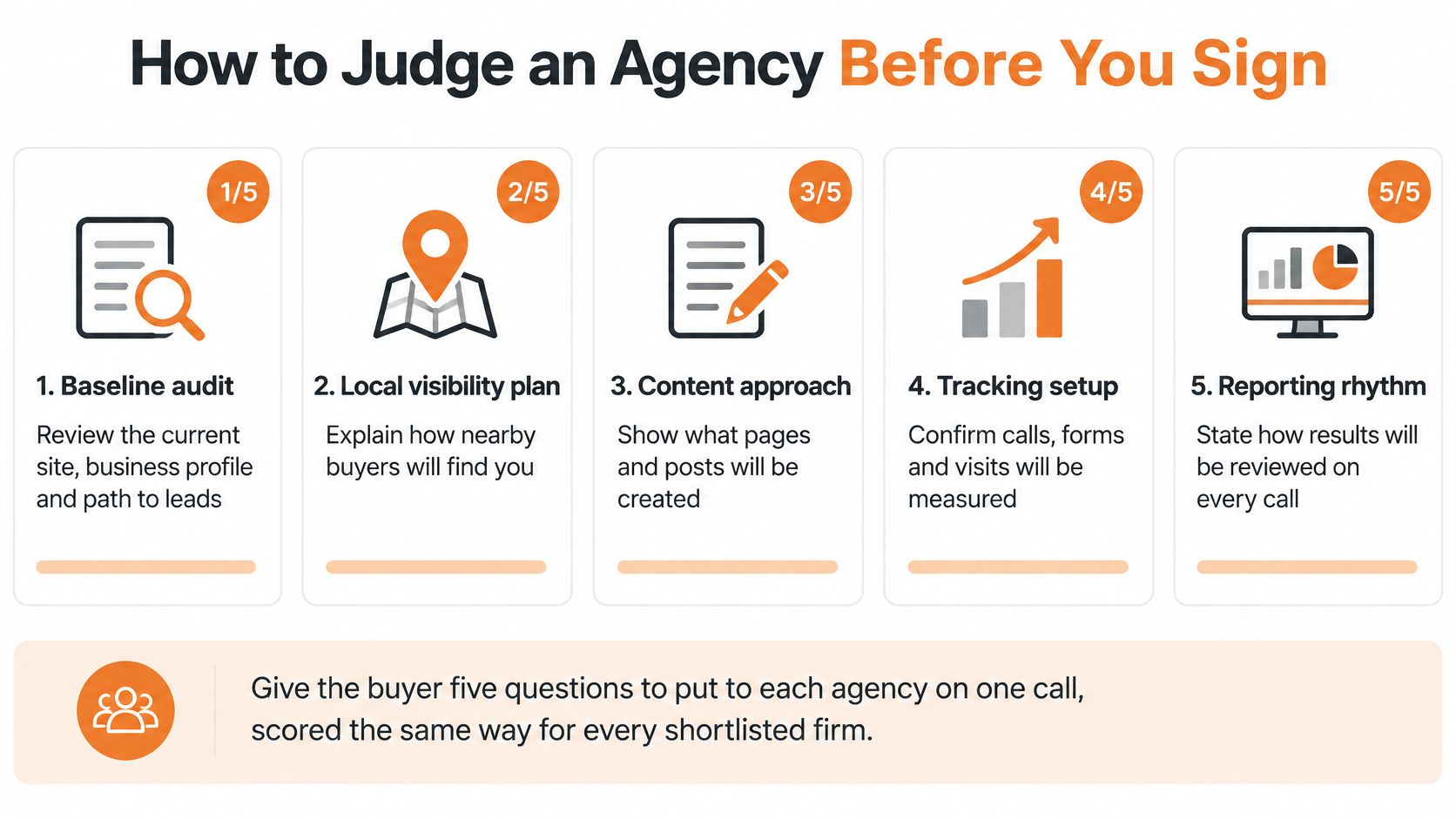
Put the same five questions to every shortlisted agency on one call and score the answers the same way. Vague confidence sounds persuasive in isolation. It becomes easier to spot when two firms must explain baselines, pages, reviews, tracking, and AI checks side by side.
Five Questions to Score
- Baseline audit: Will you audit the current site, business profile, analytics, and path from visit to lead before proposing work, rather than showing a generic ranking slide?
- Service-area plan: Which service areas and languages get their own pages, what local proof will each page contain, and how will you avoid spun duplicate copy?
- Reviews and consistency: How are reviews requested after a real job, who replies, and how do name, address, and phone stay consistent across the site, profile, and directories?
- Revenue reporting: Will monthly reporting show qualified leads and booked value by service area, with media and fees separated, instead of stopping at impressions?
- AI and accountability: How are AI drafts checked against the business record, especially for cannabis or health categories, and who does the work in house?
Also ask whether the contract is month to month, who owns the ad and analytics accounts, and what happens to content and tracking if you leave. An agency that can't answer ownership clearly is asking you to rent your own growth system.
Reading Proof Without Being Sold a Category
Juiced Digital has over a decade of experience helping local businesses and e-commerce brands thrive, and its local SEO results case studies include Tree People. During the consultation, the team audits an existing website for search engine optimization (SEO) and marketing funnels. That's the pattern to look for in any provider. A baseline first, then a scope tied to what the audit finds.
Category depth only matters when it matches your category. A cannabis brand should weight compliant local search proof. A plumber should weight local-service lead proof, call quality, and service-area reporting more heavily. Don't let an impressive ecommerce story substitute for evidence that the firm can fill a crew's calendar in Surrey or North Vancouver.
Walk away from guaranteed map-pack placement, a long lock-in before any baseline, or a proposal that cannot name the tracking that will prove a lead.
Score two agencies on the five questions, check who can show a baseline and an exit, and keep the firm whose answers make the next budget decision clearer.
Fix the Profile Then Book an Audit
You don't need a full programme to make progress this month. Start with the assets a nearby buyer sees first and the tracking that lets you judge next month.
- Complete the profile: Claim the Google Business Profile, choose the true primary category, add services, current hours, and real photos.
- Match the record: Make the name, address, and phone identical on the site, profile, and main directories.
- Publish one strong page: Build for the highest-value service and real service area, written for that place rather than with swapped city names.
- Track the enquiry: Turn on call tracking or a tagged booking link so new leads have a source.
- Ask and reply: Request a review after the job is done and reply to reviews already public.
Don't open ads in every municipality yet, and don't generate a pile of AI location pages. Both multiply weak foundations. One accurate profile, one useful page, and one tracked path will teach you more than broad activity with no source data.
If the profile is messy or the site can't show which visits became jobs, book a short audit before buying a retainer. We audit the existing website for SEO and marketing funnels during consultation, which gives Vancouver service firms, wellness clinics, cannabis brands, and ecommerce teams a practical first call. After 90 days, you should see qualified leads by service area, not only a higher rank.
Ready to turn nearby searches into tracked calls, bookings, and sales? Juiced Digital offers local SEO, conversion rate optimization, ecommerce SEO, and specialized SEO for regulated niches, starting with an audit of your website and marketing funnel. Visit us to book a consultation and get a clear first read on where your next qualified lead should come from.
