

Most advice about location based marketing starts with a bigger radius, more device signals, and increasingly aggressive retargeting. That approach is backwards for Vancouver businesses, especially cannabis retailers, wellness clinics, CBD companies, and functional-mushroom brands. The strongest campaigns usually collect less information, explain what they're doing clearly, and measure business outcomes instead of celebrating a map full of impressions.
Location can still make advertising more relevant. It can help a clinic reach people in its service area, help a retailer promote an offer to nearby shoppers, and help an e-commerce brand decide where regional demand deserves attention. The difference is whether location becomes a useful business constraint or a covert record of someone's movements.
For British Columbia marketers, privacy-by-design isn't a legal afterthought. It's a practical way to protect trust, reduce data exposure, and build campaigns that can survive stricter platform and regulatory expectations.
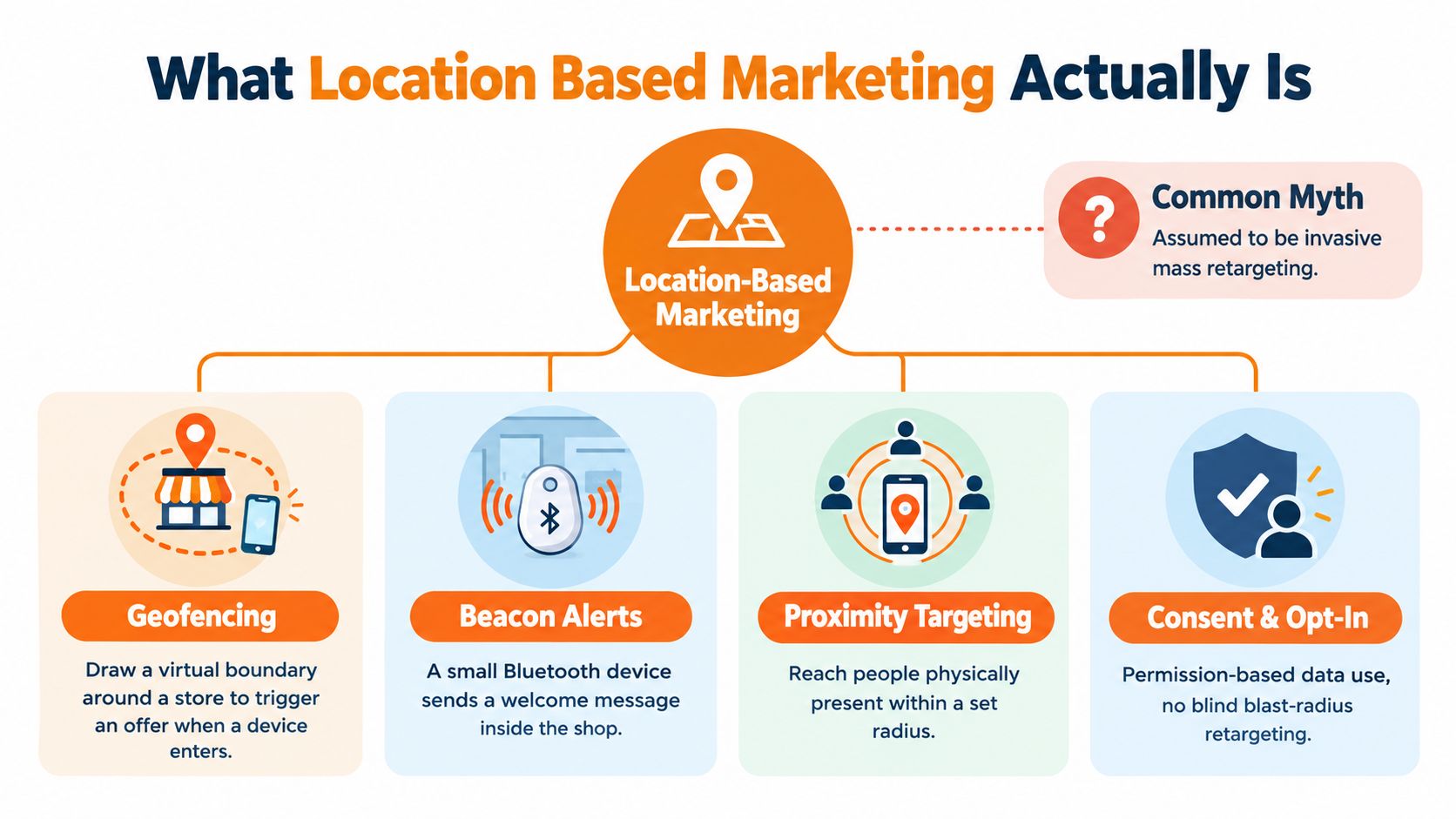
What Location Based Marketing Actually Is
Most local campaigns collect more location data than the business decision requires. A Vancouver physiotherapy clinic usually needs to know whether an audience is within its service area. It rarely needs a persistent, street-level history of where every person has travelled.
Location based marketing uses a person's current or past geographic context to shape advertising, content, offers, or measurement. That context might be a neighbourhood, service area, venue category, shopping district, or broad market. GPS, Wi-Fi positioning, mobile app permissions, and Bluetooth beacons can provide location signals, but responsible campaigns select the least precise signal that can still support the objective.
The practical building blocks
A geofence is a virtual boundary around an area. It can support a campaign around a retail location, event venue, or service zone. A beacon is a small Bluetooth device that can trigger an in-app message when a consenting user is close to it, making it more suitable for controlled indoor environments than broad outdoor targeting.
Proximity targeting reaches people within a defined geographic area, while contextual advertising uses the place itself as the signal. An ad for a massage clinic displayed around a wellness district can be relevant without identifying individual visitors or recording their personal routines.
The distinction matters because location marketing has two very different forms:
- Contextual relevance: Ads reflect a neighbourhood, venue, or service area without building personal movement histories.
- Surveillance-style targeting: Vendors collect precise trails, connect them across places, and use them to infer sensitive interests or behaviour.
For local businesses, start with the commercial question. If the objective is booked consultations, target the clinic's realistic catchment area and send traffic to a booking page. If the objective is regional e-commerce growth, compare broad markets and landing-page performance. Don't begin by asking how precisely you can track people.
Practical rule: If a campaign can work with a neighbourhood, postal area, or service zone, don't collect a device-level trail.
Key Techniques and Channels for Local Campaigns
No single location channel fits every business. A clinic, a dispensary, and a national e-commerce brand have different fulfilment constraints, customer journeys, and compliance risks.
| Channel | Precision | Useful for | Main trade-off |
|---|---|---|---|
| Geotargeting | Broad to moderate | Service areas, neighbourhoods, regional expansion | Safer and scalable, but less immediate |
| Geofencing | Moderate to high | Store zones, venues, competitor areas | More context, greater privacy and data-quality risk |
| Beacon messaging | Very local, usually indoors | Opted-in app users inside a venue | Requires hardware, app permissions, and active consent |
| Local search | Search-intent aligned | Calls, directions, bookings, local discovery | Depends on accurate business information and strong landing pages |
| Dynamic creative | Variable | Local offers, inventory, event or service messaging | Requires reliable rules and disciplined testing |
For a Vancouver wellness practitioner, local search and neighbourhood-level paid campaigns often provide a cleaner starting point than a tight geofence. The person is already expressing a need, and the business can respond with a local service page, clear availability, and a direct booking action. A cannabis retailer also needs strict control over audience, creative, and placement, rather than relying on proximity alone.
Geofencing can help when physical context signals intent. A retailer might promote a store-area offer to consenting audiences near a shopping district. A local service business could use venue or neighbourhood context to introduce a nearby consultation service. The campaign should exclude places where location inference could expose health, religious, or other sensitive activity.
Beacon campaigns are narrower still. They work best when a business controls the venue and the user has opted into the relevant app or Bluetooth experience. They don't make sense as a default tactic for a small business without a clear in-store journey.
E-commerce brands can combine broad regional targeting with localised creative, search campaigns, and market-level reporting. A Vancouver brand expanding across British Columbia might adapt delivery messages, product availability, or content by region without collecting precise movement histories. The best local SEO strategies should support that media activity with accurate service areas, local pages, and consistent business information.
A useful sequence is simple: use search to capture intent, geographic targeting to control reach, and carefully governed proximity tactics only where physical context adds measurable value.
Why Behavioral Proximity Outperforms Demographics
Demographics describe a person in broad categories. Behavioural proximity asks a more useful question: what physical contexts do people share before they respond to an offer?
Research from UC Berkeley Haas on mobile marketing found that mobile location data predicted responses to offers with up to 19% greater accuracy than demographic and psychographic variables. The study modelled responses from 217 participants to randomized mobile coupons for coffee, food, and entertainment, using GPS-derived co-location networks rather than relying only on individual attributes.

The insight isn't that every person near a place wants the same product. It's that shared physical routines can reveal useful context. People who visit similar shopping areas, complementary businesses, or event venues may have overlapping needs that age or declared interests don't capture.
Turning proximity into a safe audience signal
A Vancouver wellness brand could build a cohort from broad visitation patterns around wellness districts or complementary businesses, then test a local offer against a comparable audience that doesn't receive the campaign. The business should work with aggregated segments, not a list of identifiable individuals and their travel histories.
Build the test around a business outcome:
- Define the audience context. Choose a neighbourhood, venue category, or service area connected to the offer.
- Set a control group. Use a comparable geographic area or audience that remains unexposed.
- Choose a conversion window. Decide how long a person has to call, book, purchase, or redeem after exposure.
- Report at cohort level. Compare qualified outcomes, not individual paths.
- Review incrementality. Ask whether exposure changed behaviour compared with the control.
The study's accuracy finding supports location as a predictive feature, not as automatic proof of sales. A platform's audience label doesn't demonstrate lift. Holdout testing does.
A good campaign also has an exclusion policy. Don't build proximity audiences around clinics, shelters, places of worship, or other sensitive locations when doing so could expose a person's health, beliefs, or vulnerability. For regulated sectors, the safest useful segment is often broader than the most technically precise one.
Privacy and Compliance Requirements for Location Data
Location data can reveal far more than a postal area. Repeated visits may expose a home, workplace, clinic, religious site, or retail routine. That makes the data commercially useful and privacy-sensitive at the same time.
California provides a clear example of the compliance direction. Under the California consumer privacy definition of sensitive personal information, precise geolocation means device-derived data capable of locating a consumer within a circular area with a radius of 1,850 feet, approximately 0.35 square miles. The California Consumer Privacy Act, strengthened by the California Privacy Rights Act, gives consumers controls over sensitive personal information and the sale or sharing of personal information.
A Vancouver company serving California customers can't assume its Canadian address removes those obligations. It should understand what location signals it receives, what vendors do with them, whether advertising platforms or data brokers receive them, and whether reporting could expose movement patterns.
Re-identification changes the risk calculation
A legislative privacy briefing citing research reported that 95% of people could be uniquely identified from four spatiotemporal location points, while 50% could be identified from two points. A spatiotemporal point combines where someone was with when they were there, so a small number of observations can create a revealing behavioural profile. See the California location privacy briefing for the cited finding.
That risk makes “aggregated” or “pseudonymous” an insufficient assurance on its own. A campaign should minimise the precision and retention of the underlying data, not rename it.
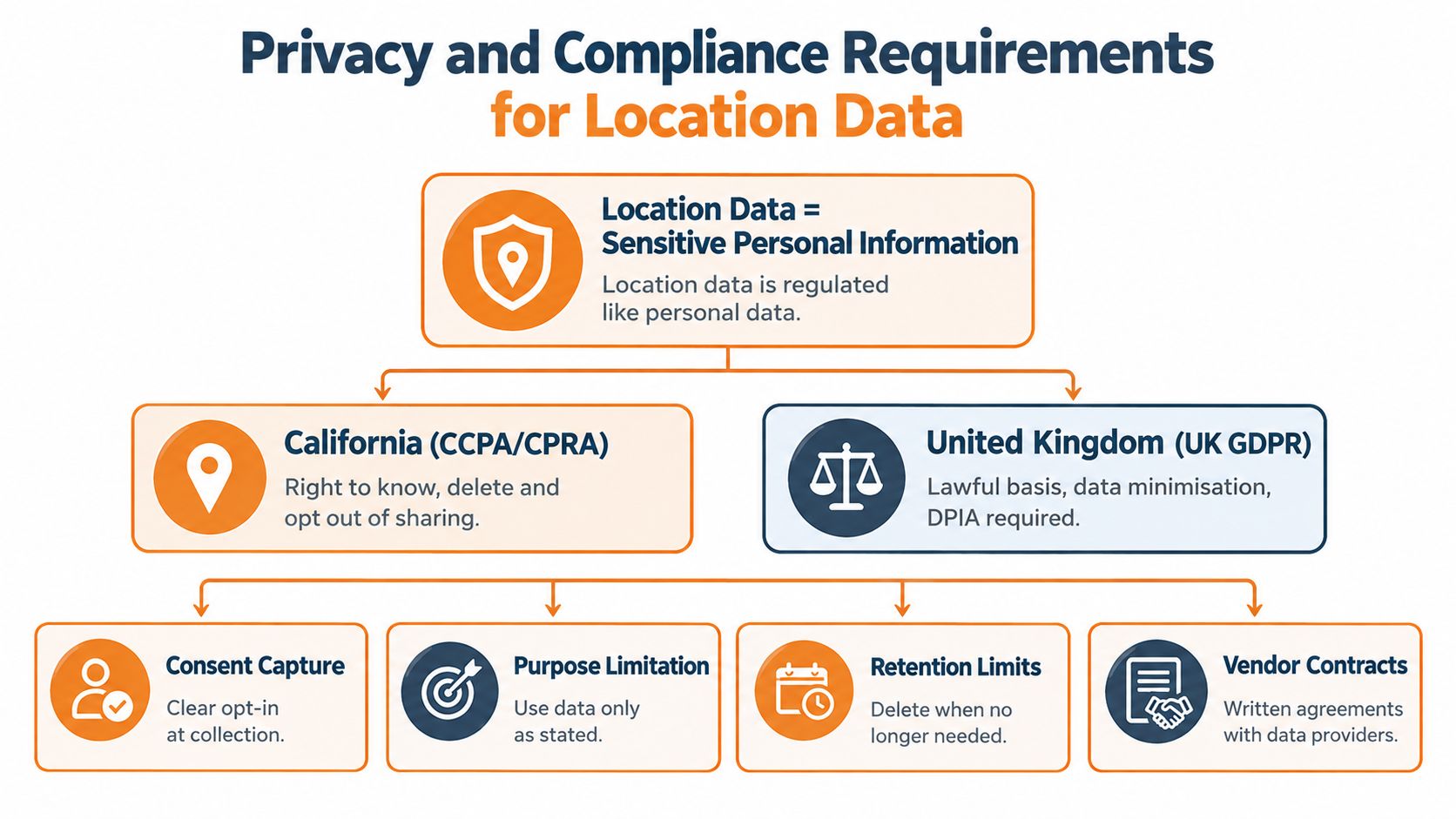
Use four safeguards:
- Collect only what the decision needs. Choose a broad zone when street-level precision doesn't improve the offer.
- Limit the purpose. Document whether the signal supports audience planning, activation, measurement, or suppression.
- Control retention and access. Avoid storing raw movement histories when cohort reporting is sufficient.
- Make choice real. Provide plain-language notice, consent or another legally valid basis where required, and simple opt-out mechanisms.
For California audiences, campaigns should also support applicable rights, including controls over use and sharing. For British Columbia audiences, privacy governance should reflect transparency, meaningful choice, appropriate safeguards, and careful handling of personal information. These are operational requirements, not copy to add after launch. A compliance risk assessment can help identify gaps across vendors, consent flows, campaign logic, and reporting.
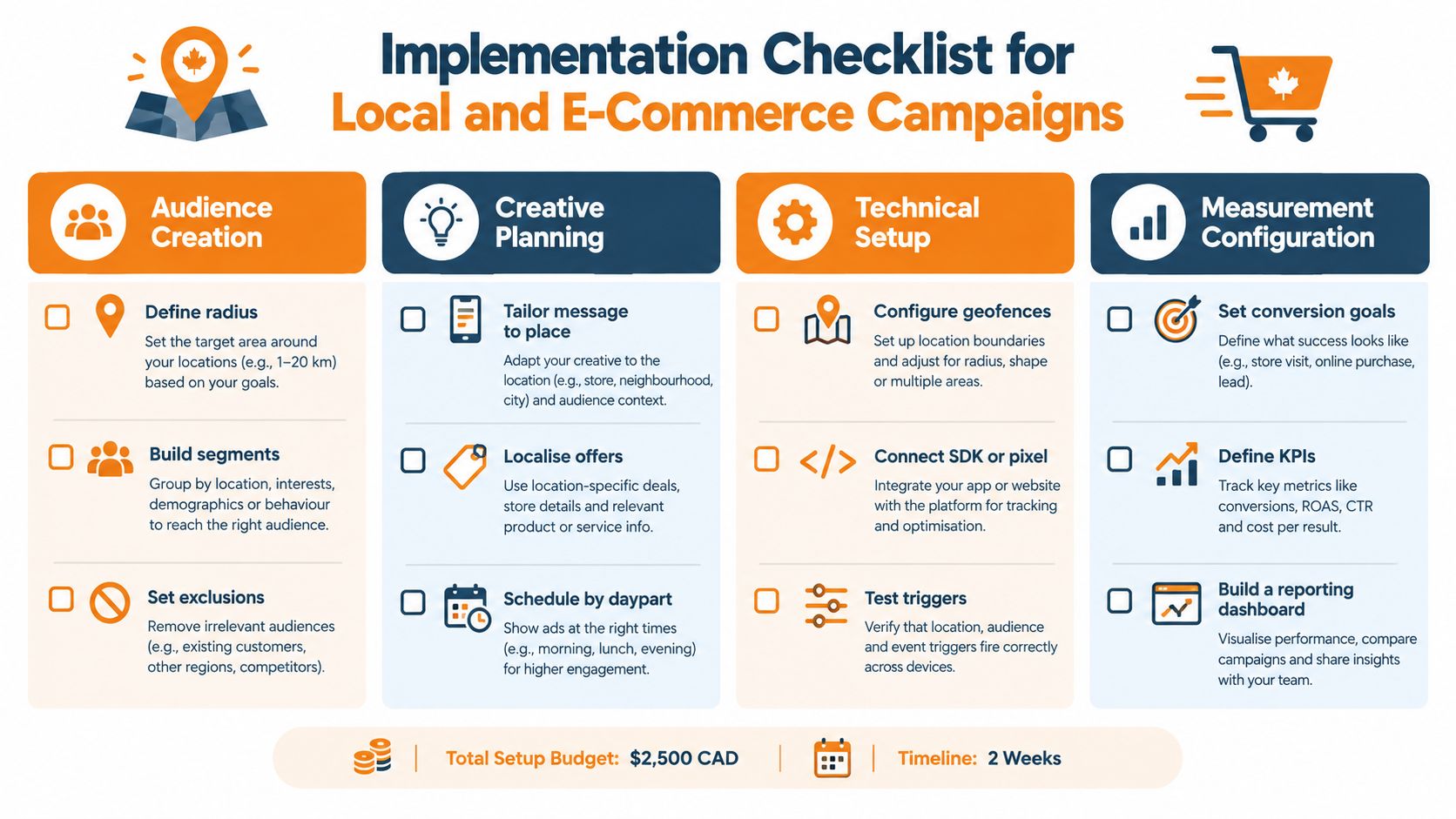
Implementation Checklist for Local and E-Commerce Campaigns
A location campaign should pass an internal review before anyone buys media. The review needs to cover the audience definition, the creative, the technical setup, and the evidence required to judge performance.
Audience creation
Start with geography that matches the business model. A mobile clinic may need a service area, while an e-commerce brand may need regional market groups. Use polygons or neighbourhood boundaries when a circle would include irrelevant roads, shared buildings, or areas the business can't serve.
Then define exclusions. Remove locations and audiences that create unnecessary sensitivity, and suppress people who withdraw permission or should no longer receive the campaign. Record the source of every audience segment, the vendor involved, and the reason the segment exists.
Creative planning
Local relevance should change the message, not just the targeting setting. A Vancouver clinic can mention appointment availability, transit access, or a specific service area. An e-commerce brand can adapt delivery information, seasonal availability, or regional product education.
Regulated categories need extra restraint. Cannabis and CBD advertisers should avoid creative that suggests a person's health status or infers a sensitive condition from their location. Wellness brands should lead with useful, compliant information and a clear next step, rather than implying the ad knows something personal about the viewer.
Technical setup
Configure the geofence or regional audience, connect the approved analytics and conversion tools, and test every trigger before launch. Check that consent signals flow through the relevant systems, that opt-outs suppress future activation, and that reporting doesn't expose raw device identifiers.
Keep a written vendor record. It should state what data the vendor supplies, how it was collected, how long it is retained, where it is shared, and how deletion or opt-out requests are handled.
Measurement configuration
Set one primary business outcome before buying media. Local services might use qualified calls, completed forms, booked consultations, or attended appointments. E-commerce teams might use incremental orders, contribution margin, or qualified regional revenue.
Account for Vancouver's dense neighbourhood overlap, seasonal tourism, weather, transit patterns, and nearby competitors when designing controls. A campaign that looks successful during a busy event period may be capturing demand that would have occurred without advertising.
Measuring What Actually Matters Beyond Clicks and Visits
A location audience can generate clicks without creating new demand. A geofence can report visits from people who were already planning to shop. Coupon redemptions can reflect loyal customers who would have purchased anyway.
The measurement question is therefore not “How many people entered the area?” It's “Did exposure increase valuable actions compared with a credible alternative?”
A practical test design
Begin with matched geographic test and control areas. The areas should resemble each other in customer mix, access, business availability, and seasonal conditions. Expose one group to the location campaign and hold the other back for the agreed period.
Use privacy-safe identifiers for response measurement, not raw movement trails. Suitable supporting tools can include:
- Unique landing pages: Give each market or campaign variant a distinct page while reporting results in aggregate.
- Call tracking: Use market-specific phone numbers and evaluate qualified calls rather than dial volume alone.
- POS codes: Connect a local offer to a redemption code that doesn't require identifying every visitor.
- Booking records: Track completed consultations or appointments, not just form starts.
- Regional order data: Compare incremental orders and contribution margin by market for e-commerce campaigns.
The reporting and analytics service should show the test design, exposure rules, conversion window, exclusions, and limitations. A dashboard that hides methodology creates false confidence.
Match the KPI to the business
For a Vancouver service business, calls, qualified leads, booked appointments, completed jobs, or revenue usually matter more than foot-traffic estimates. For e-commerce, use incremental orders, qualified customers, repeat purchase behaviour, and contribution margin. A campaign can increase visits while failing to improve profitability, or produce fewer clicks while generating stronger customers.
Canadian privacy research also shows why person-level attribution is becoming less reliable. The Office of the Privacy Commissioner of Canada research reports that 78% of respondents have refused to provide personal information to a business because of privacy concerns, while 75% have adjusted social-media privacy settings. Those behaviours make clean individual tracking harder and make geographic experiments more valuable.
Don't claim incrementality from a single platform report. Compare exposed and control outcomes, document what could have affected the result, and treat directional metrics as diagnostics rather than proof.
Case Examples and Lessons from Regulated and Wellness Brands
A health clinic can use neighbourhood-level search campaigns, service-area landing pages, and consented first-party booking data without creating a record of where prospective patients travel. The trade-off is lower apparent precision. The benefit is a campaign that communicates relevance without suggesting the clinic knows a person's health condition.
A cannabis retailer faces a stricter creative and audience environment. A privacy-conscious approach can focus on store-area discovery, compliant product education, local search visibility, and aggregated response reporting. It should avoid sensitive-location targeting, opaque data-broker segments, and copy that implies a personal inference about the viewer.
For a CBD or functional-mushroom e-commerce brand, location can support regional planning rather than individual surveillance. The team can compare broad Canadian or North American markets, adapt content to fulfilment realities, and use consented customer information for measurement. Regional landing pages, local search demand, and cohort-level revenue reporting may be less granular than a device trail, but they're more defensible.
The Canadian Marketing Association privacy research reports that 90% of Canadians are at least somewhat concerned about online privacy, while 73% prefer advertising relevant to their interests rather than generic advertising. It also finds that 59% are more comfortable sharing data when businesses explain its use, provide control, and offer opt-out choices, and 77% may switch brands that fail to protect their data.
The lesson is practical. Trust isn't a constraint to work around. Plain-language consent, limited retention, broad audience design, and credible measurement can make location based marketing more sustainable for regulated brands.
Juiced Digital helps Vancouver businesses and North American e-commerce brands connect local SEO, paid advertising, conversion optimization, and privacy-aware measurement, with experience in regulated sectors such as cannabis, CBD, functional mushrooms, and health. Visit Juiced Digital to request a consultation or audit focused on turning geographic relevance into measurable, compliant growth.