

SEO services are worth it when the gross profit from additional organic enquiries and sales covers your monthly fee and repays the initial investment within a window your business can afford. Plan for 3-6 months to see desired results, not a guaranteed break-even date.
The opportunity is substantial: Canadian retail e-commerce revenue reached $73.7 billion in 2024, according to Statistics Canada's annual retail trade report. But market size doesn't settle your investment decision. Your margins, close rate, service area and ability to measure new sales do.
The useful question isn't, “Are SEO services worth it?” It's whether the additional customers you can realistically acquire will repay the full cost, including the months before meaningful enquiries arrive.
Is SEO Worth It for Your Business Type
SEO payoff by business type
| Business type | Time to first results | Value metric to track | Break-even question |
|---|---|---|---|
| Local service business in Vancouver and B.C. | 3-6 months | Calls, form fills, booked jobs | How many additional booked jobs at your average gross profit cover the monthly fee? |
| E-commerce brand | 3-6 months | Organic sessions leading to purchases, online revenue | How much gross profit do additional organic orders generate above the fee? |
| Regulated sector, including cannabis, CBD and functional mushrooms | 3-6 months | Compliant organic orders, store visits, delivery bookings | Can compliant organic orders profitably fill acquisition gaps where paid promotion is restricted? |
| Holistic health clinic or practitioner | 3-6 months | Bookings, consultation requests | How many new bookings at your average session gross profit cover the fee? |
These are planning windows, not promises. A technically accessible site with useful service pages presents a different starting point from a store whose products aren't indexed.
Local businesses need commercially relevant discovery
The Rogers/CB Insights small-business discovery study found that 45% of respondents listed search engines among their top three discovery methods, while 64% were more likely to examine or click a listing containing an address or map. Those findings support investing in local discoverability, but they don't establish your likely conversion rate.
For a Vancouver plumber, the practical work starts with accurate Google Business Profile categories, hours and service information. It extends to useful service-area pages, consistent business details and a process for requesting honest customer reviews.
Neighbourhood pages should explain actual coverage, relevant services and booking arrangements. Replacing the neighbourhood name in otherwise identical text doesn't give a prospective customer much help choosing you.
The historical adoption gap also matters. A B.C. legislative document citing a Canadian Federation of Independent Business survey reports that only 22% of business owners surveyed made online sales before the COVID-19 emergency, in a survey covering 944 B.C. businesses. Having an online presence and operating an effective customer-acquisition system are separate achievements.
Different buying journeys require different pages
For e-commerce, category pages help shoppers compare options; product pages answer purchase questions; comparison and educational pages support earlier research. Prioritise pages where search intent, product availability and margin overlap. A popular article about a product you don't stock has little immediate commercial value.
Regulated businesses need an additional editorial filter. Confirm applicable product, jurisdiction and platform requirements before publishing offers or health-related claims. Organic visibility isn't permission to publish claims that wouldn't withstand compliance review.
At Juiced Digital, we've focused on niche industries including cannabis, CBD and functional mushrooms since 2018. That specialisation informs the questions we address in content, but it doesn't remove the need to assess each business's economics.
For wellness clinics, location information should sit alongside clear explanations of consultations, practitioner qualifications and what patients can expect. Educational content should support an informed booking decision without promising treatment outcomes.
Practical rule: Prioritise the pages that connect a real customer need to a service or product you can profitably deliver.
SEO is a poor bet right now if your sales leave too little gross profit, you can't reliably track orders or enquiries, or your realistically reachable market contains too little relevant demand. A small service area isn't automatically disqualifying. The problem is insufficient profitable demand, not geographic size alone.
Metrics That Show SEO Is Paying Off
Build a monthly dashboard around discovery, qualified actions and realised sales. Rankings help diagnose visibility; they don't establish financial return.
Use this checklist to keep traffic measures alongside commercial outcomes.
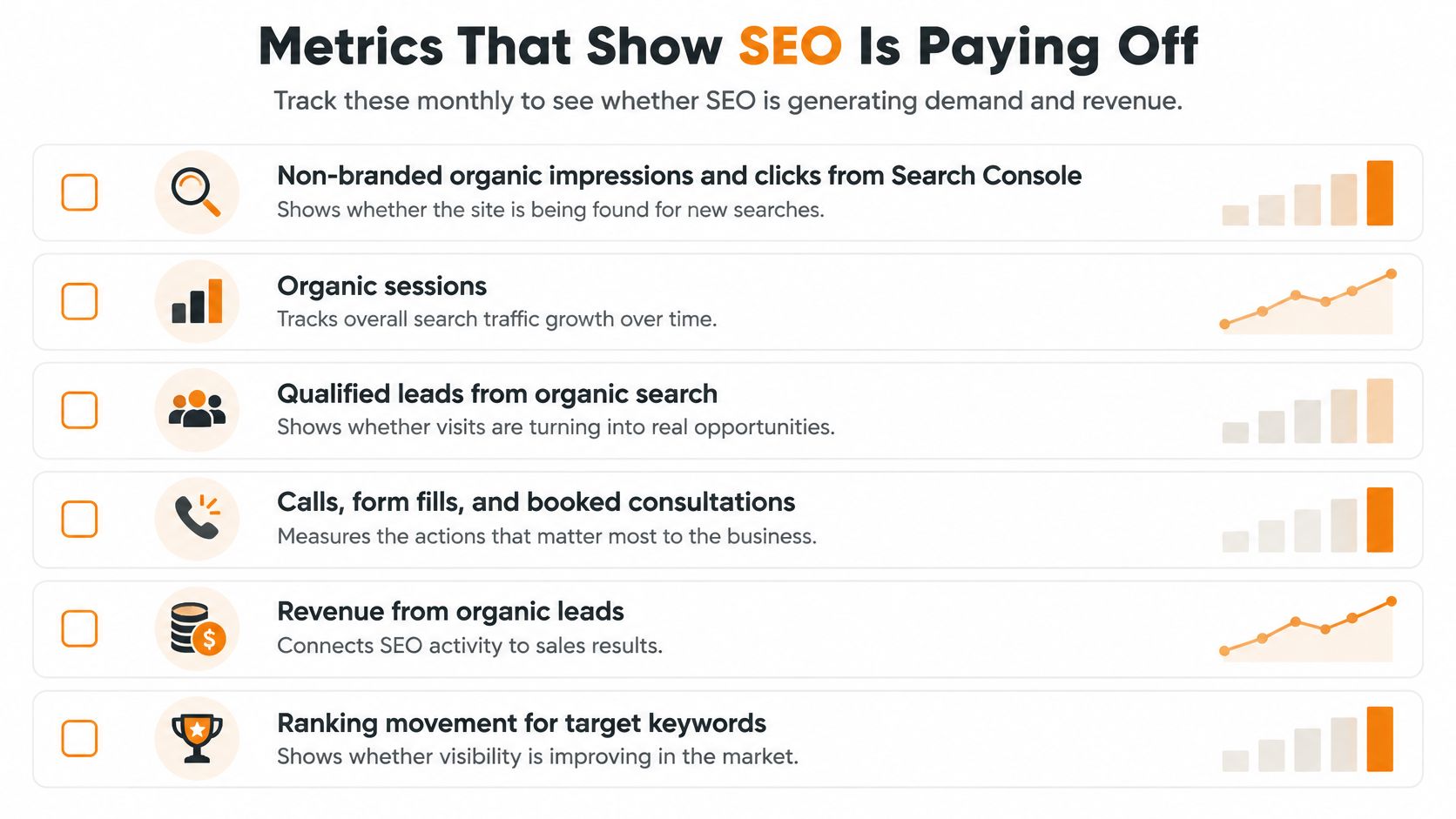
Track the customer journey
- Non-branded impressions and clicks: Use Google Search Console to separate business-name searches from service, product and problem-based searches.
- Organic sessions and landing-page conversion rate: Use Google Analytics to identify which entry pages attract visitors and which produce useful actions.
- Qualified leads and completed sales: Tag calls, forms and bookings by acquisition source in your CRM. Use source-aware call tracking on relevant location pages without making business information inconsistent.
- Branded search lift and assisted conversions: Watch for changes in business-name demand and journeys where organic search preceded a later purchase. Treat these as supporting evidence, not automatic proof of causation.
- Revenue and gross profit: Reconcile attributed sales with completed jobs, cancellations, refunds and actual order values.
Audit AI-assisted discovery separately
The Statistics Canada analysis of business AI use provides context for changing business practices, not proof that an AI recommendation produces sales. Measure that commercial connection yourself.
Each month, test a consistent set of local and product questions in AI-assisted search tools. Record the prompt, location context, answer, cited pages and whether your services, address and claims are accurate.
Track identifiable AI referrals and their resulting enquiries. Ask customers how they found you when analytics can't resolve the journey.
An accurate mention without a click may still influence a purchase, but don't assign it revenue without supporting evidence. Save baseline exports before work begins so subsequent reports show changes rather than isolated totals.
How to Run the Break-Even Test
Start with monthly SEO cost divided by gross profit per additional sale. That gives you the extra sales needed to cover ongoing expenditure, not the number needed to recover everything already spent.
Use this calculation sequence before accepting a proposal.
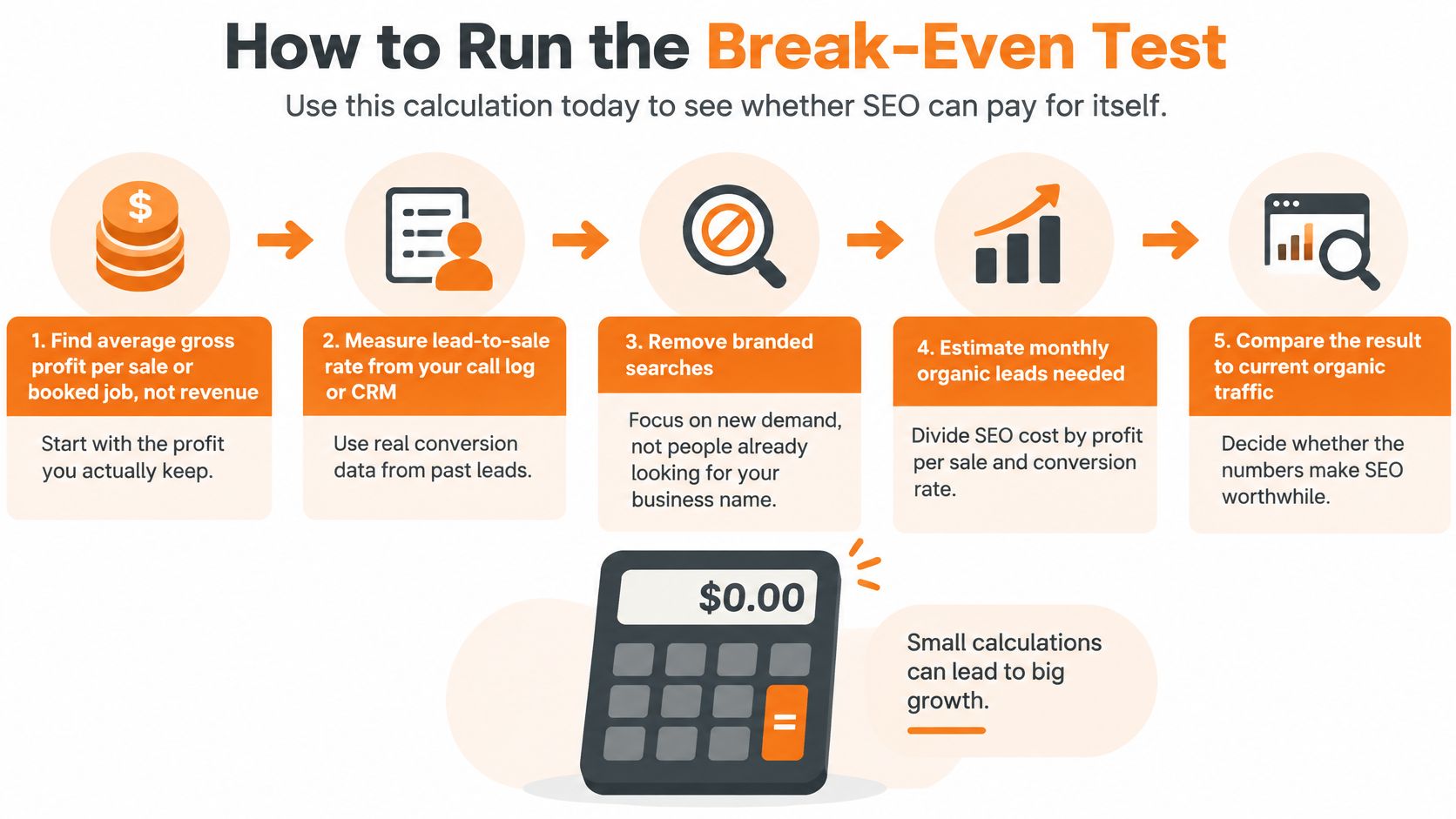
Establish the inputs
- Calculate gross profit per sale or booked job. Subtract the direct costs of delivering it, including relevant materials, labour or product costs. Don't use the invoice total.
- Measure your qualified-lead close rate. Use completed outcomes from your CRM or call log. Spam, supplier enquiries and unserviceable requests don't belong in the denominator.
- Estimate incremental demand conservatively. Separate branded searches from discovery searches. Don't automatically discard every branded sale, but don't assume every customer searching your name was created by SEO.
- Apply geographic and capacity filters. Count leads you can serve. Exclude duplicate enquiries and account for jobs you must decline.
- Include the full acquisition cost. Add the retainer, implementation, content production and tracking costs that aren't included in the proposal.
- Calculate operating and cumulative break-even separately. Divide ongoing cost by profit per sale, then divide required sales by your close rate. Track cumulative profit against cumulative costs to establish payback.
Our guide to calculating marketing ROI helps organise the distinction between sales revenue and investment return.
A hypothetical plumbing business
Suppose a plumber pays $2,000 monthly, earns $400 gross profit per additional job, and closes 25% of qualified leads. These are illustrative inputs, not market fee or performance benchmarks.
| Calculation | Hypothetical result |
|---|---|
| Monthly fee ÷ gross profit per job | $2,000 ÷ $400 = 5 additional jobs |
| Required jobs ÷ qualified-lead close rate | 5 ÷ 25% = 20 additional qualified leads |
| Gross profit from 8 additional jobs | 8 × $400 = $3,200 |
| Monthly surplus after the SEO fee | $3,200 − $2,000 = $1,200 |
Assume the first 3 months produce no incremental gross profit, leaving $6,000 to recover. If the campaign then consistently produces the illustrated surplus, repayment takes 5 further months, placing cumulative break-even at the end of month 8.
That simplified model excludes financing costs, taxes and changes in performance. In practice, use a monthly cash-flow sheet because leads, job values and collections won't arrive evenly.
Covering this month's fee doesn't mean you've recovered the launch investment.
The Office of the Privacy Commissioner's business survey examines business technology adoption, not SEO pricing or conversion benchmarks. Don't substitute technology-adoption figures for your own operating inputs.
Collect written, comparable quotes and test a cautious scenario alongside your expected case. At the end of the initial planning window, review actual incremental gross profit rather than extending the engagement solely because rankings improved.
For another explanation of the investment decision, use this video alongside your own worksheet.
SEO Versus Paid Search and a Hybrid Approach
| Channel | Time to first results | What happens when spend stops | Best use |
|---|---|---|---|
| SEO services | 3-6 months as a planning window | Existing pages may retain visibility, but maintenance and competitive changes affect performance | Long-term, high-intent pages and local discovery |
| Paid search | After approval and launch; assess actual lead timing | New paid traffic stops when campaigns stop serving | Testing offers, filling gaps and urgent demand |
| Hybrid, paid to test and SEO to hold | Paid can start after launch; organic develops over 3-6 months | Paid traffic stops; established organic pages may continue attracting visitors | Funding acquisition while building useful organic pages |
Paid search offers budget control, not guaranteed acquisition costs. You can set spending limits and test messaging, but the cost of a completed sale still reflects auction conditions, lead quality and your conversion process.
SEO doesn't charge for each organic click, yet its cost isn't zero. Technical maintenance, updated product information, content production and measurement require resources.
Use each channel for a distinct job
A hybrid approach should allocate work according to evidence rather than splitting the budget mechanically.
- Test commercially meaningful offers with paid search. Evaluate qualified enquiries and completed purchases, not just ad click-through rate.
- Build organic pages around demonstrated customer needs. Use paid search terms to inform the brief, while checking whether organic results show the same intent.
- Reallocate gradually when organic contribution becomes dependable. Reduce spending on overlapping acquisition only when the remaining channel mix still delivers enough profitable business.
- Retain paid coverage for suitable seasonal offers, urgent demand or controlled experiments.
As a cautious management rule, you could require organic gross profit to cover its ongoing fee for three consecutive months before reducing overlapping paid spend. That's a decision rule you choose, not a published performance benchmark.
Our explanation of Google advertising costs can help you identify the paid-side inputs to request. Compare total acquisition expenditure, including management and landing-page work, rather than media spend alone.
Budget safeguard: Don't cut a profitable paid campaign merely because an organic page ranks for the same phrase.
Overlap doesn't prove duplication. Some buyers respond to ads, some to organic listings, and some encounter both before purchasing.
Require separate paid and organic source reporting, plus a combined view of completed sales. If attribution is blended beyond recognition, you can't tell whether shifting the budget improved profit or only changed which dashboard receives credit.
What Published SEO Results Do and Do Not Prove
Published case studies are provider-reported results, not independently audited profit statements. Revenue and ROI estimates carry assumptions about conversion rates and order values, while traffic and keyword outcomes measure visibility rather than money retained. Read each one as evidence about what was measured, not proof of what you will earn.
| Client type | Reported result | Timeframe | Reported ROI or value |
|---|---|---|---|
| CBD e-commerce | Estimated $63,200/month in new business, not audited gross profit | Not specified for this estimate | 21x estimated ROI |
| Cannabis dispensary, e-commerce | Estimated $6,300/month in new revenue using conservative conversion assumptions | Not specified for this estimate | 3.2x estimated ROI |
| Cannabis e-commerce | 175% increase in organic traffic through keyword-focused SEO and rich content strategies | 6 months | Revenue and ROI not specified |
| Canadian online cannabis dispensary | Organic traffic grew 3X | First 6 months | Revenue and ROI not specified |
| Weed Delivery DC, cannabis delivery | Monthly traffic value rose from $0 to $131, with first revenue from SEO; revenue amount not specified | Not specified | $131 monthly traffic value, not sales revenue |
| Australian CBD e-commerce | Tracked keywords exceeded 1,600, including dozens on Google's first page | 5 months | Revenue and ROI not specified |
Read the metric before the headline
The CBD and dispensary estimates illustrate a possible commercial interpretation of search growth. They don't establish what another business will earn, and an estimated ROI is only as useful as the conversion, order-value and cost assumptions behind it. A 21x return calculated on projected new business tells a different story than 21x calculated on collected gross profit.
The traffic-based rows tell a narrower story. Tripling organic visits or raising them by 175% demonstrates audience growth over the reported period, and a keyword count above 1,600 shows broader tracked visibility. None of these figures establishes whether the growth produced an attractive financial return, because order quality, acquisition costs and margins are absent from the headline.
Traffic value isn't revenue. A tool's monetary estimate of organic traffic should not be entered into your accounts as sales, nor treated as profit available to pay invoices. The Weed Delivery DC row is the clearest example: $131 in monthly traffic value is a visibility metric, useful as an early signal, but a small fraction of what a delivery operation needs to cover its costs.
Use a case-study checklist
Before treating a published result as a reason to invest, inspect:
- Baseline: What was measured before the work, and was tracking consistent?
- Outcome: Is the headline about rankings, sessions, estimated traffic value, booked revenue or collected revenue?
- Attribution: Were sales directly tracked, modelled from assumed conversions or influenced by other campaigns?
- Timeframe: Does the report show the whole investment period or only the strongest comparison?
- Comparable economics: Do product margins, customer value, location and delivery costs resemble yours?
- Costs included: Does the return calculation include implementation and ongoing management?
A missing field doesn't automatically invalidate a case study. It limits the conclusion you can draw from it. A dispensary report showing 3X traffic growth in six months supports a claim about search exposure; it stays silent on profit because profit was never reported.
Apply that discipline to your own decision. A case study can justify investigating an opportunity. Your conservative break-even model determines whether that opportunity deserves your budget.
Decide Whether to Hire an SEO Provider
Hire, manage SEO internally or wait. Choose according to the work required, your available capacity and the financial case, not a provider's enthusiasm.
Hire outside help when your numbers support the investment but technical repairs, content production or measurement exceed your team's capacity. Manage a focused local site internally when someone can reliably maintain its pages, business information and reporting. Wait when you can't fund the ramp-up or don't yet know whether new customers generate sufficient profit.
The federal Survey on Financing and Growth of Small and Medium Enterprises found that 59% of Canadian SMEs had an online presence in 2023. That measures presence, not readiness to compete for commercially useful searches.
Require a diagnosis before a retainer
An actionable audit should distinguish indexing problems, weak page structure, missing service information and conversion obstacles. It should also identify which issues matter first, rather than presenting an undifferentiated list of warnings.
Our in-depth SEO audits identify technical gaps, speed issues, indexing problems and on-site weaknesses. During a consultation, we also review an existing website's SEO and marketing funnels so acquisition recommendations account for what happens after a visitor arrives.
For businesses serving Vancouver or other B.C. communities, our local SEO services address the local-discovery side of that work. The investment still needs to make sense against the business's service capacity and margins.
Recognise unacceptable proposal gaps
- Guaranteed first-page rankings: Treat certainty about an outcome the provider doesn't control as a warning.
- Visibility-only reports: Require a reporting design that connects discovery with qualified actions and completed business.
- No written starting point: Without baseline exports and agreed definitions, later performance claims are difficult to evaluate.
- Recommendations before diagnosis: A stock package may miss the constraint preventing your site from converting.
- Unclear exit terms: Establish account ownership, access, deliverable ownership and cancellation arrangements before signing.
Positive evidence looks less dramatic: documented audit findings, clear responsibilities, indexed-page quality, accessible analytics and a coherent before-and-after comparison. Agree on controllable milestones such as tracking installation, technical fixes and publication, while keeping sales forecasts explicitly conditional.
This week, prepare your average gross profit, close rate, existing organic enquiries and available acquisition budget. Bring those inputs to a consultation and request a written 3-6 month milestone plan before committing.
Juiced Digital offers free consultations and audits to identify technical SEO weaknesses and gaps in your marketing funnel. Visit Juiced Digital to book a review, bring your break-even inputs, and assess whether the proposed work can produce enough additional gross profit to justify the investment.
