

A Shopify founder checks Meta and sees purchases, healthy click-through rates, and a promising return. Then Shopify reports fewer orders, revenue doesn't reconcile, and the margin disappears after shipping, payment fees, discounts, and product costs. Often, the campaign isn't the first problem. The tracking is.
Paid ads for a Shopify store work best as a connected system, not as a collection of platform dashboards. Product feeds, landing pages, event tracking, creative, consent, customer acquisition cost, and contribution margin all influence the decision to increase or reduce spend. If one part is unreliable, the platform can optimise efficiently toward the wrong outcome.
Canada's paid digital advertising market reached approximately CAD $21.1 billion in 2025, representing 16% year-over-year growth, while retail and e-commerce advertisers accounted for 22% of Canadian digital-ad spending, the largest reported industry category, according to IAB Canada's 2025 revenue survey. That scale creates opportunity, but it also means Shopify merchants are competing in a mature, crowded acquisition environment.
Why Most Shopify Stores Fail at Paid Ads Before They Launch
A founder can launch an attractive campaign, select a best-selling product, and set a sensible audience. If the purchase event fires twice, fails at checkout, records the wrong currency, or excludes consent status, the platform receives bad instructions from the start. It may then favour people who click, add to cart, or revisit the site, even when those actions don't produce profitable orders.
The dashboard can look positive because each platform has its own attribution window, conversion modelling, and view of the customer journey. Shopify records the order differently. Neither system automatically gives you a complete answer about incremental revenue or contribution margin.
Practical rule: Never decide whether to scale from platform ROAS alone. Reconcile platform conversions with Shopify orders and allowable acquisition cost first.
The commercial context matters. Canadian e-commerce retail sales reached approximately US$3.82 billion in December 2020, an all-time high at that time, compared with about US$3.2 billion in May 2020, as reported through the U.S. International Trade Administration's Canada e-commerce guide. The Canadian e-commerce market was valued at approximately US$41.79 billion in 2025 and projected to reach US$66.89 billion by 2030, according to the same source. These figures don't promise that a particular store will be profitable, but they show why paid acquisition deserves proper infrastructure rather than improvised testing.
A reliable programme starts before the first impression. First, establish the economics of the products you can advertise. Then choose channels according to intent, install browser and server-side tracking, test creative against stable conditions, improve the mobile path, and scale only when blended acquisition cost remains acceptable across purchase cohorts.
This is the difference between buying traffic and managing a performance system. The former produces reports. The latter produces decisions.
Choosing the Right Channels for Your Shopify Products
Search and social perform different jobs. Search captures existing demand, while social creates or shapes demand through visual demonstrations, offers, creator-style content, and repeated exposure. A store that treats every channel as interchangeable will usually misread weak product-market fit as a targeting problem.
Google Search and Shopping suit products with clear category language and active buying intent. A shopper searching for a specific product, formulation, material, or use case is closer to action than someone encountering an unfamiliar product in a feed. Shopping depends heavily on product-feed quality, price clarity, images, availability, and landing-page relevance.
Meta works well when the product can be understood quickly through an image, video, demonstration, testimonial, or offer. It can support prospecting, catalog promotion, and remarketing, but performance depends on a steady supply of creative variations. TikTok is similarly creative-led, particularly for products that benefit from demonstrations, routines, unboxings, or an authentic founder or customer perspective. Pinterest is useful for visual discovery and considered planning, especially where people save ideas before purchasing.
| Channel | Search Intent Level | Funnel Role | Best-Fit Products | Typical Starting Budget |
|---|---|---|---|---|
| Google Search | High | Demand capture | Specific products, services, branded and category searches | Controlled test budget focused on high-intent terms |
| Google Shopping | High to medium | Product discovery and conversion | Catalogues with strong images, pricing, and availability | Feed-led test concentrated on priority products |
| Meta | Medium to low | Demand generation, prospecting, and remarketing | Visual consumer products, bundles, repeat-purchase offers | Creative testing budget with separate prospecting and retargeting |
| TikTok | Low to medium | Discovery and product education | Demonstrable, impulse-friendly, creator-compatible products | Video testing budget with several distinct hooks |
| Medium | Inspiration and considered discovery | Home, fashion, food, wellness, lifestyle, and giftable products | Focused discovery budget matched to seasonal or evergreen intent |
A high-consideration product may need search to capture active research and Pinterest or Meta to build familiarity. An impulse-friendly visual product may begin with Meta or TikTok, then use search to capture branded demand created by those campaigns. The right mix depends on margins, repeat-purchase behaviour, creative capacity, catalogue quality, and how much demand already exists.
Don't spread a small test across every available network. Select one demand-capture channel and one demand-generation channel only when both can receive enough attention, creative, and measurement discipline. For a more specialised view of channel planning, review this guide to e-commerce PPC marketing.
Building Your Tracking and Attribution Foundation First
Tracking isn't an analytics task to complete after launch. It determines what the bidding system learns, which audiences receive more budget, and whether your team can distinguish a profitable order from an attributed order.
Build the event path before spending
Use this sequence:
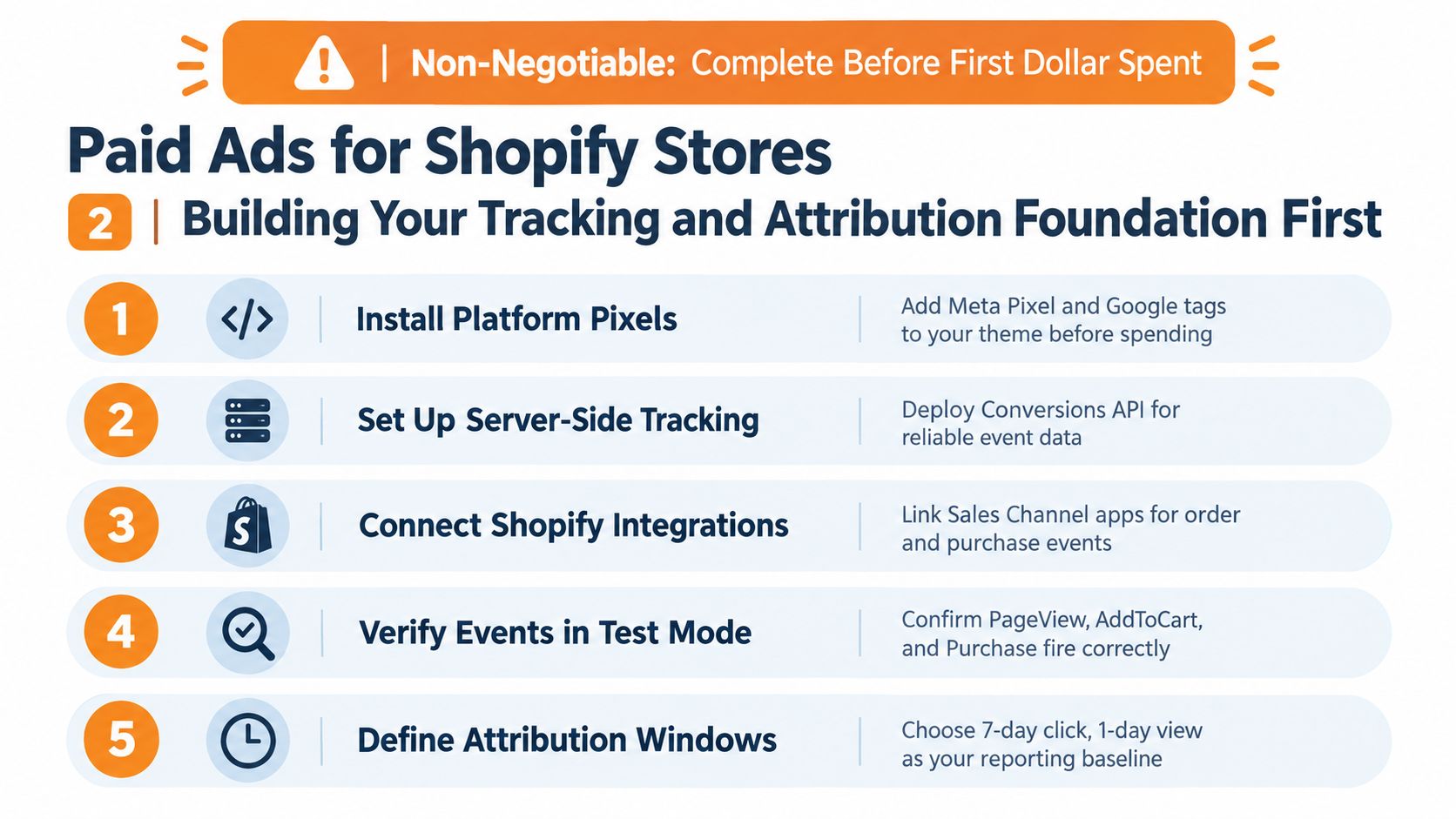
Install platform pixels and tags. Add the relevant Meta Pixel and Google tags to the Shopify setup, then confirm that page views, product views, carts, checkouts, and purchases have sensible parameters.
Add server-side event tracking. Browser events can be limited by consent choices, browser settings, and connectivity. Server-side events provide another measurement path, but they must follow applicable privacy requirements and must not create duplicate purchases.
Connect Shopify order data. Pass the actual order value, product details, order status, and Canadian-dollar revenue values into the reporting system. Keep refunds and cancellations visible rather than treating every recorded purchase as final revenue.
Deduplicate purchase events. Browser and server events should share an event ID. Without deduplication, one order can appear as two conversions and make ROAS look better than the store's bank account.
Test the complete journey. Place a test order and inspect the event in each platform. Check shipping, tax, consent behaviour, discount treatment, payment methods, and the handoff from checkout to confirmation.
The recommended pre-scale foundation is to install platform pixels and server-side tracking, connect Shopify order data, use Canadian-dollar revenue values, and deduplicate browser and server purchases with a shared event ID. Search advertising accounted for 46.4% of Canadian internet-ad spend and social media accounted for 26.8%, according to the Canadian mobile commerce data compiled by Statista. Those channel shares make measurement quality especially important for stores using both demand capture and demand generation.
Reconcile the numbers consistently
Use a consistent UTM convention that identifies the platform, campaign, audience type, creative angle, and product or offer. Keep naming stable enough that Shopify analytics, exported order data, and internal reports can be joined without manual interpretation.
Platform ROAS and Shopify revenue will disagree for legitimate reasons. A platform may claim a conversion after a click or view within its selected attribution window, while Shopify records the actual transaction and may receive direct, organic, email, or branded-search visits later. Attribution windows also overlap, so more than one platform can assign credit to the same order.
Measurement discipline: Treat platform reporting as directional optimisation data. Treat Shopify revenue, contribution margin, and cohort behaviour as the commercial ledger.
Before launch, write down the allowable acquisition cost for each product or product group. Include landed product cost, fulfilment, shipping subsidies, payment fees, discounts, returns, and any other variable cost that changes with the order. Then review attributed results alongside blended Shopify performance on a regular schedule, not only when a campaign appears to be winning.
For implementation details, use this practical resource on Google Ads conversion tracking. The specific tools may vary, but the principle doesn't: a campaign can't optimise reliably when the purchase signal is incomplete.
Launching Your First Campaigns and Testing Creative Properly
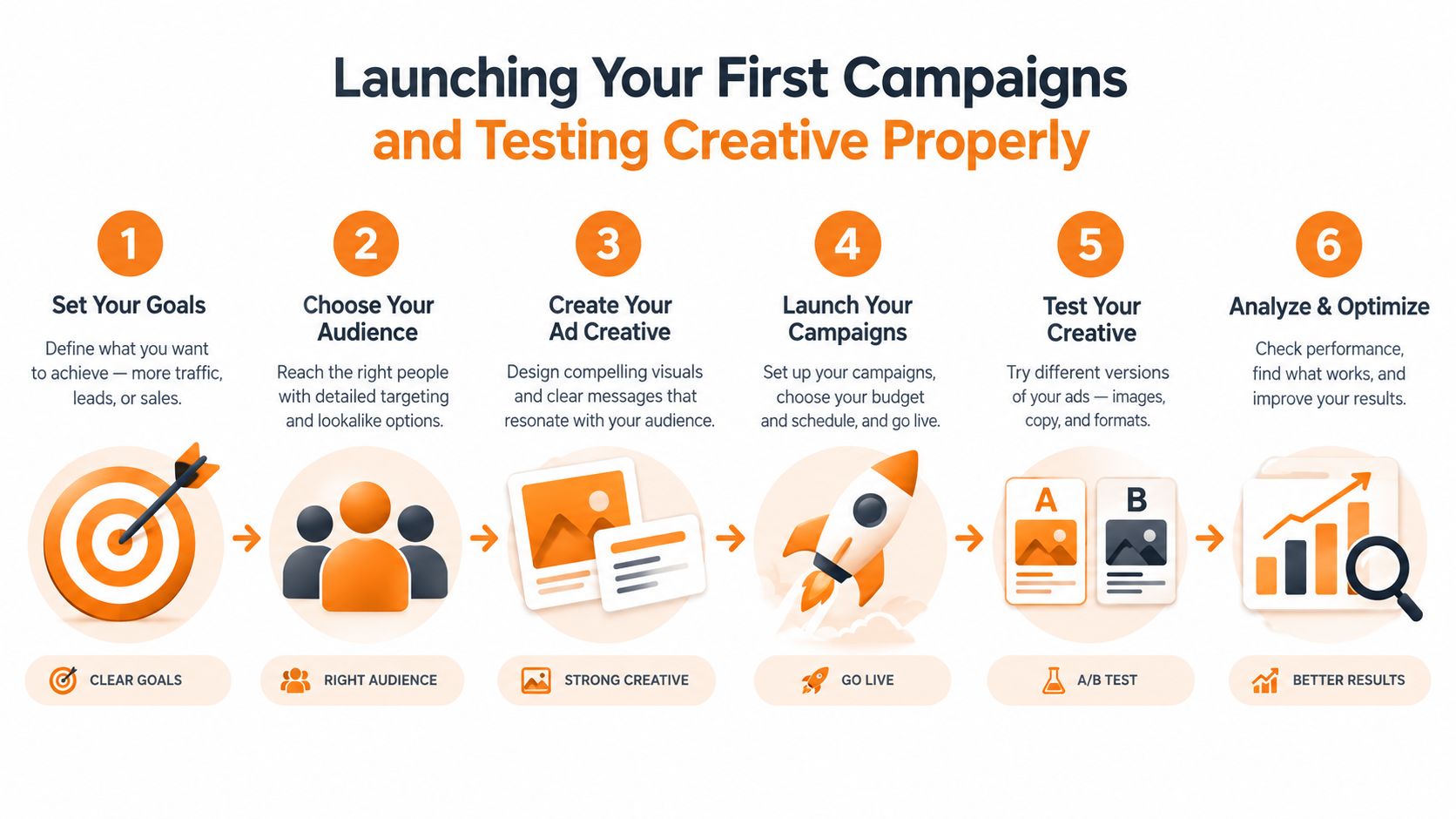
The first launch should answer a narrow question. It shouldn't attempt to identify the perfect audience, offer, format, landing page, bid strategy, and product catalogue simultaneously.
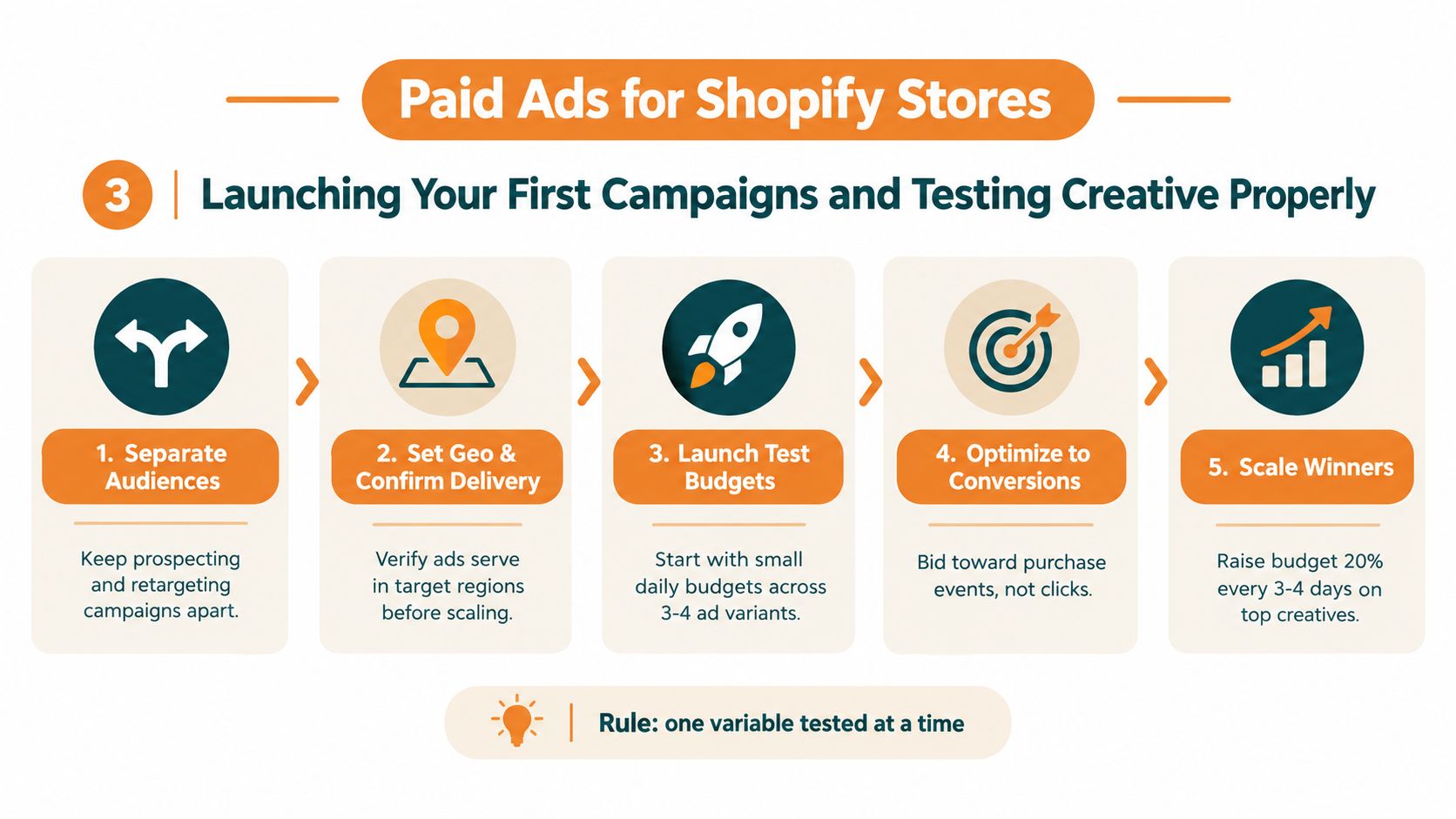
Separate prospecting from retargeting. Prospecting should reach people who aren't already customers or recent site visitors, while retargeting should address people who have shown meaningful intent. Mixing these audiences makes performance look stronger because existing demand receives credit inside a campaign intended to find new customers.
Keep the test controlled
Start with a defined geographic audience and confirm that ads deliver in the intended Canadian regions before expanding. If the store serves British Columbia first, validate delivery, shipping, taxes, and inventory there before assuming that a nationwide audience will behave the same way.
Optimise toward Purchase, not traffic or add-to-cart, once the store can provide a dependable purchase signal. Traffic optimisation often finds efficient clickers. Add-to-cart optimisation can favour people who show interest without completing payment. Neither action is the commercial outcome.
Launch at least three creative angles while keeping the landing page, audience structure, and budget conditions stable:
- Problem and solution: Show the customer situation, then demonstrate how the product resolves it.
- Proof and demonstration: Use product usage, reviews, comparison points, or an honest visual explanation of what arrives.
- Offer and value: Lead with the bundle, free-shipping threshold, introductory incentive, or product benefit, provided the order still meets margin requirements.
The creative test becomes difficult to interpret when every ad sends traffic to a different collection page or uses a different offer. Use intent-matched destinations instead. A search for a specific product should normally reach that product page, not a generic collection page that forces another choice.
Judge the test by economics
Hold the targeting and budget stable long enough to compare the creative fairly. Don't pause an ad because of one weak day, particularly when purchase volume is uneven or customers take time to decide. Instead, define a contribution-margin threshold before launch and evaluate whether the combination of ad cost and order economics can support continued spend.
A high click-through rate can reflect a strong hook, but it can also reflect a discount that attracts low-value orders. Look at landing-page views, carts, checkouts, purchases, revenue, refunds, and contribution margin together. If the creative earns attention but the product page loses buyers, the next test belongs on the site, not necessarily in the ad account.
Turning Ad Clicks Into Orders With Mobile-First CRO
Paid traffic exposes weaknesses that organic visitors may tolerate. A slow product page, unclear shipping policy, missing payment method, or price shown in the wrong currency can turn a campaign with promising platform metrics into an expensive source of abandoned checkouts.
About 34.5% of Canadian retail e-commerce in 2024–2025 occurred through mobile devices, according to Canadian e-commerce statistics compiled by Made in CA. Treat mobile as a primary testing environment, not a responsive afterthought. Audit every ad-to-checkout path on a real phone, using the same landing page, discount, location, consent experience, and payment flow a customer will encounter.
Test the page in commercial order
Prioritise product-page changes in this order:
- Offer clarity: State what the product is, who it serves, what the customer receives, and why the current offer matters.
- Primary image or video: Show the product in use at a readable scale, without forcing visitors to interpret the image.
- Trust proof: Use reviews, relevant certifications, guarantees, transparent policies, and clear business information.
- Shipping and returns: Show delivery expectations, costs, return conditions, and Canadian fulfilment details before checkout.
- Checkout friction: Remove unnecessary fields, confirm accepted payment methods, and test the complete purchase flow on the device.
Don't lead with decorative redesigns while shoppers still cannot understand the offer or delivery cost. A polished page cannot compensate for an unclear promise.
| Metric | Mobile | Desktop | Why It Matters |
|---|---|---|---|
| CPM | Report separately | Report separately | Shows the cost of reaching each device audience |
| Click-through rate | Compare by creative | Compare by creative | Indicates attention, not profitability |
| Landing-page view rate | Check load and engagement | Check load and engagement | Reveals the gap between clicks and usable visits |
| Add-to-cart rate | Diagnose product-page response | Compare with mobile | Shows product and offer interest |
| Checkout-start rate | Identify friction before payment | Compare with mobile | Helps isolate shipping or form problems |
| Purchase rate | Use Shopify reconciliation | Use Shopify reconciliation | Measures completed orders by device |
| CAC | Calculate from reconciled revenue | Calculate from reconciled revenue | Connects spend to acquisition economics |
| Contribution-margin ROAS | Include variable costs | Include variable costs | Shows whether growth is commercially sustainable |
The Americas median conversion benchmark was 2.88%, according to Dynamic Yield's benchmark data. Treat that figure as a comparison anchor, not a Canada-specific target. Your own margin, product category, device mix, consent coverage, and cohort performance should determine whether a page and campaign deserve more spend.
For a deeper technical audit, review mobile site optimisation for Shopify. Reconcile Shopify orders with ad-platform reporting before judging the result. A campaign with strong CTR can still produce low-margin orders when discounts attract weak economics or mobile checkout introduces unexpected costs.
Scaling Winning Ads Without Breaking ROAS
Scaling rarely fails because the winning ad suddenly becomes irrelevant. It fails because the team changes too many conditions at once, raises spend faster than the audience can absorb it, or mistakes platform attribution for incremental demand.
Use two forms of expansion. Vertical scaling increases budget on a proven campaign or creative combination. Horizontal scaling tests new audiences, placements, products, geographies, or creative formats. Vertical scaling is easier to interpret, while horizontal scaling can uncover additional demand but introduces more variables.
Increase budgets cautiously on combinations that remain below allowable acquisition cost. A budget increase can alter delivery, auction participation, audience composition, and frequency. If performance deteriorates, the answer isn't always to restore the old budget immediately. Check whether the new spend reached colder users, exhausted a narrow audience, or exposed a weak landing page.
Use blended economics as the decision layer
Calculate blended CAC from Shopify revenue and total paid spend, then compare it with platform-specific results. Google may claim demand captured from a product search, Meta may claim credit for an earlier impression or click, and TikTok may influence a customer who later searches the brand. Shopify may record the order under direct, organic, email, or another source.
A blended view doesn't eliminate attribution uncertainty. It stops the team from counting the same order as proof that every channel deserves more money.
Where feasible, preserve a control audience or use a geographic comparison to assess incrementality. The question is not only whether exposed users purchased. It's whether paid exposure generated more purchases than would likely have occurred without the campaign.
Scale condition: Expand only when CAC stays below allowable acquisition cost across multiple purchase cohorts, not because one reporting window looks attractive.
A practical scaling sequence is to preserve the winning product, offer, landing page, and creative angle while expanding one dimension at a time. Test a new audience without changing the offer. Add a new placement without rewriting the creative. Expand geography only after shipping, tax, and fulfilment economics remain sound.
Monitor repeat-purchase revenue separately from first-order contribution margin. A product with a credible repeat-purchase pattern may support a different acquisition threshold from a one-time purchase, but that assumption must be demonstrated in the store's own customer data.
Privacy Compliance, Common Pitfalls, and Your Next 90 Days
Targeting precision isn't the same as marketing quality. A narrow audience built from questionable data can create legal exposure, platform restrictions, and misleading attribution. A broader, consent-conscious campaign can work when the product promise, creative, landing page, and local intent signals are strong.
Canadian businesses must account for PIPEDA and applicable provincial privacy laws. Commercial data collection requires transparency about possible uses and consent obligations, and the Canadian advertising ecosystem is moving toward consent-based audience segmentation, contextual targeting, and privacy-conscious measurement, as outlined in the U.S. International Trade Administration's Canada e-commerce guidance.
Protect customer data and regulated audiences
Before uploading a customer list, document how the data was collected, what customers were told, which uses they consented to, and whether the intended platform use is compatible with that consent. Keep Canadian and U.S. audiences separated where their legal, commercial, shipping, and consent conditions differ. Don't assume that a customer who agreed to receive transactional communications also agreed to every advertising use.
For cannabis, CBD, functional mushroom, and health-and-wellness stores, avoid unsupported medical claims in both ads and landing pages. Don't build audiences from sensitive health inferences or imply that a person has a diagnosis, condition, or treatment need.
Safer approaches can include:
- Contextual targeting: Place ads beside relevant content or search themes without relying on sensitive personal profiles.
- Broad geographic targeting: Use location and product-market fit rather than fragile audience assumptions.
- Consent-based first-party data: Collect and record permission clearly, then use only data that matches the stated purpose.
- Aggregated measurement: Evaluate performance at a level that supports decisions without exposing unnecessary individual-level information.
- Privacy-conscious event design: Use server-side or enhanced measurement only where legally appropriate and configured with consent controls.
- Compliant landing pages: Describe ingredients, use, quality, and customer experience without unsupported therapeutic promises.
Over the next three months, repair the foundation first. In the opening phase, reconcile Shopify orders, event tracking, consent, product economics, and checkout performance. In the testing phase, run separated prospecting and retargeting campaigns with distinct creative angles and intent-matched pages. In the scaling phase, expand only the combinations that remain commercially viable across cohorts, while reviewing blended CAC and incrementality.
The most persistent mistakes are simple: optimising to platform ROAS alone, mixing new prospects with existing customers, sending traffic to generic collection pages, and judging a campaign by CTR. Clicks describe attention. Purchases describe behaviour. Contribution margin determines whether the behaviour is worth buying.
Juiced Digital offers paid advertising support across search, social, remarketing, conversion tracking, creative development, and ongoing optimisation for Shopify and other e-commerce stores. Visit Juiced Digital to discuss a measurement-first campaign strategy, CRO audit, or privacy-conscious growth plan for your store.