
A visitor lands on your product page, compares two options, adds one to the cart, and leaves. Your ad platform then reports an impressive retargeting return because the same person later converts after seeing your carousel. Meanwhile, the customer may have returned through branded search, email, or a direct visit, and your campaign may have received credit for a sale it didn't create.
That's the central problem with most retargeting ads strategy. Retargeting can shorten the path to conversion, but only when consent, intent, creative, exclusions, frequency, and incrementality work together. For Canadian advertisers, the opportunity is substantial. Internet advertising revenue in Canada reached C$18.2 billion in 2024, up 14% year over year, and programmatic advertising represented 62% of total internet advertising revenue, according to IAB Canada's 2024 revenue survey. The answer isn't showing the same ad more often. It's building a measured conversion layer around behaviour people have already shown.
Why Most Retargeting Budgets Disappear Without Results
A direct-to-consumer skincare brand allocates a large share of paid media to retargeting. Every website visitor enters one audience, everyone sees the same product carousel, and the campaign keeps running for weeks. Frequency rises, the creative becomes familiar, and platform-reported sales remain strong while total incremental sales stop moving.
That structure fails because it treats retargeting as a recycling bin for cold-audience spend. A visitor who read an ingredient guide, a shopper who reached checkout, and a previous customer who already purchased don't have the same objection or commercial value. Putting them in one ad set forces one message, one bid, and one exclusion policy onto several different decisions.
Practical rule: Retargeting should have a job before it has a budget.
A useful campaign stack gives each audience cell a distinct purpose:
- Nurture consideration: Help a recent visitor understand the product, service, ingredients, process, or proof behind the offer.
- Resolve hesitation: Give a high-intent viewer the information missing from the first visit, such as reviews, comparison details, availability, shipping, or booking access.
- Save the sale: Address cart abandonment or form abandonment with a relevant reminder and a direct route back to the exact conversion point.
- Reactivate selectively: Re-engage older audiences only when there's a meaningful reason to return, rather than paying to repeat an expired offer.
- Exit the funnel: Suppress purchasers, booked leads, and other converters quickly so the campaign doesn't advertise an already completed action.
The math also needs more discipline than a platform dashboard usually provides. A reported conversion can be correlated with an impression without being caused by it. A retargeting ad may assist a purchase, reinforce an existing decision, or appear before someone who was already going to buy. That's why incremental conversions, eligible audience size, frequency, and blended acquisition cost matter more than last-click ROAS alone.
The fixes are practical: build consent-aware audiences, separate intent by recency, sequence creative instead of repeating it, control bidding and exposure, connect online activity to offline outcomes, and validate lift with holdouts or geo-split testing. That approach is more work than placing every visitor into one generic audience, but it gives the budget a measurable purpose.
Building Consent-Aware Audiences and Recency Windows
Start with eligibility, not audience size. Canadian privacy guidance says browsing activity used for behavioural advertising requires knowledge and consent, and federal digital-advertising guidance identifies collection without audience consent or awareness as potentially privacy-invasive. The Office of the Privacy Commissioner of Canada's behavioural advertising guidance also explains why third-party suppliers generally require consent under applicable private-sector privacy legislation.
A reliable build sequence looks like this:
- Gate tracking through consent. Your consent-management platform should explain the purpose of advertising cookies and related events in plain language, provide a usable opt-out, and retain proof of the visitor's choice. Pass only eligible events to Google Ads, Meta, TikTok, LinkedIn, or a programmatic platform.
- Create behavioural cohorts. Separate product viewers, service-page visitors, cart abandoners, lead-form starters, purchasers, and lapsed customers. Keep the event definition narrow enough that the ad can answer the behaviour.
- Set recency tiers. A cart abandoner from yesterday needs a different message from a product viewer who visited several weeks ago. The test windows below are a practical starting point, not universal benchmarks.
- Apply exclusions before launch. Suppress converters, cancelled leads, and people who have already completed the campaign objective. For regulated categories, also exclude users whose consent state is unknown.
- Refresh audiences server-side. Browser identifiers disappear, consent changes, and CRM records become outdated. Regular audience synchronisation prevents deprecated IDs from silently inflating reported pool size.
You can use a structured audience segmentation strategy to document the event, consent requirement, message, landing page, and exit rule for every cohort.
| Recency Window | Audience Cohort | Bid Modifier | Frequency Cap | Exclude |
|---|---|---|---|---|
| 1–3 days | Cart abandoners and lead-form starters | Highest priority for qualified intent | Tight cap with creative rotation | Purchasers, booked leads, submitted forms |
| 4–14 days | Product or service viewers | Moderate priority | Controlled exposure across several assets | Converters and users with withdrawn consent |
| 15–30 days | Lower-intent visitors and content readers | Lower priority | Light reminder sequence | Converters and recent high-intent cohorts |
| Beyond 30 days | Lapsed or reactivation audiences | Test only when a relevant reason exists | Conservative exposure | Unqualified, unconsented, and already reactivated users |
Treat consent status as an audience field, not as a footnote in the implementation document. For Vancouver service businesses, municipality and service-page segmentation can be more useful than one province-wide audience. For e-commerce, pass product ID, value, currency, and consent state through supported event pipelines, then check that browser and server events aren't double-counted.
The size of the retargeting pool isn't a success metric. Cookie deletion and browser restrictions fragment identity, and users without valid consent must remain excluded. Report eligible audience size, match rate, frequency, incremental conversion rate, and cost per incremental lead or sale separately.
Sequential Creative and Messaging That Matches Intent
The creative should change as the visitor's decision changes. A person who abandoned a cart needs proof that removes the final obstacle. A visitor who only read an educational page may need a reason to trust the brand before a sales message feels appropriate.
For the 1–3 day hot window, use direct reminders tied to the known action. A dynamic product ad can show the item left in the cart, the exact service viewed, or a route back to the relevant booking page. Pair urgency with legitimate information, such as current availability, delivery expectations, return terms, or appointment access. Avoid manufactured scarcity.
For the 4–14 day warm window, move from reminder to reassurance. Useful formats include a short founder video, a review montage, a comparison chart, a product demonstration, or a case-study carousel. A local clinic might show the practitioner's approach and explain what happens after booking. A regulated brand may need education and compliant product framing before it can make a direct conversion ask.
For the 15–30 day lower-intent window, re-engage without training people to wait for discounts. Offer a useful guide, a consultation, a product education sequence, or a reason to revisit the category. The Canadian Marketing Association's 2025 consumer expectations research found that 73% of Canadians prefer digital ads relevant to their interests, while 87% are at least somewhat bothered by irrelevant information. Relevance should come from observed intent and clear value, not opaque personalisation.
Use three distinct assets per tier where production resources allow, and replace fatigued creative before the message becomes background noise. Keep a consistent visual signature so the audience recognises the brand without feeling followed across every site. Copy should lead with the visitor's behaviour, such as “Still considering this service?” or “Need more information before you choose?”, rather than opening with the company name.
Creative test: Change the objection, not just the colour of the button.
Rotate objection-handling calls to action through the sequence. One ad can lead with proof, another with availability, and another with a lower-friction next step. Don't send every audience to the homepage. Match the destination to the event, whether that's the product detail page, a comparison page, a booking form, or a useful resource.
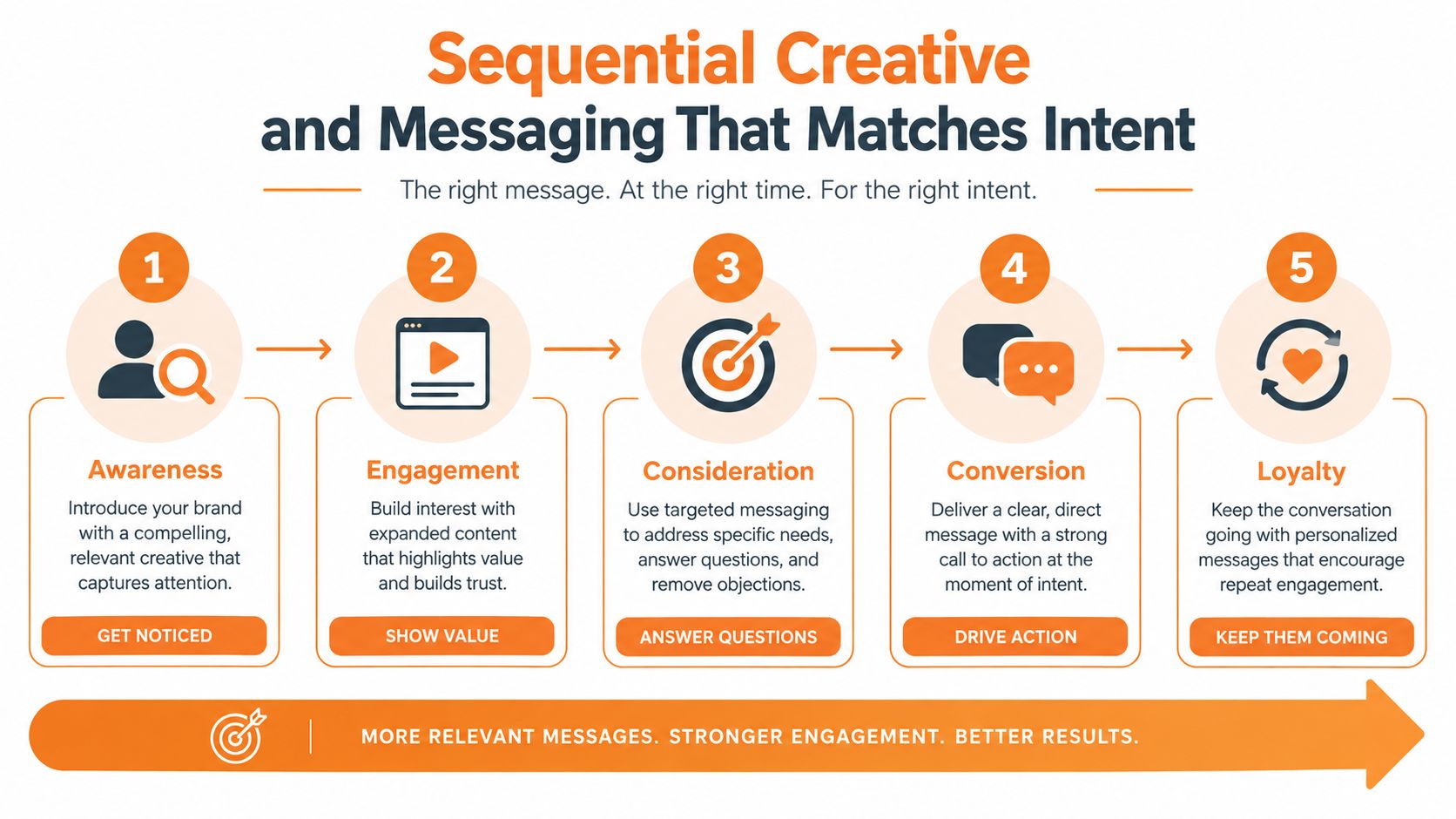
The sequence works best when each impression adds information. The following video can help teams visualise how creative should develop as intent becomes clearer.
Campaign Architecture Bidding and Frequency Controls
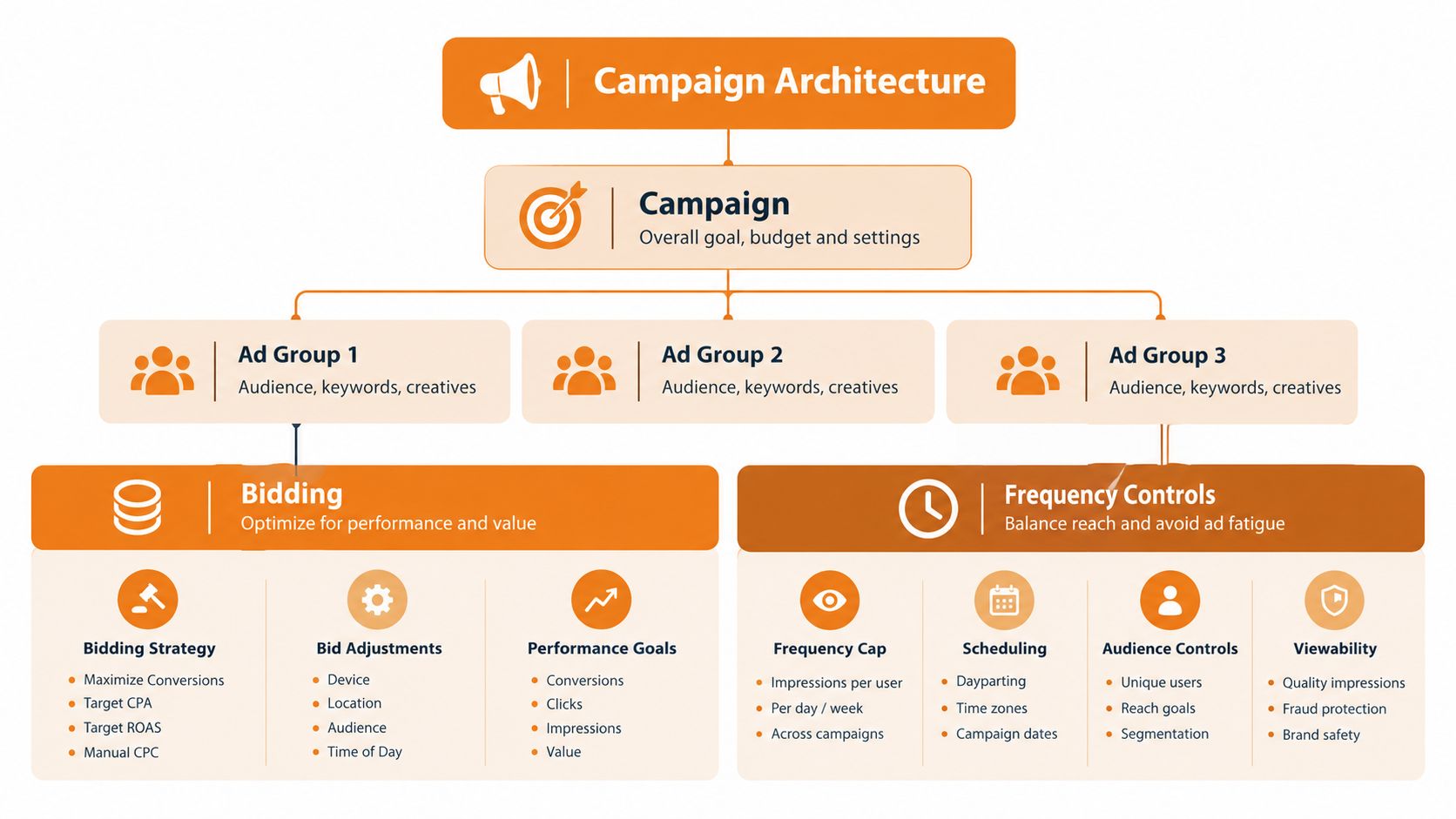
A retargeting campaign shouldn't be one oversized ad set with every visitor, every placement, and every creative. Separate the campaign by recency and intent so the team can tune bids, messaging, exclusions, and landing pages without disturbing the rest of the funnel.
A workable architecture across Google, Meta, and a programmatic DSP includes:
- Hot intent campaign: Cart abandoners, checkout starters, and high-value lead actions. Use the most direct creative and the strongest landing-page alignment.
- Warm consideration campaign: Product viewers, service-page visitors, and engaged content users. Optimise for proof, education, and qualified return visits.
- Reactivation campaign: Older audiences with a current reason to return. Keep this separate so it can't consume budget intended for active demand.
- Suppression layer: Purchasers, completed leads, staff, invalid records, and users without valid consent. Apply the layer across platforms, not only in one account.
Use consistent naming across platforms. Include the brand, channel, audience tier, event, recency, geography, creative theme, and consent state in the campaign taxonomy. Clean naming sounds minor, but it prevents reporting teams from comparing a Meta purchase campaign with a Google audience campaign that uses different eligibility rules.
Don't force automated bidding into a tier that lacks useful conversion signals. Start with a controlled optimisation event, validate the data, and move towards value-based bidding when the audience and conversion volume can support it. If a tier is too small or conversions are too sparse, manual controls and qualified traffic signals can provide a clearer learning path than letting an algorithm optimise against noisy attribution.
Frequency caps should reflect the buying cycle and the emotional tolerance of the audience. A high-consideration service may need fewer exposures than a frequently purchased consumer product, while a cart abandoner can justify tighter short-term pressure than a casual content reader. Use platform-level caps where available, then review delivered frequency by user, placement, cohort, and creative.
Canadian channel spending shows why this separation matters. In fiscal year 2023–2024, the federal government reported C$60.75 million in media placement, with 64% allocated to digital media. Display received C$23.92 million, search-engine marketing received C$8.23 million, and social media received C$6.51 million, according to the Government of Canada advertising report. Those figures aren't retargeting results, but they illustrate the different environments where prospecting, intent capture, and re-engagement need distinct measurement.
For teams reviewing PPC advertising management, the operational question is simple: can each campaign show who is eligible, what action they took, what message they saw, when they should exit, and whether the conversion was incremental?
Connecting Online Retargeting to Omnichannel Outcomes
A click isn't the finish line for a retailer, clinic, local service company, or appointment-led business. The customer may see an ad, search the brand later, call reception, visit a shop, install an app, or buy through a customer account. If reporting only accepts an online checkout as the final event, the campaign can appear weak when it influenced a valuable offline action, or appear strong because several channels claim the same conversion.
Start by defining the conversion path outside the ad platform. For a Vancouver retailer, that might include product-page visits, store availability checks, calls, directions, and purchases linked to a consented customer record. For a clinic, it might include service-page visits, booking starts, completed appointments, and repeat treatment activity. Each event needs an owner, a timestamp, a deduplication rule, and a clear consent basis.
Retargeting should reduce the time between recognised intent and completed action, wherever that action occurs.
Where consent allows, send qualified offline events back through the supported conversion tools in Google and Meta. Use CRM identifiers carefully, minimise event parameters, and separate a booked consultation from a completed sale. Don't let a page view, a call, an email open, and a purchase all count as equivalent outcomes.
Canadian shopping behaviour makes this connection particularly important. KPMG's 2025 Canadian consumer research reported that 51% of Canadians aged 12 and older prefer shopping in-store, compared with 40% who prefer online shopping. The same research highlighted frustrations involving inaccurate product descriptions, difficult returns, and shipping delays. A retargeting ad that repeats a discount won't resolve a fulfilment concern. An ad showing local stock, delivery expectations, return terms, reviews, or appointment availability might.
Keep click-through and view-through conversions as separate assisted layers. Use first-party CRM data, store-visit signals where available, call tracking, and geo-lift analysis around locations to test whether exposure corresponds with real business outcomes. The question isn't which platform gets the last click. It's whether qualified people convert more often, sooner, or at a healthier contribution margin because the retargeting programme exists.
Measuring Incrementality Instead of Platform ROAS
Platform ROAS answers a narrow question: what value did the platform assign to conversions after delivery? It doesn't answer the question a finance leader usually asks, which is what would have happened if those people hadn't seen the ads.
Build a holdout inside each meaningful retargeting pool. Eligible users are randomly assigned to receive the campaign or remain unexposed, subject to the platform and privacy controls available to your team. Compare conversion rate, revenue, contribution margin, and time to conversion between groups. A geo-split test can provide a second view when audience-level experimentation isn't practical, especially for local businesses with defined service areas.
The analysis should also check channel substitution. If retargeting produces more platform-reported purchases while organic, email, or branded search loses equivalent volume, the campaign may be claiming demand rather than creating it.
| Metric | Platform Dashboard | Incrementality Test |
|---|---|---|
| Conversion credit | Assigns credit based on platform attribution settings | Compares exposed users with a valid control group |
| Revenue view | Reports attributed revenue | Measures additional revenue above the control baseline |
| Channel overlap | May include conversions influenced by other channels | Tests whether retargeting adds value beyond existing demand |
| Optimisation decision | Follows reported ROAS and platform signals | Uses incremental CPA, contribution margin, and lift |
| Budget defence | Shows what the platform claims | Shows what the business gains because of the campaign |
Track cost per incremental conversion, baseline conversion rate, frequency, audience eligibility, and the time from first exposure to conversion. A campaign that produces efficient incremental bookings can deserve more budget even if its dashboard ROAS looks less dramatic than a heavily branded audience. A campaign that only converts people who were already likely to buy needs restructuring.
For a deeper framework on the limits of last-click reporting, use marketing attribution models as a planning reference. The practical standard remains the same: make the control group part of the campaign design, not an afterthought added during a quarterly review.
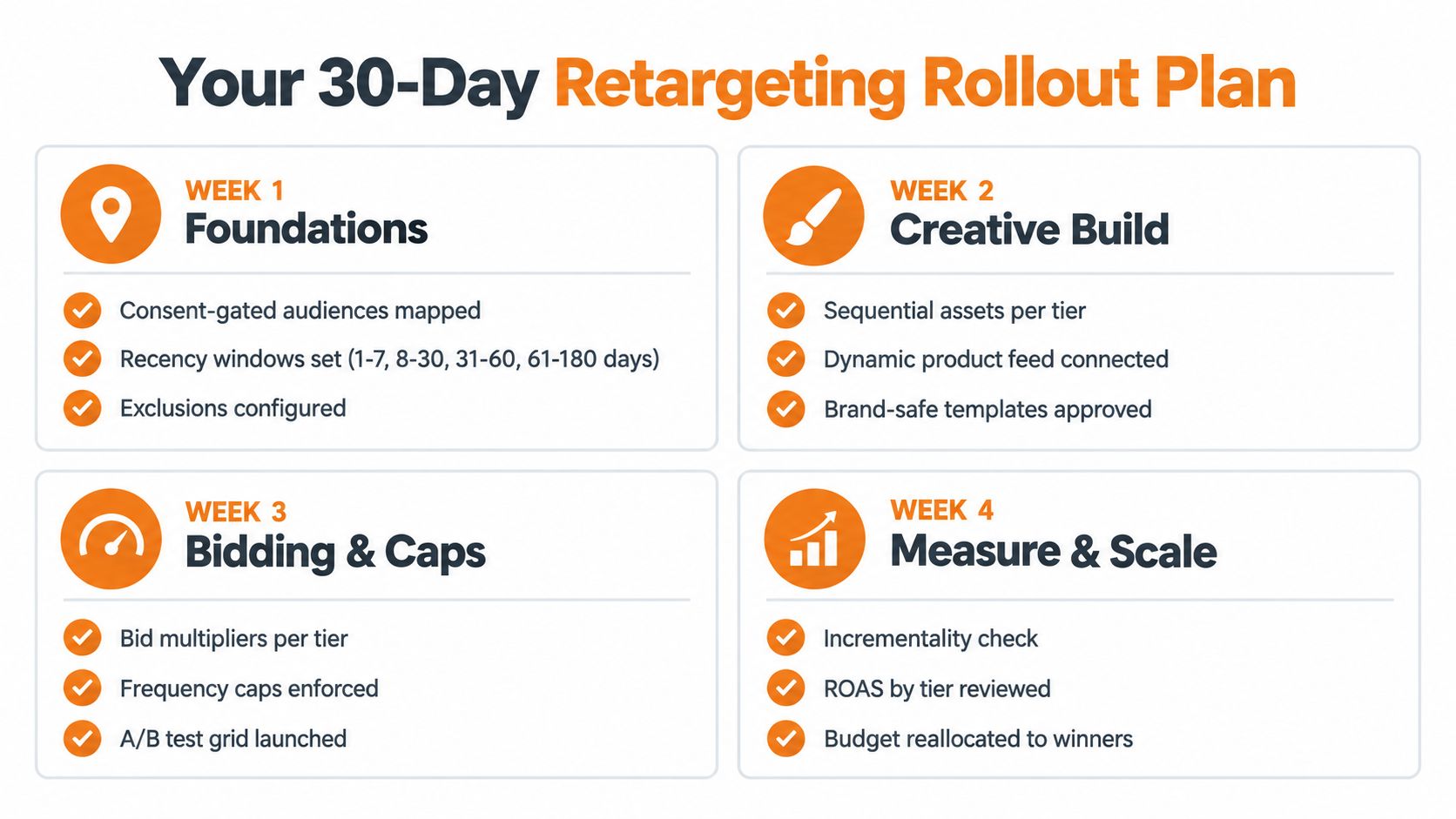
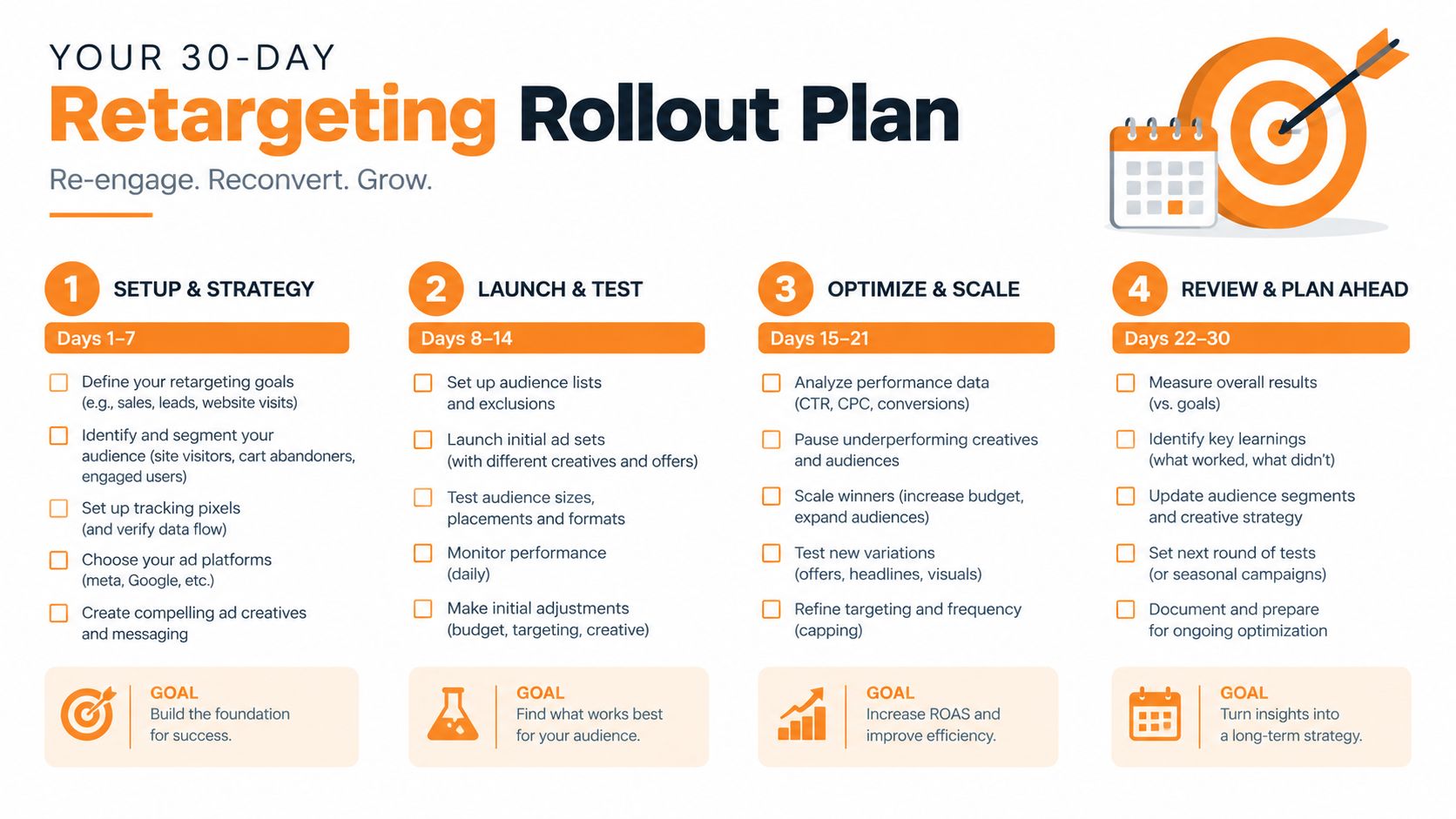
Your 30-Day Retargeting Rollout Plan
A strong rollout starts with clean eligibility and ends with a budget decision based on evidence. Assign an owner for consent, audience logic, creative, media operations, analytics, and commercial reporting before launch.
Week one builds the foundation
Map consent states, events, cohorts, recency windows, exclusions, and conversion definitions. Audit browser and server event deduplication, check that purchasers leave the appropriate audiences, and document what happens when consent is withdrawn.
Pause or fix before launch if an audience includes unknown-consent users, if converters remain eligible, or if the destination page doesn't match the event that created the audience.
Week two builds the message sequence
Create urgency and proof assets for high-intent users, trust and education assets for consideration audiences, and a useful reactivation message for older visitors. Connect the product feed where dynamic creative is appropriate, and approve brand-safe templates for regulated categories.
Rotate or pause a creative when frequency rises while engagement quality or conversion quality declines. Don't respond to fatigue by adding more budget to the same asset.
Week three organises delivery
Separate campaigns by intent and recency across Google, Meta, and programmatic placements. Set bidding around the strongest validated signal available for each tier, enforce frequency controls, and use consistent naming so the reporting layer can compare cohorts accurately.
Reallocate cautiously only after checking consented reach, match rate, delivered frequency, assisted outcomes, and landing-page performance. Keep prospecting and retargeting objectives separate.
Week four tests the business impact
Launch a holdout or geo-split test, compare exposed and control groups, and review incremental conversions, incremental cost per acquisition, revenue quality, and contribution margin. Record baseline performance before changing the audience or creative so the team can distinguish learning from random fluctuation.
Investigate before scaling if platform ROAS rises but incremental performance stays flat, if offline conversions aren't being matched, or if organic and email conversions decline alongside the campaign launch.
The common pitfalls are predictable: cookie loss makes audiences look smaller or inconsistent, audience bleed mixes intent levels, creative fatigue increases irritation, and last-click attribution overstates the campaign's contribution. The next iteration should begin with the largest verified constraint, whether that's consent coverage, poor product-page conversion, weak proof, excessive frequency, or a control group showing little lift.
Juiced Digital helps Vancouver businesses and North American e-commerce brands connect consent-aware audiences, paid media, conversion optimisation, and measurable reporting into a practical retargeting ads strategy. Visit Juiced Digital to request a consultation and identify where your current campaigns are creating incremental demand, losing it, or merely taking credit for conversions that were already likely.