
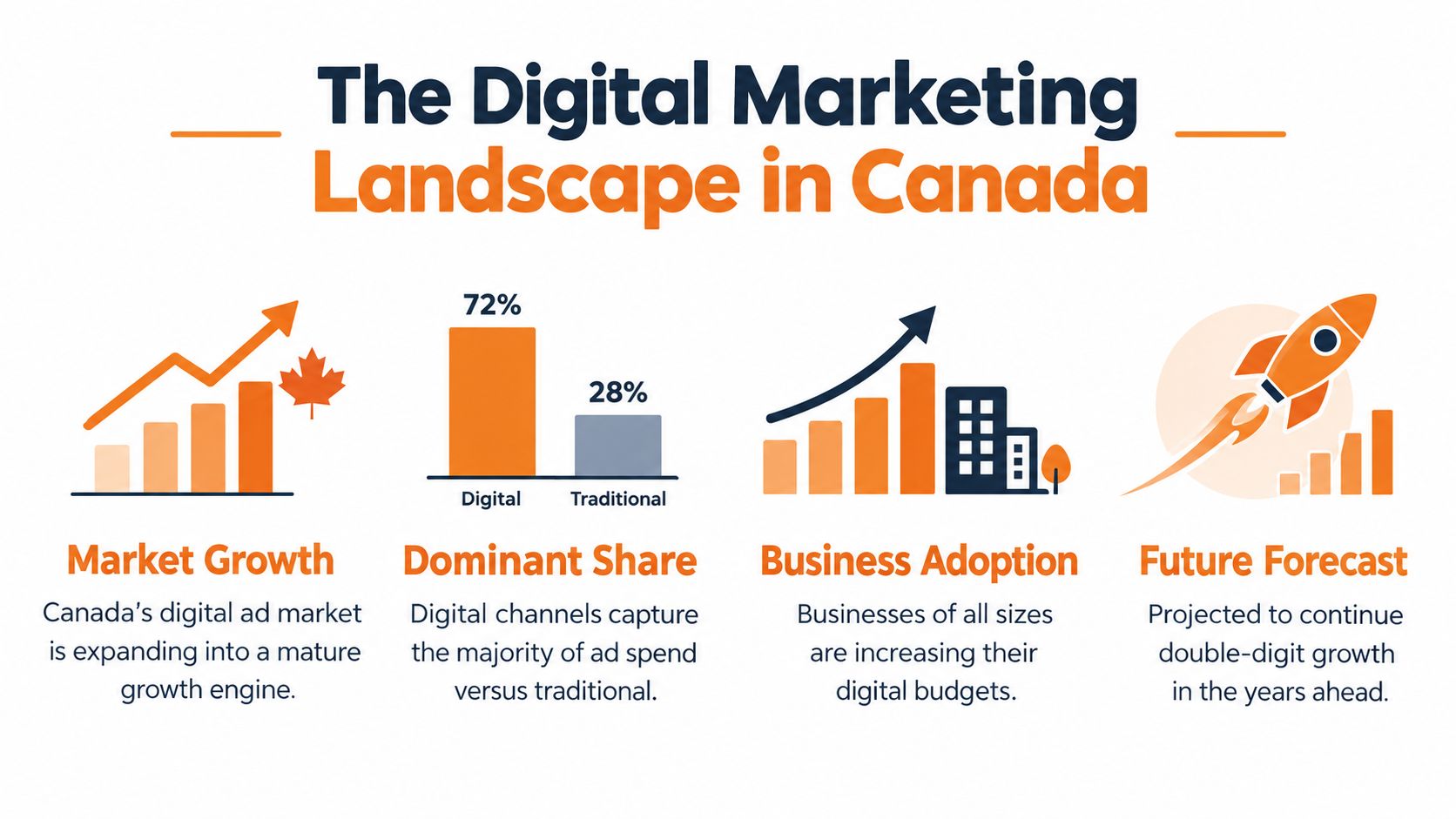
Effective digital marketing and SEO services should turn visibility into qualified enquiries and sales, not just rankings. Canada's digital advertising market is forecast to reach about CAD 26.2 billion in 2026, while 38.2 million people were online at the end of 2025, with 95.1% internet penetration.
A Vancouver business owner can spend an afternoon comparing agency proposals and still struggle to understand what they're buying. One agency promises first-page rankings, another leads with AI search optimization, and a third reports impressions, clicks, and engagement without explaining whether any of it produced a booked consultation or completed order.
That confusion is expensive. Search visibility matters, but a ranking that attracts the wrong visitor is a vanity metric. A technically polished website that doesn't persuade visitors to call, buy, or enquire is also underperforming.
Modern digital marketing and SEO services should connect four things: how people discover a business, why they trust it, what happens when they arrive, and whether the investment produces commercial value. That means combining organic search, paid media, local presence, useful content, reputation, analytics, and conversion rate optimization rather than handing each channel to a separate silo.
How Digital Marketing Works in Canada Today
A Vancouver wellness company can publish useful content, earn strong rankings, and still lose a sale when an AI-generated answer, map listing, or review site shapes the buyer's decision first. A cannabis business faces an added constraint: visibility must support trust and conversion without crossing regulatory boundaries. The winning approach connects discovery with evidence, compliant messaging, and a clear next action.
The IAB Canada revenue survey forecasts Canada's digital advertising market at about CAD 26.2 billion in 2026, up 4% from an adjusted 2025 base of CAD 24.5 billion. The practical implication is straightforward. Paid and organic channels now deserve a defined role in growth planning, not an isolated marketing experiment.
Visibility now extends beyond rankings
Traditional SEO focused on the ten blue links. Rankings still matter, yet a buyer may encounter a map profile, AI-generated answer, product result, review platform, video, or branded result before visiting a company's site.
Canadian-facing AI optimization coverage from Semrush reflects the move toward structured information, trust signals, and contextual relevance. The commercial question is no longer only, “What position do we hold?” It is, “Where does our brand appear when a buyer asks a relevant question, and does that appearance create enough confidence to act?”
For cannabis and wellness brands, this requires careful coordination. Claims, product descriptions, educational content, and testimonials must support informed decisions while respecting applicable Canadian rules. A technically visible page that creates compliance risk is not a marketing win.
Practical rule: Track visibility by intent, not by a single ranking. A service business should measure presence across urgent local searches, comparison searches, and branded searches, then connect each appearance to qualified leads or sales.
Business owners seeking a broader view can review the growth of marketing. The useful conclusion is not that every company needs every channel. Marketing activity should follow the buyer's commercial journey, with clear ownership and measurement from discovery to conversion.
Core Services That Drive Real ROI
The right service mix depends on the business model, margin, buying cycle, and level of competition. A Vancouver plumber, a national e-commerce brand, and a regulated wellness company shouldn't receive the same template with their logo added.
Start with the customer journey. Identify the searches and questions that indicate a problem, the pages that answer those questions, the proof that reduces hesitation, and the action that creates value. Then assign channels to each stage.
What the core mix should accomplish
AI-era SEO goes beyond placing a keyword in a title. It involves understanding search intent, building topic coverage, improving internal links, clarifying entities and relationships, and structuring answers so search systems can interpret them accurately. AI tools can help identify content gaps, cluster queries, review large datasets, and accelerate analysis, but human judgement still decides whether a claim is accurate, useful, and appropriate for the brand.
Technical SEO makes the site easier to crawl, interpret, and use. The work can include indexation controls, page speed improvements, canonical decisions, structured data, broken-link remediation, mobile usability, and clean information architecture. Technical work rarely produces a compelling presentation for a boardroom, but it prevents strong content from being buried or misrepresented.
Local SEO gives service businesses a way to compete for nearby demand. The practical work includes Google Business Profile optimisation, location-specific pages, consistent business information, review processes, local schema, and content that reflects the actual areas served. A company that says it serves “all of British Columbia” without useful local proof often looks less credible than a company that clearly explains its Vancouver, Burnaby, or Surrey service coverage.
Paid media creates controlled access to demand, but it doesn't repair a weak offer. Search ads can capture urgent intent, while paid social can introduce a product or retarget an interested visitor. Campaign structure, landing-page relevance, negative keyword management, creative testing, and conversion tracking determine whether paid traffic becomes a useful acquisition channel or an expensive stream of clicks.
Conversion rate optimization asks what happens after the visit. The answer may involve clearer service pages, stronger calls to action, shorter forms, better product information, trust elements, or improved mobile navigation. More traffic isn't a substitute for a page that makes a customer work too hard to understand the next step.
Later in the system, digital PR and content distribution can strengthen brand recognition and earn relevant third-party attention. They work best when tied to a credible point of view, useful research, expert commentary, or a truly newsworthy development, not when an agency distributes generic articles only to create links.
This guide to content marketing ROI is useful when a team needs to connect editorial work with commercial outcomes. The important distinction is between publishing for activity and publishing to answer a defined question for a defined buyer.
A siloed provider may optimise one channel while another provider undermines the result. An SEO team can drive visitors to a weak landing page, a paid media team can scale an offer that doesn't convert, and a content team can publish claims that create compliance risk. An integrated plan prevents those handoffs from becoming blind spots.
Why Local and E-commerce SEO Matters
Local and e-commerce SEO look different on the surface, but both depend on matching a page to a specific intention. A Vancouver physiotherapy clinic needs to be discoverable when someone seeks treatment nearby. An online retailer needs category and product pages that help a shopper compare options, understand suitability, and complete a purchase.
Canada's connected audience makes this work foundational. At the end of 2025, the country had 38.2 million internet users, 95.1% online penetration, and 42.4 million active cellular connections, equivalent to 106% of the population, according to the Canadian digital usage data cited by Amra & Elma. For a British Columbia business, mobile usability isn't a secondary refinement. It affects how people find the business, evaluate it, and contact it while away from a desktop.
Local intent needs local evidence
A local page should do more than insert a city name into a generic paragraph. It should explain the service, identify the location genuinely served, show relevant experience, answer local questions, and make contact straightforward. Google Business Profile categories, service details, photos, reviews, opening information, and location signals should agree with the website.
Reviews deserve careful handling. Asking every customer for a review without a process can produce inconsistent language and missed opportunities. A better approach makes review requests timely, responds professionally to criticism, and uses recurring customer questions to improve service pages and FAQs.
For an audit, examine:
- Discovery: Check whether the business appears for service-and-location searches, map results, and branded queries.
- Accuracy: Compare the website, Google Business Profile, directories, and contact details for conflicting information.
- Conversion: Test the mobile call button, enquiry form, booking flow, and page clarity from a new customer's perspective.
- Trust: Review testimonials, credentials, policies, staff information, and evidence supporting important claims.
A focused local SEO audit should connect each finding to a business consequence. “The title tag needs improvement” is less useful than “This service page doesn't clearly match the search intent, and visitors have no obvious route to book.”
E-commerce depends on stability
For Canadian e-commerce stores, organic search accounted for 70.7% of total site traffic in one 2026 Canada report. The same report recorded average organic sessions falling 16.4% month over month and 6.3% year over year, which shows why retailers that rely heavily on search can't treat small visibility losses as harmless fluctuations. The figures and their context are documented in the Canada e-commerce industry report.
The operational response is not to publish more articles at random. Retailers should protect category pages, improve internal linking, resolve indexation problems, use appropriate product and review structured data, and make mobile shopping effortless. They should also separate informational content from commercial pages so each asset has a clear job.
SEO can stabilise acquisition, but it won't eliminate volatility. Inventory changes, competitors, algorithm updates, seasonality, technical releases, and shifting demand all affect performance. Strong teams monitor the full path from impression to revenue, then decide whether the problem is visibility, relevance, merchandising, or conversion.
Navigating Regulated Industries and Compliance
Cannabis, CBD, functional mushrooms, wellness, and health-related businesses can't use the same growth playbook as an unrestricted consumer brand. They need visibility, but they also need claims that can withstand scrutiny, landing pages that respect platform policies, and customer journeys that attract appropriate demand.
The Canadian local SEO guidance from Search Gurus identifies the tension clearly. Regulated and trust-sensitive businesses must balance compliance, reputation, and conversion, while many marketing programmes still focus on broad traffic without explaining how that traffic becomes qualified demand.
Two approaches produce different risks
A volume-first agency usually starts with high-demand keywords and aggressive publishing. That approach can create reach, but it may also attract people outside the service area, shoppers seeking products the business can't promote in that format, or visitors looking for claims the brand can't responsibly make. Large traffic reports can conceal weak lead quality and unnecessary compliance exposure.
A trust-first programme starts with the customer and the permitted claim. It maps topics by intent, reviews language before publication, strengthens author and business information, and uses clear product or service explanations. It may pursue fewer opportunities, but those opportunities are more likely to align with the offer and the rules.

Compliance belongs inside the workflow
A responsible programme brings marketing, legal review where appropriate, and commercial teams into the same process. It should distinguish education from promotion, avoid unsupported health outcomes, present limitations plainly, and keep product information consistent across the site, profiles, advertising, and third-party references.
AI can help a team classify queries, find missing explanations, analyse competitor language, and identify patterns in customer questions. It shouldn't be allowed to publish medical, health, or product claims without review. A fluent sentence can still be inaccurate, non-compliant, or poorly matched to the evidence.
Digital PR has a specific role here. A thoughtful expert contribution, credible interview, or useful educational resource can build authority without relying on exaggerated promises. Reputation management matters just as much because reviews, public responses, and branded search results influence whether a cautious buyer trusts the business.
In regulated marketing, qualified demand is more valuable than impressive reach that creates policy problems or produces enquiries the business can't serve.
The best strategy integrates technical SEO, compliant content, local signals, paid media controls, digital PR, and conversion design. Siloed tactics create gaps. A content team may make a risky claim, a paid team may promote an unsuitable page, or a local team may optimise a listing without understanding the restrictions around the category. One accountable strategy reduces those contradictions.
Choosing the Right Digital Marketing Partner
An agency presentation can make every service sound essential. The more useful question is whether the agency can make clear decisions about what not to do.
Start by asking how the team defines a qualified conversion. For one company, it's a phone call from a service-area customer. For another, it's a completed purchase with acceptable margin. A newsletter signup, map view, or page visit may matter, but it shouldn't be treated as revenue unless the business has established that connection.
Questions worth asking before signing
- Industry judgement: Can the team explain the restrictions, buying behaviour, and trust requirements in your category without resorting to generic promises?
- Measurement: Which events will be tracked, where will the data be stored, and how will the team distinguish organic, paid, branded, and assisted conversions?
- Technical ownership: Who handles site changes, structured data, redirects, indexation, analytics quality, and release checks?
- Content governance: Who approves claims, sources, authorship, product details, and updates in regulated or sensitive subject areas?
- Commercial alignment: Will the reporting connect activity to leads, bookings, sales, margin, or pipeline quality rather than stopping at impressions?
- Exit conditions: Can you understand the scope, renewal terms, access rights, and deliverables without signing a long commitment based only on promises?
The partner's working process matters as much as its tool stack. Platforms such as Google Search Console, Google Analytics, Looker Studio, Microsoft Clarity, Ahrefs, Semrush, and Screaming Frog can reveal useful evidence, but software doesn't decide whether a page is persuasive or whether a keyword attracts the right customer.
Expertise should change the plan
A local contractor may need service-area architecture, call tracking, review processes, and landing-page testing. An e-commerce brand may need category strategy, product schema, faceted navigation controls, international targeting, and merchandising support. A cannabis or wellness company needs all relevant technical work plus claim governance, reputation protection, and careful channel selection.
Juiced Digital is one Vancouver-based option that combines AI-driven SEO, paid advertising, conversion rate optimization, digital PR, local SEO, e-commerce SEO, and AI search optimisation for local businesses, e-commerce brands, and regulated sectors. The useful evaluation isn't whether an agency lists those services. It's whether the proposed work reflects your customers, restrictions, margins, and capacity to act on recommendations.
A credible partner will identify dependencies early. If the website can't support proper tracking, if nobody approves content, or if sales teams don't follow up with leads, the agency should say so before promising growth. Honest constraints are a sign of competence, not a lack of ambition.
Measuring Success and Maximizing Impact
Measurement begins with a business outcome and works backwards. If the objective is more qualified Vancouver enquiries, track enquiry quality, booked appointments, phone outcomes, location, service type, and the pages that assisted the decision. If the objective is e-commerce growth, connect organic landing pages to product views, add-to-cart behaviour, completed orders, and margin where the data allows.
Canadian search remains heavily concentrated around Google. A Canada-focused SEO report estimates Google's market share at about 92% to 93%, with mobile responsible for roughly 65% of Canadian organic search traffic. Those estimates are reported by Toronto SEO's Canadian SEO industry report, and they support a practical priority for Canadian teams: mobile-first pages, accurate local intent, and Google Business Profile management deserve close attention.
Build a measurement chain
- Set the commercial definition. Decide what counts as a valuable lead, booking, sale, or assisted conversion before launching campaigns.
- Audit the data. Confirm analytics events, call tracking, form submissions, revenue imports, consent settings, and channel attribution are working well enough to support decisions.
- Create an intent view. Group performance by service, product, location, and stage of the buying journey rather than relying on one blended traffic number.
- Review quality. Ask sales or customer service whether leads are relevant, reachable, and commercially viable. A dashboard can't judge every lead.
- Test the bottleneck. Improve the weakest part of the journey, whether that's visibility, message match, trust, page speed, form design, or follow-up.
- Reallocate deliberately. Keep funding work that creates useful demand, reduce activity that produces noise, and document why each change was made.
Rankings still have diagnostic value. They can reveal whether a page is gaining relevance, losing coverage, or competing against the wrong intent. They shouldn't be the final score.
The same applies to AI-era visibility. Track whether your business is represented accurately in search answers, whether important pages are easy for systems to interpret, whether local information is consistent, and whether branded searches lead to a trustworthy experience. A business may receive fewer website clicks because a search system answers a question directly. That isn't automatically a failure, but it makes brand recall, qualified actions, and assisted conversions more important.
The useful report is the one that changes next month's decisions. If a metric doesn't influence budget, content, technical work, or sales follow-up, it probably doesn't belong at the centre of the report.
Juiced Digital helps Vancouver businesses, North American e-commerce brands, and regulated companies combine AI-driven SEO, paid media, conversion rate optimization, local and e-commerce search, and digital PR around measurable growth. Visit Juiced Digital to request a focused consultation or audit and identify where search visibility is being lost between discovery and revenue.