

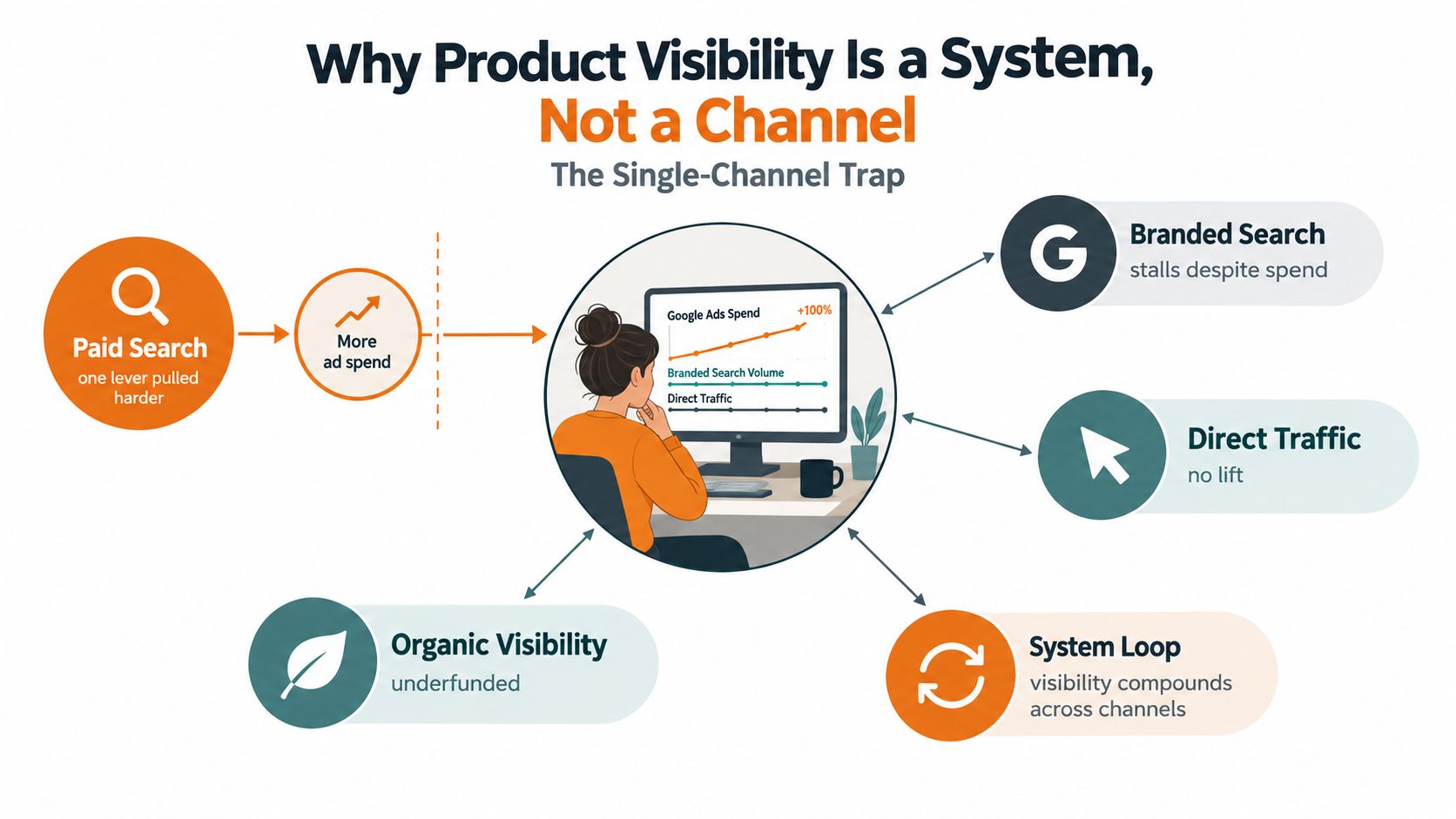
A founder sees a flat quarter and makes the familiar move: Google Ads spend goes up, but branded searches stay flat, direct traffic doesn't move, and the extra clicks become more expensive to convert. The problem usually isn't a lack of effort. It's that paid search is being asked to create demand, capture demand, build trust, and close the sale on its own.
Product visibility works differently. Buyers discover products through search results, map listings, marketplaces, social platforms, review sites, media coverage, and AI-generated answers. To understand how to increase product visibility, you need to connect those surfaces into a system that earns attention, explains the offer clearly, and makes purchase easy.
Why Product Visibility Is a System, Not a Channel
The founder in that scenario hasn't necessarily made a bad advertising decision. Paid media can produce fast traffic and reveal which messages attract buyers. The mistake is treating it as the entire visibility strategy. If the product has weak organic coverage, inconsistent listings, little third-party validation, or a product page that creates friction, increasing the budget only sends more people towards the same leaks.
Product visibility is the share of qualified buyer attention a brand captures across the places its audience uses. A ranking is one signal. It isn't the whole outcome. A shopper may first encounter a product in Google, compare it on Amazon, check reviews on a marketplace, verify the business in Google Maps, and return through a branded search before buying.
The six layers that reinforce one another
A practical visibility system has six connected layers:
- Organic search captures durable demand through category pages, product pages, editorial content, images, and answer-focused content.
- Local search connects regional products and services with map results, business profiles, reviews, and location-specific queries.
- Marketplaces place the offer inside an environment where shoppers already have strong commercial intent, but the brand gives up some control over the customer relationship.
- Paid media creates speed. Google Shopping, Performance Max, Meta, and other platforms can test demand before organic coverage has matured.
- On-site merchandising turns exposure into action through clear benefits, useful specifications, credible proof, and a low-friction checkout.
- Digital PR and earned visibility provide third-party validation, links, mentions, and branded demand that a brand's own channels can't create alone.
These layers don't need equal investment. A local Vancouver clinic may prioritise its Google Business Profile and service-area pages, while a North American ecommerce brand may put more resources into feeds, marketplace listings, and product-led content. The right mix depends on the audience, buying cycle, margins, regulation, and available capital.
Practical rule: Use paid channels to accelerate learning, not to conceal weak foundations.
The trade-off is straightforward. Quick wins can create traffic before the rest of the system is ready, while compounding work takes longer but can reduce dependence on rented attention. Regulated categories add another constraint. Cannabis, CBD, and functional mushroom brands can't just copy a generic ecommerce playbook, increase keyword density, and expect every advertising platform to accept the result. Compliance, evidence, and trustworthy product information become part of visibility itself.
Winning Organic Search With SEO Foundations
Canadian ecommerce brands have a strong reason to protect organic visibility. An industry report found that organic search delivered 70.7% of total traffic to Canadian ecommerce stores in August 2026, while average monthly visitors fell to 94,210, down 12.2% from July and 14.9% year over year. Average organic sessions reached 66,600.9976, a 16.4% month-over-month decline and a 6.3% year-over-year drop, according to the Canada ecommerce industry report. The lesson isn't that every brand should abandon paid media. Losing a dominant organic acquisition layer can leave a larger gap than a short campaign can comfortably replace.
Start with the pages closest to a transaction.
Make product pages match the buying question
A product title should identify the product and its most important differentiator without forcing awkward keyword repetition. The H1 should reinforce what the item is and who it serves. The opening copy should answer the buyer's immediate question, such as what the product does, which use case it fits, what it contains, or how it differs from a competing option.
A useful product page usually includes:
- Benefit-led copy: Explain the outcome before listing secondary features.
- Scannable specifications: Put dimensions, ingredients, materials, compatibility, usage, shipping, and warranty details where buyers can find them.
- Comparison content: Help shoppers distinguish variants without opening several tabs.
- Internal links: Link from relevant category pages, buying guides, and educational articles to the product or collection that fulfils the intent.
- Visual context: Use descriptive filenames, accurate alt text, multiple views, and product imagery that supports image search and visual discovery.
Avoid publishing blog posts just because a keyword tool produced a long list. If an existing product page already has impressions but weak engagement, improving its hierarchy, answers, imagery, and proof may create more value than adding another informational article.
Remove technical barriers before expanding the catalogue
Large catalogues often create their own search problems. Faceted navigation can generate near-duplicate URL combinations, while discontinued products can leave valuable links pointing to empty pages. Set clear canonical rules, control crawlable filter paths, consolidate thin variants where appropriate, and ensure important products are reachable through the internal link structure.
Review page speed and Core Web Vitals, especially on mobile product templates. Compress images without making them unusable, defer non-essential scripts, and test the purchase path on real devices. Search engines need to discover the page, but buyers also need to see the product, understand the offer, and complete the transaction without delay.
Give search engines and answer engines usable evidence
Implement relevant Product, Offer, Review, and FAQ schema only when the visible page supports the markup. Structured data won't repair inaccurate pricing, missing availability, or vague copy. It helps machines interpret details that are already present.
Add concise answer blocks for common questions, including ingredients, suitability, delivery, returns, use instructions, and comparisons. A practical AI search approach also includes a review of how pages are organised for retrieval, whether the catalogue is represented consistently, and whether an llms.txt file fits the site's technical governance. The wider principle is covered in this guide to AI SEO optimization. Write for a buyer first, then make the same information easy for search systems and assistants to extract.
Owning Local Search in Vancouver and BC
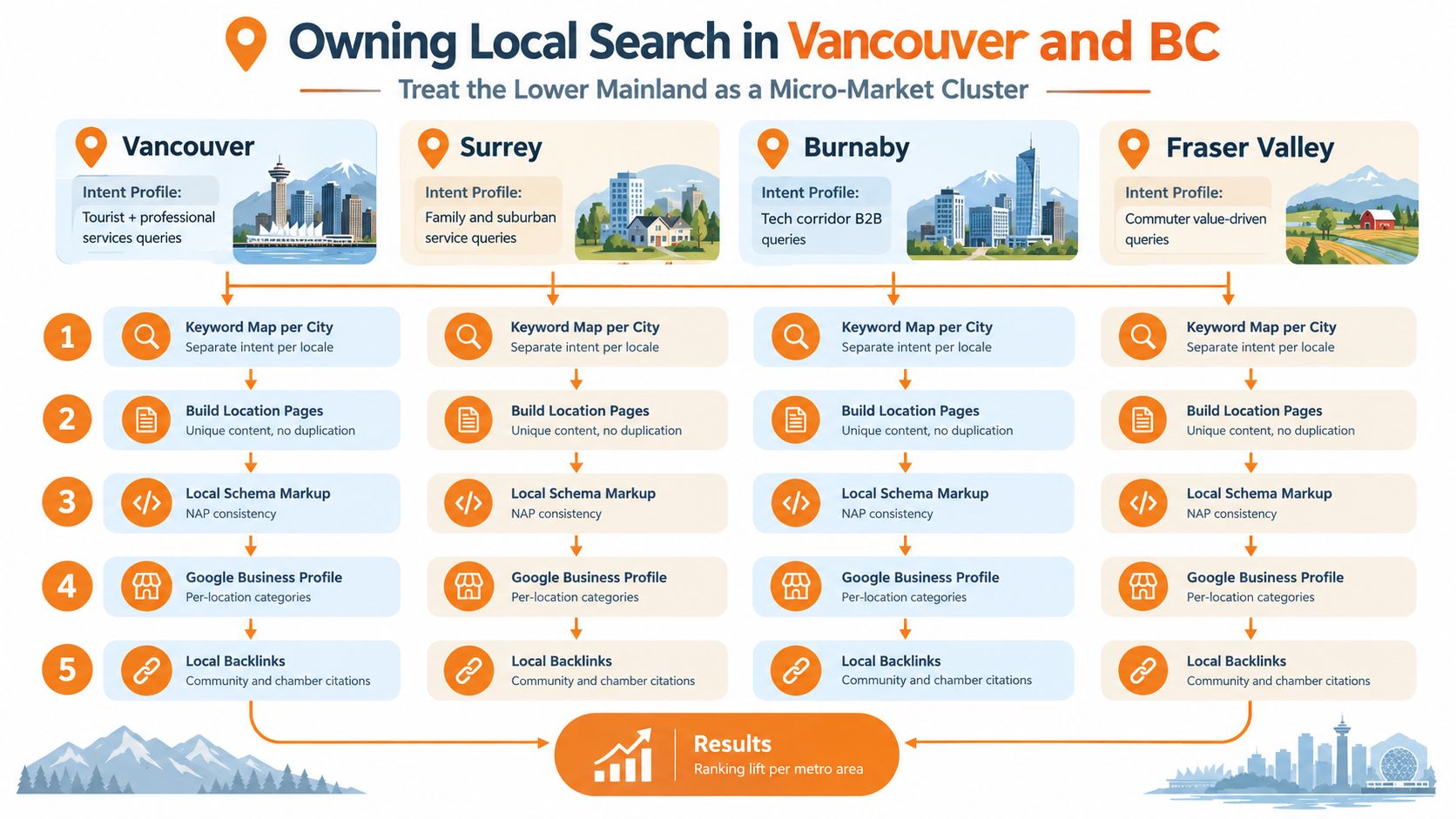
Local visibility isn't one Vancouver keyword with a collection of suburbs added as modifiers. The Lower Mainland behaves like a cluster of distinct markets. A Vancouver SEO guide identifies separate search demand across Surrey, Langley, New Westminster, Burnaby, North Vancouver, Coquitlam, Richmond, Port Coquitlam, Port Moody, West Vancouver, White Rock, and Delta. For dentist searches, Vancouver has 2,900 searches per month, Surrey and Langley have 2,400, Burnaby has 1,600, and North Vancouver and Coquitlam have 1,300, as documented in this Vancouver SEO market guide.
The exact figures will vary by service and category, but the strategic point is stable. Build pages around distinct intent, not one duplicated template with a city name swapped into the title.
Build pages that earn their location
A useful location page should contain local proof that another page can't easily replicate. Include relevant inventory or services, staff coverage, parking or transit information, neighbourhood FAQs, local project examples, service boundaries, and a clear route to contact or book. Don't create pages for every municipality unless the business actually serves those areas.
Canadian local-search data reports that roughly 46% of Google searches have local intent, the Google Map Pack appears in about 93% of those searches, and around 76% of smartphone local searches lead to a business visit within one day. The same figures report that 92% of Canadians use search engines to find local businesses and 68% do so at least weekly, according to Canadian local SEO statistics. Those behaviours make the business profile and the landing page a combined asset, not separate projects.
A location page should prove relevance to a place, not merely mention its name.
Tune the profile and create a review operating system
For each Google Business Profile, select the most accurate primary category and relevant secondary categories. Keep products, services, hours, attributes, photos, and description fields current. Use tracked links in profile posts when measurement matters, upload genuine location-relevant imagery, and seed the Q&A area with answers to questions customers commonly ask.
Reviews deserve an operating process rather than occasional requests. Ask satisfied customers at a natural moment, route negative feedback to a manager before it becomes public escalation, and respond to published reviews with specific service language. Don't force keywords into responses. Mention the service, location, and customer need naturally when those details are relevant.
Finish the local foundation with consistent business name, address, phone, hours, and category data across Yelp, Apple Maps, Bing Places, chambers of commerce, and relevant industry directories. Inconsistent citations create uncertainty for customers and search systems. Businesses wanting a more specialised workflow can review Vancouver local search optimization as one example of how local landing pages, profiles, structured data, and directory work fit together.
Marketplaces, Paid Media, and Digital PR Compared
These three channels solve different visibility problems. A marketplace can put a new product in front of existing shoppers, paid media can generate immediate testing volume, and digital PR can create authority that remains useful after a campaign ends. Treating them as interchangeable leads to poor budget decisions.
| Channel | Time to Traffic | Cost Profile | Defensibility | Best For |
|---|---|---|---|---|
| Marketplaces | Fast once listings and fulfilment are ready | Platform fees, commissions, promotions, and sponsored placement | Moderate to low, because the platform owns the environment | Capturing existing purchase intent and validating product-market fit |
| Paid media | Fast after campaigns and feeds are approved | Ongoing auction costs and creative production | Low, because traffic stops when spend stops | Testing offers, audiences, messages, and launch demand |
| Digital PR | Slower and dependent on editorial interest | Research, content, outreach, and relationship costs | High when coverage earns relevant links and brand recognition | Building authority, trust, branded demand, and organic support |
Marketplaces rent attention efficiently
Amazon, Walmart, and Best Buy Canada can shorten the path between discovery and purchase. Start with accurate titles, high-intent attributes, clear bullets, complete specifications, strong images, and video where the platform supports it. Monitor stock, delivery performance, returns, pricing, and customer service because the listing is judged as part of the buying experience.
Marketplace advertising and promotions can help a launch gain momentum, but they can also train the business to purchase every sale. Keep a price floor, measure advertising cost of sales and contribution margin, and avoid discounts that create volume without a viable profit path. The marketplace visibility guidance from Tradebyte also emphasises listing quality, promotional precision, pricing discipline, inventory health, and operational performance.
Paid media buys speed, not ownership
Google Shopping and Performance Max are useful when product feeds are clean and conversion tracking is reliable. Meta Advantage+ can help when creative communicates the product without a long explanation, while TikTok Shop may suit products that benefit from demonstration and creator-led discovery. The channel should reflect the product's buying cycle, not the platform representative's preferred solution.
Use paid traffic to answer practical questions. Which benefit earns the click? Which variant converts? Does the landing page support the promise? Can the margin absorb the acquisition cost? If the answer is unclear, scale creates noise rather than insight.
Digital PR builds an asset base
Digital PR takes longer because a journalist, editor, or publisher has to find the story credible and relevant. Data-led campaigns, founder expertise, original research, useful commentary, and niche trade relationships tend to produce stronger outcomes than generic press releases. Coverage in a Canadian industry publication may be more valuable for a regulated product than a broad audience mention that doesn't understand the category.
A sensible decision rule is simple:
- New product and limited capital: Use tightly controlled paid tests and one or two relevant marketplaces to learn quickly.
- Proven offer with healthy margin: Expand paid coverage while improving owned organic pages and marketplace retention.
- Established brand seeking defensibility: Invest in original assets, editorial relationships, and digital PR for SEO that support search authority and branded discovery.
Converting Visibility and Operating in Regulated Verticals
Traffic doesn't create revenue by itself. A product page has to resolve uncertainty quickly enough for a visitor to act. Put the primary value proposition above the fold, show the product clearly, and make the next step obvious. Then give the buyer the details that prevent hesitation, including specifications, ingredients, delivery expectations, returns, compatibility, and usage guidance.
Fix the page before buying more exposure
A practical product-page review should examine:
- Hierarchy: Can a first-time visitor identify the product, audience, benefit, price, and next action without hunting?
- Proof: Are reviews, testimonials, certifications, media mentions, and user-generated images placed near the claims they support?
- Comparison: Can shoppers understand the difference between sizes, strengths, bundles, or formulations?
- Friction: Are account creation, delivery estimates, payment options, pop-ups, and checkout fields creating avoidable resistance?
- Measurement: Can analytics distinguish organic, paid, marketplace referral, email, and returning branded traffic?
Run focused CRO tests rather than redesigning everything at once. Test a clearer benefit statement, a more useful specification block, stronger product imagery, a comparison module, or a better delivery explanation. Track conversion rate by source and product, not only total revenue, so a channel that sends cheap but unqualified traffic doesn't look healthier than it is.
Regulated products require a different evidence standard
Cannabis, CBD, and functional mushroom brands face restricted advertising environments, Health Canada copy requirements, sensitive claims, and narrower keyword opportunities. The answer isn't aggressive keyword stuffing. It is a compliant information architecture that helps buyers understand the product while giving search systems trustworthy, consistent evidence.
Build content hubs around education, product selection, responsible use, ingredients, sourcing, testing, and frequently asked questions. Keep every claim aligned with the label, available evidence, and applicable Canadian requirements. Use citations from credible Canadian media, review sites, industry directories, and relevant trade publications where they directly support the subject. Emerging Canadian ecommerce guidance has specifically highlighted answer-first product copy, FAQ schema, and external citations as useful visibility assets for categories such as cannabis, CBD, and functional mushrooms, as discussed in this Canadian food and beverage ecommerce report.
Licensed retailer partnerships can extend reach where direct advertising is constrained. Product schema should describe real attributes, offers, reviews, and availability. Don't mark up certifications that aren't visible or verifiable.
Run a compliance check before launch
Before a regulated SKU goes live, confirm:
- Label claims: Product copy matches approved packaging and doesn't imply unsupported health outcomes.
- Citation sources: Every educational or scientific claim has a credible source that the team can review.
- Age controls: The site and checkout apply the required age-gate and regional safeguards.
- Retailer details: Availability, licensing information, and product data remain accurate.
- Content review: Marketing, legal, and regulatory owners approve the page before promotion.
Visibility that triggers compliance complaints, rejected ads, or forced removals isn't a growth asset. It is operational risk.
Your 90-Day Visibility Roadmap and KPIs
A useful roadmap separates actions that create early signal from work that builds durable reach. It also assigns one owner to each data source, because fragmented reporting makes every channel look better or worse than it really is.
Days 1 to 30 focus on foundations and fast feedback
Audit indexation, product templates, canonical rules, internal links, feed quality, Google Business Profiles, marketplace listings, tracking, and conversion paths. Correct the pages that already have demand but fail to explain the offer. Add valid Product, Offer, Review, and FAQ schema, improve the most important images, and launch tightly controlled Google Shopping activity where the feed and conversion events are dependable.
For local businesses, clean up categories, services, hours, photos, Q&A, review requests, and location-page relevance. For ecommerce brands, resolve stock and variant problems before expanding the catalogue. These actions create useful diagnostic signals quickly without requiring a large content programme.
Days 31 to 60 add compounding assets
Create a content hub around the questions customers ask before buying, with concise answers that can support traditional search and AI-generated responses. Build comparison content only where the alternatives are real and the distinctions are useful. Start digital PR outreach with an original data point, a credible expert perspective, or a practical resource rather than a generic company announcement.
Run CRO experiments on high-visibility product pages. Keep each test tied to a hypothesis, such as reducing uncertainty about delivery or making variant selection easier. Record the change, audience, page, period, and decision rule before the test begins.
Days 61 to 90 prune and concentrate
Review channel-level performance and remove activity that produces attention without qualified actions. Concentrate resources on the two or three channels showing the clearest relationship between visibility, engagement, conversion, margin, and repeat demand. Don't preserve a channel because it generated impressions if those impressions never reached the right audience.
Track leading indicators and lagging outcomes separately:
- Leading indicators: Indexation, share of voice, product-feed approval, local pack presence, review velocity, page engagement, and earned mentions.
- Lagging indicators: Organic clicks, branded search, marketplace session share, blended customer acquisition cost, conversion rate by channel, revenue, and contribution margin.
A weekly report can fit on one page. Record what changed, which pages or campaigns were affected, what the data says, what will be stopped, and what will be tested next. Before adding a channel, ask three questions: Does our audience use it? Can we measure qualified outcomes? What existing weakness will this channel expose or amplify?
Juiced Digital helps Vancouver businesses and North American ecommerce brands connect SEO, local search, paid media, conversion optimization, and digital PR into a measurable product-visibility system. Visit Juiced Digital to request an audit and identify the fastest fixes and strongest compounding opportunities for your market.