

A Vancouver clinic can have search ads running, a blog on its calendar and social posts going out, yet still lack a shared answer to one question: what result would make the campaign worth its cost? When each person reports a different win, the team can stay busy while the business can't tell what to fund next.
A digital marketing campaign plan should be a working page that six people can execute, not a 40-page deck that nobody checks after launch. It connects the commercial goal to the buyer, channel choices, budget, timeline and decision metric. Fill it in before you spend, then use it to make the calls that protect revenue and margin.
The One-Page Campaign Plan You Can Run
Start with a blank table in a shared document. The six rows below are the minimum decisions the team needs to make before a campaign goes live.
| Block | Write this | Pass test |
|---|---|---|
| Commercial goal | One number, one date, one owner | Named number, date and owner on one line |
| Audience and offer | Who, objection, proof, geography | Creative and the landing page can quote it |
| Channel role | One job per channel | No channel exists only for presence |
| Budget and reserve | Total budget, channel allocation and a 10% to 15% test reserve | Money can move without a new brief |
| 90-day timeline | Setup, learn, then scale or cut | Each phase has an exit rule |
| Decision KPI | Primary metric plus a quality or margin guardrail | A channel can be paused on this number alone |
Commercial goal. Choose one business result and put its deadline and owner on the same line. “Forty booked consultations by the end of the campaign, owned by the marketing manager” can be checked. “Grow awareness” can't tell the team whether to increase spend, change the offer or stop.
Audience and offer. Name the buyer, the reason they might hesitate, the proof that addresses that hesitation and the geography you can serve. The same details should appear in the ad and on the landing page. If the ad promises a local consultation but the page doesn't explain who it's for, trust breaks at the click.
Channel role. Give every channel one job. Search might capture existing demand; social might test which message earns qualified interest. A channel that's included only because the business “should be on it” has no clear reason to receive budget.
Budget and reserve. Record the full amount, the initial allocation and the reserve. Keep the reserve unassigned until a defined test or a proven winner earns it. That way, the team can fund a good result without restarting the approval process.
Timeline and decision KPI. Split the campaign into setup, learning and scale-or-cut phases. Write an exit rule for each phase, then select a primary measure with a guardrail. A lead campaign might use cost per qualified lead as its primary KPI and lead quality as the guardrail. If lead quality drops, a cheap lead isn't a win.
Copy the table into a shared document and leave cells blank until the next sections help you fill them. A blank cell is a decision still to make, not permission to begin spending.
How to Set the Goal and the Buyer
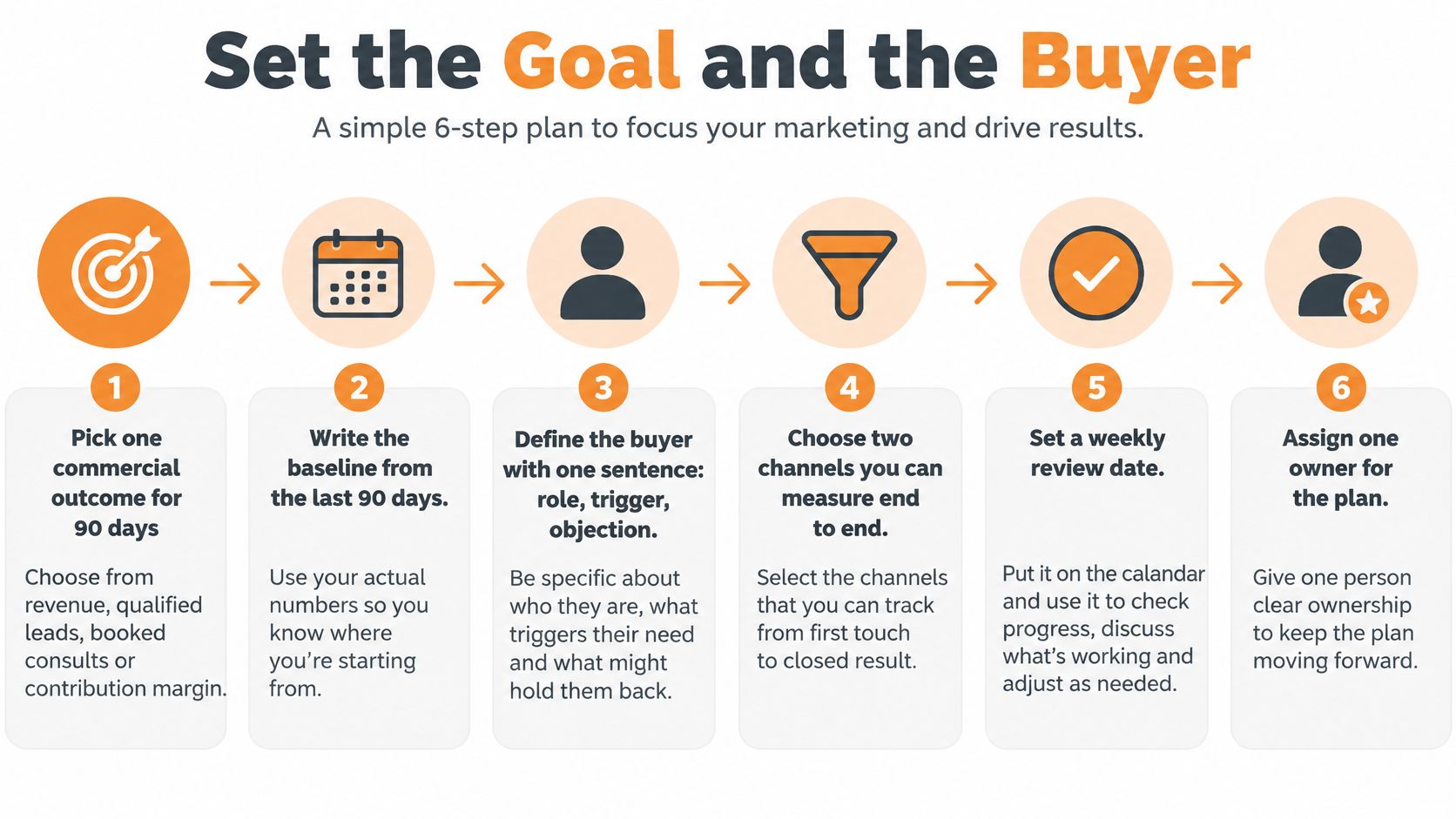
The first two rows of the plan fail in predictable ways. The goal is a direction instead of a number, and the buyer is "adults 25 to 54" instead of a person with a reason to hesitate. Five steps turn both into cells your team can use.
Choose one commercial outcome for the campaign period. Pick revenue, qualified leads, booked consultations or contribution margin. For an e-commerce offer, margin is the honest choice: shipping, returns and discounts decide whether a sale was worth buying, so write the target after those costs rather than before them. Record the baseline from the comparable period first, then set the target against it. These examples of marketing objectives show how to phrase a general ambition as a measurable outcome.
Describe a buyer, not "online consumers." Use age where it changes the decision, alongside product type, intent and device behaviour. Statistics Canada's online shopping figures reported that 82% of Canadians shopped online in 2020, up from 77% in 2018, while total online spending grew from $57.4 billion to $84.4 billion. The gap between age groups is the useful part: online shopping reached 95% among Canadians aged 25 to 44 and 55% among people aged 65 and older. Treat these as historical reference points and refresh them before using them as live assumptions. A 28-year-old reordering on a phone and a 68-year-old comparing options on a desktop are different buyers with different objections.
Name the offer and its proof. A clinic leads with a relevant service and local reviews. An online store shows landed cost and a delivery estimate before the buyer reaches checkout. The proof answers the objection the buyer already has. If the product sits in a restricted category, write down which claims the offer can make before anyone drafts copy.
Build trust into the path to conversion. In the same 2020 survey, security and privacy concerns and ordering difficulty each held back a meaningful share of shoppers, so plan for both. Write the consent request in plain language, put privacy and return policies where the buyer needs them, and cut steps between the ad and the action. Give this its own plan cell: what the campaign will measure with consent, and what it stops tracking when consent is refused. A form that works technically still loses buyers when it asks for too much.
Separate the geography. For a British Columbia campaign, report Metro Vancouver, Vancouver Island, the Interior and the rest of Canada as separate lines where those areas are in scope. A strong Vancouver result can hide regions where shipping costs erase the margin or delivery times kill conversion. Fill the geography cell with the areas you can serve profitably and mark the rest out of scope.
Write the audience line: "[Buyer] in [geography] wants [outcome], is concerned about [objection], and will act when [proof or offer] is clear."
That sentence is the brief your writer, designer and media buyer all work from.
Restricted Channels and Compliance Decisions
A regulated brand shouldn't take a generic funnel and assume every channel tactic is available. Standard retargeting, price claims or lifestyle-led creative may create compliance risk, even when those tactics are routine elsewhere. For cannabis, accessories and related services, the campaign needs a channel-by-channel decision before anyone writes copy. That decision belongs in the plan itself, filled in before any spend.
Canadian law generally prohibits promoting cannabis, cannabis accessories or related services, while allowing limited informational or brand-preference promotion under conditions that can include adult targeting, age-gating and controlled access. Health Canada's cannabis promotion rules are the starting point for a compliance review. Separate permitted informational content from price, inducement, youth-appeal and product-promotion claims before approving any asset.
For each asset, record five things:
- Legal basis: Why this content and channel are permitted.
- Audience control: How the brand limits access to the intended adult audience.
- Approval owner: The person responsible for reviewing the asset.
- Evidence file: The documentation that supports the decision.
- Fallback channel: The route the team will use if a platform closes access.
Apply that checklist to each SEO page, email, influencer post, organic social post, paid-search ad, landing page and QR code. A green light on one asset doesn't automatically clear the others, and a blank cell is a reason to hold the asset, not approve it. Keep a record of the audience controls and approvals alongside the final version of each asset.
Paid search is conditional, not a default. Whether a cannabis brand can run search ads depends on platform policy and the advertiser's licensing status, and access can tighten or close over time. Confirm eligibility and platform requirements before putting the channel into the budget.
Juiced Digital's work for a cannabis e-commerce client used informational, value-driven Google Ads copy, strategic keyword targeting and attention to landing-page experience because direct cannabis promotion is restricted. That approach produced a 3X return on ad spend over six months despite the ad restrictions, through funnel strategies. The durable lesson: first-party content and age-gated organic search keep working if paid access changes. Measure compliant reach, qualified inquiries and revenue, not only retargeting performance.
Channels Budgets and a 90-Day Timeline
Start with a working mix, not a fixed formula. A local clinic and a national online store shouldn't spend the same way: the clinic has a defined service area, while the store may need to reach buyers across multiple regions. Statistics Canada reported that the Canadian advertising and related services industry generated $14.4 billion in operating revenue in 2023, while its operating expenses rose faster than revenue and its operating profit margin fell to 13.9%. That narrow margin is a practical reason to test in stages and track commercial outcomes rather than buy reach without a clear decision rule. Statistics Canada's 2023 industry figures provide national context, not a recommended budget for any one business.
| Channel | Primary job | Decision metric | Canadian watch-out |
|---|---|---|---|
| Paid search | Capture high-intent demand | CAC or cost per qualified lead | Split brand and non-brand; some categories can't advertise |
| Paid social | Prospect and test creative | Qualified lead or assisted revenue | Don't stop at likes, followers or shares |
| SEO and content | Build durable demand and trust | Qualified sessions and revenue | Judge the trend over a longer horizon than a short paid campaign |
| Email and CRM | Convert and bring people back | Revenue per recipient and repeat rate | Needs a lawful consent basis |
| Test reserve | Fund a proven winner | Holdout or incrementality result | Don't quietly spend it on awareness |
Treat the proposed allocations as starting ranges for a test, then adjust to your business model. Paid search can take about 30% to 40% of media spend when it captures qualified demand, with brand and non-brand results reported separately. Paid social can begin around 15% to 25% for prospecting and creative tests. Keep the 10% to 15% test reserve unassigned until a pre-written experiment or a proven winner qualifies for it.
SEO and content use a different budget base because they aren't media spend. A starting allocation of 20% to 30% of total marketing budget can support durable demand, but don't judge the work by a short window of paid-ad return. Email and CRM can take 5% to 10% once the business has a lawful consent basis and useful customer data to work with.
Set a serviceable footprint
For a local service, limit paid search to the areas where the business can serve customers. Nationwide ads that exclude remote areas waste money and can mislead buyers. For national e-commerce, a broader search share may make sense when the ads and landing page clearly state delivery regions. Use an audience-building strategy to keep channel choices tied to the buyers you can reach and serve.
Use the phases as gates
- Weeks 1 to 2, setup: Validate tracking and consent, confirm the offer and prepare landing pages. Don't launch until the conversion event works.
- Weeks 3 to 6, learning: Test one clear hypothesis per channel. Don't move budget based on a handful of conversions; set the minimum evidence required before launch.
- Weeks 7 to 12, scale or cut: Move money toward channels that meet the CAC and margin guardrails. Pause channels that fail the exit rule written before the test began.
The reserve is not spare money for filling a calendar. Use it only when the evidence gives you a reason to act.
KPIs When Platform Numbers Lie
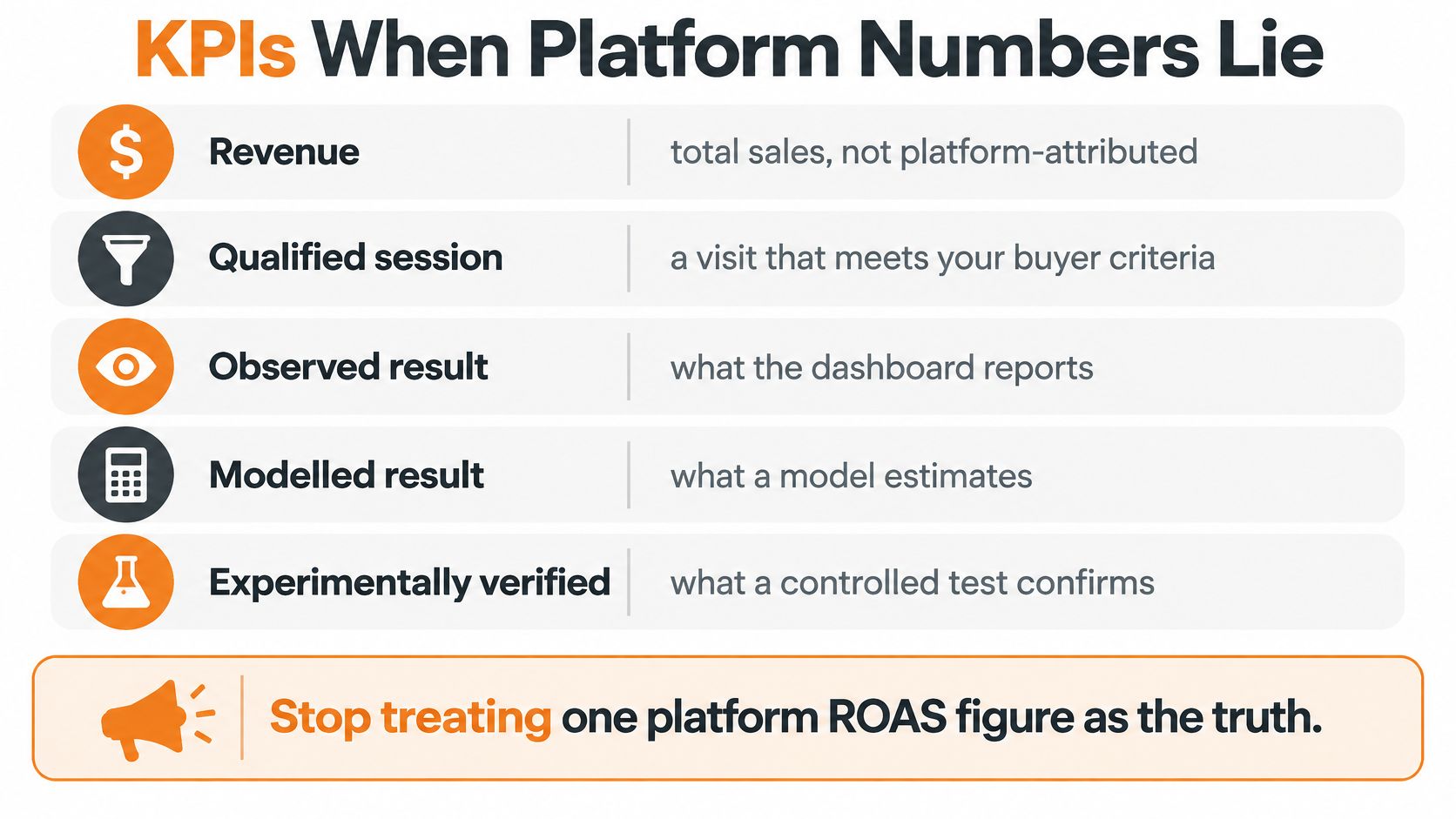
A campaign with lower reported platform ROAS can be the better campaign if it generates valuable calls, branded searches or repeat customers that the platform can't reliably connect to an ad. Label each result observed, modelled or experimentally verified. Those labels tell a founder what the dashboard reports, what an estimate fills in and what a controlled test has supported. When two reports disagree, the attribution model decides which channel gets the credit, so choose among the common marketing attribution models before spend starts, not after results are already contested.
For e-commerce, define the events before launch: revenue, qualified session, add to cart, checkout and purchase. Break them down by device, province, channel and new versus returning customer. Add-to-cart rate and cart abandonment are store-specific baselines, so record yours for a few weeks before the campaign and treat movement against that baseline as the signal. Expect substantial leakage between product interest and completed orders, and build that leakage into the forecast instead of discovering it mid-flight.
| Event | Baseline to record | Act when |
|---|---|---|
| Qualified session | By channel, device and province | Traffic is mostly bounced or shows no buying intent |
| Add to cart | Your store's pre-campaign rate by device | Rate stays flat after traffic quality is fixed |
| Cart abandonment | Your store's pre-campaign rate | Rate worsens while shipping terms stay hidden |
| Purchase or booked consult | Backend or CRM count, not the ad platform | Platform and backend disagree beyond an agreed tolerance |
| CAC and contribution margin | Blended and by channel, after shipping and returns | CAC rises while margin falls |
| Incrementality | Monthly geographic holdout or matched market | Reported ROAS is high but calls and branded search are flat |
For local service businesses, clicks aren't the main events. Track a qualified lead, an answered call, a booked consultation and an appointment that takes place. Put the source in your CRM so the team can compare ad-platform reports with the appointments and sales the business records. If you sell a regulated product, note which events each platform will even report, because restricted ad categories change what "observed" can mean on that channel.
Make the weekly review consistent
- Confirm analytics events and consent-mode behaviour are firing as intended.
- Reconcile platform conversions with backend orders or CRM records.
- Calculate channel CAC, conversion rate, revenue per session and contribution margin after shipping and returns.
- Move budget only after the campaign reaches the conversion volume required by its decision rule.
- Write down the test hypothesis and the condition that ends the test.
A Vancouver business can make privacy-aware measurement practical with first-party CRM source fields, unique landing-page phone numbers, offline conversion imports and a geographic holdout between Metro Vancouver and another B.C. region. Canadian privacy laws can affect how businesses use personal information for behavioural or targeted advertising, so the Canadian advertising and marketing legal guide is useful context for building a consent-aware approach. Collect only what you need for a stated purpose and handle it accordingly.
Don't scale from one attribution number. Scale from results you can reconcile and explain.
Keep assisted conversions as a diagnostic, not the number that earns more spend. Likes, followers and shares don't prove that the campaign generated sales or qualified appointments.
Tips That Stop Margin From Leaking
A campaign can hit every platform target and still lose money at the checkout. In Canada Post's Canadian e-commerce report, 67% of online shoppers said they would abandon a cart when free shipping wasn't available, and 62% had abandoned over returns-policy concerns. Shipping cost, delivery timing and return terms are part of the offer the campaign sells, so treat them as conversion variables rather than operations details.

Before changing any ads, fill in three cells on the one-page plan:
| Plan cell | What to write before spending |
|---|---|
| Delivered margin per order | Selling price minus product cost, shipping subsidy, payment fees and the expected cost of returns |
| Shipping promise | Free-shipping threshold, delivery window and the regions actually served |
| Return exposure | What one returned order costs after lost shipping and restocking |
If the delivered-margin cell comes out thin, a conversion lift can still lose money. Fix that number first.
Make one material change at a time, then assess both purchase conversion and contribution margin:
- Find where abandonment happens. Segment it by device and traffic source before changing the whole checkout.
- Show the full landed cost early. Put taxes, delivery timing and returns terms where the buyer can see them before payment.
- Offer useful delivery choices. Explain the delivery and pickup options and make clear which regions each one serves.
- Remove unnecessary barriers. Cut form fields the business doesn't need, and allow guest checkout where it can work.
- Match remarketing to the reason for leaving. A generic discount to every abandoner wastes spend; address the specific concern where you have a suitable, compliant way to reach that person.
- Judge the full result. Check purchase rate and contribution margin, then review refunds and repeat purchases before calling the test a win.
Delivery expectations need to match across the ad, product feed and landing page. State the serviceable region, estimated arrival, taxes or duties and return conditions consistently before a buyer clicks. When the ad implies faster or cheaper delivery than the checkout offers, that gap shows up as abandonment.
Two common mistakes erase otherwise good campaign work: advertising nationwide when remote areas can't be served, and revealing shipping costs only at the final step. A third is celebrating a quick conversion lift without checking whether refunds or thinner margin later erase the gain.
The same principle applies to a clinic's booking form. Remove fields that don't help qualify the appointment, show a real booking calendar and make the fee clear before the visitor confirms. Watch the checkout walkthrough below for another way to examine the conversion path.
Start the Sprint With a Real Audit
Use this week to find the gaps before buying more media. Book a working session, open the one-page campaign plan and assign five owners: the goal, the audience line, the channel mix, tracking and the weekly KPI review. Juiced Digital's lead-generation marketing package includes a quarterly roadmap that sets out a client's objectives and strategies, but you can assign the same responsibilities internally.
Make the first week an audit, not a rush to launch new ads:
- Technical and content gaps: Find what blocks search visibility or leaves a buyer's question unanswered.
- Funnel drop-off: Compare where visitors leave by device and source.
- Consent status: Check whether tracking and audience use match the business's consent practices.
- Source-to-sale connection: Confirm whether calls or orders can be tied to a marketing source.
If the site can't support the KPI, fix the measurement or conversion path before spending. Juiced Digital starts engagements with a technical and content audit to uncover opportunities and quick wins. A practical sprint can then focus on high-intent keywords, technical improvements, authority-driven content, quality links and conversion-focused UX.
If your baseline, offer and tracking are already solid, run the setup phase internally. If the margin math or channel limits are still guesses, Juiced Digital offers a free consultation and audit as one option for getting the baseline in place. Keep the final exit rule visible: if week six can't show a reconciled conversion count and a margin figure, don't scale.
Juiced Digital helps Vancouver businesses and e-commerce brands build measurable campaigns through SEO, paid advertising, conversion optimisation and digital PR. Visit Juiced Digital to book a free consultation and audit, and bring your campaign baseline, channel questions and margin assumptions.
