
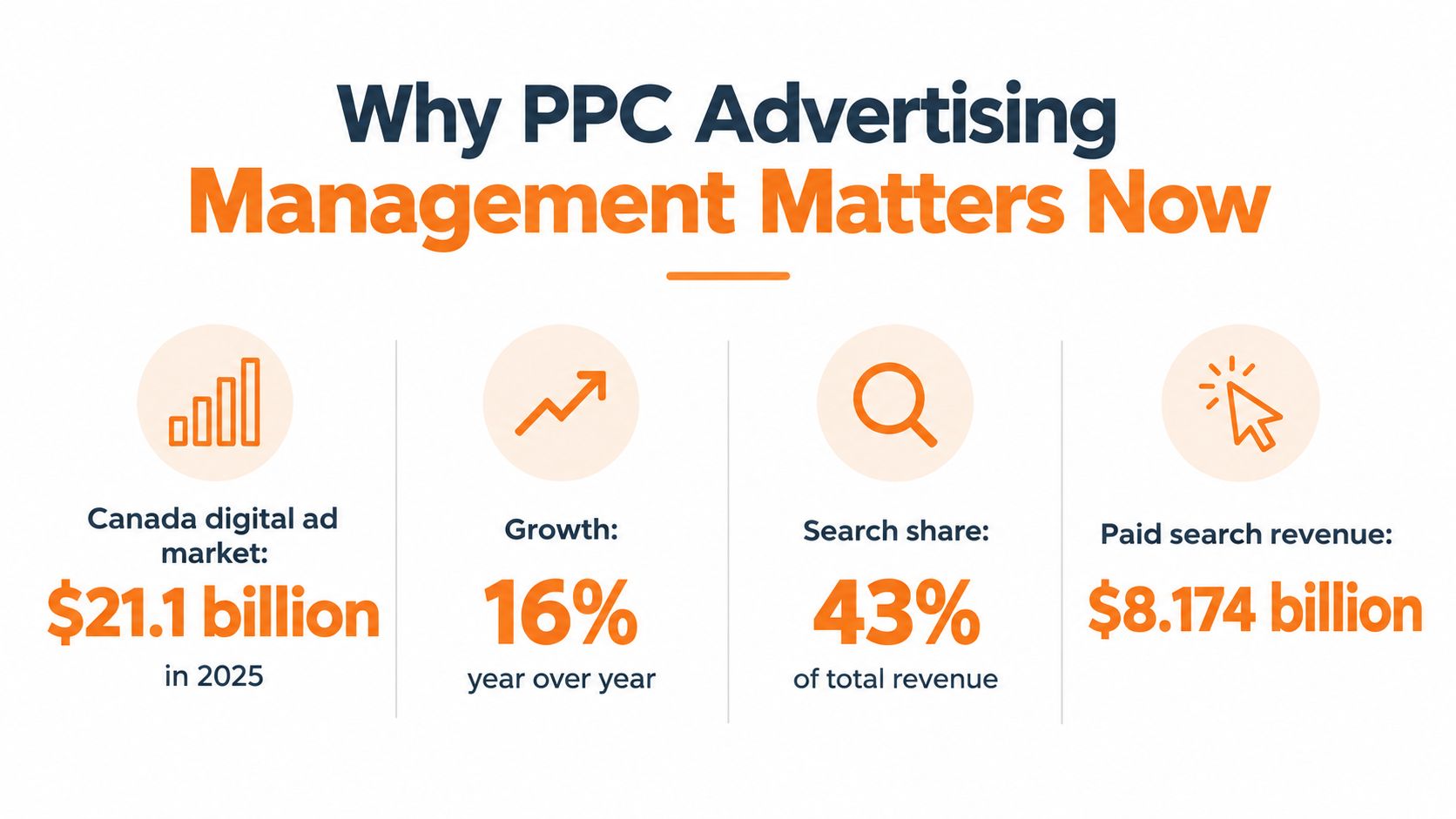
Canada's digital advertising market reached $21.1 billion in 2025, with search at 43% of total revenue and paid search accounting for 87.6% of search spending. PPC advertising management is therefore not a minor acquisition tactic, it's the operating discipline behind a substantial share of Canadian performance marketing.
The mistake is treating PPC as a set of keywords, bids, and ads. Those mechanics matter, but they don't answer the question that affects your budget most: which paid clicks create revenue that wouldn't have happened anyway? Strong Canadian PPC programmes connect campaign decisions to clean conversion data, business economics, and incrementality testing.
Why PPC Advertising Management Matters Now
Canada's digital advertising market grew 16% year over year in 2025 to $21.1 billion, according to IAB Canada's 2025 revenue survey. Search generated 43% of total revenue, or $9.33 billion, while paid search contributed $8.174 billion, representing 87.6% of search revenue.
Those figures establish paid search as a major Canadian acquisition channel. Search captures people already looking for a product, service, provider, or solution. That demand is valuable, but platform-reported conversions do not prove that advertising created it.
The standard for good management has risen with the market. IAB Canada reported 14% growth in 2024 and 16% growth in 2025, while social media held the second-largest share at 30%, as documented in its Canadian internet advertising revenue report. PPC must therefore work alongside SEO, social, retail media, email, and direct sales, with measurement that prevents channels from claiming the same customer.
The Canadian operating reality
Regional demand, competition, seasonality, and service areas change how campaigns should be managed. A Vancouver plumber, a national ecommerce brand, and a regulated wellness company need different targeting, conversion definitions, and budget rules.
Senior buyer's rule: Manage the account against profit and qualified demand, not platform activity.
The overlooked challenge is data infrastructure. Connect advertising platforms to CRM outcomes, margin data, call records, and customer quality. Then test whether exposed audiences buy more than comparable audiences that did not receive the ads. Without that foundation, reported conversions can reward branded demand, returning customers, or sales that would have happened without PPC.
IAB Canada projected the market would reach about $26.2 billion in 2026, signalling continued competition without guaranteeing results for any advertiser. More spending raises the cost of attention and the need to prove incremental business value. For background on paid advertising fundamentals, review the channel basics, then judge PPC by profit, qualified demand, and measured lift.
Core Components of Effective PPC Management
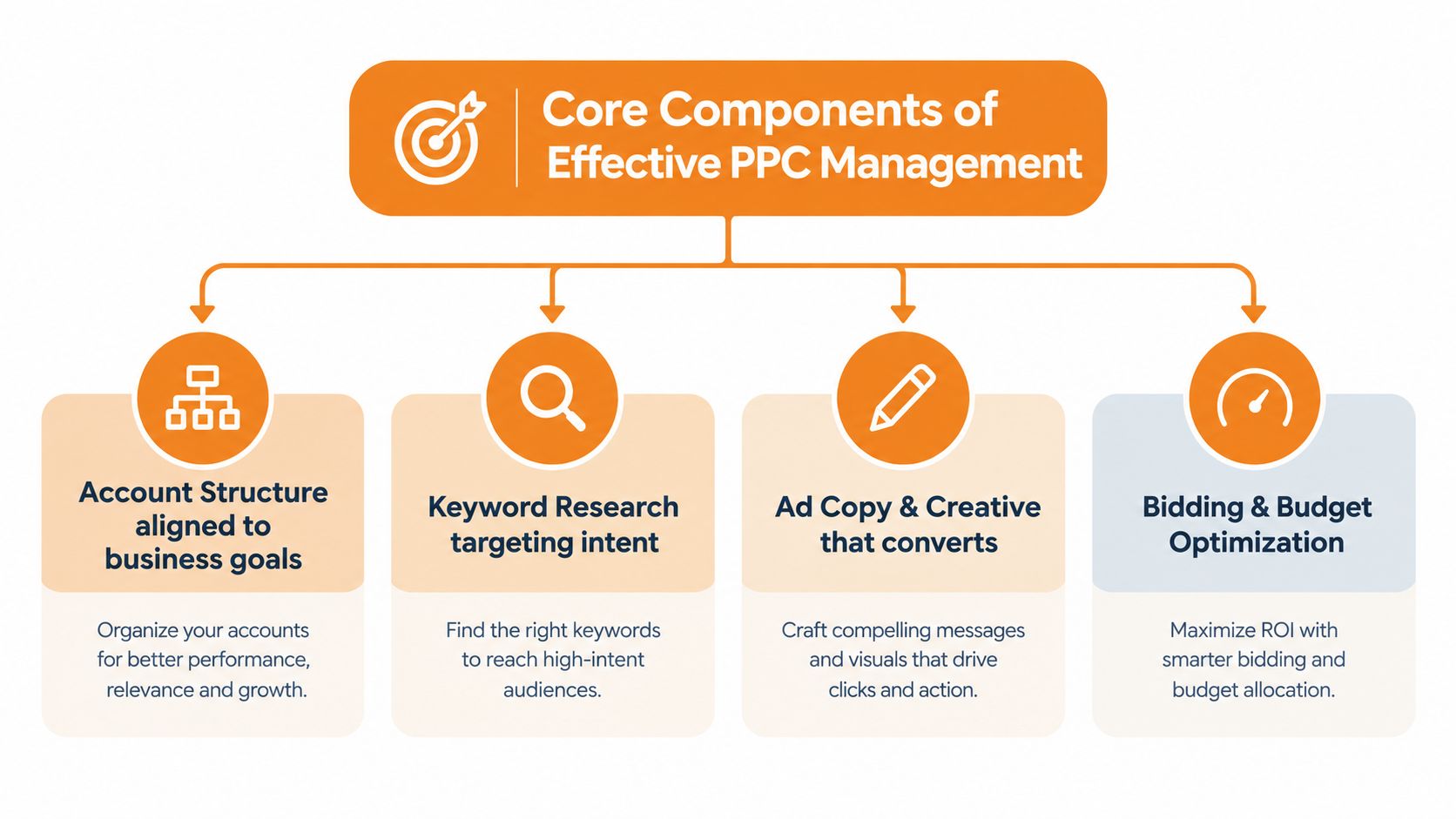
Effective PPC advertising management starts with the commercial objective, not the platform interface. Decide whether the account must generate qualified calls, booked consultations, completed purchases, or profitable repeat customers. Then build campaigns and reporting around that action.
Build structure around decisions
Separate campaigns when the business needs separate control. Location, service line, product margin, brand demand, and budget priority can all justify distinct campaign structures. Avoid creating dozens of campaigns merely to look organised. Every split should help you control bids, budgets, messaging, or measurement.
A local service account might separate emergency work from planned installations because the leads have different urgency and value. An ecommerce account might separate branded searches, high-intent product categories, and prospecting activity so brand demand doesn't hide weak acquisition.
Research intent, not just volume
Keyword research should reveal what the searcher wants and what the business can fulfil. Group terms by intent, inspect search terms regularly, and add exclusions when queries show poor fit. Broad targeting can discover demand, but it also requires disciplined review of irrelevant variants, mismatched geography, and low-value research searches.
The useful question isn't “Which keyword has the most traffic?” It's “Which query gives this business a credible path to a profitable action?”
Write ads that pre-qualify
Ad copy should make the offer and fit obvious before the click. Include the service or product, relevant location where appropriate, a meaningful differentiator, and a clear next action. Don't use vague promises that attract curiosity but fail to set expectations.
For a clinic, copy might clarify the treatment category and booking route. For an ecommerce brand, it might distinguish a specific product range from generic category traffic. Strong copy can reduce wasted clicks because it tells poor-fit prospects what they won't find.
Treat landing pages and bidding as one system
A precise ad leading to a generic homepage creates friction. Match the landing page to the search intent, make the primary action easy to find, and track the action all the way through the business process. Bidding should then reflect conversion quality, margin, capacity, and geography, not just the cheapest available click.
Practical rule: Don't automate a decision you can't measure.
Smart bidding can process signals faster than a person, but it still optimises toward the conversion events and values you provide. If the account records weak leads, duplicate calls, or low-margin orders as successes, automation can scale the wrong outcome efficiently.
Agency versus In-House PPC Management Decisions
The agency versus in-house choice determines who owns the data, decisions, and accountability behind every advertising dollar. The right model depends on operational control, measurement quality, and the cost of learning through avoidable mistakes.
An internal marketer can manage a focused account when demand is stable, tracking is reliable, and time is available for search-term reviews, creative tests, landing-page changes, and reporting. Problems start when PPC becomes an occasional duty for someone whose primary role sits elsewhere. In that setup, platform-reported conversions can look healthy while sales quality and incremental revenue remain unclear.
When in-house makes sense
Keep management inside the business when one person owns the channel and can act on its findings. That owner needs access to sales-quality feedback, analytics, landing-page updates, and budget decisions. They also need a consistent review schedule, including checks on lead quality, offline outcomes, duplicate conversions, and performance by market.
In-house management can work particularly well when:
- The account is focused: There are limited products or services and a defined geographic target.
- Feedback is fast: Sales staff can identify which leads or orders create value.
- Testing is possible: The team can change pages, offers, creative, and tracking without lengthy approvals.
- Ownership is clear: One person is accountable for commercial results, not just campaign maintenance.
When an agency earns its fee
Canadian small and mid-sized businesses commonly spend $1,000 to $5,000 per month in media, while agency management often represents 10% to 25% of spend, according to a 2026 Canada-focused PPC benchmark guide. At this scale, the fee may feel uncomfortable. Compare it with wasted spend, delayed testing, weak attribution, and the internal cost of developing specialist skills.
The same source places a practical ceiling of roughly C$15,000 in monthly spend for basic SMB management. Above that level, accounts generally require tighter query controls, conversion-rate optimisation, and structured experimentation. Rising spend also increases the cost of measurement errors. Outsourcing does not solve bad data automatically, so require an agency to define conversion quality and explain how it separates platform influence from incremental business results.
Use Google Ads management support when you need specialist execution, clearer accountability, or capacity your internal team cannot provide. Ask how the agency validates leads, imports offline outcomes, handles exclusions, reports profit-relevant results, and shares account ownership. Do this before evaluating surface-level promises.
Make the decision honestly
Choose in-house if you have time, expertise, clean data, and authority to make changes. Choose an agency if the business needs faster execution, broader testing capacity, or independent scrutiny of platform-reported performance. A hybrid model often works when internal staff provide commercial context while an external team manages account operations, experimentation, and measurement discipline. Whichever model you choose, assign one owner for the incrementality question: what revenue would have happened without the ads?
Understanding PPC Pricing Models and Benchmarks
PPC pricing has two distinct parts: media cost, paid to the advertising platform, and management cost, paid for strategy and execution. Separate them before comparing agencies or judging performance. A low management fee can still produce expensive growth if the account lacks reliable conversion data.
Common agency models include percentage-based fees, flat retainers, and hybrid arrangements. Percentage pricing links the management charge to spend, but it can encourage budget increases when efficiency is falling. Flat retainers make costs predictable, provided the scope is specific. Hybrid pricing combines a base fee with defined work such as analytics, landing pages, creative, or additional channels. Require the agreement to state who owns tracking, testing, reporting, and data quality.
What Canadian benchmarks actually tell you
A Canada-focused dataset covering more than 150,000 campaigns reported an all-industry average CPC of $2.69 and CPA of $45.27. Treat those figures as directional, not as account targets. Industry, province, competition, offer strength, landing-page quality, and conversion definitions can shift results substantially. Canadian accounts also need location-level analysis, since national averages can hide costly differences between major markets and smaller communities.
An ecommerce dataset covering 25 accounts across the United States, United Kingdom, Canada, and Australia reported Canada at $1.01 average CPC, 1.41% CTR, 2.53% conversion rate, $39.74 CPA, and 2.51x ROAS, according to Piperocket's Google Ads benchmark research. The same dataset reported a 7.16% conversion rate across its full Canadian context, below the United Kingdom's 10.84% and Australia's 9.97%.
These figures show why CPC is a weak management target. A cheap click can create an expensive customer when intent, landing-page relevance, checkout experience, or lead follow-up is poor. A higher CPC can be acceptable when the resulting customer produces stronger margin and retention.
Compare economics, not vanity metrics
| Question | What to inspect |
|---|---|
| Is the click affordable? | CPC by campaign, query theme, device, and location |
| Does the visit matter? | Qualified lead, purchase, margin, and customer quality |
| Is the account efficient? | CPA, ROAS, contribution margin, and capacity |
| Is the agency useful? | Testing output, insight quality, and actions taken |
Ask the provider to explain why costs changed and which decision follows. Reports listing impressions, clicks, and conversions are incomplete unless those figures connect to sales records, margins, and customer quality. Require offline conversion imports where possible, then assess whether platform-reported results hold up against business outcomes and incrementality tests.
The benchmark is a diagnostic, not a grade. Judge the buying decision by profitable, incremental customers, not by whether a dashboard matches an industry average.
Measurement Challenges and Incrementality Testing
The biggest Canadian PPC problem is the gap between a platform-reported conversion and a genuinely incremental customer. Campaign setup matters, but weak data infrastructure can make good media buying look ineffective and poor buying look successful.
IAB Canada reported $1.29 billion in newly measured ad-tech and data products within the $21.1 billion digital advertising market in 2025. That growth reflects a practical requirement: advertisers need reliable systems for attribution, identity, and lift as privacy constraints reduce the reliability of individual-user tracking.

A platform can assign credit to a search ad because someone clicked before converting. That credit does not prove the ad created demand. The person may have searched for the brand after seeing another campaign, returned through a saved link, or converted without the paid placement.
Build a measurement hierarchy
Start with accurate first-party actions. Track completed purchases, qualified form submissions, booked appointments, meaningful sales calls, and revenue when the business can pass it back reliably. Configure conversion tracking so duplicate, low-quality, and partial actions do not inflate the optimisation signal. A detailed Google Ads conversion tracking approach is more valuable than another round of bid changes when the data foundation is weak.
Connect advertising data to business outcomes. Compare platform conversions with CRM records, sales status, gross margin, refund behaviour, and customer quality. For local services, the valuable event may happen after form submission. For ecommerce, an order may lose value after returns, discounts, and fulfilment costs.
Testing comes next. Use controlled geographic splits, campaign pauses where operationally safe, time-based budget changes, or holdout audiences to compare exposed and unexposed demand. Account for seasonality, promotions, competitor activity, and other media changes.
The following video offers a visual reference for analysing advertising performance and measurement practice.
Incrementality does not require perfect attribution. It requires a testable question, a defined comparison, and a decision rule. If a controlled reduction in paid search leaves total sales unchanged, reallocate cautiously. If qualified demand falls, restore spend and identify which campaign or audience drove the difference.
Real-World Examples of PPC Success Stories
Specific success claims need evidence. Without verified campaign data, the responsible approach isn't to invent a Vancouver lead-generation story or attach an unsupported lift to a regulated brand. It's to examine the operating patterns that make PPC more likely to produce durable business results.
Consider a Vancouver home-services company with a defined service area. The account should separate urgent jobs from planned work, restrict location settings to areas the team can serve, and send each search theme to a relevant booking or call page. The useful feedback loop runs from search term to lead, from lead to sales qualification, and from qualified job to revenue.
An ecommerce brand needs a different system. Product margin, stock availability, returns, repeat purchase behaviour, and brand demand all affect the value of a conversion. A campaign that produces orders can still be a poor investment if it shifts existing customers into paid traffic or pushes low-margin products. Management should therefore compare paid revenue with contribution economics and broader business demand.
Regulated categories require tighter control
Cannabis, CBD, and functional mushroom companies face an added operational burden. Their campaigns must account for platform policies, restricted claims, product eligibility, landing-page language, and the difference between educational content and direct-response offers. Compliance isn't a copywriting detail. It affects where ads can run, what can be promised, and how consistently a campaign can operate.
For local clinics and wellness practitioners, the conversion path may involve several stages. A person might click a treatment ad, review credentials, call with questions, and book later. If the account optimises only for the first form completion, it may favour low-commitment enquiries over suitable patients.
A credible case study must show the measurement chain: business context, campaign change, conversion definition, revenue outcome, and the conditions that shaped the result.
Use client stories as operating evidence, not as permission to copy tactics blindly. The same bid strategy can behave differently across provinces, service categories, sales cycles, and landing pages. The transferable lesson is the discipline of connecting media activity to qualified outcomes, then testing whether those outcomes were incremental.
Getting Started with Your PPC Management Strategy
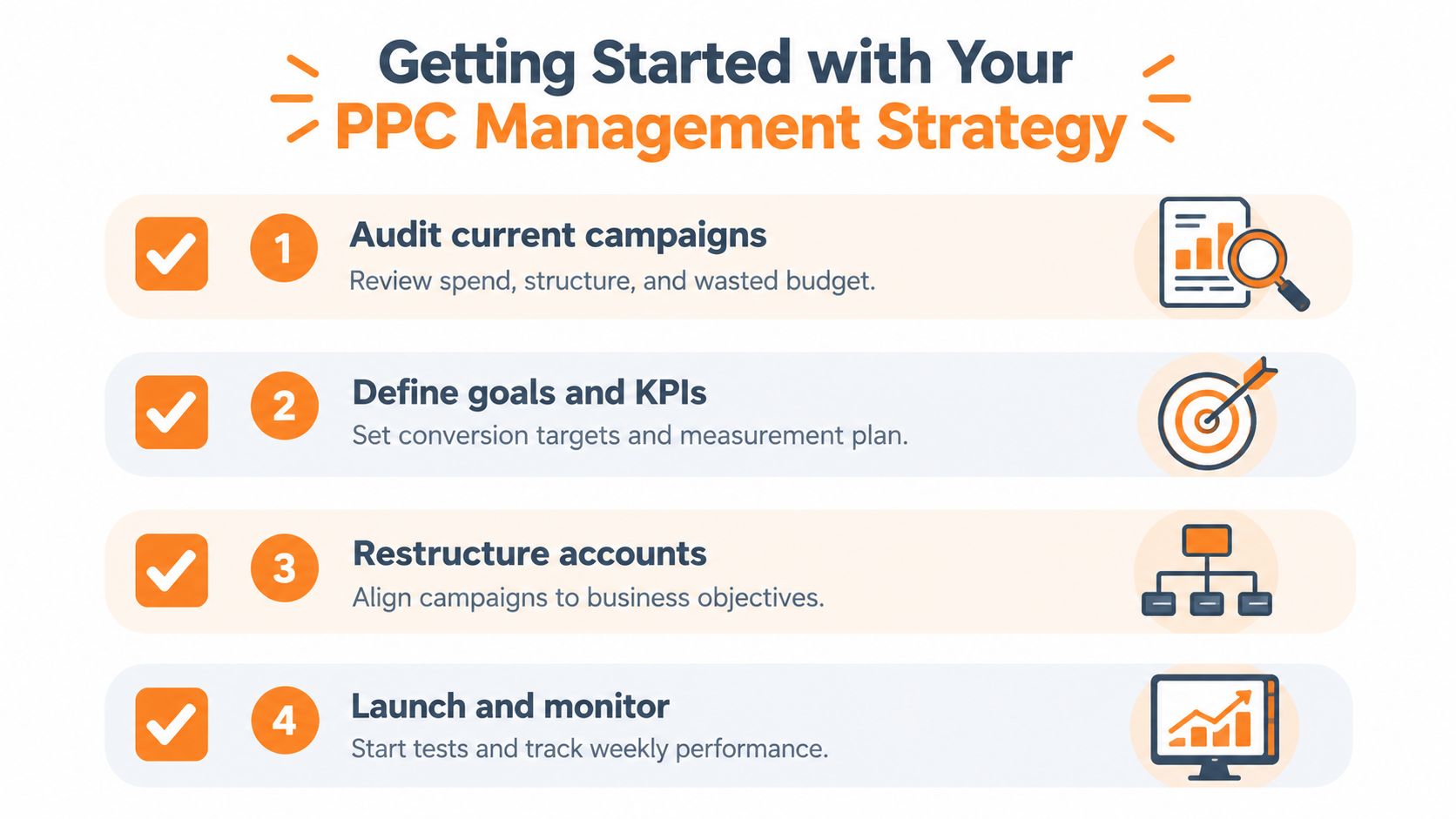
Start with an audit, not a new campaign. Export spend, search terms, conversion actions, location settings, landing pages, and change history. Look for budget flowing to irrelevant queries, duplicate conversion events, branded demand receiving too much credit, and campaigns optimising toward actions the sales team doesn't value.
Use this starting sequence
- Audit current campaigns: Review spend, structure, search terms, targeting, conversion settings, and wasted budget.
- Define goals and KPIs: Choose the business outcome that matters, then document how the account will measure it.
- Restructure accounts: Align campaigns with services, products, locations, margin, and budget decisions.
- Launch and monitor: Introduce controlled tests, review search quality and conversion quality regularly, and record what changed.
Before hiring help, ask prospective partners to show how they distinguish leads from qualified leads, how they handle offline sales data, and how they test incrementality. Ask who owns the account, what work the fee includes, how landing-page recommendations are implemented, and what happens when platform-reported conversions conflict with CRM revenue.
You can manage internally if a trained owner has the time and access to reliable data. Seek professional support when the account is consuming attention without producing clear decisions, when spend has outgrown basic controls, or when measurement needs to connect advertising with sales and margin.
Juiced Digital offers Google Ads and other paid campaign management, including budget planning, ongoing optimisation, conversion tracking, and reporting for local businesses and ecommerce brands. Visit Juiced Digital to request a PPC audit or consultation focused on qualified revenue and measurable incremental growth.