
Paid advertising is the practice of paying platforms to display promotional messages to targeted audiences. Canada's digital advertising market reached $18.2 billion in 2024, with search accounting for over 46% of digital ad spending and social media representing nearly 27%. IAB Canada's market report provides the market context, but the practical question for a founder is simpler: how do you turn that rented visibility into profitable growth?
You may have a strong product, a polished website, and a clear offer, yet your audience still doesn't find you. A Vancouver clinic competes with established practices in search results. An e-commerce brand launches a useful product but has no reliable way to reach buyers beyond its existing audience. A regulated cannabis or natural health business faces an extra constraint: the message must be relevant without creating privacy, compliance, or trust problems.
Paid advertising provides speed and control that organic reach can't always offer. You choose the audience, message, placement, budget, and conversion goal. You also accept the trade-off: traffic generally stops when spending stops, and poor targeting can turn a large number of impressions into very little commercial value.
The Core Mechanics of Paid Advertising
A business owner usually encounters paid advertising at the moment visibility becomes urgent. You need qualified leads this month, not only after a new content programme earns rankings. You want to test a product category, reach customers in a specific British Columbia community, or generate demand while your organic presence develops.
Paid advertising means buying distribution. You pay a search engine, social network, publisher, or advertising exchange to place a promotional message in front of an audience that matches selected criteria. Organic reach works differently. It depends on unpaid visibility earned through search relevance, content quality, social sharing, referrals, or brand recognition.
What happens after launch
A campaign normally moves through a sequence:
- Define the objective. Choose a commercial outcome, such as a sale, qualified enquiry, booked consultation, phone call, or useful audience action.
- Select the audience and placement. Search campaigns may use keywords and location. Social campaigns can use platform audience signals. Display campaigns use publishers, contextual categories, or remarketing pools.
- Create the message. The advert needs a clear promise, a relevant landing page, and a next step that matches the user's intent.
- Enter the auction. Platforms evaluate competing bids alongside relevance, predicted engagement, landing-page experience, and other delivery signals. The highest bid doesn't automatically guarantee the best placement.
- Measure the result. Impressions show delivery, clicks show response, and conversions show whether the visit produced the business action you wanted.
The vocabulary matters because each metric answers a different question. An impression means the platform recorded an ad delivery event. A click means someone interacted with the placement. A conversion means the visitor completed a defined action, but only your tracking and qualification rules can tell you whether that action has commercial value.
Practical rule: Treat paid media as an acquisition system, not a visibility purchase. The campaign isn't successful because an ad appeared. It's successful when the right audience takes a valuable action at an acceptable cost.
Search advertising deserves particular attention because it responds to existing demand. A person searching for a local service often has a different level of intent from someone casually scrolling through a social feed. The mechanics and planning considerations are covered in this guide to paid search advertising.
Paid Media Versus Organic Search Visibility
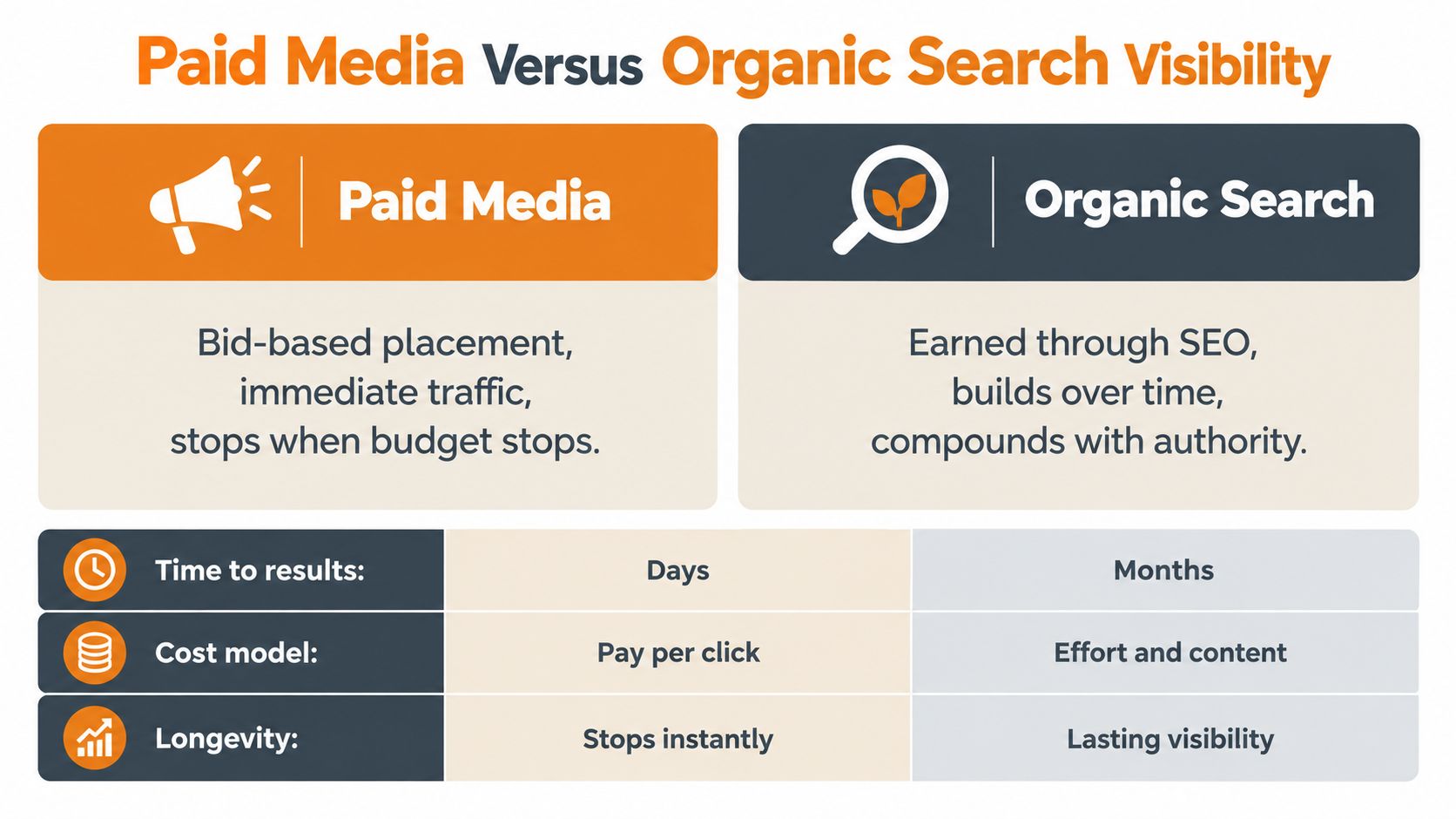
Paid and organic visibility solve different timing problems. Paid media is like renting a prominent shopfront. You can choose the location, open quickly, change the display, and stop paying when the campaign no longer serves the business. Organic search is closer to building a property. It takes sustained work, but useful pages can continue attracting qualified visitors without a charge for every visit.
Where paid media has the advantage
Paid campaigns can create visibility almost immediately after approval and launch. They let you control geography, scheduling, search terms, creative variations, and budget limits. That makes them useful when you need to:
- Capture active demand: Reach people already searching for a product, service, or solution.
- Test an offer: Compare messages, landing pages, or product angles before investing heavily in broader content.
- Enter a market: Put a new location or category in front of potential customers while organic relevance develops.
- Protect important journeys: Keep visibility for branded searches, high-value services, or seasonal promotions.
The weakness is dependence on continuous funding and platform conditions. A campaign can lose efficiency when competitors bid more aggressively, audience quality declines, creative fatigue develops, or the landing page fails to convert. Paid traffic also exposes weaknesses quickly. If the offer is unclear, visitors arrive faster and leave faster.
Where organic search compounds
Organic SEO builds assets that can support discovery over a longer period. A well-researched service page can answer a buyer's questions, establish topical relevance, attract links, and generate enquiries without a direct charge for each click. It also gives a brand more room to explain complex subjects, which matters for health, professional services, and products that require trust before purchase.
Organic visibility has its own costs. It requires research, content production, technical maintenance, internal linking, and patience. Rankings aren't guaranteed, and competitive queries may take sustained effort. Unlike a paid campaign, you can't just increase a bid and expect a precise placement tomorrow.
The strongest growth programmes use both channels deliberately. Paid search can cover commercially important queries while SEO content earns durable visibility. Paid social can distribute an educational article to a defined audience, while organic search captures people who later research the topic independently. Campaign data can also reveal which language and objections deserve attention in landing pages and SEO content.
Major Ad Formats and Channel Selection
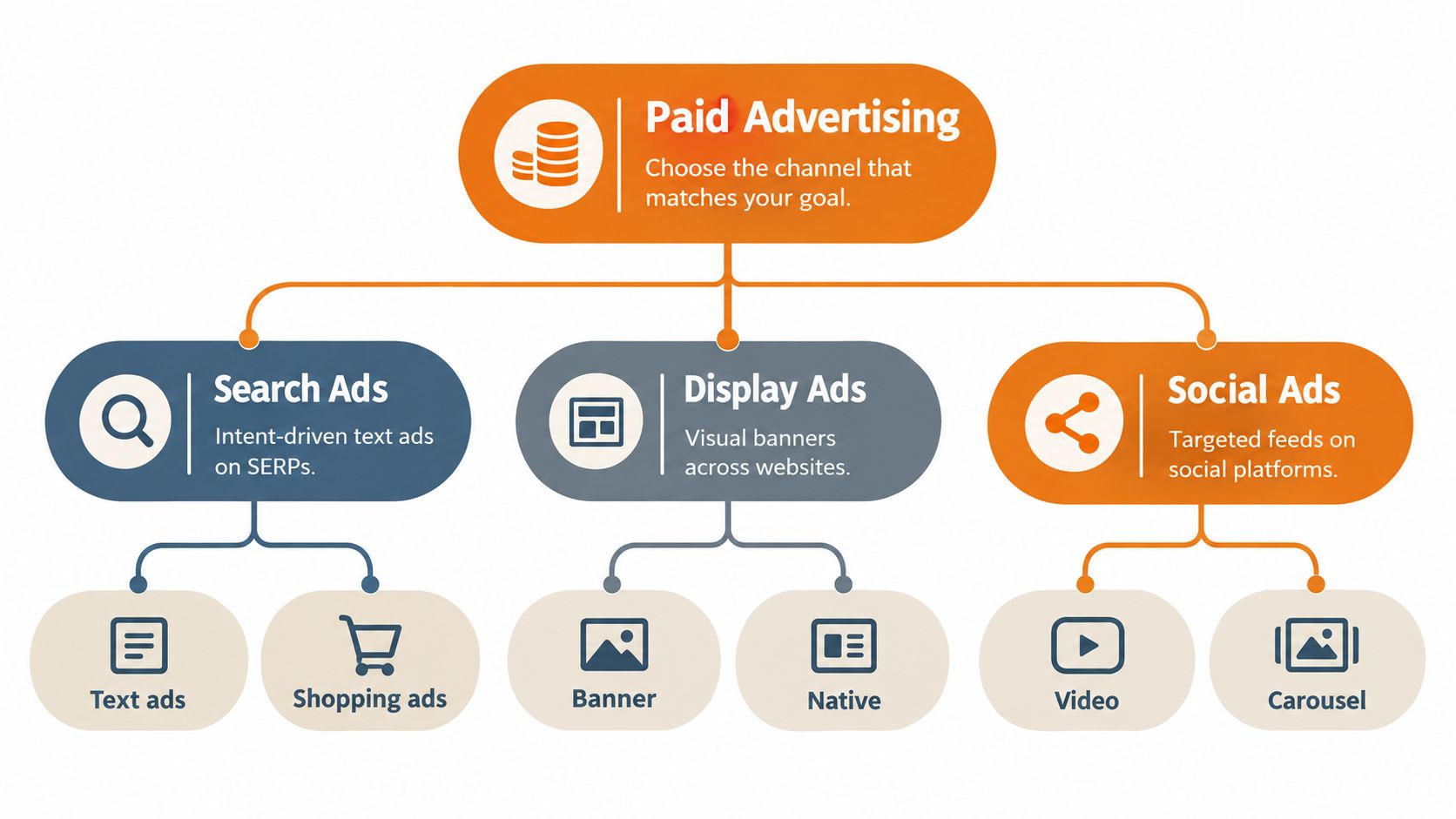
A Vancouver physiotherapy clinic with urgent appointment demand should not begin by copying a national brand's social campaign. Channel choice should follow user intent, buying context, compliance requirements, and the quality of data each platform can provide. Search, display, social, shopping, video, and programmatic inventory reach people at different stages, so one creative and targeting setup will not perform equally across them.
Search captures declared intent
Search ads appear after someone expresses a need through a query. They suit local services, urgent problems, and product categories with established demand. A physiotherapy clinic can target service-led searches, while an e-commerce brand can organise campaigns around product terms, shopping feeds, and location-specific demand.
Search performance depends on control. Broad targeting can attract irrelevant queries, weak copy can reduce engagement, and a generic landing page can turn expensive clicks into wasted spend. Negative keywords, location settings, conversion tracking, and regular search-term reviews help separate commercial intent from research traffic. In regulated categories, such as cannabis and wellness, teams also need to check claims, wording, audience rules, and destination-page compliance before scaling spend.
Social and display create or recover attention
Social ads interrupt a feed rather than answer a typed query. They can suit visual products, founder-led brands, educational content, and audiences that need to recognise a problem before considering a solution. Video, carousel, and collection formats provide room to demonstrate a product or explain a process, but the creative must match platform policies and avoid unsupported health or product claims.
Display ads place visual messages across websites and apps. They often support awareness, remarketing, product reminders, and broader reach. Because users may have weaker intent, relevance, frequency control, placement exclusions, and viewability deserve close attention. A banner delivered to the wrong audience is still wasted exposure, regardless of the bid.
Market scale doesn't remove the need for fit
IAB Canada reported that Canada's paid digital advertising market reached $18.2 billion in 2024. Search accounted for over 46% of digital ad spending, while social media represented nearly 27%, meaning more than seven in ten digital-ad dollars were concentrated in those channels.
The concentration reflects measurable demand capture, not a universal channel recommendation. Match the format to the buying situation:
- Local services: Start with high-intent search, location controls, call tracking, and a landing page focused on one service.
- E-commerce: Combine shopping and search for product demand with social creative for discovery and remarketing for consideration.
- Niche or regulated products: Prioritise compliant search opportunities, contextual education, first-party audiences, and reviewed creative. Treat consent and data quality as campaign inputs, not administrative details.
- Longer sales cycles: Use search for active demand, then support evaluation with educational content, video, email, or remarketing where platform rules permit.
More inventory creates more opportunities, but it also creates more ways to pay for irrelevant exposure. The audience, offer, creative, measurement setup, and privacy controls must align before a channel earns additional budget.
Pricing Models and Profitability Metrics
The billing model describes what triggers a charge. It doesn't tell you whether the campaign makes money. A low cost per click can still produce an unprofitable customer, while an expensive click may be acceptable if it reliably generates a high-value sale or qualified consultation.
| Pricing model | Best used for | Key success metric |
|---|---|---|
| Cost per click, CPC | Search traffic, product pages, lead-generation campaigns | Qualified conversion rate and cost per acquisition |
| Cost per mille, CPM | Awareness, video, display, and reach campaigns | Reach quality, viewability, frequency, and downstream action |
| Cost per action, CPA | Lead or purchase optimisation where conversion data is reliable | Cost per qualified action and customer value |
How the auction affects cost
In an auction, you set a bid or budget preference, but the platform also evaluates expected relevance and delivery quality. A tightly matched keyword, useful ad, and relevant landing page can support stronger efficiency than a loosely targeted campaign with a larger bid. Audience competition, placement quality, creative response, and conversion signals can all alter what you pay.
That makes campaign structure a financial decision. Separate high-intent services from exploratory terms. Keep product groups and audiences meaningful. Write landing pages that continue the promise made in the ad. If the platform receives weak conversion data, automated bidding may optimise toward shallow interactions rather than valuable customers.
Measure the business, not the dashboard
Return on ad spend, or ROAS, compares attributed revenue with advertising spend. The basic formula is:
ROAS = attributed revenue ÷ advertising spend
For lead generation, revenue may not happen immediately, so use cost per lead, cost per qualified lead, and eventual close rate. A form submission from someone outside your service area isn't equivalent to a booked consultation. Your CRM should distinguish raw leads from opportunities and customers.
Customer acquisition cost, or CAC, includes the cost required to acquire a customer. Decide whether that means media spend alone or media plus creative, agency, sales, and technology costs. Use the same definition consistently, then compare CAC with gross margin and realistic customer lifetime value.
For a practical explanation of how ROAS is calculated, keep the commercial context in view. Revenue attribution can overstate performance when several channels influenced the same buyer. Platform-reported conversions may also include actions that your sales team considers weak.
The useful question isn't “How cheap was the click?” It's “What did the qualified customer cost, and what margin remained after acquiring them?”
The Reality of Ad Delivery and Viewability
Paying for an impression doesn't guarantee that a person saw the message, noticed it, or belonged to the audience you intended to reach. Canadian benchmarks make that gap visible: comScore reported 45.7% in-target delivery and 47.5% in-view rates. In practical terms, more than half of paid impressions failed to meet the desired audience or viewability condition in those benchmarks.
Why delivery quality changes profitability
A platform can record an impression even when the placement sits below the fold, loads outside the user's active view, reaches an unsuitable audience, or appears beside content that damages brand suitability. The platform metric may look healthy while your effective exposure remains weak.
This is why paid media is also a data-quality problem. If audience classification is inaccurate, your targeting becomes less useful. If viewability isn't monitored, CPM can look reasonable while the campaign delivers little opportunity for attention. If invalid traffic enters the reporting, click and conversion data can distort optimisation.
A strong account monitors more than clicks and conversions:
- In-target delivery: Check whether the platform reached the geography, audience, or context you purchased.
- Viewability: Review the proportion of impressions with a genuine opportunity to be seen.
- Frequency: Prevent repeated exposure from exhausting a small audience or inflating costs.
- Placement quality: Exclude unsuitable sites, apps, categories, and environments where controls allow it.
- Conversion integrity: Compare platform events with analytics, CRM records, and actual revenue.
Optimise the impression before increasing the bid
Set quality requirements before scale. Use location exclusions, audience-fit checks, frequency caps, placement reports, and inventory controls. For programmatic campaigns, review supply-path and brand-safety settings rather than accepting broad network reach as a sign of efficiency.
A campaign that produces fewer but more relevant impressions can outperform one that delivers a larger volume of weak exposure. Optimisation should protect the conditions required for an impression to influence behaviour, not merely maximise delivery.
Navigating Privacy and Trust in Targeted Ads
Relevance and privacy aren't opposing goals, but careless targeting can make an advert feel intrusive before the buyer understands its value. That tension is particularly important for cannabis, CBD, functional mushrooms, health, and other categories where a customer may hesitate to share personal information or may already be sensitive to how their interests are inferred.
The Canadian Marketing Association reports that 77% of Canadians are at least somewhat likely to switch brands if a company doesn't adequately protect their data. The CMA's privacy research makes trust a commercial consideration, not merely a legal one.
Build relevance from safer signals
First-party data can help a business understand known customer relationships without relying on invasive assumptions. Use consented email lists, purchase history where appropriate, enquiry categories, and on-site behaviour collected through clear notices and lawful processes. Keep sensitive information out of ad copy, audience labels, and CRM fields that don't need it.
Contextual targeting offers another route. Instead of trying to identify a person by a sensitive inferred condition, place educational content beside relevant, permitted topics. A health brand can explain an approach or service without implying that the visitor has a diagnosis. A cannabis business can focus on compliant product information and legitimate local demand while respecting platform restrictions and applicable rules.
Make compliance part of creative review
Platform policies may restrict claims, imagery, audience construction, and categories. Canadian privacy obligations also require a business to understand its consent and data-handling responsibilities. Legal and platform review should happen before launch, not after a rejected ad or a customer complaint.
Use a practical review:
- Claim: Can the business substantiate the promise without implying guaranteed health outcomes?
- Audience: Does the targeting depend on a sensitive inference or an appropriate first-party or contextual signal?
- Disclosure: Can a customer understand how data is collected and used?
- Landing page: Does the page maintain the same privacy, regulatory, and trust standards as the advert?
- Measurement: Are events configured with only the data needed for useful reporting?
Reliable Google Ads conversion tracking should support decisions without collecting unnecessary personal information. Privacy-safe measurement won't remove every reporting limitation, but it creates a more defensible foundation for optimisation.
Integrating Paid Media into Your Growth Strategy
Paid advertising works best as a controlled accelerator inside a broader growth system. It can test demand, fill a visibility gap, and create a feedback loop for messaging. It shouldn't compensate for a confusing offer, a slow or irrelevant landing page, weak sales follow-up, or a product that customers don't understand.
Use a simple decision sequence
Start with the business constraint. If demand exists and the website converts, paid search may help capture it. If awareness is the problem, social, video, display, partnerships, or useful content may deserve attention. If the issue is low conversion, improve the offer and page before buying more traffic.
Instrument the journey. Track the event that matters to the business, then connect it to qualified outcomes. A local service needs to distinguish calls, forms, bookings, and sales conversations. An e-commerce business needs reliable purchase and margin context. Reporting should expose wasted spend rather than hide it behind platform totals.
Match spend to evidence. Begin with a focused campaign structure and a clear hypothesis. Give each channel a defined role, then reallocate budget toward audiences, messages, and placements that produce commercially meaningful outcomes. Pause activity when tracking breaks, lead quality collapses, compliance is uncertain, or the economics no longer work.
Create the flywheel
Use paid campaigns to discover language that earns attention and converts. Apply those insights to SEO pages, product descriptions, email sequences, and sales scripts. Use organic content and digital PR to build credibility, then use paid distribution selectively when a priority audience needs to see that content sooner.
A founder's pre-scale checklist should include:
- Offer clarity: The visitor understands what you sell and why it matters.
- Audience fit: Targeting reflects service areas, buying situations, and approved data sources.
- Page relevance: The landing page continues the ad promise without unnecessary distractions.
- Measurement quality: Conversion events align with qualified business outcomes.
- Economic discipline: CAC, margin, customer value, and channel costs are reviewed together.
- Compliance readiness: Claims, consent, creative, and platform rules have been checked.
Juiced Digital offers paid search, social campaigns, remarketing funnels, campaign setup, creative development, audience building, budget planning, smart bidding, and conversion tracking as part of its broader digital marketing work.
If paid advertising is producing traffic without qualified revenue, Juiced Digital can audit the targeting, creative, tracking, landing pages, and channel mix before recommending further spend. Visit Juiced Digital to discuss a practical paid media and organic growth plan for your local, e-commerce, cannabis, or health business.