
A Canadian online store can attract a serious audience and still lose most potential customers before purchase. The median Canadian e-commerce conversion rate is around 2.34% in 2026, while cart abandonment remains 69.4%, according to Canadian e-commerce conversion rate benchmarks. That isn't primarily a traffic problem. It's a signal that the buying journey contains friction customers aren't willing to overcome.
This is why conversion rate optimization matters. CRO improves the percentage of visitors who take a valuable action, whether that's purchasing a product, booking an appointment, submitting a quote request, or joining an email list. For Canadian e-commerce and local service brands, the highest-return opportunity often sits after the click, inside the product experience, forms, payment flow, and mobile journey.
The Hidden Revenue Leaks in Canadian E-Commerce
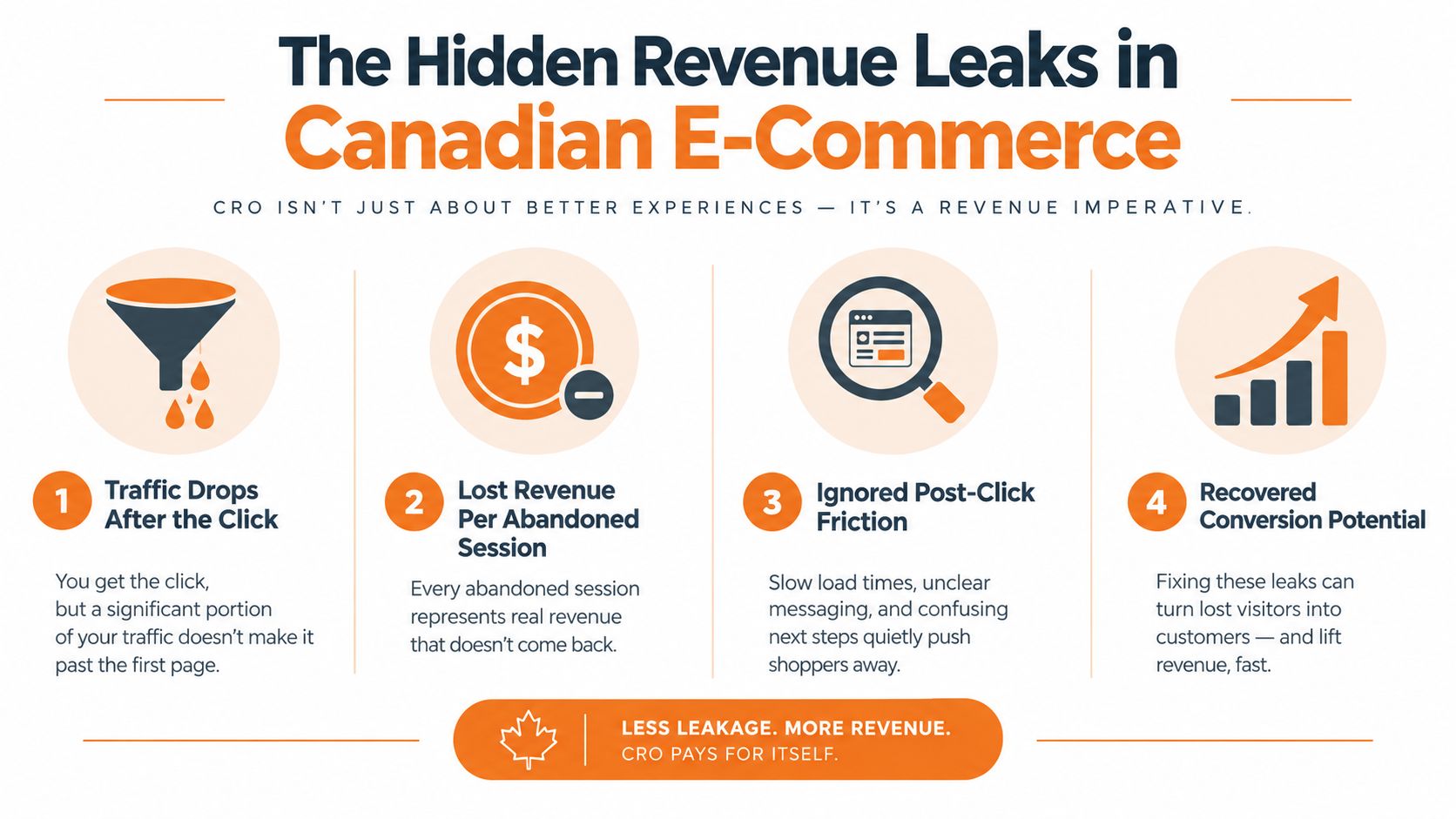
The gap between median and top-quartile Canadian stores represents revenue left inside the funnel, not merely a shortage of visitors. A brand can increase paid search budgets, publish more SEO content, or launch another social campaign, then send that additional traffic to a checkout that creates uncertainty or a mobile product page that is difficult to use.
The leak usually starts after the click. A landing page may promise one offer while the destination page leads with something else. A product page may omit dimensions, product limitations, delivery timing, return conditions, payment options, or credible reviews. Each missing answer creates another reason to leave, especially for shoppers comparing several Canadian retailers.
Where visitors disappear
The landing-page leak is a message problem. The visitor arrives from an ad, search result, or campaign and cannot quickly confirm that the page matches the original promise. The product-page leak is an information problem. Weak imagery, unclear specifications, buried reviews, and vague shipping terms force the shopper to research elsewhere.
The cart and checkout create a separate post-click failure point. Unexpected delivery charges, limited payment choices, unclear tax treatment, and forced account creation can turn strong purchase intent into abandonment. These issues are measurable in checkout exits and payment-step drop-offs, then testable through clearer cost disclosure, guest checkout, and earlier payment visibility.
Device performance adds another layer. Canadian benchmark data shows mobile conversion was 34% lower than desktop in 2026, compared with 41% in 2024, as reported in Canadian benchmark data from Ottawa SEO. That movement does not make mobile friction acceptable. It identifies a gap worth investigating across tap targets, page speed, image handling, sticky purchase controls, address entry, and mobile payment flows.
Practical rule: Before increasing acquisition spend, watch existing visitors from landing page to completed checkout. Identify the step with the sharpest intent loss, then test the smallest change that addresses its cause.
CRO turns these leaks into an evidence-led investigation. Analytics locates exits. Session recordings, heatmaps, customer-service questions, search queries, and checkout data help explain them. The resulting work might involve shorter forms, clearer delivery information, stronger product comparisons, visible payment methods, or a more usable mobile interface.
For Canadian e-commerce and local service brands, the commercial case is direct. Fixing friction creates more value from traffic already earned through search or purchased through media. The team does not need to redesign every page at once. It needs to isolate where intent drops, remove the barrier, and verify whether completed purchases improve.
How CRO Acts as a Force Multiplier for Traffic
Traffic is an input, not a business outcome. A visitor from Google, a paid campaign, or an email click only creates commercial value when the site helps that person take the next step.
The basic relationship is straightforward: revenue depends on traffic, conversion rate, and the value of each transaction. If traffic stays constant and more visitors purchase, the business can grow without expanding the acquisition programme. If the conversion rate stays flat, increasing traffic may just send more people into the same leaky funnel.
That distinction changes how marketing teams allocate resources. SEO may earn valuable visibility, but a category page that doesn't guide shoppers towards relevant products leaves that visibility underused. Paid search may attract high-intent visitors, but a landing page with a mismatched offer can waste the cost of the click. Social media may create demand, but the destination page still needs to establish relevance and reduce hesitation.
What the trade-off looks like
A redesign can be expensive, slow, and difficult to attribute. A focused CRO initiative may examine one product template, one booking form, or one checkout step. The smaller intervention isn't automatically better, but it gives the team a clearer hypothesis and a more controlled way to assess the effect.
The trade-off is especially important when acquisition costs are already pressuring margins. More media spend can increase order volume while leaving profitability unchanged if the additional customers require expensive clicks or convert poorly. CRO can improve efficiency by helping the same acquisition investment produce more completed actions.
That doesn't mean every conversion increase is valuable. A promotion that attracts low-margin orders may lift the conversion rate while weakening profit. A shorter lead form may increase submissions but reduce lead quality. A faster checkout may raise purchases while also increasing returns if product expectations remain unclear.
Measure value, not just completion
A useful CRO programme tracks the business result behind the conversion:
- Revenue per visitor: Shows whether the site creates more commercial value from each acquired visitor.
- Customer acquisition cost: Reveals whether additional conversions are making acquisition more efficient.
- Average order value: Prevents a conversion lift from hiding a reduction in basket value.
- Lead quality: Separates useful enquiries from submissions that sales can't serve.
- Refunds and cancellations: Checks whether a persuasive page creates accurate expectations.
This is the force-multiplier effect in practical terms. A stronger product page can make SEO traffic more productive. A clearer offer can help paid ads convert without changing the ad. A smoother checkout can increase the value of returning customers. CRO doesn't replace acquisition, but it determines how much of that acquisition investment survives the journey to revenue.
Segmenting Optimization by Device and Channel
A site-wide conversion rate is an average of very different experiences. It combines mobile and desktop visitors, new and returning users, high-intent searchers and casual social browsers, as well as people arriving from a promotional email and people discovering a brand for the first time.
That average can conceal the precise problem that needs attention. A desktop checkout may work well while mobile users struggle with small controls or repeated form fields. An organic visitor may need detailed comparison content, while a paid-search visitor expects a landing page that immediately confirms the ad's promise.
Device context changes the fix
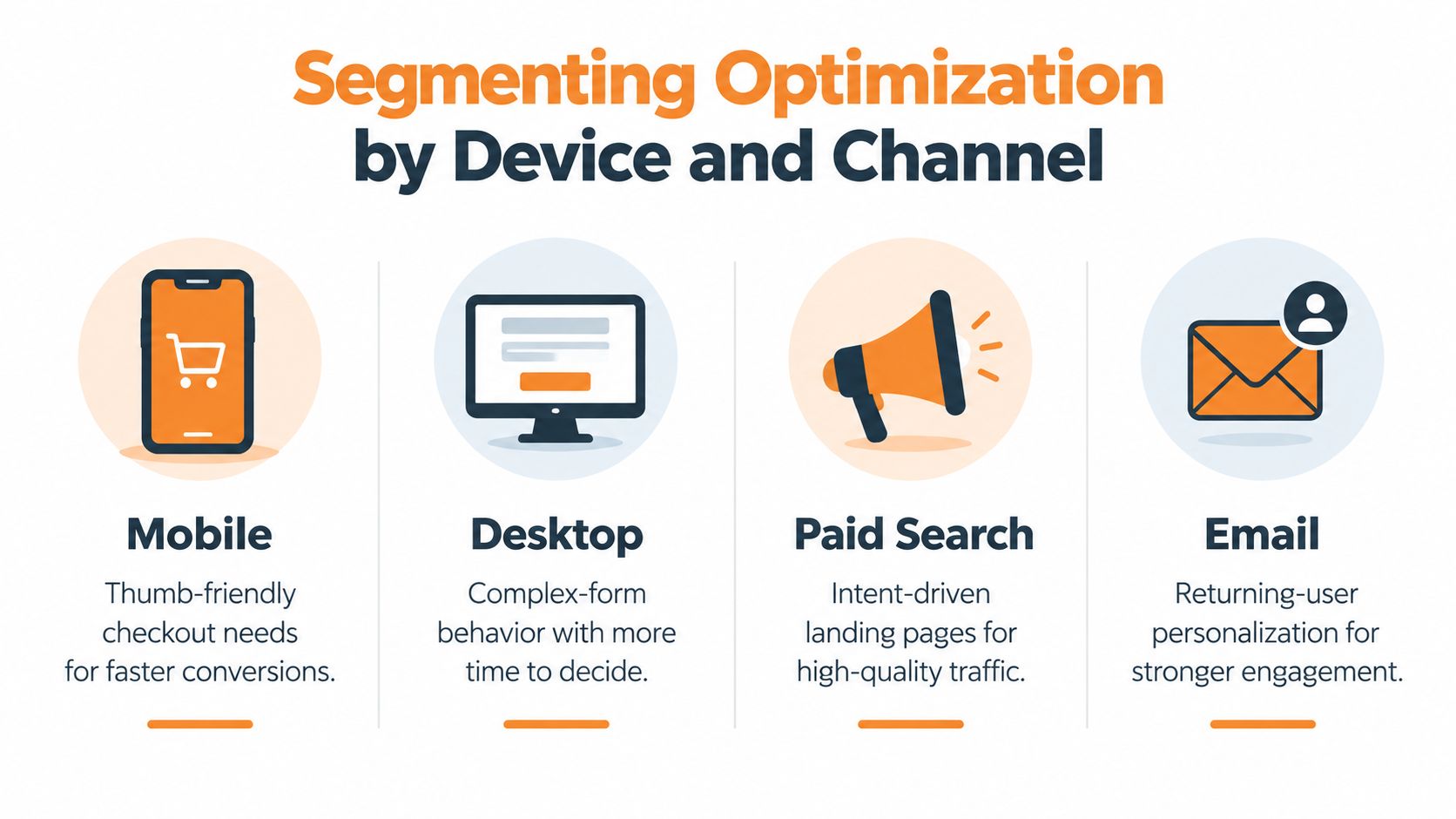
Mobile optimisation isn't just shrinking a desktop layout. Mobile users need readable product information, thumb-friendly controls, visible delivery details, and forms that work with autofill and mobile keyboards. A sticky purchase control may help on a long product page, while an oversized pop-up may block the very information a shopper needs before committing.
Desktop users can tolerate more complex comparison behaviour, especially when they're evaluating products, specifications, or service options. That doesn't make desktop friction harmless. It means the team should observe how each group moves through the site, what each group clicks, and where each group exits before choosing a solution.
Businesses can use mobile site optimisation to assess the mobile experience as its own conversion environment rather than treating responsive design as the finished task.
Channel intent deserves its own treatment
Paid search visitors often arrive with a defined problem or product query. The landing page should continue that conversation, show the relevant offer quickly, and remove distractions that don't support the intended action. Organic visitors may enter through an educational article or category page, so internal navigation and contextual calls to action matter more.
Email visitors can behave differently again. They may already know the brand, recognise a product, or return to a partially completed journey. Recent Canadian reporting shows email click-to-conversion rose from 6.23% to 9.24% year over year, while mobile continues to convert materially below desktop in Canadian e-commerce benchmarks, as reported by Retail Insider's coverage of Omnisend data.
That pattern supports channel-specific landing paths. An email link shouldn't always send an existing customer to the homepage. A paid ad shouldn't always send a prospect to a general category page. Segment the evidence first, then match the page, message, form, and call to action to the visitor's context.
Core Metrics and High-Impact Testing Tactics
CRO starts with measurement, but not every metric deserves equal attention. Page views and sessions describe reach. They don't reveal whether shoppers understand the offer, add products to a cart, encounter payment problems, or abandon a form after an error.
Canadian e-commerce data places conversion at about 2.8%, add-to-cart at 10.6%, and cart abandonment around 72.0% to 72.5%, according to Nuvei's analysis of Canada's e-commerce opportunity. The gap between adding an item and completing payment directs attention towards checkout, payment methods, trust, and post-click experience.
Track the behaviour between entry and sale
| Metric | What It Measures | Optimization Focus |
|---|---|---|
| Conversion rate | Completed purchases, bookings, or enquiries | Overall funnel efficiency and segment differences |
| Add-to-cart rate | Product interest after a product-page visit | Product information, pricing clarity, and purchase intent |
| Cart-to-checkout rate | Progress from cart into checkout | Delivery visibility, cart clarity, and payment confidence |
| Checkout completion rate | Completed orders after checkout begins | Form friction, payment errors, and guest checkout |
| Form completion rate | Submitted forms compared with form starts | Field relevance, error handling, and perceived effort |
| Micro-conversions | Smaller intent signals such as product views or email signups | Early-stage engagement and next-step clarity |
| Scroll depth | How far visitors reach on important pages | Content order, page hierarchy, and CTA placement |
Build tests from observed friction
Start with a funnel report. Identify the largest meaningful drop-off, then use recordings, support conversations, and session feedback to form a hypothesis. “If we show delivery costs before checkout, more qualified shoppers will continue” is stronger than “make the cart feel better” because it identifies a change, an audience response, and a success measure.
Prioritise tests that affect many relevant visitors and address a clear commercial barrier. Checkout flow, payment presentation, product-page messaging, mobile forms, and trust information are usually more actionable than changing a button colour without evidence that the button is being missed.
A/B testing is useful when the team can isolate a meaningful change and compare outcomes against a control. For related variables that may interact, multivariate testing can help, but it also demands stronger traffic, cleaner tracking, and disciplined interpretation.
Test the entire journey, not just the first click. A variant that increases form starts but lowers qualified submissions isn't a winner. A checkout change that improves completion but increases support requests may need refinement. Record the hypothesis, primary metric, guardrail metrics, audience, and decision before launching the experiment.
Real-World Applications Across Regulated and Local Markets
CRO becomes more valuable when the customer's concern is specific. A cannabis shopper may need reassurance about legal compliance, delivery boundaries, product information, and age requirements. A health clinic visitor may be deciding whether the practitioner understands their needs, whether the service is appropriate, and whether booking feels private and straightforward.
A generic “Buy now” or “Book a consultation” rarely resolves those questions. The page should answer the objection that stands between interest and action.

Regulated e-commerce needs confidence without clutter
Consider a Canadian cannabis or CBD product page. The brand can make the buying process clearer by placing product details, usage guidance, testing information, shipping limitations, and age-related requirements close to the purchase decision. Compliance content shouldn't be hidden in a footer if customers need it to assess the product.
Age gates create a genuine trade-off. A gate may be required or appropriate, but a confusing implementation can block legitimate visitors, reset unnecessarily, or make the site feel untrustworthy. The right CRO question isn't whether to remove every step. It's whether the step is clear, proportionate, technically reliable, and followed by a smooth path to relevant information.
Functional mushroom brands face a related challenge. Customers may have questions about ingredients, sourcing, intended use, and claims. The product page should separate evidence-based product information from unsupported promises, use precise language, and make the next action obvious without overstating outcomes.
Local services must convert intent into a conversation
A Vancouver wellness clinic has a different funnel from an online retailer. The desired conversion may be a call, an intake form, a booking request, or a map interaction. Each action carries a different level of commitment, so the page should offer suitable next steps rather than forcing every visitor into one long form.
A practical booking path can include:
- Local reassurance: Show the service area, practitioner credentials, accessibility information, and contact options where visitors evaluate trust.
- Clear expectations: Explain what happens after a booking request, how long a response may take, and what the first appointment involves.
- Low-friction contact: Ask only for information needed to respond, with clear error messages and an easy mobile experience.
- Relevant proof: Use genuine reviews and practitioner information that address the concerns of the specific service audience.
CRO doesn't mean removing necessary safeguards or making regulated claims more aggressive. It means presenting the right information at the moment of uncertainty, then making the legitimate next step easy to complete.
The Symbiotic Relationship Between CRO and SEO
SEO and CRO answer different questions. SEO helps the right people discover a page, while CRO helps those visitors understand the offer and act on it. Treating them as separate departments can create a costly mismatch, where a page earns visibility but fails to satisfy the intent behind the search.
An SEO team may target a valuable query and build a page with strong topical coverage. If the page loads slowly, buries the answer, uses vague navigation, or provides no clear next step, the business gets less value from that organic visibility. The solution isn't to remove useful content in the name of conversion. It's to organise the page so that users can find the answer, assess relevance, and continue naturally.
Relevance comes before persuasion
A product page should match the language and intent that brought the visitor there. An informational searcher may need education before a commercial offer. A local service searcher may want location, availability, credentials, and a direct way to contact the business. CRO research can reveal which questions remain unanswered, while SEO research can reveal the language visitors use to find the page.
This creates a useful feedback loop. Search queries can inform headings, product explanations, FAQs, and calls to action. On-site behaviour can show whether those elements answer the question or leave visitors searching elsewhere. The teams can then refine content and user flow together instead of optimising rankings in isolation.
Technical experience supports both objectives
Clear structure, accessible content, reliable mobile rendering, and fast interactions help users complete tasks. They also give search engines a cleaner page to interpret and evaluate. That doesn't mean a conversion test automatically improves rankings, or that engagement metrics should be manipulated as a ranking tactic. It means both disciplines benefit from a site that is useful, understandable, and technically sound.
Some CRO changes may hurt SEO if implemented carelessly. Removing explanatory content, hiding important information, changing internal links without review, or creating thin landing pages can weaken organic performance. The teams should protect search intent and accessibility while testing layout, messaging, navigation, and calls to action.
The strongest relationship is operational. SEO brings qualified opportunities into the site. CRO shows whether the site earns the next action. Together, they make organic growth more accountable to revenue, leads, and customer experience.
Building a Continuous Optimization Framework
A website launch has an end date. Customer behaviour doesn't. That makes CRO a recurring operating practice, not a one-time redesign or audit that gets filed away after implementation.
Canadian category performance shows why a permanent framework matters. In 2026, health and beauty categories in Canada convert at 3.2% to 4.2%, while electronics, home and decor, and jewellery can sit near 1.3% to 1.8%, according to Canadian e-commerce category statistics from QuakeMedia. A benchmark can identify a performance gap, but only ongoing research can explain which products, devices, channels, and customer objections create it.
Run a repeatable cycle
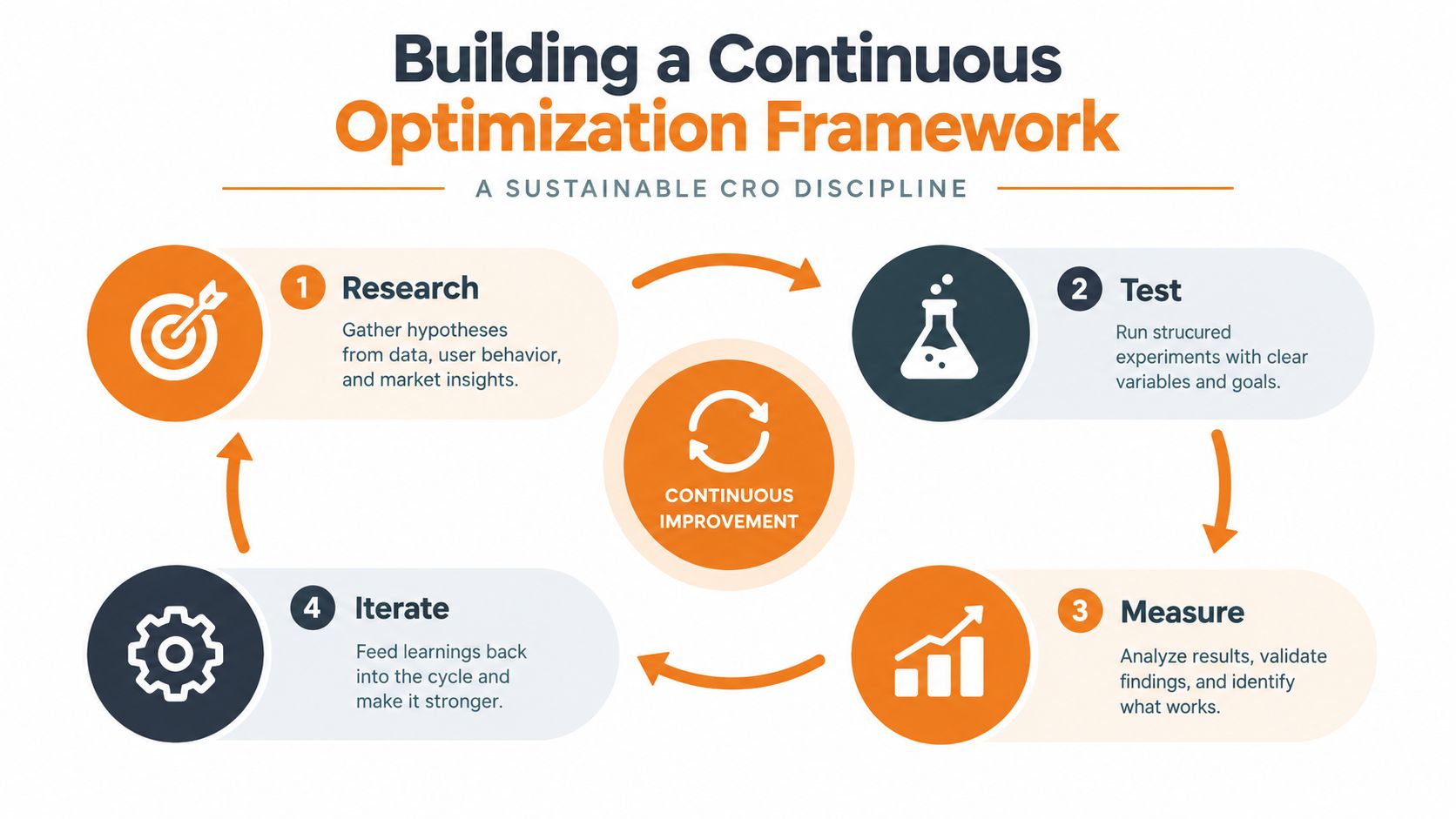
A durable framework needs four connected activities:
- Research: Review funnel data, search queries, customer-service conversations, form errors, heatmaps, and recordings. Look for repeated friction rather than isolated anecdotes.
- Test: Turn the evidence into a specific hypothesis. Define the audience, variation, primary outcome, and guardrails before releasing the change.
- Measure: Compare the result with the control and examine downstream effects. Check revenue quality, lead quality, average order value, cancellations, and technical performance where relevant.
- Iterate: Keep the learning, not just the winning variation. Apply the insight to another page or segment, then return to research with a sharper question.
A prioritisation model helps teams avoid chasing whatever idea was mentioned most recently. Score each hypothesis by likely business impact, confidence in the evidence, and implementation effort. A payment problem supported by checkout data should usually outrank a subjective preference about hero imagery.
Make learning visible across the business
Document failed tests as carefully as successful ones. A result that doesn't improve the primary metric still tells the team which assumption was wrong, which audience responded differently, or which barrier remains unresolved. That record prevents repeated experiments and gives content, design, development, sales, and support teams a shared view of customer behaviour.
An audit can establish the first set of priorities, but it shouldn't become the whole programme. A conversion rate optimization audit is most useful when it produces ranked hypotheses, measurement requirements, and a practical testing roadmap.
The answer to why is conversion rate optimization important is therefore more specific than “small improvements add up.” CRO identifies where Canadian visitors lose confidence, where mobile and desktop experiences diverge, and where checkout friction prevents intent from becoming revenue. Brands that keep researching, testing, measuring, and iterating can improve the usefulness of every acquisition channel instead of repeatedly paying to replace visitors the website already lost.
Juiced Digital helps Canadian local service businesses and e-commerce brands identify conversion leaks, improve landing pages and customer journeys, and connect CRO with SEO and paid acquisition. Visit Juiced Digital to explore its CRO, SEO, and digital marketing services and request a practical assessment of your growth opportunities.