

So, what exactly is a website maintenance package? Think of it as a subscription service for the health and performance of your website. It bundles all the crucial, behind-the-scenes work—from security checks to software updates—into a single, predictable plan.
This frees you up to focus on running your business, knowing that a team of experts is keeping your digital storefront in top shape.
Understanding Your Website Maintenance Package

It’s easy to think a website is "done" the moment it goes live, but that’s a common and costly mistake. In reality, a website isn't a static brochure; it’s more like a physical retail store. It needs constant cleaning, security monitoring, and regular upkeep to stay welcoming, safe, and functional for your customers.
Without this ongoing attention, your site can quickly become slow, buggy, and a prime target for hackers looking to exploit outdated software.
A maintenance package essentially puts all those essential technical chores on a recurring schedule, usually monthly. Instead of scrambling to fix your site after it crashes during a big promotion, a good plan works to prevent those disasters from happening in the first place.
Proactive Care vs. Reactive Fixes
The real magic of a maintenance plan is its proactive nature. The alternative—a reactive approach—means you wait for something to break before you even think about it. That path usually leads to frantic emergency calls, unexpected repair bills, and lost sales while your site is down.
A strong maintenance plan means you’re not just fixing problems when they show up—you’re stopping them before they start. It shifts your focus from costly repairs to sustained performance and security.
This consistent oversight isn't just about preventing disaster; it's about continuously improving your site's health. It’s an investment in stability and your own peace of mind. After all, with nearly 40% of users bouncing if a site takes more than three seconds to load, you can't afford to let things slide.
Key Benefits of Professional Maintenance
Putting your site's health in the hands of professionals offers real, tangible benefits that go far beyond just "keeping the lights on." It’s a smart business move that directly supports your growth.
Here’s what you stand to gain:
- Enhanced Security: With regular software updates and security monitoring, you're patching up the holes that hackers love to target. It’s the single best way to protect your business and your customer data from cyber threats.
- Improved Performance and Speed: A well-maintained site is a fast site. Ongoing optimization work ensures quick load times, which keeps visitors happy and gives your search engine rankings a healthy boost.
- Peace of Mind: This one is huge. Knowing that experts are watching over your site around the clock lets you get back to what you do best—running your business—without the nagging worry of a potential technical meltdown.
- Cost-Effectiveness: It might seem counterintuitive, but paying a monthly fee for maintenance almost always saves you money in the long run by helping you avoid catastrophic emergency repairs and costly downtime.
Ultimately, a professional website maintenance package ensures your website remains a powerful, reliable engine for your business, not a ticking time bomb.
What’s Actually Included In a Website Maintenance Plan?
Think of a website maintenance plan like the service package for your vehicle. You don’t just wait for a flat tire to get it fixed; you book regular oil changes, tire rotations, and brake checks to keep it from breaking down in the first place. In the same way, a maintenance plan bundles all the essential tune-ups to keep your website running smoothly and securely, steering you clear of costly digital emergencies.
While no two packages are identical, any plan worth its salt will cover a core set of non-negotiable services. Getting to know these components helps you understand the real value you're getting and see the difference between a basic "keep the lights on" service and a strategic package designed to help your business grow.

Core Software and Plugin Updates
Your website’s software—its content management system (CMS), plugins, and themes—is the engine that powers everything. Developers constantly release updates to patch security holes, squash bugs, and add new features. Ignoring these updates is like leaving your front door unlocked; it’s the number one way hackers get in.
Regular, scheduled updates are the foundation of any good maintenance plan. An expert handles this process with care, testing updates in a safe staging environment first. This ensures they don't crash your site or break key functions—a common headache when you try to do it yourself.
Website Backups and Recovery
Imagine your website just vanished tomorrow. A server could crash, a hacker could wipe it, or a simple human error could bring it all down. Without a recent backup, you’d likely be starting over from scratch. That's why consistent backups are your ultimate safety net.
A solid maintenance plan includes automated, regular backups of your entire website—all the files, databases, and media. These are stored securely off-site, so even if your hosting server is compromised, your data is safe. A premium plan won't just take the backups; it will have a clear, rapid-response process for restoring your site to get you back online with minimal downtime.
Backups are your insurance policy against digital disaster. It’s not a matter of if you'll need one, but when. A solid backup and recovery plan can turn a potential catastrophe into a minor inconvenience.
Security Monitoring and Malware Scanning
Updates are one thing, but proactive security means actively hunting for threats. Think of this service as a 24/7 digital security guard patrolling your website's perimeter. This part of a website maintenance package is absolutely critical for protecting your business reputation and your customers' data.
This usually involves a few key activities:
- Malware Scanning: Regular, automated scans to detect and remove malicious code that might have been injected into your site.
- Firewall Management: Setting up and maintaining a web application firewall (WAF) to block hacking attempts before they even reach your site.
- Blacklist Monitoring: Making sure your site hasn't been flagged as unsafe by search engines, which would completely kill your traffic overnight.
For businesses here in British Columbia—from a local Vancouver shop focused on local SEO to a national e-commerce brand—this is a serious investment. Technical maintenance, which covers updates and security, can range from $100 to $500 per month depending on your site's complexity. With nearly 19.8% of Canadian businesses planning to boost their online security in Q2 2025, it's clear this is a priority.
Performance and Speed Optimization
Let's be blunt: a slow website doesn't just annoy visitors; it actively costs you money and sinks your search rankings. Performance optimization is the ongoing process of making your site as fast and efficient as possible. It's not a one-time fix, but a continuous effort.
Tasks often include compressing images, minifying code, cleaning up the database, and using browser caching to speed up load times. Keeping your website fast directly improves the user experience, boosts conversion rates, and is a major ranking factor for Google. You can get into the nitty-gritty by checking out our guide on optimizing website speed.
Uptime Monitoring and Support
Finally, a good plan always includes uptime monitoring. This is an automated service that checks your website every few minutes to make sure it's online and available. If your site ever goes down, the system instantly alerts your maintenance team. They can start investigating and fixing the problem, often before you or your customers even notice.
This goes hand-in-hand with dedicated technical support. When something goes wrong or you just have a question, you need a direct line to an expert who can solve it. This access saves you hours of stress and the frustration of trying to troubleshoot complex technical problems on your own.
How Much Do Website Maintenance Packages Cost?
Trying to pin down the cost of a website maintenance package can feel a bit like guesswork, but it’s actually more logical than you might think. The price tag is almost always a direct reflection of two things: how complex your website is and how much support your business needs to stay competitive. A simple site for a local plumber just doesn't have the same demands as a busy e-commerce store juggling hundreds of daily sales.
Think of it like car maintenance. You wouldn't pay the same for a quick oil change as you would for a full engine rebuild. Website care works the same way, with different tiers of service. Getting a handle on these tiers is the key to making a smart investment—one where you’re paying for real value, not for bells and whistles you’ll never use.
Understanding Common Pricing Tiers
Most agencies, including us, tend to group their maintenance packages into a few distinct levels. This approach makes it easier for businesses to find a plan that fits their budget and technical needs, whether they just need the basics covered or require a full-on growth partner.
So, what do these different levels actually look like?
Basic Packages: This is your essential "keep the lights on" plan. It’s perfect for small businesses, startups, or blogs that don't get a ton of traffic. You can expect it to cover the absolute must-haves: software updates, regular backups, and basic security monitoring. It’s the peace of mind plan.
Standard Packages: This is the sweet spot for most growing businesses and smaller online stores. It includes everything from the basic tier but adds in things like performance tweaks to keep the site fast, more frequent backups, and usually a block of hours for content updates or minor tech support each month.
Premium or Custom Packages: This is the top-shelf option for serious players—large e-commerce sites, businesses in regulated fields, or any company whose website is the core of their business. These plans are all about proactive care, often including 24/7 uptime monitoring, advanced firewalls, dedicated support channels, and ongoing work to maximize site speed and conversions.
Real-World Cost Benchmarks in Canada
Okay, let's talk numbers. What can you actually expect to pay? Here in the competitive markets of Vancouver and across British Columbia, a good maintenance plan is a non-negotiable investment. From holistic health clinics to cannabis brands, everyone needs their site to be in top form.
Based on industry data, ongoing website maintenance costs in Canada for 2026 typically range from $50 to over $300 per month. In a major hub like Vancouver, you can expect those costs to be on the higher end of the scale. For a basic monthly plan that handles essential updates and security, you're generally looking at $50 to $150. For a deeper dive, check out this breakdown of Canadian website maintenance costs on Clickworthy.io.
The goal isn't to find the cheapest package. It's about investing in the right level of protection and support for your business's most important digital asset. Skimping now often leads to much bigger bills for emergency fixes and lost sales later.
To give you a clearer picture, here’s a quick comparison of what you might find in the Canadian market.
Typical Canadian Website Maintenance Package Tiers
| Package Tier | Typical Inclusions | Ideal For | Estimated Monthly Cost (CAD) |
|---|---|---|---|
| Basic (Starter) | Core software updates, weekly backups, basic security scans, monthly report. | Small businesses, blogs, brochure websites with low traffic. | $50 – $150 |
| Standard (Growth) | Everything in Basic, plus performance optimization, daily backups, uptime monitoring, 1-2 hours of content edits. | Growing businesses, small e-commerce stores, lead generation websites. | $150 – $300 |
| Premium (Pro/Custom) | Everything in Standard, plus advanced security (WAF), e-commerce support, SEO monitoring, dedicated support, 3+ hours of development time. | Large e-commerce sites, high-traffic websites, businesses in regulated industries. | $300+ |
This table should help you gauge where your business fits and what kind of investment makes the most sense.
Billing Models: Monthly Retainers vs. Annual Plans
Finally, you’ll want to look at how you pay. The two most common structures are monthly retainers and annual plans.
A monthly retainer is straightforward: you pay a set fee each month for a specific list of services or a block of expert time. It’s predictable, which makes it fantastic for budgeting.
An annual plan, on the other hand, means paying for the entire year upfront, almost always for a nice discount. If you’ve found a provider you trust and know you’re in it for the long haul, this can be a great way to save some money. The best choice really comes down to your business's cash flow and whether you prefer ongoing flexibility or long-term savings.
How to Choose the Right Maintenance Package
Picking the right website maintenance package isn't a one-size-fits-all affair. The best plan for you boils down to your specific business, your industry, and just how much you rely on your website day-to-day. A simple site for a local contractor, for example, has completely different needs than a bustling e-commerce store processing hundreds of sales an hour.
Choosing wisely means you’re only paying for what you genuinely need to stay secure and efficient. It’s all about finding that sweet spot between protection and price, making sure your website is an asset that drives growth, not a headache waiting to happen. This simple decision tree gives you a quick visual on which path might be right for your site.
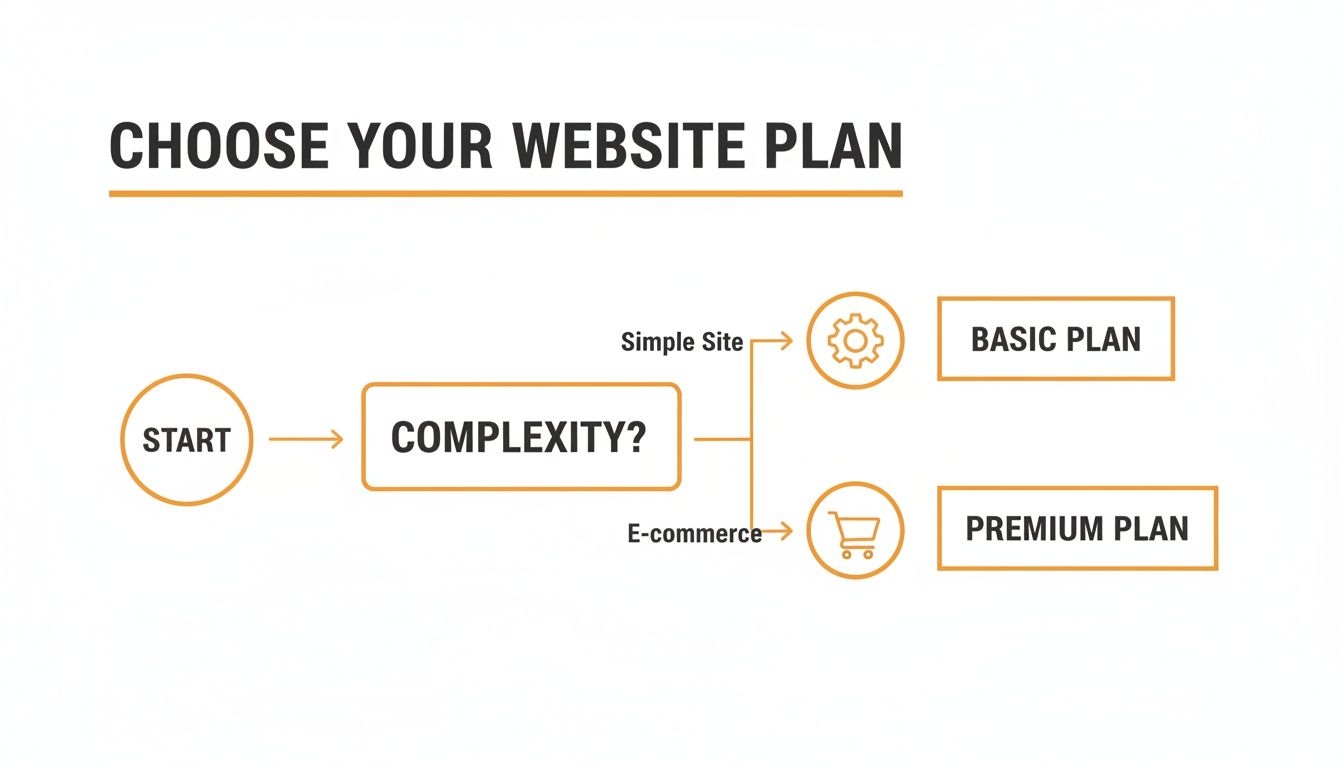
As the chart shows, the more your website does—especially when it comes to sales or handling customer data—the more robust your maintenance plan needs to be.
Assess Your Business Type and Website Needs
First things first, you need to take an honest look at your website and business model. Different businesses have different non-negotiables when it comes to keeping their site healthy. Let’s walk through a few common scenarios.
To help you pinpoint what’s most critical, here’s a quick checklist comparing the priorities for different business types.
Website Maintenance Needs by Business Type
| Feature / Service | Local Service Business | E-Commerce Store | Regulated Industry |
|---|---|---|---|
| Uptime Monitoring | Critical | Mission-Critical | Critical |
| Daily Backups | High Priority | Mission-Critical | Mission-Critical |
| Core Plugin/Theme Updates | High Priority | High Priority | High Priority |
| Basic Security Scans | High Priority | High Priority | High Priority |
| Advanced Security (WAF) | Recommended | Mission-Critical | Mission-Critical |
| Performance Optimization | Recommended | Critical | High Priority |
| Content Update Hours | High Priority | Recommended | High Priority |
| Emergency Support | Recommended | Mission-Critical | Critical |
| Compliance & Data Privacy | Low Priority | High Priority | Mission-Critical |
This table makes it clear that while everyone needs the basics, the stakes get much higher for e-commerce and regulated businesses, where things like advanced security and rapid support are absolutely essential.
Local Service Businesses (Plumbers, Clinics, Consultants)
Think of your website as your digital storefront and lead machine. Your top priorities are simply being reliable and available. If a potential customer can't find your number or book a consultation because your site is down, you just lost business.
Your key priorities should be:
- Guaranteed Uptime: Your site needs to be online 24/7. Uptime monitoring is a must.
- Core Security: This keeps your contact forms and customer inquiries safe from spam and prying eyes.
- Regular Backups: A solid backup plan means you can bounce back from any glitch without disappearing from the internet.
E-commerce Stores
For you, the website is the business. Every single minute of downtime directly translates into lost sales and shaken customer confidence. Since you're handling sensitive payment details and personal info, security isn't just important—it's everything.
Your key priorities have to be:
- Advanced Security: A Web Application Firewall (WAF) and frequent malware scans are non-negotiable for protecting customer data.
- Performance Optimization: A slow checkout is the fastest way to lose a sale. You need constant speed tuning.
- Rapid-Response Support: When something breaks, you need help now to stop the financial bleeding.
For an e-commerce brand, a maintenance package isn’t just a tech expense; it's a core part of your operations. The cost of a premium plan is pocket change compared to the revenue you could lose from just one hour of downtime during a busy sales period.
Regulated Industries (Cannabis, Finance, Health)
If your business operates in a regulated sector like cannabis, finance, or healthcare, your needs are even more specific. It's not just about uptime; it's about compliance.
For instance, a holistic health clinic in British Columbia must handle its website's data in a way that’s compliant with provincial privacy laws. That means your maintenance provider can't just be a tech expert—they need to understand these regulations and build security measures to match. A cheap, generic plan simply won't cut it.
Data from Canadian agencies really drives this home. Vancouver-based firms report that clients on professional website maintenance packages achieve nearly 99% uptime, a factor that can triple conversion rates compared to neglected sites. While monthly plans in Canada can run anywhere from $20 to $5,000, most small businesses find the best value between $150 and $300. You can find a deeper dive into website maintenance pricing and its impact on WebFX.com.
Common Red Flags When Choosing A Provider

Picking the right maintenance package is only half the battle; finding the right partner to manage it is just as important. A bad provider can do more harm than good, leaving your website at risk and your money down the drain. Knowing what to watch out for helps you sidestep the cowboys and find a team that genuinely cares about your business.
Spotting these warning signs early is your best defence. It’s the difference between partnering with an agency that will protect your digital asset and one that’s just looking to cash a cheque.
Vague or Non-Existent Service Agreements
This is a big one. If a potential provider is cagey about putting their promises in writing, you should be wary. Be on the lookout for proposals filled with fuzzy terms like "ongoing support" or "regular monitoring" without spelling out exactly what that entails.
A true professional will happily provide a detailed Service Level Agreement (SLA). This isn't just paperwork; it's your protection.
The SLA should clearly state:
- Specific Tasks: The nitty-gritty of what they’ll do, like weekly plugin updates, daily off-site backups, and monthly performance scans.
- Response Times: How fast they’ll jump on different issues. For example, a one-hour response for a site-down emergency versus a 24-hour response for a minor content edit.
- Reporting Schedule: When and how you’ll get updates on the work they've done.
Without this clarity, you have no recourse when things go wrong. It’s a recipe for arguments over what was "included," often forcing you to pay extra for work you thought was already covered.
Unusually Low Pricing
Everyone loves a bargain, but when it comes to website maintenance packages, rock-bottom prices should raise an eyebrow. Proper maintenance isn't cheap—it requires skilled technicians, premium software for security and backups, and a solid support system. If a price seems too good to be true, it is.
An unusually low price is often a sign that critical corners are being cut. This could mean infrequent backups, superficial security scans, or outsourcing support to inexperienced technicians, putting your business at significant risk.
Often, these low-cost providers make their money back through hidden fees for anything they deem "out-of-scope." Or worse, their cut-rate service simply fails when you need it most. Spending a little more for a reputable provider is always cheaper than cleaning up after a major site crash.
Lack of Transparent Reporting
If you’re paying for a service, you deserve to know what work is being done. A trustworthy agency will provide regular, easy-to-digest reports that show you exactly where your money is going. These reports should detail every completed task, from updated plugins and security scan results to uptime stats and performance tweaks.
If a provider doesn't offer reporting or just sends vague, one-line summaries, how can you be sure they’re doing anything at all? This lack of transparency can easily hide neglect, leaving your site vulnerable.
Proper reporting isn’t just a nice-to-have; it’s proof that your partner is holding up their end of the bargain. In the same way, a good partner will also advise on other critical aspects of site health, like accessibility. You can learn more by understanding ADA compliance for websites and see why it’s so important.
Let's Put Your Maintenance Plan Into Action
We’ve covered a lot of ground in this guide, but it all comes down to one simple, powerful idea: proactive website care is an investment, not an expense. Think of it as the engine that keeps your most valuable digital asset running smoothly, protecting your revenue and your reputation around the clock.
This is where having a dedicated partner really makes a difference. Here at Juiced Digital, we build our website maintenance packages to fit the unique needs of Canadian businesses, from a local service provider in Vancouver to an e-commerce brand with customers all over North America. We’ve been doing this long enough to know that a cookie-cutter plan just doesn’t cut it.
More Than Just Maintenance—It's a Partnership in Growth
Our philosophy goes beyond the usual checklist of updates and backups. We see maintenance as the solid foundation for a much bigger growth strategy. After all, a secure, fast, and reliable website is the only launchpad you want for powerful marketing campaigns.
That’s why our maintenance plans are designed to work hand-in-glove with our other core services.
- AI-Driven SEO: A healthy site is absolutely non-negotiable if you want to rank well. Our maintenance work keeps your technical SEO foundation rock-solid, which lets our advanced AI strategies do their magic to boost your visibility and bring in more organic traffic.
- Conversion Rate Optimization (CRO): We obsess over your site's speed and performance to create a seamless user experience. From there, our CRO services can fine-tune every element to turn more of those visitors into paying customers.
This isn’t just about ticking boxes; it's about creating a growth engine where every part supports the others. The end result is measurable progress that directly impacts your bottom line. We get our hands dirty with the technical stuff so you can stay focused on running your business.
Proactive maintenance is what separates a website that just exists from one that actively drives business growth. It ensures your digital storefront is always open, ready to convert visitors, protect customer data, and jump on new opportunities.
Your Next Step: A Complimentary Website Health Audit
Choosing a maintenance plan is a big decision, and we believe it should start with total transparency. You deserve to know exactly where your website stands today—what’s working, what’s not, and what vulnerabilities might be lurking under the surface.
That’s why we’d like to offer you a free, no-obligation website health audit with our team. We’ll dive deep into your site's security, performance, and overall technical health. On our call, we’ll walk you through what we find and discuss a maintenance plan built specifically for your business goals. If you're just starting out, you might also want to look at our expert website building services to ensure you start on the right foot.
Don't wait for a crisis to start thinking about your website's health. Let’s work together to build a secure, high-performing digital foundation for your business’s future.
Frequently Asked Questions
It’s completely normal to have a few questions, even after you’ve got a good handle on what website maintenance is all about. Let’s clear up some of the most common ones we hear from business owners so you can feel confident about your next steps.
How Often Does My Website Need Maintenance?
For most businesses, a monthly maintenance plan is the sweet spot. It’s frequent enough to keep everything secure and running smoothly without being overkill. This cadence allows us to apply critical updates and catch small glitches before they turn into major headaches.
That said, some websites are a bit more demanding:
- E-commerce Stores: With transactions happening and customer data being handled constantly, weekly or even daily checks are a smart move. You can't afford any downtime or security slips.
- High-Traffic Blogs or News Sites: If you’re publishing new content all the time, a weekly check-in helps keep the site fast, the database clean, and all your links working as they should.
Think of a monthly plan as the perfect starting point for almost any business website.
Can I Just Do My Own Website Maintenance?
You technically can, but it’s a classic case of weighing cost against risk and time. Going the DIY route might save you a few dollars upfront, but it requires you to invest your own valuable time and have a solid grasp of the technical side of things.
The real danger? Accidentally breaking something. One bad plugin update or a simple mistake in the code can take your entire site offline. That means lost revenue and a frantic, often expensive, call to a developer for an emergency fix.
Professional website maintenance isn't just about ticking off a checklist. It’s about having an expert safety net. You're buying peace of mind, which frees you up to focus on running your business.
What’s Usually Left Out of a Maintenance Package?
It’s really important to know where maintenance ends and new project work begins. A maintenance plan is all about keeping your current website in peak condition, not building new additions.
Generally, you’ll find these services are not included:
- New Feature Development: Need a new booking system or a customer login area? That's a separate development project.
- Major Design Changes: A complete visual overhaul or rebranding of your website is a much bigger job than routine maintenance.
- Content Creation: Writing blog posts, designing graphics, or adding new service pages falls under marketing, not technical upkeep.
- SEO or Marketing Campaigns: While good maintenance is fantastic for SEO, running the actual campaigns is a separate marketing service.
A good analogy is car care. Maintenance is your regular oil change and tune-up. Installing a brand-new stereo system is an upgrade.
How Does Website Maintenance Actually Help My SEO?
There’s a direct and powerful link between a well-maintained website and your rankings on Google. Search engines are laser-focused on showing their users fast, secure, and user-friendly websites.
Regular maintenance gives your SEO a boost in a few key ways:
- Site Speed: A clean, optimized site is a fast site. Since page load speed is a massive ranking factor, this is a huge win.
- Security: Google will actively penalise and warn users away from hacked or insecure sites. Regular security scans keep you on Google’s good side.
- User Experience: Fixing broken links and making sure your site works perfectly on mobile phones keeps visitors happy. This lowers your bounce rate and sends strong signals to search engines that your site is a quality result.
Ready to stop worrying about your website's health and start focusing on growth? At Juiced Digital, we build website maintenance packages that protect your business and give your marketing a solid foundation to build on. Schedule your free website health audit today and let's find a plan that’s right for you.