

SEO seems simple enough at first. Just sprinkle in the right keywords, follow some tips, and your website should climb those rankings. But here is where things get flipped upside down. Nearly 60 percent of marketers still believe in SEO myths that actually hurt their rankings instead of helping them. What really determines your place in search results has almost nothing to do with those old-school tricks and everything to do with how well you understand what search engines truly value.
Table of Contents
- What Are Common SEO Myths And Misconceptions?
- Why Debunking SEO Myths Matters For Your Business
- How Search Engines Really Rank Websites
- Understanding Keywords: Beyond Density And Stuffing
- The Role Of Quality Content In SEO Success
Quick Summary
| Takeaway | Explanation |
|---|---|
| Quality content drives SEO success | Creating insightful, relevant, and user-focused content improves search visibility and engagement. |
| SEO is an ongoing process | Regular updates and monitoring are essential to adapt to evolving search algorithms. |
| Keyword strategy goes beyond density | Focus on contextual relevance and user intent instead of simply repeating keywords. |
| Misinformation leads to financial loss | Using outdated SEO practices can waste resources and harm online presence. |
| Understanding ranking factors is crucial | Factors like content relevance and technical performance significantly affect search rankings. |
What Are Common SEO Myths and Misconceptions?
Search engine optimization (SEO) remains a complex landscape riddled with misconceptions that can significantly derail digital marketing strategies. Many business owners and marketers unknowingly follow outdated or incorrect practices, believing they will improve their search rankings. Understanding these myths is crucial for developing effective, modern SEO approaches.
The Keyword Density Myth
One prevalent myth suggests that cramming web pages with specific keywords will automatically boost search rankings. In reality, modern search algorithms from Google have become sophisticated enough to recognize and penalize keyword stuffing. Authentic, high-quality content that naturally incorporates relevant keywords performs far better than mechanically dense text.
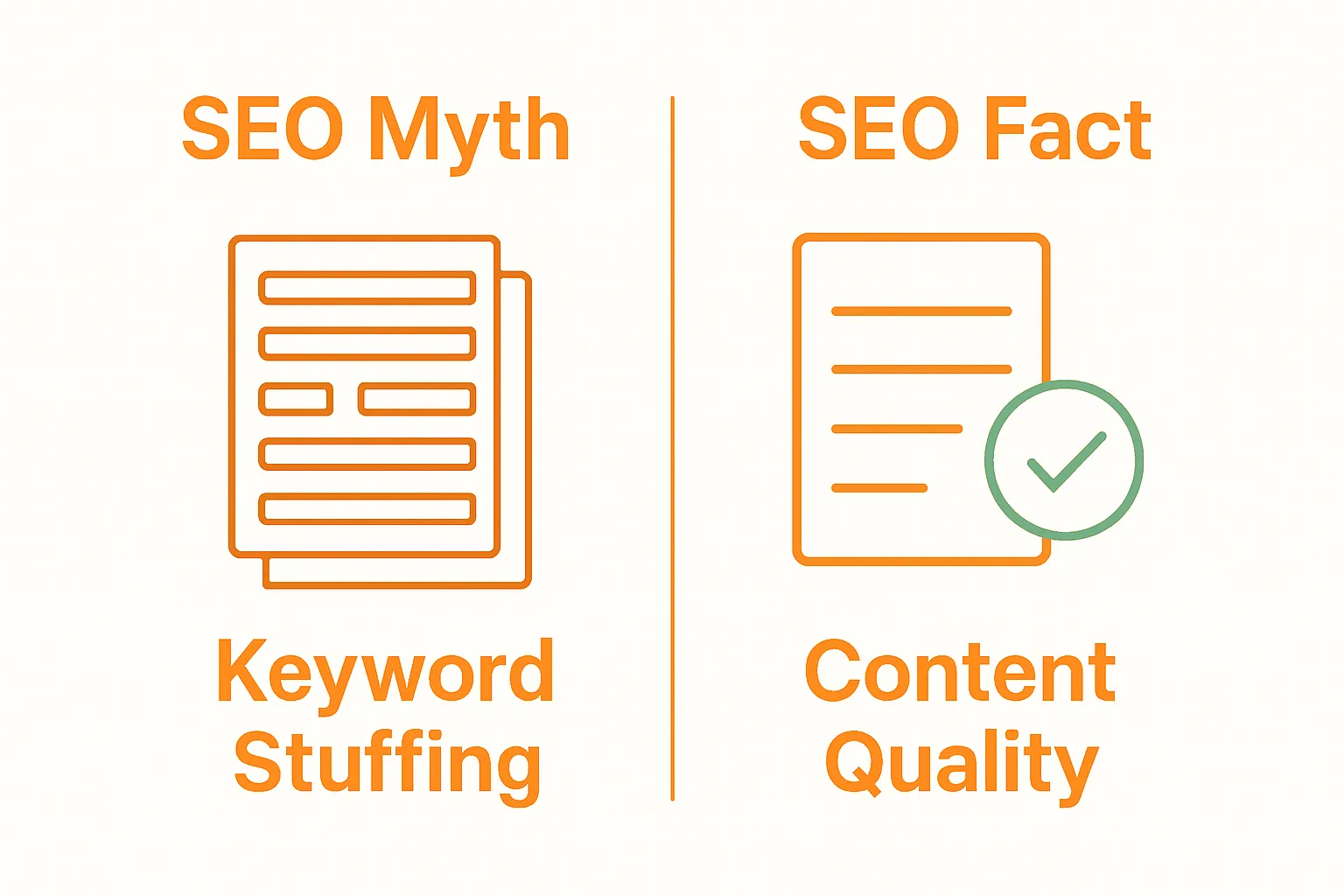 The key is contextual relevance and providing genuine value to readers.
SEO as a One-Time Effort
Another dangerous misconception is treating SEO as a singular task that can be completed and forgotten. Search engine algorithms continuously evolve, making SEO an ongoing process of adaptation and refinement. Successful digital strategies require consistent monitoring, content updates, and technical optimization. Check out our guide on sustainable SEO strategies to understand how dynamic optimization works.
Businesses must recognize that SEO is not a static set of rules but a dynamic ecosystem demanding continuous learning and strategic adjustments. By debunking these myths and focusing on genuine user experience and authoritative content, organizations can develop more effective search visibility approaches.
To help clarify how leading SEO myths differ from current best practices, the table below contrasts common misconceptions with the modern approach to search engine optimization.
| SEO Myth | Reality / Modern Approach |
|---|---|
| Keyword stuffing boosts rankings | Natural, relevant keyword use and context matter most |
| SEO is a one-time task | SEO is an ongoing process requiring regular updates and monitoring |
| More backlinks always equal higher rank | Quality and relevance of backlinks are valued over sheer quantity |
| Meta keywords are vital | Most search engines ignore the meta keywords tag |
| Longer content always ranks higher | Content quality and relevance are more important than length |
| Exact-match domains guarantee ranking | Branding and content authority are stronger ranking signals |
| Paid ads improve organic ranking | Paid search does not directly impact organic search rankings |
Why Debunking SEO Myths Matters for Your Business
Navigating the digital marketing landscape requires understanding how misconceptions can dramatically impact business performance. SEO myths are not merely theoretical mistakes but practical barriers that can significantly hinder online visibility and revenue potential.
Financial Consequences of Misinformation
Believing and implementing incorrect SEO strategies can lead to substantial financial losses. Businesses investing time and resources into outdated techniques effectively waste money on approaches that provide minimal or negative returns. According to SEO research from Semrush, companies following unverified strategies can experience:
- Reduced organic search traffic
- Lower website conversion rates
- Decreased search engine rankings
- Potential penalties from search engines
Competitive Disadvantage in Digital Marketing
When businesses cling to SEO myths, they inadvertently create competitive disadvantages. Modern search algorithms prioritize authentic, user-focused content and technical optimization. Companies that understand and implement evidence-based SEO strategies gain significant market positioning. Learn more about advanced SEO techniques to stay ahead of digital marketing trends.
Understanding and dispelling SEO myths is not optional but essential. By embracing accurate, data-driven approaches, businesses can transform their digital marketing strategies, improve online visibility, and create sustainable growth pathways in an increasingly competitive digital ecosystem.
How Search Engines Really Rank Websites
The mechanisms behind search engine rankings represent a complex interplay of advanced technological systems designed to deliver the most relevant and valuable content to users.
Contrary to popular belief, ranking is not a simple mathematical equation but a sophisticated process involving multiple interconnected factors.
The Core Ranking Factors
Google’s ranking algorithms evaluate websites through a multidimensional approach that goes far beyond traditional keyword matching. Websites are assessed across several critical dimensions:
- Content Relevance: How closely website content matches user search intent
- Technical Performance: Site speed, mobile responsiveness, and user experience metrics
- Domain Authority: Credibility established through quality backlinks and consistent performance
- User Engagement: Metrics like click-through rates, time on page, and bounce rates
Beyond Traditional Optimization Strategies
Modern search ranking transcends simplistic optimization techniques. Search engines now employ machine learning and artificial intelligence to understand context, semantic relationships, and user behavior patterns. Learn more about advanced site architecture strategies to enhance your digital visibility.
Understanding these sophisticated ranking mechanisms empowers businesses to develop holistic digital strategies.
The following table summarizes the core ranking factors described as essential by modern search engines, highlighting how each factor supports SEO and impacts ranking performance.
| Ranking Factor | Description |
|---|---|
| Content Relevance | Measures how well content matches the searcher’s intent |
| Technical Performance | Includes site speed, mobile usability, and overall user experience |
| Domain Authority | Evaluates site credibility through quality backlinks and trust |
| User Engagement | Assesses metrics like click-through rate, time on page, and bounce |
| Originality | Considers how unique and non-duplicated the content is |
Understanding Keywords: Beyond Density and Stuffing
Keywords represent the critical bridge connecting user search intent with relevant digital content. However, modern SEO demands a nuanced approach that transcends simplistic quantitative strategies and embraces contextual understanding.
The Evolution of Keyword Strategy
Keyword research has transformed dramatically from mechanical repetition to sophisticated semantic analysis. Search engines now prioritize conceptual relevance and user intent over raw numerical keyword frequency. Effective keyword strategies now require:
- Contextual Comprehension: Understanding the deeper meaning behind search queries
- User Intent Mapping: Aligning content with specific searcher motivations
- Semantic Diversity: Incorporating related terms and conceptual variations
Semantic Search and Natural Language Processing
Modern search algorithms employ advanced machine learning techniques to understand language complexity. Explore our advanced content optimization approaches to leverage these sophisticated technological capabilities. Keywords are no longer isolated words but integral components of a broader conversational ecosystem that connects user questions with precise, valuable answers.
Successful digital content strategies recognize that keywords are living, dynamic elements requiring continuous adaptation and strategic refinement. By embracing a holistic approach that prioritizes meaningful communication over mechanical optimization, businesses can develop more authentic, engaging online experiences that resonate with both users and search algorithms.

The Role of Quality Content in SEO Success
Quality content represents the foundational cornerstone of effective search engine optimization, transcending traditional technical strategies and driving meaningful user engagement. Modern search algorithms prioritize substantive, valuable information that genuinely addresses user needs and provides comprehensive insights.
Defining Quality Content Standards
Google’s content guidelines emphasize creating people-first content that demonstrates authentic expertise and value. Quality content is characterized by several critical attributes:
- Depth of Information: Comprehensive coverage that answers user questions thoroughly
- Originality: Unique perspectives and insights not duplicated elsewhere
- Relevance: Direct alignment with user search intent and current industry trends
- Actionable Insights: Practical information users can implement immediately
Beyond Surface-Level Information
Successful content strategies require more than mere information delivery. Explore our advanced content optimization techniques to understand how strategic content development can transform digital visibility. The most effective content creates genuine value by solving user problems, addressing specific pain points, and presenting information in an engaging, accessible manner.
Ultimately, quality content is a dynamic ecosystem of expertise, user understanding, and strategic communication. By consistently producing meaningful, well-researched content that prioritizes user experience, businesses can establish digital authority, improve search rankings, and build lasting audience trust.
This table outlines key attributes that define quality content according to the article, providing guidance for content creators aiming for SEO success.
| Attribute | What It Means for Quality Content |
|---|---|
| Depth of Information | Thoroughly answers user questions and covers the topic |
| Originality | Provides unique insights not found elsewhere |
| Relevance | Aligns with current user needs and industry trends |
| Actionable Insights | Offers practical, usable advice that readers can implement |
| Engagement | Presented in an accessible, interesting manner |
Cut Through SEO Noise and Unlock Genuine Growth Today
Are outdated SEO myths leaving your website invisible to real customers? If you find yourself lost between confusing keyword advice and algorithm rumors, you’re not alone. Many businesses struggle with wasted time and lost revenue, simply because they follow misconceptions instead of proven strategies. Instead of chasing misleading trends, it’s time to focus on ROI-driven SEO that actually delivers measurable results. For practical solutions that debunk digital marketing myths and increase your visibility where it counts, start with the experts.
Do not let myths slow your growth. Visit Juiced Digital and connect with a search marketing partner that specializes in high-authority link building, local SEO, and cutting-edge strategies for cannabis, e-commerce, and local businesses. Take control of your search rankings now and see what true SEO performance looks like. Your competitors are adapting quickly, so discover the truth about modern SEO and transform your results today.
Frequently Asked Questions
What are some common SEO myths that businesses should beware of?
Many businesses fall for myths such as the belief that keyword stuffing will improve rankings, or that SEO is a one-time effort. It’s important to recognize that modern SEO requires ongoing adaptation and high-quality content.
How important is keyword strategy in modern SEO?
Keyword strategy has evolved significantly; it’s not just about frequency but also about understanding user intent and contextual relevance. Incorporating related terms and focusing on semantic diversity is essential for effective keyword usage.
Why is quality content crucial for SEO success?
Quality content is the backbone of effective SEO. Search engines prioritize content that provides depth, originality, and relevance to user queries, ultimately driving better engagement and higher rankings.
How do search engines rank websites?
Search engines use complex algorithms that assess multiple factors including content relevance, technical performance, domain authority, and user engagement metrics to rank websites effectively.
Recommended
- Top 10 SEO Strategies to Boost Organic Traffic in 2024 – Digital PR Expert | Digital Marketing & Search Leaders
- Understanding White Hat vs Black Hat SEO Techniques – Digital PR Expert | Digital Marketing & Search Leaders
- Understanding SEO Best Practices for Your Business – My Blog
- Understanding Search Engines: How They Actually Work