
At its core, SEO for insurance agencies is about making sure your website shows up when potential clients are searching for policies online. It’s how you become the first agency they find, turning your website into a powerful machine for generating high-intent, qualified leads who are actively looking for the coverage you offer.
Why SEO Is a Must-Have for Insurance Agency Growth
Think of your agency’s website like a physical storefront. Without a solid SEO plan, your office might as well be tucked away on a forgotten side street with almost no foot traffic. Good SEO, on the other hand, moves your business right onto the busiest main street in town, putting you in front of thousands of potential clients daily.
This is a fundamental shift in how you get business. Instead of relying on cold calls or traditional advertising, you start attracting people who are already typing things like "best home insurance in Toronto" or "commercial auto insurance quote" into Google. They’re already looking for you; SEO just helps them find you first.
This move from outbound to inbound marketing is no longer optional. Today, nearly 87% of insurance buyers start their journey online before they ever pick up the phone to speak with an agent. They’re comparing policies, checking quotes, and reading reviews to make smart choices. If your agency isn't on the first page of Google, you're invisible to the overwhelming majority of your market.
This diagram shows exactly how a focused SEO strategy fuels your agency's bottom line.
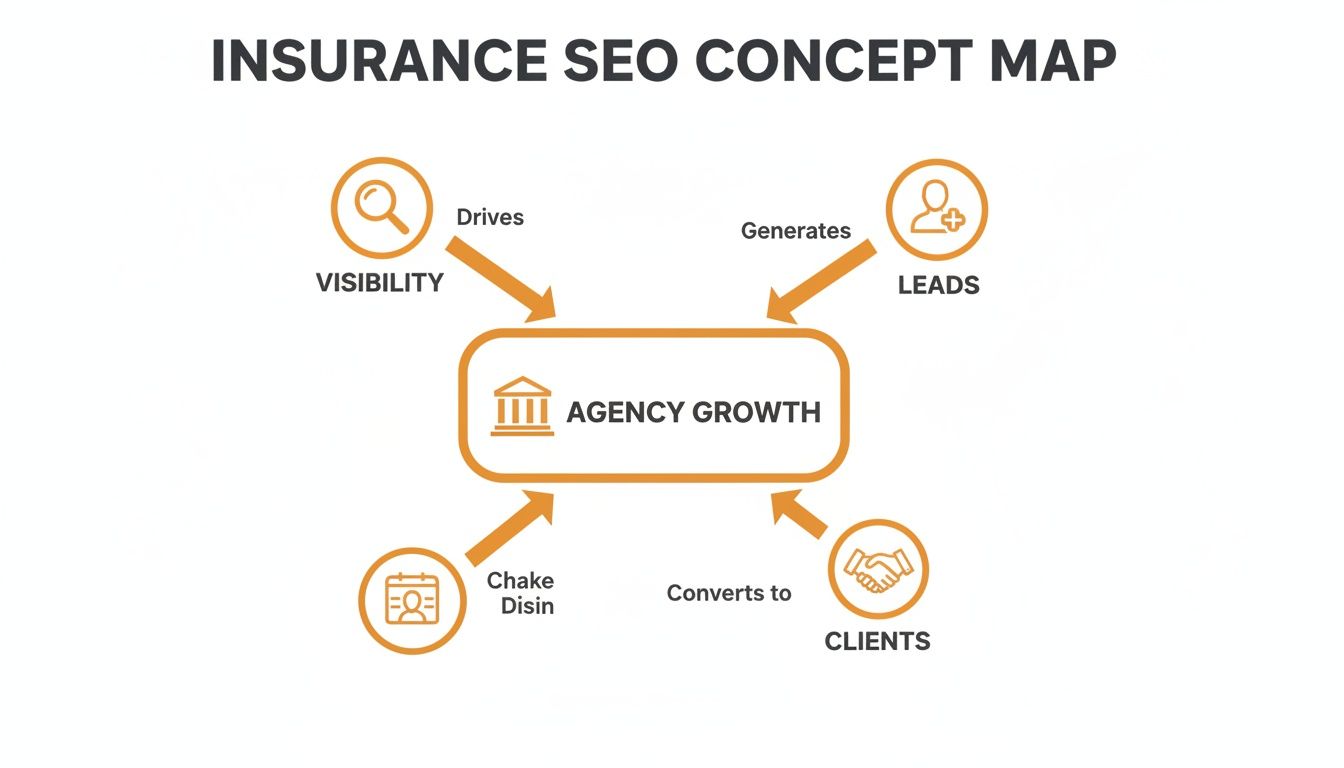
As you can see, better visibility directly leads to more qualified leads, which convert into new clients and drive real, sustainable growth.
The Financial Impact of Digital Visibility
The return on investment really tells the story. The insurance world has pivoted hard toward digital-first client acquisition. For example, agencies that get serious about SEO for insurance agencies have seen up to a 40% increase in qualified leads in as little as six months. It’s become the key difference between agencies that are scaling and those that are being left behind. You can find more details on this trend and its effect on insurance agency growth on totalcsr.com.
SEO isn’t just another marketing expense; it's an investment in a compounding asset. The content and authority you build today will continue to generate leads for years, creating a sustainable engine for your agency's success.
2. Building Your Foundation with Local SEO
For most insurance agencies, business is won on a local level. You're not trying to be the biggest agency in the country; you're trying to be the go-to expert for your city, your neighbourhood, and your community. This is precisely where local search engine optimization comes in, acting as a digital welcome mat for people searching terms like “car insurance broker near me” or “homeowners insurance in Vancouver.”
Think of it this way: local SEO is the modern-day equivalent of having the best office location in town, right on the busiest corner. It ensures that when someone in your community pulls out their phone to find an agent, your name is the first one Google puts in front of them. It’s all about winning your own backyard.
The absolute heart of this strategy is your Google Business Profile (GBP). This free listing is probably the single most important tool in your local marketing arsenal. When done right, it can land you in the coveted “Map Pack”—that box with three businesses you see at the very top of local search results.
Fine-Tuning Your Google Business Profile
Your GBP isn't just a placeholder; it's a powerful lead-generation machine waiting to be switched on. This isn't a one-and-done task; it needs consistent attention to really shine.
Start by getting the basics perfect. Choose "Insurance Agency" as your primary category, of course, but don't stop there. Use the secondary categories to signal your specialities, like "Auto Insurance Agency" or "Life Insurance Agency." This helps Google match you with more specific searches.
Your business description is prime real estate. Don't just list your services; write a compelling summary that naturally includes how you help clients and the types of coverage you offer. Weave in keywords like “independent insurance agent in [Your City]” to help both potential clients and Google understand exactly what you do.
A complete and active Google Business Profile sends a powerful message to Google. It says your agency is legitimate, relevant, and actively serving the local community. Every update and new photo tells the search engine that you're open for business and ready to help.
Next, show, don't just tell. Upload plenty of high-quality, geo-tagged photos of your office, your team, and maybe even some shots of your building's exterior. Geo-tagging embeds location data right into the image file, giving Google another strong confirmation of where you are.
Finally, get ahead of questions by using the Q&A feature yourself. Seed it with common queries you get all the time, like "What do I need for a car insurance quote?" or "Do you offer renters insurance?" and then answer them thoroughly. This lets you control the information and provide immediate value.
Creating a Web of Trust with Consistent Citations
Beyond Google, your local presence relies on consistency across the entire web. A citation is simply any online mention of your agency's Name, Address, and Phone number (often called NAP). Google acts like a detective, cross-referencing these citations to verify that your business is real and that its information is accurate.
If one directory lists you as "Smith Insurance Agency" and another has "Smith Ins. Inc.," it creates confusion for search engines and can quietly chip away at your rankings. Your mission is to make your NAP identical everywhere it appears.
Key places to build these citations include:
- Major Data Aggregators: These are services that feed your business information to hundreds of smaller online directories.
- Industry-Specific Directories: Websites that specialize in listing insurance providers are gold mines for relevant citations.
- Local Directories: Think of your local Chamber of Commerce website, community portals, and neighbourhood business associations.
Getting this foundational consistency right is a critical first step. For a deeper look at the nuts and bolts, you can explore our complete guide on the fundamentals of local SEO.
The following checklist breaks down the essential first steps for any insurance agency looking to establish a solid local SEO foundation.
Local SEO Foundational Checklist for Insurance Agencies
A step-by-step checklist to ensure your agency's local online presence is fully optimized to attract nearby clients.
| Optimization Area | Key Action | Why It Matters |
|---|---|---|
| Google Business Profile | Fully complete every section: services, hours, description, categories, photos, and attributes. | This is the single biggest factor for Map Pack rankings and provides clients with the information they need to act. |
| NAP Consistency | Audit your Name, Address, and Phone number across top directories. Correct any inconsistencies. | Google uses consistent NAP data as a primary trust signal to verify your business's location and legitimacy. |
| Local Citation Building | Submit your agency to key local and industry-specific directories (e.g., Chamber of Commerce, insurance-focused portals). | Builds your digital footprint and reinforces your geographic relevance to search engines. |
| Online Reviews | Implement a system to consistently request reviews from happy clients. Respond to all reviews, both positive and negative. | Reviews are a major ranking factor and provide the social proof needed to convert prospects into clients. |
| On-Page Local Signals | Ensure your website's contact page and footer clearly display your NAP. Mention your city/service area in page titles and content. | These on-page clues connect your website directly to your physical location for search engines. |
| Geo-Tagged Photos | Upload high-quality photos of your team and office to your GBP and website. Use a tool to add location data (geo-tags) to the image files. | Provides Google with visual proof of your location and business operations, strengthening local signals. |
Working through this checklist ensures you’ve covered the core pillars of local search. It’s not about finding a secret trick; it's about methodically building a trustworthy and authoritative presence in the places your local clients are looking.
The Decisive Power of Client Reviews
In the world of local SEO, reviews are everything. They are a massive ranking factor, but more importantly, they are the social proof that gives a potential client the confidence to pick up the phone and call you instead of your competitor down the street. In fact, research shows that 88% of consumers trust online reviews as much as a personal recommendation from a friend.
Your goal should be to create a steady, ongoing stream of genuine reviews. Put a simple process in place to ask for feedback—maybe it's an automated email that goes out after you close a new policy, or just a personal request after a great conversation.
Just as important is how you handle the reviews you get. You need to respond to all of them, good and bad. Thanking someone for a positive review shows you appreciate their business. Professionally addressing a negative comment shows that you care about customer service and are committed to making things right. This active reputation management builds incredible trust, both with potential clients and with Google itself.
Crafting a High-Trust Content Strategy

In the insurance game, your content isn't just about selling policies—it's about building trust from the ground up. Think about it: clients are trusting you with their financial security and peace of mind. That means everything you publish is held to a much higher standard, not just by your prospects, but by Google itself.
This is where the idea of Your Money or Your Life (YMYL) becomes critical. Google puts content about finance, health, and safety under a microscope because bad advice can cause serious, real-world harm. For an insurance agency, pretty much every page on your website—from a blog post about deductibles to a service page on life insurance—falls directly into this YMYL bucket.
So, your entire content strategy needs to be built around proving your E-E-A-T: Experience, Expertise, Authoritativeness, and Trustworthiness. This isn't just another SEO acronym; it's the framework Google uses to figure out if you're a legitimate expert or just another website churning out generic advice.
Building Authoritative Service Pages
Your service pages for auto, home, or commercial insurance are your digital storefront. They absolutely cannot be thin, 200-word blurbs lifted from a carrier brochure. Each one needs to be a definitive resource that tackles every major question a potential client might have.
Treat each service page like a comprehensive guide. For instance, a solid homeowners insurance page should do more than just slap a "Get a Quote" button at the top.
It needs to unpack the details, like:
- What’s covered: Break down standard coverages like dwelling, personal property, and liability in plain English. No jargon.
- What’s typically not covered: Be upfront about common exclusions, like floods or earthquakes, and then guide them toward solutions like separate riders or policies.
- Choosing the right deductible: Help people understand the trade-off between monthly premiums and their out-of-pocket costs in a claim.
- Local factors: This is where you shine. Talk about risks specific to your area, like wildfire preparedness tips for clients in British Columbia or specific bylaws affecting Calgary homeowners.
Going this deep does more than just show off your expertise. It builds real confidence. When someone finds all their answers on a single page, they're far more likely to trust you with their business.
Creating deep, educational service pages does more than just rank for keywords. It pre-qualifies your leads by educating them, making the subsequent sales conversation smoother and more effective.
Answering Real Questions with Helpful Content
While your service pages target people with their wallets out, your blog is where you connect with everyone else who's still in the "figuring it out" phase. This is your chance to become the go-to resource in your community by tackling the real-world problems and questions your clients ask you every day.
Smart SEO for insurance agencies is about targeting the intent behind the search. Instead of just writing about "car insurance," create content that directly answers questions like:
- "How can I lower my car insurance premium in Ontario?"
- "What insurance do I need for a small business in Calgary?"
- "Is tenant insurance mandatory in British Columbia?"
- "Comparing term vs. whole life insurance for young families."
Each of these topics hits on a specific pain point. When you provide a genuinely helpful, detailed answer, you’re not just making content for Google—you're starting a relationship with a potential client long before they’ve even thought about asking for a quote.
Showcasing Your E-E-A-T Signals
Proving you're an expert isn't just about what you say; it's also about what you show. You need to sprinkle trust signals across your site that tell both Google and human visitors that you are a legitimate, qualified, and trustworthy authority.
Here are the absolute must-haves for your agency's website:
- Detailed Author Bios: Every article should have a real person's name attached. Their bio needs to include their credentials, years in the industry, and a professional photo. This is a direct signal of Expertise.
- Display Credentials and Licenses: Your agency's license numbers, industry awards, and professional memberships should be easy to find, usually in the footer of your website. This screams Authoritativeness.
- Transparent Contact Information: A clear address, a working phone number, and a simple contact form prove you're a real business that's ready to talk. This is a cornerstone of Trustworthiness.
- Show First-Hand Experience: Share anonymized case studies or blog posts detailing how you guided a client through a tough situation, like a complicated claims process. This demonstrates real-world Experience.
By weaving these signals throughout your website and pairing them with genuinely helpful content, you build a powerful one-two punch. You'll satisfy Google's strict YMYL criteria while earning the confidence you need to turn a curious searcher into a lifelong client.
Getting Technical SEO Right for Your Agency Website
If your content strategy is the engine driving your SEO, then technical SEO is the chassis, the transmission, and the tires—everything that actually gets that power to the road. It’s all the work that happens behind the scenes. Clients will never see it, but search engines absolutely will. Without a solid technical foundation, even the most brilliant, helpful content will just spin its wheels.
Think about it. You could write the most compelling guide to home insurance in Canada, but if your website takes ten seconds to load, nobody is going to stick around to read it. Good technical SEO ensures your site is fast, easy for Google to crawl and understand, and gives visitors a smooth experience no matter what device they're on.

This part of the job is less about creative flair and more about precision. It's about structuring your website logically, obsessing over page speed, and speaking Google's language with specific code. Getting these elements right is simply non-negotiable if you're serious about SEO for insurance agencies.
Building a Logical Site Structure
A clean, logical website structure acts like a clear map for both your visitors and for search engine crawlers. Picture a potential client landing on your homepage. They should be able to find your auto insurance page, your contact details, or your latest blog post in just a couple of intuitive clicks.
A well-organized site usually follows a clear hierarchy:
- Homepage: The central hub that links out to all your most important sections.
- Service Pages: Dedicated pages for each core policy you offer (e.g.,
/auto-insurance/,/home-insurance/,/business-insurance/). - Sub-Service Pages: More specific pages nested under those main services (e.g.,
/auto-insurance/classic-car-coverage/). - Supporting Pages: Essentials like your 'About Us,' 'Contact,' and 'Blog' pages.
This tiered approach makes navigation second nature for users. It also helps Google understand the relationships between your pages, which allows it to pass authority through your site more effectively. A critical piece of this is your XML sitemap—it’s literally a roadmap you hand over to Google. If you’re not sure where to start, you can learn more about how to find your sitemap and make sure it’s set up correctly.
Why Site Speed Is So Critical
In the insurance game, speed translates directly into leads. Study after study confirms that even a one-second delay in page load time can cause a massive drop in conversions. When a prospect is actively searching for a quote, they have zero patience for a slow, clunky website.
A slow website doesn't just annoy visitors—it actively costs you money. Google uses page speed as a direct ranking factor, meaning faster sites get rewarded with better visibility, while slower competitors are pushed down the results page.
What's slowing you down? The usual suspects are massive, unoptimized images, bloated code, or cheap, low-quality web hosting. Running your site through a free tool like Google's PageSpeed Insights will give you a clear report card and a to-do list for getting your load times down.
Speaking Google’s Language with Schema Markup
One of the most powerful—and often overlooked—technical tools for an insurance agency is Schema markup, also known as structured data. Think of it as a special vocabulary of code you add to your website that explicitly tells search engines what your content is all about.
Instead of making Google guess, you can spell it out for them:
- "This is an insurance agency."
- "This is our business address and phone number."
- "These are our hours of operation."
- "This is the name of an insurance policy we offer."
By implementing the right Schema, you help Google understand your business with perfect clarity. This is what can earn you "Rich Results"—those more detailed, visually appealing search listings that might include star ratings, FAQs, or other elements that pop off the page. For an insurance agency, this is a huge competitive advantage that makes your listing stand out and practically begs for more clicks.
Building Authority with Digital PR and Link Building

In the insurance business, trust is everything. It's the currency you trade in every single day. That same principle holds true online. For search engines like Google, every link pointing to your website from another credible site is basically a vote of confidence. It’s a signal that you’re an authority people can trust.
This is why a smart approach to link building is a non-negotiable part of any serious SEO for insurance agencies plan.
Forget the old-school, spammy tactics of buying a bunch of cheap links. That’s a fast track to getting penalized. Today, earning quality backlinks is all about digital PR. It's about building real relationships and creating genuine value in your community, which in turn earns you the kind of endorsements Google loves to see. The aim isn’t to just hoard links; it's to build a profile of authority that improves your rankings, solidifies your local reputation, and sends high-quality referral traffic your way.
Earning Links Through Community Engagement
Your connection to the local community is your secret weapon. It's an advantage that big, faceless national carriers simply can't match. By getting actively involved in local initiatives, you can generate powerful brand mentions and backlinks that are completely natural because they’re earned, not bought.
This strategy turns your community work into a powerful SEO asset. Sponsoring a local minor hockey team, a charity 5k run, or a summer festival usually means your agency’s name and website get featured on their site and marketing materials. These are some of the most relevant and high-authority local links you can possibly acquire.
Think of each local sponsorship or partnership as a digital handshake. You're not just supporting a good cause; you're creating a public record of your commitment to the community. Search engines see that as a massive signal of local relevance and authority.
Creating Link-Worthy Local Resources
Another fantastic strategy is to create content so genuinely helpful that other local organizations and media outlets want to share it. Stop writing generic blog posts and start thinking like a local publisher. What resource can you build that serves a real need right here in your community?
Here are a few practical ideas to get you started:
- A Guide to Flood Insurance for Calgary Homeowners: Put together a comprehensive guide explaining local flood plain maps, offering prevention tips, and outlining policy details specific to Calgary. Local real estate agents and community associations would be tripping over themselves to link to that.
- Navigating ICBC Claims: A Vancouver Driver's Checklist: A simple, step-by-step checklist that demystifies the ICBC claims process would be incredibly valuable. This is the kind of resource that local auto body shops, driving schools, and community news blogs love to share.
- Small Business Liability Guide for Ontario Startups: A guide that breaks down the specific insurance needs and risks for new businesses in Ontario positions you as the go-to expert. The local Chamber of Commerce or business incubators would be prime candidates to link to it.
When you create content that serves the community, you shift from asking for links to earning them organically.
Building Relationships with Local Media
Don't sleep on the power of old-fashioned media relations—just give it a digital twist. Local journalists, bloggers, and community news reporters are always on the hunt for experts to add credibility to their stories. Your goal is to become their go-to source for anything insurance-related.
Start by following local reporters on social media and engaging with their work thoughtfully. The next time a relevant event happens—a major hailstorm, or new legislation impacting drivers—reach out with a short, helpful perspective. Offering your expert commentary can easily land you a quote in an article, complete with a valuable backlink to your agency's website. This not only builds your authority with Google but also gets your name in front of a huge local audience.
Using AI to Future-Proof Your SEO Strategy
Artificial intelligence is changing the game in search, but for an insurance agency, this isn't something to fear. It's a massive opportunity. If you're willing to adapt, AI can become an incredibly powerful assistant, helping you refine your SEO for insurance agencies and giving you a real leg up on the competition.
The biggest shift we're seeing is Google's Search Generative Experience (SGE). This has completely shaken up how insurance-related searches look in Canada. For those broad, research-focused questions—and let's be honest, that's a lot of them in insurance—Google now often shows an AI-generated summary right at the top. It answers the question on the spot, so people don't always need to click through to a website. You can get a deeper dive into how AI in search impacts insurance agents on wordandbrown.com.
At first glance, that sounds worrying. But it actually brings a critical point into focus. While AI is great at answering simple, top-of-funnel questions like "what is a deductible?", it falls flat when it comes to the complex, high-stakes queries that lead to new business.
Think about it. A search like "get a quote for commercial auto insurance in Vancouver" or "find an independent broker for life insurance" needs a human touch. It demands a direct connection with a real, local expert—someone like you.
Putting AI to Work for Your Agency
Instead of seeing AI as a competitor, think of it as the smartest research assistant you've ever hired. The tools available today can seriously boost your SEO efforts, saving you a ton of time and uncovering insights your competitors are probably missing.
Here’s how you can put AI to work right away:
Accelerated Content Creation: AI is brilliant at generating detailed outlines for blog posts or drafting the first version of a new policy page. It can act as your co-writer, helping you produce genuinely helpful content much faster than you could on your own.
Smarter Keyword Research: You can ask an AI tool to analyze a competitor’s website and pull out all the long-tail keywords you might have missed. Try a prompt like, "Generate a list of question-based keywords a new homeowner in Calgary might search for," and see what specific ideas it comes up with.
Competitor Analysis on Demand: AI can quickly scan a competitor's online presence and give you a summary of their SEO strategy. It will pinpoint their top-performing pages, the keywords they’re targeting, and—most importantly—any gaps in their content that you can jump on.
AI doesn't replace your strategy; it sharpens it. Let it do the heavy lifting with data analysis and first drafts. That frees you up to focus on what really matters: building relationships with clients and proving your value as a local expert.
By weaving these tools into your workflow, you're setting your agency up to work smarter, not just harder. This is a core idea we explore in our broader guide on the applications of AI in digital marketing. Adopting AI now means your SEO strategy isn’t just built for today—it's ready for whatever search looks like tomorrow.
Frequently Asked Questions About SEO for Insurance Agencies
Diving into SEO for insurance agencies often brings up more questions than answers. Let's tackle some of the most common ones I hear from brokers, giving you clear, straightforward insights to help you build a winning strategy.
How Long Does SEO Take to Show Results?
This is probably the most-asked question, and the honest answer is: it takes time. SEO isn't like flipping a switch.
You can usually expect to see some initial, encouraging movement in your rankings and website traffic within 3 to 6 months. But that's just the start. The real, game-changing results—like a consistent stream of quote requests hitting your inbox—typically take 6 to 12 months of dedicated work to build up. Think of it as a long-term investment that pays compounding dividends, not a quick fix.
What Is the Difference Between Local and General SEO?
Let’s break it down. It's really about the difference between being the go-to expert in your community versus being a known voice across the country.
- Local SEO is all about winning your backyard. It targets searches with local intent, like "car insurance broker in Vancouver." The goal here is to dominate the Google Map Pack and get your phone ringing with calls from nearby clients.
- General SEO casts a wider net. It focuses on broader topics that aren't tied to a specific place, such as "how does term life insurance work." This approach is fantastic for building your agency's overall brand authority and credibility.
For most independent agencies, local SEO is where the money is. It drives the most immediate and qualified leads right to your door.
Why Is a Mobile-Friendly Website So Important?
A mobile-friendly website has gone from a "nice-to-have" to a "must-have." Why? Because the vast majority of your potential clients start their insurance research on a smartphone.
If your site is clunky, slow, or hard to read on a mobile device, they won't stick around. They'll just hit the back button and find a competitor whose site actually works. Google sees this behaviour and penalizes sites with poor mobile experiences, pushing you further down the search results.
Your website has to deliver a seamless experience on a phone. A fast, easy-to-navigate mobile site doesn't just improve your search rankings; it dramatically increases the odds of a visitor actually contacting you for a quote.
How Much Should an Agency Budget for SEO?
SEO costs can be all over the map, but for a small to medium-sized agency, a realistic monthly budget usually lands somewhere between $1,000 and $5,000.
What you end up investing really depends on a few key things:
- How competitive your local market is.
- The current health and authority of your website.
- The scope of work needed (e.g., are we creating content from scratch or just optimizing?).
Putting a solid budget behind a quality strategy is what separates agencies that get a real return from those that just spin their wheels.
At Juiced Digital, we specialize in creating targeted SEO strategies that turn your online presence into a reliable source of high-quality leads. We combine technical expertise with a deep understanding of the insurance industry to deliver measurable growth. Book a free consultation today to discover how we can help your agency dominate local search and attract more clients.