

68% of Canadian consumers say they've avoided buying from or booking with a company after reading negative reviews, and 55% expect a business to reply within one week. The practical answer is to acknowledge the specific complaint quickly, stay courteous, protect personal information, and move detailed resolution offline.
A negative Google review creates two audiences. The reviewer wants to feel heard, while future customers are deciding whether your business seems responsible, trustworthy, and safe. Your reply speaks to both. A defensive response may win an argument in your head, but it can lose confidence in the people silently reading the thread.
For local businesses in Vancouver, British Columbia, and elsewhere in Canada, the strongest response process combines speed, empathy, restraint, and follow-through. Regulated businesses need an additional safeguard: a public reply must never disclose or confirm private patient or client information.
The Cost of Ignoring Negative Feedback
Silence may feel neutral to an owner, yet prospective customers often read it as a lack of accountability. Canadian review data shows that 87% of consumers trust negative reviews as much as personal recommendations (Canadian online review statistics). An unanswered complaint therefore gives readers no visible reason to believe the business investigated the issue, understood the customer, or changed its process.
Response timing also shapes that first impression. Customers expect businesses to address negative feedback within a reasonable period, and an untouched complaint can become the most prominent account of what happened. As days pass, the reviewer's version controls the public conversation while the business appears absent.
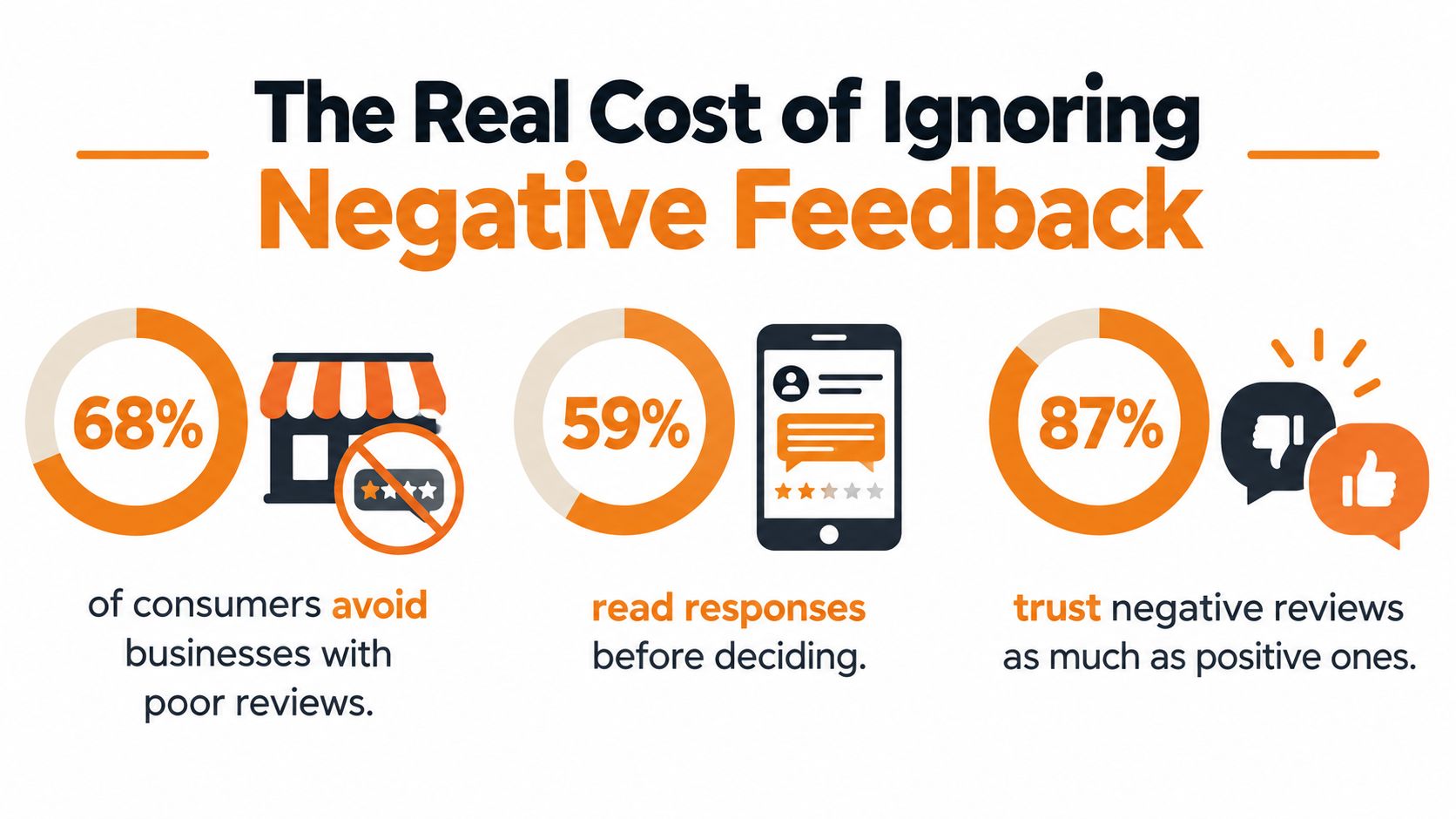
Silence is a visible business decision
Consumer Protection BC emphasises that a company's response shows how it handles consumer problems. Response quality therefore affects trust-building, not only short-term damage control. A measured reply can show future customers that the business takes responsibility, even when the service experience fell short.
The stakes rise in regulated industries. A clinic, financial service, legal practice, or other regulated business must balance public accountability with privacy obligations. Confirming that someone was a patient or client, discussing an appointment, or revealing account details can create legal and reputational exposure. Defensive replies create a second risk: they may disclose more information as the business tries to prove its side.
Recurring complaints about missed appointments, unclear pricing, weak communication, or poor outcomes can indicate a process problem. A public response cannot repair that process alone, but silence removes evidence that anyone is addressing it.
Practical rule: Treat every negative review as a public customer-care moment, while keeping personal details out of the reply.
A consistent process helps teams apply that rule without disclosing protected information. Businesses organising responses, monitoring feedback, and protecting their public presence can consult this online reputation management guidance. The goal is not universal praise. It is clear, responsible conduct when the customer experience falls short.
The Responsive Workflow for Local Businesses
A reliable workflow prevents emotional replies and missed complaints. It should give someone clear responsibility for checking the Google Business Profile, reviewing the facts, drafting the message, and tracking what happens next.
Start with a fast, informed review
Monitor new reviews routinely rather than waiting for a customer to forward a screenshot. Once a negative review appears, read it fully before writing. Identify the actual complaint, the service involved, the date if the reviewer provides one, and whether the issue can be verified internally.
The first public response doesn't need to solve every detail. It needs to demonstrate that the business has seen the concern and is taking it seriously. Google recommends a timely, empathetic reply and notes that a constructive interaction may lead a customer to update the original review (Google's guidance for responding to reviews).
Use the 24 to 72 hour window
For Canadian businesses, a practical benchmark is to reply publicly within 24 to 72 hours. That window is fast enough to show attention, but it gives the team time to check records and avoid guessing. If the complaint is complex, publish a brief acknowledgment first and continue investigating privately.
Keep the public message short and courteous. A useful sequence is:
- Acknowledge the issue: Refer to the specific concern without repeating sensitive details.
- Recognise the experience: Say that the situation sounds frustrating or disappointing.
- State the next step: Explain what the business can review or fix.
- Move details offline: Provide a phone number, email address, or appropriate contact route.
Separate the public reply from the private resolution
The public response is for reassurance and accountability. Phone and email are for detailed troubleshooting, account information, refunds, scheduling, or service records. Mixing those functions encourages oversharing and turns the review thread into a customer-service transcript.
A useful internal record should capture the review date, issue type, assigned owner, reply status, private contact outcome, and any operational change. That record helps managers see whether several apparently different complaints point to the same scheduling, communication, or billing problem. For teams managing multiple locations, a defined Google review management process can make ownership and follow-up more consistent.
Crafting the Perfect Public Response
The best response is neither a polished corporate statement nor an attempt to prove the reviewer wrong. It's a short public demonstration of judgement. Readers want to know whether the business can handle disappointment without blaming, exaggerating, or exposing private information.
A strong reply has four parts
Begin by acknowledging the specific concern. “We're sorry to hear that your appointment felt rushed” is more credible than “We're sorry you feel that way,” because it recognises the complaint without automatically accepting every allegation.
Then show empathy without arguing about intent. You can write, “That sounds frustrating,” even if the team remembers the interaction differently. Empathy recognises the customer's experience. It doesn't require the business to agree with every factual claim.
Next, state what you can do. If the team needs more information, say that plainly. If you've already identified an internal improvement, mention it only when you can do so accurately and without disclosing private details. Close with a direct invitation to continue by phone or email.
A flexible structure looks like this:
Thank you for sharing this feedback. We're sorry the service didn't meet your expectations, particularly regarding [specific issue]. We'd like to review what happened and understand more. Please contact [appropriate contact route] so our team can follow up directly.
Compare the reply, not the argument
A defensive answer might say:
“This isn't accurate. You arrived late, ignored our instructions, and are blaming our staff.”
Even if parts of that account are correct, the reply makes the business appear hostile. It also invites a public dispute that future customers can watch but can't fairly verify.
A more useful alternative is:
“Thank you for taking the time to share your feedback. We're sorry the experience was frustrating. We'd appreciate the opportunity to review the details with you and understand where communication broke down. Please contact our team directly so we can follow up.”
This version doesn't make a promise the business can't keep. It doesn't accuse the reviewer, reveal internal information, or turn the thread into a courtroom. It gives readers a clear signal: the company is calm, reachable, and willing to investigate.

Avoid copy-paste language that could apply to every complaint. Personalise the response around the issue, not around confidential details. Don't promise refunds, discounts, rebooking, or other remedies until you've confirmed that the offer fits your policy and the facts.
Navigating Privacy and Compliance Risks
Generic review advice often says to personalise a reply by explaining what happened. That approach can create serious problems for healthcare, dental, medical aesthetics, and regulated wellness businesses in Canada.
The critical boundary is simple: don't reveal or confirm treatment details in a public response. Canadian guidance for dental practices warns that PIPEDA can restrict public disclosure of patient information, even when the reviewer has already mentioned treatment details themselves (Canadian dental review guidance).
Personalisation must stop at privacy
A clinic shouldn't write, “We're sorry your whitening treatment caused sensitivity after your appointment,” even if the reviewer included that information. Repeating or confirming it can connect a person with a service or treatment in a public forum.
Instead, use neutral language:
“Thank you for sharing your concerns. We're sorry to hear that your experience was disappointing. Please contact our office directly so we can discuss your concerns through a private channel.”
That response still communicates care. It doesn't confirm that the person is a patient, identify a treatment, describe a diagnosis, or discuss a payment or appointment record.
Public reassurance, private investigation
For privacy-sensitive businesses, the public reply should do only three things:
- Acknowledge the concern: Recognise that the reviewer had a disappointing experience.
- Avoid confirmation: Don't verify the person's identity, visit, treatment, condition, or account.
- Invite secure contact: Direct the person to the office or an appropriate private communication channel.
The team can then verify the matter through its normal procedures. Staff should avoid asking the reviewer to post more details publicly, and they shouldn't request personal information in the review response. A clinic leader who wants to identify gaps in policy can use a structured compliance risk assessment before authorising staff to reply.
Regulated sectors differ from ordinary retail or home services. A plumber may be able to discuss a delayed arrival in general terms. A healthcare provider needs to consider whether even a well-intentioned explanation confirms a relationship or service. Empathy is required, but public specificity isn't.
Turning Complaints Into Reputation Assets
A negative review can reveal more than a customer's dissatisfaction. It can show where a process fails under pressure. A complaint about lateness might point to scheduling capacity. A billing objection may expose unclear estimates. A comment about staff attitude may indicate that customers aren't receiving timely updates when plans change.
The useful move is to separate the public response from the internal diagnosis. Publicly, acknowledge the issue and offer a private route to resolution. Internally, classify the complaint, check whether similar feedback exists, identify the process owner, and decide what should change.
Decide what belongs in public
A public reply is appropriate when future customers need to see that the business is responsive. Keep the message general when the issue involves personal data, legal matters, health information, employment details, or an unresolved dispute.
Private outreach is essential when resolving the complaint requires records, account information, appointment history, payment details, or a detailed explanation. The response should make that transition easy, not force the reviewer to repeat sensitive information in a public thread.
Use a simple quality test
Before publishing, ask:
- Does the reply acknowledge the actual complaint?
- Does it sound calm if someone reads it without context?
- Does it avoid blame, sarcasm, and unsupported promises?
- Does it state a realistic next step?
- Does it protect personal, health, financial, and proprietary information?
- Will the internal team follow through after the reply is posted?
The strongest reputational outcome doesn't come from persuading the reviewer to delete criticism. It comes from showing prospective customers that the business responds thoughtfully, learns from valid feedback, and respects boundaries. A complaint becomes an asset when the public sees accountability and the internal team makes a real improvement.
Your Actionable Response Checklist
A response checklist protects the business from two common failures: waiting too long and posting too much. It also gives staff a shared standard, so the tone doesn't depend on who happens to see the review first.
Before you publish
Confirm the facts you can safely verify, but don't delay a basic acknowledgment while searching for a perfect explanation. Draft a short reply that names the concern at a general level and avoids emotional language.
Check each of these points:
- Specific problem: Have you addressed the actual complaint rather than using a generic apology?
- Courteous tone: Would the message sound professional if the reviewer never replies?
- No defensiveness: Have you removed blame, sarcasm, accusations, and attempts to win the argument?
- Realistic remedy: Are you offering only what the business can deliver under its policies?
- Privacy protection: Have you excluded names of staff, account details, treatment information, appointment records, and other personal data?
- Offline path: Have you provided a clear way to continue the conversation privately?
For healthcare, dental, and wellness teams, add a second review by a manager or privacy-aware staff member when the complaint could identify a patient or client. Don't let a desire to sound personal override the duty to protect confidential information.
After you publish
Track the response, not just the review. Record who owns the follow-up, whether the reviewer made contact, what resolution was offered, and whether the complaint reveals an operational issue. If the business promised an investigation, someone must complete it and communicate appropriately through a private channel.
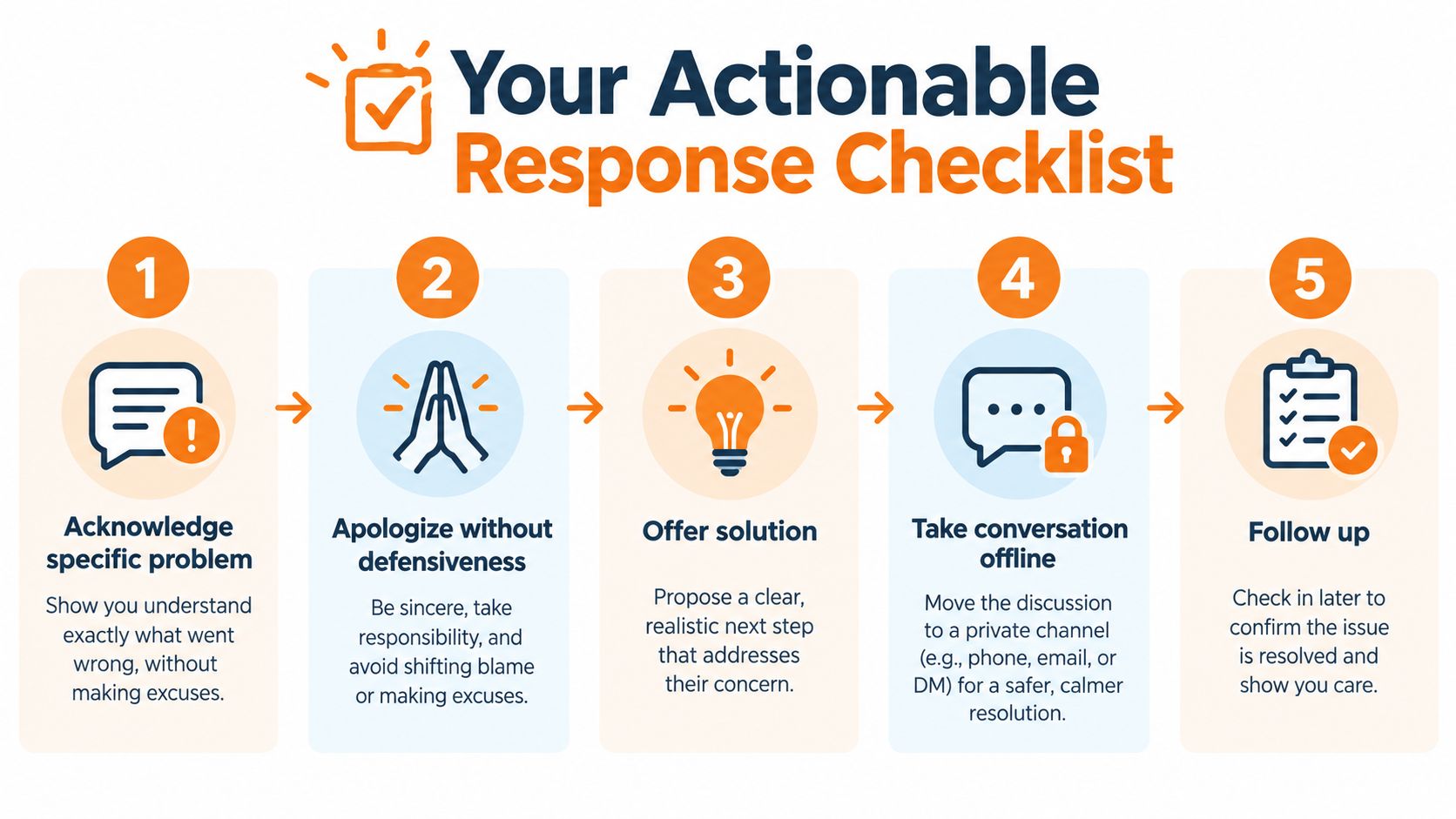
Use this five-part sequence as the team's operating standard:
- Acknowledge the specific problem.
- Apologise without becoming defensive.
- Offer a realistic next step.
- Move sensitive or complex discussion offline.
- Follow up and address the underlying process.
A business doesn't need a flawless review profile to build trust. It needs a credible response habit. Reply promptly, write like a responsible human, protect private information, and make sure internal action matches the public message. That combination turns criticism into evidence that your business can be trusted when something goes wrong.
Juiced Digital helps local businesses strengthen their online reputation through local SEO, review management, digital PR, and conversion-focused marketing. Visit Juiced Digital to request a consultation and identify practical opportunities to improve visibility, trust, and qualified leads.