
So, how much should you actually budget for Google Ads? The honest answer is, it depends. But to give you a ballpark, most Canadian businesses we see are spending somewhere between $1,000 and $10,000 per month.
Think of it like buying a car. The final price tag is going to come down to what you need it to do, the model you choose (your industry), and how fast you want to get from A to B.
Your Quick Guide to Google Advertising Costs in Canada
At first glance, the way Google prices its ads can feel a little confusing. You’re not just buying a billboard for a flat fee. Instead, you’re stepping into a live auction where prices shift constantly. The whole system runs on a pay-per-click (PPC) model, which is exactly what it sounds like: you only pay when someone is interested enough to actually click your ad.
This is what makes it so powerful. Your ad spend is tied directly to a tangible action—someone landing on your website. You aren’t just paying for eyeballs; you’re paying for a genuine shot at a new customer, which is why it’s a go-to for anyone focused on leads and sales.
Understanding the Core Cost Factors
So what determines the price you pay for that click? It’s not one single thing but a mix of factors that all work together in real-time. Knowing what they are helps you understand which levers you can pull.
- Industry Competition: It’s all about supply and demand. A personal injury lawyer in Vancouver is going to pay a lot more for a click than a local bookstore. Why? Because a single new client for the lawyer could be worth tens of thousands of dollars, so the bidding gets fierce.
- Ad Quality and Relevance: This is where you have some control. Google actually rewards you for creating a good experience for its users. If your ads are high-quality and genuinely relevant to what people are searching for, you’ll often pay less per click and get better ad positions.
- Geographic Targeting: Where you’re trying to reach people matters. Trying to get noticed in downtown Toronto will almost always cost more than advertising in a smaller, less populated town simply because more businesses are competing for the same audience.
The appetite for digital ads in Canada is stronger than ever. In a recent quarter, spending on Google Search ads jumped by a healthy 13% year-over-year, and the number of clicks hit a 5-year high. This tells us that savvy marketers are figuring out how to get more traffic without their costs spiraling out of control. You can read more about the latest Canadian ad spend trends to see the full picture.
At the end of the day, your budget is a strategic choice. It’s not just about the total amount you spend, but how smartly you use it to find the right people and turn a profit on your investment.
Understanding the Google Ads Auction
Ever wondered how Google actually decides which ads to show you? It’s not as simple as the highest bidder taking the top spot. Instead, it’s a lightning-fast auction that happens every single time someone hits “search,” and the winner isn’t just the one with the deepest pockets—it’s the advertiser offering the most value.
This whole process unfolds billions of times a day. Google’s system instantly evaluates all the potential ads for a given search query to decide who gets to show up and in what order. To consistently win those prime ad placements, you need more than just a big budget; you need a smart, quality-focused approach.
At the heart of this auction are two key ingredients: your maximum bid (the most you’re willing to pay for a click) and your Quality Score.
The Role of Quality Score
Think of Quality Score as Google’s grade on your overall ad experience. It’s a score from 1 to 10 that reflects the quality and relevance of your ads, keywords, and landing pages. A high score tells Google that you’re giving users exactly what they’re looking for, creating a positive experience.
This score is absolutely critical. Why? Because it directly influences both your ad’s position and what you ultimately pay per click. Google takes your bid and multiplies it by your Quality Score to determine your Ad Rank. It’s this Ad Rank, not your bid alone, that dictates where your ad appears on the page.
Ad Rank = (Your Maximum Bid) x (Your Quality Score)
This simple formula holds the key to efficient ad spending. A high Quality Score can vault you into a better ad position for a lower cost-per-click (CPC). For example, an advertiser with a stellar Quality Score of 9/10 could easily outrank a competitor with a score of 3/10, even if that competitor is bidding more money. This is how you make your advertising budget work smarter, not just harder.
The hierarchy of factors influencing your final ad spend is pretty clear when you break it down.
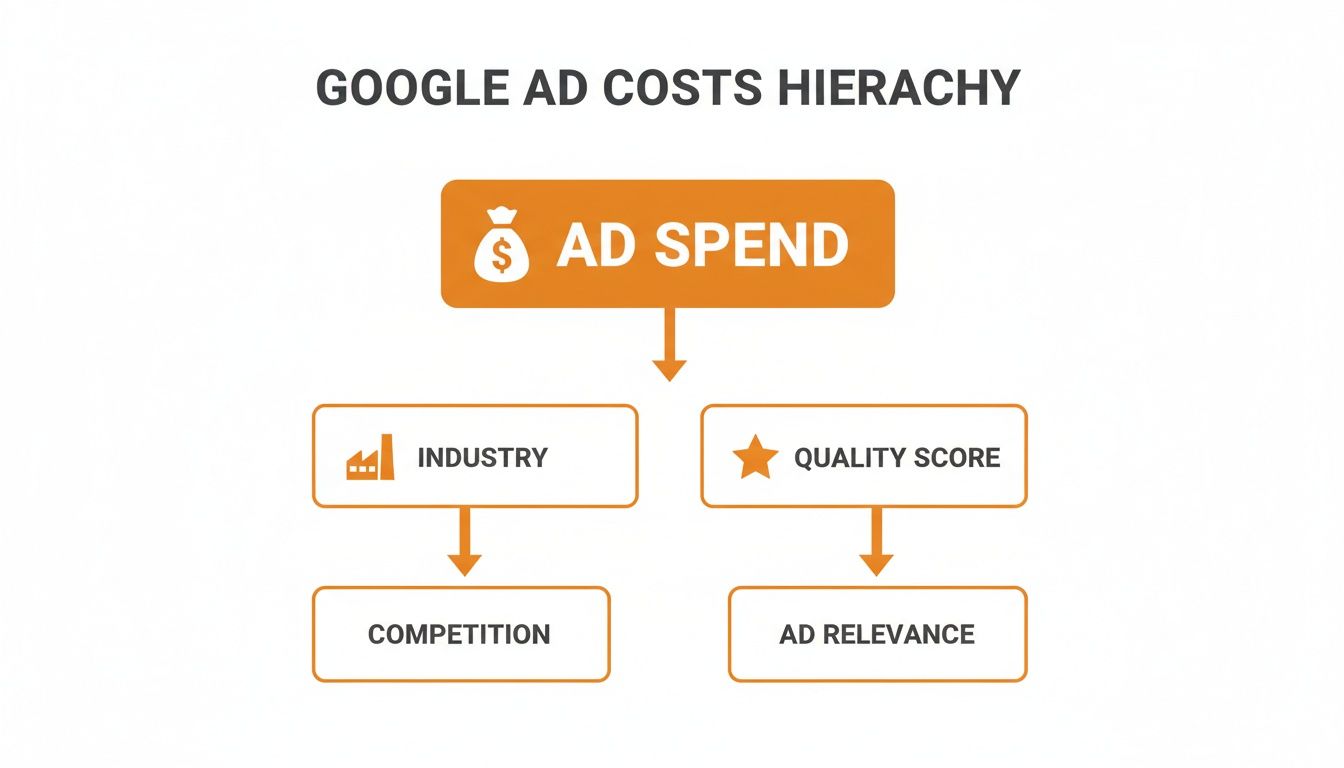
As you can see, your industry sets the stage, but the quality of your campaign is what truly determines your cost-effectiveness.
How Your Actual Cost Is Calculated
Here’s another interesting part: even if you win the auction, you don’t necessarily pay your maximum bid. You only pay just enough to beat the advertiser ranked right below you—specifically, one cent more.
The formula for your actual cost looks like this:
- Your Actual CPC = (Ad Rank of the advertiser below you / Your Quality Score) + $0.01
This model is known as a second-price auction. It encourages advertisers to bid what they’re truly willing to pay, while also rewarding them for creating high-quality, relevant ads. The big takeaway here? Focusing on improving your Quality Score is one of the single most powerful things you can do to lower your Google Ads costs.
The Key Factors That Influence Your Google Ad Costs

If you want to get a handle on your Google advertising costs, you first need to understand what’s pulling the levers behind the scenes. It’s not a simple price tag; it’s a living number that shifts based on a few crucial, interconnected variables. Once you get a feel for these, you can start making strategic moves to lower your ad spend without sacrificing results.
Let’s put it in perspective. A commercial real estate lawyer in downtown Vancouver is going to pay a hefty price for a single click. Meanwhile, a local artisan selling handmade pottery online might pay just pennies for theirs. Why the massive difference? It all boils down to the level of competition and just how much a new customer is worth in that industry.
Industry and Geographic Competition
The biggest single factor driving your cost-per-click (CPC) is the industry you’re in. It’s simple economics. When a single sale or lead can be worth thousands of dollars—think legal services, financial products, or major home renovations—businesses are willing to bid much more aggressively to get that click. That high-stakes bidding pushes the price up for everyone in the space.
Where you’re advertising plays a similar role. Trying to capture attention in a crowded urban market like Toronto or Vancouver means you’re elbowing for space with far more competitors than you would in a smaller town. More businesses fighting over the same audience always leads to higher ad costs.
Canada’s digital ad market really highlights Google’s dominance. In a competitive hub like Toronto, which is a lot like Vancouver’s bustling scene, Google Ads CPCs can swing wildly. Costs for real estate, legal, and finance are through the roof because of fierce bidding wars. But for niche markets, like functional mushrooms or wellness brands, there’s a more affordable way in if you get your targeting right. You can learn more about the trends shaping Canadian ad markets.
Keyword Strategy and Match Types
Your keyword selection is another massive piece of the puzzle. It’s tempting to bid on broad, popular keywords to get lots of eyeballs, but that’s a fast way to burn through your budget with clicks that go nowhere. Getting specific with long-tail keywords—those longer, more detailed phrases of three or more words—is often the smarter play. They usually have less competition and attract people who are much closer to making a decision.
Just as important is how you tell Google to connect your keywords to what people are searching for. This is where match types come in.
- Broad Match: This gives Google the most freedom, showing your ad for a huge range of related searches. It gives you maximum reach but the least control over relevance.
- Phrase Match: A good middle ground. Your ad shows up for searches that include the meaning of your keyword, which tightens up the relevance quite a bit.
- Exact Match: This gives you the most control. Your ad will only appear for searches that share the same meaning or intent as your keyword.
A healthy strategy uses a mix of these match types, but it absolutely must include a strong list of negative keywords. These are the terms you don’t want to show up for, and they’re your secret weapon for preventing wasted ad spend and targeting your ideal customer with surgical precision.
Ad Quality Score: The Ultimate Cost Controller
At the end of the day, the most powerful tool you have to influence your costs is your Quality Score. As we mentioned earlier, this is Google’s internal report card for your ads, grading you on relevance, how likely people are to click your ad (expected click-through rate), and the experience they have on your landing page.
A high Quality Score is your way of showing Google you’re giving its users exactly what they’re looking for. When you do that, Google rewards you. You get a better position on the page (Ad Rank) and, most importantly, a lower CPC. A super-relevant ad paired with a great landing page isn’t just a “best practice”—it’s the single most effective way to lower what you pay for Google advertising.
Example Google Ads Budgets for Canadian Businesses
All the theory in the world doesn’t mean much until you see how it works in practice. So, let’s get down to brass tacks and look at what a real-world monthly budget could look like for two very different Canadian businesses.
These examples really drive home the point that a budget isn’t just a number you pull out of thin air. It’s a strategic plan. How you allocate your ad spend depends entirely on who you’re trying to reach and what you want them to do when they find you.
Scenario 1: A Local Vancouver Health Clinic
Let’s start with a holistic health clinic in Vancouver. Their number one goal is getting new patients through the door, which means generating qualified leads—real people booking their first consultation. Their entire strategy is going to be hyper-local and laser-focused on search.
- Total Monthly Ad Spend: $2,500
- Target Keywords: “naturopath Vancouver,” “acupuncture Kitsilano,” “holistic nutritionist near me.”
- Average CPC (Health & Wellness): Roughly $3.15
With that budget, the clinic can expect to get around 790 clicks per month. If we assume a conservative 5% of those people who land on their site end up booking an appointment, that works out to about 39 new patient inquiries every single month. It’s a perfect example of how even a modest, well-managed local budget can create a predictable flow of high-value leads.
This approach is all about precision over sheer volume. By keeping the budget tight on a specific geographic area and bidding only on high-intent keywords, every dollar works hard to reach people actively looking for their services right now.
Scenario 2: A National E-commerce CBD Store
Now for something completely different: an e-commerce brand selling CBD products across Canada. Their goal isn’t just local leads; it’s driving online sales nationwide. This requires a much broader reach and a more complex mix of campaigns to not only capture existing demand but also to create it.
This business has to think bigger than just Search ads. A good chunk of their budget will need to go into channels like YouTube and the Google Display Network to introduce their brand to people who aren’t even aware they’re looking for CBD products yet. If you want to dive deeper into how e-commerce stores measure success, check out our guide on what ROAS is and why it’s so vital.
Sample Monthly Google Ads Budget Breakdown
To make the contrast crystal clear, let’s put these two businesses side-by-side.
| Metric | Local Service Business (Vancouver Clinic) | E-commerce Brand (CBD Store) |
|---|---|---|
| Total Monthly Ad Spend | $2,500 | $7,000 |
| Campaign Allocation | 100% Google Search | 60% Search, 25% YouTube, 15% Display |
| Geographic Target | Vancouver, BC | Canada |
| Primary Goal | Lead Generation (Bookings) | E-commerce Sales |
| Estimated Avg. CPC (Search) | $3.15 | $2.20 |
| Projected Monthly Clicks | ~790 | ~1,900 (from Search budget) |
This table really highlights the strategic difference. The CBD store is spending more to cover a much larger market and is using different types of ads to guide customers all the way from “What is CBD?” to “Add to Cart.” It’s a completely different ball game.
Smart Tactics to Lower Your Advertising Costs

Knowing what Google Ads can cost is one thing, but actually getting a grip on your spending is a whole different ball game. The truth is, a bigger budget doesn’t automatically lead to better results. The real magic happens when you make every dollar work smarter, ensuring your ads find the right people for the lowest possible price.
By putting a few key strategies into practice, you can patch up those common budget leaks and seriously boost your return on ad spend (ROAS). This isn’t about being cheap; it’s about being precise.
Filter Out Irrelevant Clicks with Negative Keywords
One of the quickest ways to burn through your budget is to pay for clicks from people who were never going to buy from you in the first place. This is where negative keywords come in. Think of them as a bouncer for your ad campaign, telling Google which search terms you want nothing to do with.
Let’s say you sell premium, high-end “leather running shoes.” Without any filters, your ad could easily pop up for searches like “cheap running shoes” or “vegan leather shoes.” By simply adding “cheap” and “vegan” to your negative keyword list, you immediately stop wasting money on clicks that have zero chance of converting. It’s a straightforward tactic that instantly redirects your budget toward a much more qualified audience.
Think of it this way: every irrelevant click you block frees up that cash for a click that could actually become a customer. It’s the classic case of addition by subtraction.
Boost Your Quality Score for Cheaper Clicks
We’ve touched on it before, but your Quality Score is a huge deal. It’s Google’s way of grading how relevant and helpful your ad and landing page are to the user. Earning a higher score isn’t just for bragging rights—Google rewards you with better ad positions and, most importantly, a lower cost-per-click. Improving it is one of the most powerful moves you can make to get more for your money.
To do this, you need to nail two things:
- Compelling Ad Copy: Your ad has to speak directly to what the person searched for. Your headlines and descriptions should echo their keywords, touch on their specific problem, and give them a clear, simple call-to-action.
- Optimized Landing Pages: The user’s journey doesn’t stop at the click. The landing page has to deliver on the ad’s promise. Make sure the page loads quickly, is directly related to the ad, and makes it incredibly easy for visitors to do what you want them to do next.
Automate and Optimize Your Bidding
Finally, let Google’s tech do some of the heavy lifting for you. Google’s AI-driven Smart Bidding strategies can automatically set your bids in real-time for each and every auction, all based on your specific goals, like getting more conversions. This takes the guesswork out of the equation and lets machine learning find the most efficient path to your targets.
You can also use ad scheduling to make sure your ads only run when your customers are most likely to be online and looking to buy. For instance, a B2B company might find that running ads on weekends is a total waste, whereas a local pizza joint will want to crank up the budget on a Friday night. Getting these small details right adds up to a much leaner, more effective campaign. Even correctly sizing your images matters; for a deeper dive, you can learn more about Google Display Ads sizes in our other guide.
Navigating Google Ads in Regulated Industries
Jumping into Google Ads when you’re in a regulated industry can feel like tiptoeing through a minefield. If you’re in sectors like cannabis, CBD, or functional mushrooms, you’re up against a unique set of challenges. Google’s advertising policies are notoriously strict and can shift with very little notice.
Trying to advertise a THC-infused product directly on Google Search, for example, just won’t fly. It’s a surefire way to get your ads disapproved and, worse, your entire account suspended. So, what’s the point if you can’t even mention your main products? The trick is to stop thinking about direct sales and start focusing on smart, strategic brand building.
Playing by the Rules
Success in these tricky niches isn’t about finding clever loopholes. It’s about building a compliant, long-term strategy that works within Google’s guidelines. This usually means taking a more indirect route, one that puts education and brand awareness ahead of a hard sales pitch.
Instead of running an ad for “CBD oil,” you could build content around related, permitted topics. For instance, an ad campaign might target keywords like “natural wellness tips” or “benefits of adaptogens.” The crucial part is that these ads would link to a high-quality blog post or an educational video, not a product page.
This strategy lets you grab your target audience’s attention without breaking the rules. You’re not selling a restricted product; you’re offering valuable information. This builds a relationship with potential customers who can then discover your brand on their own terms.
Compliant Strategies for Growth
Think beyond just the search results page. Platforms like YouTube are a goldmine for building brand awareness in regulated spaces. You can create engaging, educational videos that show off your brand’s expertise and values, all without making prohibited health claims or directly pushing a sale.
Here are a few ways to approach it:
- Focus on Educational Content: Create blog posts, guides, and videos that answer your audience’s questions without naming specific, restricted products.
- Build an Email List: Drive traffic with your content and get people to sign up for your newsletter. This gives you a direct, compliant way to talk to your audience.
- Leverage Permitted Keywords: Go after broader, top-of-funnel keywords related to wellness, health, and lifestyle to bring in the right kind of people.
By playing the long game and focusing on building authority and trust, brands in regulated industries can find success where many others fail. You’ll be laying a strong foundation for growth that can actually last.
Got Questions About Google Ads Costs? We’ve Got Answers.
Even with a clear plan, it’s totally normal to have questions about what you should actually be spending on Google Ads. Here are some straight-up answers to the questions we hear most often from Canadian business owners just like you.
What’s a Realistic Starting Budget for Google Ads in Canada?
If you’re a small, local business, a great starting point is usually in the $1,000 to $2,500 per month range. This gives you enough firepower to collect some real-world data and start making smart decisions about what’s working.
But if you’re in a more competitive space or you’re running a national e-commerce store, you’ll need to think bigger. A starting budget of $3,000 to $7,000 is a more practical figure to gain meaningful traction and hold your own against the bigger fish.
Can You Run Google Ads for Free?
In a word, no. Google Ads is a pay-to-play platform where you’re bidding for every click and impression. That said, Google often dangles a carrot for new advertisers, like offering $500 in ad credit once you’ve spent your first $500. It’s a nice little boost to get you started.
There’s also the Google Ad Grants program, which is a different beast altogether. It provides eligible non-profits with $10,000 USD per month in free search advertising, but it comes with its own unique set of rules and limitations.
How Long Until I Actually See Results?
You’ll see traffic from your ads almost right away, but turning that traffic into a profitable return on investment (ROI) is a marathon, not a sprint. Think of the first one to three months as your “learning phase.”
During this critical window, your campaigns are soaking up performance data like a sponge. This is the information you’ll use to refine everything. Most businesses start seeing consistent, positive results within three to six months as those optimizations kick in and the campaign finds its groove.
Wondering how this timeline compares to other platforms? We break it all down in our guide on Facebook Ads vs Google AdWords. It’s all about picking the right tool for the job.
Ready to stop guessing and start getting real returns from your ad spend? The team at Juiced Digital offers complimentary audits to uncover hidden opportunities in your account. Let’s build a performance-focused strategy that turns your advertising budget into predictable revenue. Book your free consultation today.