
It's the million-dollar question, isn't it? The truth is, there's no single price tag for running a successful Google Ads campaign. A small local business here in Canada might see great results spending between $500 to $2,000 a month. On the other hand, a competitive e-commerce store could easily invest anywhere from $5,000 to over $20,000 monthly to hit their sales targets.
Your final cost is a dynamic blend of your industry, how aggressive your goals are, and the strategy you use to get there.
Your Quick Guide to Google Ads Costs

Figuring out "how much for Google Ads" is a lot like asking how much a car costs. Are you looking for a reliable hatchback to get around town, or a high-performance sports car? The platform runs on a live auction, so there are no fixed rates. Instead, your budget is really shaped by a handful of core factors that directly influence what you'll spend.
Think of your ad budget as the fuel for your marketing engine. A smaller budget can get you around the block, bringing in local leads and building neighbourhood awareness. A larger one can take you on a cross-country road trip, driving serious online sales and grabbing national market share. The secret is to match your investment to clear, measurable business goals.
Core Variables Shaping Your Budget
Before we get into specific numbers, it’s crucial to understand what makes costs go up or down. These are the main levers you (or your agency) will pull to control spending and squeeze every bit of value out of your budget.
Your required investment really boils down to four things:
- Industry and Competition: It’s a simple case of supply and demand. A lawyer in downtown Toronto will pay a lot more for a click than a local dog walker in a small town because the competition is fierce and the value of a new client is so high.
- Business Goals: What does success look like for you? Are you aiming for a handful of high-quality leads each week, or are you trying to push hundreds of e-commerce sales every single day? Bigger goals usually need more fuel.
- Geographic Targeting: Advertising across the whole of Canada will naturally cost more than focusing on a single neighbourhood in Vancouver or a specific postal code in Montreal.
- Keyword Choice: Not all keywords are created equal. High-intent, "money" keywords like “emergency plumbing service” are much more expensive than broader, research-based terms like “how to fix a leaky tap.”
The most important thing to remember is that a well-run Google Ads account is all about profitability, not just spending. A huge budget is useless if it doesn't bring in a positive return on investment (ROI).
To help you set some realistic expectations right from the get-go, I've put together a quick reference table. It breaks down what different kinds of businesses can generally expect to invest each month.
Estimated Monthly Google Ads Budgets By Business Type
This table gives you a ballpark idea of typical monthly ad spend ranges, based on the type of business and what it’s trying to achieve.
| Business Type | Typical Monthly Budget (CAD) | Primary Goal |
|---|---|---|
| Local Services | $500 – $2,500+ | Generate local leads (calls, form fills) |
| E-commerce (Small) | $1,500 – $5,000+ | Drive initial product sales and traffic |
| E-commerce (Large) | $5,000 – $20,000+ | Maximize online revenue and market share |
| Regulated Industries | $3,000 – $15,000+ | Attract qualified leads under strict rules |
| B2B / SaaS | $2,500 – $10,000+ | Capture high-value leads and demo requests |
Remember, these are just starting points. A highly competitive local market could easily push a service business into the higher end of the spectrum, while a niche e-commerce store might find success with a smaller budget.
How the Google Ads Auction Really Works
To get a real handle on what you'll pay for Google Ads, you need to peek behind the curtain at the engine that drives it all: the ad auction. Most people assume it's a straightforward "highest bidder wins" scenario, but that's a common (and very expensive) misconception.
It’s less like a traditional auction where cash is king, and more like a talent show where the judges weigh both performance and star power. In the world of Google, this is called Ad Rank. Your Ad Rank is what determines where your ad actually shows up on the page, and it’s calculated using two main factors: your maximum bid and your Quality Score.
This is huge. It means an advertiser with a fantastic Quality Score can actually pay less for a higher ad position than a competitor with a lousy score who's bidding more money.
Decoding Your Quality Score
So, what is this all-important Quality Score? Think of it as Google's rating of how relevant and high-quality your ads, keywords, and landing pages are. It’s a score from 1 to 10, and it's a blend of three key components.
A high Quality Score is basically Google giving you a thumbs-up for creating a great experience for searchers, which is their number one priority. A better score almost always leads to lower costs and better ad placements for you.
Let's break down the three main ingredients:
Expected Click-Through Rate (CTR): This is Google's best guess on how likely someone is to click your ad when they see it. It’s not just a shot in the dark; it's based on your ad's past performance. An ad that's compelling and speaks directly to what the user is looking for will naturally get more clicks and a higher score.
Ad Relevance: This one's simple: how well does your ad match the keyword someone just typed in? If someone searches for "emergency plumbing services" and your ad headline screams "24/7 Plumber On Call," that's a perfect match. If it just talks about general home repairs, it’s not nearly as relevant.
Landing Page Experience: What happens after the click is just as crucial. Your landing page needs to continue the conversation started by your ad. It has to be relevant, easy to get around, and give the user a clear path to what they want. A slow, confusing, or clunky page will tank your score in a hurry.
Key Takeaway: You can't just buy your way to the top of Google. A lower bid paired with a high Quality Score will consistently beat a high bid with a poor Quality Score. This makes optimizing for quality the real secret to cutting your ad spend.
Pouring your effort into improving these three areas is one of the single most effective ways to lower your advertising costs. The system is built to reward advertisers who focus on the user, not just those with the biggest budgets. This is a core idea that sets it apart from many other ad platforms; for more on this, you can learn about the mechanics behind programmatic advertising.
The Key Factors That Determine Your Ad Spend
So, you’ve got the basics of the Google Ads auction down. Now, let’s get into the nitty-gritty of what actually drives your final bill. Figuring out "how much for Google Ads" isn't like looking up a price tag; it's more about understanding the different levers you can pull to manage your costs. Every one of these factors plays a role in the auction, creating a unique cost puzzle for every single business.
Think of it like planning a road trip across Canada. The total you spend on fuel depends on the car you’re driving (your industry), how far you’re going (your geographic reach), and the exact route you take (your keyword strategy). Let’s break down how these elements come together in the real world.
Industry and Competition Levels
By far, the biggest factor influencing your costs is the industry you’re in. Some fields are just naturally packed with competitors, and where there's fierce competition, you can expect higher costs-per-click (CPCs).
A local plumber in Vancouver, for instance, is up against dozens of other businesses all fighting for the same urgent, high-value search terms. Then you have a national e-commerce brand selling a niche product; while their reach is wider, they might be battling huge brands with deep pockets, which pushes auction prices through the roof. When a single new client in a field like law or insurance can be worth thousands, businesses are willing to bid a lot more for just one click.
It all boils down to simple supply and demand. When tons of advertisers are all vying for the same limited ad space on a search results page, the price to show up there is naturally going to climb.
This is where your Ad Rank comes in. It’s not just about who bids the most; it's a combination of your bid and your Quality Score.
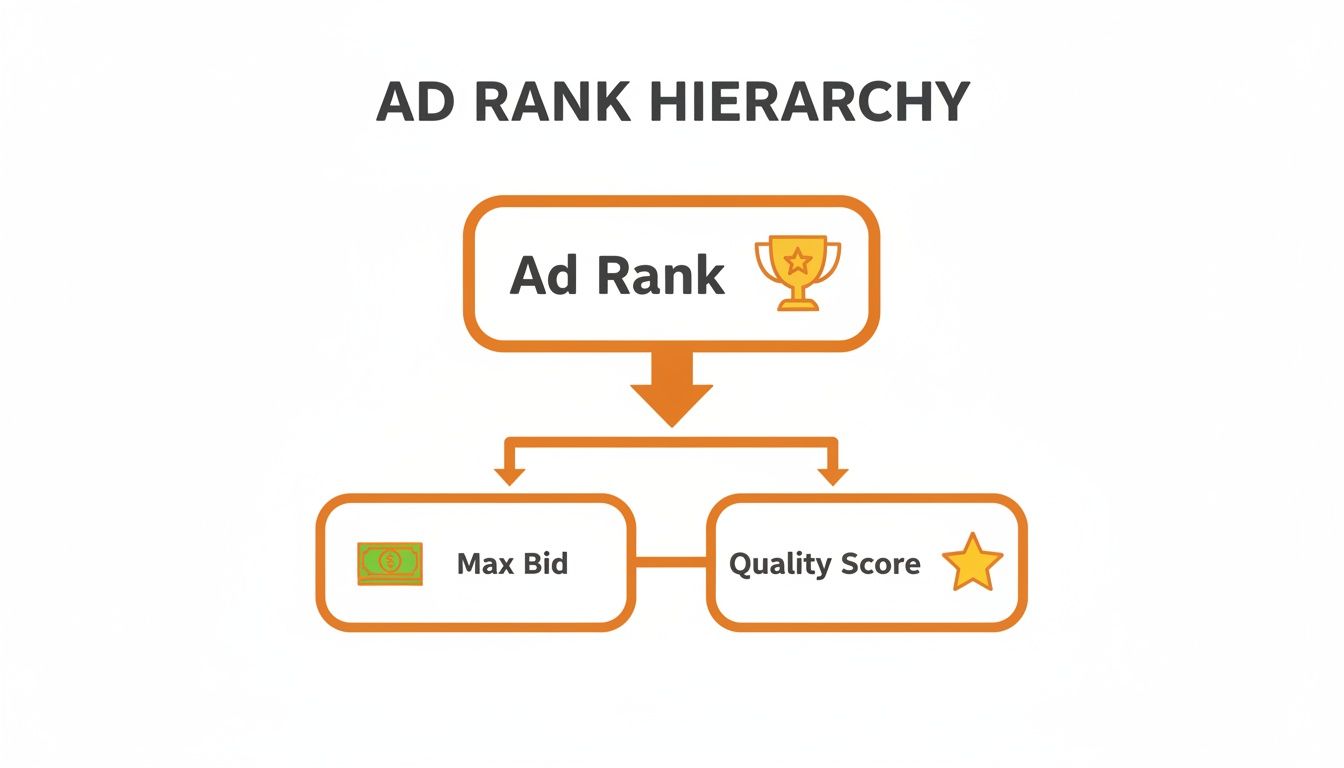
As you can see, a stellar Quality Score can actually let you outrank a competitor with a bigger budget, often letting you win better ad positions for less money.
To give you a clearer picture, here’s how CPCs can vary dramatically from one sector to another here in Canada.
Average Cost-Per-Click (CPC) Ranges Across Industries in Canada
| Industry | Average CPC Range (CAD) | Competition Level |
|---|---|---|
| Legal Services | $8.00 – $15.00+ | Very High |
| Insurance & Finance | $7.00 – $12.00 | Very High |
| Home Services (Plumbing, HVAC) | $6.00 – $10.00 | High |
| Real Estate | $3.00 – $7.00 | High |
| E-commerce (Niche Goods) | $1.50 – $4.00 | Medium |
| Local Restaurants & Cafes | $1.00 – $3.00 | Low to Medium |
These are just benchmarks, of course, but they clearly show how the competitiveness of your industry sets the stage for your advertising costs.
Geographic Targeting Precision
Where you choose to show your ads has a massive impact on your budget. It’s a whole different ball game targeting an entire country versus focusing on a single neighbourhood.
- Hyper-Local: A wellness clinic targeting just a 5km radius around its Vancouver location will have a smaller, more concentrated audience. This means a more manageable overall spend.
- Provincial: A B2B software company trying to reach all businesses in British Columbia will need a larger budget to cover that wider net and the increased competition that comes with it.
- National: An e-commerce brand selling coast-to-coast in Canada requires a substantial budget to stay visible in every major urban centre, from Victoria to St. John's.
This is especially true here in Canada, where Google’s platform dominance really shapes the ad environment. Google Ads costs are heavily influenced by the platform's 85%+ market share, with billions in digital ad revenue flowing through it annually. It’s not uncommon for mid-sized B.C. businesses to spend $2,000-$10,000 a month to drive meaningful traffic. You can explore more on these Canadian digital advertising trends and see how market share impacts local ad costs.
Keyword Intent and Value
Finally, the actual keywords you bid on are a massive piece of the cost puzzle. Not all keywords are created equal. Their value is tied directly to what the person searching is actually trying to accomplish.
High-intent keywords are the money-makers; they signal someone is ready to buy or take action right now. A search for "emergency plumber near me" is way more valuable—and therefore more expensive—than a search for "how to fix a leaky tap." The first person needs immediate help, while the second is just gathering information.
Focusing your budget on these high-intent, commercial keywords is absolutely critical for generating a strong return on your ad spend.
Budgeting for Realistic Business Scenarios
Theory is great, but let's talk about what actually happens when the rubber hits the road. Knowing how the Google Ads auction works is one thing; seeing how a real budget plays out for a business like yours is another. So, let’s move past the abstract and look at some concrete examples for different Canadian businesses.
Figuring out your budget isn't just about picking a number to spend. It's about investing that money to get specific results. Whether you're trying to get the phone to ring for your local clinic or drive sales for your online store, how you split your budget across Search, Display, and Shopping campaigns is what will make or break your efforts.
These scenarios should give you a clearer picture of how much you might really need to spend on Google Ads to hit your goals.
Scenario 1: Local Wellness Clinic in Vancouver
Imagine a holistic health clinic in Kitsilano. Their goal is simple: bring in 20 new patient bookings every month. They're targeting people right in their neighbourhood who are searching for things like "acupuncture near me" or "registered massage therapist Vancouver."
- Estimated Monthly Budget: $1,500 – $2,500
- Primary Campaign Type: Google Search Ads
- The Strategy: Almost the entire budget goes into Search campaigns, zeroing in on high-intent keywords within a very tight geographic area. A small slice might be set aside for Display retargeting, showing gentle reminders to people who visited the website but didn't book an appointment.
- The Goal: With a target Cost Per Acquisition (CPA) of $75-$125, this budget is designed to deliver those 20 new clients each month.
Scenario 2: North American E-commerce Brand
Now, picture an online store that sells niche, eco-friendly home goods. They ship across Canada and the US and want to see a 4x Return on Ad Spend (ROAS). They're up against some bigger retailers, so their strategy needs to be smart.
- Estimated Monthly Budget: $7,000 – $12,000
- Primary Campaign Types: Google Shopping & Performance Max
- The Strategy: The lion's share (60%) of the budget fuels Shopping campaigns, getting their products front-and-centre in search results. Another 30% is dedicated to Performance Max, which helps them find customers across all of Google's channels. The last 10% is reserved for Search campaigns that protect their brand name.
- The Goal: This level of investment is aiming to generate $28,000 – $48,000 in monthly revenue, hitting that crucial 4:1 ROAS target.
In Canada, Google isn't just a search engine; it's the search engine, holding a massive 87.5% market share. This dominance means businesses, especially in sectors like holistic health, are investing heavily in Google Ads because it delivers results they can actually measure. While average costs can be manageable, competition in some niches (like CBD, for example) can really drive up click prices. You can dig deeper into the numbers in these Canadian Google Ads statistics.
Scenario 3: B2B Service Provider in British Columbia
Let's look at a software company that targets small businesses across B.C. They aren't selling a product directly; they need to generate qualified leads for their sales team. The target is 30 high-quality demo requests per month from actual decision-makers.
- Estimated Monthly Budget: $4,000 – $6,000
- Primary Campaign Types: Google Search & Display Ads
- The Strategy: A big chunk of the budget is spent on super-specific B2B keywords in Search campaigns. The rest goes toward Display ads, but not just any Display ads—these are targeted to show up on industry-specific websites and to users based on their LinkedIn profiles. To get a better feel for this format, you can check out our guide on Google Display Ad sizes.
- The Goal: By aiming for a Cost Per Lead (CPL) between $130-$200, this budget is structured to produce the 30 valuable leads needed to keep the sales pipeline full.
How to Reduce Wasted Ad Spend
When it comes to Google Ads, having the biggest budget doesn't guarantee a win. It’s all about having the smartest one. The real game is getting the maximum return from every dollar you put in, and that means actively hunting down and eliminating waste before it eats into your profits.
Most wasted spend comes from campaigns that are well-intentioned but just aren't dialled in. Think clicks from totally irrelevant search queries, ads running at 3 AM when your customers are asleep, or messaging that just doesn't land. These are the common culprits, but thankfully, you have some powerful tools to tighten the ship.
By focusing on a few key areas, you can plug these leaks and make sure your budget is working as hard as possible to grow your business.
Master Your Negative Keywords
One of the fastest ways to stop burning cash is to tell Google what searches you don't want to show up for. This is where a negative keyword list comes in—think of it as a bouncer for your ad campaign, politely turning away irrelevant searchers at the door.
For example, say you sell premium, organic dog food. You’d immediately want to add words like "free," "cheap," and "jobs" as negative keywords. This simple move stops your ads from showing up for searches like "free dog food samples" or "dog food delivery jobs," saving you from paying for clicks that will never, ever convert.
A solid negative keyword list isn't a "set it and forget it" task. It's a living document. You need to be checking your search terms report regularly and constantly refining your list.
Implement Strategic Ad Scheduling
Let's be realistic: your customers aren't looking for you 24/7. Running ads around the clock is a classic rookie mistake and a massive budget drain, especially if your best leads come in during very specific windows.
This is where ad scheduling becomes your best friend. It gives you precise control over when your ads are shown, right down to the day of the week and the hour of the day.
- An e-commerce store might see that sales consistently spike in the evening, from 7 PM to 10 PM.
- A B2B service provider probably finds that their best leads come in during standard business hours, say Monday to Friday, 9 AM to 5 PM.
Dig into your conversion data to find these high-performance pockets and push more of your budget towards them. It’s a straightforward way to be visible when your customers are actually ready to buy.
By focusing your ad spend on peak hours, you not only reduce waste but also increase the chances of your budget lasting through the times when it matters most. This simple adjustment can dramatically improve your return on investment.
Commit to Continuous Testing
Never, ever assume your first ad is your best one. The most successful advertisers are relentless testers. A/B testing (or split testing) is the process of running two slightly different versions of an ad against each other to see which one performs better. It’s a non-negotiable part of a healthy campaign.
You can test just about anything to figure out what resonates with your audience:
- Headlines: Try a question versus a statement. Test different calls to action.
- Descriptions: Experiment with a professional tone versus a casual one. Highlight different features and benefits.
- Landing Pages: Does a page with a video convert better than one with just text and images? Test it!
Even a tiny lift in your click-through or conversion rates can lead to massive cost savings and better performance over time. The trick is to test only one variable at a time—otherwise, you'll never know for sure what actually caused the change.
Your Path to Profitable Advertising
So, where do you go from here? Getting a handle on the moving parts of Google Ads is the first, most critical step. Now you have a solid foundation for what you can expect to spend, but the real growth happens when you start putting that knowledge into practice.
It's time to move from learning to doing. Maybe that means auditing your current campaigns with a fresh set of eyes, or perhaps it's planning your very first one with a clear, strategic budget in mind. The goal is to build a system where every dollar you spend is an investment with a measurable return. After all, success isn't about having the biggest budget; it's about making that budget work for you. A great way to track this is by understanding your Return On Ad Spend (ROAS).
The next step is all about turning these insights into real-world results. The most successful campaigns aren't "set it and forget it"—they're the ones constantly tweaked and optimised based on performance data. Start small, test everything, and scale what works. That’s how you build a profitable advertising machine that fuels sustainable growth.
Your Google Ads Questions, Answered
To wrap things up, let's go through some of the most common questions we hear from advertisers who are trying to get a handle on their Google Ads budget. These quick answers should help clear up any lingering details.
What's a Good Starting Budget for a Small Business?
For a small Canadian business focused on a local market, a realistic starting point is usually somewhere between $500 and $2,500 per month. This is typically enough to start gathering meaningful data, test out different keywords, and begin generating a steady stream of leads or sales without breaking the bank right away.
Of course, this isn't a hard-and-fast rule. A business in a fiercely competitive space, like a law firm, will likely need to budget closer to the higher end of that range just to make a dent.
Think of it this way: commit to a budget you're comfortable with for at least three months. That gives the platform's learning algorithms enough time to work their magic and provides you with solid data to make smart decisions about where to go next.
How Long Does It Take to See Results?
While you can technically start seeing traffic from the moment your ads go live, tangible results take a bit more time. You should plan for a learning period of about one to three months. During this initial phase, your campaigns are soaking up crucial performance data, which helps Google’s algorithm optimise and gives you a clear picture of what’s actually working.
You'll see immediate metrics like clicks and impressions. But achieving a consistent, positive return on investment (ROI) and nailing down your true cost per acquisition usually becomes clear after that first 90-day window. A little patience goes a long way here.
Should I Manage My Own Google Ads or Hire an Agency?
Running your own ads is definitely an option, especially if you're starting small. But be warned: the platform has a steep learning curve, and simple mistakes can get expensive fast.
- The DIY Route: This can work if you have a very small budget, plenty of time to dedicate to learning, and a straightforward campaign setup.
- Hiring an Agency: This is the way to go if you don't have the time or deep expertise, you're in a competitive market, or you're serious about scaling your results efficiently.
A seasoned agency can often save you money in the long run, simply by sidestepping common mistakes and making your ad spend work harder right from the get-go.
Ready to turn your ad spend into measurable growth? Juiced Digital leverages expert strategies to build profitable campaigns that deliver real results. Learn more about our AI-powered approach and get a free, no-obligation audit at https://juiceddigital.com.