Here’s the honest, no-fluff answer to the question, "how much does it cost to advertise on Google?" There isn't a single, fixed price. It's a flexible budget that you have complete control over. For most Canadian small businesses dipping their toes into Google Ads, a realistic starting point is usually somewhere between $1,000 to $2,500 per month. Think of this not as a fee, but as your initial investment to get into the game.
Your Quick Answer to Google Ads Costs in Canada

It’s best to view your Google Ads budget as a dial you can turn up or down, not a bill you have to pay. Your actual costs are decided in a live, real-time auction. You're bidding against competitors for the keywords your ideal customers are typing into Google right now. This puts you firmly in the driver's seat of your spending.
The fundamental concept you need to get your head around is Cost-Per-Click (CPC). You only open your wallet when someone is interested enough in your ad to actually click on it. This is what makes the model so efficient—you're paying for genuine engagement, not just for having your ad seen. Of course, many factors influence that final click cost, which is why understanding the platform is so crucial. If you're weighing your options, our guide on Facebook Ads vs. Google Ads can help you figure out which platform aligns better with your goals.
Why Canada Is A Prime Market For Google Ads
Here's some good news for local businesses: Canada is a great place to be running digital ads. Data consistently shows that Canadian advertisers often get more bang for their buck compared to our neighbours to the south.
While a US business might see click costs between $1.99 to $4.01, the average CPC for Canadian advertisers is a much more palatable $1.66. This makes that typical $1,000 to $2,500 monthly spend go a lot further, though your specific industry and goals will always play a role.
To give you a clearer picture, here’s a quick-glance table of what to expect.
Google Ads Quick Cost Reference for Canadian Businesses
| Metric | Typical Range (Canada) |
|---|---|
| Average Cost-Per-Click (CPC) | $1.50 – $4.00+ |
| Typical Monthly Budget (SMBs) | $1,000 – $2,500 |
These figures provide a solid baseline for planning, but remember they can shift based on how competitive your market is.
The key takeaway is this: your budget is not set in stone. It is a strategic tool you can adjust based on performance, industry competition, and your specific business goals, whether that's generating leads or driving online sales.
Getting a Handle on How Google Ads Charges You
Before you can really take control of your ad budget, you need to get your head around how Google actually bills you. This isn't about memorizing a bunch of technical terms; it's about understanding the system in a practical way that makes sense for your business.
Think of your Google Ads budget like a pile of tokens at an arcade. You don't just throw them at any old machine. You use them strategically on the games that give you the best shot at winning the prize you want.
Google gives you a few different ways to spend those tokens, and each one is designed for a different business goal. The most common one, and the one most people start with, is Cost-Per-Click (CPC). It’s exactly what it sounds like: you only pay Google when someone is interested enough in your ad to actually click on it. It’s a straightforward payment for getting a potential customer to visit your website.
This model is a fantastic fit for businesses that want to generate leads, drive more traffic to their site, or make direct sales, because you're paying for a clear signal of interest.
The Three Main Ways You'll Pay
While CPC is the most well-known, it's not your only choice. The right pricing model really depends on what you're trying to accomplish with your campaign. Let's break down the three big ones you’ll come across.
-
Cost-Per-Click (CPC): Like we just covered, you pay for every single click. This is the bread and butter for most search campaigns where the whole point is to get qualified people to your site who might turn into a lead or a customer. A local plumber in Vancouver, for example, would definitely use CPC. They only want to pay when someone is actively searching for and clicks on an ad for their emergency repair services.
-
Cost-Per-Mille (CPM): "Mille" is just a fancy Latin word for a thousand. With the CPM model, you pay a flat rate for every 1,000 times your ad is shown on a screen (an "impression"). It doesn't matter if anyone clicks. This isn't about getting someone to act right now; it’s about getting your brand seen. Think of it like a digital billboard on a busy highway—the goal is pure visibility and brand awareness.
-
Cost-Per-Action (CPA): Now this is where it gets really interesting. CPA is a true performance-based model. You only open your wallet when a user does something specific you’ve defined as valuable—like filling out your contact form, signing up for your email list, or actually buying something. It’s the equivalent of only paying a salesperson their commission after they've officially closed the deal.
The Bottom Line: Picking the right model is the first step to making your budget work for you, not against you. CPC is for getting traffic, CPM is for building brand awareness, and CPA is for locking in conversions. If you match your model to your main business goal, you'll stop wasting your ad spend.
So, Which Model Should Your Business Use?
How does this all shake out for a real Canadian business? Well, it all comes down to what you want to achieve.
Let’s say a national e-commerce store is launching a new line of winter jackets. They might start with a CPM campaign on the Google Display Network, showing their ads across popular Canadian outdoor lifestyle blogs. The goal here isn't immediate sales but to build hype and brand recognition before the big sales push.
On the flip side, a local service business like a Toronto renovation company depends entirely on getting qualified leads. For them, a Target CPA bidding strategy is a game-changer. They can literally tell Google they’re willing to pay, say, $50 for every person who fills out a quote request form. Google's algorithm then goes to work, hunting for users who are most likely to convert at or below that price point.
This is the kind of control that makes Google Ads so effective when it's done right. It's not just about asking "how much does it cost to advertise on Google?" It's about telling Google exactly what a new lead or sale is worth to you, and then letting its powerful system go out and find them for you. Understanding these pricing levers is your first big step toward building a campaign that actually makes you money.
The Key Factors That Determine Your Ad Spend
Ever looked at your Google Ads account and wondered why a competitor in your city pays $20 for a click on a keyword that only costs you $2? The price you pay in the Google Ads auction isn't a random lottery. It’s a dynamic figure shaped by several key factors, and the good news is, you have direct control over most of them.
Getting a handle on these levers is the first step. It moves you from simply asking "how much does it cost to advertise on Google?" to strategically managing your spend for a much better return. Let’s pull back the curtain on what really drives your ad costs.
The Intensity of Your Industry Competition
The biggest factor influencing your costs is, without a doubt, the level of competition in your industry. Some fields are just more crowded, with advertisers willing to bid more aggressively because each new customer is incredibly valuable.
Take the legal profession, for instance. A single new client for a personal injury lawyer could be worth tens of thousands of dollars. That high value makes it easy to justify a higher cost per click, which is why some legal keywords in Canada can soar past $50 per click. Compare that to a local boutique selling handcrafted soaps—the average sale is much smaller, leading to more modest and manageable click costs.
- High-Competition Industries: Think law, insurance, home improvement, and financial services. These sectors almost always see the highest CPCs because the lifetime value of a customer is so significant.
- Lower-Competition Industries: On the other end of the spectrum, you’ll find hobbies, arts and entertainment, and certain e-commerce niches, which typically enjoy more affordable click costs.
While your industry sets the baseline, it doesn't seal your fate. Several other factors give you the power to bring those costs way down.
Your Ad Account Report Card: Quality Score
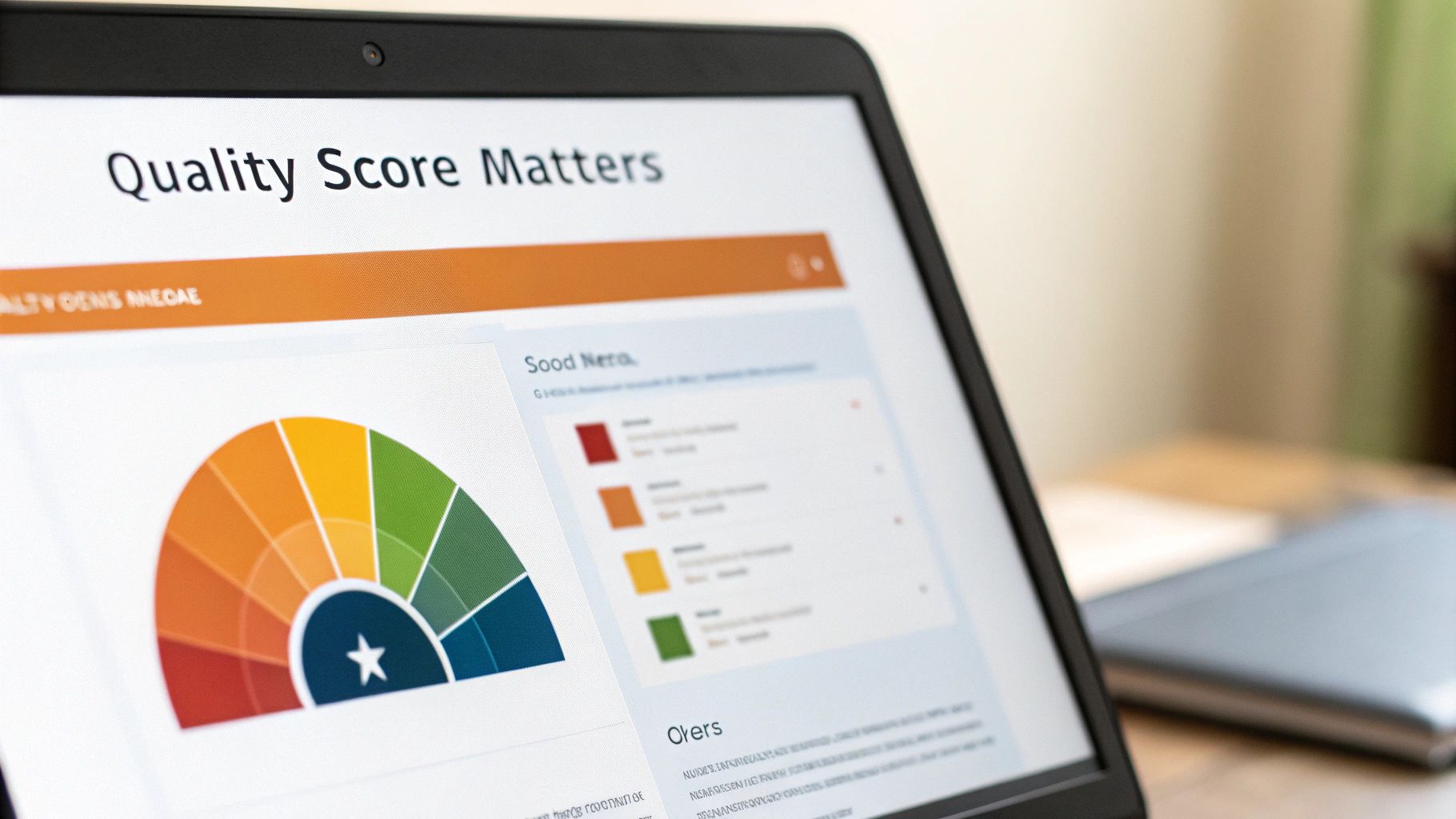
One of the most powerful—and surprisingly overlooked—levers you can pull is your Quality Score. Think of it as Google's report card for your advertising efforts. It’s a score from 1 to 10 that Google assigns to your keywords, all based on how relevant and high-quality your ads, keywords, and landing pages are.
A high Quality Score is your secret weapon for lowering costs. Why? Because Google actively rewards advertisers who create a great user experience with a discount on their CPC. A high score signals to Google that your ad is a perfect match for what the person was searching for. This means you can often win a better ad position than a competitor, even if they bid more but have a lower Quality Score.
In essence, a higher Quality Score directly lowers your cost per click. You pay less to achieve the same ad rank as an advertiser with a poorer score, making it a critical focus for any budget-conscious campaign.
Improving this score comes down to fundamentals: making sure your ad copy mirrors the keywords in your ad group, and ensuring the landing page you send people to delivers exactly what your ad promised. It's the most effective way to make every dollar in your budget stretch further.
Your Targeting Choices and Campaign Settings
Beyond the competitive landscape and your account's quality, the specific settings you choose for your campaign play a massive role in your final ad spend. How you configure your account directly impacts who sees your ads and when, which in turn determines what you pay.
These settings are the control panel for your budget, allowing you to focus your spending where it will have the biggest impact.
Here are a few of the most important settings:
- Geographic Targeting: A campaign trying to reach all of Canada will naturally need a bigger budget and face more competition than one focused exclusively on the Greater Toronto Area. Getting precise with your location settings ensures you only pay for clicks from people who can actually become customers.
- Keyword Selection: Broad, general keywords like "shoes" are wildly competitive and expensive. In contrast, more specific, long-tail keywords like "waterproof trail running shoes for men" will have less search volume but attract a much more qualified, ready-to-buy audience at a lower cost.
- Ad Schedule (Dayparting): If your business, like a local restaurant, only operates during certain hours, you can schedule your ads to run only when you're open. This is a simple but powerful way to stop wasting money on clicks when you can't even serve the customer.
By strategically managing these elements, you actively steer your campaigns toward profitability. It’s this blend of industry awareness, a relentless focus on quality, and precise targeting that ultimately dictates what it will cost to advertise on Google for your specific business.
So, How Much Does Google Ads Really Cost in Canada? Let's Break It Down by Industry
One of the first questions I always get is, "How much should I be spending on Google Ads?" The honest answer? It depends entirely on your industry. The cost isn't a one-size-fits-all number; it swings wildly from one business sector to the next. Getting a handle on the typical ad costs in your specific Canadian market is the first step to setting a realistic budget.
This data gives you a solid starting point, a benchmark to measure against before you even think about launching a campaign. Think about it: some industries are just plain more competitive because a single new customer is worth a small fortune. That high-stakes environment naturally pushes up what businesses are willing to bid for keywords, and that's what drives up the cost.
Why Some Clicks Cost a Fortune (And Others Don't)
In the Google Ads auction, not all clicks are priced the same. Industries with a massive customer lifetime value (LTV) almost always have the most expensive ad costs. It’s simple supply and demand—businesses will gladly pay a premium to get a lead that could be worth tens of thousands of dollars over time.
You see this most clearly in fields like legal services, insurance, and big-ticket home improvements. A single personal injury client or a full kitchen renovation can bring in huge revenue, so paying a higher price to acquire that customer makes perfect business sense. The competition is fierce because the potential payoff is enormous.
The Bottom Line: The more a new customer is worth to you, the more you should expect to pay to find them on Google. This direct link between customer value and ad cost is the single biggest reason why pricing varies so much between industries.
A Look at the Numbers Across Canadian Sectors
Let’s get into the actual data, because that’s where the story really gets interesting. Google Ads costs in Canada can be worlds apart. Service-based businesses often pay top dollar, while sectors like e-commerce and travel tend to have much lower costs per click.
For example, it's not unheard of for certain legal keywords in Canada to approach costs similar to the US average of $137.55 per click. That number seems shocking until you remember how valuable a new case is.
Now, compare that to the average click for an online retail product, which is just $1.16. Even better, Google Shopping Ads—those visual, product-focused ads—are incredibly cost-effective, with an average CPC of only $0.66. For an e-commerce store, the average Cost Per Action (CPA) on the Search Network hovers around $45.27, a very manageable number for most online retailers. You can always dig into more detailed industry benchmarks to see how your business stacks up.
To give you a clearer picture, here’s a snapshot of what different industries are paying on average for ads in Canada.
Average Cost-Per-Click (CPC) by Industry in Canada
A comparative look at average CPCs across different Canadian business sectors to help with budget forecasting.
| Industry | Average CPC (Search Network) | Average CPA (Search Network) |
|---|---|---|
| Legal | $8.67 | $86.04 |
| Home & Garden | $3.68 | $45.19 |
| Finance & Insurance | $4.01 | $81.93 |
| Health & Medical | $3.57 | $69.75 |
| E-Commerce | $1.50 | $33.93 |
| Travel & Hospitality | $2.26 | $54.81 |
| Real Estate | $3.03 | $150.13 |
Source: WordStream benchmarks, adapted for Canadian market estimates.
As you can see, the numbers tell a compelling story. A real estate agent is playing a completely different game than an online boutique owner, and their budgets need to reflect that reality.
Finding Your Place in the Ad Spend Spectrum
What does all this mean for your business? Simple: knowing where your industry sits helps you build a smarter, more competitive bidding strategy right from the start.
If you’re in a pricey sector, it hammers home the need for a perfectly tuned campaign where every dollar is accounted for. You have to be ruthless with your optimization, focusing only on high-intent keywords and sending traffic to landing pages built to convert. There's no room for waste.
On the other hand, if you’re in a lower-cost industry, you might have more breathing room. You could experiment with broader keywords to build brand awareness or test different ad formats without breaking the bank. This knowledge turns budgeting from a guessing game into a strategic decision, ensuring your financial planning is grounded in reality from day one.
How to Calculate a Realistic Google Ads Budget
Alright, let's move past the theory and get our hands dirty. The real magic happens when you can connect your business goals directly to your ad spend. Instead of asking the vague question, "how much does Google Ads cost?" we're going to build a couple of simple formulas to help you map out a starting budget and see what kind of return you can expect.
We’ll walk through two real-world examples—one for a local service pro and one for an online store. Think of this as reverse-engineering your success. By starting with what you want to achieve, you can build a budget that actually makes sense for your business.
Formula for a Local Service Business
Let's say you run a plumbing company in Vancouver. Your main goal isn't just clicks; it's getting the phone to ring. You've decided you want to generate 20 new, qualified leads every month from Google Ads. So, how much should you set aside?
Let's crunch the numbers using some pretty standard industry benchmarks:
- Start with Your Lead Goal: Your target is 20 leads per month. Easy enough.
- Estimate Your Conversion Rate: For a well-built landing page in the home services world, a 5% conversion rate is a solid benchmark. This just means that for every 100 people who click your ad, you can expect 5 of them to fill out your contact form or call.
- Calculate Clicks Needed: To get those 20 leads, you'll need 400 clicks. The math is simple: (20 leads / 0.05 conversion rate = 400 clicks).
- Find Your Industry CPC: The average Cost-Per-Click (CPC) for a plumber is often around $7.00. It's a competitive space!
- Calculate Your Monthly Budget: Now, just multiply the clicks you need by what each one costs: 400 clicks x $7.00/click = $2,800 per month.
So, for your Vancouver plumbing business, a starting budget of around $2,800 per month to hit that 20-lead target is a data-backed, realistic plan.
Key Insight: Budgeting shouldn't feel like guessing. It’s about working backward from a tangible business goal. When you start with your desired outcome (like leads or sales), your budget becomes a direct investment in your growth, not just another expense.
Formula for an E-Commerce Brand
Now, let's switch over to an e-commerce brand that sells beautiful handcrafted leather goods across Canada. For them, it's all about sales. Their goal is to generate an extra $10,000 in new monthly sales from their Google Ads.
We'll use the same reverse-engineering logic here:
- Start with Your Revenue Goal: The target is $10,000 in sales per month.
- Determine Your Average Order Value (AOV): You know your customers, and on average, they spend $125 every time they buy something.
- Calculate Conversions Needed: To hit that $10,000 goal, you'll need to make 80 sales ($10,000 / $125 AOV = 80 sales).
- Estimate Your Conversion Rate: For e-commerce, the average conversion rate hovers around 2%.
- Calculate Clicks Needed: To get those 80 sales, you're going to need a lot more traffic: 4,000 clicks to be exact (80 sales / 0.02 conversion rate = 4,000 clicks).
- Find Your Industry CPC: Luckily, clicks for retail and e-commerce are generally much cheaper, averaging around $1.50.
- Calculate Your Monthly Budget: Let's put it all together: 4,000 clicks x $1.50/click = $6,000 per month.
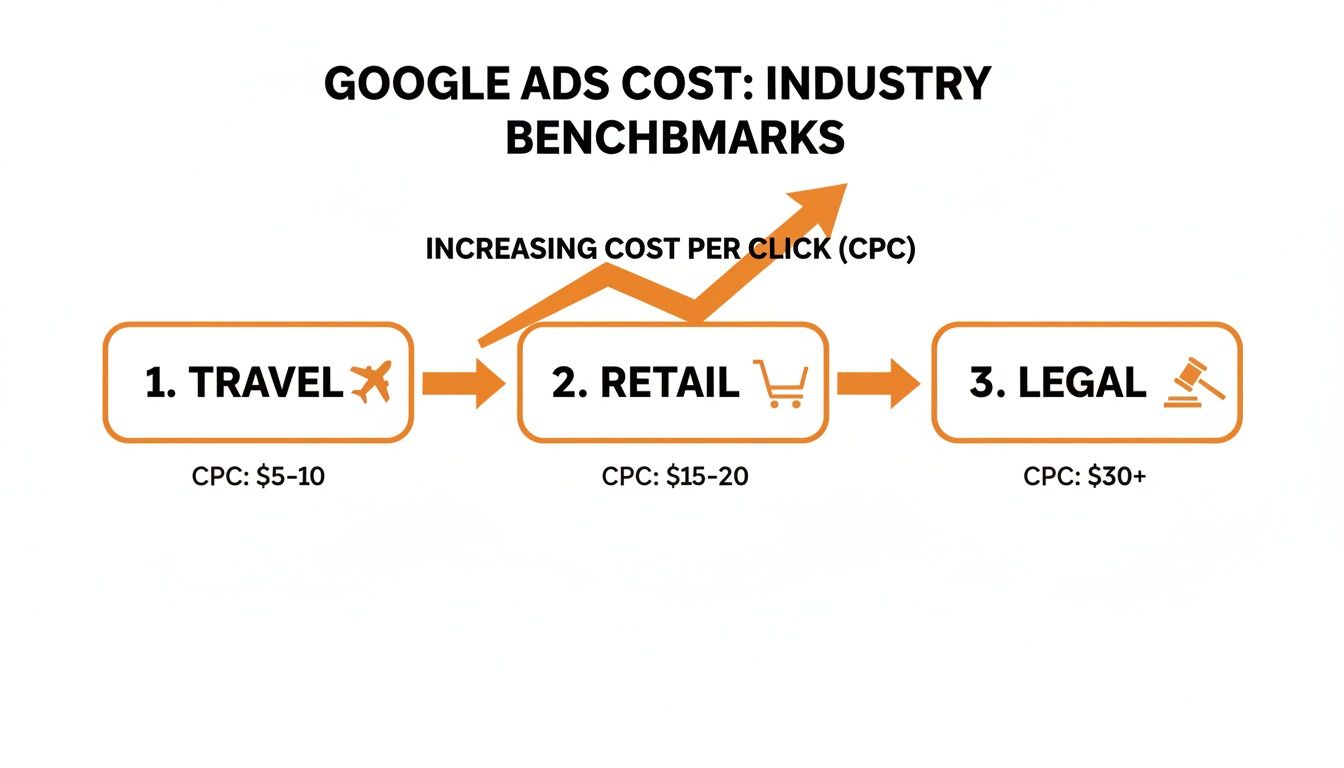
As you can see, costs can climb quickly when you move from lower-cost sectors like retail into high-value industries like legal services. It all comes down to what a single customer is worth.
To hit that $10,000 sales goal, this e-commerce brand should plan for a monthly ad spend of around $6,000. This calculation also sets a clear performance target. To make $10,000 from a $6,000 spend, their goal for Return On Ad Spend (ROAS) is 1.67x. If that term is new to you, we have a whole guide that explains what ROAS is and how to calculate it.
Proven Strategies to Control Your Ad Spend
Anyone can throw money at Google Ads. The real trick is spending it wisely. That’s where you start winning. Think of your budget not as a simple expense, but as a precision-guided investment. It’s not about slashing your spending; it’s about making every single dollar pull its weight.
These aren't just random tips. They're the fundamental practices we use to run campaigns that are not only efficient but genuinely profitable. By getting a handle on a few key strategies, you can take firm control of your ad spend and make sure you're getting clicks that actually turn into customers.
Stop Wasted Clicks with Negative Keywords
One of the fastest ways to burn through your budget is paying for clicks from people who will never, ever buy from you. This is where negative keywords become your campaign's most valuable player. They act like a bouncer for your ads, turning away all the wrong search queries at the door before they can cost you money.
Let's say you sell high-end, premium running shoes. You’d immediately want to add words like "cheap," "discount," and "free" to your negative keyword list. This one simple move stops your ads from showing up for bargain hunters who aren't your target audience. You instantly stop paying for clicks that have zero chance of converting.
Make it a habit to regularly check your search terms report for new negative keywords to add. It's one of the single most effective cost-control tactics you can adopt.
Target Your Most Profitable Times and Places
Not every hour of the day or every neighbourhood holds the same potential for your business. So why would you pay for ads at 3 a.m. if your customers only shop during business hours? This is exactly what ad scheduling and geographic targeting are for. They let you focus your budget with laser precision.
- Ad Scheduling: If you run a local restaurant, you can set your ads to run exclusively during the lunch and dinner rushes. This focuses your entire budget on those peak hours when people are actively looking for a place to eat.
- Geographic Targeting: A landscaping company in Vancouver has no business advertising to someone in Toronto. You can narrow your targeting to specific cities, postcodes, or even a tight radius around your shop, cutting out all the irrelevant locations.
By focusing your budget on the times and places that bring in the most business, you get the most impact from every dollar you spend and make your entire campaign drastically more efficient.
Lower Your Costs by Improving Your Landing Page
Here’s a strategy that many advertisers completely miss: you can slash your cost per lead without touching your ad budget. The secret is to perfect the experience after someone clicks your ad. This is a process called Conversion Rate Optimization (CRO).
A well-designed landing page that clearly explains your offer and makes it dead simple for a visitor to take the next step will convert a much higher percentage of your traffic. This means you need fewer clicks—and less ad spend—to get the same number of leads or sales. For businesses selling online, this is non-negotiable. You can dive deeper into this in our detailed guide to e-commerce PPC marketing.
Improving your landing page also gives your Quality Score a healthy boost, and Google rewards high Quality Scores with lower click costs. It’s a win-win cycle: a better user experience leads to a higher conversion rate and a lower ad spend, creating a far more profitable campaign.
Common Questions About Google Ads Costs
Even with a solid plan, the question of "how much does it actually cost?" always comes up. I've spoken with countless business owners across Canada, and they almost always have the same core concerns when they're first dipping their toes into Google Ads. Let's tackle those head-on.
One of the biggest worries? Whether it's even worth trying with a shoestring budget. It's a fair question—spread your ad spend too thin, and you might not see any real movement at all.
Can I Run Google Ads With A Very Small Budget?
Technically, yes, you can set a budget as low as $100 for the month. But honestly, it's incredibly difficult to get anywhere with that. A budget that small might only buy you a few clicks a day, which isn't nearly enough data for Google's algorithm to learn and start making smart decisions.
For most local businesses here in Canada, a realistic starting point is somewhere in the $500 to $1,000 per month range. This gives you enough volume to start collecting meaningful data, which allows for the kind of smart adjustments that give your campaigns a fighting chance at turning a profit.
The goal of your initial budget isn't just to get leads; it's to buy data. Investing enough to learn what works is the fastest path to building a profitable, long-term advertising strategy.
How Long Does It Take To See Results?
This is the other big question everyone asks. You'll start seeing traffic from your ads almost as soon as they're approved. But seeing consistent, profitable results—like actual leads and sales—takes a bit more patience.
Think of the first 30 days as a testing and data-gathering phase. We're figuring out what your audience responds to. For most businesses, you should start to see a clear picture of performance and an initial return on your investment within the first 90 days.
That three-month window gives us enough time to properly test different keywords, ad copy, and bidding strategies. It's all about methodically finding the most profitable combination for your specific business.
Is Paying For Google Ads Worth It If I Already Do SEO?
Yes, one hundred percent. This is a crucial point that a lot of people miss. SEO and Google Ads aren't competitors; they're powerful partners that work together to help you own the search results page.
SEO is your long-game. It builds organic authority and trust over time. Google Ads, on the other hand, gives you immediate, top-of-the-page visibility the second you hit "launch."
Here’s how they strengthen each other:
- Dominate the Page: When you have both paid and organic listings for the same keywords, you push your competitors further down the page and boost your brand's credibility.
- Share Key Insights: You can take what you learn from your paid ads—like which keywords convert best—and use that data to supercharge your SEO strategy.
- Capture More Clicks: A combined approach helps you connect with more potential customers, no matter where they are in their buying journey.
Time and time again, we see that a strategy where SEO and Google Ads work in tandem delivers the strongest overall results.
Ready to stop guessing and start getting real, measurable results from your advertising budget? The expert team at Juiced Digital uses data-driven strategies to build profitable campaigns that turn clicks into customers. Book a free consultation today and let's create a plan that fits your business goals.