
So, how much are Google Ads? It’s the million-dollar question, isn't it? For a Canadian business, the honest answer is: it depends. But to give you a starting point, you can expect an average cost-per-click (CPC) of around $1.66. Your actual monthly spend could be a few hundred dollars or climb well past $10,000—it all comes down to your industry, your goals, and how aggressive you want to be.
A Quick Answer to Google Ads Costs in Canada
Trying to pin down a single price for Google Ads is like trying to price a house. The final number depends entirely on the neighbourhood, the square footage, and the finishes. Your ad spend works the same way; it’s shaped by how competitive your industry is, the keywords you bid on, and frankly, how good your ads are.
That said, we can definitely establish a realistic baseline. Most Canadian businesses find their sweet spot by starting with a budget anywhere from $500 to $5,000 per month. This range is usually enough to gather meaningful data, figure out what’s working, and start optimising your campaigns toward real profitability.
Understanding The Cost Spectrum
The great thing about Google Ads is that you are always in the driver's seat. You set a daily spending limit, which means Google can't go over your total monthly cap. It’s a flexible system that lets a local Vancouver flower shop and a national e-commerce brand compete on their own terms.
Several key factors will directly influence what you end up spending:
- Industry Competition: A single click for a "Toronto personal injury lawyer" will cost a lot more than one for "handmade dog collars." Why? The potential value of a new client is astronomically different, and the competition reflects that.
- Keyword Choice: Broad, high-traffic keywords are almost always more expensive. Getting specific with long-tail phrases (like "vegan leather dog collars in Halifax") can be a much more cost-effective way to find your ideal customer.
- Ad Quality: Google actually rewards you for being relevant. A compelling ad that sends people to a great landing page earns a higher Quality Score, and a better Quality Score directly lowers what you pay per click. It’s a win-win.
- Geographic Targeting: It’s a lot cheaper to run ads in a specific Calgary neighbourhood than it is to target all of Canada. The broader you go, the more you'll spend.
Real-World Canadian Benchmarks
To bring this out of the theoretical, let's look at some real numbers. The average cost-per-click (CPC) for Google Ads in Canada hovers around $1.66, which is quite a bit lower than what our neighbours in the US see.
For example, it's common for small businesses in British Columbia to start with monthly budgets between $100 and $5,000. But the industry makes all the difference. Highly competitive sectors like legal services can see CPCs around $6.75, while e-commerce clicks average just $1.16, making it an incredibly attractive channel for online stores.
The table below gives you a general idea of what a monthly budget might look like, depending on your business goals.
Estimated Monthly Google Ads Budgets for Canadian Businesses
This table outlines typical starting points for monthly ad spend based on common business objectives and scale.
| Budget Tier | Typical Monthly Spend (CAD) | Best For |
|---|---|---|
| Starter | $500 – $1,500 | Small local businesses, testing new markets, or focusing on hyper-niche keywords with low competition. |
| Growth | $1,500 – $5,000 | Established businesses looking to scale lead generation or e-commerce sales and gather significant performance data. |
| Advanced | $5,000+ | Businesses in competitive industries or those aiming for national reach and aggressive market share growth. |
Remember, these are just benchmarks. Your ideal budget will be unique to your business and its specific needs.
The most important takeaway is this: Google Ads isn't about having the biggest budget; it's about having the smartest strategy. A well-managed, smaller budget can easily outperform a larger, poorly optimised one.
Ultimately, figuring out your ideal spend involves starting with a test budget, measuring what happens, and then doubling down on what works. For a more detailed breakdown, you can dive deeper into how much it costs to advertise on Google. This foundational knowledge will set you up perfectly for the next sections, where we’ll get into the nitty-gritty of what drives your ad costs up or down.
Understanding the Google Ads Auction
To really get a handle on Google Ads costs, you have to stop thinking about it like buying a product with a fixed price. It’s much more like a live auction—one that happens in the blink of an eye every single time someone types in one of your keywords. In that split second, Google runs a complex auction to decide which ads get shown and in what order.
But here’s the twist: this isn't your typical auction where the person with the most money automatically wins. Google’s system is actually built to reward ads that are high-quality and genuinely helpful to the searcher. This is great news because it means a smart strategy can beat a big budget. The winner of this lightning-fast auction is determined by something called Ad Rank.
What Is Ad Rank?
Think of Ad Rank as the score that decides your ad's placement on the search results page. It's a surprisingly simple formula that levels the playing field, making sure that users see the most relevant ads, not just the ones from companies with the deepest pockets.
Here’s how it’s calculated:
Ad Rank = Your Maximum Bid x Your Quality Score
Your maximum bid is simply the highest amount you’re willing to pay for a click. But the other half of that equation, your Quality Score, is where the magic really happens. This is where you can gain a serious advantage and directly lower your advertising costs.
The Power of Quality Score
Quality Score is essentially Google's report card for your ads, keywords, and landing pages, graded on a scale of 1 to 10. A higher score tells Google that your ad is a great match for what the user is looking for, and you get rewarded for it. It's your secret weapon for making your budget go further.
A high Quality Score leads to lower costs and better ad positions. In fact, it’s entirely possible for an advertiser with a lower bid to rank above a competitor, simply because they have a better Quality Score.
Google looks at three main things to calculate this score:
- Expected Click-Through Rate (CTR): How likely is someone to click on your ad when it appears? Google predicts this based on your ad’s past performance, making compelling ad copy a must.
- Ad Relevance: Does your ad actually match what the person was searching for? If someone searches for "burst pipe repair," an ad for "emergency plumbing services" is a perfect fit. An ad for "bathroom renovation ideas"? Not so much.
- Landing Page Experience: After someone clicks, does your landing page deliver what the ad promised? Google checks if your page is relevant, user-friendly, and provides a good experience on both desktop and mobile.
How You Actually Pay
Now for the most interesting part. Even when you win the top spot in the auction, you rarely pay your maximum bid. The price you actually pay for that click (your Actual CPC) is just one cent more than what was needed to beat the Ad Rank of the advertiser right below you.
The formula works like this:
Actual CPC = (Ad Rank of the Ad Below You / Your Quality Score) + $0.01
This really highlights how a higher Quality Score directly lowers your costs. You could be in the exact same ad position as a competitor, but if your Quality Score is better, you'll pay less for every single click. That’s why focusing on ad relevance and the user’s landing page experience isn't just a "best practice"—it’s a direct path to saving money.
This kind of sophisticated, automated bidding is a cornerstone of what's known as programmatic advertising, a fascinating field that shows how automated systems buy and place ads across the web.
The Six Key Factors That Drive Your Ad Spend
Knowing about the Google Ads auction and Quality Score is like knowing the rules of hockey. But to win, you need to understand the players, the rink conditions, and the specific plays that lead to a goal. When people ask, "how much are Google Ads?", there's no simple price tag. The real answer lies in how six critical factors play off each other to determine your final cost.
Think of these factors as sliders on a mixing board. Pushing one up can change the entire sound, and mastering the mix is how you go from just spending money to making a smart, profitable investment.
1. Industry and Keyword Competition
Your industry is, without a doubt, the single biggest factor dictating your ad costs. Some fields are just naturally more competitive because a single new customer can be worth thousands of dollars. This reality sparks intense bidding wars for the most valuable keywords.
Take a keyword like "Vancouver emergency plumber," for example. The intent behind that search is urgent and high-value. You'll have dozens of plumbing companies fighting for that click, which naturally drives the price up. Now, compare that to a search like "DIY sink repair tips." The commercial intent is almost zero, meaning far less competition and a much, much lower cost-per-click (CPC).
With Google holding over 85% of the search market share in Canada, the competition in high-value sectors is fierce. Data shows that consumer services like home repair can see an average CPC of $6.40, while the average for e-commerce is a more manageable $1.16. As these updated Google Ads statistics show, your industry sets the baseline for your budget right from the start.
2. Geographic Targeting
Where you show your ads has an immediate and direct effect on your costs. It’s a classic case of supply and demand. Targeting a dense, competitive urban hub like downtown Toronto will always cost more than targeting a smaller town in rural Saskatchewan.
This gives you an incredible amount of strategic control. A local bakery can be hyper-efficient by only targeting people within a five-kilometre radius, making sure not a single dollar is wasted on someone too far away to pop in. On the other hand, a national e-commerce brand has to be prepared to pay higher costs to cover the entire country.
Pro Tip: Start small and expand deliberately. Targeting a specific neighbourhood or city is a great way to test the waters and prove your campaign works before scaling up to a provincial or national level.
3. Your Chosen Keywords and Match Types
The specific keywords you bid on are the engine of your ad spend. We've established that high-intent keywords cost more, but there's another layer of control you have: match types.
- Broad Match: This is your widest net. It shows your ad for a huge variety of related searches, offering massive reach but risking a lot of wasted spend on irrelevant clicks if you're not careful.
- Phrase Match: A nice middle ground. Your ad appears for searches that include the meaning of your keyword, giving you a good balance of reach and relevance.
- Exact Match: This is your sniper rifle. Your ad only shows for searches with the exact same meaning or intent as your keyword. It offers the most control and usually the best relevance, leading to a stronger Return On Ad Spend (ROAS). You can learn more about how to calculate and improve your ROAS in our detailed guide.
4. Audience Targeting and Demographics
Who sees your ads is just as crucial as where they see them. Google Ads lets you zero in on users based on their age and gender, their interests, their online habits (like visiting a competitor's site), and even their past interactions with your business (remarketing).
By layering these targeting options, you can focus your budget exclusively on the people most likely to become customers. Imagine a high-end fashion boutique targeting high-income earners in specific postal codes who have also shown an interest in luxury brands. That level of precision is what stops you from throwing money away on clicks from people who were never going to buy.
5. Ad Scheduling
Your business probably isn't open 24/7, so why should your ads run around the clock? Ad scheduling, sometimes called dayparting, gives you the power to choose the exact days and hours your ads are live.
This is a seriously powerful tool for trimming the fat from your budget. A B2B software company, for instance, might discover that their best leads come in during standard business hours, Monday to Friday. By simply switching their ads off on weekends, they can pour their entire budget into the time slots that actually make them money.
6. The All-Important Quality Score
And that brings us back to the one factor you have the most direct control over: your Quality Score. As we touched on earlier, this is Google's grade on the quality and relevance of your keywords, ads, and landing page. A high Quality Score doesn't just help you rank higher—it actively lowers what you pay for each click.
Improving your Quality Score is the single most effective way to make every dollar in your ad budget work harder. When you create super-relevant ads that send users to a genuinely helpful landing page, you're signalling to Google that you're a top-tier advertiser. Google rewards you for this with a discount, letting you get more clicks and better ad positions for less money than your lower-scoring competitors.
Putting It All Together: Budget Scenarios for Canadian Businesses
Okay, we've covered the theories behind what drives Google Ads costs. But what does this look like in the real world? It's one thing to understand the concepts, but it’s another to see them in action.
To make this tangible, let's walk through a few detailed budget scenarios for typical Canadian businesses. These examples should help you get a real feel for what a monthly investment looks like and the kind of results you could realistically expect. We'll break down the numbers—from budget to clicks to actual leads or sales—to connect the dots between spending and return.
Before we dive in, this chart gives a great visual summary of the main levers controlling your ad spend: your industry, the keywords you choose, and your Quality Score.
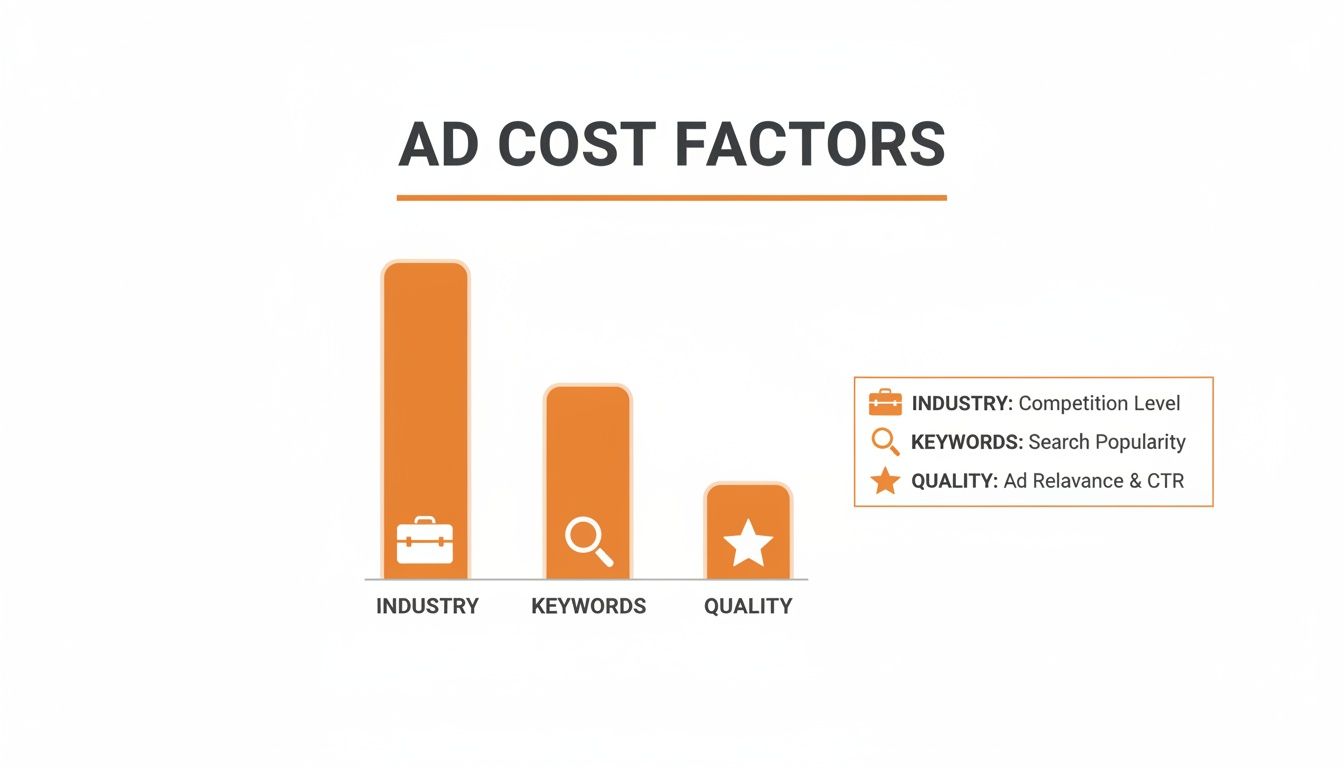
As you can see, the competitiveness of your industry really sets the baseline. From there, your keyword strategy and the quality of your ads determine just how far your budget can stretch.
Local Service Business: A Vancouver Physiotherapy Clinic
Picture a physiotherapy clinic in Vancouver’s trendy Kitsilano neighbourhood. Their main goal is simple: get more new patient bookings through their website. They decide to start with a modest monthly budget of $1,500 to see what happens.
The healthcare and wellness space is pretty competitive. In Canada, clicks for keywords like "physiotherapy near me" or "sports injury clinic Vancouver" can easily run between $3.00 and $6.00. Let’s split the difference and use $4.50 as our average Cost-Per-Click (CPC).
- Monthly Budget: $1,500 CAD
- Average CPC: $4.50
- Estimated Monthly Clicks: $1,500 / $4.50 = ~333 clicks
Now for the important part—conversions. For a well-designed landing page in this field, a 5% conversion rate is a solid, achievable target. This means 5 out of every 100 people who click the ad actually fill out the booking form.
Projected Leads: 333 clicks x 5% conversion rate = ~16-17 new patient inquiries per month.
If the average lifetime value of just one new patient is $750, those 16 new leads could turn into a significant return, making that initial ad spend look like a very smart investment.
National E‑commerce Brand: Sustainable Home Goods
Next up, let's imagine a Canadian e‑commerce brand that sells ethically sourced, sustainable home goods and ships nationwide. Their objective is clear: drive direct online sales. They have a more aggressive growth strategy and have set aside a $7,000 monthly budget.
E-commerce often has a lower CPC than local services. For search terms like "eco friendly cleaning supplies" or "bamboo bed sheets Canada," the CPC might hover around $1.80.
- Monthly Budget: $7,000 CAD
- Average CPC: $1.80
- Estimated Monthly Clicks: $7,000 / $1.80 = ~3,888 clicks
For online stores, a typical conversion rate is a bit lower, often around 2%. Let’s also assume their average order value (AOV) is $90.
- Projected Sales: 3,888 clicks x 2% conversion rate = ~77 sales
- Projected Revenue: 77 sales x $90 AOV = $6,930 in revenue
At first glance, spending $7,000 to make $6,930 seems like a loss. But wait. This simple calculation doesn't factor in customer lifetime value. If even a quarter of those new customers come back for repeat purchases over the next year, the campaign suddenly flips into profitability.
B2B Software Company: A SaaS Provider
Finally, let's look at a Toronto-based B2B software company that sells a project management platform to construction firms. This is a high-value, niche market. They've allocated a $5,000 monthly budget to find new clients.
B2B keywords can be notoriously expensive because a single client is worth so much. Terms like "construction project management software" can see CPCs from $8.00 to over $15.00. We’ll be conservative and use an average of $12.00.
- Monthly Budget: $5,000 CAD
- Average CPC: $12.00
- Estimated Monthly Clicks: $5,000 / $12.00 = ~416 clicks
The goal here isn't an instant sale; it's generating a qualified lead who requests a product demo. With a highly targeted landing page, a 4% conversion rate is well within reach.
- Projected Demo Requests (Leads): 416 clicks x 4% conversion rate = ~16-17 demo requests
Now, if the sales team is able to close 20% of these highly interested leads, and each new client subscription is worth $10,000 a year, the numbers start to look very attractive.
- New Clients: 16 leads x 20% close rate = ~3 new clients
- Projected Annual Revenue: 3 clients x $10,000 = $30,000
These scenarios drive home a critical point: figuring out how much Google Ads are is less about the upfront cost and all about the potential return that spend can unlock for your specific business.
Proven Tactics to Lower Your Ad Costs
Throwing money at Google Ads is easy. The real trick is turning that spend into a profitable engine for your business. The good news? You have far more control over your advertising costs than you might think. By focusing on a few smart, data-backed tactics, you can make every dollar in your budget work harder and seriously improve your return on investment.
This isn't about outspending your competition; it's about outsmarting them. A well-tuned campaign with a modest budget can consistently run circles around a larger, poorly managed one. Let's dig into the most effective strategies for cutting your ad costs while actually boosting performance.
Refine Your Keyword Strategy
The bedrock of any cost-effective campaign is a solid keyword strategy. Just bidding on the most obvious, high-traffic terms is a fast track to burning through your budget with very little to show for it. The goal is to find that sweet spot between relevance, search volume, and competition.
A great place to start is by targeting long-tail keywords. Think of these as longer, more specific phrases people use when they're much closer to making a decision. A keyword like "emergency plumber" is broad and expensive. But "24-hour burst pipe repair Vancouver"? That's specific, shows clear intent, and will almost always have a lower cost-per-click (CPC).
Just as crucial is building out a thorough negative keyword list. This is your way of telling Google which searches you don't want your ads showing up for. If you sell premium leather shoes, adding words like "cheap," "discount," and "repair" to your negative list stops you from wasting money on clicks from people who aren't your ideal customers.
Obsess Over Your Quality Score
As we've touched on, your Quality Score is the single most powerful lever you can pull to lower your ad costs. Think of a high Quality Score as a direct discount from Google. It's their way of rewarding you for creating a relevant and helpful experience for their users. Improving it isn't just a good idea—it's essential for a profitable campaign.
There are three main ingredients to focus on:
- Ad Relevance: Your ad copy needs to speak directly to the keyword it's targeting. This means creating tightly themed ad groups where a small cluster of similar keywords maps to super-specific ads.
- Expected Click-Through Rate (CTR): Write compelling ads that grab attention and make people want to click. Use ad extensions to add more info and take up more screen real estate.
- Landing Page Experience: The journey doesn't stop after the click. Your landing page has to deliver on the promise made in your ad. It must be easy to navigate and, crucially, load quickly, especially on mobile.
A higher Quality Score means you can win the same ad position as a competitor while paying a fraction of the cost. It is the most direct path to reducing what you pay for every single click.
Optimise Your Landing Pages for Conversion
A low ad cost doesn't mean much if the clicks you're buying never turn into customers. That’s where Conversion Rate Optimisation (CRO) comes into play. The whole point is to make it as easy and intuitive as possible for a visitor to do what you want them to, whether that's buying a product or filling out a contact form.
You should be constantly testing different elements on your landing pages:
- Headlines: Do they clearly and instantly communicate the value?
- Calls-to-Action (CTAs): Is the button text clear and compelling? Does the colour stand out?
- Forms: Are you asking for too much information? Shorter forms almost always get more completions.
- Page Layout: Is the most important information visible "above the fold" without any scrolling?
Every single improvement you make to your conversion rate directly lowers your cost-per-acquisition (CPA). If you double your conversion rate, you've just gotten twice the value from the exact same ad spend. It’s a powerful way to make your campaigns far more profitable.
Got Questions About Google Ads Costs? We've Got Answers.
Even after you get the hang of budgets and bidding, it's totally normal to have some lingering questions. Diving into Google Ads spending can feel a bit like stepping into the unknown, but getting clear answers is often simpler than you'd think.
Let's tackle some of the most common questions we hear from Canadian business owners. My goal here is to give you straightforward, practical answers to help you invest your advertising dollars wisely.
Can I Really Run Google Ads With A Small Budget?
You absolutely can. In fact, the platform's scalability is one of its biggest perks. You can genuinely get started with a budget as modest as $10-$20 a day, which works out to about $300-$600 a month.
Think of a smaller budget as your testing ground. It’s the perfect way to dip your toes in the water, gather some initial data on what works, and figure out what your audience responds to—all without a huge financial commitment. The trick is to be laser-focused. Concentrate on one specific service or product and target a tight geographic area to make every single dollar pull its weight.
The real goal at the start isn't just to spend money; it's to prove you can turn a profit. Once you see a positive return on investment (ROI), you can scale up your budget with confidence, knowing that every extra dollar you put in is likely to bring even more back.
How Long Until I Actually See Results?
This is a big one. While you can see traffic and clicks roll in almost right away, getting to the point of meaningful, profitable results takes a bit of patience. As a rule of thumb, you should plan for at least a 90-day period of learning and fine-tuning.
Here’s what that timeline usually looks like:
- The First 30 Days (Data Collection): This initial month is all about gathering intel. Your campaigns are in a learning phase, and you're discovering which keywords, ads, and targeting settings are hitting the mark with your audience.
- The Next 30 Days (First Round of Optimisation): With a month's worth of data under your belt, you can start making informed tweaks. This is when you’ll pause the ads that aren’t performing, clean up your keyword lists with negative keywords, and shift your bids toward what’s already working.
- The Following 30 Days (Refining and Scaling): By this point, you should have a much clearer picture of your cost-per-acquisition. Now you can begin to carefully increase the budget on your winning campaigns and continue refining your strategy to get more efficient.
The key here is patience. One of the most common mistakes we see is people pulling the plug after a week or two. That’s often far too early to know if you're on to something truly successful.
What Is a Good Cost Per Acquisition?
Honestly, this is a trick question. The real answer? It depends entirely on your business. A "good" Cost Per Acquisition (CPA) is simply any number that leaves you with a profit. It all comes down to your profit margins and how much a new customer is worth to you over their lifetime.
Let's look at a couple of examples:
- An e-commerce shop selling $50 t-shirts with a $20 profit margin needs to acquire customers for well under $20 to make any money.
- A law firm, where a single new client could be worth $10,000, could easily justify a CPA of $500 or more and still see an incredible return.
Your first step is to figure out your break-even point. Once you know the absolute maximum you can afford to pay for a new customer, your ongoing mission is to consistently beat that number through smart optimisations.
Is It Worth Hiring An Agency to Manage My Ads?
Hiring an agency can be a game-changer, especially if you don't have the time or deep expertise to run your campaigns yourself. Yes, it's an added cost—most agencies charge a flat monthly fee or a percentage of your ad spend—but the value you get in return often far exceeds the expense.
A good agency brings a wealth of experience from managing countless accounts across different industries. They know the common, costly pitfalls to avoid and can implement advanced strategies to get you a better ROI, faster. If your campaigns are getting complex or you're spending a significant amount each month, bringing in a professional is often a very sound investment.
Ready to stop guessing and start getting real returns from your ad spend? At Juiced Digital, our AI-powered approach is built to maximise your budget and drive measurable growth for your Canadian business. Book your free, no-obligation strategy session today and let's unlock your true advertising potential.