Ecommerce digital marketing is the art and science of getting people to your online store and turning them into loyal customers. It’s not about doing just one thing right; it's about building a connected system where everything—from search visibility and paid ads to email engagement—works together to grow your business.
What Is Ecommerce Digital Marketing, Really?

Think of your online store as a physical shop in a massive, sprawling city. Without a marketing plan, you’re tucked away on a quiet side street where nobody really goes. Ecommerce digital marketing is your entire toolkit for moving that store onto the busiest intersection, creating stunning window displays, and guiding a constant stream of interested shoppers through the door.
It's a complete ecosystem. Every channel has to work in sync because today's customers don't just walk in and buy. They see an ad, read a review, get an email, and browse your site multiple times before they ever pull out their credit card.
The Core Components of Your Digital Storefront
Let's stick with the physical store analogy to break it down. Each part of your digital marketing plays a specific, vital role in making your business a success.
- Your Website is the Store: This is home base. It's where you show off your products, tell your brand story, and, most importantly, make sales.
- SEO is Your Prime Location: Search Engine Optimization is how people find you without you having to pay for every click. A solid SEO strategy puts your store on the city's main drag (the first page of Google), so you're right in front of people already searching for what you offer.
- Paid Ads are Your Billboards: Running ads on platforms like Google and Meta is like putting up flashy billboards and handing out flyers. It drives immediate, targeted traffic, which is perfect for big promotions or launching a new product.
- Email Marketing is Your Personal Shopper: This is how you build a real connection. Your emails act like a personal shopper, offering tailored suggestions, exclusive deals, and friendly reminders that keep customers coming back again and again.
- CRO is Your Store Layout: Conversion Rate Optimization (CRO) is all about how you arrange your store. From where you place your bestsellers to making the checkout process dead simple, CRO ensures the path to purchase is as smooth as possible.
The Shift to a Digital-First Marketplace
Getting a handle on these components is non-negotiable now that the entire market is moving online. This isn't just a passing trend; it’s a massive change in how people shop and where businesses are putting their money.
By 2025, digital advertising is projected to account for a staggering 76.7% of all ad spending in Canada. That number alone shows just how seriously brands are investing in online channels to fuel their growth. This shift creates a huge opportunity for agencies that know how to blend AI-powered SEO and paid advertising to get the best possible return for ecommerce businesses. You can find more details about these Canadian digital marketing trends on Accio.
At the end of the day, a winning ecommerce strategy isn't about being good at just one of these things. It's about weaving them together into a powerful engine that attracts new customers, builds lasting relationships, and generates revenue you can count on. This guide will walk you through exactly how to do that.
Building a Lasting Foundation with Ecommerce SEO
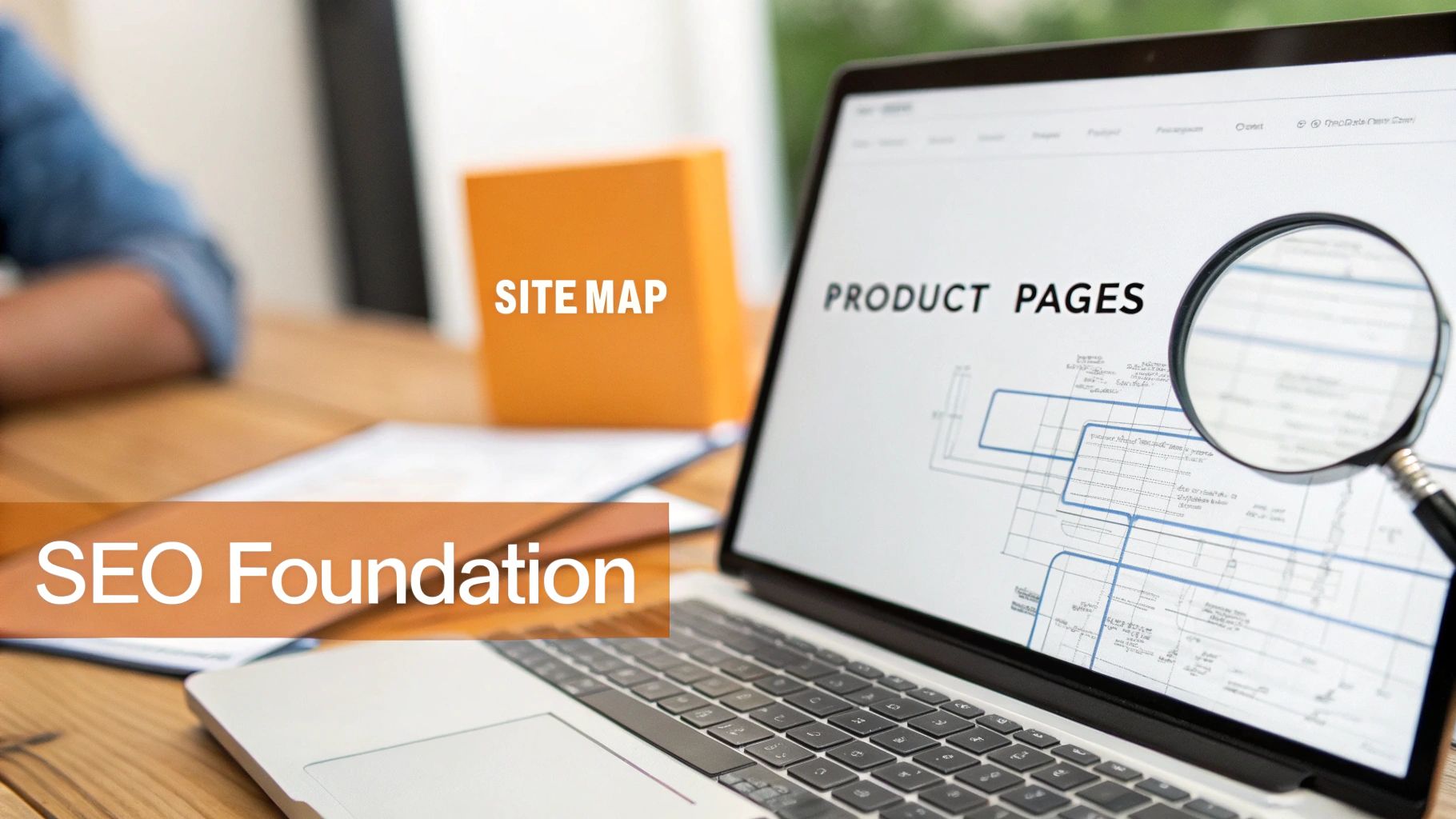
Paid ads are great for a quick traffic boost, but Search Engine Optimization (SEO) is what builds the very bedrock your business grows on. It’s a long-term play, a way to attract a steady stream of highly motivated shoppers directly from places like Google—without paying for every single click.
Think of it this way: SEO is like building your shop in the best part of town, making sure the signs are clear and the layout is intuitive. It’s not just one action, but a coordinated effort across three core areas that all work together.
The Three Pillars of Ecommerce SEO
A solid e-commerce digital marketing strategy needs a balanced approach to SEO. If you ignore one of these pillars, the whole structure gets wobbly, and you’ll miss out on a ton of valuable organic traffic.
Technical SEO (The Foundation): This is the non-negotiable groundwork. It’s all about making sure search engines can easily crawl, index, and make sense of your website. If your store’s foundation is cracked—plagued by slow page speeds, broken links, or a confusing structure—every other effort will fall flat.
On-Page SEO (The Signage and Merchandising): This is where you optimize the content on your actual product and category pages. It’s about using the right keywords in your titles, descriptions, and images so both customers and search engines know exactly what you’re selling. It’s your digital merchandising, making every product pop.
Off-Page SEO (The Reputation and Authority): This pillar is all about building your brand’s reputation across the web. It means earning links from other credible websites, gathering positive reviews, and carving out a strong brand presence. It's essentially word-of-mouth marketing for the digital age; the more trustworthy sites that point to you, the more authority Google grants you.
A well-executed SEO strategy is an incredibly cost-effective way to attract visitors who are actively looking to buy what you're selling. Over time, it builds an asset that generates compounding returns in traffic and revenue.
Mastering On-Page SEO for Products
Your product and category pages are the commercial heart of your store, and optimizing them starts with getting inside your customer's head. You need to understand what they're actually searching for. This means moving beyond generic terms and targeting purchase-intent keywords—the specific phrases people use when they’re ready to pull out their wallets.
For instance, instead of aiming for a broad term like "running shoes," you’ll get much better results by focusing on specifics like "women's trail running shoes size 8" or "best price for waterproof hiking boots." Sure, these long-tail keywords get less search volume, but it's the right kind of traffic, which almost always leads to higher conversion rates.
Once you’ve identified these keywords, weave them naturally into:
- Product Titles: Keep them clear, descriptive, and keyword-rich.
- Product Descriptions: Write compelling copy that answers customer questions and includes relevant terms.
- Image Alt Text: Describe your product images for visually impaired users and to give search engines context.
- URL Slugs: Use clean, descriptive URLs (e.g.,
/products/womens-trail-runner-blue).
Preparing for the Future with AI Search
The search world is shifting under our feet. With Google's introduction of AI Overviews, users are getting direct answers to their questions, not just a list of blue links. For any forward-thinking e-commerce digital marketing plan, getting your products featured in these AI-generated summaries is the new frontier.
To get ready, focus on creating content that is clear, factual, and directly answers common customer questions. Structuring your product pages with FAQs, detailed specifications, and helpful guides makes it much easier for AI to pull your information into its answers. Understanding this evolution is crucial, and you can learn more about how to monitor your visibility in this new landscape with our guide on AI rank tracking for modern SEO strategies.
By building a solid SEO foundation today, you’re not just ranking in current search results; you’re future-proofing your business for whatever comes next.
Driving Immediate Traffic with Paid Advertising
While SEO is your long-term play for building brand authority, paid advertising is the accelerator. It’s how you get immediate, highly targeted traffic flowing to your product pages right now. Think of it as the go-to tool for new product launches, seasonal sales, or any time you need to kickstart growth quickly.
It's like putting up a billboard on a digital highway at the exact moment your ideal customer is driving by. You aren't just crossing your fingers and hoping for traffic; you're paying to show up in front of shoppers who are either actively searching for what you sell or perfectly match your best customer's profile.
With paid ads, you can turn on a stream of visitors almost instantly. The real trick is managing your budget wisely to make sure you're not just buying clicks, but generating profitable sales and achieving a strong Return on Ad Spend (ROAS).
Mastering the Top Paid Channels
For any ecommerce brand, it's crucial to know that not all paid channels are created equal. The most effective strategies zero in on platforms where shoppers are ready to buy or where you can find your perfect audience with pinpoint accuracy. This is how you capture existing demand and create new interest simultaneously.
The paid ad world is generally split into two camps:
Search Ads: Platforms like Google Ads are incredibly powerful because they connect you with people who have high purchase intent. When someone types “buy waterproof trail running shoes” into Google, they’re telling you exactly what they want. Google Shopping ads are especially effective here, putting your product, image, and price right at the top of the search results.
Social Media Ads: Platforms like Meta (Facebook and Instagram) and TikTok are masters of demand generation. They let you target users based on their interests, online behaviours, and demographics. You can introduce your products to people who are very likely to love them, even if they weren’t actively looking for them.
The Canadian market is a perfect example of this opportunity in action. Canada's ecommerce revenue is expected to hit a massive C$90.80 billion by 2025, making it the ninth-largest market globally. With over 27 million people shopping online and mobile commerce making up a third of all purchases, a sharp paid ad strategy is essential to grab a piece of that pie. You can discover more insights about Canada's booming ecommerce market on eMarketer.
To help you decide where to invest your budget, let's break down the top platforms.
Comparing Top Ecommerce Ad Channels
Choosing the right channel depends entirely on your goals—are you trying to capture existing demand or create new awareness? This table compares the heavy hitters to help you make a more informed decision.
| Channel | Primary Use Case | Best For Targeting | Key Metric (KPI) |
|---|---|---|---|
| Google Search Ads | Capturing high-intent shoppers actively looking for specific products. | Keyword-based targeting (what users are searching for). | Cost Per Acquisition (CPA), Return on Ad Spend (ROAS). |
| Google Shopping | Showcasing products directly in search results for comparison shoppers. | Product-feed based, targeting users with commercial intent. | ROAS, Conversion Rate. |
| Meta Ads (FB/IG) | Building brand awareness and driving impulse buys through visual ads. | Demographic, interest, and behavioural targeting. | Cost Per Click (CPC), ROAS, Engagement Rate. |
| TikTok Ads | Reaching younger audiences with engaging, short-form video content. | Interest-based and trend-based targeting. | View-Through-Conversions (VTC), Cost Per Mille (CPM). |
| Pinterest Ads | Inspiring users who are in the discovery and planning phase of a purchase. | Visual search and interest-based targeting (e.g., home decor). | Click-Through Rate (CTR), Brand Awareness Lift. |
Ultimately, a strong ecommerce strategy often uses a mix of these channels. Search ads capture the low-hanging fruit, while social ads build your audience and fill the top of your funnel for future growth.
The Game-Changing Role of AI in Paid Media
The days of manually adjusting every bid and constantly tweaking ad copy are over. AI is now at the very core of modern paid advertising, completely changing how we manage and optimise campaigns. These algorithms can process millions of data points in real-time to make decisions that are simply beyond human capability.
AI doesn't just make campaigns better; it redefines what's possible. It analyses user behaviour, predicts who is most likely to convert, and automatically shifts your budget to the ads and audiences delivering the best ROAS—all with minimal hands-on effort.
Take Meta's Advantage+ and Google's Performance Max campaigns, for example. These systems use machine learning to do all the heavy lifting. You provide the creative assets—your best images, videos, and ad copy—and set your business goals. The AI then handles everything else, from audience targeting to bidding. This frees you up to focus on high-level strategy and creative, instead of getting lost in the weeds of manual campaign management. To truly scale your sales, you should explore a comprehensive ecommerce PPC marketing strategy that puts these powerful AI tools to work for you.
Turning Social Platforms into Sales Channels
The line between social media and shopping has all but disappeared, giving rise to what we now call social commerce. Platforms like Instagram and TikTok aren't just for building awareness anymore; they are powerful, direct sales channels.
Features like shoppable posts and in-app checkout mean a user can go from discovering a product to buying it without ever leaving the app. This creates a seamless, frictionless experience that capitalizes on impulse purchases. By pairing compelling visuals with authentic user-generated content (UGC), brands can build trust and drive sales directly on the platforms where customers are already spending their time.
Turning Visitors into Loyal Customers

Getting traffic to your website is a huge win, but it’s really only half the battle. A store full of window shoppers doesn't pay the bills; you need those visitors to become paying customers. This is where the strategy shifts from attracting attention to driving action—turning clicks into conversions and one-time buyers into loyal fans.
This make-or-break phase of ecommerce marketing is built on two core ideas that work together. First, making it incredibly simple for people to buy (Conversion Rate Optimization). Second, building a direct connection with them so they have a reason to return (Email Marketing). Nail these two, and you create a powerful engine for getting the most value out of every single visitor you've worked so hard to attract.
Making the Path to Purchase Effortless
Conversion Rate Optimization, or CRO, is all about refining your website to remove any and all roadblocks from the shopping experience. Think of yourself as the world's most attentive store manager. You’re constantly watching how people move through the aisles, spotting where they get stuck, and making small tweaks to guide them smoothly to the checkout.
A confusing menu, a slow-loading product image, or a checkout form that feels like an interrogation are all forms of friction. These are the digital versions of a cluttered aisle or a broken debit machine—they cause frustration and kill sales. The entire point of CRO is to systematically find and fix these weak spots.
A tiny improvement in your conversion rate can have a massive impact on your bottom line. Just increasing your rate from 1% to 2% literally doubles your revenue from the exact same amount of traffic, all without spending another cent on ads.
Tools and Tactics for Optimizing Conversions
Effective CRO isn't about guesswork; it's about using data to get inside your customers' heads and make informed changes. With the right tools, you can see your website exactly as your shoppers do.
- A/B Testing: This is the heart and soul of CRO. You create two versions of a webpage (an 'A' and a 'B') with one small difference—maybe a different headline or button colour. You then show each version to different groups of visitors to see which one performs better. No more guessing.
- Heatmaps: These tools give you a visual map of where users click, move their mouse, and scroll. In an instant, you can see which parts of your site are grabbing attention and which are being completely ignored.
- User Session Recordings: Imagine watching over your customer's shoulder as they browse. Session recordings do just that, showing you their entire journey, including every moment of hesitation or confusion.
By combining these insights, you can form solid hypotheses about what needs fixing and test your ideas methodically. For a deeper dive, check out our guide packed with more actionable tips on conversion rate optimizations that can directly boost your sales.
Building Relationships with Email Marketing
The moment a customer makes a purchase, email marketing becomes your single most powerful tool for turning that transaction into a real relationship. Social media algorithms decide who sees your posts, but email gives you a direct, personal line to your audience. It's a channel you actually own.
The secret sauce here is automation. By setting up targeted email sequences that trigger based on specific actions, you can send the perfect message at the perfect time. These automated "flows" do the work for you 24/7, nurturing customers and recovering sales you might have otherwise lost.
Here are the essential automated email flows every ecommerce store needs:
- The Welcome Series: A sequence of emails sent to new subscribers that introduces your brand, shows off your bestsellers, and maybe offers a small incentive to get them to make that first purchase.
- The Abandoned Cart Reminder: A friendly nudge sent to shoppers who added items to their cart but left without checking out. These emails have incredibly high open rates and can recover a serious amount of otherwise lost revenue.
- Post-Purchase Follow-ups: Emails that thank the customer, provide shipping updates, ask for a review, and suggest other products they might like based on what they just bought.
This kind of personalized communication makes customers feel seen and valued. It dramatically increases their Customer Lifetime Value (CLV) and helps you build a much more profitable and sustainable business for the long haul.
Marketing Strategies for Niche and Regulated Industries
The standard ecommerce marketing playbook gets tossed out the window the second you step into a niche or heavily regulated industry. If you’re in sectors like cannabis, CBD, or even functional mushrooms, the usual heavy hitters like Google Ads and Meta are often a no-go zone. This forces a complete rethink of how you find and connect with your customers.
When you're navigating this kind of complex environment, you can't just shout louder than the competition. You have to build genuine trust and authority in a space where consumers are naturally cautious and desperate for reliable information. Success here calls for a much more nuanced strategy, one built on education, strict compliance, and a healthy dose of creativity.
Thriving Without Mainstream Ad Platforms
So, what do you do when the biggest advertising networks on the planet say "no"? You don't pack it in; you get smarter. The game shifts from interruption-based advertising—blasting ads at people—to attraction-based marketing. Instead of trying to force your way onto platforms that don't want you, you create valuable resources that pull your ideal audience directly to you.
This is where adopting a content-first mindset becomes your greatest strength. Your primary mission is to become the most trusted, go-to educational resource in your niche.
Think of your strategy less like putting up billboards and more like building the definitive library on your topic. By providing clear, credible answers to your customers' biggest questions, you earn their trust—and their business—long before they’re even ready to buy.
Alternative Channels for Driving Growth
Without the easy wins from conventional paid channels, your marketing efforts have to lean on tactics that build organic momentum and foster direct relationships. These alternative channels aren't just a backup plan; they become the very heart of your growth engine.
Here’s where you should focus your energy for compliant, sustainable growth:
High-Value Content Marketing: This is your bedrock. We're talking in-depth blog posts, comprehensive guides, and articles that tackle common questions, demystify complex subjects, and educate consumers on how to get the most out of your products. A CBD brand, for instance, could publish a definitive guide on understanding different extraction methods and what they mean for the final product.
Technical SEO Dominance: Since you can't pay to be at the top of the search results, you have to earn your way there. An aggressive SEO strategy, especially one focused on long-tail keywords, can capture traffic from people who are actively looking for the solutions you provide. A functional mushroom company might target a phrase like "best lion's mane supplement for focus" to connect with users on the verge of making a purchase.
Compliant Programmatic Advertising: While Google and Meta are off the table, the digital ad world is a big place. Certain ad networks are much more accommodating. Programmatic advertising lets you place display ads on a massive inventory of websites your target audience already visits, all while working within compliant network guidelines.
Digital PR and Link Building: Nothing builds credibility faster than a seal of approval from a trusted source. Earning mentions and backlinks from reputable publications in the health, wellness, or science spaces is a massive win. It boosts your site's authority for SEO and provides that crucial third-party validation that consumers crave.
Building a Compliant Yet Effective Strategy
At the end of the day, the core of any successful marketing strategy in a regulated space is education. When customers are well-informed, they feel confident and empowered in their decisions. Your content must always prioritize accuracy, transparency, and strict adherence to regional regulations, like those set out by Health Canada.
For example, a brand selling cannabis accessories in Canada can build a loyal audience by creating content around product care, usage tips, and industry news—all without making prohibited health claims. This approach doesn't just attract the right kind of customer; it establishes your brand as a responsible and authoritative leader. By mastering these alternative tactics, you can build a truly sustainable and scalable business that thrives by playing within the rules.
Your Actionable Ecommerce Marketing Roadmap
Knowing what to do is one thing; actually doing it is another. All this theory is great, but turning these insights into a real growth engine for your store demands a clear, practical roadmap. This is where we lay out the essential phases for building a high-performance marketing machine, from the first look under the hood to scaling your brand for the long haul.
It’s about creating a repeatable process that drives real results. Whether you're a local Vancouver brand trying to own your neighbourhood or a global player, the core principles don't change. You have to start by getting an honest look at your current position, then systematically build and fine-tune each channel. This is how you turn big goals into small, achievable wins.
Phase 1: The Foundational Audit
Before you can figure out where you're going, you need to know exactly where you are. A comprehensive audit isn't just a good idea; it's a non-negotiable first step. It gives you a clear baseline and, most importantly, uncovers the low-hanging fruit—those quick wins that can immediately boost your bottom line.
A proper audit digs into:
- SEO Health: What technical glitches are holding your site back? Where do you actually rank for important keywords, and who are you up against in search results?
- Paid Media Performance: What’s your real Return on Ad Spend (ROAS)? Are your campaigns hitting the right people, or are you just burning cash?
- Conversion Rate Analysis: Where are people bailing on the buying journey? Is your checkout process smooth, or is it a clunky roadblock costing you sales?
Think of this initial analysis as a diagnostic check-up for your business. It pinpoints weaknesses but, more importantly, reveals your biggest opportunities for growth. Every decision you make from here on out should be built on this data-driven foundation.
Phase 2: Building an Integrated Channel Strategy
Once the audit is done, it's time to build a strategy where every channel works together, not in silos. It’s about creating a flywheel effect. For instance, the keyword insights you pull from SEO research can give you killer ad copy ideas for your Google Ads campaigns. At the same time, what you learn from paid social ads can spark new content angles for your blog.
This interconnected approach is incredibly powerful, especially if you're in a niche industry. This visual breaks down a proven three-step process we use to build authority and drive sales in specialized markets.
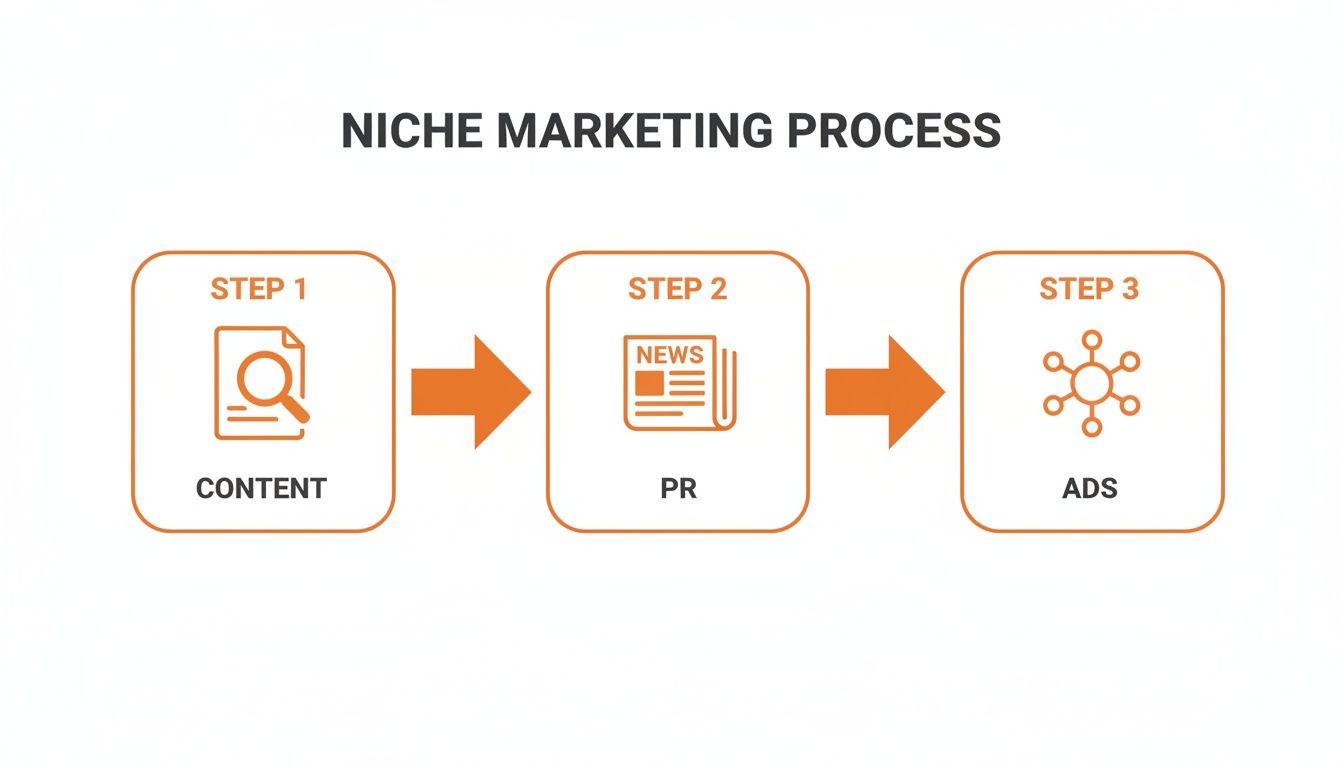
The process is simple but effective: create solid, foundational content, amplify it through digital PR to build trust, and then pour fuel on the fire with highly targeted ads.
Phase 3: Constant Optimization and Scaling
The final phase never really ends. It’s a continuous loop of optimizing and scaling. You take the data from your live campaigns and use it to constantly refine your tactics. This means A/B testing your ad creative, tweaking landing pages to improve conversion rates, and expanding your content to capture even more organic traffic.
Case Study Snapshot: Compliant CBD Growth
We worked with a CBD brand that was hamstrung by strict advertising regulations. After going through Phase 1 (Audit) and Phase 2 (Integrated Strategy), we found a huge opportunity in educational content. We built an SEO-driven blog answering common customer questions, which started ranking at the top of Google and built massive trust. We then retargeted this organic traffic on compliant ad networks, leading to a 300% increase in sales within six months.
At Juiced Digital, this isn't just theory—it's how we operate. We blend this phased approach with AI-powered insights to focus relentlessly on your ROI. Our integrated strategies in SEO, paid media, and CRO are designed to build a growth plan that lasts. A complimentary audit from our team can be the first step in uncovering your greatest opportunities.
Frequently Asked Questions
It’s easy to feel like you're navigating a maze when you're deep in the world of ecommerce digital marketing. New questions always seem to pop up just as you start to grow. We've put together some clear, straightforward answers to the most common queries we hear, helping you cut through the noise and make smarter decisions for your online store.
What’s the Difference Between Ecommerce Marketing and Digital Marketing?
Think of digital marketing as the entire toolbox. It covers every online marketing effort imaginable, whether you're promoting a local service or a massive software company.
Ecommerce marketing, on the other hand, is like grabbing a specific set of tools from that box for one job and one job only: driving sales for an online store. It uses the same channels—SEO, paid ads, email—but everything is viewed through a commercial lens. Every single tactic is judged by its direct impact on revenue, average order value, and customer lifetime value. It's an incredibly performance-driven field.
How Much Should an Ecommerce Business Spend on Marketing?
There’s no one-size-fits-all answer here, but a good rule of thumb for a growing ecommerce brand is to set aside 10-20% of total revenue for your marketing budget. Of course, that number can swing quite a bit depending on your situation.
- Business Stage: If you’re a new store trying to make a splash in a crowded market, you might need to push that budget higher, maybe to 20-30%, just to get noticed.
- Industry Margins: Companies with healthier profit margins simply have more fuel to invest in acquiring new customers.
- Growth Goals: A brand with its sights set on explosive growth will naturally need a much bigger marketing spend than one aiming for slow and steady progress.
Ultimately, the most critical metric to watch is your Return on Ad Spend (ROAS). As long as your ROAS is healthy, you know your budget is pulling its weight, no matter how big or small it is.
Which Marketing Channel Is Most Important for Ecommerce?
This is the million-dollar question, but the truth is, no single channel is the "most important." The brands that truly win at ecommerce don't rely on a silver bullet; they build a connected system where every channel has a crucial role to play.
An effective ecommerce digital marketing strategy isn't about finding one perfect channel. It's about creating a flywheel where SEO brings in steady organic traffic, paid ads capture high-intent buyers, and email marketing turns those buyers into repeat customers. They all work together.
Picture this: a customer sees your brand for the first time in an Instagram ad (paid social). A week later, they search for reviews on Google and find your blog (SEO). They add a product to their cart but get distracted. The next day, an abandoned cart email reminds them to complete the purchase (email). It took three different channels working in harmony to secure that one sale.
At Juiced Digital, our entire focus is on building these integrated, ROI-driven strategies to make sure every part of your marketing engine is firing on all cylinders. Find out how our AI-powered approach can scale your business by visiting us at https://juiceddigital.com.