

At its core, digital marketing for healthcare is all about using online tools to connect with patients where they are already looking for answers. It’s about building a trustworthy digital presence that helps people find you, from their first panicked symptom search to the moment they book an appointment. We’re talking about things like search engine optimization (SEO), creating genuinely helpful content, and managing your online reputation.
Why Your Practice Needs Digital Marketing Now

The days of relying solely on community flyers and word-of-mouth referrals to fill your waiting room are long gone. Today, the patient journey starts long before anyone steps into your clinic—it begins with a late-night search on a smartphone.
Think about it. Someone in Vancouver is up late, worried about a persistent cough. Their first move isn’t calling a friend for a recommendation; it’s typing “persistent cough symptoms” into Google.
That simple search kicks off a whole series of digital touchpoints. They’ll read blog posts, browse clinic websites, and scan patient reviews on Google Maps. This new reality means your practice’s visibility and credibility are almost entirely decided online. A smart digital marketing strategy makes sure you’re not just present, but trusted, at every one of these crucial steps.
The Modern Patient Is an Empowered Researcher
We’ve moved past the era where patients were passive recipients of care. Today, they’re active participants, armed with a mountain of information and countless options. This isn’t just a fleeting trend; it’s a profound shift in how people approach their health, especially across digitally connected provinces like British Columbia and Ontario.
The numbers back this up. According to Canada Health Infoway, by 2021, a staggering 76% of Canadians were already turning to the internet for health information. More recent studies show that 59% of Canadians research their symptoms or look for providers online before deciding where to go, and 41% say online reviews directly swayed their choice of clinic. You can dive deeper into these healthcare marketing statistics to see just how ingrained this behaviour has become.
The way patients find and choose care has fundamentally changed. The table below breaks down this evolution from traditional methods to the digital-first approach that defines today’s healthcare landscape.
The Shift in Patient Behaviour From Offline to Online
| Patient Action | Traditional Method | Modern Digital Approach |
|---|---|---|
| Finding a Provider | Relying on family/friend referrals or phone book listings. | Searching “doctor near me” on Google; checking online directories. |
| Evaluating Trust | Word-of-mouth reputation in the local community. | Reading patient reviews on Google, RateMDs, and other platforms. |
| Getting Information | Calling the clinic; waiting for brochures or pamphlets. | Visiting the clinic’s website for services, hours, and provider bios. |
| Booking an Appointment | A phone call during business hours. | Using an online booking system on the website, available 24/7. |
This comparison makes it clear: the patient journey has migrated online, creating new opportunities for practices that are ready to meet them there.
An online presence is no longer just a digital brochure for your practice. It is the primary vehicle for building trust, demonstrating expertise, and making meaningful connections with the community you aim to serve.
From Waiting Rooms to Web Pages
This digital-first mindset affects every kind of healthcare provider, from dentists and physiotherapists to highly specialized medical clinics. Your website, your Google Business Profile, and your social media channels have become the new front doors to your practice. They are the first impression and, for many potential patients, the deciding factor.
If you aren’t investing in a solid online presence, you are essentially invisible to a massive part of the population that is actively looking for care. It’s like having a beautiful, state-of-the-art clinic hidden down a laneway with no signs. You could offer the best care in the city, but if patients can’t find you online, they’ll book with the competitor who shows up on the first page of their search results.
The rest of this guide is designed to give you the practical strategies you need to make sure your practice not only gets found but thrives in this new environment.
Building a Practice on Trust and Privacy
Before you even think about running an ad or publishing your first blog post, we need to talk about the foundation of everything you’ll do online: trust. In healthcare marketing, trust isn’t just a warm, fuzzy feeling. It’s a non-negotiable legal and ethical requirement, cemented by serious privacy laws.
Think of handling patient data like a pharmacist handles a prescription. It demands absolute precision, security, and confidentiality. One slip-up doesn’t just damage your reputation; it can have massive legal and financial consequences. Getting these rules right isn’t about box-ticking to avoid fines—it’s about fundamentally showing your patients you value their privacy as much as you value their health.
This commitment has to be visible everywhere, from the contact form on your website to the emails you send out. It’s the bedrock. Without it, the rest of your marketing efforts will eventually crumble.
Navigating Canadian Privacy Laws
In Canada, the big one is the Personal Information Protection and Electronic Documents Act (PIPEDA). This is the main federal law that dictates how you collect, use, and share personal information. For any healthcare provider, this is your rulebook.
At its heart, PIPEDA is all about consent. You can’t just take someone’s information. You have to clearly explain why you’re collecting it and how you’ll use it, and then get their explicit permission. This applies to everything, whether it’s a simple newsletter signup or a detailed patient intake form.
Here’s a simple way to look at it: you’d never perform a medical procedure without informed consent. Your patients’ data deserves the exact same standard of care.
Patient trust is earned in drops and lost in buckets. A transparent, privacy-first approach to digital marketing ensures you are continuously earning that trust with every click, form submission, and email opened.
A Practical Checklist for Digital Compliance
It’s one thing to understand the law; it’s another to put it into practice on your website. This can feel a bit overwhelming, but if you focus on a few key areas, you can make sure your digital front door is both welcoming and secure.
Here’s a straightforward checklist to get you started:
- Lock Down Your Data Transmission: Any and all data submitted through your website—especially through contact or intake forms—must be encrypted. You do this by installing an SSL certificate, which turns your site’s address from
HTTPtoHTTPS(look for the little padlock). This isn’t optional; it’s a baseline requirement. - Write a Clear Privacy Policy: Your website needs a privacy policy that’s easy to find and, more importantly, easy to understand. It should spell out what info you collect, why you need it, how you store it, and who can see it. Ditch the dense legal jargon. Write it for a patient, not a lawyer.
- Get Explicit Consent on Every Form: Every single form on your site needs a checkbox for consent. This goes for appointment requests, contact forms, newsletter signups—everything. The text needs to be crystal clear, something like, “I consent to [Your Clinic’s Name] collecting my information to contact me about my inquiry.” And remember, pre-checked boxes don’t count.
- Use Prominent Disclaimers: If you’re sharing health information in blogs, articles, or videos, you must include a clear disclaimer. Make it obvious that your content is for informational purposes only and isn’t a substitute for professional medical advice.
Beyond Privacy: Accessibility Matters, Too
Building trust also means making sure everyone can access your digital resources. This is where accessibility comes in. Just like your physical clinic needs a wheelchair ramp, your website needs to be built for people with disabilities, including those who use screen readers or other assistive tools.
This means doing things like using proper heading structures in your text, adding descriptive alt-text to your images, and ensuring the entire site works with just a keyboard. It’s not just a technical task; it’s a powerful signal that you’re committed to inclusive care for all patients.
For a deeper dive, you can learn more about understanding ADA compliance for websites and apply similar principles to meet Canadian standards. It’s a crucial piece of creating a truly patient-first digital experience.
Winning the Local Search for Patients
For most healthcare practices, winning at digital marketing doesn’t mean conquering the entire internet. It means winning on a specific street or in a particular neighbourhood. When someone in your area searches for “chiropractor near me” or “dentist in Vancouver,” they’re not just browsing—they’re looking for immediate care. Your goal is to be the first and most trusted name they see.
This is where local search engine optimization (SEO) comes in. Think of it as the digital version of having the best-located, most visible clinic on the busiest street in town. It’s all about making sure that when local patients are actively looking for your services, your practice shows up right at the top of the search results, especially in that all-important Google Map Pack.
Getting there isn’t about some massive, complex global strategy. It’s about a tight, focused approach on your immediate service area and building a rock-solid digital reputation that speaks directly to your local community.
Your Most Powerful Local SEO Tool
At the heart of any smart local SEO strategy is your Google Business Profile (GBP). This free listing is your digital storefront on Google, and it’s often the very first impression a potential patient has of your practice. An incomplete or neglected profile is like a sign with missing letters—it just doesn’t inspire confidence.
A well-tended profile, on the other hand, is a patient-acquisition machine. It gives people the critical information they need at a glance and starts building trust long before they even click through to your website.
A well-managed Google Business Profile does more than just list your hours. It validates your expertise, showcases patient trust through reviews, and provides a direct, frictionless path for new patients to find and book appointments with your clinic.
To turn your GBP into a true patient magnet, you need to nail these key areas:
- Complete and Accurate Information: Make sure your clinic’s name, address, and phone number (NAP) are perfectly consistent across the entire web. Even a small discrepancy can confuse both search engines and potential patients.
- Select the Right Categories: Get specific. Don’t just settle for “Medical Clinic.” Choose “Family Practice Physician” or “Paediatrician” to make sure you’re attracting the right kind of searches.
- Upload High-Quality Photos: Show, don’t just tell. Post clear, professional photos of your clinic’s exterior and interior, your friendly staff, and any specialized equipment. This helps put new patients at ease and makes your practice feel more real and approachable.
For a deeper dive, check out our detailed guide with more tips on optimizing your Google My Business profile. Honestly, mastering this one platform can make a huge difference in your local visibility.
This infographic outlines the foundational principles of building patient trust online, starting with secure data, gaining consent, and providing clear disclaimers.
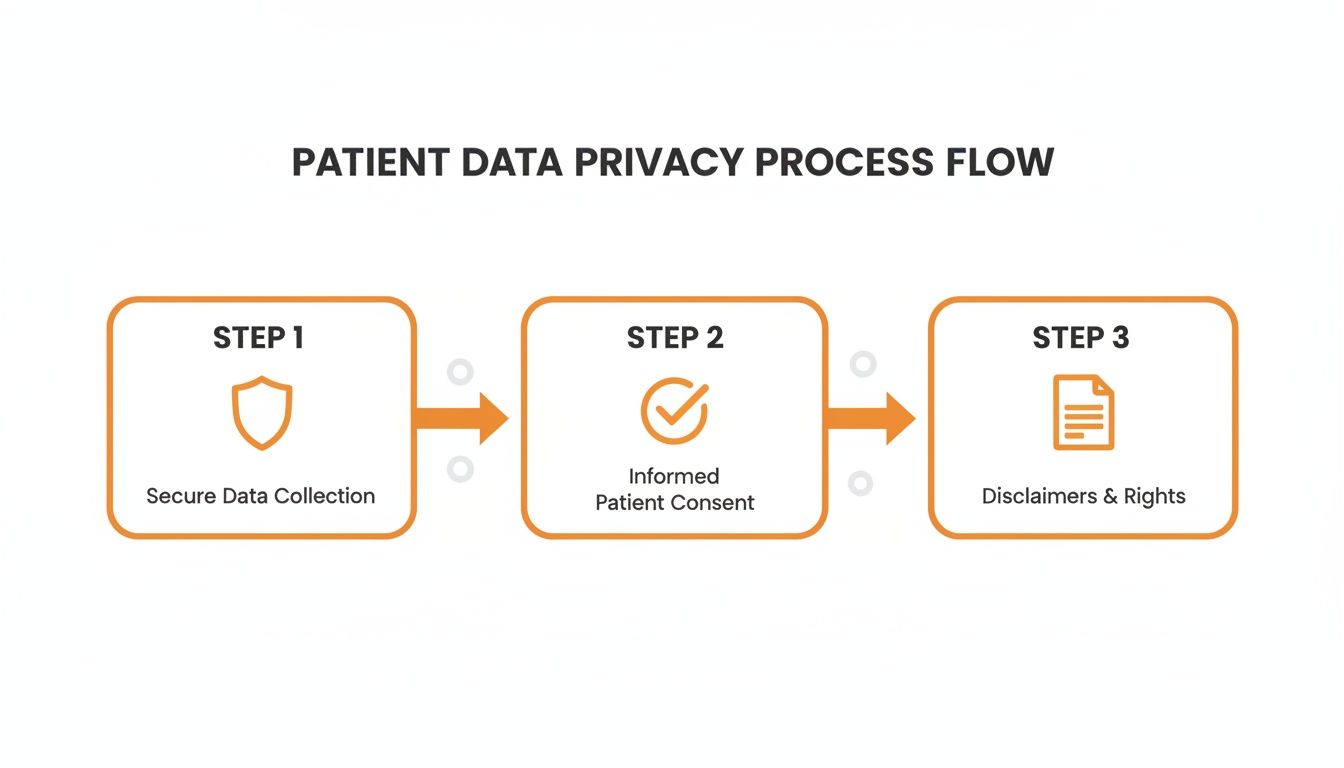
These steps are not only crucial for legal compliance but also for building the credibility you need to earn those glowing local reviews and foster lasting patient loyalty.
Targeting Hyper-Local Keywords
Beyond your GBP, the content on your website has to clearly signal to Google that you are the go-to authority for your services in your specific location. You do this by targeting hyper-local keywords. These are simply search terms that include a neighbourhood, city, or other geographic detail, which makes the searcher’s intent crystal clear.
For example, instead of just targeting “physiotherapy,” a clinic in a Vancouver neighbourhood should be targeting phrases like:
- “Physiotherapy in Kitsilano”
- “Sports injury clinic near UBC”
- “Best physiotherapist Vancouver west side”
When you weave these location-specific terms naturally into your website’s service pages, blog posts, and provider bios, you’re sending a direct message to Google about who and where you serve. This drastically improves your chances of showing up for those valuable “near me” searches.
Building a Stellar Online Reputation
Finally, your local SEO success is heavily tied to your online reputation, which is built almost entirely on patient reviews. A steady stream of recent, positive reviews is one of the most powerful signals you can send to both Google and potential patients that your practice is trustworthy and provides exceptional care.
You need a simple, ethical process to encourage satisfied patients to leave feedback. Make it easy for them. A follow-up email after their appointment with a direct link to your Google Business Profile review section works wonders.
Even more important: respond to every single review, good or bad. A thoughtful thank you on a positive review shows you appreciate your patients. A professional, empathetic response to a negative one shows your commitment to patient satisfaction and can often defuse a situation before it gets worse. This kind of public engagement builds incredible social proof and can easily be the deciding factor that convinces a new patient to choose you over a competitor.
Creating Content That Cares and Converts

In healthcare, your content has a much bigger job to do than just sell. People aren’t shopping for a product; they’re searching for answers to deeply personal, often stressful, health questions. Your content strategy is your first real chance to offer them clarity and relief.
This is where you build a relationship founded on empathy and expertise, long before someone even thinks about booking an appointment.
The secret is to shift your mindset from promotion to education. Stop creating content about why your clinic is the best and start creating content that genuinely helps people understand what’s going on with their health. This patient-first approach isn’t just good ethics—it’s incredibly effective for long-term growth.
When you consistently provide real value with no strings attached, you become more than a local clinic. You become a trusted resource, the first name that comes to mind when they, or someone they love, needs care.
Mastering the E-E-A-T Framework
Creating high-quality content is important for any business. For a healthcare provider, it’s absolutely non-negotiable. Google holds health-related content to a much higher standard, running it through a rigorous filter known as E-E-A-T: Experience, Expertise, Authoritativeness, and Trustworthiness.
Think of E-E-A-T as Google’s credibility checklist. Because your content can impact someone’s life and well-being, the bar is set incredibly high. Falling short doesn’t just hurt your search rankings; it means you’re not meeting the standard of care your patients deserve.
In healthcare, your content is a direct reflection of your standard of care. E-E-A-T isn’t just an SEO guideline; it’s a digital extension of your commitment to patient well-being, ensuring every piece of information you share is safe, accurate, and genuinely helpful.
Here’s a quick look at what this means for your practice:
- Experience: Show that your content comes from someone with real-world, firsthand experience. This could be a doctor sharing insights from years of treating a specific condition, or a patient testimonial (with full consent) describing their journey.
- Expertise: Your content must be written or, at the very least, reviewed by a qualified medical expert. You need to clearly display author credentials, link to their professional profiles, and ensure every claim is medically sound.
- Authoritativeness: This is all about your reputation in the wider medical community. Are other respected medical sites linking to your content? Do you have strong local reviews? This signals to Google that others see you as a leader.
- Trustworthiness: Can people trust your website? This comes down to the basics: a secure (HTTPS) site, a clear and accessible privacy policy, and transparent contact information. It’s about making your digital front door feel safe.
Content Ideas That Build Trust
So, what does E-E-A-T-aligned content actually look like? It’s about taking complex medical information and turning it into clear, accessible, and reassuring resources that ease a potential patient’s mind.
Great content doesn’t just inform; it reduces anxiety and empowers people to take the next step in their health journey.
Here are a few practical ideas that put your patients’ needs first:
- Symptom and Condition Explainers: Write detailed but easy-to-follow blog posts about the common conditions you treat. Use simple language, helpful analogies, and clear headings to explain symptoms, causes, and treatment options. This is a core part of great SEO copywriting, with more tips available here.
- Procedure Walkthroughs: Demystify a common procedure with a step-by-step guide or a short video. Simply explaining what a patient can expect before, during, and after their visit can dramatically reduce their fear of the unknown.
- “Meet the Team” Videos: Let people meet your practitioners through short, personable videos. Hearing a doctor talk about their philosophy of care builds an immediate human connection and makes your practice feel far more approachable.
- Virtual Clinic Tours: You’d be surprised how much a simple video tour of your office can help an anxious new patient. Showing the waiting area, treatment rooms, and the friendly faces at the front desk makes that first visit feel familiar before they even arrive.
By focusing your content on genuinely serving your audience, you do more than just attract website traffic. You build a foundation of trust that turns anxious searchers into confident, loyal patients.
Growing Beyond Your Clinic Walls
Digital marketing used to be about one thing: filling your local waiting room. But today, it’s about expanding the very idea of what your practice can be. For healthcare providers, real growth now means reaching patients both down the street and across the province, blending in-person care with the incredible reach of virtual services.
Getting this right requires a smart, two-pronged strategy. Think of it like having two different fishing nets—one for the local pond, and another for the entire lake. The first net uses targeted ads to capture nearby patients looking for immediate, physical care. The second uses broader, content-led campaigns to attract telehealth clients who might be hundreds of kilometres away.
When you get paid advertising, landing page optimization, and telehealth services all working in harmony, something powerful happens. You create two parallel streams for acquiring patients, allowing you to scale your impact and your revenue far beyond your clinic’s four walls.
Attracting Local Patients with Performance Marketing
For your in-person services, performance marketing is your most direct and powerful tool. This is your local fishing net, designed specifically to catch patients who are actively searching for care in your neighbourhood right now. The goal is immediate action.
Paid advertising platforms like Google Ads are perfect for this. You can launch incredibly specific campaigns that only appear to people searching within a few kilometres of your clinic. So, when someone searches “physiotherapist in downtown Vancouver,” your ad pops up at the top. They click, land on a page focused on booking an in-person appointment, and you’ve got a new patient.
This approach is all about precision and efficiency. You only pay when someone shows genuine interest by clicking your ad, making it a surprisingly cost-effective way to drive qualified foot traffic straight to your door.
Reaching Provincial Patients Through Telehealth
While local ads secure your home base, telehealth is what unlocks provincial-level growth. The explosion of virtual care in Canada has made digital marketing a game-changer for clinics and regulated wellness brands, especially in provinces like British Columbia.
The global telehealth market is on a trajectory to hit an incredible US$286.22 billion by 2030, and Canadian adoption is a huge part of that story. Even after the pandemic, virtual visits in provinces like BC and Ontario have stayed high, often making up 25–35% of all physician services. You can get a deeper look at these key healthcare marketing predictions and see how they’re shaping the future.
But your telehealth strategy can’t just be a copy-paste of your local one. It’s less about “near me” searches and more about solving specific health problems that can be managed from a distance. This is where content-driven campaigns truly shine.
Your telehealth marketing should focus on solving problems, not just promoting a service. Create content that answers specific questions a remote patient might have, positioning your virtual care as the ideal solution.
Instead of an ad targeting a single city, you could run a campaign across all of British Columbia, built around a blog post like “Managing Chronic Migraines from Home.” The call-to-action wouldn’t be “visit our clinic,” but a link to a dedicated landing page that clearly explains your virtual consultation process.
This brings us to a critical point: you need high-converting landing pages built specifically for virtual care. These pages have to do three things exceptionally well:
- Clearly Explain the Process: Break down exactly how a virtual appointment works, what tech is needed, and what the patient should expect. No confusion.
- Build Trust from a Distance: You don’t have a physical handshake to build rapport. Use practitioner bios, intro videos, and patient testimonials to create that connection and credibility.
- Provide a Frictionless Booking Experience: Your online booking system has to be dead simple to use, and it must clearly distinguish between in-person and virtual appointment types.
By running a hyperlocal ad strategy in tandem with a broader, content-focused telehealth campaign, you build a formidable growth engine. You solidify your presence in the local market while simultaneously scaling your practice to serve an exponentially larger patient base. The result? A consistently full appointment book, both in your physical clinic and your virtual one.
Your Healthcare Marketing Questions, Answered
Jumping into digital marketing for your practice can feel overwhelming. You’re dealing with tight budgets, navigating a minefield of privacy laws, and feeling the pressure to see a real return on your efforts. It’s only natural to have a few questions.
This section cuts through the noise and gives you direct, practical answers to the most common hurdles we see healthcare providers face. Think of it as a quick-reference guide to help you move forward with confidence, tackling the tough topics from budgeting to social media compliance.
How Much Should I Actually Budget for Digital Marketing?
There’s no magic number that fits everyone, but a solid benchmark for a local practice in a competitive Canadian market is somewhere between 7% and 12% of your gross revenue. The key is to stop thinking of this as an expense and start seeing it as an investment in patient acquisition and the long-term health of your business.
A smart budget isn’t just one lump sum; it’s broken down into key pillars that work together:
- Search Engine Optimization (SEO): This is your long game. It’s all about building organic visibility and earning trust with both search engines and potential patients over time.
- Paid Advertising (PPC): This is your short game. It’s for immediate lead generation, putting your practice directly in front of people actively searching for care right now.
- Content Creation: This is the fuel for your SEO fire. We’re talking about blog posts, videos, and patient resources that prove your expertise and draw people in.
If you’re a brand-new practice, you’ll likely need to invest at the higher end of that range to build some initial momentum. But the most important thing, bar none, is to meticulously track your Return on Investment (ROI). For example, if you spend $2,500 a month and that brings in 12 new patients with an average lifetime value of $1,800 each, the investment more than pays for itself. Start with a modest, measurable budget, and once you see what works, you can scale up with confidence.
Can I Use Social Media Without Breaching Patient Privacy?
Absolutely, but it demands a strict, privacy-first approach from day one. The golden rule is non-negotiable: never, ever share anything that could be considered Protected Health Information (PHI). Even a post that seems completely innocent on the surface could inadvertently reveal something about a patient.
Your social media strategy should be focused on building your brand and connecting with your community, not on providing clinical advice. It’s a fantastic tool for sharing general health education, introducing your amazing staff (always with their explicit consent!), posting clinic updates, and showing off what makes your practice special.
Think of your social media profiles as a welcoming public lobby, not a private examination room. The conversations you have there should be general, informative, and open to everyone, never touching on specific patient situations.
To keep your practice and your patients safe, put these safeguards in place:
- Create a Clear Social Media Policy: Make sure every single person on your staff knows the do’s and don’ts of posting.
- Disable or Monitor Direct Messages: Private DMs can quickly become a place where patients start sharing sensitive information. It’s often much safer to direct all inquiries to a secure contact form on your website.
- Never Engage in Clinical Discussions Publicly: If a patient asks a specific health question in a comment, your only response should be to guide them to a private, secure channel—like a phone call or your patient portal.
What Are the Most Important Metrics to Track?
It’s incredibly easy to get lost in a sea of data. Vanity metrics like “likes” or “impressions” might give you a temporary ego boost, but they don’t help grow your practice. To truly understand if your digital marketing is working, you have to focus on the numbers that connect directly to your bottom line.
These are the Key Performance Indicators (KPIs) that actually matter:
- New Patient Appointments Booked: This is the ultimate goal. Whether you track it through online booking forms, call tracking, or contact form submissions, this is the clearest possible measure of success.
- Cost Per Acquisition (CPA): How much are you spending in marketing dollars to get one new patient through the door? A low CPA is the hallmark of an efficient, profitable marketing machine.
- Website Conversion Rate: What percentage of people visiting your website actually take the action you want them to? That could be booking an appointment, calling the clinic, or downloading a patient guide. A higher rate means your site is doing its job.
- Organic Search Rankings for Key Terms: Are you showing up on the first page of Google for searches like “dentist in [your city]”? Your ranking is a powerful leading indicator of your future patient flow from organic search.
- Google Business Profile Engagement: This is a goldmine for local patient intent. Track how many people click to call, ask for directions, or click through to your website from your GBP listing. These are often people who are ready to book.
By zeroing in on these five core metrics, you can cut through the noise and get a clear, accurate picture of how your digital marketing is driving real-world growth for your practice.
Ready to turn these insights into a powerful growth strategy for your practice? The team at Juiced Digital designs tailored digital marketing plans that drive measurable results for healthcare providers. Book your free consultation today and discover how we can help you connect with more patients.