

Three quotes sit in your inbox for the same one-location plumbing company in Burnaby. One is $450 a month, one is $1,900, and one is a $6,000 setup fee with a promise of page-one rankings within 30 days. All three are called local SEO packages. None of them names what should be in your calendar by the end of month three.
That's the problem with how this service gets sold. Providers price the work, not the outcome, then hand you a report full of impressions and average position. Meanwhile the phone rings less than you hoped, and nobody can tell you whether the package failed or the leads went unanswered.
I judge a package by one thing: the leads and bookings it can prove. Component counts are marketing. A package with nine deliverables that produces four booked jobs is worse than a smaller package that produces twelve.
What follows is how to read a scope like a practitioner, where the money goes, and which questions separate a real program from a template with your logo on it.
What a Local SEO Package Includes at a Glance
A local SEO package should spell out which work will bring in more qualified calls, enquiries, and bookings. The label alone tells you little: two providers can call very different scopes a “local SEO package,” even when both charge a monthly retainer or project fee.
The table lists eight common components, the work each covers, the deliverable to request, and the businesses that are most likely to need it. Use it to identify gaps, then judge the scope by whether it can connect work to leads.
| Component | What it covers | Typical deliverable | Who needs it most |
|---|---|---|---|
| Google Business Profile management | Categories, services, hours, photos and posts | Complete listing overhaul, then monthly updates | Every local business |
| Citations and NAP consistency | Matching name, address and phone details across directories | Audit and corrections across core directories | Multi-location and relocated firms |
| Location and service-area pages | Pages for cities or neighbourhoods the business genuinely serves | Useful, distinct pages with relevant local details | Businesses serving several areas |
| Map pack optimization | Structured data, geotagged content and local backlinks | Map visibility report by grid or ZIP code | Service businesses competing in map results |
| Review management | Review requests, responses and quality monitoring | Response workflow and monthly review summary | Clinics, contractors and restaurants |
| Technical local audit | Mobile speed, indexing and structured data | Prioritised fix list with owners | Sites with slow or thin pages |
| Conversion tracking and reporting | Calls, direction requests and form submissions | Report linking enquiries to city, device and landing page | Any business paying for leads |
| AI search visibility check | Accuracy of business details in AI-generated answers | Accuracy audit and monitoring notes | Regulated and multi-service businesses |
Where the money actually lands
For a single-location business, start with an accurate Google Business Profile and consistent business information across directories. These basics help customers find the right hours, services and contact details. They also give a provider a clear starting point for tracking enquiries.
Add location pages and map pack work when the business serves multiple areas and can handle enquiries from them. Pages for neighbourhoods without distinct service information add cost without giving customers a useful reason to call.
Reviews and conversion tracking show whether visibility is turning into action. A review workflow should include a response process; reporting should connect calls and forms to their source, not stop at rankings. Technical audits help identify site issues that could block or frustrate enquiries. An AI search visibility check can sit later in the scope, after the business details and core pages are accurate.
Most California businesses are small operators. Many need their profile, directory listings and review process in order before investing in a regional content program.
Practical rule: Ask which deliverables the provider will scale back after month three, and what evidence will guide that decision. If the answer is only a fixed list of tasks, the scope is not tied to results.
Start by listing what is already in place and where leads are being lost. Prioritise accurate profiles, consistent citations and call tracking. Add location pages when they reflect real service areas, and retain any other component only when it supports measurable enquiries or bookings.
How Local Visibility Works Inside a Package

A service business can rank in the map pack and still lose the enquiry. Local visibility earns its keep when the right customers can find the business, understand what it offers, and call or book without friction.
Map results are shaped by relevance, distance and prominence. Accurate categories, services and profile descriptions strengthen relevance. Distance limits how far a business can reasonably compete, so location pages should describe genuine service areas rather than list every nearby municipality. Prominence grows through consistent citations, detailed reviews and mentions from local partners or associations.
The phone experience often decides who gets the call. Urgent local searches commonly happen on phones, where slow pages can send potential customers elsewhere. A useful package checks page speed, compresses images and makes tap-to-call, directions and booking actions easy to find. Map embeds should also load properly.
For a closer look at how local search rankings are built, examine the factors behind map visibility and organic results.
- Profile accuracy: Categories, hours and services match what the business currently offers.
- Service-area wording: Every named area is one the business serves.
- Phone-first actions: Call, directions and booking buttons are easy to find on a phone.
Package Tiers and What Each One Typically Costs
Start with a reference point. Ahrefs put the average monthly local SEO fee at US$1,557 in 2024 from a survey of SEO providers, as reported in this Canadian SEO cost breakdown. That number comes from providers rather than a Canada-specific sample, so treat it as a broad benchmark and nothing more.
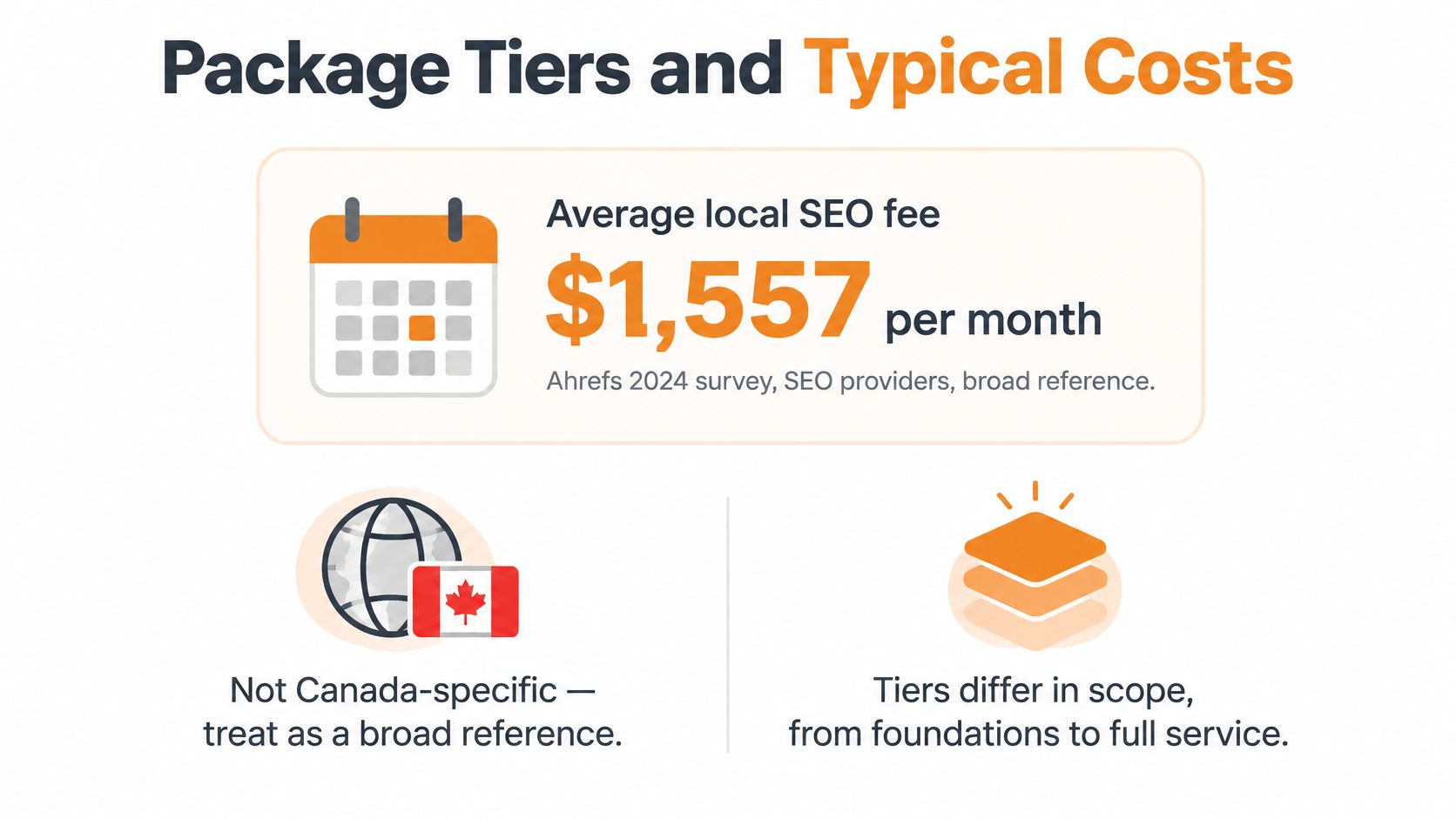
Three tiers cover most of the market. The difference between them isn't the component list, it's the number of locations and service areas the work has to carry.
| Tier | Components included | Typical buyer | Monthly budget benchmark |
|---|---|---|---|
| Foundation | Google Business Profile, citations, review workflow, basic monthly report | Single-location service business testing local SEO | Written quote, lowest of the three; no published benchmark |
| Growth | Foundation plus location pages, map pack work and technical audit | Service business covering several areas | Broad average near US$1,557 (Ahrefs 2024 survey, not Canada-specific) |
| Multi-location or regional | Growth plus per-location profiles, AI visibility checks and lead tracking by site | Chains and clinics with several sites | Written quote that scales per site; no published benchmark |
What pushes a price up inside the same tier
Four things move the number: location count, service-area count, content volume (how many new pages per month) and the depth of the technical audit. Reporting detail and contract length do the rest. A single-location contractor and a three-clinic group can both buy "growth" and pay very differently for it.
Know what you're comparing. One proposal covers a profile review and a spreadsheet. Another builds location pages, fixes indexing problems and installs call tracking. Asking for a named deliverable list with frequency and dependencies on your side, such as who supplies photos and approvals, exposes the difference faster than any price discussion.
Setup work is usually billed separately from monthly management, and SEO generally takes three to six months to produce the results you're paying for. A very cheap package on a three-month term rarely survives long enough to show measurable movement, so you end up judging it on vibes.
Ask before you compare quotes: What's the setup fee? How many locations and service areas are priced in? What happens in month four when you have nothing new to build?
Settle those three questions first, then compare written quotes for identical scope. No published benchmark exists for the foundation or multi-location tiers, so a single headline number tells you almost nothing about value.
Measuring Results Beyond Google Rankings
Ranking first near your own address proves very little. It's the easiest number for a provider to produce and the easiest to game with a rank tracker pointed at a single location. It says nothing about lead quality, answer rates or whether the enquiry fits your service area.
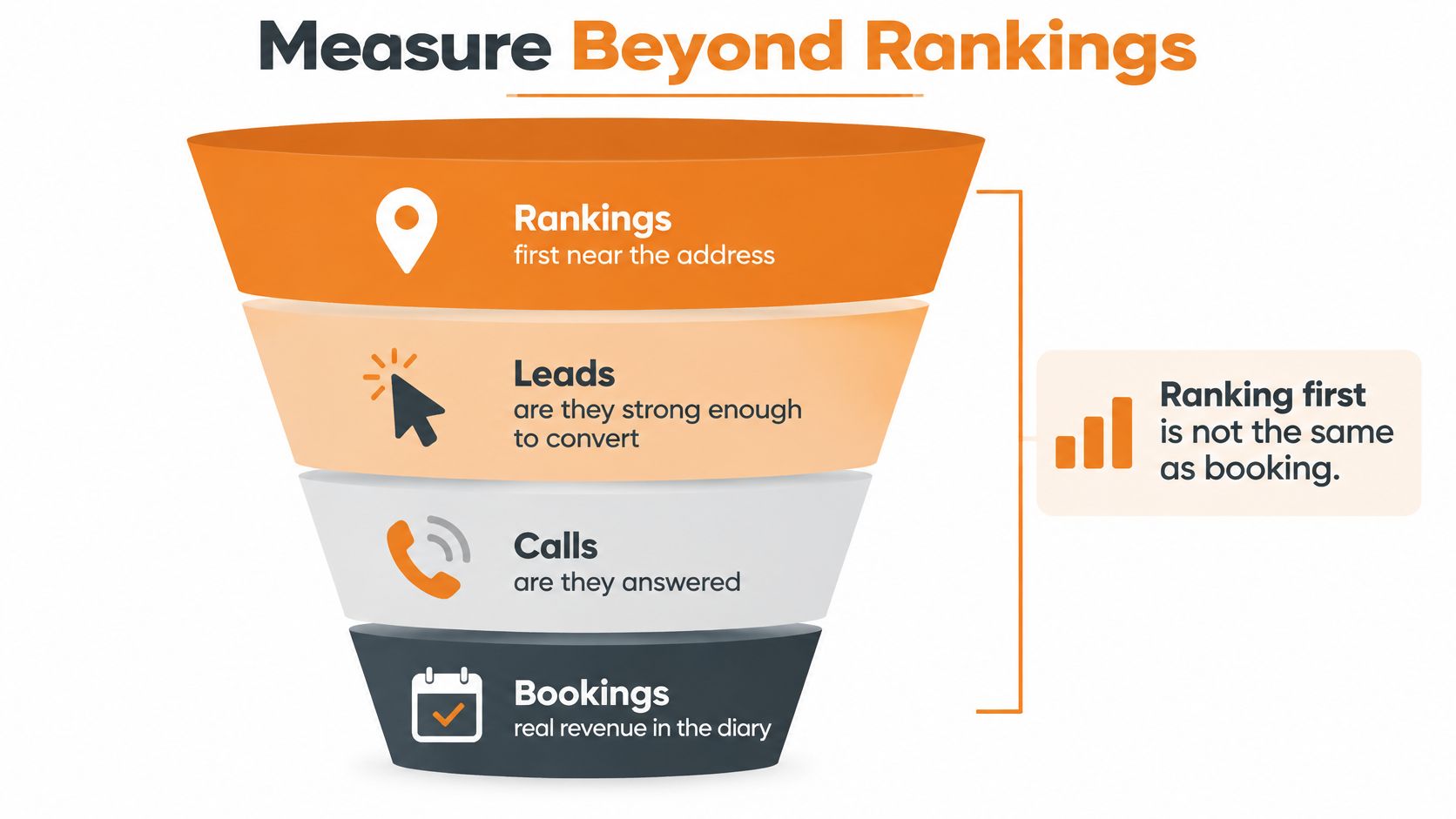
The framework should change with the business type. Home services live on calls and form submissions. Clinics need booked consultations. Retail tracks direction requests and in-store visits. B2B firms want qualified enquiries with a pipeline value attached. One report template across all four is how agencies hide weak results.
Online discovery isn't the bottleneck for most buyers. The Business Development Bank of Canada's marketing channel research reports that 89% of Canadians use digital channels to discover new brands, while Canadian businesses still lean almost equally on digital and traditional channels when finding suppliers, at 74% versus 73%. Visibility is table stakes. Proving it produced revenue is the job.
Say a Langley roofing company's call volume jumps 30% in a quarter. The provider celebrates. Then the owner checks and half the calls come from outside the service area, mostly renters asking about repairs the company doesn't do. The fix isn't more rankings. It's tighter service-area wording on location pages, a qualifying question in the form, and call tracking that tags area and job type.
The four-line report to demand
Every monthly report should answer these four lines, in this order. Anything else is optional.
- Leads by location: calls, forms and direction requests, split by city or service area.
- Qualified versus junk: how many turned into a real conversation or appointment.
- Conversion rate by service: which services your landing pages turn into enquiries.
- Revenue or booked value: the number your accountant would recognise.
Distinguish branded from non-branded searches, and check rank across a grid of ZIP or postal codes rather than one pin on your office. For the reporting mechanics, tracking SEO conversions explains how to reconcile profile actions with CRM outcomes.
Matching Package Scope to Your Business Type
Scope follows structure. A plumber covering four suburbs and a two-site wellness clinic can both be "local," and they need completely different work.

Take the plumber in East Vancouver who serves Kitsilano, Mount Pleasant, Hastings-Sunrise and Burnaby. Foundation scope with a properly built profile, map pack work and call tracking fits, and the measure that matters is booked jobs by neighbourhood. Add location pages only where the van goes. Duplicate listings across neighbouring towns are the classic failure here, usually left behind by a previous agency that never removed an old address.
Now the wellness clinic with two sites. It needs growth scope: service pages for each treatment, a review workflow that captures specific outcomes, and booked consultations tracked per location. The extra risk is claim accuracy, because an AI-generated summary that invents a certification or overstates a treatment's effect creates both lost bookings and a compliance problem.
Why the AI line item is now real
Generative AI has moved from curiosity to habit for a lot of buyers. A Canadian Internet Registration Authority survey reported in the Ottawa Business Journal found that 46% of adult Canadian internet users had used generative AI in the previous year, up from 33% in 2025 and 16% in 2024. Among those users, 52% had used AI as a search engine, while only 19% said they verified AI-generated results. Separate Canadian research cited in the same report put generative AI use for a purchase decision at 34% in British Columbia against 39% nationally.
That gap matters. People ask a model for a recommendation, get an answer, and don't check it. A useful deliverable is an accuracy audit of whether models describe your service area, licensing, hours, specialties and contact routes correctly, followed by monitoring for hallucinations and stale details.
| Business type | Recommended scope | Measure first | Pitfall to watch |
|---|---|---|---|
| Home services such as plumbing or roofing | Foundation plus map pack work and call tracking | Calls and booked jobs by service area | Duplicate listings across neighbouring towns |
| Clinics and wellness practitioners | Growth with service pages and a review workflow | Booked consultations by location | Inaccurate AI answers and unverified health claims |
| Retail shops | Foundation plus profile posts and product or inventory pages | Direction requests and in-store visits | Outdated hours and stale photos |
| Multi-location firms | Multi-location scope with per-site reporting | Qualified leads by location | Inconsistent NAP details across sites |
| B2B service firms | Growth with enquiry tracking and CRM link | Qualified enquiries and pipeline value | Low-quality leads from broad keywords |
Hybrid businesses need a note of their own. In California, the U.S. Small Business Administration's state profile recorded 63,953 identified firms exporting goods in 2022, with 60,617 of them, 94.8%, being small businesses. Plenty of small operators combine a local base with wider sales, so their scope needs local trust signals plus the content that supports broader reach.
Pick the row closest to your business, then read the pitfall column before you call anyone.
Questions to Ask a Provider Before You Sign
A package can list plenty of deliverables and still fail to produce qualified leads. Ask every provider these questions in writing, then compare the answers against the calls, bookings, and other outcomes the work is meant to improve.
How do you detect fake and duplicate Google Maps listings? These listings can mislead customers and undermine local visibility. Ask how the provider identifies them, verifies profile ownership, monitors reviews, and handles misleading profiles. Look for specific tasks and responsibilities, not vague promises.
How many local landing pages will you build, and which areas will they cover? Ask what makes each page useful and distinct. A town name swapped into a generic template is not enough. Review a sample page and check for relevant service details, photos, and accurate coverage information.
How do you report visibility across neighborhoods or ZIP codes? A single ranking check from one map location can hide weak areas. Ask which locations the provider tracks and how the reports show where visibility is improving or needs work.
How do you connect calls and direction requests to booked work? A dashboard alone cannot show whether leads are qualified. Ask how reporting will distinguish inquiries from bookings and how often you will review lead quality together.
Who controls the Google Business Profile and other accounts? Your business should retain administrator access. Get written terms covering ownership of listings, reviews, content, and analytics if the agreement ends. During a consultation, Juiced Digital audits the existing website for SEO and marketing funnels to understand what is already in place.
Three red flags: guaranteed first-place rankings, bulk location pages for places you do not serve, and review requests scripted to produce praise instead of honest feedback.
Keep the answers in one document and compare providers against the same questions. For a clearer picture of how a local SEO agency should scope its work, review the deliverables and reporting before you sign. Judge the package by the leads and bookings it can help you track, not by how many items appear in its checklist.
Confirm Your Scope Before You Commit
Four steps, in order.
- Inventory what exists. Profile claims, citation accuracy, review volume, live location pages. Use the component table from earlier and mark each line covered, partial or missing.
- Count locations and service areas. That count, not your budget wish, decides which tier fits.
- Choose two revenue measures and write them into the brief. Booked jobs by area, booked consultations by site, qualified enquiries per month. Two is enough.
- Request a written scope naming every deliverable, the reporting cadence, and who owns listings, analytics and admin access.
A strong starting point is the scope we build most often: a complete Google Business Profile overhaul with proper categories, service descriptions, high-quality images and NAP consistency across directories; SEO-optimized local landing pages focused on the neighbourhoods and key delivery terms in your service area; and map pack work that uses structured data, geotagged content and local backlinks to lift Google Maps visibility.
None of that is exotic. It's the foundation every larger program sits on, and it's the part a cheap package skips.
This week, gather three things: your current listings and logins, a few months of call logs, and a written list of the areas you serve. Compare at least two written scopes against those documents using the checklist above. The proposal that survives that comparison is the one worth signing.
Juiced Digital builds local SEO programs around provable leads rather than component counts, starting with an audit of your existing site, listings and funnels so the scope matches what your business needs. Bring your current listings, call logs and service-area list to a free consultation and we'll test any proposed scope against real numbers before you commit to it. Book that audit at Juiced Digital.
