

Most advice about buying ecommerce SEO starts with the monthly fee, then asks whether the agency will guarantee first-page rankings. Both measures are close to useless. Two proposals at the same price can buy wildly different amounts of work, and a ranking guarantee describes what a page shows on the day the vendor takes a screenshot, not what a shopper did next.
The weak work hides in the deliverables list, never in the invoice. One $4,000-a-month proposal covers 60 product pages, a category rebuild and province-level reporting. Another, at the same fee, covers four blog posts and a PDF, with the same confident wording in the cover email.
So I judge a package by two things: the revenue it can move per organic visit, and the scope it commits to in writing. Fee and promises come a distant third.
Ecommerce SEO Package Tiers at a Glance
Four tiers cover almost every ecommerce website SEO package you'll see quoted in the Canadian market. Each one offers a clear starting point before you read a page of theory.
| Tier | Typical scope | Minimum term | Time to visible results |
|---|---|---|---|
| Audit and roadmap ($2,000 to $5,000 one-time) | Technical and on-page audit, prioritized fix list, keyword map | Project only | Roadmap in 2 to 4 weeks |
| Foundation ($1,500 to $3,000 per month) | Technical fixes, on-page work for top 50 to 100 SKUs and core categories, monthly reporting | 3 to 6 months | 3 to 6 months |
| Growth ($3,000 to $7,000 per month) | Foundation plus category content, internal linking, product-page expansion, link outreach, conversion tests | 6 to 12 months | 4 to 8 months |
| Enterprise ($7,000 to $15,000 or more per month) | Multi-market or multi-language work, catalogues of thousands of SKUs, dedicated technical support, data integrations | 12 months | 6 to 12 months |
These are typical market ranges, so check a quote against its scope rather than its price. The jump from foundation to growth isn't a prettier report. It's category copy, internal linking across hundreds of product pages, outreach that earns links and conversion tests run on live traffic.
Organic search suits retailers because it compounds. A category page rebuilt properly keeps earning clicks long after that invoice is settled, and it reaches buyers who are already comparing specific products, which is where margin lives. The channel carries real commercial weight now: Statistics Canada reported $73.7 billion in Canadian retail e-commerce operating revenue for 2024, up 9.0% year over year, while total retail operating revenue grew 3.0%, meaning digital sales expanded three times as fast as the broader retail market (Statistics Canada).
What every tier must name in writing
- Page counts. How many product pages and category pages are covered each month, and which ones. A number, not "key pages".
- Reporting cadence. Monthly at minimum, with the metrics fixed in advance rather than chosen after the fact.
- Who does development. Whether the vendor implements template, schema and speed fixes, or hands a ticket to your developer and stops there.
- What you keep. The keyword map, redirect list, content files and analytics access should transfer to you when the contract ends.
The practical test is blunt. A cheaper tier that leaves product and category pages untouched rarely moves revenue, because nothing on the pages buyers land on has changed.
The test I'd apply to any quote: if it doesn't state how many product and category pages it touches, the fee is buying activity rather than assets.
Technical Work Every Package Should Include
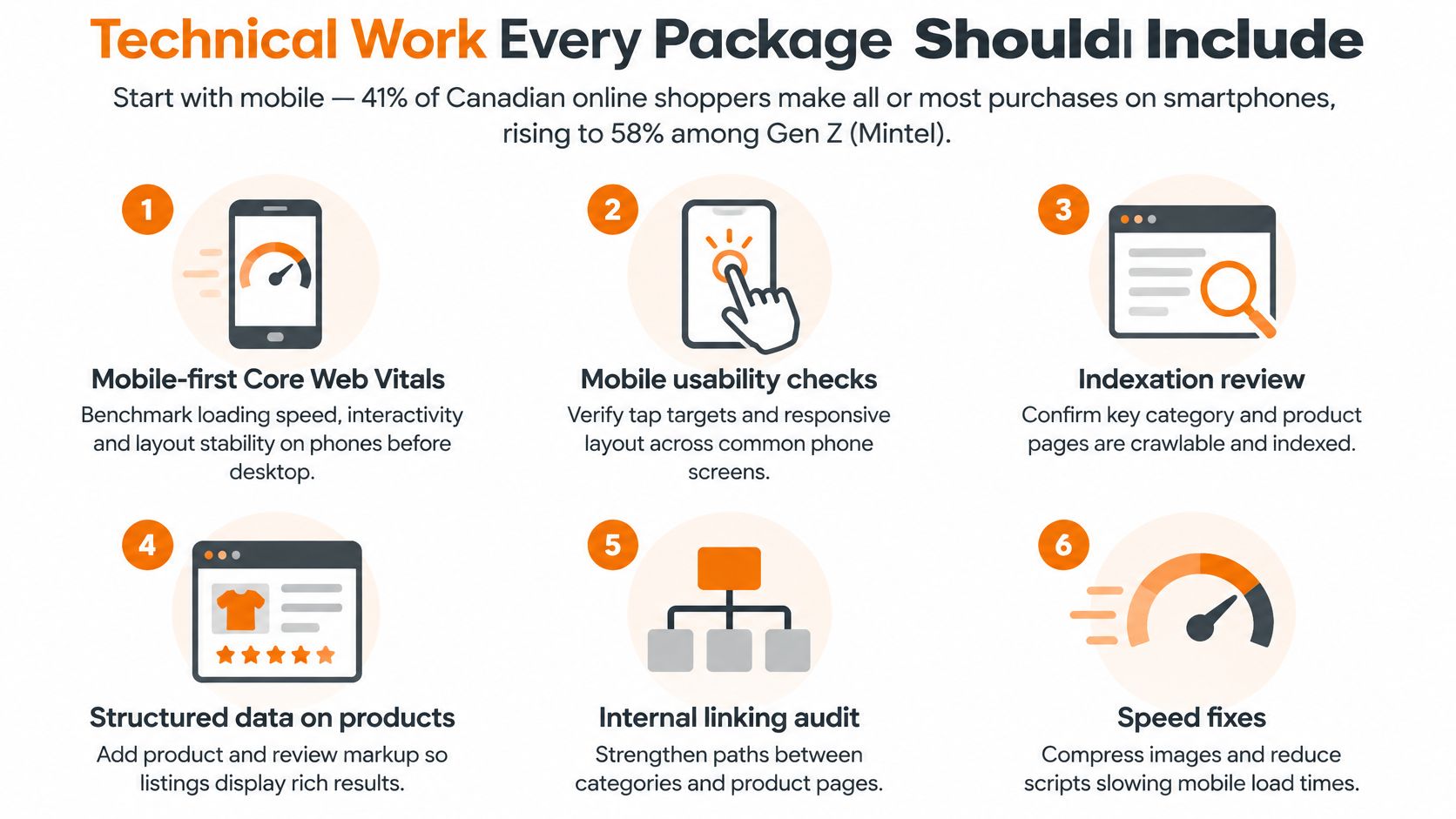
Technical work is where vague packages hide. "Ongoing optimization" can mean a genuine crawl-budget cleanup or a plugin update, and the phrase appears in both proposals. Start with mobile, because that's where Canadian shoppers buy.
Mobile first, benchmarked separately
The case for treating mobile as its own workstream sits in the shopping data. Mintel reports that 95% of Canadian consumers shop online, while 41% of online shoppers make all or most purchases on smartphones, rising to 58% among Gen Z (Mintel). A healthy desktop average can hide a mobile checkout that leaks revenue at the payment step.
- Benchmark mobile Core Web Vitals on their own. Loading speed, interactivity and layout stability measured on a mid-range phone over 4G, not on your laptop.
- Test tap targets and the mobile checkout end to end. Two products in a cart, a discount code applied, payment completed on a small screen.
Product data a crawler can read
- Server-render product content. Name, price, variants and specifications should appear in the HTML, not wait on a client-side script Google may never execute.
- Add product structured data. Price, availability, reviews and shipping details, so listings can show rich results.
- Fix media dimensions. Compressed next-generation images with defined width and height, which stops the layout shift that drags down mobile scores.
Navigation and crawl budget
- Control faceted navigation. Canonical tags or noindex rules on filter combinations, so a colour and size matrix doesn't spawn thousands of near-duplicate URLs.
- Clean the crawl budget on large catalogues. Accurate sitemaps, sensible pagination and internal search pages kept out of the index.
On-page work that ships
- Metadata templates for category and product patterns, with the top-selling SKUs rewritten by hand rather than templated.
- Internal links in both directions. Category to product, product back to its parent category, and cross-links between related categories.
Test your own site against the same list with this ecommerce SEO audit checklist before you shortlist anyone. Our technical work on ecommerce accounts covers mobile-first improvements, site speed and structured data implementation, with on-page work spanning metadata, product descriptions, architecture, internal linking and load speed.
Pricing Models and What Each One Protects
The billing model matters more than the headline rate, because it decides who carries the risk when work slows down.
| Model | How it is billed | Best fit | Main risk |
|---|---|---|---|
| Monthly retainer | Fixed fee for an agreed scope | Catalogues that need continuous optimization | Scope creep when deliverables are vague |
| Project fee | Fixed price for a defined audit, migration or cleanup | Pre-launch stores, replatforming, one-time cleanups | Work stops after delivery |
| Hybrid retainer and bonus | Base fee plus bonus tied to organic revenue or qualified leads | Brands with reliable revenue tracking | Bonuses reward volume rather than margin |
| Hourly | Billed by hours logged | Small, specific fixes | Total cost is hard to forecast |
A retainer protects continuity. It's the right shape for a store with thousands of SKUs, because technical debt returns the moment work pauses. A project fee protects a budget for a defined outcome, which suits a replatform or a post-migration cleanup where the finish line is visible. Hybrid models align the vendor with revenue, though only as well as your attribution does. Hourly work protects flexibility on narrow fixes, such as repairing a broken hreflang set, and punishes indecision everywhere else.
The value check that compares proposals like for like
Divide the monthly fee by the number of product and category pages actively optimized. A $4,000 retainer naming 80 pages works out to $50 per page per month. A $2,500 retainer naming 12 pages works out to $208 per page per month. The cheaper quote is the expensive one unless those 12 pages are the only ones that matter to revenue.
Negotiate any bonus on gross profit, not revenue. A campaign that doubles organic sales of a loss-leading line raises the invoice while the business makes less money.
Whatever the model, the base fee should cover the named deliverables in full. A proposal that funds the basics through a bonus is a proposal that hasn't priced its own work.
Vetting a Vendor Proposal Step by Step
A proposal is a sales document. These six checks turn it into something you can compare across vendors, and each one catches a specific kind of weak work.
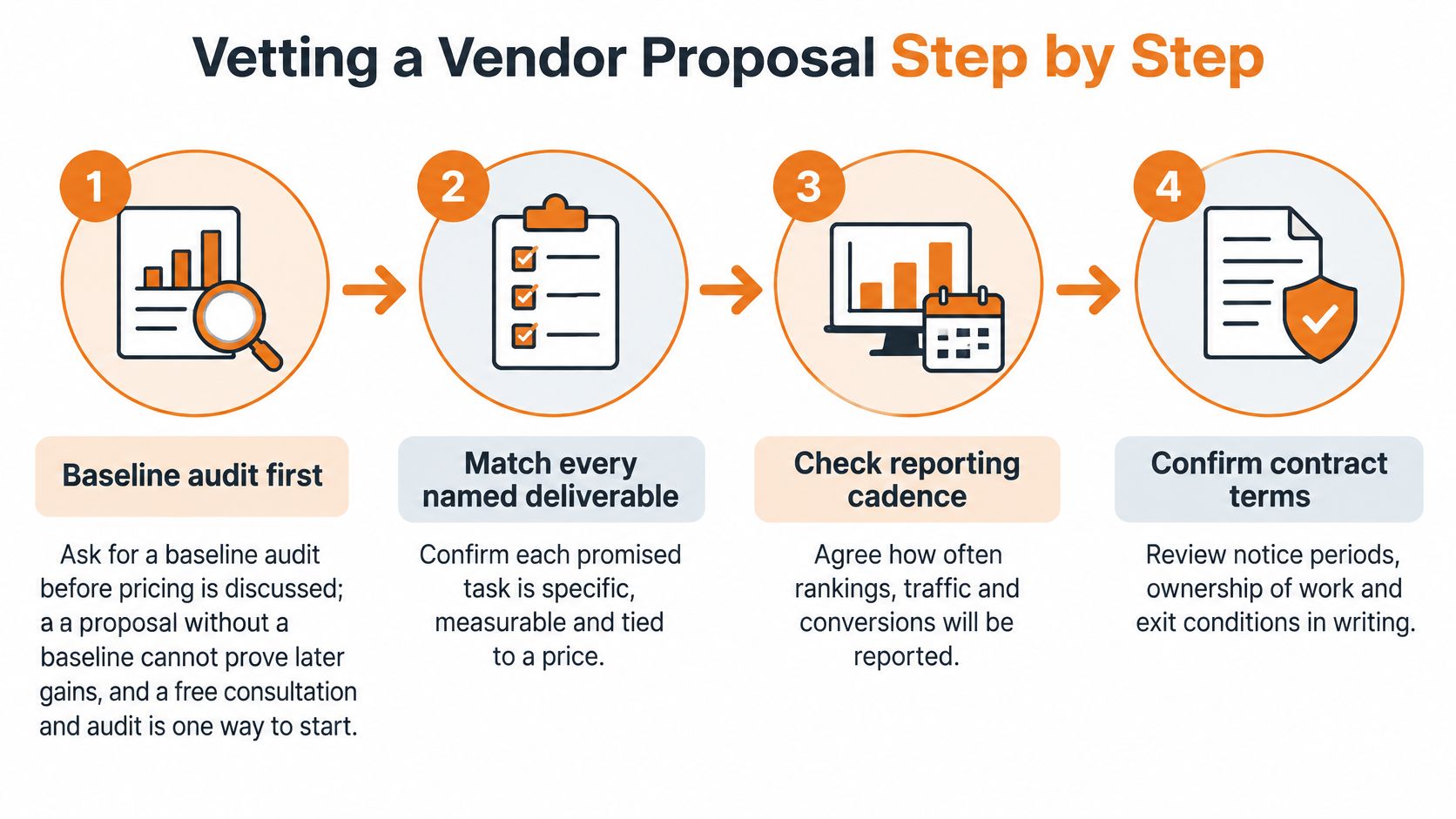
- Ask for a baseline audit before pricing is discussed. Without a baseline, nobody can prove a gain later, and the vendor has no reason to be specific about your site's problems. It also reveals whether they looked at your crawl data or just your homepage.
- Map every named deliverable to the tier table. Flag anything described only as "ongoing optimization" and ask for a number of pages, a format and a deadline. Vague lines are where the hours disappear.
- Lock the reporting metrics. Organic sessions to product pages, add-to-cart rate from organic visits, checkout abandonment, and revenue by province or market. Rankings alone can improve while orders fall.
- Check the logistics and trust content. The DHL 2025 Canada report found that 82% of Canadian shoppers would abandon a basket without preferred delivery options and 78% would do the same without preferred returns options (DHL). Indexable delivery and returns pages, province-aware estimates and clear currency and tax explanations belong in the plan.
- Confirm ownership of content, redirects and analytics access. If you can't take the keyword map, the redirect list and read access with you, you're renting your own visibility.
- Ask what the first 90 days contain, week by week. Weeks one to four should be audit and baseline. After that you want fixes shipping, not another discovery phase.
Red flags repeat across the market: guaranteed first-page rankings, no baseline audit, no page counts, and no direct analytics access. Any one of them is enough to walk.
For a visual version of the same review, the walkthrough below is worth the ten minutes.
During a consultation we audit an existing website for search engine optimization and marketing funnels, so the conversation with an ecommerce SEO specialist starts from your crawl data rather than a template.
Realistic Results and How to Measure ROI
Revenue lags traffic, and traffic lags technical repair. Any package promising sales in month one is buying ads or guessing.
| Window | Metrics to track | Revenue metric | Realistic expectation |
|---|---|---|---|
| Months 1 to 3 | Crawl errors fixed, indexed product pages, mobile Core Web Vitals | Organic sessions to product pages | Technical gains visible, revenue usually flat |
| Months 4 to 6 | Non-branded impressions, category rankings, organic add-to-cart rate | Organic add-to-cart rate | Early traffic growth on targeted categories |
| Months 7 to 12 | Non-branded clicks, top-3 rankings for money keywords, organic checkout initiation | Revenue per organic visit and organic revenue | Measurable revenue lift if conversion paths hold |
| Month 12 onward | Organic revenue share, assisted conversions, branded versus non-branded split | Organic revenue share | Scope review and reinvestment decisions |
The ROI formula to apply each month
Take incremental organic gross profit, subtract the package cost, and divide by the package cost. That's the only figure that tells you whether the tier is working.
Say a $3,000 monthly package produces $9,000 in incremental organic revenue in a given month at a 40% gross margin. That's $3,600 in gross profit. ROI is ($3,600 minus $3,000) divided by $3,000, or 20% for that month. Two things make that number worth watching: the margin figure keeps you honest about which products organic traffic sells, and the cost base stays flat while revenue compounds in later months.
- Track revenue per organic visit by landing page type. Category pages, product pages and buying guides earn at different rates, and averaging them hides the winner.
- Separate branded from non-branded queries. Branded traffic grows with your ad spend and your reputation, so crediting it to SEO flatters the report.
- Reassess scope at the end of the minimum term. A foundation tier that has fixed the architecture is a reason to move up or step down, not to renew on autopilot.
A 20% return in month seven looks modest. It's a much better number by month twelve, when the same retainer is riding a year of compounded category rankings.
If the fee is still the sticking point, work through whether SEO services are worth it before you shorten the scope to fit a budget.
Matching a Package to Your Catalogue and Markets
The right tier depends on your catalogue size and where you ship. Five situations cover most of the stores I'd expect to see comparing ecommerce website SEO packages in Canada.

A small catalogue with a broken site
Under 200 SKUs, the bottleneck is usually architecture, not content volume. Buy the audit first, then a foundation tier. Adding blog posts to a site with duplicate category URLs and a slow template wastes the budget.
Selling across provinces
Segment reporting by province and device, and make delivery estimates match each region. A single national average hides the fact that one province converts at half the rate of another, and that's a fixable problem rather than a mystery.
Shipping across the border
Separate Canada-targeted URLs and metadata from their U.S. equivalents, keep currency and availability signals consistent, and watch for duplicate content created by regional storefronts or filter combinations. Cross-border sellers need this scoped in writing, because it's the first thing to fall off a vague retainer.
A seasonal peak
Start category and content work about four months before peak trading, so pages are indexed and ranking when demand rises. A package that begins in November is buying next year's peak.
AI-assisted discovery
This is the newest line item and the one most often oversold. More than 70% of Canadian users who use AI on Google say they use its AI features for ideas or discovery before they know exactly what they want to buy, and 71% of shoppers arriving at Google Search are open to trying new brands or products (Google's AI product discovery research). The practical work is structured product data, consistent attributes, expert buying guidance, first-party reviews, feed quality, and measurement of branded discovery and assisted conversions. No package can guarantee inclusion in AI answers, and weak category architecture will still limit visibility and sales regardless of what the proposal claims.
Choosing Your Package and Next Step
Five confirmations, then one action.
- Count your SKUs and priority categories. Map the number to a tier in the first table. If the count is 900 and the proposal covers 40 pages, the maths doesn't work.
- Name the goal. Technical repair, growth or AI-assisted discovery each point to a different tier, and a vendor can't scope against all three at once.
- Confirm revenue tracking by landing page type, with branded and non-branded queries separated and results measured in gross profit.
- Confirm the billing model, and whether any bonus is calculated on gross profit from organic orders rather than total revenue.
- Confirm the minimum term matches the timeline for the tier you're buying, and that every vetting question has an answer in writing.
We've been doing SEO work for six years, and we state that our results are proven to improve a range of businesses' search exposure and bottom line within a few months. That claim is only checkable if the report is tied to orders rather than positions.
Then take a single next action: request a baseline audit from each shortlisted vendor and score every proposal against these checks. A vendor who won't produce a baseline before pricing is discussed has already told you how the engagement will run.
Juiced Digital builds ecommerce SEO programs around the two measures this article uses: the scope named in writing and the revenue each organic visit produces. The work spans technical repair, category architecture, product-page content, link building and reporting that ties organic sessions to orders rather than rankings alone. Book a free consultation and audit with Juiced Digital and we'll score your current proposals against these checks before you sign anything.
