

A founder in Vancouver sends the same brief to three agencies. "We want to show up in AI search." The first proposal rebuilds her Google Business Profile and local landing pages. The second rebuilds her category pages and product schema. The third sells her a monthly dashboard tracking brand mentions in ChatGPT and Perplexity. All three call the work AI SEO. All three cost roughly the same. Only one of them will move the number she cares about, which is qualified leads by the end of Q3.
That's the trap in this category. Most "best AI SEO agency" lists rank on vague quality signals, and AI engines build their own shortlists from whichever pages they happened to read, which is often a list published by the agency ranking itself first. The useful question isn't who's best overall. It's which agency fits the job you have: local visibility, ecommerce category revenue, a regulated niche, AI-answer monitoring, or a dedicated organic partner.
This roundup sorts seven options that way. For each one, it names the trade-off and what to verify before you sign anything.
1. Juiced Digital
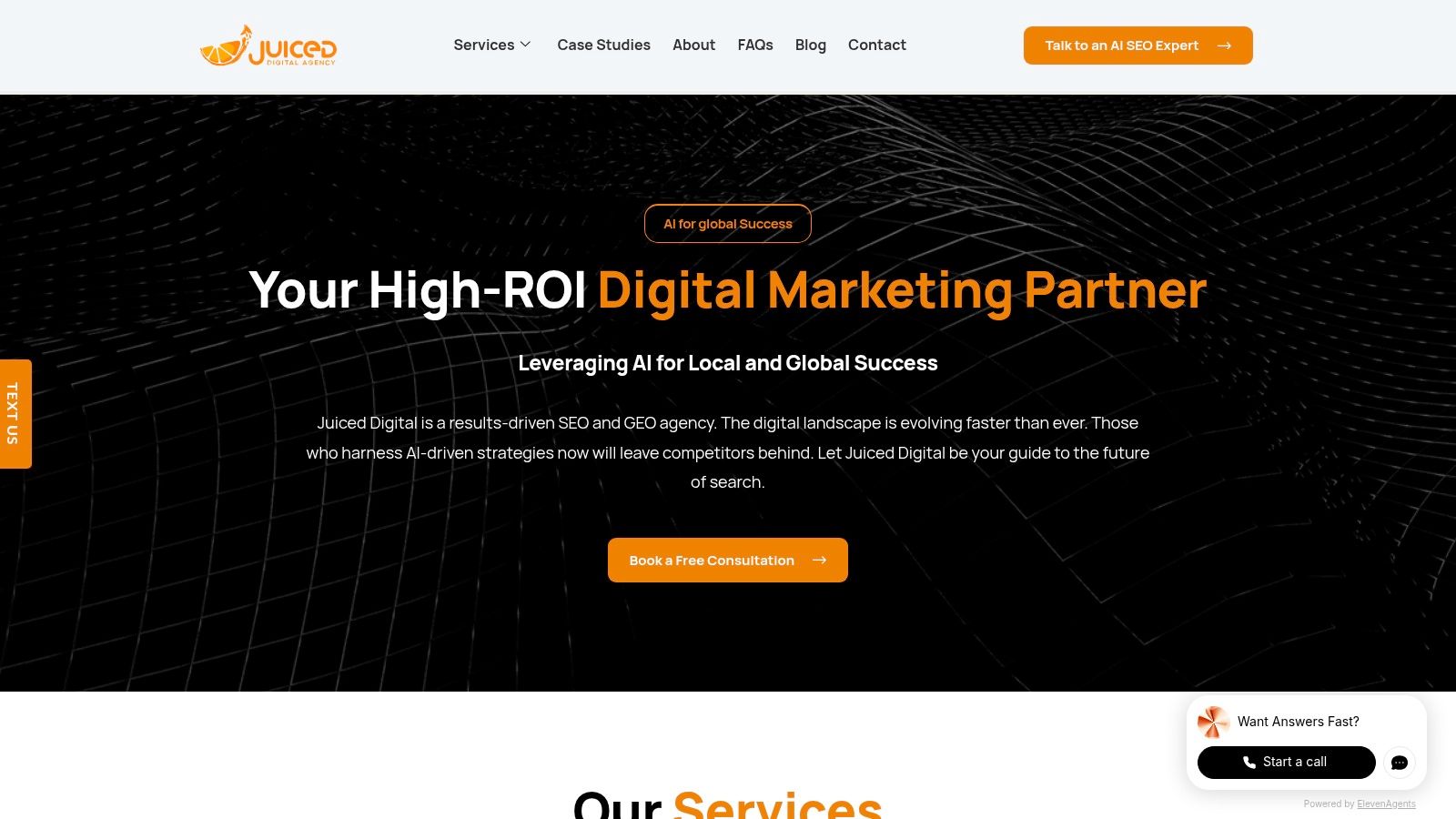
Best fit: local service businesses, wellness clinics, and ecommerce brands that want SEO, paid media, and PR under one roof, including regulated niches.
Juiced Digital is a Vancouver-based, family-run digital marketing and PR agency. Its stated scope covers six services: AI Marketing Solutions, Conversion Rate Optimization, E-Commerce and Local SEO, AI-Powered Paid Advertising, Specialized SEO Niches, and AI Search SEO. In practical terms, one team can touch the local landing page, the category page, and the paid campaign pointing at it. Pricing isn't published, so the first call ends with a quote rather than a rate card.
The regulated-niche question generalist agencies avoid
Cannabis, CBD, functional mushrooms, and health clinics rarely fail at SEO because of keywords. They fail at claims. The Dentons overview of AI and data law in Canada notes that PIPEDA still governs personal information used to train, fine-tune, or operate AI systems, and Québec's Law 25 adds notice duties when decisions rest exclusively on automated processing, plus privacy-impact assessments for some projects. An agency generating content at scale for a supplement brand needs a documented stop line.
Ask which tasks are automated and which aren't. Technical audits, keyword clustering, and reporting are low risk. Patient data, testimonials, medical claims, and personalized recommendations are not. If the pitch includes AI agents creating ad campaigns, ask where a human approves copy before spend.
What to verify: a written AI-use register, a claim-substantiation workflow, and a named human reviewer for every regulated page. If an agency can't produce all three, don't sign.
Strengths
- One integrated scope: SEO, AI search visibility, paid ads, digital PR, and CRO sit with a single team, which helps when organic and paid share a landing page.
- Niche depth: the agency has focused on cannabis, CBD, and functional mushrooms since 2018.
- Concrete audit surface: its audit offer names technical gaps, speed issues, indexing problems, and on-site weaknesses, so ask for a sample audit with fixes and owners.
- Low commitment: no long-term contracts, plus free consultations and audits.
Trade-offs
- No public pricing: expect a custom quote. Push for scope, deliverables, and reporting cadence in writing.
- Agency-reported proof: case studies cite names such as BASI Pilates, Forklift Certification, Orca Coast Play, Tree People, and cannabis clients. Ask for analytics access, prompt-tracking exports where relevant, and two references in your niche.
Current services and audit options are listed on the Juiced Digital site.
2. BlueHat Marketing
BlueHat Marketing fits Canadian and U.S. companies that want traditional SEO and AI-answer visibility handled by one Toronto-based team. The AI visibility program covers prompt tracking, content and technical work, and reporting across ChatGPT, Gemini, Perplexity, Copilot, and Google AI Overviews, so it suits buyers who care where the brand appears inside answers, not only on blue links.
The timing case is still practical: AI use is climbing from a low base, and plenty of firms have budgets before they have rules. That gap lets weak pitches hide, which makes published entry pricing useful. BlueHat lists starting prices for some programs, offers no annual contracts, and includes a free SEO and AI-visibility audit, so you can price a first quarter before a sales call.
Strengths
- Range: local, national, enterprise, international, and ecommerce SEO, plus PPC, CRO, and web development.
- Named engines: the AI work targets specific platforms instead of "AI search" in the abstract.
- Easier entry: no annual contract and a free audit lower the cost of testing fit.
Before signing: ask for a prompt-tracking export, two references in your category, the named person doing AI work, their account load, and a written line between starting price and expected quote.
Trade-offs
- Agency-reported results: review counts, outcomes, and service claims come from the agency's own site.
- Broad-scope risk: SEO, paid, CRO, and development under one roof can spread thin.
- Entry prices aren't your price: competitive markets and multi-location scopes usually land above the starting figure.
Platforms, programs, and current pricing are on the BlueHat Marketing site.
3. Digital Commerce Partners
Say you run 4,000 SKUs, your product pages rank fine, and your category pages are a wall of product tiles with no text. That's the store this agency is built for. Digital Commerce Partners is a Toronto-headquartered, remote-first ecommerce SEO shop working with direct-to-consumer and retail brands across North America, organized around a Category-First approach to strategy, site architecture, and content.
Category pages are where AI answers get their raw material. Statistics Canada found that text analytics was the most common AI application among businesses using AI, at 35.7%. If a category page carries no descriptive copy, there's nothing for a model to classify, quote, or cite. Product schema and clean HTML help, but they don't replace the words.
What to verify before signing
- Scope fit: confirm they'll touch internal linking, canonical rules, and faceted navigation, not just copy.
- Senior access: the agency says a senior strategist works directly on accounts. Ask how many accounts that strategist holds.
- Proof: ratings and results on the site are agency-reported. Request comparable case studies and a client reference.
Trade-offs
- Wrong tool for lead generation: local service businesses and B2B pipeline work should look elsewhere.
- No public pricing: quoted on request only, so compare the scope line by line against other proposals.
If you want to see what category-first work looks like from the inside, this walkthrough of an ecommerce SEO specialist is a useful primer before your first call.
Details are on the Digital Commerce Partners site.
4. Parabolic Studio
A design studio that added search. That ordering tells you what you're buying: brand systems and website builds first, then SEO, GEO, and AEO layered on top. Parabolic says it benchmarks AI-search visibility before work starts and reports progress in plain language, across Google AI Overviews, AI Mode, ChatGPT, Perplexity, and Copilot.
The case for it is local. Statistics Canada found that only 15% of B.C. businesses were already using generative AI (9%) or planning to adopt it soon (6%), while 68% had not considered it and only 39% of owners had thought about integrating AI at all. When most of your market hasn't started, measuring the baseline before a redesign beats opening with a content retainer.
A slow site, a weak brand, and no search presence usually travel together. A studio that fixes all three in one project saves you a rebuild later.
A benchmark you can't see is a benchmark you'll argue about in month six. Ask for the pre-work numbers in writing.
Strengths
- Local and technical: Vancouver-based, tying design, implementation, and search strategy into one project.
- Baseline first: pre-work benchmarking makes later reporting verifiable.
- Rebuild-friendly: suits businesses whose website is the bottleneck, not the content calendar.
Trade-offs
- Project-shaped: design-led studios fit scoped work better than a multi-year organic retainer.
- Agency-reported benchmarking: the pre-work audit is described on their own site. Ask for a sample report before you rely on it.
- Thin public proof: pricing and independent client reviews are hard to find before a call.
- Self-inclusion: its own list of AI SEO agencies includes itself, which isn't independent validation.
Services and process are described on the Parabolic Studio site.
5. EMDigital
Monitoring-first. EMDigital, based in Mississauga, builds its AI visibility service around a baseline set of buying questions run across ChatGPT, Gemini, Claude, and Perplexity, then checks brand mentions, competitors, and cited sources monthly. It pairs that with structured data and content recommendations, a chatbot product called CathyAI, and paid search.
Tool use is no longer a differentiator. Microsoft Canada's fifth annual SMB report found that 71% of Canadian small and medium-sized businesses reported using AI or generative AI in their operations in 2025. Everyone claims AI. What separates a real provider is whether the monitoring changes what you publish next month.
Ask for the export, not the screenshot. A monthly report should show the prompts, the answers, which competitor got named, which sources were cited, and what you changed as a result.
Strengths
- Named engines: four specific platforms rather than a vague "AI search" claim.
- Connected to conversion: the chatbot and paid search give visibility work somewhere to land.
- Free check: an AI visibility check before you commit to a retainer.
Trade-offs
- Prompts aren't users: a fixed question set can't represent every buyer's session, so treat mention counts as a signal.
- No guarantees are possible: the agency says so itself, which is honest. Be suspicious of anyone promising placement.
- Pricing opacity: recurring service pricing wasn't published, so ask for a scoped quote.
Platforms and the free visibility check are on the EMDigital site.
6. Hello Search Marketing
The value question, aimed at smaller Vancouver businesses. Hello Search Marketing runs SEO and website services, and a Canadian agency shortlist describes its AI SEO work as audits, content and technical fixes, entity work, and recurring visibility checks, with month-to-month plans for local, ecommerce, and national or B2B clients. Confirm the current scope directly.
Return is the missing half of most AI pitches. The Business Development Bank of Canada's report on digital transformation found that 14% of SMEs used generative AI in 2025, and 78% of those users were satisfied with the return on investment, while 36% had an adoption plan that included AI. So ask for a payback model: hours saved, incremental qualified conversions, gross-margin contribution, and the review cost for regulated or expert content.
What to verify before signing
- Sample report: ask how the visibility checks are run and whether they repeat the same way each month.
- Deliverable terms: confirm what happens if a deliverable slips, and how guarantees are measured.
- Reputation: pricing and independent review evidence weren't established, so request two client references.
Strengths
- Short commitment: reported month-to-month plans suit a first engagement.
- Local: Vancouver-based, so site and content work can happen in person.
- Website plus search: technical barriers get fixed by the same team that writes the content.
Trade-offs
- Thin public evidence: treat case study numbers as agency-reported until a reference confirms them.
Before comparing retainers, read this explanation of what an AI SEO agency delivers, so you can tell AI-assisted tools from AI-answer work in any proposal.
Services are listed on the Hello Search Marketing site.
7. Enginely
Organic only, by design. Enginely is a Canada-headquartered SEO and GEO practice working internationally, treating traditional search, local search, and AI-answer visibility as three related but separately measured areas. It says it works with organizations whose customers research carefully before making contact, runs an AI visibility audit before scope is set, and doesn't sell paid media or social management. Clients keep ownership of accounts, content, documentation, and strategy.
Ownership is the detail I'd underline. It's what lets you leave without rebuilding from zero. Ask for it in writing, and ask what you keep if the engagement ends in month four.
Strengths
- Narrow scope: a dedicated organic partner instead of a full-service agency.
- Audit first: you see the plan before committing to a retainer.
- Honest limits: the agency states plainly that it won't guarantee rankings or AI recommendations.
Trade-offs
- Coverage gaps: you'll need a second provider for paid and social.
- Unproven in your sector: high-trust positioning doesn't prove experience in a regulated industry.
- Verification burden: no published pricing and no independent review evidence, so ask for two references and a sample audit.
If you plan to run part of this in-house, start with a shortlist of the best AI tools for SEO and see what your team can absorb before you pay a retainer for it.
Scope and positioning are described on the Enginely site.
How the seven AI SEO agencies compare on focus, location, pricing visibility, and contract terms
Read this as a fit filter, not a ranking. The rows separate local visibility, e-commerce, regulated niches, AI-answer monitoring, and pure organic scope. Pricing and contract columns show how much you can verify before a sales call.
| Item | Best For | Location | Pricing Visibility | Contract Terms |
|---|---|---|---|---|
| Juiced Digital | Businesses seeking integrated SEO, paid media, PR, and conversion optimization | Vancouver, Canada | Not published; request a custom quote | No long-term contracts |
| BlueHat Marketing | Canadian and U.S. businesses seeking SEO, AI visibility, and related marketing | Toronto, Canada | Starting prices published for some programs | No annual contracts |
| Digital Commerce Partners | Mid-market and enterprise ecommerce and retail brands | Toronto-headquartered; remote-first | Public pricing not available | Not published; confirm length and exit |
| Parabolic Studio | Businesses needing website or brand work alongside SEO and AI visibility | Vancouver, Canada | Public pricing not established | Not published; confirm renewal and scope |
| EMDigital | Businesses combining AI visibility monitoring with lead generation | Mississauga, Canada | Recurring-service pricing not found | Not published; confirm term and notice |
| Hello Search Marketing | Vancouver-area businesses seeking SEO and website services | Vancouver, Canada | Public pricing not established | Month-to-month plans reported; confirm directly |
| Enginely | Organizations seeking an organic SEO, local search, and AI visibility partner | Canada-headquartered; serves internationally | Public pricing not established | Client keeps accounts, content, documentation, and strategy |
Where terms are not public, the missing detail becomes part of the shortlist test.
Matching an Agency to Your Actual Goals
Name the one outcome first. Local call volume, category-page revenue, AI-answer visibility, or a dedicated organic partner: those four lead to different shortlists, and picking two of them usually means hiring two providers. Then check whether your own team can support the work. Most Canadian businesses haven't adopted much AI yet, so the right partner teaches and implements rather than handing over dashboards.
Shortlist two or three that fit the goal, then run the same test on each:
- Sample report: request a real monthly report with prompts, answers, cited sources, and the changes made as a result.
- Measurement: confirm which numbers get reported, over what period, and how seasonality is separated from your results.
- References: ask for two clients of similar size in a similar category, then call them.
- Contract terms: get deliverables, review turnaround, data handling, and exit terms in writing before signing.
- Regulated claims: if your content needs clinical or legal review, ask who reviews it and how long that takes.
Claims on any agency site, including the seven above, are agency-reported until a reference or a document proves otherwise. Pricing pages show entry points, not your price. Case studies show a result, not a repeatable method. The proof that matters is a baseline you can see, a reporting format you can audit, and a named person who answers when a claim goes wrong.
One more filter. Ask each agency to explain, in plain language, how an AI answer gets built from a crawl to a citation, and what they change on your site to influence it. A team that can walk through retrieval, entity clarity, structured data, and source citations without jargon is doing the work. A team that pivots to search volume and keyword difficulty is selling 2019 SEO with a new cover page, and you'll find out in month five.
If your goal is local lead volume, ecommerce category revenue, or compliant visibility inside AI answers, Juiced Digital builds the strategy around that outcome and reports against it. The Vancouver team combines AI search SEO, paid media, conversion optimization, and digital PR, and every engagement starts with a free consultation and website audit. Book the free audit at Juiced Digital and get your baseline before you weigh another proposal.
