

Ranking first and getting no calls is not a near miss. It's a failed programme with good screenshots. Popular advice tells you to publish more, target more keywords, and wait for traffic to turn into revenue on its own. It won't. If a page can't produce a qualified call, booking, quote, or purchase, its ranking is trivia, and SEO for lead generation should be judged accordingly.
Why SEO for Lead Generation Is Not a Rankings Project
A British Columbia contractor can rank for a broad Vancouver term, watch sessions climb, and still have no idea which visits became estimates, which became jobs, or which came from outside the service area. The report looks healthy. The pipeline doesn't. That gap is where most programmes fail.
Search creates commercial actions directly, not just website visits. Google's Canada economic impact reporting on direct customer connections states that more than 2.8 million Canadian businesses used Google's tools in 2025 to receive phone calls, bookings, reviews, requests for directions, or other connections, and that Google generated more than 440 million such free connections each month. The same reporting states that 83% of surveyed Canadian businesses identified online search as an important way customers found them.
Those actions matter more than position. A direction request from someone in Burnaby, a call from a homeowner with a burst pipe, or a booking start for a first appointment is closer to revenue than a session from a reader who wanted a definition.
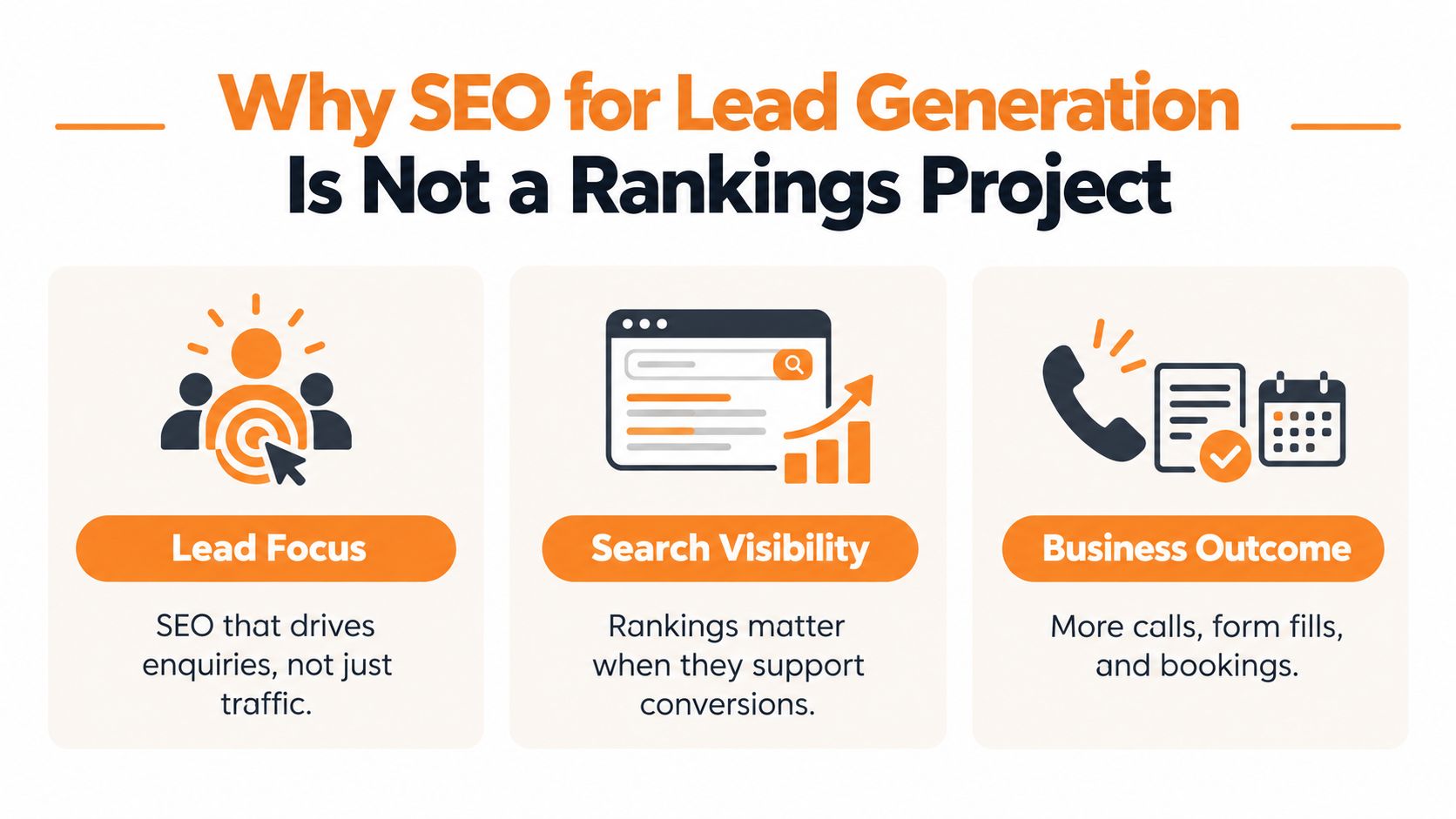
What Counts as Success
Canadian buyers also move between channels. They research online, then phone, visit, or buy later. A ranking report can't capture that delay, which is why you need attribution that follows the enquiry offline.
Practical rule: If you cannot name the business action a page is supposed to create, don't optimise it yet. Fix the offer and the path first.
Build around intent-matched pages, a clear local lead path, and contact choices that fit the search. Measure qualified calls, booked appointments, and revenue before you celebrate impressions. Fewer sessions with more completed jobs is progress. More sessions with a quiet phone is not, no matter how clean the chart looks in a monthly deck.
Rankings still matter, but only as distribution. They put you in front of people who already need help. Whether those people become clients depends on everything after the click, and often on whether they ever needed to click at all.
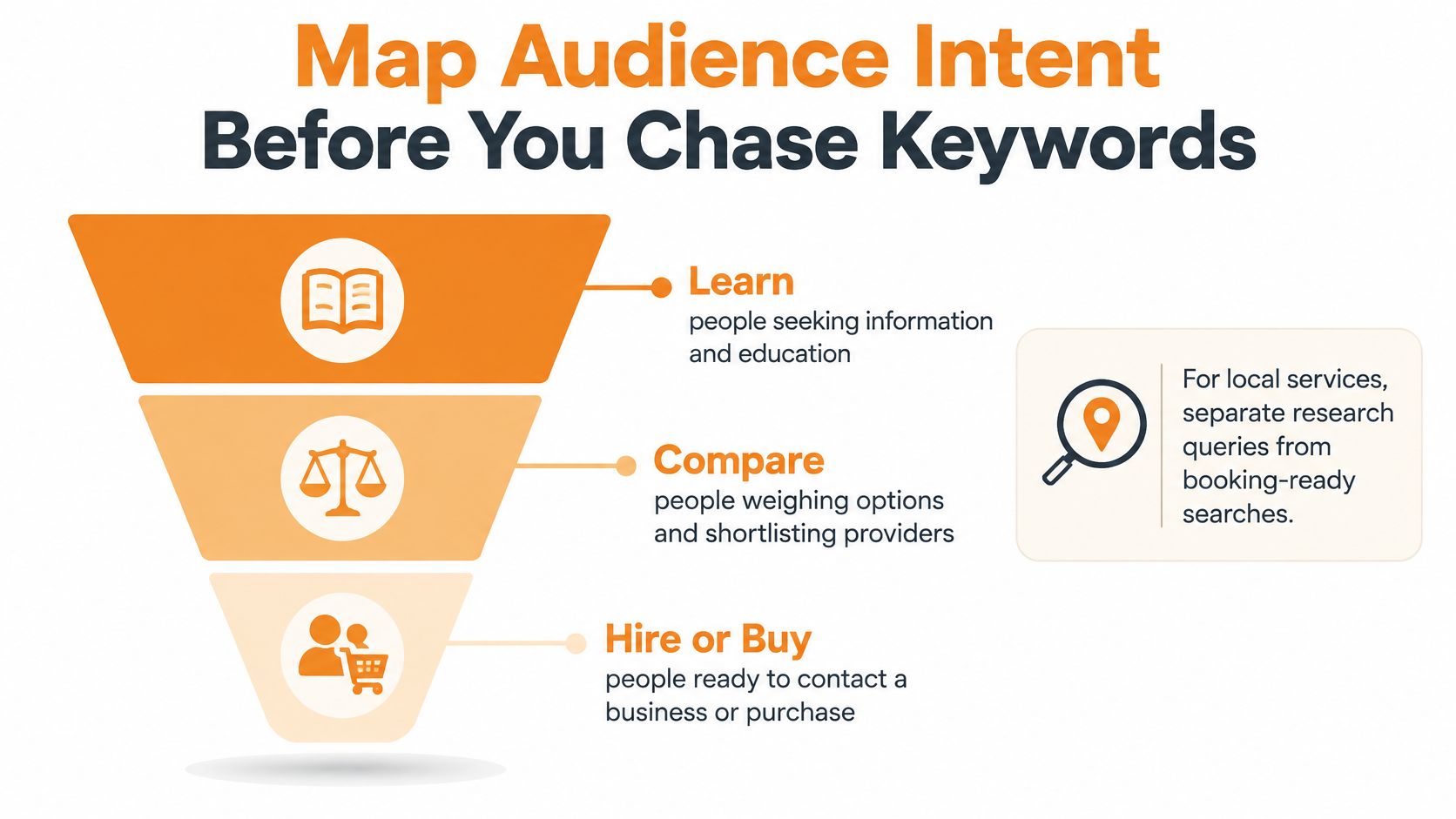
Map Audience Intent Before You Chase Keywords
Stop exporting thousands of keywords and calling it strategy. Sort searches by the job the person is trying to do, then decide which jobs deserve budget.
Three Jobs, Three Different Pages
- Learn: The person wants an explanation, such as what a treatment involves or how a service works. These pages can build familiarity, but they rarely produce an enquiry today.
- Compare: The person is weighing providers, methods, pricing logic, or product types. They need proof, differences, and honest limitations.
- Hire or buy: The person uses a service and a place, such as physiotherapy Burnaby, or a product and a problem. These pages carry your pipeline and should get attention first.
That distinction sounds basic, yet businesses routinely fund Learn content for a year while their Hire pages say little more than a brochure. Reverse the order. Earn the enquiry from ready buyers, then add supporting content where it has a clear route to a commercial page.
Build a Short Intent Sheet
Create one row per candidate page with audience, location or market, problem, query class, page type, and one lead action. If you can't fill in the last column with call, booking, quote, or purchase, park the idea. A focused process for researching keywords by commercial intent will usually shrink the list, and that's the point.
The market context supports useful pages over volume. Business Development Bank of Canada research on Canadians buying online reports that the share buying online rose from 43% in 2013 to 61% in 2019, while Statistics Canada data cited in the same research showed 46.4% of Canadian businesses did not have a website, or had only limited e-commerce functionality, in 2017. The same source found 84% of surveyed businesses promoted themselves online, 67% explored markets or competitors online, and 55% used the Internet to expand into new markets.
For regulated categories such as cannabis, CBD, functional mushrooms, and health, add a compliance column to the sheet. Note which claims require review and which promises you won't make. Your output should be a short, prioritised list of page targets, not a spreadsheet nobody can act on.
Build Service Pages That Earn the Enquiry
A service page earns an enquiry when a sceptical buyer can verify who you are, what you do, where you serve, and what happens next without hunting for it.

One Page, One Primary Action
Take an emergency plumber in Vancouver. The page should promise emergency plumbing, name the actual service area, explain what counts as an emergency, and make calling the obvious next step. It should state licensing and insurance, describe how pricing ranges are handled where they can be stated clearly, and answer practical questions about arrival, shutoff steps, and payment.
A thin clone does none of that. It swaps Vancouver for Richmond, repeats the same paragraphs, and adds no local proof. Don't publish municipality pages you can't make distinct. You're not building coverage. You're building clutter that gives visitors no reason to choose you.
Proof a Buyer Can Check
Use first-party proof over adjectives:
- Licensing and credentials: Name practitioners, trades qualifications, and relevant registrations.
- Service-area coverage: List neighbourhoods or municipalities you serve.
- Real process details: Explain assessment, timelines, follow-up, and what the client needs to prepare.
- Outcomes with context: Describe completed work carefully, without guarantees you can't support.
Match the title and heading to the job, keep service details scannable, and link the page from a relevant service or city hub. Put contact options where a mobile visitor sees them early, but keep one primary conversion dominant.
E-commerce brands should apply the same discipline to category and on-site search pages. A shopper finding the right product quickly is an assisted lead moment, even when no form exists. Clear filters, plain product differences, and useful search results do the work a vague category description can't.
The short walkthrough below reinforces how page purpose and contact paths should be planned together before writing begins.
Hand your writer a brief with audience, query, proof points, one action, and what not to promise. If the proof section is empty, delay publication and gather evidence first.
Make Local Search Produce Calls and Bookings
Many local leads never become long website sessions. The visitor checks a profile, reads reviews, taps call, or asks for directions. Treat that discovery layer as part of the funnel, not as a directory chore.
Finish the Profile Before Publishing More
Complete and verify your Google Business Profile. Keep name, address, and phone details consistent everywhere, choose accurate service categories, add location-specific photos, and include an appointment link where booking applies. Use a call-tracking number that forwards to the business line so you can measure demand without breaking contact.
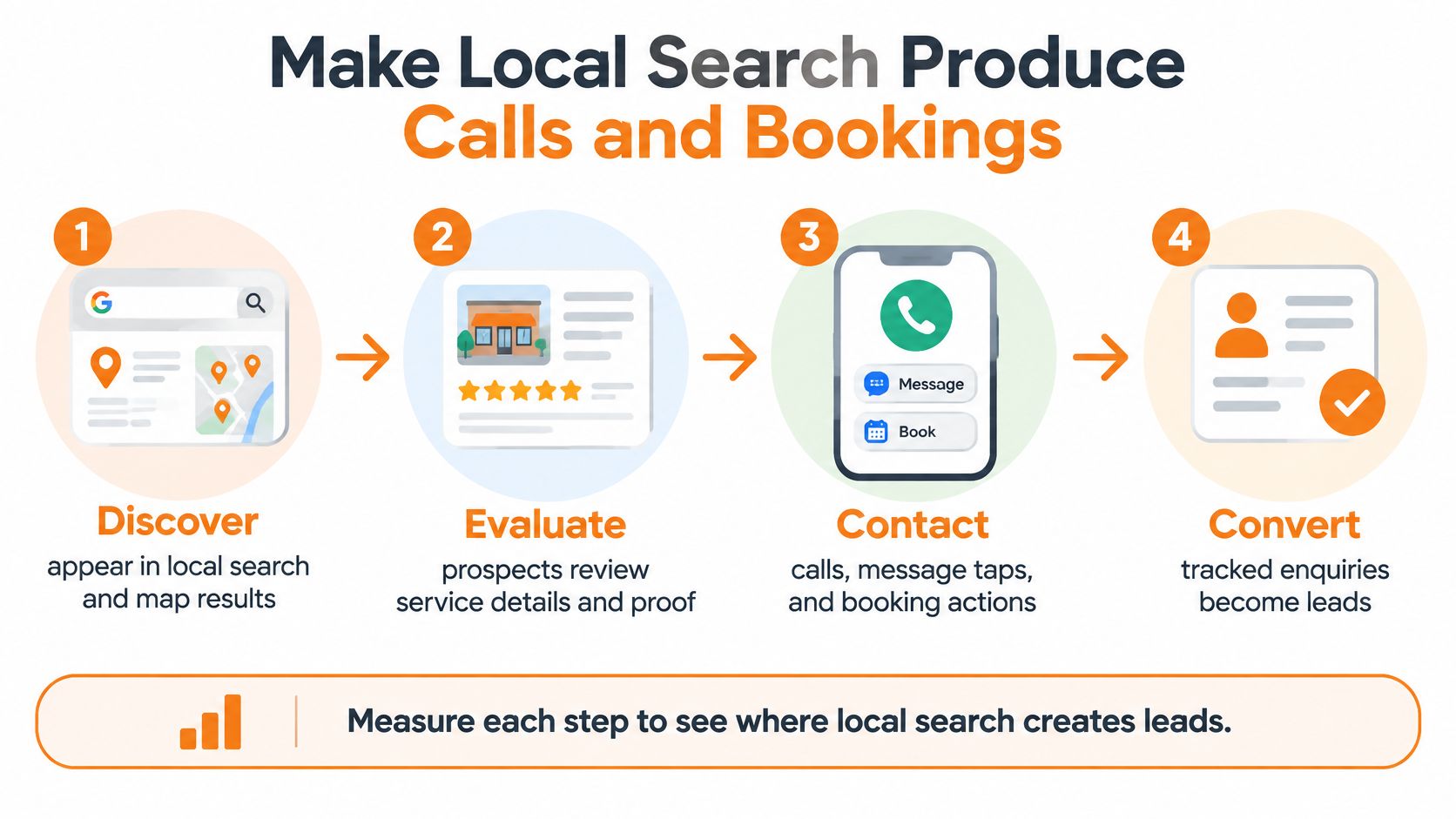
Then make the actions countable. Add LocalBusiness and Service schema, keep indexable name, address, and phone content on the site, link from city and service hubs, and track events for calls, form submissions, booking starts, direction requests, and qualified opportunities. If front-desk staff can't tell a profile call from any other call, your reporting is fiction.
The urgency is real because Canadian local search summaries on local intent and same-day visits report that about 46% of Google searches have local intent, while Google-reported behaviour in the same summary indicates 76% of people making a local search on a smartphone visit a related business within one day.
Reviews, Then the Right KPI Order
Ask satisfied customers for legitimate reviews and reply with service and neighbourhood context. Don't offer incentives, don't fabricate reviews, and don't coach customers into keyword-stuffed scripts. Buyers can smell it, and platforms can too.
Measure in this order, Map Pack impressions, profile actions, qualified calls, booked appointments, lead-to-customer rate, and revenue. Impressions explain reach. They don't prove demand.
Two pitfalls waste budget repeatedly. First, chasing broad Vancouver visibility while never listening to whether calls are qualified. Second, publishing near-identical city pages that provide no unique local proof. Fix the profile, tracking, and review habit first. More content won't rescue a local path you cannot measure.
Improve the Page Until More Visitors Convert
You don't always need more traffic. You often need the same visitor to stop hesitating.
Start with the headline. If someone searched for a specific service in a specific place, say that plainly and add a concrete next step. A mobile visitor should see the phone number or booking action without scrolling through brand poetry. Response expectations help too, provided they're realistic and your team can meet them.
Remove Friction That Serves Nobody
Cut form fields sales never uses. Ask for the details needed to respond and qualify, then collect the rest in conversation. Replace competing buttons with one next step, and remove distractions such as a generic blog sidebar from high-intent pages.
- Do: State who is licensed, where you serve, and what a first visit or order includes.
- Do: Clarify service area before the form, so unsuitable enquiries decline voluntarily.
- Avoid: Inventing clinical or performance claims for regulated and wellness offers.
- Avoid: Sending every visitor to a generic contact page that forgets why they arrived.
Small changes carry weight because intent is already present. Clarifying that you serve a neighbouring municipality, naming the practitioner, or explaining what happens after a quote request can remove the exact doubt blocking action. A quieter page often beats a louder redesign.
Use disciplined conversion rate improvement work on high-intent pages before you approve a new content batch. Test headline clarity, form length, contact placement, and proof order on the URLs closest to revenue.
Don't confuse lead conversion with a storewide e-commerce rate. A clinic booking, a contractor quote, and a product purchase involve different risk and timelines. Judge each page by its own intended action and its own qualified outcomes. Your goal for the afternoon is a short fix list, applied in priority order, not a redesign manifesto nobody finishes.
Track Qualified Revenue Not Just Form Fills
If you count every form as a lead, you'll reward pages that attract spam, job seekers, and shoppers outside your area. That's not measurement. It's self-deception with a dashboard.
Record a Baseline You Can Defend
For each target page, record organic sessions, non-brand clicks, impressions, average position, engaged sessions, form completion rate, call volume, qualified-lead rate, sales-accepted leads, and revenue. Then map conversions back to landing page, query class, device, municipality, and first-touch versus assisted-touch attribution in analytics and the CRM.
Consistent identifiers matter when revenue happens offline or weeks later. Connect Google Business Profile interactions, call tracking, booked appointments, CRM stages, and closed-won value. A solid approach to tracking SEO conversions through to qualified outcomes gives you cost per qualified lead, lead-to-sale rate, revenue per organic visitor, and time to conversion.
Use a 90-day window to fix crawl, indexation, and Core Web Vitals issues, consolidate cannibalising pages, publish the bottom-of-funnel pages you selected, add original proof, and earn relevant local citations or editorial links. Don't judge the programme after a few weeks.
Canadian benchmark compilations cited in Canadian SEO statistics on conversion and sustained investment report an average e-commerce conversion rate of about 2.3% and claim businesses sustaining SEO for 12 months or more generate 2.4 times the qualified-lead volume of those investing for under six months. Treat both as directional planning context, not targets. Calculate your own visitor-to-lead and lead-to-sale rates.
What to Measure in an SEO Lead Program
| Signal | What it answers | Keep or demote |
|---|---|---|
| Qualified calls | Did ready buyers contact us? | Keep |
| Booked appointments | Did interest become scheduled work? | Keep |
| Raw form fills | Did anyone submit anything? | Demote until qualified |
| Rankings alone | Are we visible? | Demote |
| Closed-won revenue | Did search create customers? | Keep |
Exclude spam and duplicates, avoid last-click-only decisions, and never scale unreviewed AI pages in cannabis, CBD, or health topics. Lower traffic with more completed jobs is a win.
Choose the Right SEO Partner and Take the Next Step
You have three realistic ways to run this, and they produce different problems.
An in-house generalist knows the business and can gather proof quickly, but may lack time for technical fixes, local tracking, and conversion testing. A volume-first content or AI programme produces pages quickly, yet often can't show which pages created qualified demand. A specialist partner should connect search, local profiles, landing pages, and CRM outcomes, and should be willing to recommend fewer pages when proof is thin.
Choose based on your constraints. Are you local, e-commerce, or trust-sensitive? Can you track calls and CRM stages? Do you have licensing, credentials, reviews, and service-area evidence ready to publish? If those basics are missing, AI-search content is premature.
BC generative AI adoption research on business readiness reports that only 9% of BC businesses were using generative AI and another 6% planned to adopt it soon, while 68% had not considered adoption and 17% had considered it but did not plan to proceed. The same source reports that in Canada, search users represented 7% of e-commerce visits but generated 17% of online orders in Q1 2025.
Don't buy mass AI visibility before you can prove branded searches, qualified calls, bookings, and assisted conversions from the pages you already own.
Juiced Digital is a Vancouver-based, in-house team that combines AI-driven SEO, paid media, conversion rate optimisation, and digital PR for local businesses, e-commerce brands, and compliant work in cannabis, CBD, functional mushrooms, and health. It offers free consultations and audits without a long-term contract as the default pitch.
Take one step this month. Audit your highest-intent pages, record this month's qualified calls and bookings, then use a consultation or internal working session to choose the first 90-day fixes.
Stop paying for ranking reports that cannot explain a single booked job. Juiced Digital will audit your highest-intent service pages, local profile, and lead tracking to identify where search demand is leaking before it becomes revenue. Book a free consultation and leave with a prioritised 90-day plan tied to qualified calls, bookings, and sales, not vanity traffic.
