
Most advice about what is long-tail keywords gets the first decision wrong. It tells you to count words, usually four or more, then publish a page for every phrase that passes the test. That approach creates bloated keyword lists, thin content, and pages that never produce a qualified enquiry.
A better question is: what does the searcher want to do next, and which asset can help them do it? A query may need a service page, a Google Business Profile, a product page, an FAQ, or a booking flow. Word count can provide a clue, but it can't decide the strategy.
For Vancouver and British Columbia businesses, this distinction matters. Search demand is spread across specific combinations of location, urgency, eligibility, product attributes, and use case. The opportunity isn't to chase every unusual phrase. It's to connect the right search intent with the right business response.
The Misleading Myth of the Four-Word Rule
The familiar definition says a long-tail keyword contains four or more words. It's a useful shorthand for beginners, but a poor rule for planning SEO. Canadian search data shows why: 27.7% of Google searches contain one word, 23.98% contain two words, and only 12.12% contain six or more words, according to the Canadian query-length analysis. A large number of searches aren't long phrases, yet some still have highly specific local or commercial intent.
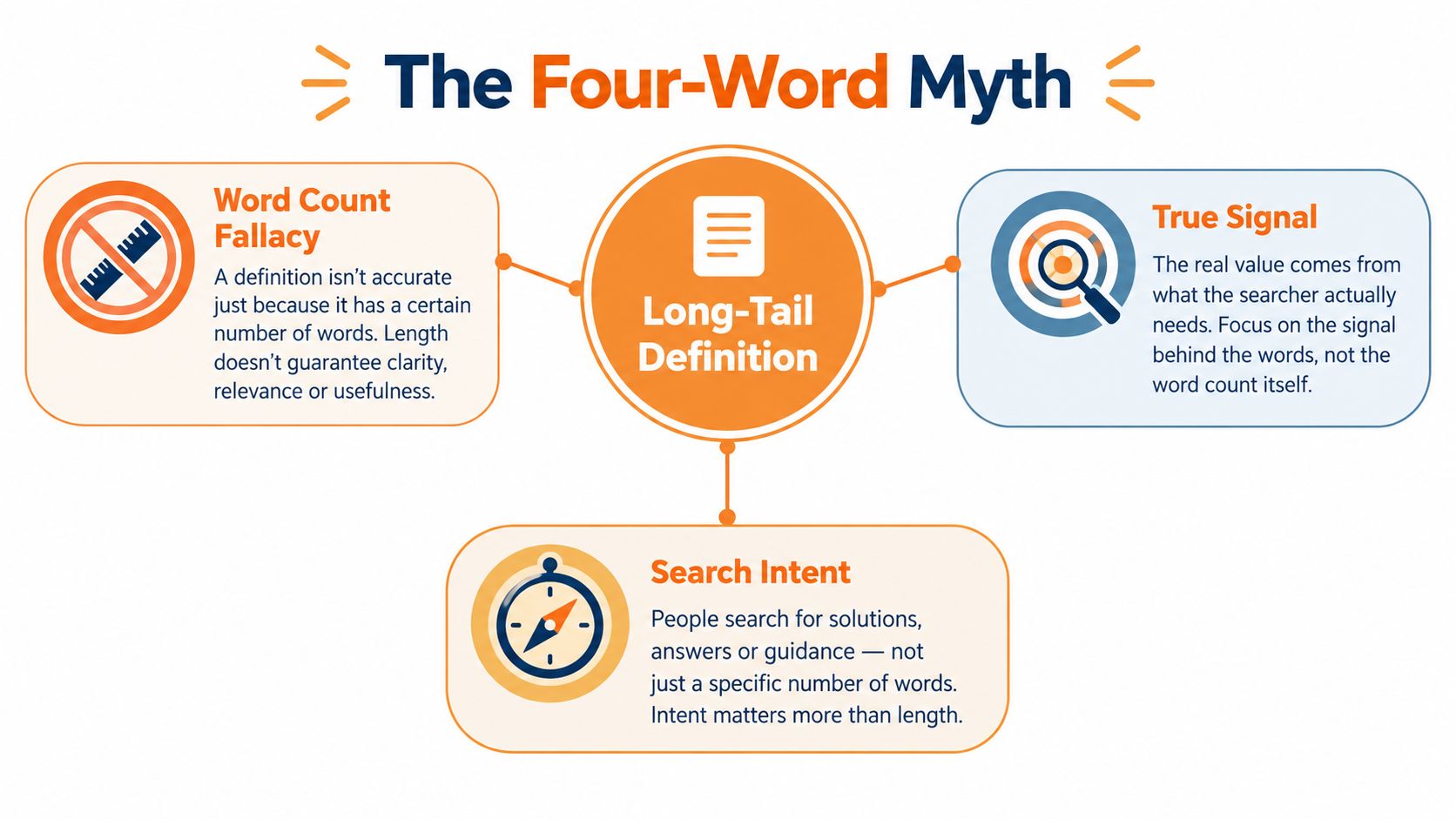
Consider “Vancouver physio.” It has only two words, but the location and service narrow the audience substantially compared with “physiotherapy.” In a Vancouver campaign, it may function as a long-tail local term because it expresses a defined market and service need. By contrast, “best web developer” has three words but remains broad, competitive, and ambiguous about location, budget, platform, and project type.
The signal that actually matters
A practical long-tail definition has three parts:
- Specificity: The query identifies a particular service, product, audience, location, problem, or constraint.
- Intent: The wording indicates what the person is trying to learn, compare, contact, book, or buy.
- Relative demand: The phrase usually attracts less individual demand than a broad head term, although that isn't a guarantee of value or low competition.
This definition changes the way you evaluate keyword research. Instead of rejecting “Vancouver physio” because it isn't long enough, ask whether it maps to a distinct audience and service. Instead of accepting every six-word question, ask whether it deserves a separate asset or belongs on an existing page.
Practical rule: Treat word count as a discovery clue, not a qualification threshold. Intent decides the investment.
The research also cautions against assuming that longer means better. A University of Alberta study using Canadian search behaviour found that one- and two-word queries performed better across the tested search engines than queries containing three or more terms. The useful lesson isn't that short phrases always win. It's that length alone can't predict rankings, leads, or revenue.
What a Long-Tail Keyword Actually Is
Think of search demand as a curve. On the left, a small number of broad terms attract considerable attention. In the middle, more focused phrases describe a category, audience, or location. Along the tail, many less frequently repeated queries express precise needs. Each tail phrase may be modest on its own, but the collection can reveal how customers describe problems and buying conditions.
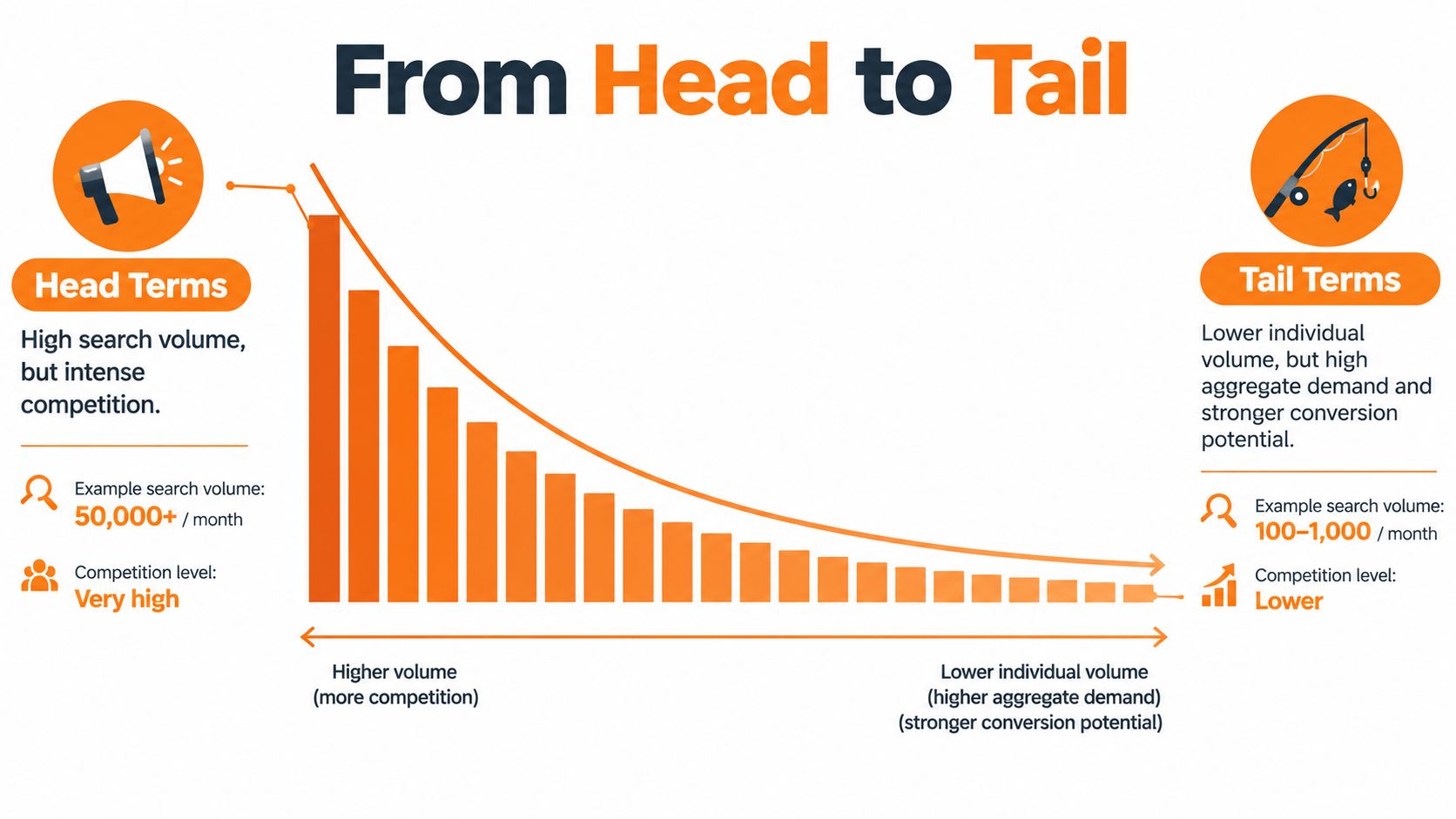
A head term is broad and often difficult to interpret. “Dentist” could describe a person seeking a definition, a student researching the profession, or a patient looking for an appointment. A local modifier makes the query more useful, but “Vancouver dentist” can still cover routine care, cosmetic work, emergencies, pricing, and insurance.
A tail query narrows the job:
“Emergency dentist open Sunday Vancouver” tells you about the service, urgency, opening requirement, and location.
That wording may attract fewer searches than “dentist,” but it gives the business a clearer idea of what must appear next. The visitor likely needs accurate hours, a phone number, directions, and a way to request care. The query's value comes from the combination of specific need and likely action, not from its word count.
Three traits to evaluate
Use these questions when classifying a keyword:
How narrow is the audience?
“CBD oil” can refer to education, product research, regulations, or purchase intent. “CBD oil shipping British Columbia” adds a jurisdiction and transaction constraint.How defined is the intent?
“Physiotherapy” is a category. “Same day pelvic floor physiotherapy Kitsilano” identifies a service, urgency, treatment area, and neighbourhood.What asset could satisfy the query?
A query that needs immediate contact information shouldn't automatically become a blog post. A product comparison may need a buying guide and product detail pages. A basic definition may fit an educational resource.
The same phrase can occupy different positions in different markets. “Vancouver dentist” is more specific than “dentist,” but it may be a central local term for a large clinic. “Vancouver dentist open Sunday for emergency care” is more clearly tail-oriented because it combines several constraints.
Long-tail doesn't mean “long phrase.” It means a specific search path that can be connected to a relevant audience, action, and asset.
Why Long-Tail Keywords Matter for SEO and Conversions
The strongest argument for long-tail strategy is behavioural. Searchers don't always repeat a small set of standard phrases. A foundational Canadian study by researchers at the University of Alberta found that 90.6% of queries in its dataset appeared only once, as reported in the study on end-user web-search behaviour. The dataset also recorded a mean query length of 2.4 terms, with two-term searches the most common, while still showing a distributional tail of less frequently repeated queries.
That combination creates a planning problem. If you optimise only for a handful of popular terms, you may capture visible demand while missing the varied language people use to describe their actual circumstances. A Vancouver clinic could target a broad service category, yet patients may search through combinations involving neighbourhood, pain type, appointment timing, eligibility, or treatment method.
Ranking opportunity and conversion opportunity aren't identical
Specific queries can make relevance easier to demonstrate because the page can answer a narrower question. That doesn't mean every long-tail term is easy to rank for, or that low volume automatically makes a query commercially useful. Search features, established competitors, business profiles, and strong marketplaces can still dominate the results.
Conversion intent also requires care. The Canadian search-engine research cited above found that one- and two-word queries performed better than queries of three or more terms across the tested engines. That finding rules out a common shortcut: adding words and assuming the result will produce better leads.
A better operating principle is:
Specificity plus business intent beats length alone.
“CBD oil” is broad and ambiguous. “CBD oil shipping British Columbia” communicates product interest, location, and a practical purchasing constraint. The second query gives you a clearer content and conversion brief, but you still need evidence about demand, competition, compliance, and the asset that can satisfy the visitor.
Why BC businesses have a strong use case
British Columbia has a highly connected digital market. Statistics Canada reported that 94% of residents in British Columbia and Alberta used the Internet in 2018, compared with 91% of Canadians aged 15 and older nationally. The same Statistics Canada release reported that nearly 84% of Canadian Internet users purchased goods or services online in 2018, with online spending reaching $57.4 billion, up from $18.9 billion in 2012.
Those figures don't prove that every long-tail page will convert. They do establish a market where people use digital channels to investigate, compare, and transact. Long-tail SEO helps a business meet the detailed questions that appear before a call, booking, or purchase, provided the content and conversion path match the query.
Long-Tail Examples Across Local, E-commerce, and Regulated Niches
A keyword list becomes useful when each query is tied to an expected action. The following examples show how the same research principle changes across business models.
| Business type | Long-tail query example | Likely intent | Best-fit asset |
|---|---|---|---|
| Local healthcare | same day pelvic floor physiotherapy Kitsilano | Find an available, nearby specialist | Dedicated service page supported by an accurate Google Business Profile |
| Local dental | emergency dentist open Sunday Vancouver | Contact a provider immediately | Emergency service page, visible phone access, hours, directions, and booking |
| E-commerce | organic lion's mane gummies Canada third-party tested | Evaluate a product and its evidence | Product page with compliant claims, testing information, reviews, and shipping details |
| Regulated wellness | best CBD oil for sleep Canada | Compare products for a specific use case | Educational comparison page connected to compliant product details |
| Cannabis retail | cannabis delivery West Vancouver same day | Check availability and arrange fulfilment | Local or category page with delivery conditions, service area, and product access |
| Health clinic | physiotherapy for runner knee pain Vancouver | Assess treatment suitability and contact a provider | Condition-focused service page with practitioner information and an enquiry path |
The local examples require more than copy. “Emergency dentist open Sunday Vancouver” is a high-priority operational query because a visitor may call without visiting several pages. If the profile shows outdated hours, the content strategy has failed even if the service page ranks.
E-commerce queries carry different requirements. A phrase such as “organic lion's mane gummies Canada third-party tested” creates expectations around product evidence, ingredients, shipping, reviews, and compliant wording. A generic article about functional mushrooms won't satisfy that purchase investigation as effectively as a well-structured product page supported by useful educational content.
The asset should inherit the query's job. If the searcher wants availability, show availability. If they want proof, show proof. If they want to book, make booking obvious.
Run this exercise across your own list. Write down the likely action beside every candidate term, then choose the format that removes the largest obstacle to that action.
How to Research and Prioritise Long-Tail Keywords
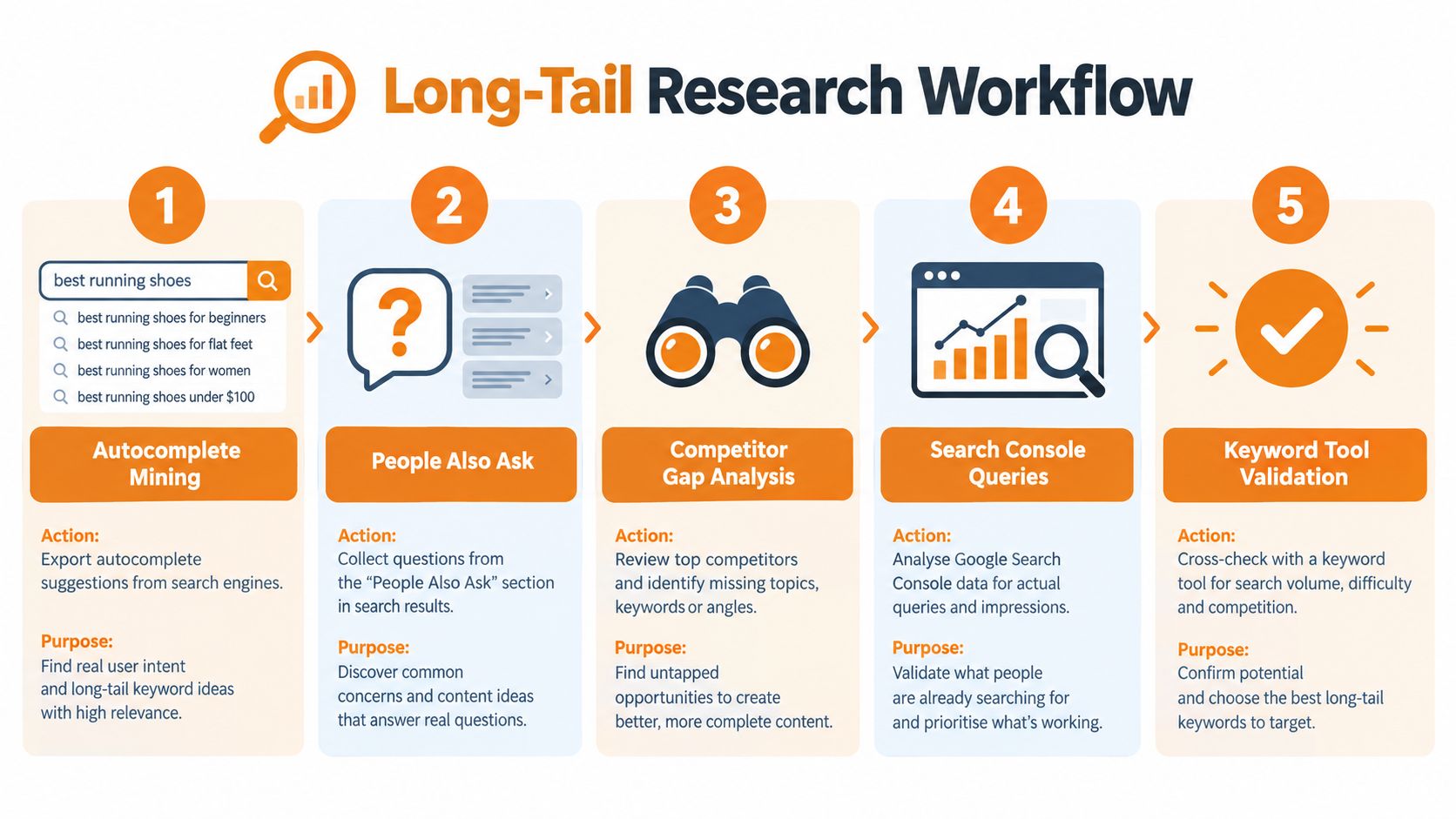
Start with language customers already use, not with a spreadsheet full of invented variations. Google Autocomplete, People Also Ask, related searches, competitor service pages, support enquiries, on-site search data, and keyword tools can reveal how people frame a problem. Google Search Console is particularly useful because it shows queries for which your site already receives impressions, including wording you may not have planned for.
A practical research sequence
Mine autocomplete patterns. Start with a service, product, problem, or location. Add modifiers such as “near me,” neighbourhoods, urgency, price, eligibility, shipping, or use case. Keep the language that reflects a real customer constraint.
Read question surfaces. People Also Ask often exposes the objections that sit around a topic. A product query may lead to questions about safety, ingredients, returns, or suitability. Those questions can become sections on a commercial page instead of disconnected articles.
Inspect competitor gaps. Search your priority phrases and study the assets that appear. Note whether Google favours service pages, local profiles, product pages, comparison content, videos, or FAQs. A competitor gap is meaningful only when your business can provide a more useful answer.
Validate with your own data. Search Console can identify pages that are visible for relevant queries but don't yet attract strong engagement. Compare the query with the page's actual offer. Sometimes the answer is better copy. Sometimes it's a missing location page, clearer pricing context, or a more direct conversion path.
Use tools and AI for expansion, not truth. Keyword tools can surface related phrases, while AI can group questions by topic and suggest modifiers. Neither proves commercial value. Validate the final candidates against search results, customer language, location settings, and business priorities.
For a broader process covering seed terms, query discovery, and evaluation, use Juiced Digital's guide to keyword research.
Score candidates before creating pages
Give each query a qualitative score for:
- Intent clarity: Can you tell what the person wants?
- Business action: Could the search lead to a booking, enquiry, purchase, or qualified call?
- Asset fit: Do you have, or can you create, the right format?
- Consolidation potential: Does the query share intent with terms you already target?
- Evidence and differentiation: Can your business provide information competitors can't easily replicate?
The last question prevents content teams from publishing pages that merely rearrange generic advice. Group close variants when they share the same result type and customer need. Create separate pages only when the audience, offer, location, or action changes enough to justify a distinct experience.
Matching Long-Tail Queries to the Right Asset
The default response to a long-tail keyword is often “write a blog post.” That shortcut wastes opportunities because searchers don't all want an article. The correct workflow is to identify the next action, then choose the asset that makes that action easy.
Use pages for defined services and commercial topics
A dedicated service page fits a query such as “same day pelvic floor physiotherapy Kitsilano.” It can explain the service, identify the neighbourhood, establish practitioner credibility, answer practical questions, and make booking available. The Google Business Profile should reinforce the same service and location signals with accurate category, hours, services, photos, and contact details.
A comparison or educational page can suit “best CBD oil for sleep Canada,” but it shouldn't make unsupported health promises. The page can explain product differences, purchasing considerations, compliant usage language, and how to evaluate ingredients, then connect readers to relevant product details.
A landing page strategy becomes useful when the query and campaign require a focused conversion experience with limited distractions. The page should make the offer, audience, proof, and next step immediately clear.
Use profiles, product assets, and FAQs deliberately
An urgent local query such as “emergency dentist open Sunday Vancouver” may be satisfied partly in the search result or business profile. Accurate opening hours, phone access, directions, and appointment capability matter before a long article does. The supporting service page still has value, but it shouldn't hide the information needed for immediate contact.
Product queries require product-level detail. “Organic lion's mane gummies Canada third-party tested” calls for a product feed and product page with specific attributes, evidence, reviews, shipping information, and compliant claims. An FAQ can answer a focused concern, but it can't replace missing product information.
Match the surface to the decision. Informational uncertainty needs an answer. Local urgency needs access. Product evaluation needs proof. A booking query needs a working booking path.
This framework also helps avoid zero-click disappointment. A ranking report may show visibility while the customer calls from a profile, reads reviews, checks directions, or uses a product result without visiting an article. Optimise the complete search presence, not only the page that receives organic sessions.
Metrics, Pitfalls, and a Quick-Start Plan
Long-tail SEO should be judged by the quality of the business actions it creates. Track qualified organic conversions, assisted revenue, booking rate, and cost per lead, then connect those outcomes to the query groups and assets involved. Rankings and impressions remain diagnostic signals, but they aren't the commercial objective.
The most common failures are predictable:
- Length obsession: Teams filter out valuable local phrases because they don't contain enough words.
- Thin-page production: Writers create one page for every minor wording variation, causing duplication and cannibalisation.
- Surface blindness: Businesses publish articles while their profiles, product feeds, hours, reviews, or booking paths remain incomplete.
- Ranking fixation: Reports celebrate positions without showing whether qualified enquiries or sales followed.
A focused first month
First, audit existing queries by intent. Group Search Console terms into informational, local, commercial investigation, transactional, and urgent service needs. Identify where the current asset doesn't answer the query's real job.
Next, consolidate near-duplicates. Choose one strong page when several phrases share the same audience, result type, and conversion path. Redirect or revise weak pages where appropriate, rather than adding another article.
Then, align local and commercial surfaces. Update the Google Business Profile for priority local queries, improve service and product pages, and add FAQs only where they remove genuine objections. Keep claims accurate and compliant in regulated categories.
Finally, connect measurement to leads. Use SEO conversion tracking guidance to distinguish useful organic actions from passive visibility. Review the results regularly and promote the query groups that produce qualified business outcomes.
Long-tail SEO works when it becomes an intent-to-asset system, not a word-count exercise. Juiced Digital helps businesses research niche search behaviour, align local and e-commerce assets, and connect AI-driven SEO with conversion measurement. Visit Juiced Digital to discuss a practical long-tail strategy built around qualified leads, bookings, or sales.