
A Vancouver clinic can rank well, pay for clicks, publish regularly, and still have an empty appointment book. The owner sees traffic in Google Analytics, rising impressions in Search Console, and a monthly advertising invoice, but can't answer the question that matters: which activity produced profitable, qualified customers?
That gap is where a digital marketing agency earns its value. A capable partner doesn't just manage channels. It connects search intent, paid media, conversion paths, public relations, customer data, and revenue reporting into one operating system for growth. The work is less about generating more activity and more about finding where demand leaks out of the funnel.
Why Most Businesses Struggle to Turn Traffic Into Revenue
Consider a Vancouver home-services company that has invested in local content and Google Ads. Its rankings have improved, website sessions are healthy, and the owner receives regular reports showing impressions and clicks. Yet the sales team says many enquiries are outside the service area, poorly qualified, or never reach a booked consultation.
The agency's first job isn't to publish another article. It is to establish what the existing activity produces. Are phone calls being recorded? Are Google Business Profile direction requests separated from website form completions? Can the CRM distinguish a genuine service opportunity from a spam submission or an existing customer?

Google's Canada Economic Impact reporting says that more than 2.8 million Canadian businesses used Google tools at no cost in 2025, while Google generated over 440 million monthly direct connections to Canadian businesses through calls, direction requests, messages, bookings, and reviews. The same reporting says 83% of surveyed businesses considered online search an important way customers found them. Those interactions matter, but they aren't revenue until the business measures what happened after the click or call. Google's Canada Economic Impact reporting provides useful context for why local visibility deserves proper instrumentation.
The bottleneck is usually downstream
A business can have strong visibility and weak commercial performance for several reasons:
- Tracking is incomplete: Calls, forms, bookings, and offline sales sit in separate systems.
- The conversion path is unclear: A visitor lands on a generic page instead of a service-specific page with a direct next step.
- Budget follows platform metrics: Spend increases because clicks are cheap, even though those clicks rarely become qualified opportunities.
- Channels compete instead of cooperating: SEO targets branded demand while paid media claims the same customers, or social activity generates interest without a path to conversion.
- The sales handoff fails: Marketing delivers leads, but no one records response time, qualification, close rate, or customer value.
A growth-oriented agency diagnoses these failures before recommending more media. It may redirect paid search toward high-intent services, build location-specific landing pages, improve call tracking, or connect advertising platforms to the CRM. For an e-commerce brand, the equivalent work might involve product feeds, category architecture, checkout friction, and repeat-purchase measurement.
Practical rule: More traffic is only useful when the business can identify which visitors become customers, what they buy, and whether the acquisition cost leaves room for profit.
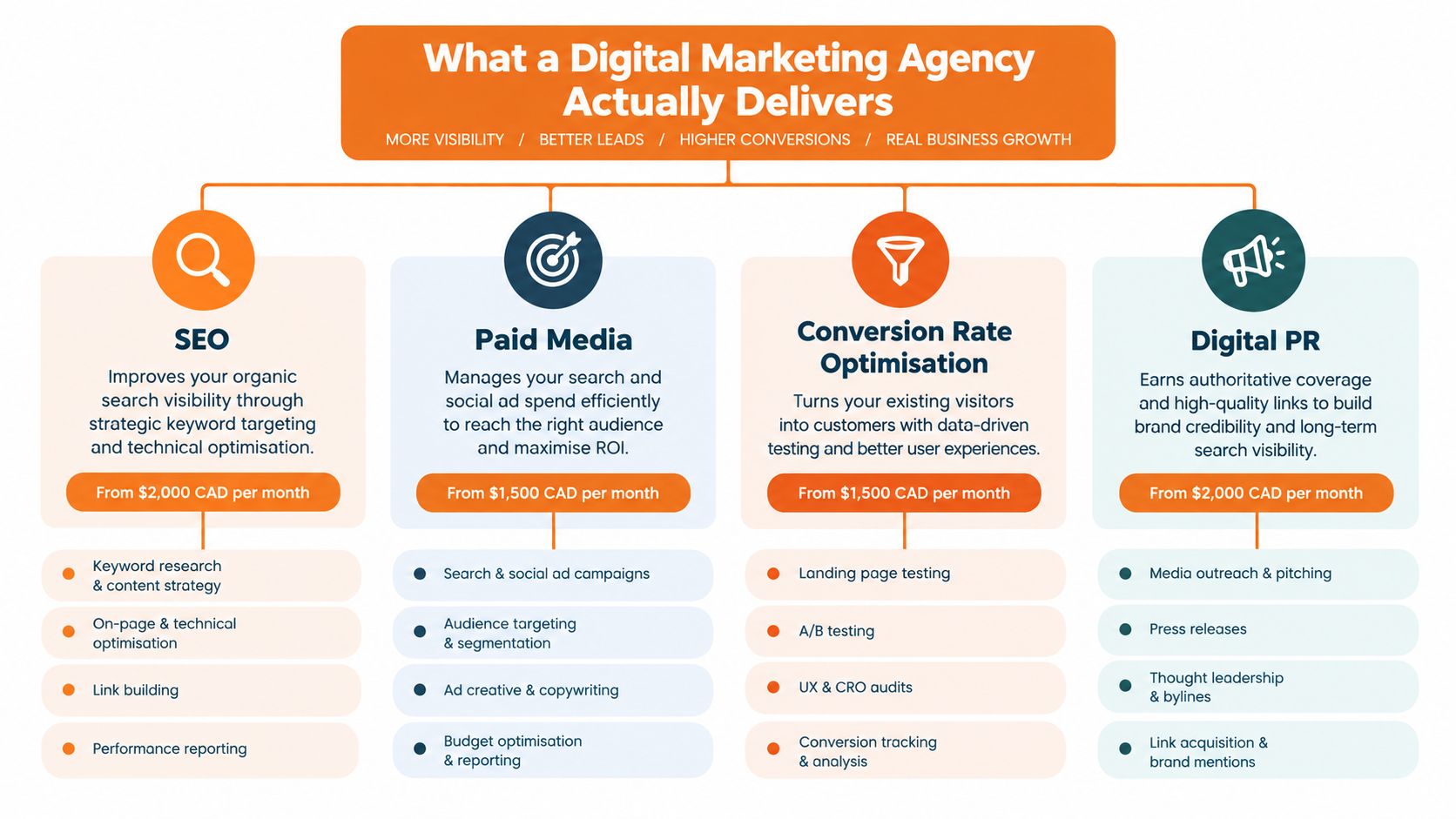
The right partner therefore acts as a growth engineer. SEO creates discoverability, paid media captures demand, social and video influence consideration, CRO removes friction, and PR builds credibility and authority. The value comes from the connections between those disciplines, not from the number of services listed in a proposal.
What a Digital Marketing Agency Actually Delivers
A modern agency should organise work around the customer's decision process rather than around platform departments. Search often captures existing intent, while social and video can create or shape demand before a prospect searches. Paid and organic activity then need landing pages, persuasive proof, and reliable conversion tracking to turn attention into commercial action.
Canada's advertising market shows why an integrated approach matters. IAB Canada reports that digital advertising reached approximately CAD $21.1 billion in 2025, growing 16% year over year. Search accounted for 43% of digital advertising revenue, social media represented 30%, and video was the fastest-growing major format, increasing 26%. IAB Canada's 2025 revenue survey supports treating these channels as different jobs within the same funnel, not interchangeable traffic sources.
SEO builds durable discoverability
SEO starts with search intent, not a list of keywords. The agency maps commercial queries to useful pages, resolves technical barriers, improves internal linking, strengthens local relevance, and develops content that answers the questions customers ask before contacting a business.
For a Vancouver clinic, that could include service pages, practitioner information, location signals, structured data, and Google Business Profile improvements. For an e-commerce brand, it might mean a cleaner category structure, stronger product descriptions, indexation control, and content that supports product discovery without cannibalising transactional pages.
Paid media buys attention with a purpose
Paid search captures demand that already exists. Social and video can introduce a problem, product, or point of view to people who haven't formed a search query yet. A competent agency assigns each campaign a role, a conversion event, an audience definition, and a budget rule.
That means testing search terms, ad copy, landing-page relevance, audience exclusions, creative fatigue, and geographic performance. It also means refusing to scale a campaign just because the platform reports a low cost per lead.
CRO improves the value of existing demand
Conversion-rate optimisation examines what happens after the visit. Agencies review message match, page speed, trust signals, forms, calls to action, checkout steps, mobile usability, and friction in the booking process.
The best CRO work isn't a redesign based on preference. It uses analytics, recordings where consent permits, customer feedback, and controlled testing to identify changes that improve qualified actions.
Digital PR compounds credibility
Digital PR earns relevant coverage, expert commentary, brand mentions, and authoritative links. It can support SEO, give paid campaigns stronger proof, and help a brand become recognisable before the customer is ready to buy.
The four pillars should share information. Paid-search query data can reveal language for landing pages. Sales objections can shape SEO content. PR coverage can strengthen conversion pages. CRM outcomes should influence every channel's next decision.
How Agencies Prove ROI Beyond Rankings and Clicks
Rankings and clicks are useful diagnostic signals, but they aren't business outcomes. A local firm can rank for a high-volume query and attract visitors who live outside its service area. Another firm can receive fewer visits from a narrower query and book valuable consultations consistently.
Statistics Canada reported that businesses with five or more employees generated CAD $398 billion in e-commerce sales in 2021, compared with CAD $305 billion in 2019. The share of businesses making or receiving online sales rose from 25% in 2019 to 33% in 2021, and 89% had at least one web presence in 2021. Statistics Canada's business e-commerce release shows why digital activity has become commercial infrastructure, not merely a branding exercise.
Build the measurement chain
A serious engagement begins with a measurement map:
- Define the commercial outcome. Choose qualified leads, booked consultations, completed purchases, gross profit, or another business result.
- Separate conversion events. Track Google Business Profile actions, calls, forms, bookings, purchases, and messages independently.
- Connect marketing to the CRM. Record qualification, sales status, revenue, service area, and customer type.
- Reconcile channel reporting. Compare platform conversions with first-party records instead of accepting every claimed conversion.
- Review incrementality. Ask whether the campaign created new demand or captured customers who would have arrived through branded or direct channels.
- Use the result to allocate budget. Invest more where qualified revenue and contribution margin justify it, not where a dashboard looks busy.
A report should make it possible to answer, “How many qualified customers did this activity create, what did they cost, and what did they return?” For a deeper financial framework, use this guide to calculate marketing ROI, then adapt the model to your margins, sales cycle, and repeat value.
| Surface Metric | Why It Misleads | Better Outcome to Track |
|---|---|---|
| Impressions | Visibility can rise without meaningful intent | Qualified enquiries or product revenue |
| Clicks | A click doesn't confirm fit, location, or buying intent | Engaged sessions followed by a tracked action |
| Cost per lead | Cheap leads may be irrelevant or impossible to close | Cost per qualified lead and booked appointment |
| Form completions | Duplicate, incomplete, and spam submissions inflate volume | Validated opportunities in the CRM |
| Rankings | Position doesn't show whether visitors can convert | Revenue or qualified demand from target queries |
| Platform-reported conversions | Attribution windows can claim assisted or existing demand | Incremental customers and contribution margin |
The agency should also distinguish branded search from actual new customer acquisition. If a campaign receives credit for people who already knew the business, the apparent return can look stronger than the actual growth contribution. That doesn't make branded campaigns useless. It makes their role different, and their reporting should say so.
The Hidden Risk of AI-Powered Marketing Without Governance
AI can accelerate analysis, production, segmentation, and testing. It can also accelerate the publication of an unsupported health claim, the use of sensitive customer data without a defensible purpose, or a report that confuses machine-assisted attribution with incremental revenue.
Statistics Canada reported that 12.2% of Canadian businesses used AI to produce goods or deliver services in the 12 months preceding Q2 2025, up from 6.1% a year earlier. Among businesses using AI, marketing automation rose to 23.1%, from 15.2% in Q2 2024. Separately, 14.5% of Canadian businesses planned to use AI over the next 12 months in Q3 2025, with marketing automation selected by 25.6% of those businesses. Statistics Canada's AI adoption analysis indicates that adoption is moving quickly enough for governance to become part of normal marketing operations.

Use data with a defined purpose
An agency should document which data it uses, why it needs it, who can access it, how long it is retained, and whether the customer consented to the relevant use. First-party data such as authenticated purchase history or voluntarily submitted enquiry details may support legitimate marketing work, but sensitive inferences require greater care.
For cannabis, CBD, functional mushrooms, wellness, and health businesses, the review process should cover:
- Claims: Every product, health, and performance claim needs human approval before publication.
- Audience rules: Avoid targeting built on sensitive or speculative personal attributes.
- Consent: Keep a clear record of permission for email, remarketing, profiling, and data sharing.
- Prompt and output review: Treat AI drafts as unapproved working material, not publish-ready expertise.
- Attribution: Separate AI-assisted reporting from evidence that a campaign produced additional customers.
- Access controls: Limit customer data exposure to the people and systems that need it.
Faster content production isn't a strategy if the brand must later retract claims, explain an opaque audience decision, or repair customer trust.
AI is particularly useful for clustering search terms, identifying patterns in call transcripts where lawful, generating test variants, summarising reporting, and finding anomalies across campaigns. It is less reliable at deciding whether a medical implication is acceptable, whether a customer inference is fair, or whether a small lift is genuinely incremental.
A practical governance system includes an approval owner, a claims library, a consent record, documented exclusion rules, and a test design that can distinguish new demand from demand the brand would have captured anyway. Businesses operating in sensitive categories can begin with a compliance risk assessment before giving an agency access to customer or campaign data.
How to Evaluate and Choose the Right Agency Partner
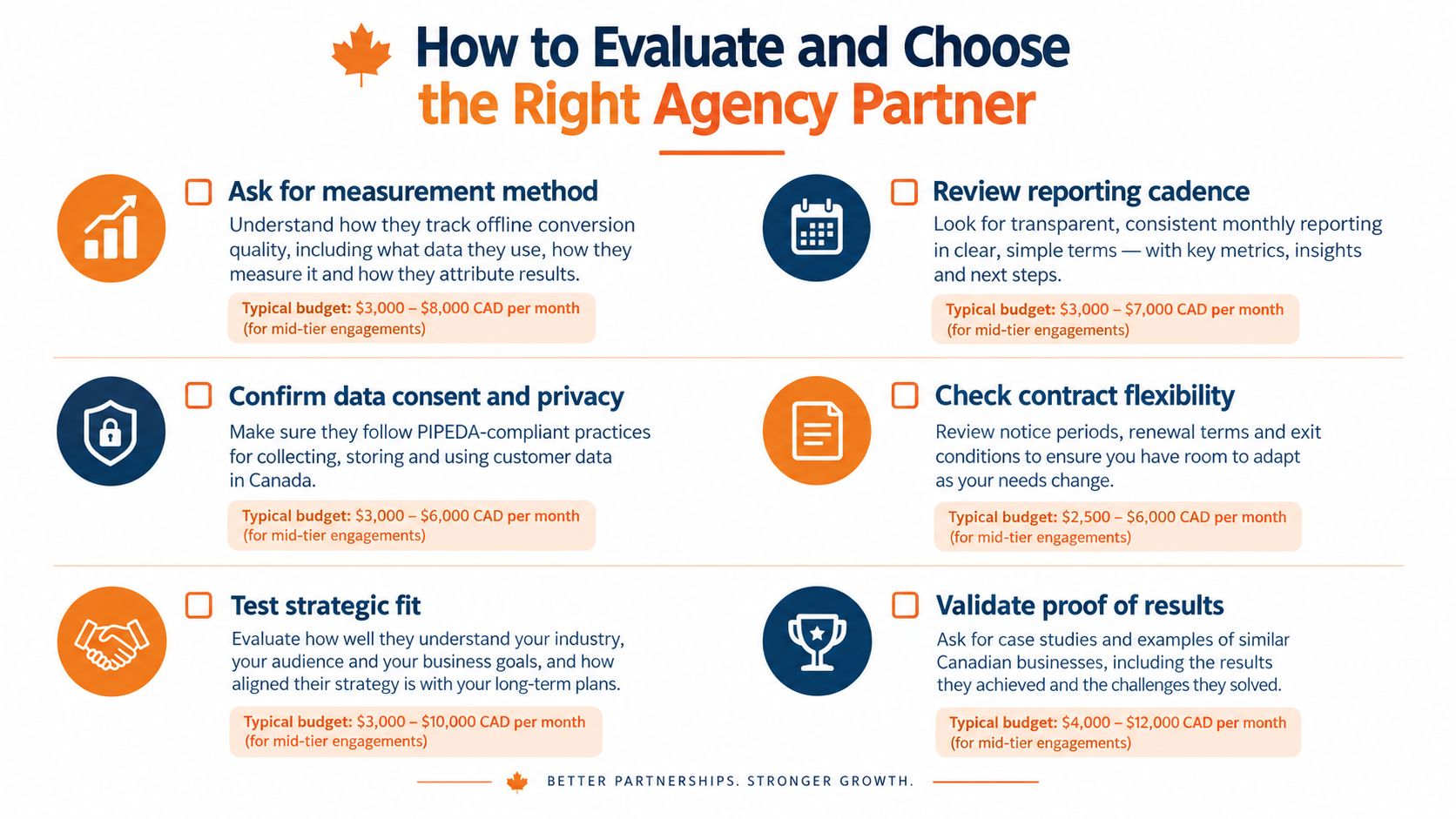
Choosing an agency is less about finding the longest service list and more about testing how the team thinks. Ask for the reporting path from impression to qualified customer, then ask what happens when a platform conversion doesn't match the CRM. If the answer stops at clicks or form fills, the engagement may optimise activity rather than growth.
Use a decision filter before discussing tactics
Measurement comes first. Ask whether the agency can track calls, booked appointments, purchases, and lead quality. Request a sample report with fake or anonymised data if necessary. You should be able to see what the agency labels as a conversion and how it validates that label.
Privacy should be operational. Ask where customer data goes, which tools process it, who reviews AI output, and how consent is documented. An agency working with regulated or sensitive categories should explain its approval workflow without hiding behind general assurances.
Contract flexibility reveals confidence, but it isn't proof. A flexible notice period can reduce switching risk, while a long agreement may sometimes reflect the time required for technical SEO or content development. Judge the terms alongside milestones, access ownership, reporting cadence, and exit conditions.
Strategic fit matters more than platform fluency. A local-service firm needs geographic segmentation, call quality, and booking economics. An e-commerce brand needs product-feed quality, landing-page relevance, merchandising insight, and retention measurement. The same agency model won't suit both equally.
Match the investment to the bottleneck
Start with the constraint, not a preselected package. If local demand exists but the business misses calls, fix tracking and conversion paths. If the offer converts but lacks visibility, prioritise SEO and paid search. If traffic is substantial but sales are weak, CRO may create more value than adding another acquisition channel.
Ask each candidate to explain what it won't do yet. A disciplined agency can say that a new social channel is premature, that broad content won't solve a broken booking flow, or that more ad spend is unjustified until lead quality is visible.
Vancouver-based Juiced Digital works with regulated and niche sectors including cannabis, CBD, and functional mushrooms, and describes compliant, performance-focused campaigns without long-term contracts. Its published case-study positioning focuses on sustained organic traffic, local visibility, and sales growth. You can compare engagement structures through its digital marketing agency pricing information, then ask for evidence relevant to your business model.
Traditional Versus AI-Augmented Agency Engagement Models
The choice isn't between a human agency and a machine. The meaningful distinction is whether automation supports accountable strategy or replaces judgement that should remain with people.
Two-thirds of Canadian businesses reported no plans to use AI in Q3 2025, while 18.9% were uncertain, according to Statistics Canada's business adoption reporting. That uneven adoption means many firms need clear decision rules before they need additional automation.
| Dimension | Traditional engagement | AI-augmented engagement |
|---|---|---|
| Research | Strategists conduct manual analysis and prioritisation | Systems accelerate clustering, pattern detection, and summaries |
| Content | Writers produce and revise material | AI drafts variants, with human fact-checking and editing |
| Paid media | Specialists manage audiences, bids, and creative | Automation supports testing and anomaly detection |
| Reporting | Analysts compile channel and business data | Systems speed reconciliation, but people validate attribution |
| Governance | Review depends on team process | Human approval remains essential for claims, privacy, and sensitive audiences |
| Best fit | Businesses needing close strategic collaboration or cautious change | Teams seeking operational speed with documented oversight |
A traditional model can suit a founder who needs education, hands-on coordination, and a narrow set of tested channels. An AI-augmented model can suit a larger operation with clean first-party data, repeatable workflows, and enough governance to review outputs properly.
Regulated businesses should favour controlled automation over maximum automation. A smaller funnel with verified calls, bookings, and sales can outperform a broad programme that produces impressive activity but uncertain customer quality.
Case Studies Showing Measurable Growth Without Long-Term Contracts
Case studies should show the chain from intervention to outcome, not just display a before-and-after traffic chart. For a Vancouver clinic, that means connecting local SEO and Google Business Profile work to calls, booking requests, completed appointments, and repeat demand.
For an e-commerce brand selling across North America, the relevant evidence includes technical SEO, category and product-page improvements, product-feed quality, landing-page relevance, and sales data. Organic traffic growth matters, but the commercial question is whether qualified sessions produce purchases at an acceptable margin.
A regulated wellness or cannabis client requires another layer of proof. The agency must demonstrate that content and paid campaigns followed approved claims, that audience data was handled appropriately, and that reported sales did not rely on unsupported attribution. Juiced Digital describes case studies involving sustained gains in organic traffic, local dominance, and sales growth, including work for regulated and niche sectors, while operating without long-term contracts.
The strongest case study names the baseline, intervention, measurement method, time period, and business result. If an agency can't explain how it verified the outcome, treat the success claim as a marketing asset rather than decision-grade evidence.
Next Steps to Start Building Your Growth Strategy
Start with a diagnostic, not a channel wishlist. List your highest-value services or products, the locations you serve, the customer actions that create revenue, and the points where tracking currently breaks. Pull together Google Business Profile activity, advertising data, analytics, call records, booking information, and CRM outcomes so the agency can assess the whole path.
A useful audit should answer practical questions:
- Which searches and audiences create qualified demand?
- Which landing pages lose visitors before conversion?
- Which calls, forms, or bookings become real opportunities?
- Which campaigns claim conversions that the CRM cannot verify?
- Where could AI save time without weakening consent, claims review, or attribution quality?
- Should the next investment favour local SEO, paid search, CRO, PR, or measurement infrastructure?
The right strategy may be narrower than the one you expected. You may need better call tracking before increasing ad spend, stronger service pages before producing more blog content, or a controlled AI workflow before automating customer communications. Those choices protect budget because they address the constraint closest to revenue.
A free consultation or audit gives you a practical way to test whether your current marketing creates profitable growth. Bring your reporting, sales process, and compliance concerns to the conversation, and ask the agency to explain what it would prioritise, what it would postpone, and how it would prove progress.
Juiced Digital combines SEO, paid media, CRO, digital PR, and AI-assisted execution with human review for local, e-commerce, and regulated businesses. Visit Juiced Digital to request a free consultation and assess where better measurement, stronger conversion paths, and privacy-aware growth work can improve your funnel.