
A Vancouver service business can do everything “right” in traditional search and still feel invisible when a customer asks an AI assistant for a recommendation. The company may hold a strong organic position, publish useful pages, and maintain accurate local listings, yet the searcher receives a synthesized answer before seeing the familiar list of blue links. Sometimes the answer includes a citation. Sometimes it satisfies the question without sending a visit at all.
That changes the commercial problem. AI search optimization services aren't a new label for keyword research. They help businesses become understandable, sourceable, and credible inside AI-generated answers, while connecting that visibility to calls, bookings, enquiries, and sales. The right strategy starts with conversion value, then works backwards to determine which prompts, entities, pages, and citations deserve investment.
Why AI Search Is Reshaping the Buying Journey
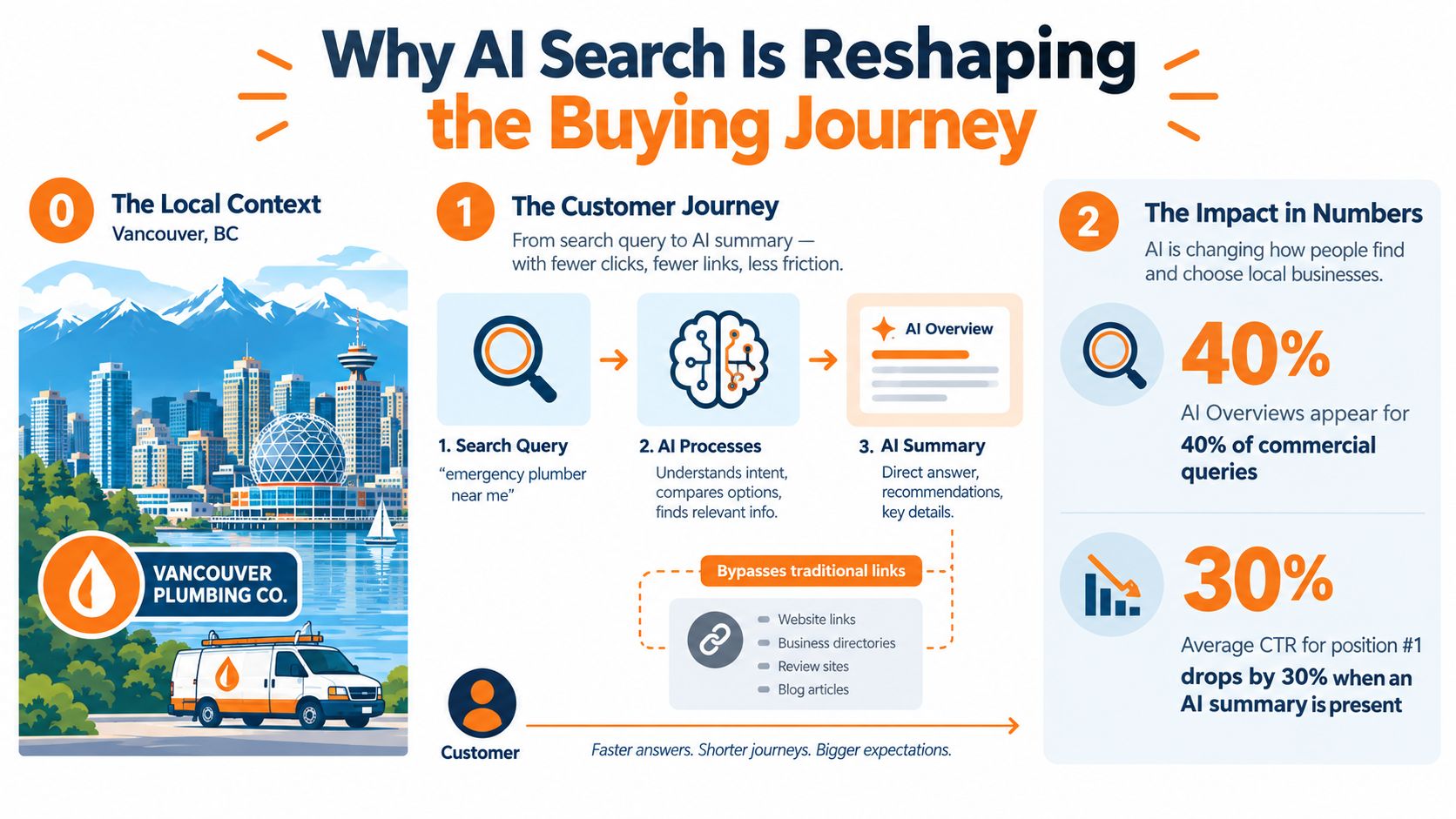
A Vancouver plumbing company owner notices the shift in a weekly report. The page targeting emergency sump pump repair in Burnaby still appears prominently in conventional results, but fewer searchers reach the site. The query now produces an AI summary that explains likely causes, suggests urgent next steps, and may mention local providers. The owner hasn't necessarily lost relevance. The buying journey has moved closer to the answer itself.
Google AI Overviews, Microsoft Copilot, ChatGPT, and Perplexity can compress several research steps into one response. A customer asks what service is needed, what it might involve, and which provider serves the area. The system assembles information from multiple sources, then presents a shortlist or explanation. The remaining click often comes from a user who wants confirmation, pricing context, availability, or a trusted provider, not from someone casually gathering information.
Canada already has a substantial audience operating inside AI-enabled workflows. In March 2026, 41.6% of Canadian workers had used at least one AI or automation technology in their main job or business during the previous 12 months, according to Statistics Canada data reported in a Canadian AI search adoption analysis. That doesn't prove that every worker uses an AI search tool to choose a plumber or purchase a product. It does show that AI-assisted research and production are becoming familiar parts of the Canadian commercial environment.
The click is no longer the only visibility event
An organic ranking remains useful, but it no longer captures the full path to a sale. A brand can be:
- Cited in an AI answer: The assistant uses the page as supporting evidence.
- Mentioned without a visit: The business becomes part of the user's consideration set before the user reaches its website.
- Used as a comparison source: A product, service area, credential, or policy helps the assistant form a recommendation.
- Visited after a high-intent prompt: The user clicks because the answer has already narrowed the decision.
A Canadian industry report states that Google AI Overviews appeared on approximately 47% of Canadian commercial-intent queries in Q1 2026, compared with about 24% in Q1 2025. The figures come from a Canadian AI search index report. The commercial implication is straightforward. A ranking report that ignores answer inclusion, citation share, and lead quality can make a healthy-looking channel appear healthier than it is.
Practical rule: Treat an AI result as a conversion touchpoint, not merely a new search feature.
Classic SEO still supplies important foundations, including crawlability, internal linking, relevant content, and authority. AI search optimization adds another layer by asking whether a system can identify the business, extract a direct answer, verify the claim, and confidently associate the source with a specific commercial need. That is why the useful question isn't “How do we rank first?” It is “Which high-value prompts should produce a qualified recommendation, and what evidence will make our business a credible source?”
How AI Search Optimization Services Actually Work
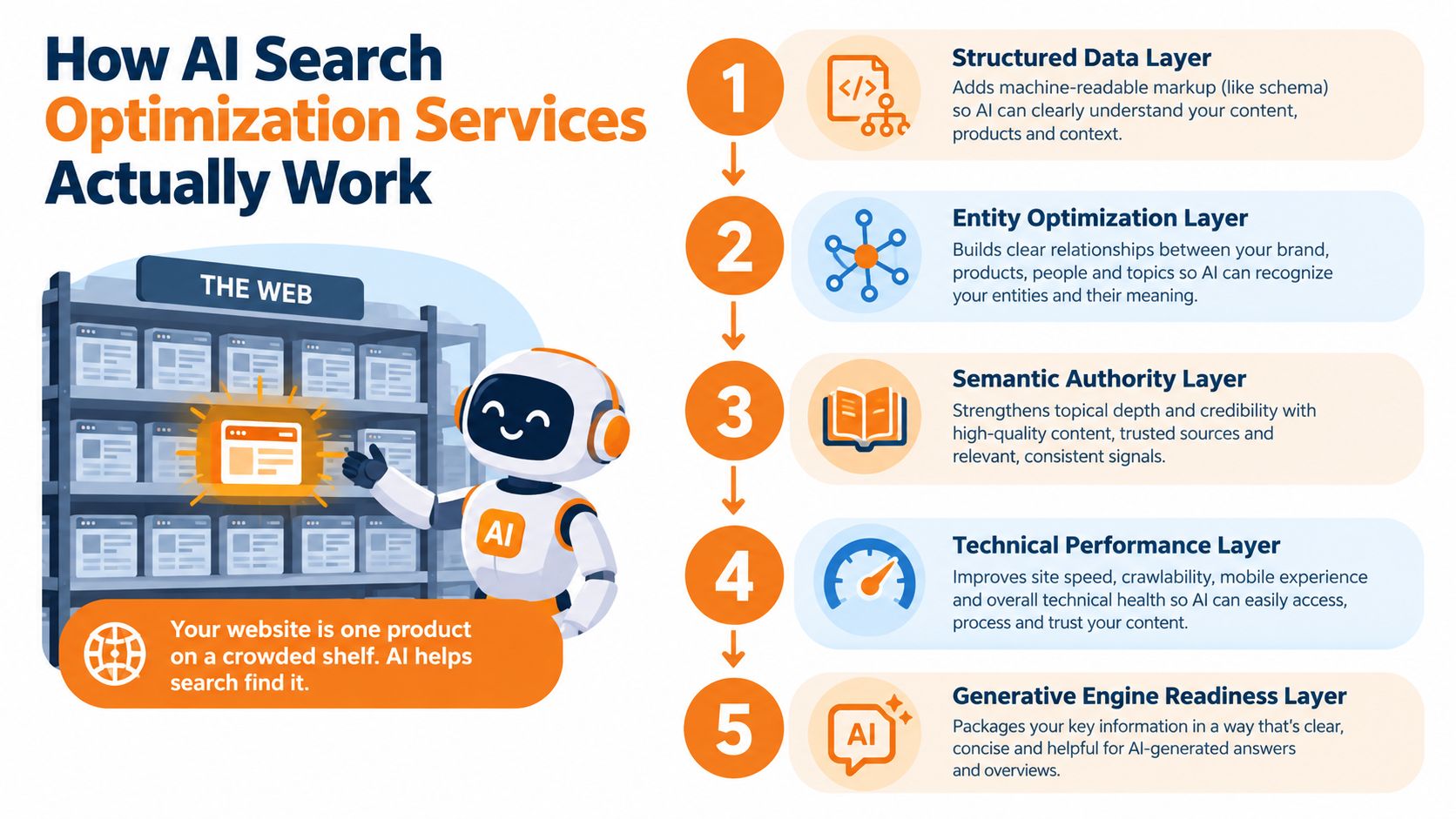
Think of a website as a product on a crowded warehouse shelf. Entities are the shelf labels, structured data is the barcode, crawlability determines whether the forklift can reach the product, answer blocks describe the contents clearly, and external citations resemble reviews from sources the buyer trusts. An AI assistant needs all of those signals to find, interpret, and reuse the information.
A credible programme usually works across five technical layers.
Entity consistency
The business name, address, phone number, service areas, founders, products, qualifications, and category should describe the same organisation everywhere. That includes the site's About page, Organization or LocalBusiness schema, Google Business Profile, Bing Places, social profiles, industry directories, and relevant knowledge sources.
Inconsistency creates ambiguity. If one profile uses a shortened company name, another lists an old address, and the website describes a different service category, an AI system has to resolve competing versions before it can recommend the business. Entity work should produce a documented source of truth, not a collection of disconnected listing updates.
Structured data
JSON-LD gives search systems machine-readable context. Depending on the page, an implementation may use Organization, LocalBusiness, Service, Product, Article, FAQPage, or HowTo schema. The markup must reflect visible, accurate content. Adding every available schema type won't make a weak page authoritative.
Speakable markup can help identify content intended for spoken presentation where supported, but it isn't a universal shortcut to voice or AI inclusion. The practical objective is clearer classification, stronger relationships between pages, and fewer unanswered questions about what the business offers.
Crawlability for AI systems
Technical audits should examine access for relevant crawlers, including GPTBot, ClaudeBot, PerplexityBot, and Google-Extended, while preserving the organisation's privacy, licensing, and security preferences. Robots.txt rules, rendering, blocked resources, canonical tags, redirects, and server responses can prevent useful information from being discovered.
Some Canadian agency guidance describes audits that check AI crawler access, schema coverage, and query tracking across answer engines in its overview of AI search optimisation. The important distinction is between an audit that identifies a real access problem and a sales report that treats every bot as a ranking lever.
Prompt-answer content
Pages should answer real buyer questions in clean, self-contained sections. Use descriptive headings, short explanations, comparison tables, process steps, and FAQs where they help. A service page should state who the service is for, where it operates, what happens next, and which limitations apply.
The strongest answer block can stand alone when extracted. It should identify the subject, make one clear claim, and provide enough context that a reader doesn't need the surrounding page to understand it.
Citation signals
AI systems often draw confidence from sources beyond a company's own website. Relevant trade publications, local organisations, professional directories, product reviews, community discussions, and editorial references can reinforce the entity and its expertise.
The target isn't the highest possible mention count. It is mention quality, including topical relevance, factual consistency, editorial independence, and a clear relationship to the query. A dozen unrelated directory listings won't substitute for a few credible sources that describe the business accurately.
Teams often bundle technical audits, schema, content restructuring, and citation monitoring into one retainer. Digital PR may remain separate because it involves different editorial workflows, relationship building, and compliance review. Buyers comparing approaches can also review this guide to generative engine optimisation strategy.
A short demonstration can make the difference between a conceptual framework and a practical implementation. The video below provides another perspective on how these layers fit into an AI search workflow.
The Core Capabilities Worth Paying For
A proposal deserves scrutiny when it labels familiar SEO work as AI search expertise. Semantic clustering and internal linking may already sit inside a strong traditional SEO engagement. Structured data, prompt-level monitoring, crawler analysis, and citation development can justify incremental spend when the vendor connects them to commercial visibility and qualified actions.
| Capability | What It Actually Delivers | AI Search Metric Moved | Overlap With Classic SEO |
|---|---|---|---|
| AI-driven keyword and intent clustering | Groups questions by buyer stage, service, location, and decision context | Prompt coverage and visibility across related queries | High |
| Semantic entity mapping | Identifies the people, places, products, services, and concepts the brand must be associated with | Entity coverage and recommendation relevance | Medium to high |
| SERP feature optimisation | Structures pages for AI Overviews, featured snippets, People Also Ask, and knowledge panels | Answer inclusion and feature presence | Medium |
| On-site signal hardening | Improves crawlability, internal links, page clarity, and trust signals | Eligible source pages and qualified referral visits | High |
| Generative-answer content | Creates concise, sourceable answers, comparisons, definitions, and process explanations | Citation share and prompt-level visibility deltas | Medium |
| Structured data implementation | Labels organisations, services, products, articles, and FAQs for machine interpretation | Entity recognition and page classification | Medium |
What a useful report contains
A monthly report should show more than rankings or a proprietary “AI score.” Require the fixed prompt set, checking dates, answer engine, competitor set, and change in citation presence. Without those details, a visibility trend is difficult to reproduce or assess.
Useful fields include:
- Citation share: How often the brand appears as a cited source against named competitors.
- Prompt visibility delta: Which prompts gained or lost inclusion, and the page or content change associated with that movement.
- Entity coverage: Whether key services, locations, experts, and products are represented consistently.
- Qualified outcomes: Calls, forms, bookings, revenue, and lead quality connected to the exposure.
A fixed prompt set should reflect buying intent, not every question a language model can answer. For a BC service business, that may mean queries combining a service with a city, urgency, eligibility, or comparison. AI summaries can compress clicks, so prioritise prompts where a citation can influence a shortlist, enquiry, booking, or store visit.
AI keyword tools can speed up clustering and content analysis, but editorial judgement still determines whether an answer is accurate, locally relevant, and worth publishing. Teams reviewing their workflow can use this resource on AI tools for SEO to assess available tools, then design measurement around business outcomes rather than tool output.
For a budget below $3,000 per month, prioritise measurement, entity cleanup, technical access, structured data on commercial pages, and rewrites for the highest-value prompts. Avoid distributing limited budget across every informational topic or purchasing large volumes of generic AI-written articles. Each deliverable should have a defined buyer query, source page, and conversion path.
Pricing Models and ROI Metrics in Canada
Canadian buyers should assess AI search work by qualified demand and commercial outcomes, not dashboard volume. A practical benchmark places AI search optimisation for many SMBs at approximately $1,500 to $4,000 per month on top of traditional SEO, covering foundation work, answer-focused rewrites, and ongoing measurement. See its Canadian pricing benchmark for the stated reference.
| Tier | Monthly Cost CAD | Typical Deliverables | ROI Metrics Tracked |
|---|---|---|---|
| SMB add-on retainer | $1,500 to $4,000 | Prompt audit, entity cleanup, priority schema, selected content rewrites, monthly reporting | Citation share, qualified enquiries, AI referral traffic |
| Project engagement | Project fee varies by scope | Technical audit, schema rollout, crawlability fixes, measurement setup | Indexed commercial pages, prompt coverage, assisted conversions |
| Attribution-based model | Varies by provider and scope | Prompt monitoring or citation-focused work | Verified citations, qualified visits, pipeline influence |
| Enterprise programme | Custom retainer with content velocity | Multi-site governance, digital PR, content production, technical support, reporting | Share against competitors, revenue influence, cost per qualified lead |
Use the benchmark as an operating reference, not a fixed price list. Site size, sector risk, content requirements, and market coverage affect the final scope. A vendor charging separately for every citation or prompt should show how those events relate to enquiries, bookings, sales, or pipeline.
Metrics that survive executive scrutiny
Track referral sessions from ChatGPT, Perplexity, Gemini, and Copilot where analytics can identify them. Connect those visits to call tracking, form submissions, booking systems, CRM stages, and sales outcomes. Citation share remains useful for competitive visibility, but it is not revenue.
For BC businesses, prioritise local commercial queries where an AI-generated shortlist can influence a call, appointment, visit, or quote. A broad increase in AI mentions may look positive while producing little qualified demand. Measure the queries that reach buyers, especially those combining a service with a city, urgency, eligibility, or comparison.
The metric that matters most is not how often an AI system says your name. It is whether the right prospects take the next commercial step.
Require a measurement plan before signing. It should define attribution limits, assisted conversions, offline sales, branded searches after exposure, and methods for separating visibility gains from seasonal or campaign-driven demand. Contract red flags include vague service fees, outdated metrics treated as primary KPIs, locked dashboards that prevent data export, and guaranteed citation counts without clear query or quality definitions.
Choosing a Vendor Without Getting Burned
Glossy pitch decks often describe “AI visibility” without explaining how the work is performed. A credible vendor should be comfortable showing the audit method, the prompt set, the source-quality criteria, and the path from a citation to a qualified lead.
Use seven checks during evaluation.
What to ask before approval
- Platform experience: Ask whether the team has separately tested Google AI Overviews, Bing Copilot, ChatGPT search, and Perplexity. A generic claim about “optimising for AI” isn't enough.
- Technical methodology: Require a written explanation of entity consistency, schema, crawlability, rendering, internal linking, and answer-first content.
- Crawler evidence: Request log-file analysis covering relevant AI crawlers, rather than a simple robots.txt screenshot.
- Commercial reporting: Confirm that citation share is tied to named competitors, priority prompts, leads, and pipeline influence.
- Regulated-sector proof: For cannabis, health, finance, or legal work, ask for examples of claims review, author credentials, disclosures, and approval workflows.
- Editorial control: Confirm who approves facts, edits claims, handles publisher changes, and responds to inaccurate AI summaries.
- Canadian fit: Discuss PIPEDA awareness, data handling, Canadian market context, regional intent, and bilingual capability where the audience requires it.
A real proposal should identify the site sections being audited, the initial prompts, the technical changes, content deliverables, external authority work, reporting cadence, owners, dependencies, and review gates. It should also say what the vendor won't do, such as publish unsupported medical claims or create artificial reviews.
The thirty-minute interview
Give each candidate the same questions:
- Which pages would you inspect first, and why?
- How do you define a citation?
- How will you test whether a citation produces qualified demand?
- What happens when an AI answer misstates our product or service?
- Which work overlaps with our existing SEO retainer?
- What access and approval responsibilities remain with our team?
- Can we export the raw prompt and referral data?
A proprietary score can be useful for internal prioritisation, but it shouldn't replace observable evidence. If a vendor cannot show the prompts, sources, changes, and business outcomes behind the score, treat it as a presentation device.
Businesses that need a Canadian team combining AI search, SEO, paid media, CRO, and digital PR can review Juiced Digital's AI SEO agency services alongside other providers. Compare methodology and accountability, not just branding.
A Realistic 90-Day Implementation Roadmap
A representative Vancouver professional services firm starts with a familiar problem. Its website explains the offer, its local profile is active, and several pages rank for relevant terms, but AI answers describe the category without consistently naming the firm. The first ninety days should improve the evidence base before anyone promises a dramatic outcome.
Days 1 to 15
The team records baseline visibility for a fixed set of commercial prompts and checks whether the firm appears, is cited, or is omitted. It reviews analytics, call tracking, CRM stages, local listings, page templates, schema, canonicalisation, internal links, and crawl logs.
The citation-gap audit compares the firm with its three most relevant competitors. The comparison should identify which sources appear repeatedly in AI answers, which entities are associated with each competitor, and which factual claims lack a reliable source.
Days 16 to 45
Foundation work corrects the organisation's name, location, services, experts, and relationships across the website, Google Business Profile, Bing Places, and appropriate knowledge sources such as Wikidata. Developers implement accurate Organization, LocalBusiness, Service, FAQ, or Product schema where the page content supports it.
Technical fixes address blocked resources, poor rendering, confusing redirects, orphaned pages, duplicate content, and unclear navigation. Robots rules and any llms.txt guidance are reviewed as part of the access policy, but no file should be treated as a guaranteed inclusion mechanism.
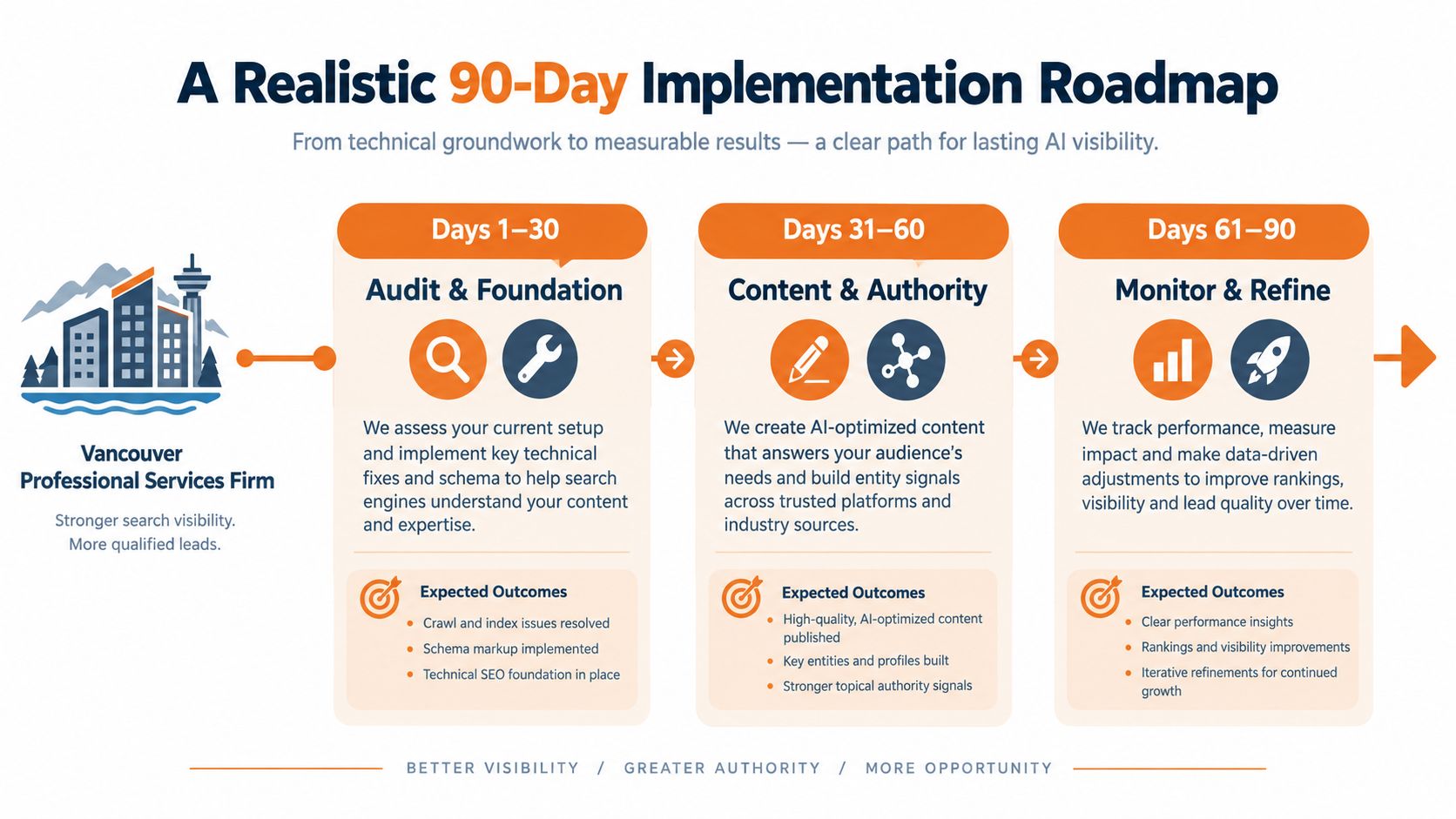
Days 46 to 75
Writers restructure priority pages around questions buyers ask. A professional services page might explain fit, process, service boundaries, locations, timelines in qualitative terms, and the evidence supporting the firm's expertise. Comparison pages can clarify alternatives without making unsupported competitor claims.
Digital PR then gives other publishers a reason to mention the firm. Original commentary, useful Canadian market resources, expert contributions, and data that the business can substantiate are more valuable than mass-produced outreach. Every proposed claim needs an owner and a source.
Days 76 to 90
The team measures changes in AI referral traffic, citation share, prompt inclusion, lead quality, and sales progression. A 30, 60, and 90-day review should distinguish completed work from observed outcomes and identify which prompts deserve continued investment.
No reputable programme can guarantee that an AI system will cite a page on a fixed schedule. Warning signs include reports with no prompt list, traffic increases without lead-quality analysis, schema that doesn't match visible content, unexplained AI scores, or content published without client review.
Regulated Sectors and Compliance Considerations
AI citation visibility can be valuable in cannabis, CBD, wellness, telehealth, financial services, legal services, healthcare, and e-commerce. It also creates a sharper risk: a generated answer may present a simplified or inaccurate claim with the business's name attached. In regulated markets, that isn't merely a branding inconvenience.
A CBD company in Kelowna shouldn't allow an AI-generated summary to become an implied dosing recommendation. A Vancouver fintech needs clear, sourceable explanations of eligibility, fees, risks, and limitations. A healthcare clinic must distinguish general education from diagnosis or treatment advice, while a law firm needs content that respects applicable professional conduct requirements.
| Sector | Primary Regulator | Key AI Search Risk |
|---|---|---|
| Cannabis and CBD | Health Canada and applicable provincial authorities | Unsupported therapeutic, efficacy, dosing, or health claims |
| Telehealth and healthcare | Health Canada, provincial health authorities, and professional colleges | AI summaries that blur education, diagnosis, treatment, or professional advice |
| Financial services and fintech | FINTRAC and applicable provincial or federal authorities | Incomplete disclosures, misleading product descriptions, or inaccurate eligibility claims |
| Legal services | Provincial law societies | Overstated outcomes, misleading comparisons, or claims that imply guaranteed results |
| E-commerce and wellness | Product and consumer-protection authorities | Product claims, reviews, ingredients, and usage information repeated without context |
The playbook needs human review wherever AI-assisted content touches a regulated claim. Require a source for factual statements, show author credentials, display relevant dates, review language for implied promises, and maintain a change log for regulated pages. Freshness signals should reflect real editorial review, not an arbitrary date update.
A citation is not an approval. It only shows that an AI system selected a source, and the source still carries responsibility for what it publishes.
E-commerce often has a simpler path when pages focus on specifications, compatibility, ingredients, shipping, returns, and product comparisons that the business can verify. That doesn't remove compliance obligations. It does make the content easier to structure without turning the AI assistant into an unsupervised claims writer.
Next Steps and Common Questions
A Canadian business can run a useful first check this week:
- Request a crawler audit: Confirm that important pages can be discovered and rendered.
- Benchmark citation share: Use a fixed set of commercial prompts and named competitors.
- Inspect structured data: Compare schema with the visible claims on each priority page.
- Reconcile entities: Standardise business details, services, locations, and expert profiles.
- Instrument lead quality: Connect AI referrals and assisted visits to calls, forms, bookings, and CRM stages.
- Review the contract: Ensure raw data, definitions, approvals, and exit terms are clear.
Common buyer questions
How long does it take to earn citations? There isn't a universal timetable. Technical corrections can be implemented quickly, while editorial references, entity recognition, and competitive prompt visibility depend on the market and source quality.
What should reporting show? Ask for prompts, engines, citations, competitors, changes, referral data, and qualified outcomes. A single composite score isn't enough.
Does AI search replace SEO? No. Crawlability, useful content, internal linking, local accuracy, and authority still support discovery. AI search adds another visibility and attribution layer.
What contract length is reasonable? The work should have a defined foundation phase and a clear review point. Ongoing monitoring makes sense when the business has enough commercial prompts and content to optimise.
Can an in-house team manage it? Yes, if it has technical SEO, analytics, editorial, PR, and compliance capacity. Smaller teams often need outside help for crawler analysis, schema implementation, or citation outreach.
How should case studies be evaluated? Look for comparable sector, market, prompt evidence, lead-quality measurement, and documented constraints. Traffic alone doesn't establish commercial value.
The central test is simple. AI search optimization services earn their cost when they improve qualified pipeline, not when they inflate a vanity dashboard.
Juiced Digital provides AI Search SEO, technical optimisation, digital PR, and conversion-focused measurement for Vancouver businesses, Canadian regulated brands, and e-commerce teams. Visit Juiced Digital to request a free AI visibility audit and arrange a 30-minute consultation focused on citation share and qualified leads.