
Your campaign is getting attention. Search impressions are rising, paid ads are sending visitors to the site, and your email list is growing. Yet the sales page still feels quiet. People read the headline, browse a little, and leave without booking, buying, or requesting a quote.
That gap usually isn't a traffic problem. It's a message problem. Visitors need to understand what you offer, why it matters to them, why they should believe you, and what to do next. Copywriting connects those decisions across search results, advertisements, landing pages, emails, product descriptions, and local listings.
Canada adds another layer. Federal advertising must reach Canadians in the official language of their choice, and government advertising operations have used an approximately 80% English and 20% French spend mix, as documented by Statistics Canada. Canadian copy also has to account for regional language preferences, AI-assisted content, privacy expectations, and regulated claims.
Introduction Why Great Marketing Still Lives or Dies on Words
A founder launches a new service with a polished website. The design is clean, the logo is memorable, and the ad targeting is carefully configured. The hero section says, “Transform your business with solutions,” followed by a button labelled “Learn More.”
The campaign attracts clicks, but visitors don't know what they'll receive, who the service is for, or why this company deserves their trust. A rewrite might replace the vague promise with something more concrete: “Get a conversion-focused website for your Vancouver clinic, with messaging that helps more local patients book an appointment.” The second version gives the reader a market, an outcome, and a next step.
That's copywriting in marketing. It isn't decoration added after the strategy. It's the language that turns positioning into a decision.
Copy carries the promise through the funnel
SEO copy earns relevance for a search query, then gives the visitor a reason to continue. Paid ad copy earns attention during an interruption, then qualifies the click. Email copy uses an existing relationship to create urgency, explain value, or overcome hesitation. Landing-page copy gathers those promises and makes the next action feel logical.
The channels differ, but the underlying job stays consistent. Copy helps a person answer:
- Is this for me?
- Does it solve the problem I have?
- Can I trust the claim?
- What happens if I take the next step?
AI-led discovery adds a second audience. Search and shopping systems increasingly interpret product information, compare options, and surface recommendations. Canadian research describes cautious openness to these experiences, with trust remaining a barrier. One Canadian shopping study found that only 19% trust AI recommendations outright, while another found that 21% would let an AI agent make the final purchase decision, according to Retail Insider's coverage of the IBM study.
A performance system, not a writing exercise
Strong copy starts with customer research, clarifies the offer, adapts to the channel, and gets measured against business outcomes. Juiced Digital treats copy as part of a broader performance system, alongside SEO, paid media, conversion rate optimization, and digital PR.
The practical path is straightforward. First, understand what copy does. Then adapt it to each channel, build a message with proof, use AI with human oversight, measure the result, and refine the words that influence revenue.
What Copywriting in Marketing Really Means Today
Canadian advertising history offers a useful starting point. Early newspaper advertisements were often described as “bare and stilted,” with little warmth or colour, and they relied mainly on reason-based selling. As the industry matured from the late nineteenth century through 1930, historians identified the emergence of a distinct advertising trade in Canada, with agencies and practitioners becoming more formally organised, as documented by the Guelph Historical Society.
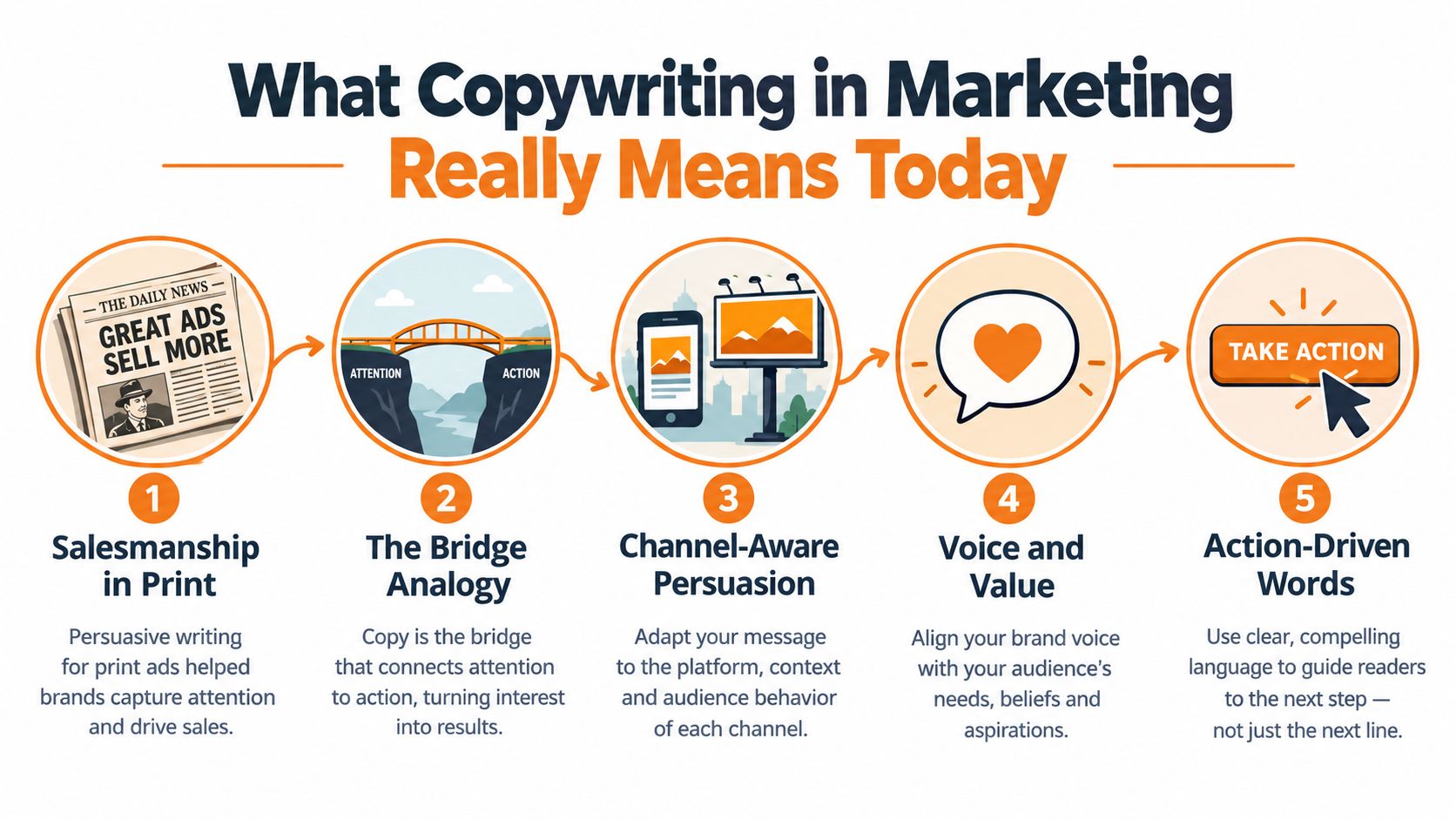
Another Canadian advertising history source describes advertising as “salesmanship in print.” The phrase still works because effective copy guides a reader through a decision, even when the medium is now a search result, TikTok caption, product page, or AI-generated shopping summary.
Think of copy as a guided conversation
A sales conversation rarely begins with a hard close. It begins by recognising the person's situation, explaining a relevant option, answering doubts, and asking for an appropriate next step. Copy does the same work at scale.
Use this four-part mental model:
- Voice makes the message sound like the brand and fit the audience.
- Message identifies the customer's problem and the desired outcome.
- Offer explains what the buyer receives, how it works, and what action to take.
- Proof reduces uncertainty through evidence the audience can evaluate.
A content writer might produce an educational article about improving sleep. A copywriter turns that understanding into a product page that explains who the product suits, what it does, how to use it, and why the buyer should act. Brand storytelling can create emotional meaning, but conversion copy must eventually connect that meaning to a decision.
Practical rule: If a sentence sounds impressive but doesn't help the reader understand, believe, or act, it probably needs revision.
Clarity beats cleverness
Clever copy asks the reader to interpret the message. Clear copy makes the relevance obvious. “Improve your everyday” could describe almost anything. “Book same-week physiotherapy in Vancouver” gives the reader a concrete service, location, and expectation.
This doesn't mean every brand should sound plain or generic. A distinctive voice matters, especially in crowded categories. But personality should strengthen the promise, not hide it.
Copy also changes with context. A searcher who types “CBD consultation Vancouver” has a different need from someone reading a wellness newsletter. The first person may want location, eligibility, and process details. The second may be open to education and a softer invitation.
The best copy preserves one central promise while changing its shape for the reader's situation. That's why copywriting isn't “writing words for ads.” It's message design for human and machine-mediated decisions.
How Copy Changes Across SEO Paid Media Email and Local
A single campaign promise shouldn't be pasted into every channel. The reader's attention, intent, available space, and relationship with the brand change from one surface to another.
SEO copy answers an existing question. Paid media interrupts attention and must qualify the click quickly. Email arrives in a more personal environment, where the subject line earns the open and the body earns the action. Local copy must make proximity, service relevance, and trust easy to verify.
Channel Copy Jobs at a Glance
| Channel | Primary Job | Copy Must-Haves |
|---|---|---|
| SEO page | Match intent and move the visitor toward a solution | Search-aligned headline, useful explanation, internal paths, proof, clear CTA |
| Paid ad | Earn a relevant click without overpromising | Specific hook, audience fit, benefit, qualification, action-oriented CTA |
| Continue a relationship and motivate one next step | Relevant subject line, focused message, reason to act, one primary CTA | |
| Landing page | Convert existing interest into a decision | Outcome-led hero, offer details, proof, objection handling, risk reduction |
| Google Business Profile | Support local discovery and contact | Accurate services, location context, concise benefits, booking or call action |
Paid search deserves special care because the ad and landing page form one conversation. Your paid search advertising strategy should carry the same core promise from keyword to ad to destination page. If the ad promises a local consultation but the landing page opens with a generic corporate statement, the visitor has to rebuild trust from scratch.
SEO copy follows intent
A useful SEO page doesn't repeat a phrase mechanically. It identifies what the searcher is trying to accomplish and organises information around that task. A service page should explain the service, suitability, process, location, proof, and next step. A product page should answer practical buying questions before the visitor has to leave for another site.
Search-friendly writing and persuasive writing work together. The page needs enough substance to satisfy the query, but every section should also help the reader progress.
Paid copy earns the right click
A strong ad isn't designed to attract everyone. It filters for the people most likely to value the offer. “Affordable marketing for Canadian wellness clinics” is more useful than “Grow your business today” because it signals category and audience.
The landing page then has to fulfil the ad's promise. Don't introduce a new angle above the fold unless the visitor can understand the connection immediately.
Email and local copy rely on context
Email readers already have some relationship with the sender, so the copy can be more direct or personal. A welcome email might teach, a case-based email might build belief, and a reminder email might remove a final obstacle. Each message should have one dominant job.
Local copy has less room for ambiguity. Name the service area, state what the business does, and make contact options visible. For Canadian brands, language adaptation matters too. Translation alone may preserve words while losing tone, cultural relevance, or the intended action.
A Simple Framework for Messages Offers and Proof That Convert
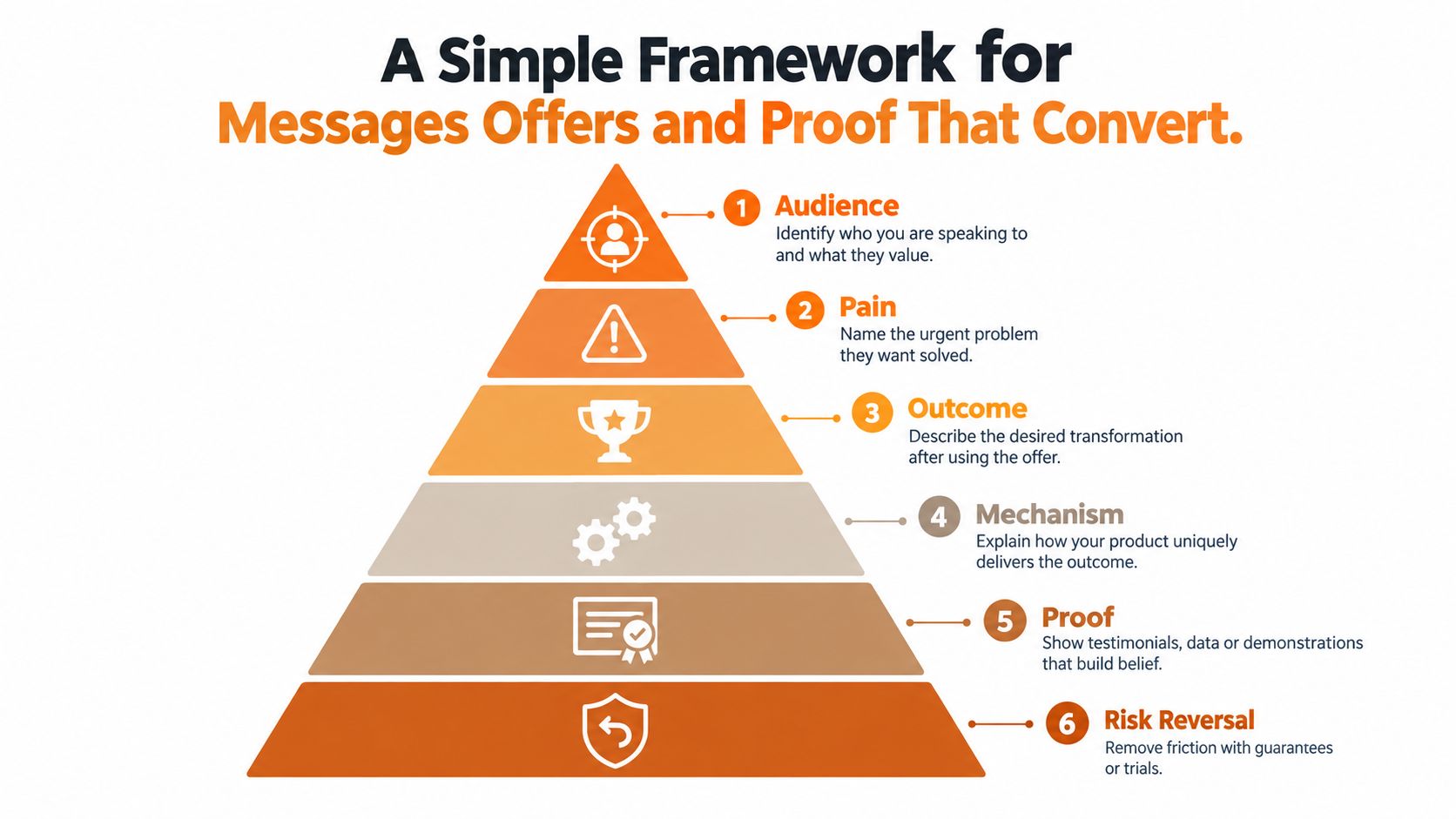
Good copy becomes easier to write when you separate the decisions. Start with the audience, then identify the problem, describe the outcome, explain the mechanism, provide proof, and reduce perceived risk.
Begin with the customer's situation
Audience: Define who is reading and what they value. “Small business owners” is too broad for a useful message. A Vancouver clinic owner concerned about empty appointment slots needs different language from an e-commerce manager trying to improve product discovery.
Pain: Name the problem in the customer's language. “Our ads get clicks but few enquiries” is stronger than “You need better marketing.” Pain doesn't require dramatic language. It requires recognition.
Outcome: Describe the change the buyer wants. “Get more qualified booking enquiries from local search” gives the reader a meaningful destination without promising an unsupported result.
Explain the mechanism
Features describe what you provide. The mechanism explains how those features create value.
- Weak: “We provide SEO services.”
- Stronger: “We align local service pages, location signals, and conversion copy so nearby prospects can find the right service and request a quote.”
The stronger version gives the reader a process, not a label. It also creates a basis for proof. You can demonstrate the audit, show the page structure, explain the research, or describe how decisions are reviewed.
Stack proof without inflating the claim
Proof can include a customer testimonial, a demonstration, transparent process details, certifications, editorial coverage, or a clearly documented comparison. Use the form that best answers the reader's actual doubt.
If the concern is credibility, show relevant experience. If the concern is complexity, explain the process. If the concern is risk, make the commitment and cancellation terms easy to understand. Never use a testimonial to imply a result that the quoted customer didn't describe.
The offer should make the next step feel safer, clearer, and more valuable than continued delay.
Build the page in decision order
Above the fold, state the audience, outcome, and action. Follow with the mechanism, supporting proof, process, objections, and risk reversal. A local service page might invite a consultation. An e-commerce page might lead with product suitability, usage guidance, and delivery information. A wellness page needs especially careful language around outcomes and health-related claims.
This framework also works in email. The subject line earns attention, the opening names the situation, the body explains the useful idea, the proof builds belief, and the CTA asks for one action.
AI Assisted Copy Workflows That Keep Trust and Compliance Intact
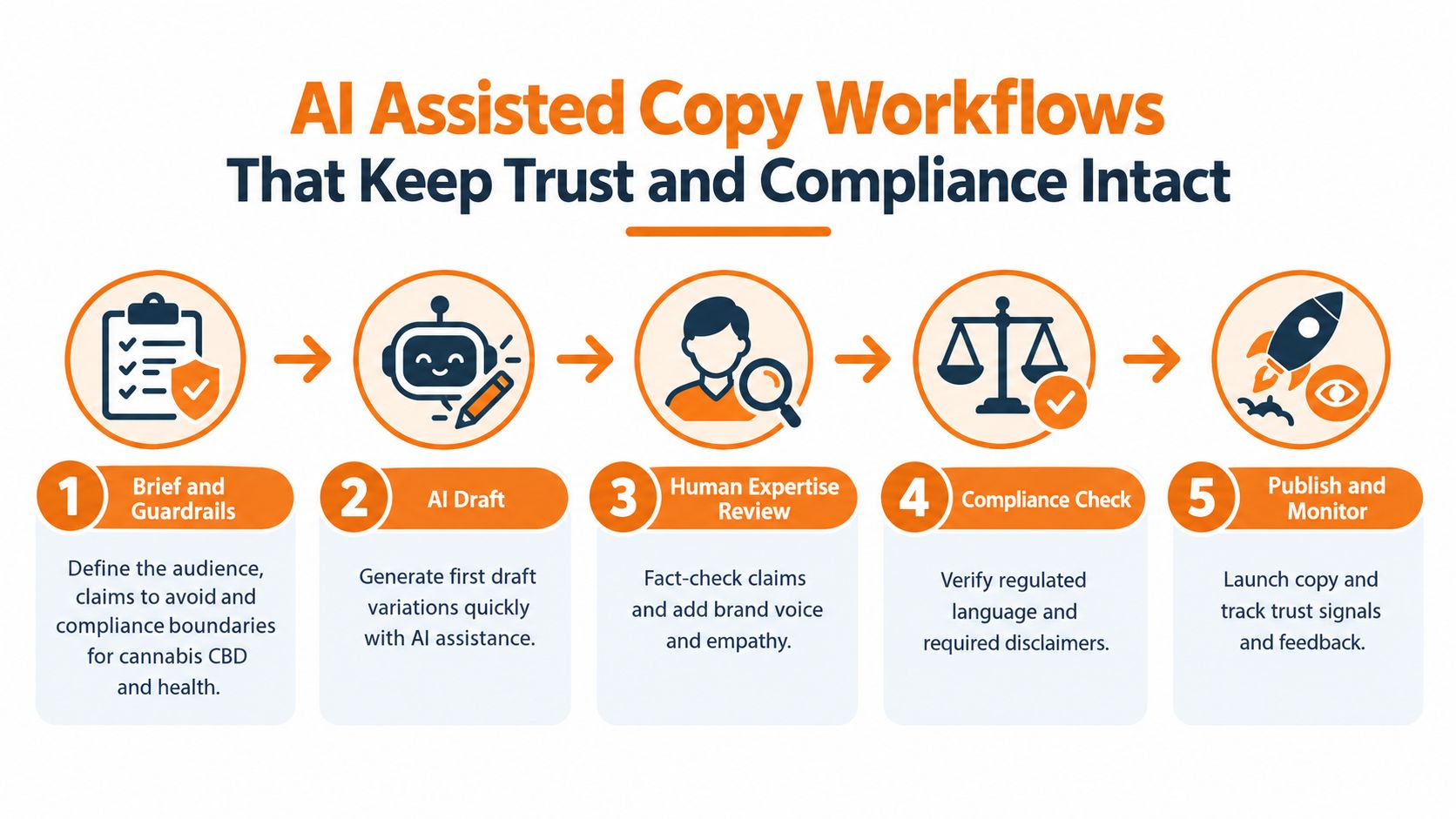
AI can produce a useful first draft quickly, but speed doesn't make a claim accurate. The safest workflow treats AI as an assistant for variation and organisation, while a human owns the brief, facts, judgement, voice, and final approval.
Canadian attitudes make that distinction important. Recent Canada-focused data reports that 86% of Canadians want AI-generated content disclosed, 57% say nondisclosure reduces trust, and 71% say AI content feels less authentic than human-created content, according to IT Nerd's report on YouGov and Meltwater findings. Those figures don't mean every AI-assisted workflow damages a brand. They show why teams need a deliberate trust policy.
Use a human-in-the-loop process
Brief and guardrails: Record the audience, offer, approved facts, prohibited claims, required disclosures, brand voice, market, and language. For cannabis, CBD, functional mushrooms, and health, separate educational language from claims that could imply diagnosis, treatment, prevention, or guaranteed results.
AI draft: Ask for several angles, headlines, CTAs, and objection-handling options. Give the tool source material and tell it not to invent testimonials, clinical findings, product specifications, or legal assurances.
Human review: Verify every factual statement against the approved brief. Replace generic phrasing with customer language, add empathy, and remove confident-sounding claims that the evidence doesn't support.
Compliance check: Review disclaimers, testimonials, comparative language, imagery references, and language versions. Legal and platform requirements can vary by product and jurisdiction, so use qualified review where appropriate.
Publish and monitor: Track complaints, feedback, conversions, search visibility, and signs of confusion. A trustworthy workflow treats post-publication feedback as part of quality control.
Write for AI intermediaries without abandoning people
AI systems need clear, structured information. Human buyers need confidence and relevance. Both respond better to precise product names, plain explanations, transparent limitations, and verifiable proof than to inflated adjectives.
Canada's official-language requirements also make localisation a strategic task. Advertising must reach Canadians in the official language of their choice, and multilingual audiences may need creative variants beyond English and French. Rogers Sports & Media discusses large Punjabi-, Mandarin-, Cantonese-, Spanish-, Arabic-, Tagalog-, and Italian-speaking audiences and the importance of reaching newcomers in the languages they use, as described in its Canadian audience research.
Don't treat French copy as a word-for-word export of English. Review terminology, formality, cultural references, offer framing, and CTA meaning with a fluent reviewer who understands the audience.
Teams evaluating broader applications can also review AI in digital marketing as part of a workflow that combines automation with strategic oversight. The tool can accelerate production. It can't take responsibility for truth.
Measuring What Works and Improving Copy Over Time
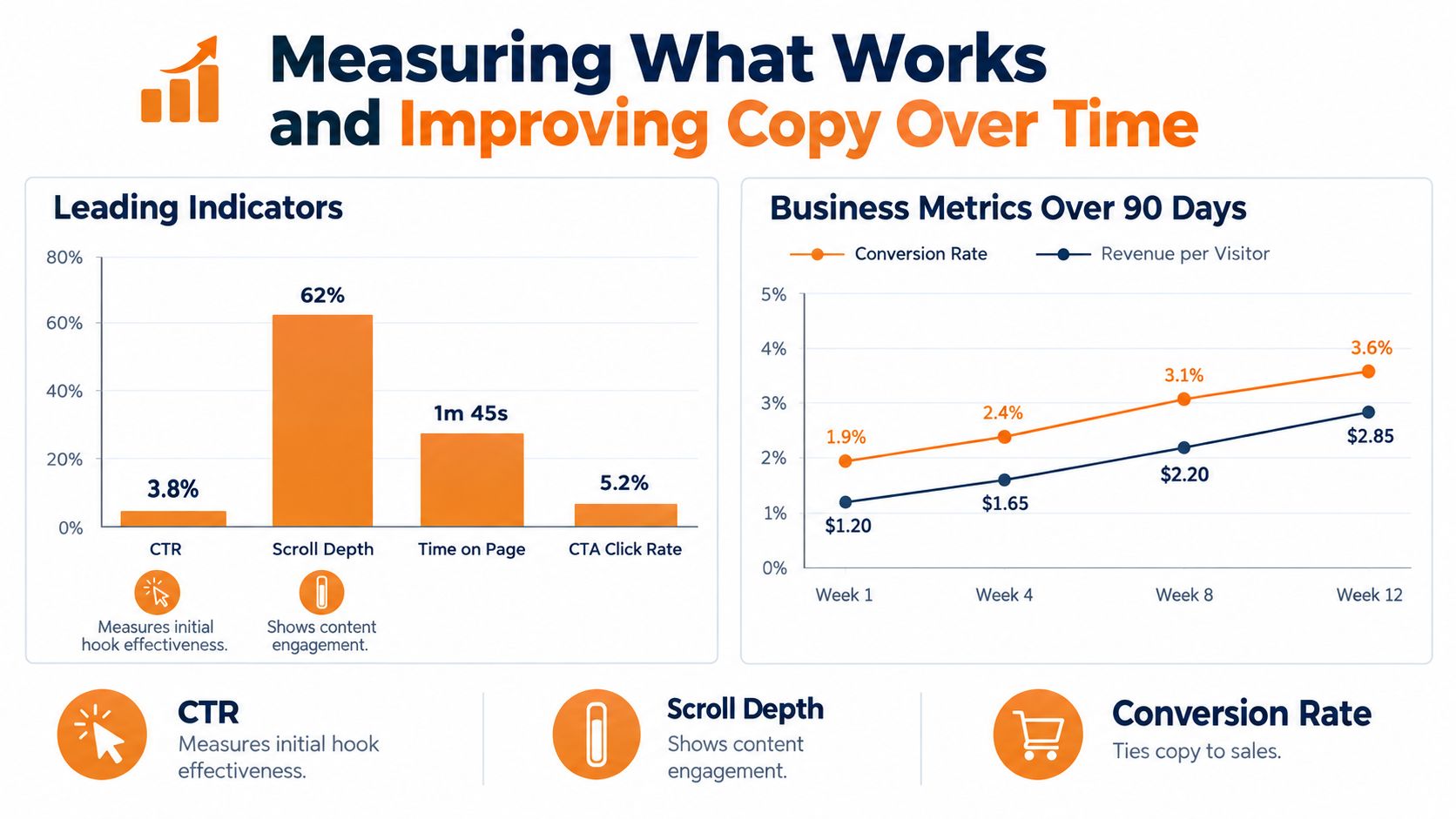
Copy performance should be judged by business movement, not by whether the writing sounds polished. Start with the action that matters, such as a qualified lead, completed purchase, booked consultation, or profitable repeat order. Then connect the copy decision to the steps between exposure and revenue.
Read metrics in sequence
Leading indicators show whether the message earns attention and engagement. Depending on the channel, that may include click-through rate, scroll depth, time on page, CTA clicks, email clicks, or search snippet engagement.
Lagging indicators show whether attention became commercial value. These can include conversion rate, qualified enquiries, booked calls, completed purchases, average order value, and revenue per visitor.
A high click-through rate with weak lead quality often means the ad is overpromising or targeting too broadly. Strong scroll depth with few CTA clicks may indicate that the page educates well but doesn't make the next step compelling. Metrics become useful when you interpret them as a sequence rather than isolated scores.
For a fuller view of performance reporting, use reporting and analytics to connect channel activity with commercial outcomes.
Test one meaningful change
A clean copy test changes one major variable at a time. Compare a specific headline against a vague one, a benefit-led CTA against a process-led CTA, or a proof block near the offer against the same proof lower on the page.
Don't rewrite the headline, pricing explanation, testimonials, and form simultaneously if you want to know what caused the change. Keep the audience, traffic source, offer, and page experience as stable as practical.
A test should answer a business question, not settle a stylistic argument.
Use a simple review cadence. Check early signals for technical or relevance problems, then wait for enough comparable activity to make a responsible decision. Avoid declaring a winner because of a short-lived spike. If the message attracts the wrong audience, revise the promise. If visitors understand the offer but hesitate, strengthen proof or risk reduction. If the page fails to earn attention, revisit the opening before rewriting everything.
Real Examples and Templates You Can Steal for Your Next Campaign
A local service page often fails because it starts with the company instead of the customer. “Welcome to our award-winning clinic” makes the reader work to find the value. A clearer hero could read:
Book personalised physiotherapy in Vancouver, with appointments designed around your recovery goals.
“Meet with a qualified practitioner, understand your options, and request an appointment.”
The first version names the service, location, audience need, and action. It doesn't promise an outcome the business can't guarantee.
Product copy should answer buying questions
Weak product copy says:
“Premium wellness formula for your everyday routine.”
A more useful version says:
A simple daily formula for adults who want a clearly explained wellness routine.
“Review the ingredients, usage guidance, and product details before choosing whether it fits your needs.”
The rewrite gives the reader a reason to continue and avoids unsupported health promises. For regulated products, add only claims that the brand can substantiate and approve.
Build campaign variants from one promise
For a paid campaign, start with a shared message and change the angle:
- Problem angle: “Struggling to turn local searches into booked consultations?”
- Outcome angle: “Make it easier for Vancouver prospects to find and contact your clinic.”
- Process angle: “Clarify your service pages, local signals, and conversion path.”
- Trust angle: “Get a transparent review of the copy and funnel behind your local leads.”
Each ad should connect to a landing page that fulfils the selected promise.
A simple three-email nurture sequence can follow the same logic:
- Recognition: Name the problem and show the cost of leaving it unclear.
- Education: Explain the mechanism and give the reader a practical improvement.
- Decision: Present the offer, proof, expectations, and one low-friction CTA.
Localise before you publish
Use this checklist for Canadian variants:
- Language fit: Adapt English and French separately instead of relying on literal translation.
- Regional relevance: Check location names, service areas, spelling, and local terminology.
- Audience clarity: Review whether the message speaks naturally to the intended community.
- Proof accuracy: Confirm that testimonials and qualifications remain valid in each version.
- Compliance: Recheck health, product, comparative, and AI-disclosure language.
- Action clarity: Make sure each language version gives the same understandable next step.
Copywriting in marketing works when the words reduce uncertainty at the moment a buyer must decide. Use the templates to audit one high-value page, one campaign, or one email sequence, then measure the next business action rather than judging the prose in isolation.
Juiced Digital helps local businesses and e-commerce brands build conversion-focused copy across SEO, paid media, landing pages, email, and AI-led search experiences. Visit Juiced Digital to request a focused audit and identify the messaging, trust, localisation, or compliance changes most likely to improve your next campaign.