
Think of your advertising budget like a vending machine. Every dollar you put in should give you something back, right? ROAS (Return on Ad Spend) tells you exactly how much you get back in sales for every single one of those dollars. It's the cleanest, most direct way to see if your ads are actually working.
The Vending Machine Analogy for ROAS
Let's be honest, vanity metrics like clicks and impressions feel good, but they don't pay the bills. ROAS cuts straight to the chase and answers the one question that truly matters: Are my ads making me money?
This single number gives you a clear picture of how financially efficient your campaigns are. Whether you're a local plumber running a campaign on Google Ads or a national e-commerce store advertising on Meta, understanding your ROAS is non-negotiable. It's how you turn advertising from a hopeful guess into a predictable engine for growth.
To give you a quick overview, here's a simple breakdown of what ROAS is all about.
ROAS At a Glance
| Concept | What It Measures | Why It Matters |
|---|---|---|
| Return on Ad Spend (ROAS) | The total revenue generated for every dollar spent on advertising. | It directly links ad spend to revenue, providing a clear measure of campaign profitability. |
| Financial Efficiency | How effectively your ad budget is converted into sales. | It helps you identify high-performing channels and campaigns, allowing for smarter budget allocation. |
| Performance Indicator | The health and success of your paid marketing efforts. | It provides the data needed to make informed decisions about scaling, pausing, or optimising your ads. |
This table captures the essence of ROAS, but let's dive a bit deeper into why it's such a critical metric for any business.
Why This Metric Is So Important
Getting a solid handle on your ROAS isn't just about looking back at what worked. It's about giving you the power to confidently shape your future strategy. When you know, without a doubt, which campaigns are driving profit, you can put your money where it will have the biggest impact.
Here's what tracking ROAS unlocks for your business:
- A Simple Profitability Check: At a glance, you can see if a campaign is actually making you more money than it's costing you to run.
- Smarter Budget Optimisation: By comparing the ROAS of different channels, you can easily spot which platforms are giving you the best bang for your buck and deserve more investment.
- Confident Decision-Making: A low ROAS is a clear signal that something needs to change, whether it's your targeting, creative, or offer. A high ROAS, on the other hand, is the green light to scale up.
In short, ROAS is the bridge connecting your ad spend to your revenue. It provides the clarity needed to stop guessing and start building a truly efficient advertising engine that fuels sustainable growth. This guide will walk you through everything from simple calculations to advanced improvement strategies.
The Simple Formula for Calculating Your ROAS
You don't need a math degree or fancy software to figure out your Return on Ad Spend. At its heart, the ROAS formula is refreshingly straightforward. It’s designed to give you a quick, clear snapshot of whether your ads are actually making you money.
It all comes down to one simple division: you take the total revenue your ads brought in and divide it by what you spent to run them. The result tells you exactly how many dollars you earned for every dollar you put in.
ROAS = Total Revenue from Ads / Total Ad Spend
This little equation is the foundation of performance marketing. It cuts through the noise of clicks and impressions to give you a hard number, tying your marketing budget directly to your bank account. Let's dig into what each piece of that puzzle really means.
Defining Your Variables
Getting an accurate ROAS depends entirely on the numbers you plug in. One of the most common mistakes I see is when businesses use incomplete data for either revenue or ad spend. This gives you a warped view of your campaign's performance, so let's get crystal clear on what to include.
What Counts as Ad Spend?
Your ad spend isn't just what you pay Google or Meta. For a true picture of your investment, you need to tally up all the related expenses:
- Platform Spend: This is the obvious one—the money you pay directly to the ad network.
- Management Fees: If you're working with an agency or a freelancer, their fees are part of the cost.
- Creative Costs: Don't forget the budget for designing visuals, shooting videos, or hiring a copywriter. It all adds up.
What Counts as Revenue?
This is the total sales value that came directly from your ads. We track this using conversion pixels and UTM parameters that link a specific purchase back to the ad that drove it. Think of it as the top-line income before you factor in the cost of your products or other overhead.
Practical ROAS Calculation Examples
Theory is great, but let's see how this works with a couple of real-world examples.
Example 1: E-commerce Brand on Meta Ads
Let's say a Canadian online shop selling handmade leather goods launches a new line of wallets using Meta Ads.
- Total Revenue from Ads: The campaign brings in $10,000 in sales.
- Total Ad Spend: They spent $2,000 on the ads themselves and paid a designer $500 for the creative. Total spend: $2,500.
Now, we run the numbers:$10,000 (Revenue) / $2,500 (Ad Spend) = 4
Their ROAS is 4:1. For every single dollar they invested, they got $4 back in revenue. Not bad at all.
Example 2: Local Health Clinic on Google Ads
A health clinic in Vancouver is running Google Ads to get more people to book their first consultation.
- Total Revenue from Ads: They get 10 new patients, and each initial visit is worth $300. That's a total of $3,000 in new revenue.
- Total Ad Spend: Their Google Ads budget for the month was $1,000.
Let's do the math:$3,000 (Revenue) / $1,000 (Ad Spend) = 3
The clinic’s ROAS is 3:1. They're generating $3 for every $1 they put into their ads. Once you get the hang of this simple calculation, you have a powerful tool to measure what's working and what isn't.
What Is a Good ROAS and How to Set Benchmarks
So, you’ve got your ROAS number. What’s next? On its own, that figure doesn't tell you much. The real question is whether it's good or not, and the answer is rarely straightforward. A "good" ROAS isn't some magic number pulled from thin air; it’s completely dependent on your business model, your profit margins, and the industry you operate in.
You’ll often hear a 4:1 ROAS thrown around as the gold standard—$4 in revenue for every $1 spent. While that's a decent target, it’s far from a universal rule. Your ideal ROAS is all about profitability. A company with fat profit margins might be doing great with a 3:1 ROAS, but an e-commerce store with razor-thin margins might need to hit a 6:1 or higher just to stay in the black.
This infographic breaks down the basic relationship between what you spend and what you earn.
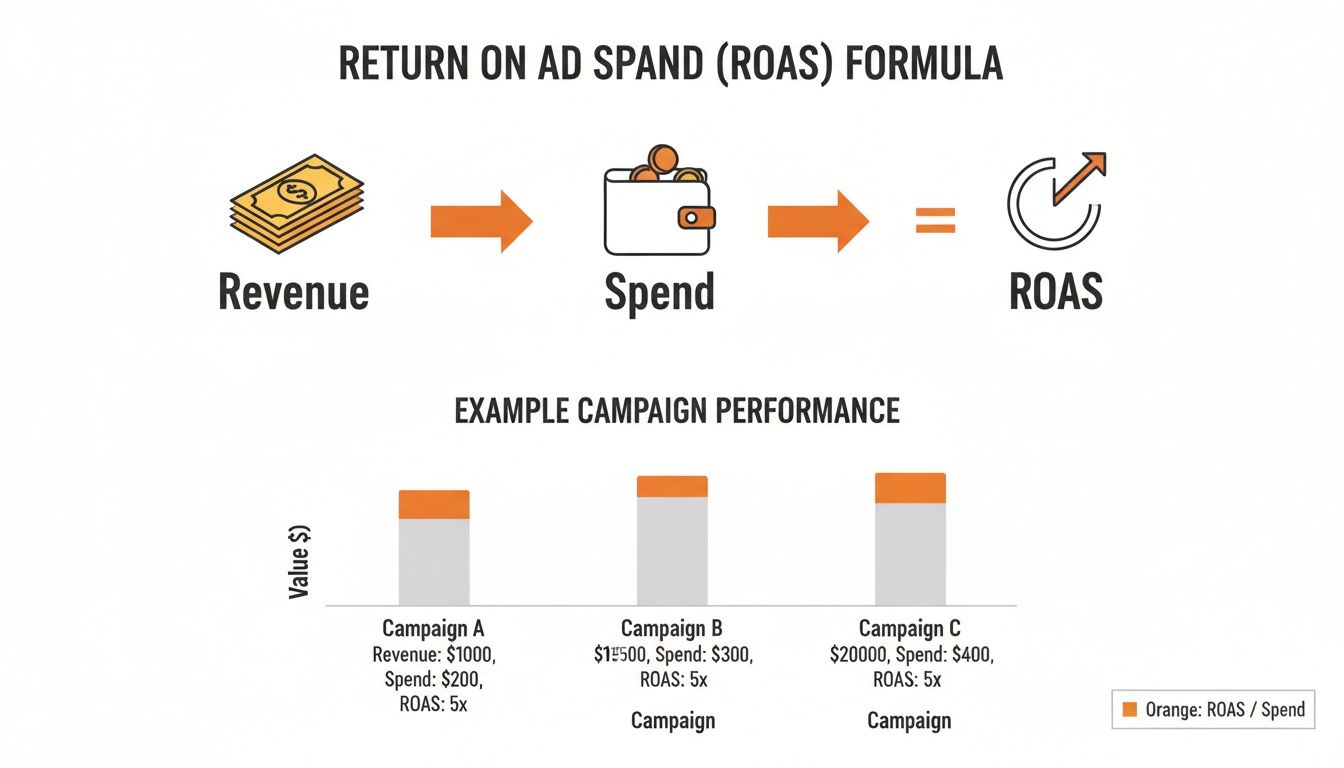
As you can see, the calculation is simple division. But interpreting what that final number means for your business is where the real work begins.
How to Establish Your Own Benchmarks
Instead of aiming for a generic industry figure, start by figuring out what makes sense for your business. The first step is to know your break-even point. What ROAS do you need just to cover your advertising costs and the cost of the goods or services you sold?
Anything you make above that break-even number is pure profit. A service-based business with minimal overhead, for instance, could be very profitable at a 3:1 ROAS. On the flip side, an online retailer has to account for manufacturing, shipping, and fulfillment costs, which means they need a much higher number to see real growth.
The smartest way to set a benchmark is to measure your performance against industry averages while never losing sight of your own profit margins. A good ROAS for you is any number that fuels sustainable, profitable growth for your company.
ROAS Benchmarks By Platform and Industry
While your own numbers are king, knowing what’s typical in your field gives you valuable context. The table below outlines some general ROAS targets across different platforms and industries to help you see where you stand.
| Platform / Industry | Average ROAS Target | Considerations |
|---|---|---|
| Google Search Ads | 4:1 | High-intent searches often lead to better conversion rates, but competition can be fierce. |
| Google Display Ads | 2:1 | Lower ROAS is common as it's more for brand awareness. Success depends on precise audience targeting. |
| Meta Ads (Facebook/Instagram) | 3:1 | Great for e-commerce and impulse buys. Creative quality and audience segmentation are critical. |
| E-commerce | 4:1 to 6:1 | Needs a higher ROAS to cover COGS, shipping, and returns. Margins are everything. |
| Lead Generation | 2:1 to 3:1 | A lower ROAS is acceptable if the customer lifetime value (LTV) is high. One lead can turn into thousands in revenue. |
| SaaS (Software as a Service) | 3:1 | Similar to lead gen, the focus is on acquiring long-term subscribers, making a lower initial ROAS viable. |
These figures are just a starting point. Your target ROAS is directly tied to how much you're actually paying for ads. By setting realistic goals based on these factors, you can make smarter decisions with your budget and scale your campaigns with confidence.
ROAS vs. ROI: Understanding the Critical Difference
It’s one of the most common mix-ups in marketing, and it can lead to some seriously flawed business decisions. People often use Return on Ad Spend (ROAS) and Return on Investment (ROI) interchangeably. While they sound alike, they measure two completely different things. Getting this right is absolutely crucial for knowing how your marketing is really doing.
Here’s a simple way to think about it: imagine your business is an airplane. ROAS tells you how efficiently one specific engine is running—your ad campaign. ROI, on the other hand, tells you if the entire airplane is on a profitable flight path.
ROAS Measures Revenue, ROI Measures Profit
The real split between these two metrics comes down to what they include in their calculations.
ROAS is a top-line metric. Its job is laser-focused. It only cares about the gross revenue generated directly from your ad spend, ignoring every other business cost. This gives you a clean, simple look at whether your ads are bringing in more money than they cost. It’s a specialist’s tool for judging an ad campaign’s raw performance.
On the flip side, ROI is a bottom-line metric. It’s the true measure of profitability because it accounts for all the costs involved in making and selling your product. This isn’t just about ad spend; it pulls in essential expenses like:
- Cost of Goods Sold (COGS): What it costs you to produce or buy the items you sell.
- Operational Costs: Things like software fees, office rent, and utilities.
- Labour and Salaries: Paying your team is a big one.
- Shipping and Fulfilment: All the costs to get the product into your customer’s hands.
This is why a campaign can have a stellar ROAS but a terrible ROI. A 3:1 ROAS sounds pretty good, right? You made $3 for every $1 you spent on ads. But what if your product costs, fees, and shipping add up to $2.50 for that $3 sale? Your actual profit is just $0.50. The ads are generating revenue, but the business is barely making any money.
ROAS tells you if your ads are working. ROI tells you if your business is profitable. You need to know both, but they answer very different questions. A high ROAS is just a vanity metric if it doesn't lead to a positive ROI.
Using ROAS Alongside Other Key Metrics
ROAS is a powerful number, but it doesn't tell the whole story on its own. It's most valuable when you look at it in context with a few other key performance indicators. Think of it as one instrument on a much larger dashboard.
-
Cost Per Acquisition (CPA): This is the price you pay to get one new customer. A low CPA is fantastic, but when you look at it next to ROAS, you can see if those cheaply acquired customers are actually spending enough to make the ad spend worthwhile.
-
Customer Lifetime Value (LTV): This metric forecasts the total amount of revenue a single customer is likely to bring in over their entire relationship with your business. A campaign might start with a modest ROAS, but if it consistently brings in high-LTV customers who buy again and again, it's an incredible long-term win.
When you start analyzing ROAS, ROI, CPA, and LTV together, you graduate from just measuring ad results to making truly strategic decisions. This complete picture ensures every dollar you spend isn’t just chasing immediate revenue, but is also building a healthy, sustainable business for the long haul.
Actionable Strategies for Improving Your ROAS

Knowing your ROAS is one thing; actually making it better is where the magic happens. The good news is, boosting your return isn't about spending more money—it's about spending it smarter. This means getting forensic with every part of your campaigns, from the people you target to the page they land on after they click.
The real goal is to stop wasting money and put more fuel behind what’s already working. Whether you're selling products online or providing services in your local community, a few core strategies can give your performance a serious lift, turning your ad budget from an expense into a powerful investment.
Refine Your Ad Targeting and Creative
A high ROAS always starts with reaching the right people with the right message. If your targeting is too broad, you're just paying to show ads to people who were never going to buy. The trick is to get specific and never stop testing your creative.
Start by tightening up who sees your ads. On search platforms, use negative keywords to filter out irrelevant searches. For social media, build lookalike audiences based on the profiles of your best customers. Then, it's time to A/B test everything you can think of:
- Headlines: Try out different hooks to see what actually grabs attention.
- Visuals: Does a polished studio photo work better than a raw, user-generated video? Test it.
- Calls-to-Action (CTAs): See if direct language like "Shop Now" outperforms a softer invitation like "Learn More."
This used to be a gruelling manual process, but modern agencies now use AI-powered tools to find the winning ad combinations way faster. This data-first approach is non-negotiable if you want to get the most out of every dollar.
The most reliable path to a higher ROAS is a relentless focus on optimisation. Small, consistent improvements in your targeting and creative will compound over time, leading to huge gains in revenue without ever increasing your ad spend.
Master Conversion Rate Optimisation
Getting traffic to your site is only half the job. If your landing pages aren't built to turn visitors into customers, even the most brilliant ad campaign will fall flat and deliver a poor ROAS. This is where Conversion Rate Optimisation (CRO) becomes your secret weapon.
Think about the user's journey. Your landing page has to load fast, be dead simple to use on a phone, and instantly show the value of what you're offering. Critically, the message on the page needs to perfectly match the promise you made in the ad. Any disconnect creates friction and kills conversions.
In Canada's digital ad market, where spending is projected to reach US$24.55 billion, a solid ROAS is essential for survival. With search ads dominating and the average e-commerce ROAS hovering around 2.87x, every single click has to count. To learn more about Canada's digital advertising landscape, you can check out the latest trends on Statista.com.
Implement Tailored Campaign Strategies
Different businesses need different playbooks. A one-size-fits-all ad strategy almost never delivers a high ROAS. For instance, the tactics that work wonders on Google Ads will likely be very different from what you need to succeed on Facebook. If you're curious about the specifics, you can learn more about Facebook Ads vs. Google AdWords in our detailed breakdown.
Here are a couple of tailored strategies to get you started:
-
For E-commerce: Use dynamic retargeting to show people ads for the exact products they just looked at but didn't buy. Make sure your product feeds are in top shape, with high-quality images and clear, descriptive titles.
-
For Local Services: Get hyper-local with your geo-targeting. Focus your ad spend on specific neighbourhoods or even postal codes. Use ad extensions to prominently display your phone number and address, making it incredibly easy for nearby customers to find and contact you.
Turning Ad Spend into Sustainable Growth
Think of your ad budget less like a cost and more like an engine. When you get ROAS right, that engine doesn't just run—it powers predictable, sustainable growth for your business. It’s the difference between just spending money and building a system where every dollar you put in comes back with friends.
This isn't about finding a single "magic" channel. Real success comes from a blended approach. You need sharp paid advertising to bring people in, strong SEO to capture organic interest, and relentless Conversion Rate Optimization (CRO) to make sure your website turns that hard-won traffic into actual sales. When they work together, it's a powerful combination.
But it’s not always straightforward. The digital ad market, especially here in Canada, can be a real rollercoaster. Take Facebook's Cost Per Purchase, for example. It can swing wildly from month to month, far more than the global average. We saw costs jump by a staggering 47% in one recent year before plummeting in January. Navigating those kinds of seasonal shifts without an expert hand on the wheel can absolutely demolish your ROAS. You can see more on these trends in the full cost-per-purchase analysis on SuperAds.ai.
A consistently high ROAS is what separates fleeting campaigns from a truly scalable business. It means you’re growing quickly, but more importantly, you’re growing profitably and building something that lasts.
Getting your ad spend dialed in is the starting point. Our team can dive into your accounts and pinpoint where you can make improvements with a complimentary ROAS audit and strategy session. It's a foundational piece of any solid plan for digital marketing in e-commerce.
Common Questions About ROAS
Even after you've got the basics down, a few tricky questions always seem to pop up when you start applying ROAS in the real world. Let's clear up some of the most common points of confusion so you can use this metric with confidence.
Can ROAS Be Negative?
Technically, no—you won't see a minus sign. But a ROAS between 0 and 1 is the same as a loss.
Think of it this way: if you spend $200 on an ad campaign and only bring in $100 in sales, your ROAS is 0.5:1. You got fifty cents back for every dollar you spent. Anything under a 1:1 ratio means your ads are losing money. While that might be a strategic move for a huge brand-building push, for most businesses, it’s a red flag that something needs fixing, and fast.
How Often Should I Check My ROAS?
This really depends on how your business operates and how long it takes for a customer to make a purchase. There's no one-size-fits-all answer, but here are some solid starting points:
- Daily Checks: This is for the fast-paced world of e-commerce, especially if you have a significant daily ad budget. Checking daily lets you jump on winning ads or kill the losers before they drain your account.
- Weekly or Bi-Weekly Checks: This is a much better rhythm for service businesses or companies with a longer sales cycle. It gives you enough data to see real trends without overreacting to the normal ups and downs of a single day.
The goal is to find a consistent schedule that works for you. It’s about making smart, informed decisions, not just reacting to every little blip.
Your job isn't just to watch the ROAS number. It's to understand the story it's telling you about your campaign's performance over time. Consistency beats frequency, every time.
What Are the Best Tools for Tracking ROAS?
You can't manage what you don't measure, and good tracking is everything. Luckily, you don't have to go far to find powerful tools to help.
Your first stop should always be the ad platforms themselves. Both Google Ads and Meta Ads have excellent built-in dashboards that track conversions and calculate ROAS for you. To get the bigger picture of how all your marketing works together, Google Analytics 4 is a must-have for tracing revenue back to the right channel.
If you’re running an e-commerce store, platforms like Shopify have fantastic internal analytics, too. And for businesses that need to understand a complex customer journey with multiple touchpoints, dedicated third-party attribution software can offer a much deeper level of insight.
Ready to stop guessing and start growing? The team at Juiced Digital uses AI-powered strategies to maximize your ROAS and turn your ad spend into predictable revenue. Book your free consultation and ROAS audit today!