

SEO and web accessibility sound like two completely separate worlds and yet both aim to make online spaces easier for everyone. You might expect that making a website accessible is just an extra checklist item for legal safety. But studies show the opposite is true. Accessible websites can generate significantly more revenue and reach a broader audience than their inaccessible competitors. The real magic happens when local businesses merge these strategies and see their digital presence grow in unexpected ways.
Table of Contents
- What Is Seo And Accessibility?
- Why Seo And Accessibility Matter For Local Businesses
- How Seo And Accessibility Work Together
- Key Concepts In Seo And Accessibility You Should Know
Quick Summary
| Takeaway | Explanation |
|---|---|
| SEO and accessibility are interconnected | Both strategies enhance user experience and improve website visibility in search engines. |
| Implement semantic HTML for better clarity | Proper use of HTML tags helps both search engines and assistive technologies understand your content. |
| Consider legal requirements for accessibility | Compliance with web accessibility standards is increasingly important to avoid legal issues and enhance user access. |
| Invest in robust metadata practices | Comprehensive metadata supports SEO efforts while aiding users with assistive technologies for better navigation. |
| Prioritize user engagement with inclusive design | Creating accessible digital experiences can expand your customer base and enhance brand loyalty. |
What is SEO and Accessibility?
Search Engine Optimization (SEO) and web accessibility are complementary strategies that enhance digital experiences for both search engines and users. While they might seem distinct, these approaches share a fundamental goal: creating online content that is discoverable, understandable, and usable for everyone.
Understanding SEO Fundamentals
SEO represents a strategic approach to improving a website’s visibility in search engine results. For local businesses, this means optimizing digital content to appear prominently when potential customers search for relevant services or products. Search engines like Google use complex algorithms that evaluate websites based on factors such as content relevance, site structure, loading speed, and user experience.
The primary objectives of SEO include:
- Increasing organic website traffic
- Improving search engine rankings
- Enhancing online visibility for target audiences
- Building credibility and trust with potential customers
Web Accessibility Explained
Web accessibility ensures that websites, applications, and digital content can be used by people with diverse abilities and disabilities. This includes individuals using assistive technologies like screen readers, those with visual or hearing impairments, and users with cognitive or motor challenges. Web Content Accessibility Guidelines (WCAG) provide a comprehensive framework for creating inclusive digital experiences.
By implementing accessibility standards, businesses not only support equal access but also improve overall user experience and potentially expand their customer base. Learn more about our local SEO optimization strategies to enhance your digital presence effectively.
Why SEO and Accessibility Matter for Local Businesses
For local businesses navigating the digital marketplace, SEO and web accessibility are not just technical considerations but critical strategies for sustainable growth, customer engagement, and competitive advantage. These interconnected approaches transform how businesses connect with potential customers and create meaningful online experiences.
Economic and Competitive Advantages
Implementing robust SEO and accessibility strategies offers significant business benefits. Local businesses that prioritize these elements can differentiate themselves from competitors by demonstrating commitment to inclusive digital experiences. According to research from the International Labour Organization, accessible digital platforms can generate substantial revenue while expanding market reach.
Key economic advantages include:
- Reaching broader customer demographics
- Reducing potential legal compliance risks
- Improving overall website performance and user engagement
- Creating positive brand perception and customer loyalty
Legal and Ethical Considerations
Web accessibility is increasingly becoming a legal requirement, not just a recommended practice. Businesses that fail to provide inclusive digital experiences risk potential lawsuits and reputational damage. The Americans with Disabilities Act (ADA) has increasingly been interpreted to include digital spaces, making web accessibility a critical compliance issue.
Explore our comprehensive SEO strategies for local businesses to understand how these approaches can transform your digital presence. By integrating SEO and accessibility, local businesses can create powerful, inclusive digital platforms that attract, engage, and retain customers more effectively than traditional marketing approaches.
How SEO and Accessibility Work Together
SEO and web accessibility are not separate strategies but interconnected approaches that enhance digital experiences. By understanding their synergistic relationship, local businesses can create websites that are both search engine friendly and universally usable.
Technical Alignment of SEO and Accessibility
At their core, SEO and web accessibility share fundamental principles of creating clear, structured, and meaningful digital content. Search engines and assistive technologies both rely on well-organized, semantically structured websites to interpret and navigate content effectively. Accessible design practices directly improve search engine optimization by providing clear signals about content hierarchy, relevance, and context.
Key technical alignments include:
This table summarizes essential elements that contribute to both SEO and accessibility, highlighting how technical implementations support both strategies for optimal website performance and inclusive experiences.
| Element | SEO Benefit | Accessibility Benefit |
|---|---|---|
| Semantic HTML | Clear site structure for search engines | Allows assistive tech to interpret content |
| Descriptive Headings | Emphasizes content topics and hierarchy | Enables better screen reader navigation |
| Alternative Text (Alt Text) | Increases image indexing in search results | Describes images for visually impaired users |
| Logical Navigation | Improves internal linking and crawlability | Supports keyboard and screen reader navigation |
| Metadata (Titles, Descriptions) | Boosts click-through rates and rankings | Provides context for assistive technology |
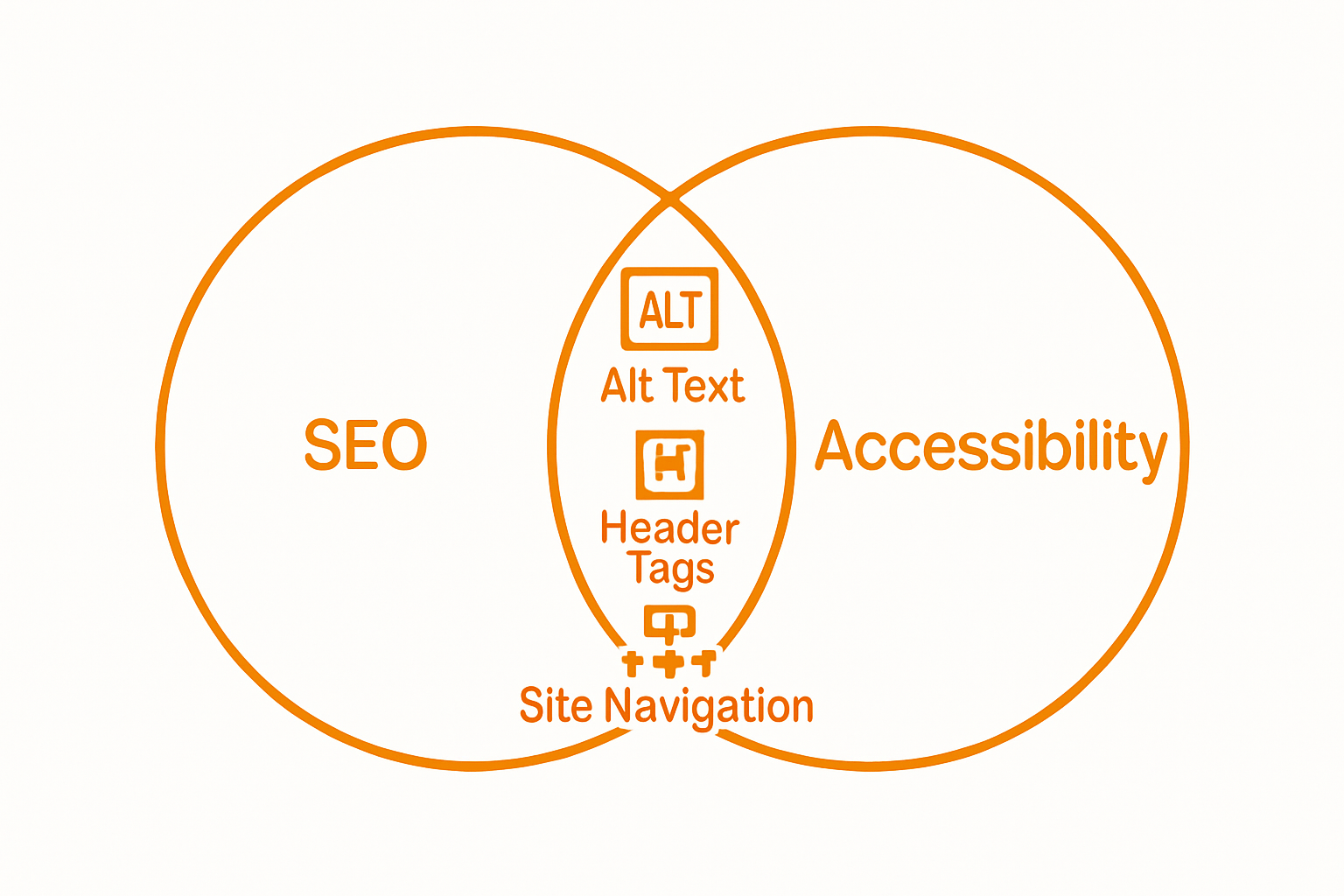
- Using descriptive header tags (H1, H2, H3)
- Creating meaningful alternative text for images
- Developing logical site navigation structures
- Implementing clear, concise content descriptions
Mutual Performance Benefits
Implementing accessibility features can significantly enhance a website’s SEO performance. According to the W3C Web Accessibility Initiative, semantic HTML and comprehensive metadata improve both user experience and search engine crawlability. Screen readers and search engine bots benefit from the same underlying content structure, making websites more discoverable and navigable.
Discover advanced site architecture strategies that can simultaneously optimize for search engines and user accessibility. By treating these approaches as complementary rather than competing priorities, local businesses can create digital platforms that are inclusive, performant, and strategically positioned for online success.

Key Concepts in SEO and Accessibility You Should Know
Navigating the interconnected world of SEO and web accessibility requires understanding core principles that drive digital inclusivity and search engine performance. Local businesses must recognize these fundamental concepts to create robust, user-friendly online platforms.
Semantic HTML and Content Structure
Semantic HTML serves as the foundational language that communicates content meaning to both search engines and assistive technologies. By using appropriate HTML tags like headings, paragraphs, and lists, businesses can create clear hierarchical structures that enhance both readability and search engine comprehension. These structured approaches enable screen readers and search crawlers to interpret website content more accurately.
Key semantic HTML principles include:
- Using descriptive and sequential heading tags
- Implementing meaningful alternative text for images
- Creating logical content divisions
- Ensuring proper link and button descriptions
Metadata and Accessibility Signals
Metadata plays a crucial role in bridging SEO and accessibility strategies. Comprehensive and descriptive metadata provides context that helps search engines understand page content while simultaneously supporting users with assistive technologies. According to the World Wide Web Consortium (W3C), well-structured metadata improves both search engine rankings and user navigation experiences.
Explore advanced SEO strategy techniques that integrate accessibility best practices. By treating these elements as interconnected components, local businesses can develop digital platforms that are not just discoverable but genuinely inclusive and user-friendly.
Ready to Make Your Local Business Stand Out Online?
Understanding SEO and accessibility is just the first step. Local businesses face real challenges getting noticed in a crowded market, especially when your website is not ranking or is hard for some users to navigate. The pain is clear: lost traffic, unreachable audiences, and opportunities slipping by. Discover how integrating strong SEO foundations and accessible design can transform obstacles into growth. Our SEO solutions are built around the very concepts you’ve just learned, designed for those who demand visible, lasting results.
Imagine what happens when you upgrade your digital presence to the next level. At Juiced Digital, we deliver high-performance search marketing with a focus on ROI, compliance, and inclusivity. Take action now to put your business ahead in organic rankings and the local map pack. Start a conversation with our experts or explore our digital marketing strategies and see measurable improvements. Your customers are already searching — let’s help them find you.
Frequently Asked Questions
What is the relationship between SEO and web accessibility?
SEO and web accessibility are interconnected strategies aimed at improving digital experiences. While SEO focuses on enhancing a website’s visibility in search engine results, accessibility ensures that content can be used by individuals with diverse abilities. Implementing both strategies creates a website that is discoverable and usable for everyone.
To clarify how SEO and web accessibility complement each other, the following table compares their main purposes and shared benefits for local businesses.
| Aspect | SEO (Search Engine Optimization) | Web Accessibility | Shared Benefit |
|---|---|---|---|
| Core Purpose | Increase website visibility in search results | Make digital content usable for people with disabilities | Broader reach and better online experience |
| Key Focus Areas | Rankings, traffic, metadata, site structure | Usability, inclusivity, assistive technology support | Enhanced user engagement, improved site performance |
| Target Users | Search engines, potential customers | Users with diverse abilities, all online visitors | All audience segments, including underserved groups |
| Legal Considerations | Compliance with search algorithms | ADA and digital accessibility requirements | Reduced risk of legal action, better brand reputation |
| Competitive Advantage | Higher rankings, more website visitors | Expanded audience, positive social perception | Stronger differentiation, customer loyalty |
How can local businesses improve their SEO and accessibility simultaneously?
Local businesses can improve both SEO and accessibility by utilizing semantic HTML, creating descriptive metadata, and ensuring clear site navigation. These practices not only enhance user experience but also help search engines better understand and index content, ultimately benefiting both search rankings and accessibility.
What are the economic benefits of prioritizing SEO and accessibility?
Prioritizing SEO and accessibility can lead to reaching broader customer demographics, improving website performance, reducing legal compliance risks, and fostering positive brand perception. This combination can result in increased customer engagement and loyalty, providing a competitive edge in the digital marketplace.
Are there legal requirements for web accessibility that local businesses should be aware of?
Yes, web accessibility has become a legal requirement in many jurisdictions, including interpretations of the ADA that apply to digital spaces. Businesses that fail to comply with accessibility standards risk potential lawsuits and reputational damage, making it crucial for local businesses to implement inclusive digital practices.