

Bounce rate seems simple at first glance. It just measures how many people leave after viewing a single page. But did you know that a bounce rate above 70 percent means you’re losing seven out of every ten potential customers before they even explore your website? Most people think the biggest digital threat is slow loading times or bad SEO, yet the real silent killer is visitors who check out and never look back. Surprised? Watch what happens when you rethink bounce rate as your true first impression—and the unexpected key to website growth.
Table of Contents
- What Is Bounce Rate And Its Definition
- Why Bounce Rate Matters For Your Business
- How Bounce Rate Influences SEO And User Engagement
- Interpreting Bounce Rate: Key Concepts And Metrics
- Strategies To Improve Bounce Rate And Retain Customers
Quick Summary
| Takeaway | Explanation |
|---|---|
| Understand bounce rate fundamentals | Bounce rate measures the percentage of single-page visits without engagement, highlighting engagement issues. |
| High bounce rates indicate problems | A high bounce rate may signal poor design, low-quality content, or technical issues affecting user experience. |
| Bounce rate impacts revenue directly | Higher bounce rates lead to lost sales opportunities, reflecting diminished returns on digital marketing efforts. |
| Optimize user experience to reduce bounce | Implementing intuitive designs and fast loading speeds can keep visitors engaged and lower bounce rates. |
| Track bounce rates alongside other metrics | Analyzing bounce rates with average session duration and conversion rates provides a comprehensive view of user engagement. |
What is Bounce Rate and Its Definition
Bounce rate represents a critical website performance metric that measures the percentage of visitors who navigate away from a site after viewing only a single page. Usability experts define bounce rate as the proportion of single-page sessions where no meaningful interaction occurs, effectively signaling potential issues with website engagement or content relevance.
Understanding the Core Concept
When a visitor lands on your website and immediately leaves without clicking additional pages or engaging with the content, this action is considered a “bounce”. Think of bounce rate like a digital first impression test. If your website fails to capture a visitor’s attention or provide clear value within seconds, they will likely exit, contributing to a higher bounce rate.
The calculation for bounce rate is straightforward: total number of single-page visits divided by total website entries. For instance, if 100 people visit your website and 45 leave after viewing only the homepage, your bounce rate would be 45%.
Why Bounce Rate Matters for Digital Performance
Bounce rate serves as a powerful diagnostic tool for website owners and digital marketers. A high bounce rate might indicate several potential problems:
- Poor website design or user experience
- Irrelevant or low-quality content
- Slow page loading speeds
- Misaligned marketing messages
- Technical issues preventing smooth navigation
Understanding your bounce rate helps identify areas for improvement, ultimately driving better user engagement and conversion potential.
This table summarizes common causes of high bounce rates alongside the typical solutions addressed in the article to help diagnose and resolve engagement issues.
| Common Cause of High Bounce Rate | Description | Typical Solution |
|---|---|---|
| Poor website design or UX | Unintuitive navigation and unattractive layout | Redesign for clean, clear navigation and visuals |
| Irrelevant or low-quality content | Content does not meet visitor needs or expectations | Create targeted, valuable, and engaging content |
| Slow page loading speeds | Website takes too long to load for users | Optimize site speed and technical performance |
| Misaligned marketing messages | Visitor expectations don’t match actual website content | Align marketing campaigns with site content |
| Technical issues | Errors or bugs make navigation difficult | Regularly test and fix technical problems |
Professional digital marketing teams like Juiced Digital use bounce rate analytics to develop targeted strategies that transform casual website visitors into engaged potential customers.
Why Bounce Rate Matters for Your Business
Bounce rate is not just a technical metric but a critical indicator of your website’s overall health and effectiveness. Google Analytics experts suggest that understanding bounce rate can provide profound insights into user behavior and digital marketing performance.
The Financial Impact of Bounce Rates
For businesses operating in competitive digital landscapes like cannabis dispensaries, e-commerce platforms, and local services, bounce rate directly translates to potential revenue loss. When visitors leave your website quickly, you lose opportunities for engagement, sales conversions, and brand building. A high bounce rate means your digital marketing investments are not generating the expected return.
Consider this scenario: if your online cannabis dispensary website has a 70% bounce rate, you are essentially losing 70 out of every 100 potential customers before they even explore your products or services. This represents a significant missed opportunity for revenue generation and customer acquisition.
Strategic Implications for Digital Marketing
Bounce rate serves as a powerful diagnostic tool that reveals critical insights about your digital strategy. High bounce rates can signal various underlying issues that require immediate attention:
- Misaligned target audience targeting
- Ineffective website design and user experience
- Slow page loading speeds
- Irrelevant or low-quality content
- Unclear value proposition
By tracking conversion rates alongside bounce rates, businesses can develop more sophisticated digital marketing strategies. Understanding these metrics helps optimize website performance, improve user engagement, and ultimately drive more meaningful interactions with potential customers.
Professional digital marketing agencies specialize in analyzing these complex metrics to develop targeted strategies that transform casual website visitors into engaged, converting customers. Reducing bounce rates requires a holistic approach that combines technical optimization, compelling content creation, and strategic user experience design.
How Bounce Rate Influences SEO and User Engagement
Search engine optimization experts recognize bounce rate as a significant ranking signal that directly impacts website performance and visibility. Understanding the intricate relationship between bounce rate, search rankings, and user engagement reveals critical insights for digital marketing strategies.
Search Engine Ranking Dynamics
Search engines like Google interpret bounce rate as a key indicator of content quality and user experience. When visitors quickly exit a website without interaction, search algorithms interpret this behavior as a potential signal of irrelevant or low-quality content. Websites with consistently high bounce rates may experience reduced search rankings, making it harder for potential customers to discover their digital presence.
For cannabis dispensaries, e-commerce platforms, and local businesses, maintaining a low bounce rate becomes crucial for maintaining competitive search visibility. A well-optimized website that keeps visitors engaged can significantly improve organic search performance.
User Experience and Engagement Metrics
Bounce rate serves as a comprehensive metric that intersects multiple performance indicators. High-quality websites typically demonstrate lower bounce rates because they effectively:
- Provide clear and immediate value to visitors
- Offer intuitive navigation and design
- Deliver relevant, targeted content
- Ensure fast loading speeds
- Create compelling visual experiences
By implementing strategic site architecture, businesses can create digital experiences that naturally reduce bounce rates. This approach involves designing websites that guide visitors smoothly through their journey, encouraging exploration and interaction.
Professional digital marketing teams understand that reducing bounce rates requires a holistic approach. This involves continuous analysis, optimization of user experience, and alignment of content with audience expectations. By treating bounce rate as a dynamic metric rather than a static number, businesses can develop more responsive and engaging digital strategies.
Interpreting Bounce Rate: Key Concepts and Metrics
Google Analytics experts emphasize that bounce rate is a nuanced metric requiring sophisticated interpretation beyond simple numerical analysis. Successful digital marketing strategies demand a comprehensive understanding of how bounce rate interconnects with broader website performance indicators.
Context-Specific Bounce Rate Analysis
Bounce rate interpretation varies dramatically across different website types and purposes. A blog post might naturally have a higher bounce rate compared to an e-commerce product page. For cannabis dispensaries and local businesses, understanding these contextual variations becomes crucial in developing accurate performance benchmarks.
Typical bounce rate ranges provide essential guideposts for digital performance:
To help clarify what different bounce rate percentages reveal about your website performance, the table below categorizes typical bounce rate ranges and their implications.
| Bounce Rate Range | Performance Level | Interpretation |
|---|---|---|
| 26% – 40% | Excellent | Highly engaging site; minimal optimization needed |
| 41% – 55% | Average | Acceptable performance; monitor for issues |
| 56% – 70% | Above Average | Some improvements needed |
| 70%+ | Significant Performance Concerns | Immediate intervention required |
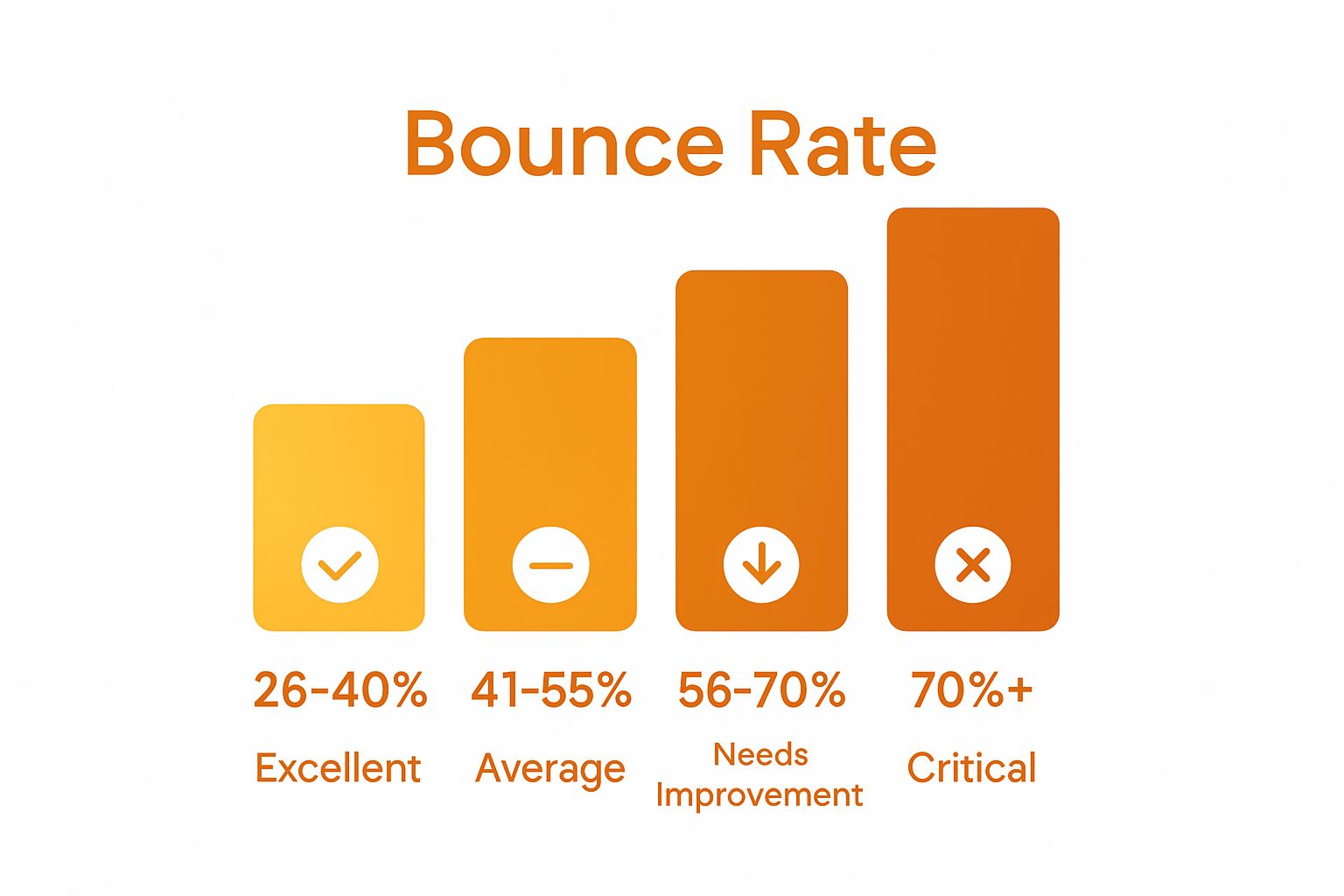
- 26-40%: Excellent performance
- 41-55%: Average website performance
- 56-70%: Above average, potential optimization needed
- 70%+: Significant performance concerns requiring immediate intervention
Advanced Metrics and Comparative Analysis
To develop a holistic understanding of website performance, businesses must examine bounce rate alongside complementary metrics. Tracking SEO strategies reveals that comprehensive analysis involves understanding:
- Average session duration
- Pages per session
- Conversion rates
- Traffic source variations
- Device-specific performance
These interconnected metrics provide a more nuanced view of user engagement than bounce rate alone. Professional digital marketing teams utilize sophisticated analytics to transform raw data into actionable insights, helping businesses optimize their digital strategies with precision and depth.
Strategies to Improve Bounce Rate and Retain Customers
User experience research demonstrates that reducing bounce rates requires a multifaceted approach targeting website design, content quality, and user engagement. Successful digital strategies transform casual visitors into committed customers through intentional, data-driven optimization.
Optimizing Website User Experience
Website design plays a critical role in retaining visitor attention. For cannabis dispensaries and e-commerce platforms, creating an intuitive, visually appealing interface becomes paramount. Key considerations include:
- Clean, modern design with clear navigation
- Mobile-responsive layout
- Fast loading speeds
- Intuitive product categorization
- Consistent brand visual identity
Technical performance directly impacts user perception. Websites that load within two seconds significantly reduce bounce rates and increase the likelihood of visitor interaction.
Content Strategy and Engagement Techniques
Compelling content serves as the primary mechanism for reducing bounce rates. Improving customer loyalty requires developing targeted, valuable content that immediately addresses user needs. Effective strategies include:
- Creating clear, concise product descriptions
- Implementing engaging multimedia elements
- Developing informative blog content
- Using targeted calls-to-action
- Providing immediate value propositions
Professional digital marketing teams understand that reducing bounce rates is not about tricking visitors but genuinely meeting their expectations. By combining technical optimization with strategic content development, businesses can create digital experiences that naturally encourage exploration and engagement.

Turn High Bounce Rates Into Revenue With Juiced Digital
Are you tired of seeing visitors leave your site without taking action? If your business struggles with a high bounce rate, you are not alone. Many cannabis, e-commerce, and local businesses face this costly challenge. As highlighted in the article, bounce rate is often tied to poor user experience, irrelevant content, or technical barriers that drive away potential customers. These issues do more than hurt engagement — they impact your bottom line.
Now is the time to take back control and convert lost clicks into real results. The team at Juiced Digital specializes in advanced SEO strategies that reduce bounce rates and boost your site’s ability to attract and keep engaged customers. Our experts analyze your current metrics, including bounce rate and conversion rates, to identify hidden weaknesses and transform your website experience. Visit our main site at Juiced Digital to see how you can start lowering your bounce rate and increasing revenue today. Don’t let another visitor slip away — take the first step toward smarter search visibility and higher growth now.
Frequently Asked Questions
What is bounce rate?
Bounce rate is the percentage of visitors who leave a website after viewing only one page without engaging further. It measures the effectiveness of a website in capturing visitor interest.
Why is bounce rate important for businesses?
Bounce rate is crucial because it reflects user engagement and satisfaction. A high bounce rate can indicate issues such as poor design, irrelevant content, or slow loading speeds, which can ultimately impact sales and brand perception.
How is bounce rate calculated?
Bounce rate is calculated by dividing the number of single-page visits by the total number of entries to the website, expressed as a percentage. For example, if 100 visitors come to your site and 45 leave after the first page, your bounce rate would be 45%.
What are some strategies to reduce bounce rate?
To reduce bounce rate, focus on optimizing user experience with a clean, modern design, ensuring fast loading speeds, and creating engaging, relevant content that meets visitor needs. Additionally, strategic calls-to-action can encourage users to explore the site further.
Recommended
- Measuring Conversion Rates: Boost Sales for Cannabis and Local Businesses 2025 – Digital PR Expert | Digital Marketing & Search Leaders
- Conversion Rate Optimizations – Digital PR Expert | Digital Marketing & Search Leaders
- Top 10 SEO Strategies to Boost Organic Traffic in 2024 – Digital PR Expert | Digital Marketing & Search Leaders
- Local SEO – Digital PR Expert | Digital Marketing & Search Leaders
- What Is Website Traffic? Essential Guide for Growth in 2025