

When someone is looking for a therapist, their journey almost always starts with a search engine. SEO for therapists is simply the art and science of making sure your practice shows up when they search for help on Google. It’s about more than just technology; it’s about using the right words, showing up for local searches, and creating a website that speaks directly to people in need of support.
Building Your Digital Front Door
Think of your website as the digital front door to your practice. Long before a client walks through your physical door, they find you online. Getting your SEO right ensures that when someone in your community is struggling and types their needs into a search bar, your practice is the most visible, welcoming, and reassuring option they see.
This isn’t about chasing algorithms or using confusing jargon. It's about building a genuine, empathetic online presence that connects with people precisely when they need it most. We need to move past generic advice and focus on what actually works for a private practice. That means digging into the exact language your ideal clients use when they're looking for support—the difference between a broad term like "therapist" and a specific phrase that signals they're ready to book an appointment.
Finding Clients Through Empathetic Keyword Research
Good SEO starts with stepping into your potential client's shoes. Someone searching for a therapist is often feeling vulnerable, and the words they use reflect that. Your first job is to uncover these phrases, which almost always combine a specific need with a location.
For instance, people rarely search for just "counselling." Their searches are far more specific and urgent:
- "Couples counselling Vancouver"
- "CBT for anxiety in Surrey"
- "Trauma therapist near me"
- "Child psychologist that takes Blue Cross"
These aren't just keywords; they're direct expressions of need. Researching them helps you understand what your community is looking for on a much deeper level. Local search is absolutely everything here. Data consistently shows that potential clients overwhelmingly include a location in their search, making local intent a non-negotiable part of your strategy. It’s what connects you to the people you can actually help.
High-Intent vs. Informational Keywords for Therapists
One of the most important concepts to grasp is "search intent"—the difference between someone who is ready to book a session and someone who is just gathering information. Targeting the right intent is what separates a website that gets inquiries from one that only gets traffic.
I see so many practices make the mistake of only writing blog posts about broad topics like "what is anxiety." While that content has its place, it primarily attracts researchers. Targeting "anxiety therapist Burnaby" is what brings in potential clients who are actively looking to schedule a consultation.
Understanding this distinction will fundamentally change how you approach your website. Here’s a simple way to think about it.
High-Intent vs. Informational Keywords for Therapists
| Keyword Type | Example Search Query | User Intent | Strategic Value |
|---|---|---|---|
| High-Intent | "Best marriage counsellor near me" | Transactional – Ready to book an appointment. | High – Directly leads to client inquiries and bookings. |
| Informational | "Signs of a toxic relationship" | Informational – Seeking knowledge or advice. | Medium – Builds trust and authority over time. |
| High-Intent | "EMDR therapy for PTSD in Richmond" | Commercial – Evaluating specific services. | High – Attracts clients looking for your specialty. |
| Informational | "How to cope with stress at work" | Informational – Looking for self-help tips. | Medium – Can lead to future clients who trust your blog. |
By focusing your core service pages and your Google Business Profile on high-intent, local keywords, you place your practice directly in front of the people who need you right now. For a deeper dive, read about the importance of Google My Business in attracting local clients. This foundational work ensures your digital front door is not just visible, but that it opens for the right people.
Becoming the Go-To Therapist in Your Area
For any private therapy practice, showing up when a local person searches for help isn't just a marketing nice-to-have; it's how you keep your doors open. When someone is looking for support, they’re almost always looking for someone nearby. Your most powerful tool for making that connection is your Google Business Profile (GBP), and the best part is, it's completely free.
Think of your GBP as your practice's digital front door. It’s the engine behind those map results—what we call the "Local Pack"—that pop up at the very top of Google for searches like "anxiety therapist near me." Honestly, if you only do one thing for your local SEO, perfecting your GBP is where you'll get the most bang for your buck.
Mastering Your Google Business Profile
Just claiming your profile isn't enough; the real magic is in the details. The information you fill out gives both Google and potential clients a crystal-clear picture of who you are, what you specialize in, and where they can find you.
First things first, nail your primary category. Don't just settle for a generic "Therapist." Get specific. Choosing something like "Psychologist," "Marriage Counsellor," or "Mental Health Clinic" gives Google a much stronger signal. You can then layer on secondary categories to cover all your bases, like adding "Family Counsellor" or "Psychotherapist."
Next, pour some thought into your business description. This isn't just a spot to stuff keywords; it's your first handshake with a potential client. Use it to briefly touch on your therapeutic approach, the issues you feel most passionate about helping with, and what makes your practice a safe space. You can easily weave in your main local keywords here, like "couples counselling in Vancouver," so it reads naturally.
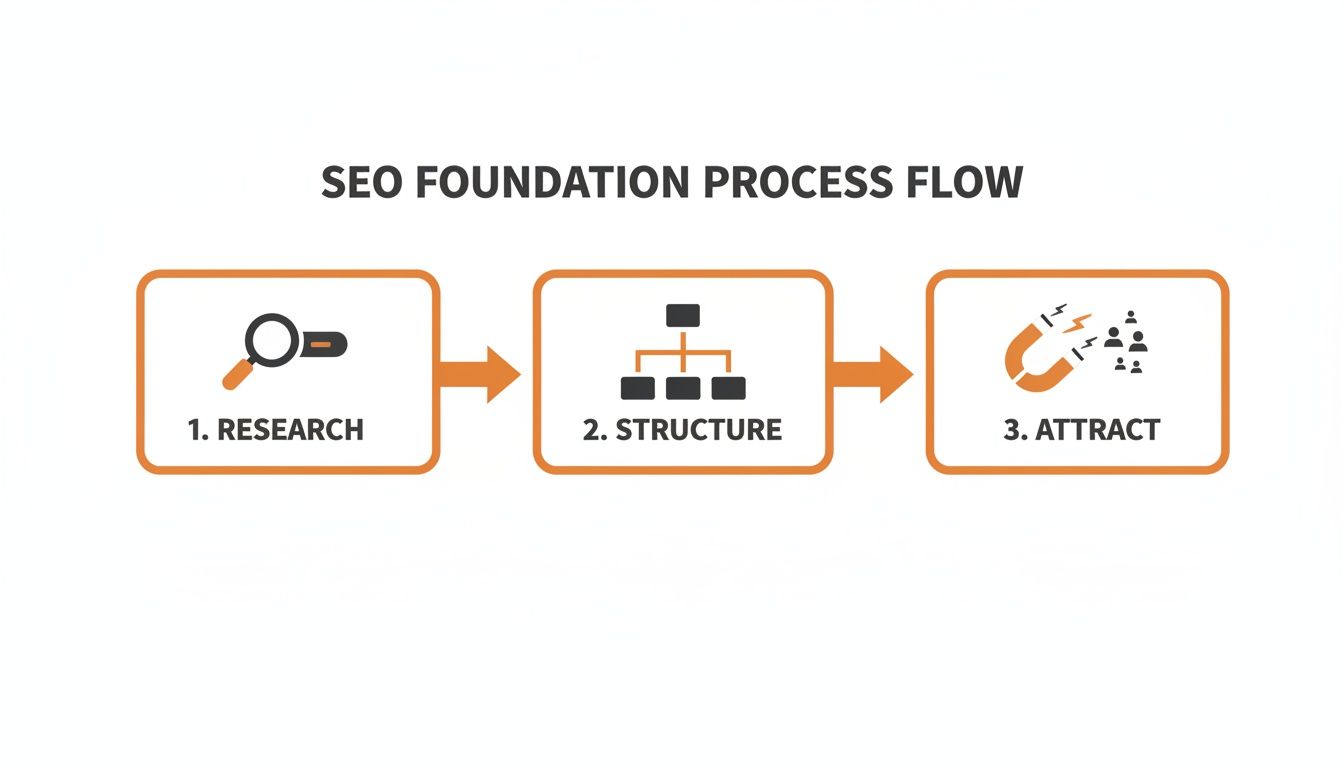
This whole process really boils down to laying a solid foundation. You do the research and build the right structure, which is what ultimately attracts the clients you want to work with.
Ensuring Consistency Across the Web
One of the bedrock principles of local SEO is NAP consistency. That stands for your Name, Address, and Phone number. Search engines are all about trust, and they trust businesses that present the same core information everywhere online. Even tiny differences—like using "St." on one directory and "Street" on another—can create confusion, dilute that trust, and hurt your ranking.
Think of your NAP as your practice's digital fingerprint. If it's smudged or inconsistent across different websites, Google gets confused and is more likely to show a competitor with a clearer signal. Make it identical. Everywhere.
The best approach is to decide on one "master" version of your NAP and stick to it religiously.
This means ensuring it's exactly the same on:
- Your Website: Have your full NAP clearly visible, usually in the footer and on your contact page.
- Your Google Business Profile: This has to be a perfect match to what's on your website. No exceptions.
- Therapist Directories: Listings on huge platforms like Psychology Today or local health directories are incredibly important.
- Social Media Profiles: Double-check that your business pages on Facebook, LinkedIn, etc., all have the correct, matching info.
These consistent listings are called citations. The more high-quality, consistent citations you build, the more confident Google becomes that you are who you say you are, and you're located where you say you are.
Speaking Google’s Language with Schema Markup
If you want to give your local SEO an extra edge, it’s time to look at local schema markup. This is just a bit of code you add to your website's backend that acts like a translator for search engines. It explicitly labels your information so Google understands its meaning perfectly.
For instance, schema can tell Google, "This string of text is a business Name," "this is an Address in Vancouver," and "these are the Hours of Operation." This structured data makes it incredibly easy for Google to validate your information, which seriously increases your chances of showing up in prominent spots like the Local Pack.
While it sounds technical, many website builders like WordPress have plugins that make adding basic local schema a surprisingly simple task. It’s a small effort for a potentially huge reward.
Creating Content That Genuinely Connects
Let's be honest, SEO for therapists isn't just about keywords and rankings. It's about creating a digital front door that feels safe, supportive, and genuinely human. Your website content is the very heart of that effort, a delicate dance between your professional authority, real empathy, and smart search optimization. It's where you translate the compassion you show in your office into an online experience that builds trust long before a potential client ever works up the courage to reach out.
Your content strategy needs to meet people exactly where they are—answering their unspoken questions, validating their fears, and showing them a path forward. This isn’t just marketing; it's an ethical extension of your practice, offering value and reassurance from the very first click.

Core Pages Every Therapist Website Needs
Think of your website's pages as different rooms in your practice. Each one has a specific job, whether it's explaining your services or showing the person behind the credentials. Getting these foundational pages right is crucial for both search engines and the real people seeking help.
Start by sketching out these essentials:
- Detailed Service Pages: Please, don't lump all your services into one generic page. Give each specialty its own space. A dedicated page for 'Couples Counselling,' 'Anxiety Therapy,' or 'EMDR for Trauma' lets you get specific. This helps you rank for targeted searches (like "EMDR therapist in Burnaby") and gives potential clients the detailed information they're desperately looking for.
- An Empathetic 'About Me' Page: This is often the most visited page right after your homepage. It’s your chance to be more than just a list of qualifications. Share your philosophy, what brought you to this work, and what someone can truly expect from a session with you. A warm, professional photo here isn't optional—it's essential for building that initial connection.
- A Proactive FAQ Page: Get ahead of the questions that make people hesitate. Be upfront about session fees, insurance, your cancellation policy, and what the first appointment actually looks like. This kind of transparency demystifies the process and removes a huge barrier for someone who is already feeling vulnerable.
Writing Blog Content That Resonates
Your blog is where you can really let your expertise and empathy shine. It's the perfect place to explore the real-world struggles your clients face while naturally including the phrases they use when searching for help. With over 80% of clients starting their therapist search online, a thoughtful blog is a powerful way to be discovered.
Move beyond dry, clinical explanations. The content that connects most deeply is the content that addresses the specific pain points and questions you hear in your office every day. Instead of a generic post like "What Is Social Anxiety," try writing something more targeted and genuinely helpful, like "5 Practical Ways to Manage Social Anxiety in Downtown Vancouver."
Your blog isn't just a marketing tool; it's an ethical way to offer support and information to your community. By addressing real-life scenarios, you validate people's experiences and show them that help is not only available but also understands their specific context.
This approach shows you have a deep understanding of their challenges and establishes you as a trusted local resource. If you're looking to polish your writing, exploring these valuable SEO copywriting tips can help you strike that perfect balance between expertise and search visibility.
Upholding Ethical Standards and Privacy
As a healthcare provider, your marketing must always be guided by a strict ethical code and privacy regulations. In Canada, that means a firm commitment to laws like the Personal Information Protection and Health Information Act (PHIPA), which dictates how sensitive client information is handled.
Here’s how to keep your content strategy both compliant and ethical:
- Always Use Disclaimers: Every blog post and service page needs a clear disclaimer. It should state that the content is for informational purposes only and does not create a therapist-client relationship or replace professional advice.
- Protect Confidentiality Above All: Never share identifiable details about clients, no matter how helpful you think a story might be. Use composite characters or completely anonymous examples to illustrate your points without ever risking a breach of confidence.
- Avoid Making Guarantees: Your writing should be hopeful and supportive, but it must never promise specific outcomes or "cures." Ethical marketing focuses on your approach, your qualifications, and your commitment to client care—not on guaranteeing results.
By building these principles into your content from the ground up, you'll create a website that not only attracts the right clients through smart SEO for therapists but also upholds the trust and integrity that are the bedrock of your profession.
Building Trust Before the First Session
In the world of therapy, everything hinges on trust. But that trust doesn’t magically appear during the first session—it starts forming the very moment a potential client finds your practice online. Your digital reputation, built on client reviews and how you respond to them, is one of your most powerful assets for creating that initial sense of safety and credibility.
Think about it from their perspective. Someone is feeling vulnerable, searching for help, and seeing positive feedback from others who have been in their shoes can be the final push they need. It’s powerful social proof that validates their decision to reach out. Google sees this, too. A steady stream of good reviews signals that you’re a reputable, trusted local practice, which is a major factor in how you show up in local search results.

Ethically Asking Clients for Reviews
As a therapist, asking for reviews requires a delicate touch. This isn't about getting marketing testimonials; it's about inviting someone to share their experience on a public platform if they feel comfortable. The entire process has to be optional and pressure-free, always protecting client confidentiality and the therapeutic relationship you've built.
The best approach is to weave the request into the natural conclusion of your work together.
- Timing is Key: Wait until the off-boarding process. When a client is finishing their sessions and feeling good about the progress they've made, that's the right moment.
- Make it Simple: Send a private, simple email with a direct link to your Google Business Profile review section. The easier you make it, the more likely they are to follow through.
- Keep the Language Gentle: Frame it as an invitation. Something like, "If you feel comfortable, sharing your experience on our Google profile could really help others who are looking for support," works beautifully. It empowers them to make the choice.
Your ethical obligation to your client always comes first. A review is a generous gift, not something they owe you. The goal is to adhere to your profession's guidelines while giving satisfied clients a chance to help others find you.
Looking After Your Online Reputation
Replying to reviews, both good and bad, is non-negotiable. Every response you post is a public signal of your professionalism and how much you care. It shows you're engaged, you value feedback, and you listen.
When you get a positive review, a simple, heartfelt "Thank you for taking the time to share your experience" is perfect. It’s appreciative without crossing any privacy lines.
Handling a rare negative review is even more important.
- Acknowledge Their Feedback: Start by thanking them for bringing their concerns to your attention.
- Protect Confidentiality: This is critical. Never confirm or deny whether the person was a client. A neutral phrase like, "We are committed to providing a positive and supportive experience for everyone who connects with our practice," is a safe way to respond.
- Move the Conversation Offline: Immediately offer a private channel to resolve the issue. Provide a phone number or email and invite them to discuss their concerns directly with you, away from the public forum.
This calm, measured response shows potential clients that you handle difficult conversations with grace. By actively monitoring your profiles on Google and directories like Psychology Today, you can manage feedback quickly. This turns every review, good or bad, into another opportunity to build the trust that is so fundamental to your work.
Adapting to the Future of Client Searches
Let's be honest: the way clients find therapists is changing right under our feet. That familiar list of ten blue links on Google is quickly becoming a thing of the past. It’s being replaced by a much more conversational, answer-focused experience, all driven by artificial intelligence.
This forces a major shift in our thinking. We can no longer obsess over just being "number one." The new goal is to be present and helpful wherever a client's search for support takes them.
We're now operating in a world of AI Overviews and "zero-click searches." This is where Google’s AI pulls information from multiple websites to give a direct, comprehensive answer right at the top of the page. The searcher gets what they need instantly, often without ever clicking through to a single practice's website.
For a therapy practice, the writing is on the wall. Industry forecasts show that by 2026, a staggering 70 percent of Google searches could end without a single click to a website. That's a huge departure from how we've always measured success. If your whole strategy is built on getting that one click, you're going to be left behind.
This doesn't mean SEO is dead; it means our definition of visibility has to expand beyond a single website ranking.
Thriving in a Zero-Click World
Your new mission is to achieve omnipresence. You want your practice’s name, your expertise, and your contact info to pop up in as many places as possible when someone in your area searches for help.
Instead of focusing all your energy on your homepage, think about every digital touchpoint a potential client might encounter:
- Google's Local Pack: Those map results, fuelled by your Google Business Profile, are gold. They are often the first thing a local searcher sees.
- "People Also Ask" Boxes: By answering common client questions on your blog or FAQ page, you can get featured directly in the search results.
- AI Overviews: Clear, well-structured content on your site makes it far more likely that Google's AI will cite you as a trusted source in its generated answers.
- Reputable Directories: Never underestimate the power of a well-maintained profile on platforms like Psychology Today. It's a critical piece of the visibility puzzle.
It's a complete mindset change. You’re not just trying to win a single race; you're building a web of visibility that establishes your practice as an undeniable authority in your community. To dive deeper into this evolution, check out our guide on the future of search engines.
Technical Health Signals That Still Matter
While the search results page is evolving, the foundational health of your website is more important than ever. Google’s AI isn’t going to recommend a site that’s slow, broken, or frustrating to use.
If you focus on nothing else technical, nail these two things: site speed and mobile-friendliness.
A slow website is a conversion killer. A potential client who is already feeling distressed isn't going to wait ten seconds for your page to load; they'll just hit the back button and find someone else. You should be aiming for a load time of under three seconds.
And since most local searches now happen on a phone, your website has to be seamless to use on a small screen. No pinching and zooming required.
Think of your site's technical health as the foundation of your digital office. If the foundation is cracked—if it's slow or broken on mobile—it doesn't matter how beautifully you've decorated the rooms. People won't stick around long enough to see it.
Measuring What Truly Matters
With all this change, how do you actually know if your SEO is working? You have to track the right data. It's time to move past vanity metrics like "website traffic" and focus on the Key Performance Indicators (KPIs) that directly impact your practice's growth.
This is where your Google Analytics 4 (GA4) account becomes your most valuable tool. It gives you the real-world data needed to make smart decisions and fine-tune your approach.
Here are the core metrics you should be watching.
Key SEO Metrics for Therapists to Track
| Metric | What It Measures | Why It's Important for Therapists |
|---|---|---|
| Organic Sessions | The number of visitors who find your site through unpaid search results. | This shows how well you're attracting people who are actively looking for a therapist. |
| Local Pack Rankings | Your practice's position in the Google Maps results for key local searches (e.g., "anxiety therapist near me"). | For a local practice, this is a primary driver of new client calls and inquiries. |
| Conversion Rate | The percentage of visitors who complete a key action, like submitting your contact form or calling your office. | This tells you if your website is effectively turning curious visitors into potential clients. |
| Bounce Rate | The percentage of visitors who leave your site after viewing only one page. | A high bounce rate can signal a mismatch between your page content and what the searcher expected to find. |
By keeping a close eye on these specific KPIs, you shift from guessing to knowing. You’ll see exactly which parts of your online presence are connecting with clients and which areas need a bit more work, ensuring your practice doesn't just survive this new era of search, but thrives in it.
Got Questions About SEO? Let's Talk.
Diving into SEO for your practice can feel a bit like starting a new therapeutic modality—it’s exciting, but it also comes with a lot of questions. It's totally normal to wonder about how long it all takes, whether it's ethical, and if you can realistically tackle this on your own. Let's get into some of the most common concerns I hear from therapists.
How Long Does SEO Actually Take to Work for a Therapy Practice?
This is probably the number one question I get, and for good reason. The honest answer is that SEO is a marathon, not a sprint. Much like building a strong therapeutic alliance, it takes time, consistency, and patience. For a brand-new practice or a website that's just getting started with optimization, you're typically looking at six to 12 months before you see significant results, like showing up on the first page of Google for your key local searches.
But that doesn't mean you're flying blind for a year. Some wins can come much faster.
- Quick Boosts: Getting your Google Business Profile dialled in can improve your visibility in local map searches in just a few weeks.
- Steady Climb: If you consistently publish genuinely helpful, locally-focused blog posts, you can start seeing trickles of traffic from them within three to four months.
The best way to think about SEO is as a core part of your practice's foundation. It’s not a quick fix for a slow month. Every piece of content you create and every local directory you're listed in adds another brick to a solid digital presence that will serve you for years.
Can I Do My Own SEO, or Do I Need to Hire Someone?
This is a big one, and the right answer really comes down to your time, budget, and how comfortable you are with the digital side of things. The good news is, you can absolutely manage many SEO fundamentals yourself. For a lot of therapists, a hands-on approach is the perfect way to start.
DIY SEO tasks that are totally manageable:
- Setting up and completely filling out your Google Business Profile.
- Writing blog posts that answer the real questions you hear from clients every day.
- Making sure your practice name, address, and phone number are consistent on key sites like Psychology Today.
On the flip side, bringing in an SEO agency or a consultant gives you access to specialized expertise that can seriously speed up your growth. They’ll handle the more technical stuff, dig deep into what your local competitors are doing, and put advanced strategies in place. This saves you a ton of time and helps you avoid common pitfalls.
A great middle ground? Handle the basics yourself and maybe hire an expert for a one-time website audit or for a few hours of consultation each month to make sure you're on the right track.
Is It Unethical for Therapists to Use SEO?
I’m so glad when therapists ask this. It shows a deep commitment to our professional integrity. The truth is, using SEO for therapists isn't unethical at all—it’s just a modern way to make your practice visible to people who are actively looking for the support you provide. The ethics come down to how you do it.
Ethical SEO simply means your marketing is truthful, transparent, and puts client privacy first. It's about informing and connecting, not making over-the-top promises or using clickbait to get people in the door.
To keep your marketing efforts firmly in the ethical camp:
- Be Honest: Never, ever guarantee outcomes or "cures." Your content should focus on your therapeutic approach, your qualifications, and the safe, supportive space you offer.
- Protect Privacy: Don't even think about using client testimonials or case details without explicit, informed consent. Always follow PHIPA guidelines to the letter.
- Uphold Professional Standards: Make sure everything you publish online—from your website copy to your blog posts—aligns perfectly with the ethical guidelines of your professional regulatory body.
When you get right down to it, ethical SEO is just an extension of your duty of care. It helps people who are struggling find a qualified, safe, and trustworthy professional to guide them.
At Juiced Digital, we get the unique challenges and ethical lines that come with marketing a therapy practice in Canada. We build effective, compliant SEO strategies that connect you with the clients who truly need your help. Ready to grow your practice with a partner you can trust? Book your free consultation with Juiced Digital today.