At its core, programmatic display advertising is simply using technology to automatically buy and sell digital ad space. Forget the old days of phone calls and manual negotiations; think of it as a super-fast, automated auction for eyeballs, happening in the blink of an eye.
This system replaces the slow, cumbersome process of the past with lightning-fast, data-driven decisions. It’s all about getting your ads in front of the right person, at the right time, on the right device.
From Guesswork to Precision: How Programmatic Ads Work

Let’s imagine a local e-commerce brand selling handmade candles in Vancouver. Not too long ago, their marketing team would have had to manually call or email individual websites and blogs they thought their customers might visit. This was a tedious, expensive process built on a lot of guesswork. Were their ads actually reaching candle lovers, or just getting lost in the noise? They could never be sure.
This is exactly the problem that programmatic display advertising was built to solve. Instead of locking into one-off deals, our candle brand can now use a single software platform to tap into millions of websites all at once. The entire ad buying process is automated, turning a manual headache into a precise, intelligent strategy.
The Power of Automation and Data
So how does it actually work? The system crunches massive amounts of anonymous user data to make decisions in milliseconds. When someone who fits the candle brand's ideal customer profile—say, a person in British Columbia who recently searched for "organic home décor"—visits a website with ad space, an auction is triggered.
In the fraction of a second it takes for that webpage to load, multiple programmatic platforms bid against each other for that single ad impression. The highest bidder wins, and their ad is instantly displayed to that user. This means our Vancouver candle maker only pays to show their ad to someone who is genuinely a potential customer, making every dollar work harder.
Programmatic isn't just about speed; it's about smarts. It uses sophisticated algorithms to figure out where your ad spend will have the most impact, moving marketing from broad-stroke campaigns to precision-guided, individual-level targeting.
Key Advantages for Your Business
Switching to this automated approach brings some serious advantages over the old way of doing things. By ditching the manual grunt work, businesses can get a lot more out of their advertising budget. The main benefits really boil down to this:
- Enhanced Efficiency: Automation frees up your team from tedious tasks. They can spend their time on what really matters: strategy, creative thinking, and optimising campaigns.
- Precision Targeting: You can get incredibly specific, reaching people based on their demographics, what they’re interested in, their online behaviour, and even their real-world location.
- Improved ROI: When you stop wasting money on irrelevant audiences, your conversion rates go up. This directly translates to a much stronger return on your investment.
Ultimately, programmatic display advertising levels the playing field. It gives a local Vancouver brand access to the same powerful advertising tools that were once only available to the biggest global corporations, allowing them to compete and win.
Getting to Know the Programmatic Ecosystem
To get the most out of programmatic display ads, you first need to understand the moving parts. It’s less like a single tool and more like a high-speed digital stock market, where advertising space is bought and sold in the time it takes you to blink. Each platform in this system has a specific, crucial job to do.
At its core, the whole setup is designed to connect advertisers looking for ad space with the publishers (websites, apps, etc.) who are selling it. They don’t talk directly, though. Instead, they use specialized platforms as their agents to make every deal happen instantly and efficiently.
Let’s break down who’s who.
The Buyers: Demand-Side Platforms (DSPs)
On the buying side of the market, you have advertisers and the platforms they use: Demand-Side Platforms (DSPs). Think of a DSP as the advertiser's command centre. It’s the software they use to buy ad placements across a huge network of publisher sites, all aimed at very specific audiences.
For example, say our Vancouver-based e-commerce store wants to reach women aged 25-45 in British Columbia who've recently browsed for sustainable home goods. The marketing manager plugs those targeting details and a budget into a DSP like The Trade Desk or DV360. The DSP then automatically finds and bids on ad spots that match this exact person, across thousands of websites, all at once.
The Sellers: Supply-Side Platforms (SSPs)
On the other side, you have the publishers—the blogs, local news sites, and apps with ad space to fill. They use a Supply-Side Platform (SSP) to manage their inventory and sell it to the highest bidder. An SSP's entire purpose is to make sure publishers get the most money possible for the ad space they have available.
An SSP, like Magnite or OpenX, connects a publisher's inventory to countless ad exchanges and DSPs. This creates a massive, real-time auction, driving up the price and ensuring the publisher gets the best deal for every single ad impression. It’s basically their automated sales team, working around the clock.
The Auction House: Ad Exchanges
So, where do the buyers and sellers actually meet to make the deal? That all happens in the Ad Exchange. An ad exchange is the central, neutral marketplace that makes the buying and selling possible. It’s the digital auction house connecting inventory from countless SSPs to the bids coming from DSPs.
This is where the real magic happens, a process called Real-Time Bidding (RTB). In the milliseconds it takes for a webpage to load for you, an entire auction takes place behind the scenes. A DSP sees you, decides if you're the right audience, submits a bid, and if it wins, you see the ad. It’s lightning-fast, and today, over 80% of digital display ads in North America are bought and sold this way.
To help visualize how these platforms work together, here’s a simple breakdown of their roles.
Key Players in the Programmatic Ecosystem
| Platform | Primary User | Core Function | Analogy |
|---|---|---|---|
| Demand-Side Platform (DSP) | Advertisers & Agencies | Buys ad space and targets audiences | A stockbroker buying shares for an investor |
| Supply-Side Platform (SSP) | Publishers & App Developers | Sells ad space to maximize revenue | A real estate agent selling a property for the best price |
| Ad Exchange | DSPs & SSPs | Connects buyers and sellers for auctions | The New York Stock Exchange floor |
| Data Management Platform (DMP) | Advertisers & Publishers | Collects and organizes audience data | A research analyst providing market intelligence |
This table simplifies it, but it shows how each piece is essential. The DSPs and SSPs are the agents for the two sides, the ad exchange is the venue where they trade, and DMPs provide the critical intelligence to make it all work.
The Brains of the Operation: Data Management Platforms (DMPs)
To make targeting so precise, advertisers lean on a Data Management Platform (DMP). A DMP is essentially a data warehouse. It collects, sorts, and activates huge amounts of audience data, which can come from a few different places:
- First-party data: This is your own data, collected directly from your customers. Think website visitors, email subscribers, or loyalty program members. It's pure gold.
- Second-party data: This is just someone else's first-party data that you buy directly from them in a private deal.
- Third-party data: This is data you buy from large aggregators who collect it from all over the web.
A DMP, like Salesforce DMP or Lotame, feeds this rich audience information straight into the DSP. It empowers the DSP to make much smarter bidding decisions by answering the most important question: "Who is this user, and are they valuable enough for us to bid on?" This data-first approach is what truly sets programmatic advertising apart from the old way of buying ads.
Mastering Your Targeting and Creative Strategies
Knowing how the programmatic ecosystem works is one thing, but making it work for you is where the real magic happens. This is all about precision—moving beyond just buying ad space to connecting with the right person, at the right time, with a message that actually means something to them.
It's a two-part puzzle: smart targeting and compelling creative. Instead of blasting a generic ad to the masses, you can pinpoint your audience with incredible accuracy and show them an ad that feels like it was made just for them. This focus is what makes your ad spend work harder, driving up your return on investment.
Choosing the Right Audience Targeting Strategy
Great programmatic campaigns start with a simple question: who are we trying to reach? The platforms give you some incredibly powerful tools to answer that, and a solid strategy will usually mix and match a few of them to engage people at different points in their journey.
Here are the core targeting methods you'll be working with:
- Contextual Targeting: This is the most intuitive approach. You place your ads on websites where the content is directly related to what you sell. Think of a company selling organic dog food placing its ads on a popular blog that reviews pet supplies. It’s about being in the right place.
- Behavioural Targeting: This method shifts the focus from the content to the person. It uses anonymous data about someone's recent online activity—like websites they've visited or products they've browsed—to show them relevant ads. So, if someone was just researching running shoes, they might see your ad for athletic gear on a completely unrelated news site.
- Lookalike Modelling: This is where you can really scale your efforts. You take a list of your best customers (your first-party data), and the DSP analyses their common traits to find brand-new audiences across the web who "look like" them. It’s a fantastic way to find new customers who share the same DNA as your most loyal ones.
- Geofencing and Location-Based Targeting: An absolute game-changer for local businesses. This lets you draw a virtual perimeter around a specific geographic area. For example, a wellness clinic in Vancouver could serve ads to people within a 5-kilometre radius, maybe promoting a last-minute opening for a massage.
This is how all those pieces fit together to get your ad in front of the right person.
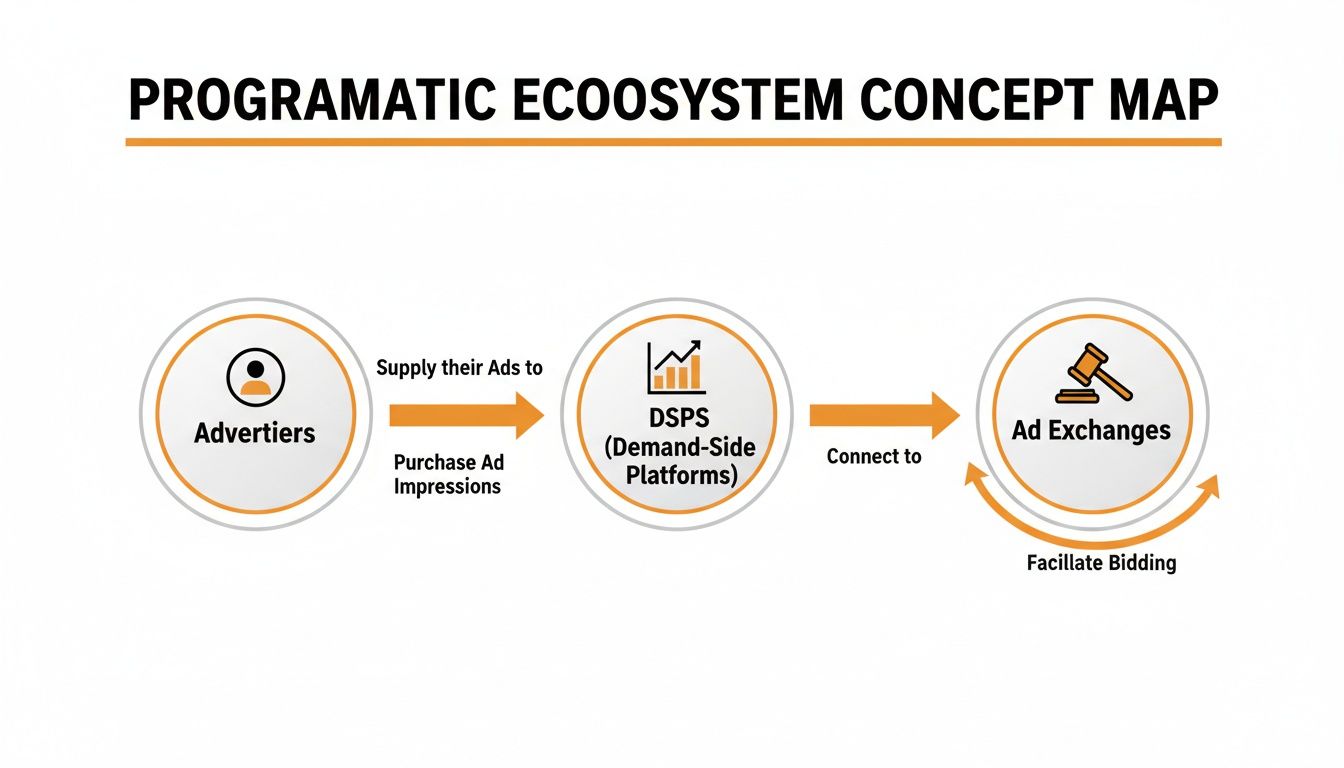
As the diagram shows, the technology handles the complex bidding and delivery in milliseconds, all based on the targeting decisions you make.
The Power of Dynamic Creative Optimization
Reaching the right person is only half the battle. You also have to show them the right message. That’s where Dynamic Creative Optimization (DCO) steps in. Think of DCO as an AI-powered creative director that builds the perfect ad for each individual, on the fly.
Instead of designing one static banner, you feed the DCO platform a library of creative components:
- A few different headlines
- A variety of images or videos
- Several calls-to-action (CTAs)
- Different background colours or designs
The DCO algorithm then instantly assembles the best combination for each user based on data points like their location, browsing history, or even the weather. For an e-commerce brand, this could mean showing someone an ad with the exact pair of shoes they just left in their cart. This hyper-personalization makes your ads feel genuinely relevant and can lift conversion rates significantly—sometimes by more than double compared to their static counterparts.
The goal is to make every ad impression count. By combining precise audience targeting with dynamically optimised creative, you ensure that your message is not only seen by the right person but is also perfectly tailored to them at that exact moment.
Of course, none of this matters if your ads don't display correctly. To ensure your creative looks great across the endless variety of publisher sites, you need to stick to standard ad specifications. It’s always a good idea to check a complete guide to Google display ad sizes to make sure your assets are built right from the start.
Navigating Privacy and Compliance Challenges
In programmatic advertising, data is the fuel that powers the engine. But with consumers becoming increasingly aware of their digital footprint, privacy has become the undisputed law of the road. Getting a handle on the complex web of regulations isn't just a box-ticking exercise—it's absolutely critical for building trust and making sure your campaigns have a future.
This is a huge hurdle, especially if you're in a tightly regulated space like cannabis, CBD, or holistic health, where ad platform policies can be incredibly restrictive. It’s easy to see these rules as a roadblock, but that’s the wrong way to look at it. They're really an opportunity to build a more honest and transparent relationship with your audience.
The New Rules of Engagement
The ground is shifting under our feet. Landmark privacy laws like Europe’s General Data Protection Regulation (GDPR) and the California Consumer Privacy Act (CCPA) have completely changed the game for how user data is collected and managed. These regulations put power back in the hands of consumers, demanding their clear consent before any tracking happens.
At the same time, the industry is finally weaning itself off its long-standing addiction to third-party cookies. This so-called "cookiepocalypse" is making many of the old-school behavioural targeting tactics obsolete. As marketers, our job now is to find new, privacy-friendly ways to connect with people without sacrificing results.
We're being forced to pivot. Instead of chasing users across the web, the focus is now on engaging them in the right moment and context. It’s less about who a person is and more about what they’re interested in right now—a subtle but powerful shift that respects privacy while delivering real relevance.
These changes are also making waves in the market. For instance, in 2025, programmatic ad spending growth in Canada is projected to slow down relative to other major markets. This is partly due to economic factors and the new Digital Services Tax, which makes ad buys more expensive. Even with these headwinds, programmatic is still expected to account for about 90% of all display ad budgets, proving it’s an essential tool that’s simply adapting to new rules. You can find more global programmatic ad spending insights on eMarketer.com.
Privacy-First Programmatic Strategies
So, how do you actually run a successful programmatic campaign in this new reality? It all comes down to embracing privacy-first solutions that don't rely on those crumbling third-party cookies. Not only are these methods fully compliant, but they often create more genuine connections with your audience.
Here are the key strategies you need to master:
-
Contextual Targeting: This is the classic, reinvented. Instead of tracking users, you place your ads on web pages where the content is directly relevant. Think about an ad for a local Vancouver yoga studio showing up on an article about mindfulness—it’s a perfect match. It works, it isn't creepy, and it's 100% compliant.
-
First-Party Data Activation: The data you collect yourself is pure gold. We're talking about information from your newsletter subscribers, customer purchase histories, or website interactions. With full consent, you can use this data to build incredibly effective lookalike audiences or run retargeting campaigns that people actually appreciate.
-
Brand Safety and Suitability: Use smart, AI-driven tools to make sure your ads only appear next to content that aligns with your brand's values. These systems scan pages in real-time to steer clear of controversial or inappropriate topics, protecting your hard-earned reputation at a massive scale.
By leaning into these modern strategies, you can keep tapping into the incredible power of programmatic display advertising. You’ll be building campaigns that not only hit their targets but also treat user privacy with respect—fostering the kind of trust that turns a simple click into a loyal customer.
Unifying Your Strategy with AI-Powered Optimization
The real magic in programmatic display advertising happens when you stop thinking in terms of isolated campaigns. The true competitive edge comes from unifying your entire strategy with artificial intelligence. Think of advanced AI algorithms as the engine driving modern programmatic success—working 24/7 to fine-tune bids, predict what users will do next, and automatically sniff out ad fraud.
This isn't just about making your display ads smarter on their own. It’s about building a single, cohesive marketing system. When you tear down the walls between your programmatic display, search, and social media advertising, you finally get a complete picture of the customer's journey. This holistic view is what lets you make genuinely smart decisions about your budget and, ultimately, drives much better results.
From Siloed Data to a Single Source of Truth
Let's be honest, many businesses still run their advertising channels in separate bubbles. The search team has its own data, the social team has theirs, and the programmatic team operates in a world of its own. This separation creates massive blind spots, making it impossible to see how each channel actually influences the others. You're leaving valuable insights—and money—on the table.
This is exactly the problem that a unified tech stack solves. By integrating your platforms, you create a central hub where all performance data flows together. An AI layer can then sift through this combined information, spotting patterns and opportunities that no human could ever catch. For example, the AI might discover that users who see a specific display ad are 35% more likely to convert when they later click a search ad.
An AI-first approach transforms raw data from disparate channels into a unified, actionable strategy. It ensures every advertising dollar is intelligently invested, maximizing performance and paving a clear path for sustainable business growth.
This integrated approach is precisely what separates the market leaders from everyone else. Recent industry analysis points to a huge gap in programmatic maturity, showing that top-performing Canadian marketers are four times more likely to consolidate their technology and integrate AI than their slower competitors. And while 75% of marketers expect their budgets to grow, a massive 84% say that fragmented tools are a major roadblock to executing a true omnichannel strategy. This is especially true for specialized Vancouver agencies trying to navigate complex industries like e-commerce and cannabis. You can read more about this in the 2026 Programmatic Advertising Report on businesswire.com.
The Practical Benefits of AI Optimization
Bringing an AI-powered, unified strategy into your marketing mix isn't just a fancy concept; it delivers real, tangible advantages that directly impact your bottom line. It's about making your entire marketing effort more intelligent and a whole lot more efficient.
Here’s what this actually looks like day-to-day:
- Smarter Budget Allocation: The AI can dynamically shift your budget between channels in real time. If it sees that display ads are driving high-quality awareness that leads to a surge in search conversions, it will automatically funnel more money into display to keep filling the top of your sales funnel.
- Predictive Performance: These advanced algorithms can forecast which groups of people are most likely to convert and proactively adjust your bidding to reach them at the lowest possible cost.
- Enhanced Personalization: By understanding the full customer journey from start to finish, the AI can deliver a much more relevant sequence of ads. A user might first see a brand awareness video on social media, then a display ad for a specific product they browsed, and finally, a search ad with a clear call to action to buy.
At the end of the day, integrating AI turns your marketing from a collection of separate tactics into a single, intelligent growth machine. This is the heart of what our approach to AI powered paid advertising is designed to do.
Expanding Your Reach with Programmatic DOOH
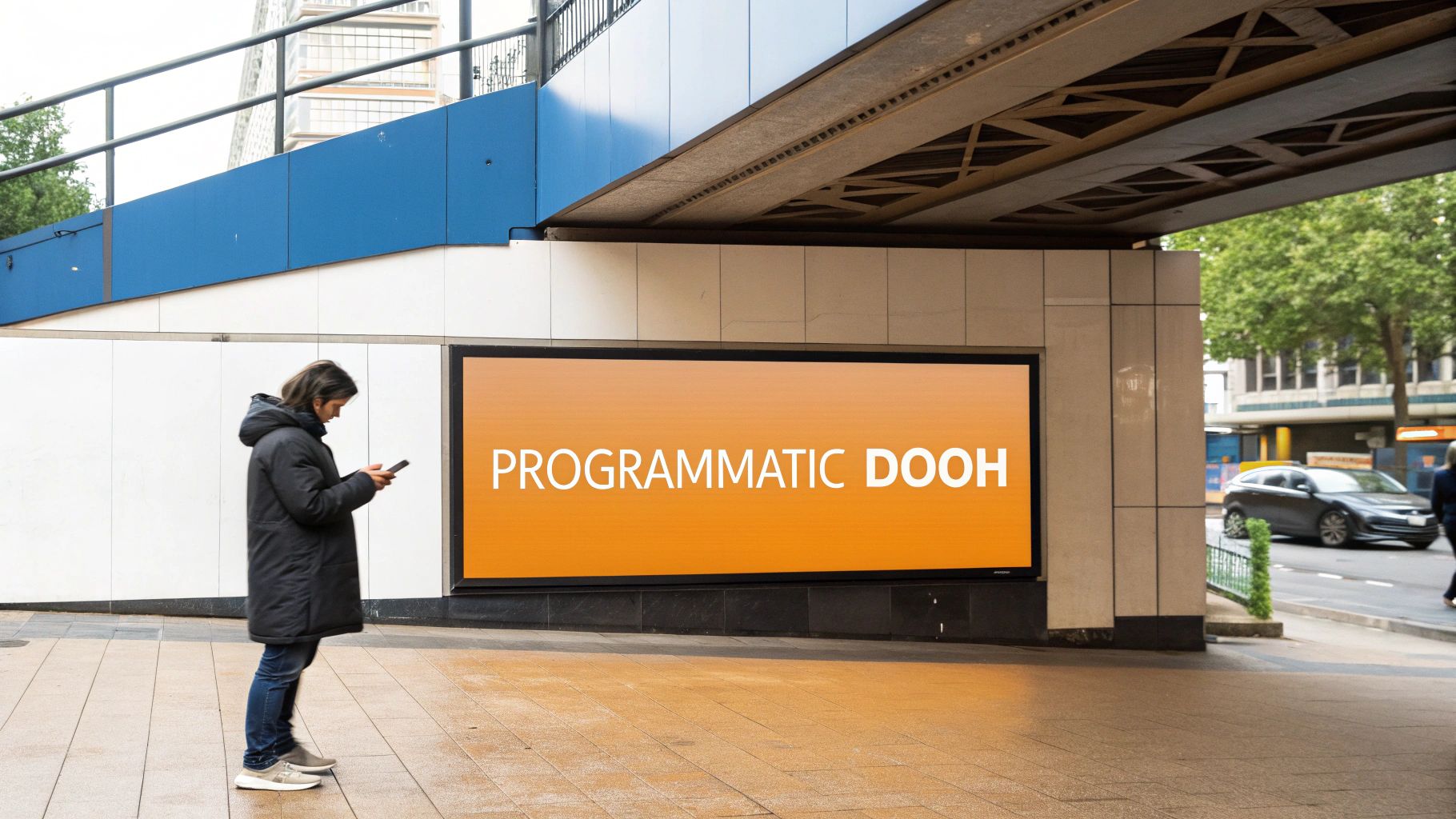
The world of programmatic doesn't stop at your browser window. It's now stepping out into the real world through an exciting channel: Programmatic Digital Out-of-Home (DOOH). This is exactly what it sounds like—taking the automated, data-rich buying process we use for online ads and applying it to physical, real-world digital screens.
Just think of those massive, eye-catching digital billboards in downtown Vancouver, the screens inside a bustling GO station, or the video displays you see at the mall. Programmatic DOOH lets you bid on and place your ads on these screens using the same automated platforms and precise targeting you're already used to. It's the perfect way to bridge your online marketing with your customers' physical journey.
Why DOOH Is a Game Changer
Old-school billboards were a huge commitment. You bought the space for weeks or months at a time, stuck with one static message, and hoped the right people saw it. Programmatic DOOH is the exact opposite: it’s dynamic, flexible, and incredibly smart. It gives you that same high-impact visibility in public places, but with the ability to connect with people while they're on the move and often more open to new ideas.
The real magic is how it uses data to make smarter ad placements. You can set your ads to run based on specific triggers—like the time of day, a sudden change in weather, or even live foot traffic data. This adds a whole new, powerful dimension to any omnichannel programmatic display advertising strategy.
Programmatic DOOH turns static outdoor ads into a responsive, living medium. It lets you deliver the right message, in the right place, at precisely the right moment—influencing decisions as they happen in the real world.
Real-World Applications for Your Business
For local businesses and e-commerce brands, the practical uses here are massive. Instead of just buying a billboard and crossing your fingers, you can run hyper-targeted campaigns that get people to act now.
Here’s how it could work:
- Local Restaurant: Imagine promoting a lunch special with geo-targeted DOOH ads on screens within a two-block radius of your restaurant, running only from 11 a.m. to 1 p.m. You're directly influencing hungry pedestrians at the perfect time.
- E-commerce Brand: An online clothing store could have ads for rain jackets appear on digital bus shelter screens the moment it starts to rain. The message is perfectly timed and incredibly relevant.
- Event Promoter: A concert venue could run ads on screens near other downtown entertainment spots on a Friday night, targeting people who are already out and looking for something to do.
This kind of targeted approach is fuelling some serious growth. In Canada, the digital out-of-home market is on track to hit $467 million USD in ad spending by 2025, and that figure is expected to jump to $605 million by 2030. What's driving this surge? The demand for the real-time, automated buying that makes programmatic DOOH so powerful for local businesses. You can dig into more OOH advertising trends on stackadapt.com.
Your Programmatic Campaign Launch Checklist
Alright, let's turn all this theory into action. This isn't just a list; it's a practical roadmap I’ve seen work time and time again for launching a successful programmatic display campaign. Following these steps helps organize your thinking, sidestep the usual mistakes, and get you on the path to real results from the get-go.
Think of it as your pre-flight check before takeoff. Ticking off each box ensures all the critical pieces are in place, giving you the confidence to navigate the programmatic space like a pro.
Step 1: Define Clear Campaign Objectives
Before you even think about spending a dollar, you need to know what winning looks like for you. What's the goal? Are you trying to get your name out there (brand awareness), pull more people to your website (drive traffic), fill your sales pipeline (generate leads), or straight-up boost online sales?
Your main objective steers every other decision you'll make, from who you target to what your ads look like. An e-commerce brand might live or die by its Return On Ad Spend (ROAS), while a local service business is probably more focused on getting qualified leads through a contact form. You absolutely must have a clear goal.
A campaign without a defined objective is like a ship without a rudder. You’ll be busy, but you won't be productive. Start with your end goal and work backward to build a strategy that gets you there.
Step 2: Identify Your Ideal Audience
Now, let's get crystal clear on who you're trying to talk to. Go deeper than just age and location. Build out detailed personas of your ideal customers. What are they interested in? What websites do they visit? What problems are they trying to solve? This is where you'll mix and match targeting strategies like contextual, behavioural, and lookalike audiences to find them.
For example, a local Vancouver wellness clinic could target people who recently searched for "massage therapy near me" (hello, high intent!). At the same time, they could upload their existing client list to build a lookalike audience, finding new people who share similar traits. This layered approach is powerful because it captures both active searchers and new potential customers who just don't know you exist yet.
Step 3: Set Your Budget and KPIs
You need a realistic budget and a clear way to measure success. Your Key Performance Indicators (KPIs) should be a direct reflection of the objective you set in Step 1.
- For awareness: Keep an eye on metrics like impressions, reach, and video completion rate.
- For traffic: You'll want to focus on clicks, click-through rate (CTR), and cost-per-click (CPC).
- For conversions: This is all about the bottom line. Measure conversions, cost-per-acquisition (CPA), and ROAS.
Knowing your numbers is everything. If you need a refresher on connecting your ad spend directly to revenue, our guide explaining what is ROAS is a great resource for tracking profitability.
Step 4: Develop Compelling Ad Creative
Finally, the fun part: designing ads that people actually want to look at. Your creative needs to grab attention in a split second and tell people exactly what you offer. Use high-quality images, punchy copy, and a can't-miss call-to-action (CTA).
Don't forget about Dynamic Creative Optimization (DCO). This lets you automatically test and personalize different ad elements for different users, which can give your engagement a serious boost. And a pro tip: make sure all your ad creatives are built to standard industry specs so they look great on any website they appear on.
Ready to turn this checklist into a high-performance campaign? Juiced Digital uses AI-powered programmatic advertising to help brands in Vancouver and beyond achieve measurable growth. https://juiceddigital.com