

A healthcare SEO agency does more than just get your medical website to show up on Google. They specialize in a unique blend of technical optimization, content strategy, and strict regulatory compliance (think HIPAA) to help practices like yours attract more of the right patients online. Finding a true partner means looking past generalist marketing firms and zeroing in on an agency with proven, real-world experience in the healthcare sector.
Defining Your Goals Before Hiring an Agency

Before you even think about shortlisting agencies, you need to get brutally honest about what success actually looks like for your practice. Without specific, grounded goals, you're setting yourself up for misaligned expectations and a marketing budget that just evaporates. This internal audit is the single most important first step.
Your objectives will shape the entire strategy. For instance, a local dental clinic’s game plan is worlds apart from a national telehealth provider's. That clinic needs to own the local map pack for terms like "emergency dentist near me," while the telehealth company might be chasing broader, informational searches tied to its specialized services.
Setting Concrete and Measurable Objectives
Vague aspirations like "get more traffic" are useless. You need to focus on tangible business outcomes that directly affect your bottom line. Actionable objectives give you a clear yardstick to measure an agency’s performance against.
Here are a few examples of strong, specific goals:
- Increase online appointment bookings by 30% within six months.
- Rank in the top three on Google Maps for "pediatric dentist in Vancouver."
- Drive down our patient acquisition cost from organic search by 15% over the next year.
- Generate 20 new qualified leads per month for our new cosmetic dermatology service.
This kind of clarity changes everything. It transforms your initial calls with agencies from a generic sales pitch into a focused, strategic discussion about hitting your specific targets.
A well-defined goal acts as your North Star. It guides every decision—from keyword selection to content creation—and ensures every action an agency takes is directly tied to a measurable business result.
From Vanity Metrics to Patient Acquisition
It’s easy to get fixated on flashy numbers like website traffic or keyword rankings. And while they have their place, they don't pay the bills. The Key Performance Indicators (KPIs) that truly matter for any healthcare practice revolve around patient acquisition and return on investment (ROI). A great healthcare SEO agency not only understands this but insists on it.
Think about it: driving 10,000 visitors to a blog post is a complete waste of time if not a single one books a consultation. A much better measure of success is tracking the conversion rate from an organic visitor to a qualified lead who actually shows up. This shift in mindset is crucial.
The strategies needed to attract ready-to-book patients are often very different from those designed just for traffic, a nuance that’s especially critical in sensitive fields like mental health. For a closer look at this, our guide on SEO for therapists dives deep into connecting with the right audience when it matters most.
To help you get started, here's a table that connects common practice goals with the SEO metrics that actually measure progress. Use it to clarify what you need and what to ask potential agencies.
Matching Your Practice Goals to SEO Metrics
| Business Goal | Primary SEO Focus | Key Performance Indicator (KPI) |
|---|---|---|
| Increase New Patient Appointments | Local SEO & Conversion Rate Optimization (CRO) | Form submissions, click-to-call conversions, online bookings |
| Boost Revenue for a Specific Service | Service-specific landing page optimization | Leads generated for that service, conversion rate on the page |
| Improve Brand Reputation & Trust | Content marketing & online reviews | Branded search volume, Google review ratings, high-quality backlinks |
| Become the Go-To Expert Locally | Google Business Profile & Local Content | Map pack rankings, local organic rankings, "near me" search visibility |
Mapping your goals to these KPIs before you talk to an agency ensures you're both speaking the same language—the language of results.
Ultimately, a successful SEO campaign is one that fills your appointment book, not just your analytics reports. When you define your goals around patient growth from day one, you set the stage for a partnership that delivers real, sustainable value.
Digging Into an Agency's Compliance and Technical Chops
When you're choosing a partner in the healthcare world, it's about so much more than just traffic and rankings. An agency can send visitors to your site all day long, but if they don’t have a rock-solid, ingrained understanding of the industry's strict compliance and technical standards, they're a liability, not an asset. This is where you truly separate the generalists from the specialists.
The biggest hurdle, without a doubt, is regulatory compliance—especially when it comes to patient privacy. You have to be absolutely certain about how an agency handles potentially sensitive information. Their entire approach to contact forms, appointment schedulers, and even basic analytics tracking has to be built from the ground up to avoid accidentally collecting Protected Health Information (PHI) in a non-compliant way. One slip-up can lead to crippling penalties and a complete breakdown of patient trust.
Talking Through HIPAA and Patient Privacy
Any prospective healthcare SEO agency worth its salt must be able to explain exactly how they keep their work HIPAA-compliant. This isn't about a simple disclaimer on a form; it's baked into their core processes.
You need to ask them some direct questions:
- How do you set up website forms to block the submission of PHI?
- What’s your exact process for configuring analytics and tracking pixels so they don't capture sensitive data?
- Can you walk me through a few examples of compliant lead-generation funnels you’ve built for other healthcare clients?
Their answers should be confident, detailed, and show you they’re proactive about security. If they hesitate or give you vague, hand-wavy responses, that’s a massive red flag. Their job is to protect your practice, not put it in jeopardy.
An agency’s commitment to compliance is a direct reflection of their professionalism. A partner who prioritizes protecting your practice is one who understands the true weight of working in the medical field.
Showing They've Mastered E-E-A-T
Beyond the legal side, there's Google's own rulebook for healthcare content, known as E-E-A-T: Experience, Expertise, Authoritativeness, and Trustworthiness. For any medical topic—what Google calls "Your Money or Your Life" (YMYL)—these factors are non-negotiable. An agency must come to the table with a clear, actionable plan to build your website's E-E-A-T.
This goes way beyond just writing blog posts. A top-tier agency will lay out a strategy that includes:
- Authoritative Content Creation: Making sure every piece of medical content is either written or rigorously reviewed by a qualified professional.
- Building Trust Signals: Getting high-quality backlinks from reputable medical journals, health organizations, and educational institutions.
- Showcasing Expertise: Creating detailed author bios for your practitioners, citing all sources meticulously, and keeping information up-to-date with the latest medical consensus.
They should be able to show you how they’ve successfully done this for other clients, turning their websites into trusted resources that Google feels confident ranking at the top. To see how this fits into the bigger picture, our guide on digital marketing for healthcare provides more context.
Expertise in Niche and Regulated Sectors
If your practice is in a specialized or heavily regulated field—like functional medicine, cannabis health, or psychedelic-assisted therapy—you absolutely need an agency that gets the niche. These areas face unique content restrictions and advertising policies that would leave a generalist agency completely lost.
For instance, an agency working with a CBD wellness clinic needs to know the exact language they can and can't use when talking about health benefits. There's a reason the best medical SEO agencies highlight this specialized experience. In fact, in highly regulated sectors like cannabis health, compliance can be responsible for as much as 90% of ranking success. This kind of deep knowledge is what turns searches into revenue for wellness professionals. You can see more on how top agencies deliver proven results across North America.
When you're vetting an agency for a niche practice, demand case studies specifically from that vertical. Their ability to drive growth while navigating a minefield of regulations is the ultimate test of their expertise. It’s what ensures your marketing is not only effective but also safe and sustainable for the long run.
How to Shortlist Agencies and Run an Effective RFP
Once you have your goals dialled in, it's time to find the real contenders. This isn't about blasting a generic email to every marketing firm in your inbox; it’s a focused search for a specialist who truly gets healthcare. The quality of your shortlist directly shapes the quality of your partnership, so it pays to be methodical here.
Where do you start looking? Think places where credibility is already baked in. Industry-specific directories, referrals from colleagues at non-competing practices, and even top-ranking lists from reputable SEO software companies like Ahrefs or Semrush are great launchpads. If you see an agency’s name popping up consistently in healthcare marketing circles, that’s usually a strong signal.
As you start compiling names, your very first filter should be their track record in the medical field. A quick look at their website and case studies will reveal if they're a generalist who dabbles in healthcare or a genuine healthcare SEO agency. You want to see a deep portfolio with practices that look like yours—whether in specialty, size, or local focus.
Creating Your Initial Shortlist
With a few promising candidates in mind, it's time for a bit of detective work before you even think about picking up the phone. This pre-vetting step saves everyone a ton of time and makes sure your conversations are only with the most qualified firms.
Here's what I'd look for:
- Drill into Their Case Studies: Don't get distracted by vanity metrics. Did they help a local clinic increase patient bookings by 35%, or did they just get more people to the website? The best case studies tell a clear story of business growth.
- Check Their Reviews and Reputation: Go beyond the hand-picked testimonials on their homepage. Look up their reviews on third-party sites to get an unfiltered view of their client relationships, communication, and reliability.
- Assess Their Own SEO: This one is simple but powerful. How does the agency rank for its own target keywords? If they can't effectively market themselves online, it’s a major red flag.
This process should help you whittle down your list to three to five highly qualified agencies you’re genuinely excited to talk to.
The process below outlines the key checkpoints I always recommend for vetting a potential healthcare partner, focusing on the absolute non-negotiables: compliance, authority, and quality.
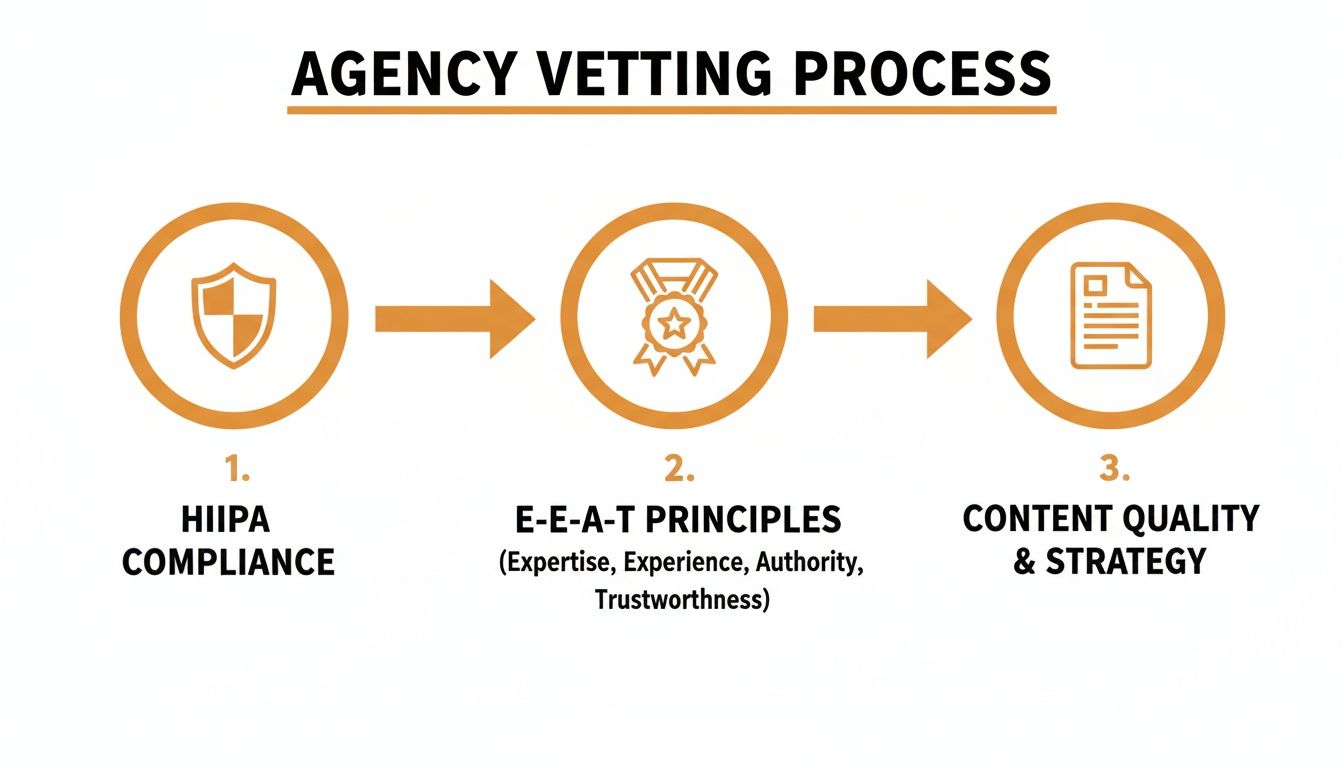
This really just boils down to the three pillars of a successful partnership in this space: a deep, practical understanding of HIPAA, a concrete plan for building E-E-A-T, and an unwavering commitment to high-quality, medically accurate content.
Running a Meaningful RFP Process
With your shortlist ready, it’s time to send out a Request for Proposal (RFP). The goal isn't to create a giant, bureaucratic document. You want to craft something concise that pushes agencies to give you a thoughtful, custom response instead of a canned sales pitch.
A strong RFP cuts to the chase and asks questions that reveal an agency's strategic mind. It should force them to show you how they would actually solve your specific problems and hit your goals.
Your RFP should be a test of strategy, not just a request for a price list. The quality of their response is your first real glimpse into what it would be like to work with them—are they thoughtful, strategic, and detailed?
Make sure you include questions that cover the core of a potential partnership. This is the only way you can make a true apples-to-apples comparison when the proposals start rolling in.
Here are some essential questions to include in your healthcare SEO RFP:
- Proposed Strategy: Based on our goals, what would your strategic approach look like for the first 90 days?
- Team Structure: Who would be our day-to-day contact? What are the roles and experience of the core team members who would be on our account?
- Reporting and Communication: How often will we get reports, and what specific KPIs will you track to measure success against our business goals?
- Compliance and E-E-A-T: How do you ensure all your work is HIPAA-compliant? What's your process for building our site's E-E-A-T?
- Fee Structure: Please provide a detailed breakdown of your fees, including any one-time setup costs and the ongoing monthly retainer.
By asking these pointed questions, you get past the fluff and right to the heart of how each agency thinks and operates. Their answers will give you the concrete plans you need to confidently choose a partner who can drive real, measurable growth.
Digging into Case Studies to See What’s Real
An agency’s proposal can promise you the moon, but their case studies are where you find out if they’ve ever actually built a rocket. Past performance is hands-down the best predictor of your future success, so learning how to dissect these documents is a crucial skill. It's your chance to slice through the marketing fluff and find hard proof that they can deliver real business results.
So many agencies love to flash big, impressive numbers, like a "300% increase in traffic." It sounds great on paper, but without context, it’s a classic vanity metric. A huge spike in traffic means absolutely nothing if it doesn't translate into more patients calling your clinic or booking appointments online. Your job is to connect their so-called results to your actual business goals.
Asking the Tough Questions
When an agency hands you a case study, don’t just nod along with the headline figures. You have to dig deeper with some pointed questions to get the real story behind the numbers. This is where you can truly test their strategic thinking and transparency.
Start by asking these key questions:
- Timeline: How long did it take to get these results? A 300% traffic jump over two years is a completely different story than achieving it in six months.
- Starting Point: What was the baseline? Growing from 100 to 400 monthly visitors isn’t nearly as impressive as going from 10,000 to 40,000.
- Business Impact: How did this traffic actually affect what matters—phone calls, form fills, or new patient bookings? Ask for specific conversion data.
- Keyword Quality: What kind of keywords were they ranking for? Were they high-intent, money-making terms (like "orthopedic surgeon Toronto") or just low-value informational ones?
A confident and capable healthcare SEO agency will not only expect this level of scrutiny but welcome it. They should have the data on hand and be excited to show you exactly how their SEO work directly impacted their client’s bottom line. If they get defensive or vague, that’s a massive red flag.
What Strong, Verifiable Results Actually Look Like
So, what should you be looking for? The best case studies aren't about website metrics; they're about business impact. They tell a clear story of return on investment (ROI) and draw a straight line from SEO activities to patient acquisition.
A great case study isn't about traffic; it's about transformation. It shows how the agency solved a real business problem—like an empty appointment calendar or low visibility for a high-value service—using a focused SEO strategy.
Look for proof of tangible outcomes that matter to a practice like yours. For example, some of the top agencies are achieving incredible results. We've seen a wellness client get a 352.1% year-over-year boost in organic traffic, while another campaign generated nearly 1 million Google impressions and built over 2,500 referring domains. For many clients, a realistic average ROI can hit 4x on their SEO investment within the first year.
Tying Their Past Success to Your Future Needs
The final piece of the puzzle is figuring out how relevant their past work is to your specific situation. If you run a multi-location dermatology clinic, a case study about a solo dental practice isn’t going to tell you much. You need to see that they get your market, your patients, and the challenges you’re up against.
Push them for examples that mirror your own goals. If you're aiming for local dominance, ask to see how they’ve helped another clinic own the Google Map Pack for their main services. If you’re launching a new telehealth platform, ask for proof that they can build authority and drive leads for a brand-new digital service.
It's also a good idea to look at a range of their work to get a feel for their overall capabilities. For a broader view, exploring a collection of digital marketing case studies can show you patterns in their strategy and the consistency of their results across different types of businesses.
Ultimately, this deep dive does more than just check an agency’s claims. It gives you a clear window into how they think, how they measure success, and how they communicate—all critical parts of a healthy, productive partnership.
Finalizing Your Partnership Agreement

You've sifted through case studies, grilled the experts, and finally found a healthcare SEO agency that just feels right. But before you pop the champagne and kick things off, there's one last, crucial step: getting it all down on paper. This is where you translate all those great conversations and promises into a solid agreement that gets everyone aligned on what success actually looks like.
Think of a strong contract as the bedrock of a healthy, long-term relationship. It's there to protect both you and the agency by spelling out every detail, from the exact work they'll be doing to the numbers that will prove it's working. Any top-tier agency won't just accept this level of detail—they'll insist on it. It’s the best way to clear up any gray areas and build a partnership focused on real results.
Defining KPIs That Actually Drive Patient Growth
The heart and soul of your agreement will be the Key Performance Indicators (KPIs). These are the specific, measurable goals you'll use to judge the agency's performance. It's so important to get past vanity metrics like website traffic and zero in on the numbers that directly impact patient bookings and your bottom line.
Your KPIs need to be SMART—Specific, Measurable, Achievable, Relevant, and Time-bound. Here are a few examples of what powerful, business-focused KPIs look like for a healthcare practice:
- Boost new patient phone calls from organic search by 25% within 90 days.
- Secure a top-three spot in the local map pack for five of our most valuable services within six months.
- Generate 30 qualified leads per month through our "Request an Appointment" form for the new orthopaedic service line.
- Cut our cost-per-acquisition for organic leads by 20% over the next fiscal year.
When you set goals like these, every SEO activity is directly tied to a tangible business outcome. It ensures your agency is laser-focused on what really matters: filling your appointment schedule.
An agency focused on patient-centric KPIs is a partner invested in your growth, not just your traffic reports. The contract should reflect a shared commitment to measurable business results.
Structuring a Comprehensive Service Level Agreement
Working hand-in-hand with your KPIs is the Service Level Agreement (SLA). This is the part of the contract that gets into the nitty-gritty of the working relationship. It's the operational playbook that should leave no room for guesswork.
A truly solid SLA needs to cover a few key areas to keep the collaboration running smoothly:
- Scope of Work (SOW): This should be a detailed checklist of every single deliverable. We're talking about everything from the number of blog posts per month and technical SEO audits to link-building campaigns and on-page optimizations.
- Communication Protocols: How will you stay in touch? This section should specify the frequency of meetings (like bi-weekly strategy calls), name the primary points of contact on both sides, and set expectations for response times.
- Reporting Frequency and Format: Get this in writing. Define when you’ll get performance reports (e.g., the first business day of the month) and exactly what they'll include. A good report tracks progress against the KPIs you've both agreed on.
- Termination Clause: This spells out the conditions for ending the agreement. You’ll want to look for a reasonable notice period, like 30 or 60 days, which gives you an out without being locked into an ironclad, long-term commitment if things don't work out.
This level of detail is especially critical in a cutthroat market. In a place like California, where a staggering 80% of patients use online search to find their doctors, the right agency partner can be a massive advantage. In fact, specialized firms have shown they can increase patient inquiries by up to 150%, turning that local search traffic into real, confirmed appointments. You can discover more insights on California's competitive healthcare market to see just how high the stakes are.
Finalizing a clear, detailed agreement is the best possible way to launch a new partnership. It makes sure everyone is on the same page from day one, ready to work toward the one goal that matters: growing your practice.
Common Questions When Choosing a Healthcare SEO Agency
Even after all your research, a few questions can make that final decision feel a bit overwhelming. Let’s clear the air and tackle the most common things I hear from healthcare leaders right before they’re ready to sign on with a new marketing partner.
How Long Does It Take to See Real Results from Healthcare SEO?
This is probably the number one question, and for good reason. The honest answer? It takes a bit of patience. While you might see some small wins from technical fixes within a few weeks, the kind of meaningful, business-driving results you’re looking for typically start showing up around the four-to-six-month mark. Any reputable healthcare SEO agency will be straight with you about this from the get-go.
Think of those first few months as building your foundation. This is when the heavy lifting happens: deep technical audits, sizing up the competition, hammering out a keyword strategy, and getting your website’s core structure in order. It's the critical groundwork that all future growth is built upon.
You should start to see early signs of progress, like climbing up the rankings for some key terms or a noticeable uptick in organic traffic, within the first three months. But the real prize—that steady, predictable stream of patient inquiries and online bookings—usually kicks in during the second and third quarters. That's when your site’s authority really starts to build and the content strategy hits its stride.
My Two Cents: Treat SEO as a long-term investment in your practice's health, not a quick-fix prescription. An agency promising you the top spot on Google overnight is selling snake oil. A real partner sets realistic expectations and focuses on building sustainable, lasting growth.
What’s the Average Cost for a Healthcare SEO Agency?
The price tag for a specialized agency can be all over the map. What you’ll end up investing really depends on the scope of work, how fierce the competition is in your local market, and the overall size of your practice.
Generally speaking, you can expect monthly retainers to fall into a couple of common buckets:
- Small Local Clinic: For a solo practitioner or a smaller clinic in a less crowded area, retainers often land somewhere between $2,500 and $5,000 per month.
- Multi-Location Practice: If you're running a larger practice with several locations or you're based in a major metropolitan centre, costs can easily range from $5,000 to well over $10,000 per month.
It’s incredibly tempting to just shop around for the lowest price, but I’ve seen that backfire more times than I can count. A cheaper agency is often cutting corners somewhere, whether it’s on compliance, content quality, or the strategic thinking needed to actually win. The smart move is to look at the value, not just the cost. A great agency will give you a transparent proposal that spells out exactly what you’re paying for—from content and technical work to link building and reporting. They should also be able to map out a potential return on your investment tied to clear KPIs.
Can an Agency Guarantee First-Page Rankings on Google?
Let me be crystal clear: absolutely not. Any agency that guarantees a #1 spot or even a first-page ranking on Google should be shown the door immediately. That kind of promise is one of the biggest red flags in the SEO world because nobody—and I mean nobody—controls Google's algorithm. It's a complex, constantly evolving beast.
Instead of hollow guarantees, a trustworthy partner will guarantee their process. They will commit to a transparent, data-driven approach built on proven best practices.
Specifically, they’ll promise:
- A Clear Strategy: They’ll show you the exact roadmap they plan to follow to improve your online visibility.
- Consistent Effort: You'll see the work they're putting in on your behalf, month in and month out.
- Transparent Reporting: You’ll get detailed reports that connect their work to the business goals you both agreed on.
Their focus won't be on some arbitrary ranking but on the metrics that actually grow your practice: qualified organic traffic, better conversion rates, and more new patient bookings. Your confidence should come from their proven process and their track record, not from empty promises.
How Important Is It That an Agency Only Works in Healthcare?
While it isn't a hard-and-fast rule that an agency must only serve healthcare clients, deep specialization gives you a massive leg up. A dedicated healthcare SEO agency just gets it. They bring a level of nuanced understanding that a generalist firm simply can’t replicate.
This specialization is critical for a couple of big reasons. First, they live and breathe the industry's complex regulations. They have built-in processes for maintaining HIPAA compliance and understand the very fine line between effective marketing and stepping into a legal minefield.
Second, they are masters of E-E-A-T (Experience, Expertise, Authoritativeness, Trustworthiness). They know exactly what it takes to build the credibility signals Google demands for medical content, from properly citing sources to showcasing your practitioners' expertise. That knowledge helps them build more effective and compliant strategies right out of the gate. An agency with a strong portfolio of healthcare clients, even if not exclusive, can still be a fantastic choice, as long as they can prove they have a firm handle on these critical areas.
Ready to partner with an AI-powered agency that understands the unique demands of the healthcare sector? Juiced Digital combines deep industry knowledge with data-driven strategies to drive measurable patient growth. Book your free consultation today and discover how we turn rankings into revenue for practices like yours.