
The most fundamental difference between Facebook Ads and Google AdWords boils down to a simple concept: Google Ads helps you find new customers, while Facebook Ads helps new customers find you.
Think of it this way: Google is like putting your business on the busiest street corner where people are already looking for what you sell. You're capturing active demand. Facebook, on the other hand, is like setting up a captivating storefront in a massive shopping centre, showing your products to people who didn't even know they wanted them until they saw them. You're generating new demand.
Your Executive Summary for Choosing a Platform
There's no single "better" platform. The right choice depends entirely on your business goals, what you're selling, and who you're trying to reach. The smartest advertisers I know don't just pick one; they figure out how to make both work together for a more powerful strategy.
Google Ads is the undisputed king of capturing high-intent leads. When someone types "emergency plumber in Vancouver" into Google, they have a problem right now. By putting your ad at the top of their search results, you connect with them at the precise moment of need. This makes it incredibly powerful for immediate sales and lead generation, particularly for service businesses or products that solve an urgent problem.
Facebook Ads, in contrast, excels at creating awareness and sparking interest. It’s the perfect place to introduce an innovative new product or a visually stunning brand to people who aren’t actively searching but perfectly match your ideal customer profile. For example, a new eco-friendly clothing line could use beautiful video ads to target environmentally conscious millennials, building a community long before they're ready to buy. This is a core pillar of modern digital marketing in ecommerce, where telling a great story is what drives sales.
Key Takeaway: Use Google Ads when you need to be the answer to a question someone is already asking. Use Facebook Ads when you want to introduce your brand to the right people and make them want what you have.
This table offers a quick framework to help guide your decision based on common business goals.
Quick Decision Guide Google Ads vs Facebook Ads
Use this high-level summary to choose a platform based on your primary business goals and scenarios.
| Business Goal | Choose Google Ads When… | Choose Facebook Ads When… |
|---|---|---|
| Immediate Sales/Leads | Customers are actively searching for your service or product (e.g., "roof repair," "buy running shoes"). | You want to drive impulse buys with visually compelling products (e.g., fashion, home decor, gadgets). |
| Brand Awareness | You want to own the search results for your brand and industry keywords, establishing yourself as the authority. | You need to introduce a new brand or product to a large but targeted audience that isn't aware of you yet. |
| Niche Audience Targeting | Your audience is best defined by specific search terms or their recent online shopping behaviour. | Your audience is defined by complex interests, life events, or demographics (e.g., new parents who also like hiking). |
| Lead Nurturing | You're retargeting people who found you through a search and visited your website. | You're building a community by retargeting users who have engaged with your posts or watched your videos. |
Ultimately, this isn't an either/or decision. The best strategies often start with one platform to prove the business model and then expand to the other to scale growth and build a more resilient marketing engine.
2. Demand Capture vs. Demand Generation: The Core Difference
Before we get into the weeds of targeting options and ad formats, we need to talk about the single most important strategic difference between these two advertising giants. It all boils down to one simple question: are you trying to capture existing demand or generate new demand?
Your answer to that question will instantly tell you which platform should be your starting point.
Google Ads: The Ultimate Demand Capture Machine
Think of Google Ads as the ultimate tool for demand capture. You’re getting in front of people who are right now actively looking for what you sell. They have a problem or a need, they know it, and they've gone straight to Google to find a solution.
These aren't casual browsers. They’re people with clear intent, often well into their buying journey and sometimes ready to pull the trigger immediately.
Let’s get practical. Imagine a homeowner in Calgary whose furnace conks out during a nasty cold snap in January. What’s their first move? They’re grabbing their phone and searching for "emergency furnace repair Calgary." They need help, and they need it now.
The business whose ad shows up at the top of that search page has a massive advantage. That's the raw power of capturing high-intent demand at the precise moment of need.
Google Ads is the undisputed king for:
- Urgent Services: Plumbers, locksmiths, electricians, and any other emergency service. When the need is immediate, the search is immediate.
- Specific Product Hunts: Someone searching for "buy Nike Air Max 90 in Canada" isn't just browsing; they have their credit card ready.
- High-Stakes Decisions: People use search to research and compare options for big-ticket items like B2B software or to find a local lawyer.
In every one of these cases, you aren't trying to persuade someone that they have a problem. You’re simply positioning your business as the best solution for the problem they’re already desperate to solve.
Facebook Ads: The Art of Generating New Demand
Facebook Ads (and Instagram) work on the other side of the coin. This is a demand generation powerhouse. The goal here is to introduce your products or services to people who aren't actively looking for them but are very likely to be interested based on their demographics, behaviours, and interests.
You're essentially creating awareness and sparking a desire that wasn't there a moment before. It's about interrupting someone's scroll through photos of friends and family with an ad so relevant or captivating that it makes them stop and pay attention.
The real magic of Facebook Ads is in discovery. You're showing the perfect audience a product they didn't even know they wanted, effectively creating a new customer from a passive scroller. It's proactive marketing, not reactive.
Take a company that sells unique, handcrafted leather journals. Very few people are waking up and typing "handcrafted artisanal leather journal" into Google. The search volume is tiny.
But with Facebook's incredibly detailed targeting, that journal company can put a beautiful video ad right in the feed of people who show an interest in:
- Creative writing or calligraphy
- High-end stationery brands
- Hobbies like sketching and art journaling
- "Slow living" or mindfulness influencers
This puts the product directly in front of a perfect potential customer. They may make an impulse buy, or they might just remember the brand a few months later when looking for a gift. You've just generated brand new demand and started building a customer base from scratch, guiding people from total unawareness to genuine interest.
Comparing Audience Targeting Capabilities
The real magic of any ad platform isn't just about ads—it's about getting your message to the right people. When you line up Facebook Ads and Google Ads, you see they have fundamentally different philosophies on how to do this, stemming from their core functions.
Think of it this way: Google targets a person's immediate intent, while Facebook targets their entire identity. One is about capturing existing demand, the other is about creating it from scratch.
Google Ads: Targeting Based on Commercial Intent
Google is the undisputed champion of finding people who are actively looking for a solution. It's a precision tool for capturing someone's commercial interest right when it peaks. And while keyword targeting is its bread and butter, its audience tools go much, much deeper.
To build a truly sophisticated strategy on Google, you need to look beyond just keywords. Here are three key targeting layers that let you get ahead of the search query:
- In-Market Audiences: Google is smart. It can tell when users are actively researching and comparing products, signalling they are "in the market" to buy something specific. This lets you target people who are, for example, deep in the process of comparing mortgage rates or browsing for a new SUV.
- Custom Audiences: This is where you get to guide the machine. You can build a bespoke audience by feeding Google relevant keywords, URLs of competitor sites, and even apps your ideal customer might use. Its AI then gets to work, finding people with those exact interests and behaviours across its vast network.
- Precise Location Targeting: For any local business, this is a non-negotiable. Google lets you zero in on specific postal codes, draw a radius around your shop, or target entire cities and provinces. This ensures your ad for "emergency plumbing in Burnaby" is only being seen by people who could actually hire you.
At its core, Google's audience targeting is about intercepting a user mid-thought. The entire goal is to show up as the most helpful, relevant answer the exact second they realize they have a problem. It’s a reactive approach, but it’s incredibly powerful for driving sales and leads.
Facebook Ads: Targeting Based on User Identity
If Google is about intent, Facebook is all about identity. Its targeting capabilities are legendary for a reason—they offer a level of granular detail that Google's system simply wasn't built for. This is proactive advertising in its purest form.
With Facebook, you can introduce your brand to your ideal customer persona, even if they've never heard of you and aren't actively looking for what you sell.
Facebook's targeting arsenal can be broken down into a few key categories:
- Interests and Behaviours: This is the classic approach. You can target people based on the pages they've liked, the content they engage with, their online purchase history, and even the groups they belong to. A local vegan cafe could build an audience of users interested in "plant-based diets" and "sustainability" who also follow specific vegan influencers.
- Life Events: Reaching people at pivotal moments in their lives is incredibly effective. Facebook lets you target users who are recently engaged, have just moved to a new city, or are expecting a child, making it invaluable for businesses tied to these milestones.
- Custom and Lookalike Audiences: This is where the platform’s true power is unlocked. You can upload your customer list to create a Custom Audience and retarget them with new offers. Better yet, you can ask Facebook to create a Lookalike Audience. Its algorithm analyzes the common traits of your best customers and then finds millions of new users who share those same characteristics, expanding your reach with uncanny accuracy.
This deep dive into psychographics allows you to build brand awareness from the ground up. Someone might not be searching for your product today, but a perfectly targeted Facebook ad can plant that seed, creating the initial interest that pulls them into your world.
A Realistic Look at Cost, Performance, and ROI
When you stack up Facebook Ads against Google Ads, the conversation always lands on cost. But just comparing the cost-per-click (CPC) of each platform is a rookie mistake—it only gives you a sliver of the full picture. The real game is understanding the value behind that click and whether it’s actually making you money.
The core difference in cost boils down to one thing: user intent. On Google, you’re paying a premium for a hot lead. These are people actively searching for a solution, which means they have high commercial intent. So while the CPC is often steeper, the journey from click to conversion can be incredibly short and sweet.
Facebook, on the other hand, is all about discovery. You’re essentially interrupting someone’s social scroll with an ad they weren’t looking for. This usually means a lower CPC, but you'll likely need a few more touchpoints to warm them up and guide them toward a sale.
Understanding the Cost-Per-Click Divide
The first thing you’ll notice is that Google Ads clicks are almost always more expensive. It makes sense, right? Advertisers are in a bidding war for valuable, high-intent keywords. A click from someone typing "emergency plumber Vancouver" into Google is far more valuable than a click from someone idly browsing their Instagram feed.
Facebook's lower CPCs make it a fantastic playground for building an audience and drumming up awareness. You can get your brand in front of a massive number of people for the same budget, which is perfect for top-of-funnel goals like launching a new product or sharing great content.
Key Insight: Don't judge a platform by its CPC. A high CPC on Google can be wildly profitable if it lands a high-value client, while a low CPC on Facebook is just money down the drain if it never leads to a conversion. The metric that truly matters is your Cost Per Acquisition (CPA).
How Intent Shapes Conversion Rates and ROI
This is where the financial comparison really gets interesting. Google Ads usually wins when it comes to direct conversion rates—turning a click into an immediate sale or lead. Because the user is already looking for what you offer, your ad is the perfect answer at the perfect time. This makes calculating a direct ROI for a specific campaign pretty straightforward.
Facebook's ROI is often a longer game, but it can be just as powerful when you know how to measure it. Someone might see your video ad, follow your page a few days later, and then finally click a retargeting ad a week after that to buy something. That first ad didn't get the direct conversion, but it was the critical first step that got the ball rolling.
- Google's ROI Strength: High-intent traffic delivers faster conversions and a clear path to profit, especially for businesses solving an immediate problem. Our experience in managing paid traffic from Google Ads consistently shows it's the quickest way to generate qualified leads.
- Facebook's ROI Strength: Its lower costs are perfect for large-scale audience building and brand nurturing. The ROI here is realized over time as you build a loyal community that trusts you and comes back to buy again and again.
Here in Canada, this performance gap is crystal clear. Google Ads commands a massive 50% market share, with the average CPC sitting between CAD $2–$5. That’s a stark contrast to Meta's average of CAD $0.80–$1.50 per click. For instance, a local business in BC might spend a median of $1,057 a month on Google to get over 200 high-intent clicks at $5.26 each. At the same time, they could spend just $860 on Meta to get 500 clicks at a much lower $1.72 CPC, striking a smart balance between capturing immediate demand and building long-term awareness. You can find more insights on the Canadian ad market over at mooxomedia.com.
Ultimately, a truly profitable ad strategy rarely bets on a single platform. The key is to allocate your budget intelligently, playing to the unique strengths of both.
Ad Creatives and Platform Rules: The Practical Side of Things
So we've talked about targeting and cost, but what about the nuts and bolts of actually creating the ads and keeping them live? This is where the practical differences between Facebook and Google really hit home. The two platforms have completely different creative demands and, crucially, different rulebooks. Getting this right impacts your workflow, your budget for assets, and whether you can even advertise at all.
Google Ads, especially on the Search network, is all about the power of the written word. It’s a direct-response game. Winning here means writing sharp, concise headlines and descriptions that perfectly mirror what someone just typed into the search bar. Your "creative" is text, and its only job is to be the best, most relevant answer to a user's problem.
Facebook is a different beast entirely. It's a visual-first world where you need to stop people from scrolling. Your ad isn't answering a question; it's an interruption in a social feed full of friends' photos and viral videos. This means you need high-impact, engaging images and videos that grab attention, tell a story, or make your product look irresistible.
The Creative Asset Divide
This fundamental difference has huge practical consequences. For a Google Search campaign, your most important assets are your copywriting skills and a deep understanding of what your customers are searching for. Of course, the Google Display Network uses images and banners, and knowing the right Google Display ad sizes is key to making that channel work for brand awareness and retargeting.
On the other hand, running ads on Facebook requires a constant supply of fresh visual content. A great image or video can get stale fast—a phenomenon we call "ad fatigue"—forcing you to test new creative constantly just to keep performance up. This often means a real investment in photography, video production, or graphic design is necessary to keep your campaigns from fizzling out.
Here’s the bottom line on creative: Google Ads demands you be an expert problem-solver with words. Facebook Ads demands you be a captivating storyteller with visuals. Your team's natural creative strengths should absolutely play a part in deciding which platform to lead with.
Walking the Compliance Tightrope
Now, let's talk about the rules. This is where the platforms can feel worlds apart, particularly if you're in a regulated or sensitive industry. Facebook (Meta) has become infamous for its strict and often unforgiving advertising policies. Ads related to wellness, finance, housing, employment, or anything deemed "controversial" are frequently flagged or shut down.
For instance, businesses in the holistic health or CBD industries constantly struggle with ad disapprovals on Facebook, sometimes for content that's purely educational. The platform's automated review system can feel like a black box, making it a frustrating and unpredictable place to generate leads for these types of businesses.
Google, while still having its own set of comprehensive policies, tends to offer a bit more wiggle room, especially for search ads. Because the user is proactively looking for a solution, Google is often more lenient with sensitive topics, as long as you're meeting all the legal and platform requirements. This makes Google the primary choice for many businesses in regulated fields who need to connect with high-intent customers without fighting a daily battle against ad rejections.
Which Platform Is Right for Your Business?
Deciding between Facebook Ads and Google Ads isn't about finding a single "best" platform. It's a strategic choice that hinges entirely on your specific business, your goals, and how quickly you need to see a return. Think of it less as a competition and more as choosing the right tool for the job at hand. This framework will help you figure out the best place to put your ad dollars first.
To get this right, you need to answer three fundamental questions about your business. Be brutally honest with your answers—they'll point you toward the platform that truly aligns with your growth strategy.
What Is Your Primary Business Objective?
First things first: what does success look like for you right now? Are you chasing immediate leads and sales, or are you playing the long game by building brand awareness?
-
Need Sales and Leads Now? If your main goal is to get conversions from people who are already looking to buy, Google Ads is your best bet. It’s built to capture existing demand—connecting you with users who are actively searching for what you offer.
-
Building a Brand or Launching Something New? If you need to introduce a new product to the market or cultivate a community, start with Facebook Ads. Its superpower is creating demand by putting your brand in front of people who match your ideal customer profile, even if they aren't searching for you yet.
Does Your Product Require Discovery?
Think about how customers typically find what you sell. Is it something they know they need and are actively looking for, or is it an item they don't know exists until they see it?
A critical piece of the puzzle is your product's novelty. If you're selling something innovative that people aren't searching for, you have to create the demand before you can ever hope to capture it.
If you sell a known commodity like "women's running shoes" or a common service like "emergency plumbing," Google Ads is the obvious choice. People already know they need these things and are typing those exact terms into the search bar.
But what if you've invented a completely new type of kitchen gadget or a unique fashion accessory? Your potential customers don't even know it exists, so they can't search for it. In that case, the visual, scroll-stopping nature of Facebook Ads is absolutely essential for getting your product out there and sparking that initial flicker of interest.
This decision tree breaks down how your product type should influence your ad creative on each platform.
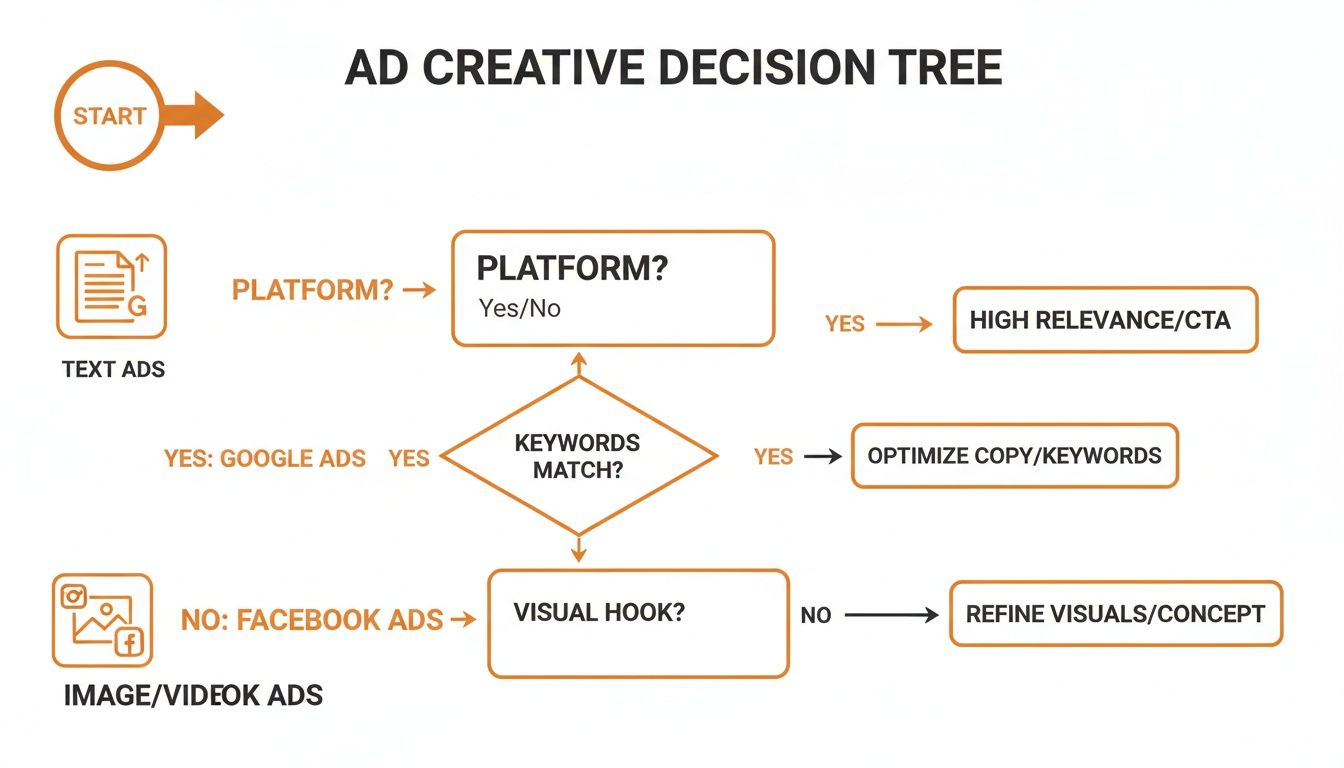
As you can see, Google Ads is all about text-based creative that directly answers a search query. Facebook, on the other hand, relies on eye-catching images and videos to grab attention and stop the scroll.
What Is Your Budget and ROI Timeline?
Finally, let's talk money. How much can you realistically invest, and how fast do you need that investment to pay off?
-
High Budget, Need Quick ROI: Google Ads can often deliver a faster return on investment, but it usually requires a higher budget to compete for those valuable, high-intent keywords. A single click costs more, but that click is far more likely to convert into a sale.
-
Lower Budget, Focused on Long-Term Growth: Facebook Ads generally has a lower cost-per-click, which makes it more approachable if you're working with a smaller budget. The trade-off is that the path to a sale is often longer; it might take several touchpoints to move someone from initial awareness to making a purchase.
Walking through these questions gives you a clear roadmap. If your answers all point to one platform, you've found your starting line. If you're seeing a mix, that’s a powerful sign that a hybrid strategy is your best move—using Facebook to build awareness and then using Google to close the deal with ready-to-buy customers.
Frequently Asked Questions
When you're trying to figure out where to put your ad money, a lot of the same questions tend to pop up. Let's tackle some of the most common ones that come up when comparing Facebook Ads and Google AdWords to help you get clear on the best path forward.
Is Google Ads Always Better for Generating Sales Leads?
Not necessarily. It really depends on what you're selling and who you're selling it to. Google Ads is fantastic for capturing people who are already looking for what you offer—they have high "purchase intent." Think of someone searching for an "emergency plumber near me." That's a hot lead, and Google is the place to catch them.
But what if nobody knows your product exists yet? If you’ve got something new or innovative, people aren't searching for it. That's where Facebook Ads shines. It's built to create demand, not just capture it. You can put your solution in front of people based on their interests and habits, introducing them to something they didn't even know they needed. For most local services like dentists or electricians, though, Google Ads is usually the best place to start for immediate, high-quality leads.
Can I Run Facebook Ads and Google Ads at the Same Time?
You absolutely can, and honestly, you probably should. The most powerful marketing strategies use both platforms together to cover the entire customer journey, from the first time someone hears about you to the moment they decide to buy. It's not really an "either/or" question; it's about how they work together.
Here's a pro tip: Use Facebook and Instagram for your top-of-funnel marketing. Think engaging videos or beautiful images that build brand awareness and get people interested. Then, when those people start searching for solutions or your brand name, your Google Search and Shopping ads are waiting to close the deal. You’re there at every step.
A perfect example is a new clothing brand. They might launch with a splashy carousel ad campaign on Instagram to show off their new line. As people become aware of the brand, they'll start searching for it. By running Google Search ads for their brand name and specific products, they make sure they're right there when that interest turns into a decision to buy.
How Much Should I Budget for My First Campaign?
There's no magic number, as it really boils down to how competitive your industry is. The most important thing isn't the exact dollar amount, but spending enough to get meaningful data. If you don't spend enough to see what works, you're just guessing.
Here are a few realistic starting points to think about:
- For a local Google Ads campaign: In a typical market, you'll likely need between $500 to $1,500 per month to get enough clicks and conversions to properly evaluate performance. If you're in a super competitive field like law or home services, expect that number to be higher.
- For a Facebook Ads campaign: You can usually start with a bit less, often in the $300 to $700 per month range. That's generally enough to begin testing different ad creatives and audiences to find a winning combination.
Whatever you decide to spend, commit to it for at least 30 to 60 days. It takes time for the platform algorithms to learn and for you to gather enough reliable data to know where to double down and scale your campaigns profitably.
At Juiced Digital, we specialize in creating AI-powered paid advertising strategies that maximize your ROI on both Google and Facebook. Book a free consultation today to discover how we can build a profitable, data-driven ad strategy for your business.