When you hear "digital marketing for e-commerce," it’s easy to think of just running a few ads. But in reality, it’s a complete system designed to promote and sell your products directly to people online. It’s about weaving together channels like SEO, social media, and email to create a path that brings shoppers to your store, guides them to the checkout, and keeps them coming back for more.
This strategy is the engine that powers your online store’s visibility, sales, and customer loyalty.
Your Blueprint for Sustainable E-commerce Growth
Staring at flat or falling sales figures is a familiar source of frustration for any online store owner. The immediate reflex is often to just throw more money at marketing, but that’s rarely the answer. The real solution isn't about spending more; it’s about spending smarter.
What you need is a blueprint—a detailed plan for a digital marketing engine that systematically grows your business.
This guide is designed to move past generic tips and show you how these different channels are meant to work together. Stop thinking of your marketing efforts as separate tools in a box. Instead, picture them as an interconnected ecosystem where SEO, paid ads, and email marketing work in concert to create a smooth, intuitive journey for your customers.
Building a Cohesive Strategy
A solid foundation starts with figuring out how to attract shoppers who are already looking for what you sell. That means getting your store optimised for search engines so that high-intent customers can find you organically. From there, your plan needs to be laser-focused on turning that traffic into sales and, crucially, nurturing those new customers to build loyalty and earn their repeat business.
The core of a winning e-commerce marketing blueprint breaks down into three stages:
- Attraction: Pulling in qualified traffic with SEO and well-targeted ads.
- Conversion: Fine-tuning product pages and the checkout flow to turn browsers into buyers.
- Retention: Using email and SMS to build genuine relationships and encourage more purchases.
This integrated approach makes sure every piece of your marketing supports the others, creating a powerful growth cycle.
From Side Project to Scalable Machine
The aim here is to graduate from random acts of marketing to a structured, data-driven system. It's about building a machine where every component has a clear job and contributes directly to your bottom line.
Before getting into the specific tactics, you need to know what you’re trying to accomplish. Clearly outlining the objectives of marketing gives you the roadmap needed to build a strategy that can truly scale.
By focusing on creating a cohesive customer journey, you transform your marketing from a cost centre into a predictable revenue generator. This framework is what turns a promising online store into a scalable, profitable business that can sustain its growth over the long term.
The Core Channels That Drive Ecommerce Sales
Think of your online store's marketing strategy like a high-performance engine. It's not just one part that gets you moving; it's a finely-tuned system where several key components work together. In ecommerce, these components are your core marketing channels, each with a specific job in attracting, engaging, and converting customers.
The real trick isn't just picking one channel and going all-in. It's about understanding how they all fit together to create a seamless customer journey that turns browsers into buyers and buyers into loyal fans. Let's break down the four essential pillars that every online store needs to build a solid foundation for growth.
Search Engine Optimization (SEO)
SEO is all about making sure your store shows up when people are actively looking for your products on search engines like Google. It’s the digital equivalent of getting the best spot in a busy shopping centre—the one right at the entrance where everyone sees you.
When a potential customer types “waterproof hiking boots for women” into the search bar, SEO is what gets your store on that coveted first page. It’s not a quick fix; it’s a long-term strategy that builds trust with both search engines and shoppers by proving your site is a legitimate, helpful, and authoritative source for what they need.
A solid ecommerce SEO plan usually involves:
- Keyword Research: Digging into the exact words and phrases your ideal customers use to find products like yours.
- On-Page SEO: Fine-tuning your product pages, category pages, and blog content with the right keywords, compelling descriptions, and high-quality images.
- Technical SEO: Making sure your site is fast, works beautifully on mobile, and is easy for search engine crawlers to understand.
- Link Building: Earning mentions and links from other credible websites, which acts as a vote of confidence for your store.
Paid Advertising
While SEO is the long game, paid advertising is your fast track to getting in front of the right people, right now. It's like putting up a billboard directly on the path of your ideal customer, just as they're thinking about making a purchase.
Platforms like Google Ads and Meta Ads (for Facebook and Instagram) let you zero in on specific demographics, interests, and even past online behaviours. This means your budget gets spent reaching people who are actually likely to buy. A good paid campaign can start driving sales from day one, which is perfect for launching new products, running a big sale, or just testing the waters for a new idea. The main goal here is a strong Return on Ad Spend (ROAS)—making sure every dollar you put in brings back much more in revenue.
In Canada, digital marketing has become the go-to growth engine for ecommerce. Ad spend and online shopping are climbing hand-in-hand, with digital ads forecast to make up about 76.7% of all advertising spending in Canada by 2025. That's a massive shift away from traditional media. You can find more insights on Canadian digital marketing trends over at digitaldot.com.
Email and SMS Marketing
If SEO and paid ads are about getting new people in the door, email and SMS marketing are all about building relationships with the customers you already have. This is your own private, direct line to your most valuable audience—the people who liked you enough to hand over their contact information.
This is where the real connection happens. It allows you to:
- Tell your engaged audience about new arrivals and special offers first.
- Send a gentle nudge to recover abandoned shopping carts.
- Share useful content that reinforces your brand's expertise and builds loyalty.
- Send personalized deals based on what a customer has bought before.
Your email and SMS list is one of your most powerful assets. You own it. It isn't at the mercy of some algorithm change on Google or a social media platform, giving you a reliable way to drive repeat business.
Social Media Marketing
Social media is your brand’s personality brought to life. It’s less about the hard sell and more about building a genuine community. On platforms like Instagram, TikTok, and Facebook, you get to show the human side of your business, share content from your happy customers, and have real conversations with your followers.
This channel is fantastic for building brand awareness and creating a loyal tribe that feels personally connected to your story and your mission. When you engage with people on a personal level, you start to turn one-time buyers into true brand advocates who will happily spread the word for you.
To give you a clearer picture of how these channels fit together, here’s a quick breakdown:
Comparing Core Ecommerce Marketing Channels
| Channel | Primary Goal | Key Metrics (KPIs) | Best For |
|---|---|---|---|
| SEO | Drive long-term, organic traffic and build authority. | Organic traffic, keyword rankings, conversion rate, bounce rate. | Building a sustainable, low-cost customer acquisition foundation. |
| Paid Ads | Generate immediate, targeted traffic and sales. | Return on Ad Spend (ROAS), Cost Per Acquisition (CPA), Click-Through Rate (CTR). | Product launches, promotions, and quickly scaling revenue. |
| Email & SMS | Nurture customer relationships and drive repeat purchases. | Open rate, click rate, conversion rate, list growth, unsubscribe rate. | Maximizing customer lifetime value and recovering lost sales. |
| Social Media | Build community, increase brand awareness, and foster loyalty. | Engagement rate, reach, follower growth, shares, brand mentions. | Creating brand personality and engaging directly with customers. |
Each channel has its strengths, and the most successful ecommerce brands learn to weave them together into a strategy where the whole is greater than the sum of its parts.
Using AI to Amplify Your Marketing Efforts

Artificial intelligence isn't some far-off sci-fi concept anymore; it’s a real, practical toolkit that gives e-commerce brands a serious edge. Bringing AI into your digital marketing isn't about letting robots take over. It's about making your team's efforts smarter, faster, and way more effective.
Think of AI as a tireless assistant who can crunch massive datasets in seconds, spotting patterns and opportunities a human team might take weeks to find. It handles the repetitive, grunt work, which frees you up to focus on the big picture: strategy and growth. From pinpointing new customer segments to nailing the perfect ad copy, AI is a powerful amplifier for your entire marketing plan.
Smarter SEO and Content Creation
SEO can feel like a massive, complex puzzle. AI gives you a lens to see the whole board. AI-powered tools can dissect competitor strategies and search engine results pages (SERPs) on a scale that’s impossible to do manually, uncovering valuable keywords and content gaps you’d otherwise miss.
So, instead of just guessing what topics will connect with your audience, these tools can generate content outlines based on what’s already performing well. They help ensure every product description, blog post, and category page is properly optimised to pull in organic traffic. This data-first approach removes the guesswork and helps you create content that actually has a fighting chance of ranking. You can explore a variety of AI trends in ecommerce to see just how fast this stuff is moving.
Precision Targeting With AI-Driven Advertising
Running paid ad campaigns can feel like a constant battle of tweaking bids and A/B testing creative. AI-driven ad platforms completely change this game by putting much of the process on autopilot. These systems are constantly analyzing campaign performance in real-time, making thousands of tiny adjustments to squeeze out better results.
What this means for you is that your ad budget automatically flows toward the audiences, creatives, and platforms delivering the best return. AI algorithms can actually predict which users are most likely to convert and hit them with the right ad at the right time.
AI algorithms take over the tedious work of campaign management, identifying your most profitable customer segments and optimising bids to maximize conversions. This not only saves you an incredible amount of time but also ensures your ad spend is working as hard as possible to generate sales.
This level of automation ultimately leads to more efficient campaigns and a lower customer acquisition cost (CAC).
Delivering Hyper-Personalized Customer Experiences
One of the most powerful ways to use AI in e-commerce is through personalization. Today’s shoppers don't just want personalized experiences; they expect them. AI is what makes it possible to deliver that unique touch at scale. By analyzing a visitor’s browsing behaviour, purchase history, and even how they move their mouse on the page, AI can craft a shopping journey that feels like it was made just for them.
This is so much more than just sticking a customer's first name in an email subject line. We're talking about AI-powered recommendation engines that suggest products they'll genuinely love—almost like having a personal shopper guiding them through your store.
Here’s where AI-powered personalization really shines:
- Dynamic Product Recommendations: Showing shoppers items based on what they've viewed, added to their cart, or bought before.
- Personalized Email Campaigns: Firing off automated emails with tailored offers and content that reflect what each person actually cares about.
- Customized On-site Content: Adjusting the homepage, banners, and even site navigation to match a visitor's known preferences.
This tailored approach makes customers feel seen and understood, which is key to building loyalty and boosting conversion rates. In fact, AI-powered personalization is becoming a make-or-break factor for e-commerce performance in Canada. The Canadian digital marketing market is projected to grow from USD 14.01 billion in 2025 to USD 43.62 billion by 2034, largely because retailers are using AI for things like predictive analytics and automated campaigns to deliver these highly tailored experiences.
By bringing AI into the fold, you shift from shouting at a crowd with broad campaigns to having meaningful, one-to-one conversations that drive real business results.
Turning Website Clicks Into Loyal Customers

Getting traffic to your online store is a great start, but it's only half the battle. If those clicks don’t turn into sales, traffic is just a vanity metric—it looks impressive on a chart but does nothing for your bottom line. The real magic of digital marketing happens when you turn curious visitors into paying customers. This is where Conversion Rate Optimization (CRO) comes in.
CRO is the methodical process of fine-tuning your website to increase the percentage of visitors who take a specific action, which for an e-commerce store is usually making a purchase. Forget about massive, risky redesigns. Think small, data-backed tweaks that smooth out the customer journey and gently guide shoppers toward the checkout. It's the science of making your store work smarter, not just harder.
Instead of just guessing what your customers want, CRO relies on cold, hard data and real user behaviour to drive every decision. This transforms your website from a static digital brochure into a dynamic selling machine that’s constantly improving.
Uncovering Hidden Friction Points
Every online store has invisible barriers that stop potential customers in their tracks. These "friction points" could be anything from a confusing navigation menu to surprise shipping costs at checkout or a form that asks for too much information. The core of CRO is finding and fixing them.
To get started, you need to see your website through your customers' eyes. Tools like heatmaps can show you precisely where people are clicking (and, just as importantly, where they aren't). Session recordings let you watch anonymized user journeys, revealing the exact moments of confusion or frustration. This kind of analysis often uncovers pain points you'd never spot on your own.
Think of your website like a physical shop. If customers were constantly abandoning their carts in the same aisle, you’d investigate immediately. CRO gives you the digital equivalent, pinpointing exactly where and why shoppers are dropping off.
This kind of analysis gives you the clues needed to form a hypothesis. For example, if you see that a lot of people leave after seeing the shipping costs, your hypothesis might be: "Showing a 'free shipping' threshold earlier in the process will reduce cart abandonment."
Testing Your Assumptions With A/B Tests
Once you have a solid hypothesis, it's time to put it to the test. A/B testing, also known as split testing, is a beautifully simple yet powerful way to do this. You create two versions of a webpage: the original (Version A) and your new, modified version (Version B). Then, you show each version to different segments of your traffic.
You can test almost anything.
- A product page with a bright green "Add to Cart" button versus a classic red one.
- A homepage banner featuring a lifestyle photo versus a product-focused shot.
- A checkout form with five fields versus a streamlined version with only three.
By measuring which version gets more conversions, you get undeniable proof of what actually resonates with your audience. This data-driven approach takes guesswork and personal opinions out of the equation, ensuring every change you make has a positive impact on your revenue.
Leveraging Psychological Triggers
Great CRO also taps into the psychology of how people shop. By weaving in subtle psychological triggers, you can gently nudge visitors toward making a purchase. These aren't manipulative tricks; they're proven principles that build trust, create excitement, and encourage action.
Some of the most effective triggers include:
- Social Proof: Featuring customer reviews, star ratings, and testimonials to show that other people love your products.
- Urgency: Using countdown timers for sales or displaying low-stock alerts to create a "buy now" impulse.
- Scarcity: Highlighting limited-edition items or exclusive offers that create a fear of missing out.
These elements tap into fundamental human behaviours and can give your conversion rates a significant lift when used ethically and honestly. The goal is to build confidence and make the decision to buy feel both easy and smart.
Of course, getting the sale is just one piece of the puzzle. Once you’ve converted a visitor, the next step is to turn them into a repeat customer. You can explore some fantastic strategies in our guide on 7 customer retention ideas that help build lasting loyalty.
Marketing Safely in Regulated Industries
Selling products in a high-growth but heavily regulated space like cannabis, CBD, or functional mushrooms is a unique marketing puzzle. The customer demand is definitely there, but the rulebook for how you can actually reach them is completely different. Your standard digital marketing playbook often gets tossed right out the window, forcing you to get a lot more strategic and creative.
Big players like Google and Meta have strict policies that either severely limit or flat-out ban ads for these products. This means the usual go-to channels for quick traffic, like paid search and social ads, are pretty much off-limits. Trying to sneak past the rules is a bad idea—it’s a fast track to getting your accounts suspended and facing major setbacks. A compliance-first approach isn't just a good idea; it's essential for survival.
This is where you have to get smart and adapt your digital marketing in ecommerce strategy. The game shifts from chasing quick wins with paid ads to building a solid, long-term brand using organic methods.
Building Authority When Ads Aren't an Option
When you can't just buy your way to the top, your own assets—your website and the content on it—become your most valuable marketing tools. The whole strategy flips. Instead of interrupting people's feeds with ads, you focus on attracting customers who are already looking for information and answers. This is done almost entirely through a heavy focus on Search Engine Optimization (SEO) and content marketing.
Start thinking of your website as more than just a store; it's a trusted educational hub. When you create high-quality, genuinely helpful content that answers your audience's questions, you build authority and earn their trust.
This organic-first approach really boils down to a few key tactics:
- Educational Blog Content: Create in-depth articles that explore product benefits, offer usage guides, and explain the science behind your ingredients—all without making any direct medical claims. This is how you become the expert in your niche.
- Targeted SEO: Go after long-tail keywords. These are the specific phrases that serious, high-intent customers are typing into search engines. Think "best CBD oil for sleep in Canada" or "how to use lion's mane mushroom powder." This brings qualified, ready-to-learn traffic straight to you.
- Building an Email List: Your email list is gold because you own it. It's a direct, compliant line to your audience. Use all that great content you're creating to encourage newsletter sign-ups, and then build that relationship with exclusive info and promotions.
Navigating Copywriting and Influencer Guardrails
Every single word you publish matters. Regulators and ad platforms will scrutinize everything from your product descriptions to your blog posts, looking for unapproved health claims. It is absolutely critical to avoid any language that even hints your products can diagnose, treat, cure, or prevent a disease.
Your marketing copy needs to be squeaky clean and compliant. Centre your messaging around wellness, lifestyle benefits, and product quality. Steer well clear of anything that could sound like medical advice. This doesn't just keep you out of trouble; it builds trust with savvy consumers.
Influencer marketing can be a fantastic workaround, but it needs to be managed with care. You have to make sure any partners you bring on board understand the advertising rules just as well as you do. Give them crystal-clear guidelines on what they can and can't say to protect your brand from risk. By putting education, transparency, and compliance at the heart of your strategy, you can build a successful ecommerce business, even in the trickiest of industries.
Building Your Ecommerce Growth Roadmap
A brilliant strategy is useless without a plan to make it happen. To turn all these concepts into actual results, you need a roadmap—a clear, step-by-step guide for your team that cuts through the noise and keeps everyone focused on what genuinely drives growth.
Think of it as the bridge between your big-picture goals and the day-to-day work required to get there.
Building this plan starts with ignoring the vanity metrics. Things like social media likes are nice to see, but they don't keep the lights on. The true health of your ecommerce business comes down to a handful of core numbers.
Defining Your Most Important Metrics
To make smart decisions, you absolutely have to track the right data. For any online store, the two most critical Key Performance Indicators (KPIs) are Customer Acquisition Cost (CAC) and Customer Lifetime Value (LTV).
CAC tells you exactly how much you spend to get a new customer through the door. LTV, on the other hand, predicts the total revenue you can expect from that customer over their entire relationship with your brand.
The interplay between these two numbers is the fundamental formula for growth. For your business to be scalable, your LTV has to be significantly higher than your CAC. This simple truth should steer every budgeting decision you make, turning your digital marketing in ecommerce from a cost centre into a profit-generating machine.
A healthy ecommerce business aims for an LTV to CAC ratio of at least 3:1. This means for every dollar you spend to acquire a customer, you should expect to get three dollars back over their lifetime. This ratio is non-negotiable for long-term success.
Creating a Phased Implementation Plan
Once you know your core metrics, you can start building a phased roadmap. This lets you scale from foundational setup to more advanced tactics without getting overwhelmed. The key is to resist the urge to do everything at once. A structured, step-by-step approach builds momentum and prevents burnout.
For businesses in regulated industries, this journey often involves laying a compliant groundwork before scaling up.
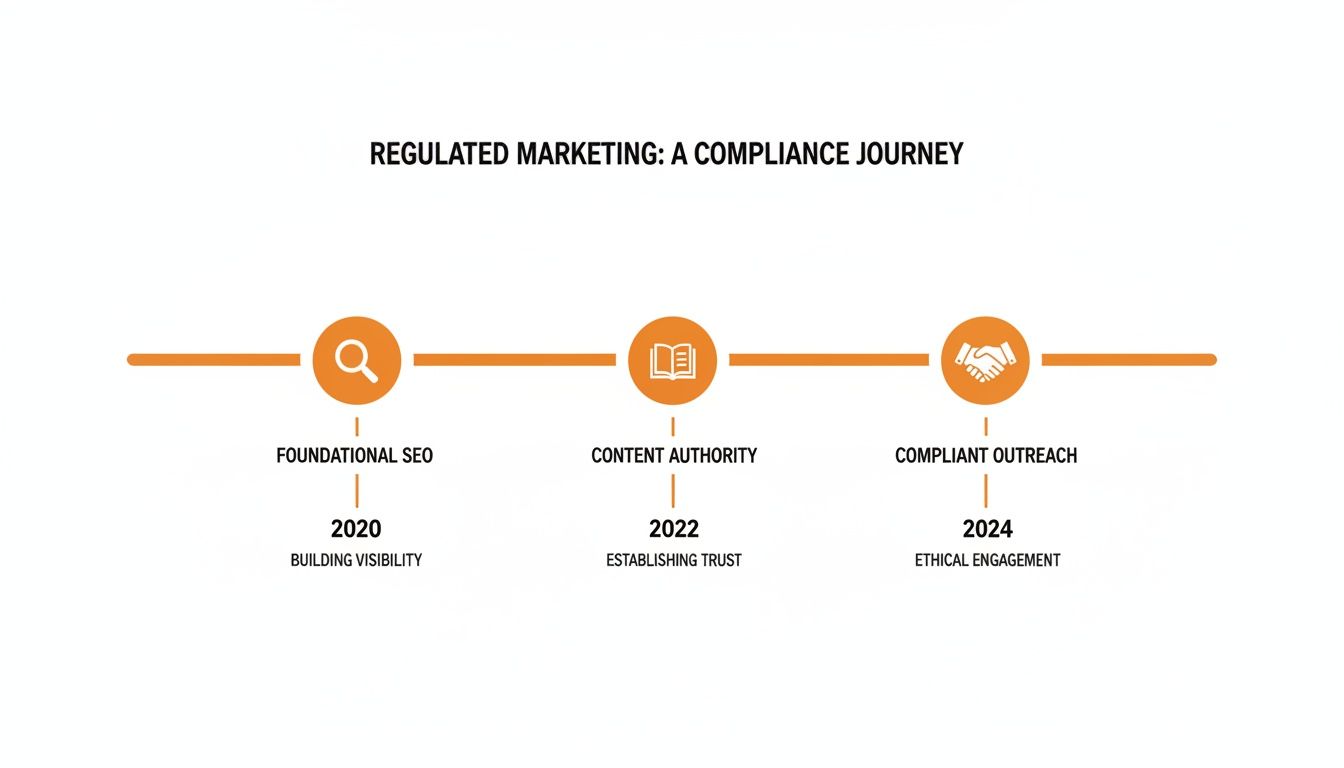
This visual shows how you might start with foundational SEO to build organic traffic before moving into content and outreach, ensuring your growth is both sustainable and compliant from day one.
Here’s a practical way to structure your own plan:
-
Phase 1: Foundational Wins (Months 1-3): Nail the basics first. This is where you set up accurate analytics and tracking, dive deep into keyword research, optimize your product pages, and launch a simple welcome email series for new subscribers.
-
Phase 2: Channel Expansion (Months 4-6): Now it's time to experiment. Start a small, highly targeted Google Ads campaign. Develop a consistent content calendar for your blog. Begin segmenting your email list to send more relevant, personalized messages.
-
Phase 3: Scaling and Optimization (Months 7-12): Go all-in on what's working. Increase the budget for your proven ad campaigns, explore advanced CRO techniques like A/B testing on your checkout page, and build out automated email flows for abandoned carts and customer win-backs.
Remember, this roadmap isn't set in stone. It's a living document. You need to review and adjust it regularly based on the data you're seeing in your KPIs. This creates a powerful feedback loop of continuous improvement, turning your marketing efforts into a predictable engine for revenue.
Frequently Asked Questions
When you're deep in the trenches of growing an e-commerce brand, questions about digital marketing are bound to pop up. Here are some of the most common ones we hear, with straightforward answers to help you map out your strategy.
How Much Should an E-commerce Business Budget for Digital Marketing?
There’s no one-size-fits-all answer here, but a solid rule of thumb is to earmark 7-12% of your total revenue for marketing. If you're just starting out, you might need to push that a bit higher to really make a dent and start building brand recognition.
The most important thing is to set a budget you can actually stick with. Pour those initial funds into channels known for a strong return, like hyper-targeted paid ads and foundational SEO. Keep a close eye on your Return on Ad Spend (ROAS) and be ready to double down on what’s working, funnelling profits back into your most successful campaigns.
Think of your marketing budget less as a fixed expense and more as a dynamic investment. It should be a flexible tool that you adjust based on real performance data—feed the winners and starve the losers.
Which Digital Marketing Channel Is Most Important for a New Store?
For a brand-new shop, you can't just pick one channel. The best approach is a two-track strategy that balances immediate wins with long-term, sustainable growth.
- Paid Advertising: Kick things off with targeted ads on platforms like Google Shopping or Meta. This gets traffic in the door and starts generating sales and data from day one, giving you crucial early insights into who your customers are and what they want.
- Search Engine Optimization (SEO): At the same time, start laying the groundwork for SEO. It’s a slow burn, but SEO builds an incredibly valuable, cost-effective asset that will pull in free, organic traffic for years to come.
This combination gets cash flowing right away while you build the solid foundation you'll need to thrive down the road.
How Long Does It Take to See Results from E-commerce SEO?
Let’s be clear: SEO is a marathon, not a sprint. While you might see small bumps from technical fixes in a few weeks, don't expect a major surge in organic traffic and rankings for at least 4-6 months.
In really competitive markets, it could take even longer. It all comes down to consistently publishing great content, keeping your site technically sound, and building genuine authority in your niche. The reward for your patience is a steady, reliable stream of high-intent organic traffic that delivers an incredible long-term return on your investment.
At Juiced Digital, we build data-driven strategies that turn clicks into loyal customers. If you’re ready to ignite growth for your e-commerce brand, explore our services and see how we can help you scale.