

Chiropractic search engine optimization is all about making your clinic easy to find on Google when people nearby are searching for care. Forget the complicated code and tech jargon. At its heart, SEO is about one thing: connecting with local people who are actively looking for a solution to their pain. It’s how you turn your website from a simple online brochure into a predictable system for attracting new patients.
Why SEO Is Your Most Valuable Patient Magnet
Think about your next patient. They aren't waiting for a postcard in the mail or flipping through the Yellow Pages. They're on their phone, right now, typing things like "chiropractor near me," "back pain relief Vancouver," or "sciatica treatment Burnaby" into Google. The clinics that show up on that first page are the ones that get the call.
It’s no longer enough to just have a website. To really grow your practice, you need to shift your mindset. You have to stop thinking of your site as a static business card and start treating it as a dynamic patient-attraction system. That means strategically setting up your online presence so you become the first and best answer when someone in your area searches for help.
Understanding the Modern Patient Journey
The path from feeling pain to booking an appointment is shorter and faster than ever, and it almost always starts with a search engine. When someone decides they need help, they want a solution immediately. This makes your visibility at that precise moment absolutely critical.
This is what that journey looks like—a straight line from a Google search right to your front desk.
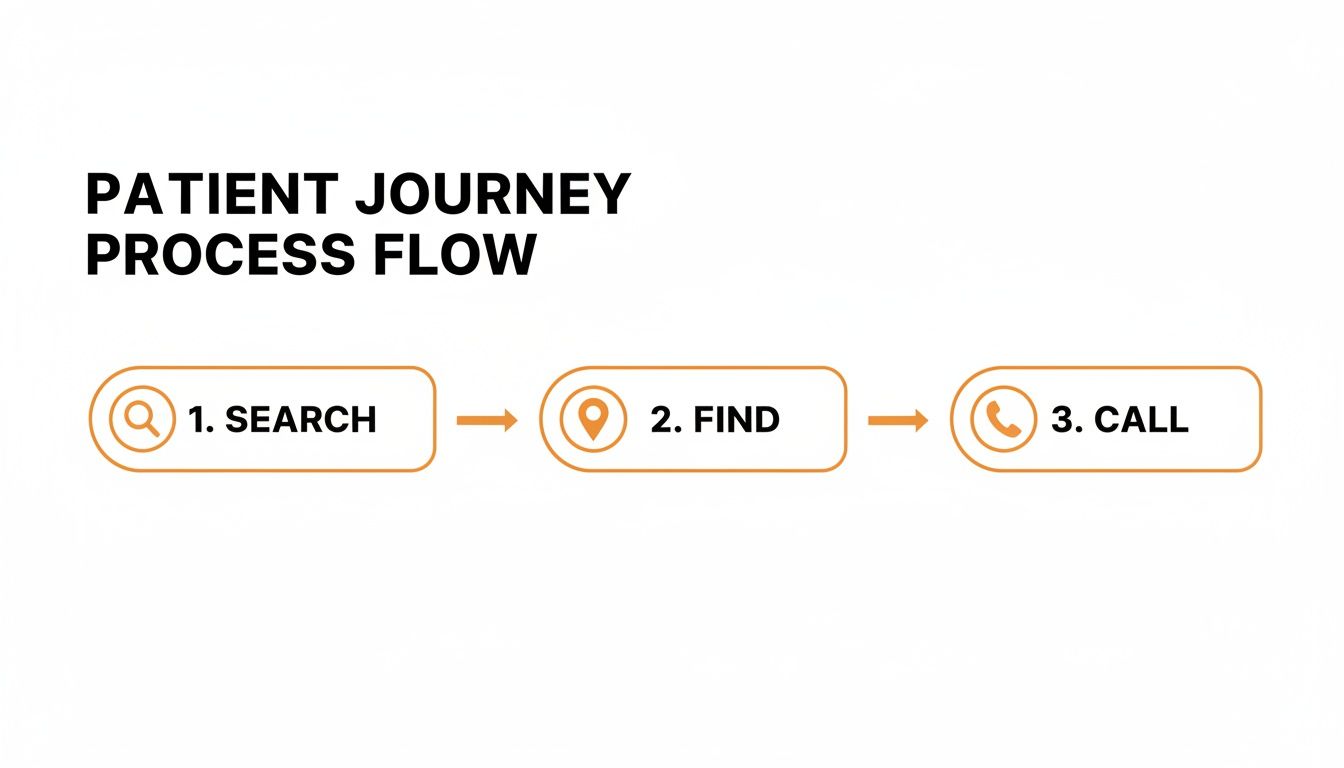
The takeaway here is simple. If you're not showing up in local search results, you’re invisible to a huge number of potential new patients.
The opportunity is massive. In Canada alone, about 4.7 million people see a chiropractor each year, and most of them start their hunt online. In a city like Vancouver, a full 46% of all Google searches are for local information, and an incredible 80% of those searches convert into action, like a phone call or a clinic visit. You can dive deeper into how local search intent drives patient acquisition, but the bottom line is that a focused chiropractic search engine optimization plan is the key to capturing this demand.
SEO isn’t just about rankings; it’s about revenue. Every position you climb in Google for a valuable keyword is another step toward a fuller appointment book and a more predictable stream of new patients.
Setting Realistic Expectations for Growth
While the results from SEO are powerful, it's crucial to have the right timeline in mind. This isn't an overnight fix; it's a long-term growth strategy. You can expect to see some initial traction and positive signals within the first few months.
But the real, sustainable growth—the kind that makes you the go-to clinic in your area—takes time. That momentum builds over six to twelve months and beyond. Consistent effort builds your authority and trust with search engines, leading to lasting visibility that pays for itself for years to come.
Winning the 'Near Me' Search Game

Let's get one thing straight: for a chiropractor, your most valuable patients aren't across the country; they're right around the corner. If you want a full appointment book, you have to dominate the local search results. It's the only way to become the go-to clinic for anyone needing care in your neighbourhood.
This all comes down to mastering the "near me" search. When someone types "chiropractor near me" into Google, they aren't just browsing—they're looking to book. They have a need, and they're ready to act. Your clinic needs to be the first and best answer they find.
Perfecting Your Digital Front Door
The absolute cornerstone of your local strategy is your Google Business Profile (GBP). Seriously, think of it as your digital front door. It’s often the very first impression a potential patient has of your clinic. If it's incomplete, outdated, or just plain wrong, they'll simply scroll to the next listing without a second thought.
I've seen it time and again: a small discrepancy, like using "St." on your GBP but "Street" on your website, can create confusion for search engines and hurt your local authority. Your clinic's Name, Address, and Phone number (your NAP) must be 100% consistent across the web. No exceptions.
But a great GBP goes way beyond just the basics. It needs to be a rich, engaging snapshot of your practice. To make that happen, you'll want to:
- Complete Every Single Section: Don't skip anything. Detail your services, from spinal adjustments to massage therapy. Add high-quality photos of your team, your clinic's interior, and maybe even a few happy patients (with their permission, of course).
- Use Google Posts Actively: Share regular updates, health tips, or clinic news using the Google Posts feature. This shows Google—and potential patients—that your profile is current and active.
- Turn on Messaging: Let people send you a direct message right from your profile. It's a low-friction way for someone to get in touch and take that next step.
For a comprehensive walkthrough of these tactics, our guide on optimizing your Google My Business profile is a great next read.
A fully fleshed-out profile doesn't just help you rank higher; it builds trust before a patient even picks up the phone. Here's a quick checklist to make sure your GBP is in top shape.
Google Business Profile Optimization Checklist
Your Google Business Profile is a powerful tool for attracting local patients. Use this checklist to ensure every element is working hard to bring new clients through your door.
| GBP Element | Optimization Action | Why It Matters |
|---|---|---|
| Clinic Name | Ensure it matches your official business name exactly. | Consistency builds trust with Google and prevents duplicate listings. |
| Address & Phone | Verify that your address and phone number are 100% accurate and consistent everywhere. | This is the foundation of local SEO. Inaccuracies will tank your rankings. |
| Categories | Select "Chiropractor" as your primary category, then add relevant secondary categories. | Helps Google understand exactly what you do and show your profile for relevant searches. |
| Services | Add every service you offer with detailed descriptions and pricing (if applicable). | Informs potential patients about your offerings and helps you rank for specific service queries. |
| Photos & Videos | Upload high-quality photos of your team, office interior/exterior, and equipment. | Visuals build trust and give patients a feel for your clinic before they visit. |
| Google Posts | Post updates, offers, and health tips at least once a week. | Signals to Google that your profile is active and provides fresh content for searchers. |
| Reviews | Actively request reviews from patients and respond to every single one (good and bad). | Social proof is massive. Reviews are a huge local ranking factor and influence patient decisions. |
| Q&A Section | Proactively add and answer common questions patients might have. | Addresses patient concerns upfront and positions you as a helpful expert. |
By methodically working through this list, you're not just checking boxes; you're building a powerful patient-attraction machine that works for you 24/7.
Creating Hyper-Local Content Signals
While your GBP lays the foundation, you need to build on it with content that screams "local expert." Google's job is to connect users with the most relevant local authority, and you prove that's you by speaking directly to the communities you serve.
This means creating specific pages on your website for the different neighbourhoods you serve. Instead of a generic "Back Pain Treatment" page, think bigger. Create a "Kitsilano Back Pain Treatment" page or a "Spinal Decompression in Burnaby" page.
On these pages, be sure to:
- Weave in neighbourhood-specific language: Mention local landmarks, cross streets, or community hubs. Show that you're truly part of the fabric of that area.
- Target local keywords: Naturally include terms like "chiropractor in [Your Neighbourhood]" and "chiropractic clinic near [Local Landmark]."
- Embed a Google Map: Show your clinic's location in relation to that specific neighbourhood to make it easy for locals to find you.
This hyper-local approach sends powerful signals to search engines that you are the definitive chiropractic authority for that specific geographic zone.
A winning local SEO strategy isn't just about showing up in search results. It's about being the undeniable best answer for someone searching for care within a few kilometres of your clinic. That laser focus is what lands you in the coveted Google Local Pack.
Building Authority with Reviews and On-Page Content

Once your digital front door is in order, the next layer of a dominant chiropractic search engine optimization strategy is building undeniable trust. In healthcare, authority isn't just a suggestion—it's a requirement. Prospective patients need solid proof you can help them, and Google needs to see signals that you're a credible, respected clinic in your community.
This authority rests on two main pillars: the authentic voice of your patients (reviews) and the expert content on your website (on-page SEO). When you get both right, you create a powerful feedback loop. Happy patients attract new patients, and your website becomes a go-to resource that turns searchers into scheduled appointments.
The Undeniable Power of Patient Reviews
Word-of-mouth has always been the lifeblood of a chiropractic practice. Today, that word-of-mouth happens online, mostly through Google reviews. These testimonials are one of the most powerful tools you have, acting as a direct signal of trust to someone who is in pain and weighing their options.
But their importance goes far beyond simple social proof. Review signals now make up roughly 20% of local search ranking factors for chiropractors in Canada. Why? Because engagement signals on your Google Business Profile—clicks, calls, and requests for directions—are heavily influenced by your star rating and review volume. The data is clear: since 80% of local searchers take action after checking reviews, a steady stream of positive feedback directly boosts your visibility and your bottom line.
Simply put, a robust review strategy is no longer optional.
Your best marketing assets are the happy patients who walk out of your clinic feeling better. A simple, consistent process for capturing their feedback is one of the highest-return activities you can focus on.
A Simple System for Getting More Google Reviews
Asking for reviews can feel awkward, but it doesn't have to be. The key is to make it a natural, seamless part of your patient experience. Timing is everything. The best moment to ask is right after a patient expresses how happy they are with their treatment.
Here’s a straightforward process you can put into action immediately:
-
Identify the "Happy Moment": Train your team to listen for positive comments like, "Wow, I feel so much better!" or "Thank you, that made a huge difference." That’s your cue.
-
Make a Personal, Direct Ask: In that moment, just say something like, "That's fantastic to hear! We're so glad we could help. Would you be willing to share that experience in a quick Google review? It really helps other people in our community find us."
-
Remove All Friction: Don't just ask and hope they remember later. Have a direct link to your Google review page ready to go. You can print it on a small card with a QR code or, even better, text or email it directly to their phone while they’re at the front desk. The easier you make it, the higher your success rate will be.
By systematizing this, you turn a passive hope into an active strategy that consistently builds your online reputation. You can learn more by exploring our detailed article on the importance of online reviews for local businesses.
Crafting On-Page Content That Converts
While reviews build external trust, your website's content must build internal authority. This is where on-page SEO comes in. Your goal is to create pages that directly answer the specific questions and concerns of potential patients, making your clinic the obvious choice for care.
This means moving beyond a single, generic "Services" page. You need to create dedicated pages for each primary condition you treat and every service you offer. Think about it: someone searching for "sciatica treatment" is far more likely to click on and trust a page titled "Effective Sciatica Treatment in Vancouver" than a general page that just lists it among a dozen other services.
These pages should be structured to guide a patient from their problem to your solution:
- Acknowledge Their Pain: Start by describing the exact symptoms and frustrations associated with their condition. Show them you understand.
- Explain Your Approach: Detail how your specific chiropractic techniques can address the root cause of the problem.
- Showcase Your Expertise: Include information about your experience, any relevant technology you use, and patient success stories (testimonials are great here, too).
- Provide a Clear Call-to-Action: Make it incredibly easy for them to take the next step, whether that's "Book an Assessment," "Call Our Clinic," or "Request an Appointment Online."
This targeted approach doesn't just improve your search engine rankings for high-intent keywords; it dramatically increases the chance that a website visitor will become a new patient.
Executing Advanced SEO Your Competitors Ignore

Once you've nailed the fundamentals of local and on-page SEO, you're already ahead of most clinics in your area. But to truly own your local market, you need to dig into the advanced strategies that your competitors either don't know about or find too complicated to tackle. This is where you build a real, sustainable advantage that’s tough for anyone else to copy.
These aren't just minor tweaks. These next-level tactics are what signal deep authority and expertise to search engines. You’ll be focusing on the nuts and bolts of your website's health and the strategic depth of your content, shifting your clinic from being just another option to becoming the go-to choice for care. This is a critical part of any mature chiropractic search engine optimization plan.
Fine-Tuning Your Technical SEO Health
Think of technical SEO as the foundation of your digital practice. It's all the work that happens "behind the curtain" to make sure your website is fast, secure, and incredibly easy for search engines to crawl and understand. While it might sound technical, focusing on a few key areas can make a massive difference in your rankings.
First up: speed. A fast-loading website isn't a "nice-to-have" anymore; it's essential. Google has explicitly stated that site speed is a ranking factor, especially on mobile, which is where the vast majority of your potential patients are searching. If your site takes more than 2-3 seconds to load, they’re gone. They’ll hit the back button and click on your competitor without a second thought.
The mobile experience is just as crucial. Your website absolutely must be responsive, meaning it looks great and works perfectly on a phone. If a potential patient has to pinch and zoom to read about your services or struggles to tap a tiny "Book Now" button, you've already lost them.
Key Insight: Technical SEO isn't just for web developers; it's a core part of the patient experience. A slow, clunky website creates friction and doubt. A fast, seamless site builds instant confidence and makes it easy for them to take the next step.
Finally, let's talk about schema markup. This is one of the most powerful tools in your arsenal. It's a special code you add to your website that essentially translates your content into a language search engines understand perfectly. For a chiropractic clinic, you can use schema to spell out:
- Your clinic's name, address, and phone number (NAP)
- Your hours of operation
- The specific medical conditions you treat
- The therapies and services you offer
This helps Google show enhanced "rich results" for your clinic right in the search listings, like star ratings or FAQs. That makes your listing pop off the page and gets you more clicks.
Becoming a Community Health Authority
Your content is your best chance to prove your expertise and build genuine trust with potential patients. The goal shouldn't be to just sell your services. It should be to become the undisputed educational resource for musculoskeletal health in your city.
This means creating and publishing content that answers the actual questions your patients ask every single day. Move beyond generic service pages and start building a library of genuinely helpful blog posts, guides, and videos. An effective content plan might look something like this:
- List-Based Articles: Think "5 Stretches to Relieve Desk-Related Neck Pain." This format is easy to scan, immediately useful, and highly shareable. It positions you as a practical, helpful expert.
- "How-To" Guides: A post like "How to Set Up an Ergonomic Home Office" targets a common pain point for your ideal patient. You're addressing their needs before they even think about booking, building incredible goodwill.
- Weekly Health Tips: A short, consistent blog or video series on topics like "This Week's Tip for Better Sleep Posture" gives people a reason to keep coming back to your site and establishes a routine.
When you shift your focus from selling to helping, you naturally attract more of the right kind of traffic and build a loyal following. This educational approach solidifies your clinic’s authority in the eyes of both Google and your future patients.
Acquiring High-Quality Local Backlinks
In the world of SEO, backlinks—links from other websites pointing to yours—are like powerful votes of confidence. A single link from a well-respected local source tells Google that your clinic is a trusted and important part of the community.
This is an area most clinics completely neglect. By creating a proactive backlink strategy, you can create a huge competitive gap. Don't just wait for links to appear; go out and earn them. Consider reaching out to:
- Local news outlets about a community health workshop you're hosting.
- Nearby gyms or yoga studios to write a guest post for their blog about injury prevention.
- Community business associations you're a part of or local charities you support.
Every high-quality local link you earn strengthens your website's authority. This makes it significantly harder for your competitors to outrank you for those all-important "chiropractor near me" searches. It's the final piece of the puzzle, connecting your on-site expertise and solid technical foundation to the wider digital community.
Using AI to Streamline Your SEO Efforts
Let's be realistic—AI isn't some science-fiction concept anymore. It's a practical tool that can give your clinic a real, measurable advantage in a crowded local market. By weaving AI into your workflow, you can save dozens of hours a month, uncover what your local competitors are missing, and scale your marketing without losing that essential human touch patients trust.
The point isn't to let a robot run your marketing. Think of AI as your super-efficient marketing assistant. It tackles the tedious, data-heavy tasks, freeing you up to focus on high-level strategy and, most importantly, on caring for your patients. This is a massive part of what modern chiropractic search engine optimization looks like today.
Automating the Repetitive SEO Grind
So much of good SEO is repetitive but necessary. These predictable, time-sucking tasks are perfect candidates for AI. You can genuinely reclaim hours every single week by offloading this routine work to specialized tools.
Think about writing meta descriptions for all your service pages or coming up with unique posts for your Google Business Profile. AI can spit out a dozen compelling options in seconds. Your job is to then review, tweak, and approve them with your clinical expertise.
Here are a few ways to put this into action immediately:
- Meta Descriptions & Titles: Feed an AI tool the URL for your "Sciatica Treatment" page and ask for five different, SEO-friendly meta descriptions.
- GBP Post Ideas: Ask for ten engaging Google Post ideas for the spring season, focusing on "common running injuries and chiropractic solutions."
- Image Alt Text: Upload a picture of your clinic’s adjustment room and have an AI tool write descriptive alt text that helps with both accessibility and image search.
Discovering Untapped Local Opportunities
This is where AI goes beyond simple automation and gives you a serious competitive edge. It excels at analyzing huge amounts of data to spot patterns a human would almost certainly miss. AI tools can sift through competitor websites, local search results, and even patient forums to paint a clear picture of what's happening in your neighbourhood.
For example, an AI-powered SEO tool can analyze the top-ranking chiro websites in Vancouver and pinpoint "content gaps"—topics your competitors are all over that you haven't touched. It might find that patients are constantly asking about "chiropractic care for TMJ," a service you offer but don't have a dedicated page for. Suddenly, you have a clear, data-backed plan for your next piece of content.
AI acts like a powerful magnifying glass for your local market. It helps you see not just what your competitors are doing, but what patients are actually searching for, allowing you to create content that meets a proven demand.
This data-driven approach takes the guesswork out of your marketing. To get a better handle on this, it's worth exploring the benefits of AI in SEO for local businesses to see just how deep the rabbit hole goes.
Scaling Your Content Creation
Consistently creating high-quality, helpful content is one of the biggest challenges for any clinic. AI can be a fantastic brainstorming partner and first-draft assistant, seriously speeding up your process. It’s brilliant for generating blog post outlines, suggesting fresh angles on a topic, or even producing a rough draft that your team can then polish with clinical insights and personal stories.
Say you want to write a blog post on preventing back pain for people working from home. You could ask an AI tool to create a detailed outline, complete with sections on ergonomic setups, common posture mistakes, and specific stretches. Just like that, you have a solid structure to build on, turning what was a multi-hour project into a much more manageable task.
To give you a clearer idea, here’s how different tools can slot into your workflow.
AI Tool Applications for Chiropractic SEO
This table breaks down how specific AI tools can be applied to different parts of your SEO strategy, making you far more efficient and effective.
| SEO Task | Example AI Tool | Practical Application for a Clinic |
|---|---|---|
| Keyword Research | SEMrush Keyword Magic Tool | Discover long-tail keywords like "best chiropractor for athletes in Kitsilano." |
| Content Outlines | ChatGPT or Jasper | Generate a comprehensive outline for a blog post on "5 Myths About Spinal Decompression." |
| Competitor Analysis | Ahrefs or SurferSEO | Analyse the top 3 competitors for "car accident injury chiropractor Vancouver" to find their weak spots. |
| Local SEO Posts | Copy.ai or LocalViking | Draft weekly Google Business Profile posts about clinic news, patient testimonials, or health tips. |
By intelligently using these tools, you're not cutting corners; you're building a smarter, more efficient engine to attract new patients. This approach allows you to produce more valuable resources for your community, which strengthens your authority and boosts your search visibility all at once.
Tracking Your Success and Staying Compliant
A powerful chiropractic search engine optimization strategy is only as good as the results it brings in. If you can’t clearly measure what’s working and what isn’t, you're essentially marketing in the dark. Just as important is making sure all your marketing is both ethical and effective, especially when you're talking about health.
Navigating the rules around health marketing in Canada isn't optional—it's a must. Regulatory bodies have strict guidelines to protect people from misleading information. This means every single claim on your website, from a service page to a blog post, has to be truthful, verifiable, and can't create false hope about treatment outcomes. Steer clear of definitive words like "cure" or "guaranteed results." Instead, frame your content around patient education and improving quality of life.
Measuring What Truly Matters
It's easy to get excited about vanity metrics like a spike in website traffic or seeing your clinic rank on the first page. While those feel good, they don't pay the bills. The real measure of SEO success is how it directly impacts your clinic's growth. You have to connect what you're doing online to actual new patients walking through your door.
The best way to do this is by getting conversion tracking set up properly. You can use free tools like Google Analytics 4 (GA4) and Google Search Console to keep an eye on the actions that really matter. These are the key performance indicators (KPIs) that show you're getting a genuine return on your investment.
Here are the essential metrics every chiropractor should be tracking:
- New Patient Phone Calls: With call tracking software, you can see exactly which calls came from someone who found you through a Google search.
- Appointment Form Submissions: Every time someone fills out your "Request an Appointment" form, that’s a direct lead generated by your website.
- Clicks-to-Directions from GBP: This metric in your Google Business Profile is a strong signal that someone is actively trying to get to your physical location.
Don't get lost in a sea of data. Focus on the handful of metrics that directly translate to new patients in your practice. If a metric doesn't point toward a new appointment, it’s a distraction, not a measure of success.
Connecting SEO Efforts to Clinic Revenue
Once you start tracking these conversions, you can make decisions based on real data, not guesswork. For example, you might discover that your blog post on "stretches for desk workers" is generating a ton of appointment form submissions. That’s a clear signal to create more content just like it.
On the flip side, maybe one of your service pages gets plenty of visitors, but the phone never rings because of it. That tells you it’s time to revisit the page's content or strengthen its call-to-action.
By analyzing what drives tangible results, you can fine-tune your strategy, double down on what works, and clearly see the value your SEO investment is creating. This shifts your marketing from a simple expense into a predictable engine for growing your clinic.
Got Questions? We’ve Got Answers.
When it comes to SEO for chiropractors, a few questions pop up time and time again. Let’s clear the air and give you the straightforward answers you need.
How Long Until I See Real Results From SEO?
This is the big one, isn't it? While you might see some early positive signs in the first month or two, you should plan for a 3-6 month timeframe before you see a significant, measurable impact on patient bookings and phone calls.
Think of it like building a reputation in your community—it doesn't happen overnight. SEO is a long-term play where consistent, quality effort compounds over time. The work you do today in local optimization, content, and getting reviews is what builds that unstoppable momentum down the road.
Can I Handle My Clinic's SEO Myself?
You absolutely can, and many chiropractors do! A lot of the foundational work, like keeping your Google Business Profile updated and polished or creating a system for asking patients for reviews, is perfectly manageable in-house.
Where it gets tricky is the more technical side of things. Deep keyword research, optimizing your site's loading speed, or implementing structured data (schema markup) can be complex. Partnering with a specialist for these areas can often save you from costly mistakes and get you to your goals much faster. It's all about knowing where your time is best spent.
Should I Focus on Local SEO or General SEO?
For a hands-on practice like a chiropractic clinic, local SEO is everything. Your patients are looking for care right now, in their neighbourhood. They're searching for "chiropractor near me" or "back pain treatment [your city]."
Your primary goal is to show up for those people. That means dominating the Google Map Pack and being the obvious choice for anyone searching within a few kilometres of your clinic. While broader SEO has its place, your most direct and valuable new patients will always come from a rock-solid local strategy.
Ready to turn your online presence into a predictable patient-attraction system? At Juiced Digital, we build data-driven SEO strategies that deliver measurable results for clinics across Canada. Book your free, no-obligation strategy session today.