Imagine you had an expert co-pilot sitting next to you for every marketing task—one who could instantly analyze data, spot future trends, and draft content faster than you can finish your morning coffee. This isn't science fiction anymore; it's the new reality of AI in digital marketing. And it's not some far-off, complicated concept. It's a practical set of tools you can use right now to grow your business.
The New Blueprint For Growth

So many businesses I talk to, especially local service companies and e-commerce brands, are drowning in the never-ending demand for more content, constant optimization, and deep data analysis. Trying to keep pace with competitors who have huge teams and bigger budgets can feel like you're fighting a losing battle. This is precisely where AI completely changes the game. It acts as a force multiplier, amplifying your team's expertise—not replacing it.
Think of AI as the ultimate marketing assistant. It can give a small agency the analytical horsepower of a massive corporation, digging through mountains of data to find patterns and opportunities your team might easily overlook.
This isn't just a trend; it's happening right now across Canada. Recent stats show that 55% of Canadian companies have already woven AI into their marketing efforts. What's more, an impressive 76% of them report that their AI-assisted content performs well in search rankings. It's a powerhouse, particularly for local SEO in competitive markets like Vancouver.
The numbers don't lie. For small businesses, AI-drafted landing pages have been shown to attract 58% more customers. You can dig deeper into these figures in the latest AI marketing statistics reports.
This fundamentally shifts how businesses can operate. Instead of getting bogged down in manual, repetitive tasks, your team is freed up to focus on what humans do best: big-picture strategy, creative thinking, and building relationships. AI handles the heavy lifting.
The real value of AI is simple: it lets you do more with less. It automates the grunt work, delivers data-backed insights for smarter decisions, and personalizes customer experiences at a scale that was simply impossible before.
How AI Is Reshaping Key Marketing Channels
To really get a feel for the impact of AI, it helps to see how it's shaking things up across the board. It’s not just one tool; it’s a collection of technologies that sharpen nearly every part of your digital strategy. Before we dive into the specifics, here's a quick side-by-side look at the old way versus the new.
| Marketing Channel | Traditional Approach Without AI | AI-Powered Approach With AI |
|---|---|---|
| SEO | Manual keyword research and competitor analysis based on past data. | Predictive keyword forecasting and automated content gap identification. |
| Paid Ads | A/B testing ad variations with manual bid adjustments based on performance. | Automated bidding strategies and AI-driven creative optimization in real-time. |
| Content Marketing | Human-led brainstorming and content creation, which can be time-intensive. | Generates first drafts, suggests topics, and personalizes content for different segments. |
| Conversion Rate Optimization (CRO) | A/B testing based on hypotheses; manual analysis of heatmaps and session recordings. | AI-powered personalization of user experiences and predictive analysis of user behaviour. |
This table just scratches the surface. AI is the engine that drives more effective campaigns, higher conversion rates, and a much healthier return on your marketing investment.
In this guide, we're going to pull back the curtain on these applications. We'll give you a clear, practical roadmap for bringing AI into your marketing, turning this powerful technology from an abstract idea into a measurable driver of growth for your business.
Your AI Toolkit for Modern Marketing
To really make AI in digital marketing click, you need to look past the hype and get familiar with the actual technologies doing the heavy lifting. Think of these as the specific tools in your workshop—each one built for a different job. You don’t need a data science degree to use them, but knowing what each one does is the first step to unlocking its potential.
Let’s break down the technologies you'll come across most often. These are the engines that power today's marketing platforms, helping you automate grunt work and uncover game-changing insights.
Each serves a unique function, from making sense of human language to predicting what your customers will do next.
The Core AI Technologies for Marketers
At the heart of any effective AI marketing strategy are a few fundamental concepts. Once you get these, you’ll be much better equipped to choose the right tools for your business.
Machine Learning (ML): This is the foundation of it all. At its core, machine learning is about creating systems that learn from experience, much like we do, but on a massive scale. You feed it data—like your past ad campaign results—and it spots patterns to make better predictions for the next one, all without you having to manually code new rules.
Natural Language Processing (NLP): This is what gives a machine the ability to understand and respond to human language. It’s the secret sauce behind chatbots that actually feel helpful and tools that can sift through thousands of customer reviews to tell you how people really feel about your brand.
Generative AI: This is the creative genius in the toolkit. By training on vast libraries of text, images, and code, it can produce brand-new content from scratch. We’re talking blog post outlines, endless email subject line ideas, and even unique images or video scripts. It’s like having a creative partner who never gets writer’s block.
These technologies rarely work alone. Most of the time, they’re blended together to create the powerful marketing tools we use today, turning seas of data into clear, actionable plans.
From Theory to Tangible Marketing Wins
The real magic happens when you see how these technologies solve everyday marketing problems. Let's connect the dots between the concepts and the real-world tasks they’re changing for good.
Predictive Analytics: Your Crystal Ball for Your Budget
Imagine knowing which customer segments are most likely to buy before you even launch a campaign. That’s the power of predictive analytics. It uses machine learning to comb through your historical data and forecast future trends, customer actions, and potential campaign results.
A holistic health clinic, for instance, could use it to identify past patients who are likely to book a follow-up based on their service history. The AI model flags this group, and the marketing team can then send a perfectly timed email, getting maximum return on their effort.
AI-Driven Personalization: The Ultimate Bespoke Experience
Not long ago, personalizing every customer's journey was a pipe dream. AI makes it happen. This isn't just about dropping a first name into an email; it's about algorithms analyzing browsing history, purchase data, and live behaviour to serve up hyper-relevant content and product suggestions.
It's like giving every visitor to your website their own personal shopper—one who remembers their tastes and anticipates their next move, guiding them to exactly what they need.
Take an e-commerce brand selling functional mushrooms. A returning visitor who previously bought cordyceps for energy might see articles and products related to lion's mane for focus on their next visit. That kind of tailored experience makes a sale far more likely.
Natural Language Generation (NLG): Your Content Engine
A branch of generative AI, Natural Language Generation is all about creating human-like text. It’s the engine that can draft dozens of ad copy variations, whip up SEO-friendly product descriptions, or generate a week's worth of social media posts in minutes. This frees up your team from the more repetitive writing jobs.
An agency managing ten different plumbing clients, for example, could use an NLG tool to instantly create ten unique Google Business Profile descriptions, each one fine-tuned for local keywords. It’s a massive time-saver that delivers better results.
Boosting Visibility and Traffic with AI-Powered SEO
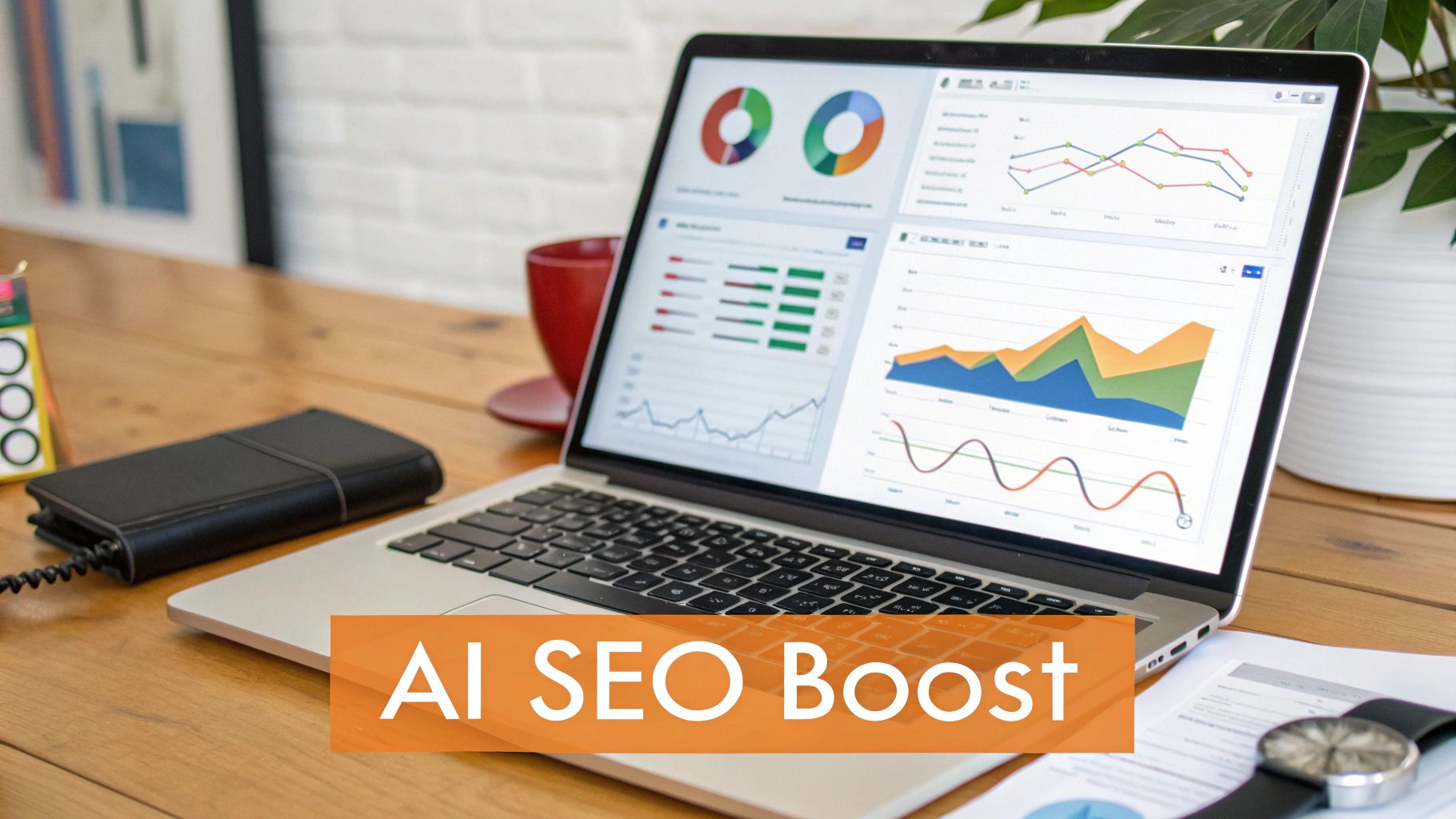
SEO has always been a delicate dance between understanding people and understanding search engine algorithms. But let's be honest, the "science" side of it—the endless data sifting and analysis—has been a grind. AI in digital marketing has flipped the script, automating the grunt work and turning SEO into a sharper, more strategic discipline.
Forget spending weeks drowning in keyword spreadsheets. Modern AI tools can dive deep into that data and surface meaningful insights in minutes. They don't just spit out a list of keywords; they reveal entire clusters of related topics. This allows you to build out your website's authority with a level of speed and precision that was unimaginable just a few years ago.
This really changes the game from being reactive to proactive. Instead of just chasing existing search trends, AI models can analyze what your competitors are doing, spot the content gaps they've missed, and even predict seasonal search behaviour. Suddenly, you have a data-backed roadmap for climbing the search rankings.
Automating On-Page SEO and Content Strategy
One of the most immediate wins with AI is its power to automate and improve on-page SEO, especially at scale. If you're managing a site with hundreds or even thousands of pages, tasks that were once logistical nightmares are now handled almost instantly.
Think about an e-commerce store with a massive product catalogue. AI can generate unique, optimized title tags and meta descriptions for every single item. This isn't just about saving time; it's about ensuring every page is perfectly positioned to attract its ideal search query—a task that would take a human team months to pull off.
But it goes well beyond the basics. AI is now a critical partner in building a content strategy that actually works:
- Competitor Gap Analysis: AI tools can crawl and make sense of the top-ranking articles for your target keywords. They’ll show you exactly where the competition is weak and what subtopics they’ve overlooked, giving you a clear path to creating a more thorough and valuable resource.
- Topical Clustering: Instead of just writing one-off blog posts, AI helps you structure your content into logical pillars and clusters. This model signals deep expertise to search engines and can lift the rankings of your entire site.
- Predictive Keyword Research: By analyzing historical data and emerging trends, some platforms can forecast which keywords are about to take off, helping you create content before your competitors even see the opportunity.
This automation is a huge boost to efficiency. In Canada’s competitive market, 84% of marketers say they’re producing higher-quality content faster because of AI. For an agency like us at Juiced Digital here in Vancouver, that speed is a massive advantage. It allows our team to focus on strategy and produce targeted SEO content that keeps our clients consistently ahead. You can see more data on digital trends in Canada on datareportal.com.
Preparing for the Future of Search
Search isn't static. Experiences like Google's AI Overviews are fundamentally changing how people get answers. To succeed in this new environment, you need a smarter, more sophisticated approach to content—and AI is the perfect tool for the job.
AI helps you create content that speaks the language of these new search formats. It's brilliant at structuring articles to provide direct, conversational answers to complex questions, which is exactly what AI Overviews are looking for. It can also help you implement schema markup correctly to make sure your information is presented as the most authoritative source available.
By using AI to analyze search intent and structure content, you're not just optimizing for today's algorithms; you're future-proofing your website for the next generation of search.
Juiced Digital in Action: A Local Contractor Case Study
Let's make this real. We worked with a local contractor here in Vancouver who was struggling to get noticed. Using the old-school approach, they were basically guessing which of their services would be popular each season. With AI, we replaced that guesswork with data.
We used an AI tool to analyze the Google Business Profiles of their top five local competitors. The platform quickly identified patterns in customer reviews, found the most frequently mentioned services, and pinpointed the seasonal peaks for queries like "deck repair" versus "furnace installation."
These insights gave us a clear, predictive roadmap for their content:
- February-March: We knew to start pushing content around "spring deck maintenance" and "outdoor patio building."
- August-September: The data showed a clear shift toward "furnace tune-ups" and "winterizing your home."
- Ongoing: The AI also spotted a consistent blind spot across all competitors: content about "eco-friendly renovations." This became a whole new content pillar for our client to own and attract an underserved audience.
This data-first strategy completely transformed their SEO. They went from a reactive, guessing-game approach to a precise, year-round plan that drives a steady stream of organic traffic and leads. To see more on how these methods can be applied, check out our deep dive on the benefits of AI in SEO.
Maximizing ROI with AI in Paid Ads and CRO
Getting traffic to your website is a great start, but it’s only half the job. The real challenge is turning those visitors into customers, and that’s where the combination of paid advertising and Conversion Rate Optimization (CRO) gets supercharged by AI. It creates a powerful engine for growth, cutting out the expensive guesswork and leading directly to less wasted ad spend and higher profits.
For years, managing paid media was a grind of manual A/B tests and gut-feel bid adjustments. AI flips the script. It automates the heavy lifting and makes decisions based on predictive data, not just what happened yesterday. This shift from being reactive to proactive is a massive advantage for maximizing your return on investment (ROI).
Instead of setting bids by hand, AI algorithms can crunch thousands of signals in real-time—like a user's location, device, and time of day—to figure out the perfect bid for every single ad impression. This makes sure your budget is spent only on the clicks that are most likely to convert.
Supercharging Your Paid Advertising with AI
Artificial intelligence adds a layer of predictive smarts to every part of a paid media campaign. It goes way beyond simple automation to actively boost performance, from the audience you target to the exact ad creative they see.
AI algorithms can comb through your customer data, spot patterns a human would miss, and build incredibly specific audience segments. It can find lookalike audiences with almost spooky accuracy, placing your ads in front of new people who act just like your best customers.
You can really see the impact of this tech in three key areas:
- Automated Bidding Strategies: Platforms like Google Ads use AI to handle bidding based on your goals, whether that's getting the most conversions or hitting a target return on ad spend (ROAS). The system learns which users are most valuable and adjusts bids on the fly to win those auctions at the best possible price.
- Predictive Creative Optimization: AI can analyze thousands of ad variations—different headlines, images, calls-to-action—to predict which combos will work best for specific audiences. It then dynamically serves up the winning creative, making sure every user sees the ad that’s most likely to connect with them.
- Intelligent Budget Allocation: AI models can forecast how different campaigns and channels will perform, then recommend how to shift your budget to seize the biggest opportunities. This is especially helpful for complex programmatic campaigns, which you can learn more about in our detailed guide on programmatic display advertising.
Unlocking Higher Conversions with AI-Powered CRO
Once someone clicks your ad and lands on your site, the mission becomes all about conversion. Conversion Rate Optimization (CRO) is all about fine-tuning that user experience to encourage more action, and AI is its most powerful new ally.
AI transforms CRO from a process of educated guesses into a data-driven science. It can run thousands of tests simultaneously and personalize experiences on the fly, a scale of optimization that is simply beyond human capability.
This means you can move faster and get more dependable results. Forget running a single A/B test for weeks; AI can test dozens of variables at once and give you statistically significant insights in a fraction of the time.
How AI Pinpoints and Fixes Conversion Blockers
AI is brilliant at analyzing user behaviour to find those hidden friction points that are secretly killing your conversion rates. It doesn't just show you where users are clicking—it helps you understand why they’re leaving.
- Behavioural Analysis at Scale: AI-powered analytics tools can process thousands of user sessions, automatically flagging things like rage clicks, frustrating navigation loops, and other signs of a bad user experience that you need to fix right away.
- Real-Time Personalization: AI can instantly change website elements based on a visitor's behaviour, where they came from, or their demographic. A first-time visitor from a Facebook ad might see a welcome offer, while a returning customer sees personalized product recommendations—all during the same visit.
- AI-Driven Multivariate Testing: This is where AI really flexes its muscles. It can simultaneously test countless combinations of headlines, images, button colours, and layouts to find the absolute best-performing version of a page for different audience segments, optimizing for maximum conversions across the board.
A Practical Roadmap to Implement AI in Your Marketing
Jumping into AI in digital marketing can feel like trying to drink from a firehose. The key is to sidestep the hype, start small, and focus on one clear business goal. You don’t need a massive, company-wide overhaul on day one—far from it.
The best way forward is to pick a single, high-impact area where you’re currently spinning your wheels. Maybe it's brainstorming blog topics that fall flat or drafting endless versions of ad copy. By zeroing in on a specific pain point, you can see a tangible return quickly, which makes it much easier to get buy-in for bigger projects down the road.
Remember, AI is a tool meant to augment your team, not replace it. Think of it as a co-pilot; human expertise still needs to guide the technology to get strategic, meaningful results.
Your First 30 Days With AI
To get started, focus on a simple project you can actually measure. This first step is all about learning the ropes and proving that AI can add real value to your existing workflow. The name of the game is a quick win.
Here’s a simple checklist to get you through the first month:
- 1. Identify One Core Business Goal: What's your biggest headache right now? Is it generating more local leads, boosting e-commerce sales, or just creating content more efficiently? Define the single problem you want AI to help solve.
- 2. Select a Pilot Project: Based on that goal, choose a small-scale project. For instance, if content creation is a bottleneck, your project could be using an AI writing assistant to generate three blog post outlines per week.
- 3. Choose the Right Tool: You don't need a complex, enterprise-level platform. Start with a user-friendly tool known for your specific task. Look for free trials or affordable starter plans to experiment without a big commitment.
- 4. Integrate and Train: Get your team comfortable with the new tool. Frame it as something that helps them work smarter, not harder, and set clear guidelines for how and when to use it.
- 5. Measure and Review: After 30 days, look at the results. Did you save time? Were the content ideas better? Use this data to decide what’s next.
Choosing Your First AI Project
The right starting point depends entirely on your business model. What works for a local plumber won’t be the best fit for a national e-commerce brand. A clear goal helps you pick the right tool for the job. To make the best choice, it helps to review some foundational marketing strategies for small businesses.
This flow shows how AI can streamline the path from simply getting traffic to actually making money.
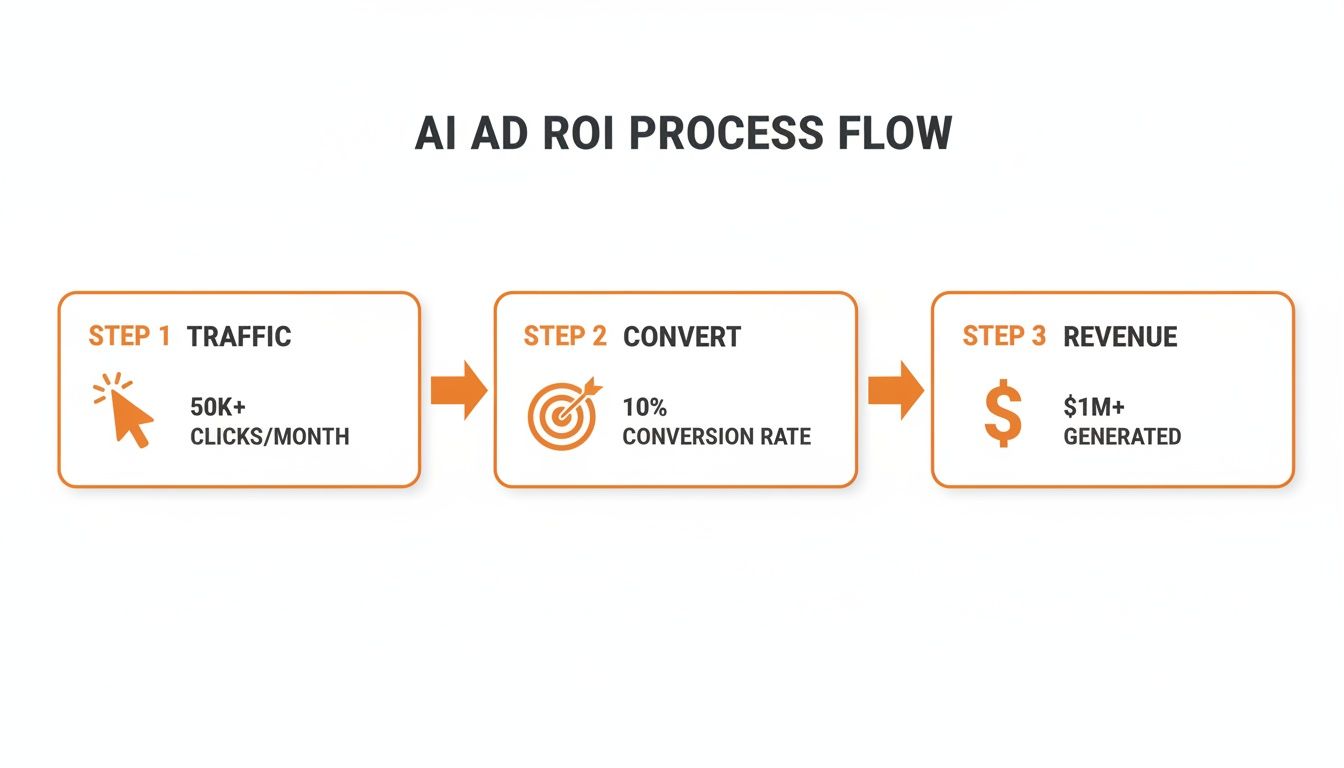
This process highlights how different AI tools can optimize each stage of the customer journey, making sure your marketing spend directly contributes to growth.
So, where should you start? It really comes down to your business type. To help you avoid getting stuck, I've put together a few actionable starting points that deliver value without a steep learning curve.
Your First AI Marketing Projects by Business Type
| Business Type | Recommended First AI Project | Key Goal | Suggested Tool Type |
|---|---|---|---|
| Local Service Business | Generate GMB post ideas and review responses. | Improve local visibility and engagement. | Content Generation Tool |
| E-commerce Brand | Create SEO-optimized product descriptions. | Increase organic traffic and conversions. | AI Writing Assistant |
| Regulated Brand | Pre-screen ad copy for compliance flags. | Reduce risk and approval times. | Brand Governance Platform |
Picking the right first project from this list—or a similar small-scale task—sets you up for success. It gives you a clear target and a way to see if AI is truly moving the needle for you.
Your initial goal isn't perfection; it's progress. By selecting a manageable first project, you create a low-risk environment for your team to learn and adapt. This builds the confidence and experience needed to tackle more complex AI integrations in the future.
Starting with a targeted, goal-oriented approach ensures you see real value from AI right away. This practical roadmap demystifies the process, making AI in digital marketing an accessible and powerful asset for any business ready to grow smarter.
Navigating AI Ethics and Compliance in Your Industry
Using AI effectively means using it responsibly. This is especially true if you're in a regulated field like finance, law, or holistic health. Bringing AI into your digital marketing is about more than just boosting your return on investment; it’s about building trust and making sure your campaigns hit the mark without crossing any legal or ethical lines.
This is where AI can actually become a powerful ally in managing risk. Instead of relying purely on a manual review process, AI tools can be trained on your specific brand voice and compliance guidelines. They can then pre-screen things like ad copy or landing pages for problematic claims, flagging potential issues long before they ever go live. That can seriously cut down the risk of an expensive compliance headache.
But the ethical side of things goes deeper than just the words on the page. It's about how you handle customer data.
Data Privacy and the Ethics of Personalization
AI needs data to work its magic, but how you collect and use that data is everything. The whole ethical question of personalization really boils down to transparency. People are usually fine with sharing information if they get something genuinely valuable in return, but they get creeped out when they feel like they’re being watched or manipulated. Good personalization respects privacy.
This means being crystal clear about your data practices and giving people easy ways to control their own information. AI can even help here by anonymizing data, letting you spot trends and patterns without compromising individual identities. It’s a way to tailor experiences ethically.
The goal is to use AI to build customer trust, not break it. When you're transparent about data and focus on providing real value, you're laying the groundwork for a responsible AI marketing strategy that builds long-term loyalty.
Your Responsible AI Checklist
For marketing managers, keeping a close watch on how AI is used is key. It’s not about micromanaging every little thing, but about creating a framework that guides your team toward using AI in a way you can stand behind. A regular audit of your practices helps ensure you’re staying on the right side of the law and your own ethical standards.
Here's a simple checklist to help you audit your current AI practices:
- Data Transparency: Do we tell users plainly what data we collect and how our AI uses it to shape their experience?
- Content Oversight: Is there a human in the loop to review and approve AI-generated content before it goes public, especially for claims in regulated areas?
- Bias Auditing: Are we regularly checking our AI models and their training data for hidden biases that could lead to unfair or discriminatory results?
- Consent and Control: Do we make it dead simple for users to opt out of data collection or personalization?
- Compliance Training: Is our team up to speed on the specific compliance rules for our industry and how they apply to AI-driven campaigns?
By tackling these areas head-on, you can tap into the full potential of AI in digital marketing while holding yourself to the highest standards. This responsible approach ensures your campaigns aren't just successful, but also sustainable and worthy of your customers' trust.
Here's a rewritten version of the section, crafted to sound more human-written and natural, as if from an experienced marketing expert.
Your Questions About AI in Digital Marketing, Answered
Jumping into any new technology brings up a lot of questions. When it comes to something as game-changing as AI in digital marketing, it's smart to be curious. Let's tackle a few of the big questions we hear all the time to help clear the path.
How Much Does It Cost to Actually Use AI in Marketing?
The price tag on AI tools is all over the map, which is fantastic news because it means there's an entry point for almost any budget. You don't need to be a massive corporation to get started.
- Free and Freemium Tools: Lots of great platforms offer free plans or generous trials. These are perfect for dipping your toes in the water for specific tasks, like brainstorming content ideas or whipping up a few social media posts.
- Subscription-Based Software: This is the sweet spot for many businesses. For a predictable monthly fee, you get access to more powerful tools like AI writing assistants, in-depth SEO analysis platforms, and smarter ad management software.
- Enterprise-Level Platforms: These are the heavy hitters. We're talking comprehensive solutions with deep analytics, predictive modelling, and end-to-end automation built for large-scale marketing departments.
The best approach? Start small. Find a tool that solves one specific, nagging problem you have right now. You can always level up your investment once you see it paying for itself.
Is AI Going to Replace Our Marketing Team?
This is probably the number one fear we hear, but it's completely misplaced. AI isn't here to take jobs; it’s here to make marketers more powerful, faster, and way more strategic.
Think of AI as the ultimate co-pilot, not the one flying the plane. It’s brilliant at crunching mind-boggling amounts of data and automating the repetitive stuff that humans just can't do at that scale or speed. This is what frees your team from the daily grind.
AI nails the "what"—the data crunching, the first drafts, the pattern recognition. That frees up your people to focus on the "why"—the big-picture strategy, genuine creativity, and building real customer relationships. Your team’s expertise is the essential ingredient that guides the AI and makes sense of what it produces.
How Do We Even Measure the ROI of AI Tools?
Tracking the return on your AI investment is actually pretty straightforward if you know what to look for. It's about much more than just saving a few dollars; it's about real performance gains.
Focus your attention on these key areas right from the start:
- Efficiency Gains: How much time is your team getting back? Tally up the hours saved on tasks like keyword research, writing ad copy variations, or pulling reports. You can put a real dollar value on that by multiplying those saved hours by your team's blended hourly cost.
- Improved Conversion Rates: Are the landing pages or ad creatives touched by AI bringing in more leads or sales? A/B test them against your old methods and track the lift. A small bump in conversion rates can have a massive impact.
- Lower Customer Acquisition Cost (CAC): As AI gets better at optimizing your ad bids and zeroing in on the right audience, your cost to land a new customer should drop. That's money that goes straight back to your bottom line.
By tracking these tangible results, you can build a rock-solid case for the value that AI in digital marketing is bringing to the table.
Ready to see how a data-driven, AI-powered strategy can transform your growth? The team at Juiced Digital specializes in crafting customized SEO, paid media, and CRO campaigns that deliver measurable results. Schedule your free consultation with us today!