
Think of e-commerce PPC not as just another line on your expense sheet, but as the high-octane growth engine for your online store. It’s the art and science of paying for ad placements on platforms like Google and Meta to pull in high-intent traffic directly to your product pages. Unlike slower, more organic strategies, this approach delivers instant visibility and sales data—making it absolutely vital for brands that live and die by their ROI.
Your Strategic Growth Engine
While building a solid foundation with SEO is a smart long-term play, e-commerce PPC is your accelerator pedal. It’s like setting up a premium digital storefront right where your ideal customers are already searching, scrolling, and shopping. You get to jump the queue, placing your products directly in front of buyers at the very moment they’re ready to pull out their wallets.
This immediacy is a total game-changer. Instead of waiting months for your content to climb the search rankings, you can launch a campaign and start seeing traffic—and sales—within hours. That quick feedback loop gives you crucial data to refine your offers, get inside your customers’ heads, and make much smarter business decisions.
Why Paying for Clicks Is a Smart Investment
The beauty of the pay-per-click model is that it’s built on performance. You only open your wallet when someone is interested enough to actually click your ad. This direct line between cost and action is precisely why PPC is so critical for ROI-focused brands trying to make their mark.
Just think about the advantages here:
- Immediate Visibility: Got a new product or a flash sale? You can get it in front of a targeted audience almost instantly.
- Granular Targeting: You can zero in on customers based on what they search for, their demographics, their interests, and even their past shopping habits.
- Measurable Results: Every dollar you spend is trackable. This lets you measure your Return on Ad Spend (ROAS) with incredible precision.
The real power of PPC is control. It gives e-commerce brands a tap they can turn on and off for traffic, allowing them to scale what’s working and quickly cut what isn’t.
This level of control is more important than ever. Digital advertising is booming, which tells you that any business sitting on the sidelines is leaving huge growth opportunities on the table. In fact, by 2025, digital advertising is projected to grab a massive 76.7% of all ad spending in Canada. While average e-commerce PPC conversion rates in the country hover under 2%, getting specific pays off—health and beauty brands, for example, see a solid 2.7%.
Cutting Through the Noise with a Smart Approach
But let’s be clear: success in e-commerce PPC takes more than just a big budget. It demands a smart, data-informed approach to stand out from the crowd, attract qualified buyers, and turn a real profit. By getting to know the core platforms and adopting a data-first mindset, you can build a truly powerful sales engine. To see the full picture, it helps to understand how paid advertising fits into the broader world of digital marketing in ecommerce.
This guide will walk you through everything you need to know to get there.
Choosing the Right Ecommerce Advertising Platforms
Picking the right place to spend your ad budget is a lot like choosing the perfect spot for a retail store. Each digital platform is its own unique marketplace, complete with a distinct crowd, different shopping habits, and its own rules of engagement. A winning e-commerce PPC strategy isn’t about shouting your message everywhere; it’s about being in the right places, right when your ideal customers are ready to pull out their wallets.
Think about it this way: some shoppers walk into a store with a specific item in mind, while others are just browsing, hoping to discover something new. Your advertising needs to cater to both. The real trick is matching your product and brand to the platform where your message will hit home the hardest.
Comparing Top Ecommerce PPC Platforms
To help you decide where to focus your efforts, here’s a quick breakdown of the major players. This table compares the top PPC platforms, so you can choose the right channel based on your specific goals, audience, and the kind of ads you want to run.
| Platform | Best For | Primary Audience | Key Ad Formats |
|---|---|---|---|
| Google Ads | Capturing high-intent buyers actively searching for products. | Broad audience with strong purchase intent. | Search, Shopping, Performance Max, Display, YouTube. |
| Meta (Facebook & Instagram) | Generating new demand and building brand awareness through discovery. | Highly targeted users based on demographics, interests, and behaviours. | Image, Video, Carousel, Stories, Reels, Collection Ads. |
| Microsoft Advertising | Reaching a slightly older, often more affluent audience with less competition. | Mature and professional demographics, often with higher disposable income. | Search, Shopping, Audience Network Ads. |
| TikTok | Engaging a younger, trend-focused audience with creative, short-form video content. | Primarily Gen Z and Millennials; users seeking entertainment and discovery. | In-Feed Video Ads, TopView, Branded Hashtag Challenges. |
| Inspiring users who are actively planning future purchases and projects. | Predominantly female audience looking for ideas and product discovery. | Promoted Pins, Video Pins, Shopping Pins, Carousel Ads. |
Ultimately, the best strategy often involves a mix of platforms. Starting with Google to capture existing demand and then expanding to Meta to create new interest is a common and effective path for many e-commerce brands.
Capturing High-Intent Shoppers on Google
When someone types a product query into Google, they aren’t just window shopping—they’re on a mission. This makes Google Ads the absolute best place to capture purchase intent and an essential channel for almost every e-commerce business out there.
Within the Google ecosystem, different ad formats play different roles:
- Google Search Ads: These are the classic text ads you see at the top of the search results. They’re perfect for targeting people who know exactly what they want, using specific keywords like “buy waterproof running shoes” to put your product right in front of them.
- Google Shopping & Performance Max: Think of these as your digital storefront windows. Shopping ads showcase your product image, price, and brand directly in the search results. Performance Max takes it a step further, using AI to push your products across all of Google’s properties—from YouTube to Gmail—essentially creating a powerful, automated sales engine for your brand.
Generating Demand on Meta Platforms
While Google is great for capturing existing demand, Meta—home to Facebook and Instagram—is where you go to create it. This is the world of social discovery. People are scrolling through their feeds to connect and be inspired, not necessarily to shop. Your job is to interrupt that scroll with visuals and stories so compelling that they can’t help but want your product.
Meta’s real power is its incredibly detailed audience targeting. You can reach people based on their lifestyles, hobbies, recent life events, or even how they’ve interacted with other brands. This is a goldmine for visually striking products or items that tap into specific passions, like sustainable fashion or specialty coffee. To learn more, this guide on Facebook Ads vs. Google Ads breaks down the nuances.
“Google Ads is like fishing in a stocked pond—the fish are already there and hungry. Meta Ads is like creating the most appealing lure to attract fish from all over the lake, even those that weren’t planning on biting.”
The explosion of mobile shopping makes social platforms more critical than ever. With mobile commerce revenue projected to hit $2.5 trillion globally, being mobile-first isn’t just an option for Canadian stores; it’s a necessity. Instagram Reels, for instance, have driven a staggering 304.4% increase in traffic to external sites. Short-form video ads are especially powerful, with 68% of Facebook advertisers reporting they generate more clicks.
Exploring Strategic Alternatives like Microsoft Ads
Don’t make the mistake of overlooking Microsoft Advertising (which you might remember as Bing Ads). It may have a smaller market share than Google, but it brings some serious advantages to the table. The audience on Microsoft’s network often skews a bit older and tends to have more disposable income, which can be a perfect match for certain types of products.
More importantly, Microsoft Ads usually has less competition and lower costs-per-click (CPCs). This makes it a really smart, budget-friendly way to either supplement your Google campaigns or get started in paid search. For many e-commerce brands, it’s an untapped stream of high-quality traffic that delivers great returns for a fraction of the cost.
Designing a High-Performing Campaign Structure
A great e-commerce PPC strategy starts with a rock-solid foundation. The best way I’ve found to explain campaign structure is to think of it like the blueprint for a well-organised retail shop. Your campaigns are the main departments, your ad groups are the aisles inside those departments, and your ads and keywords are the actual products on the shelves. This simple analogy makes a complex system feel instantly more manageable.
Getting this structure right from the beginning is non-negotiable. It has a direct knock-on effect on your budget, how precise your targeting can be, and your ability to figure out what’s actually working. A messy, disorganized structure is just a recipe for wasted ad spend on clicks that go nowhere, leaving you scratching your head. A logical structure, on the other hand, gives you the control you need to drive real, profitable growth.
The Retail Store Analogy for PPC Structure
Let’s dive a little deeper into that retail store analogy to see how it works in practice when you’re building out your campaigns. A clear hierarchy is your best friend for managing everything efficiently.
- Campaigns (The Departments): This is your highest level of organisation. Just like a physical store has a ‘Skincare’ department or a ‘Footwear’ department, your campaigns should represent broad product categories. This is where you’ll set your overall budget, location targeting, and your main bidding strategy.
- Ad Groups (The Aisles): Within each department, you have aisles for more specific types of products. In the PPC world, ad groups are nested inside campaigns and hold a tightly-themed cluster of keywords. So, for that ‘Footwear’ campaign, you might have ad groups for ‘Men’s Running Shoes’ and ‘Women’s Hiking Boots’.
- Keywords & Ads (The Products): Finally, the products sitting on the shelves are your keywords and the ads that pop up when someone searches for them. In your ‘Men’s Running Shoes’ ad group, your keywords would be things like “buy men’s running shoes” or “best trail running shoes for men.”
This structure helps you visualise how the big ad platforms fit into your strategy, with each one acting as its own unique digital marketplace.
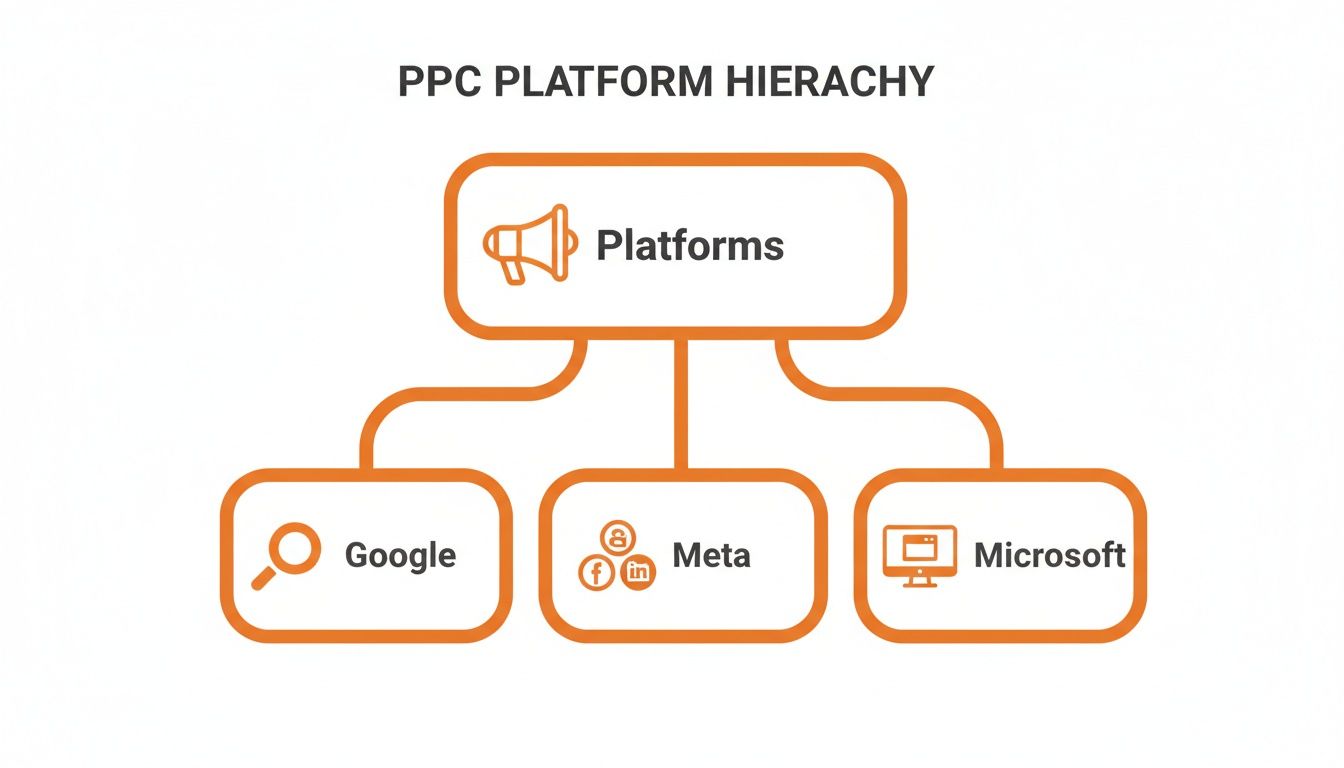
This setup shows how platforms like Google, Meta, and Microsoft are the main channels where you’ll build and launch these carefully organised campaigns.
Structuring Campaigns for Maximum Profitability
While organising your campaigns by product category is the go-to method for most, seasoned advertisers often use more advanced structures to tie their campaigns directly to business goals. The endgame is always the same: put your budget where it will bring back the highest return.
Here are a few strategic ways to think about structuring your campaigns:
- By Product Line or Category: The classic approach, and for good reason. You create separate campaigns for ‘T-Shirts’, ‘Hoodies’, and ‘Hats’. This keeps everything neat, tidy, and relevant.
- By Profit Margin: Now we’re getting a bit more sophisticated. Group your high-margin, bestselling products into one campaign and your lower-margin items into another. This gives you the freedom to set much more aggressive bids and bigger budgets for the products that actually make you the most money.
- By Promotion or Season: Running a “Summer Sale” or a big “Black Friday” event? Give it a dedicated campaign. This lets you control the budget, ad copy, and landing pages specifically for that promotion without messing with your regular, evergreen campaigns.
A well-structured campaign is your first line of defence against wasted ad spend. It ensures the right person sees the right ad for the right product, making every click more valuable.
Writing Ad Copy That Converts
Your campaign structure gets the right people to your digital doorstep, but it’s your ad copy that convinces them to come inside. Writing compelling ad copy is a crucial skill, especially for businesses in regulated niches where you absolutely have to be clear and compliant.
Your copy needs to speak directly to what your ideal customer wants and needs. It has to be clear, concise, and focused on the benefits. Don’t just list features; tell the customer what your product does for them.
To write ads that actually get clicked, make sure you always include these elements:
- A Strong Hook: Kick things off with a question or a bold statement that grabs their attention right away.
- Key Benefits: Highlight what makes your product the one to choose (e.g., “Made with Organic Materials,” “Free Next-Day Shipping”).
- A Clear Call-to-Action (CTA): Tell people exactly what you want them to do next. Use action-packed phrases like “Shop Now,” “Order Today,” or “Explore the Collection.”
When you combine a logical campaign structure with persuasive ad copy, you create a powerful system for attracting and converting shoppers who are ready to buy. This is how you turn your PPC efforts into a reliable engine for e-commerce growth.
Optimizing Your Product Feeds and Ad Creatives
In e-commerce PPC, your product feed is much more than just a technical file—it’s the digital DNA of your entire inventory. Think of it as the foundational sales pitch you’re giving to platforms like Google Shopping. A messy, poorly managed feed is like having a disorganized storefront; potential customers will simply walk right past.
A meticulously optimized feed, on the other hand, makes sure your products show up for the right searches, with the right information, at the right time. This is where you can carve out a serious competitive edge, turning basic product listings into powerful, click-driving ads.
Powering Up Your Product Feed
Your product feed is the backbone of your campaigns on Google, Bing, and Meta. Getting the details right not only prevents frustrating errors but also dramatically boosts your visibility where it counts.
Here are the key elements to dial in for a high-performing product feed:
- Descriptive Product Titles: Don’t settle for just the product name. You need to front-load your most important keywords and include key attributes like brand, colour, size, or material. Instead of “Running Shoes,” aim for something like “BrandName Men’s Trail Running Shoes – Blue – Size 10.”
- Keyword-Rich Descriptions: Your product description is another golden opportunity to tell the platform’s algorithm exactly what your product is. Weave in relevant long-tail keywords naturally, but always focus on the benefits and features a real shopper would be searching for.
- High-Quality Images: Your main image should be a clean, high-resolution shot on a plain white background. But don’t stop there. Supplement it with lifestyle images that show the product in use. This helps shoppers visualize it in their own lives and can significantly lift engagement.
Your product feed is the single most important asset for any Shopping campaign. Treating it as an afterthought is the fastest way to limit your reach and waste your ad spend.
By continuously refining these elements, you create a far more informative and seamless shopping experience that will pay dividends across all your advertising platforms.
Creating Thumb-Stopping Ad Creatives
While your product feed handles the heavy lifting for platforms like Google Shopping, your ad creatives are what capture attention on visually driven platforms like Instagram and Facebook. The goal here is to create “thumb-stopping” content—something that genuinely interrupts a user’s scroll and makes them take notice.
This isn’t just about making things look pretty; it’s about data-driven creativity. For Canadian SMEs, mastering this is the key to unlocking immediate results. We’ve seen well-executed campaigns generate up to 146% more leads and slash cost-per-conversion by 63%. In a Canadian e-commerce market that hit $386 billion in 2022, this translates directly into qualified traffic and new client consultations. The secret lies in the daily tweaks—A/B testing and smart pacing are what ultimately drive sustainable revenue. You can find more insights about PPC for Canadian SMEs on Thrive Agency.
To make your ads truly stand out, focus on these core principles:
- Lead with a Visual Hook: Use vibrant colours, dynamic video clips, or intriguing imagery right in the first three seconds to grab attention. A static, boring image will simply get lost in the noise of the feed.
- Tell a Visual Story: Don’t just show the product; show it solving a problem or enhancing a lifestyle. A carousel ad, for instance, can walk a user through the benefits and uses of your product in a few simple swipes.
- A/B Test Everything: Never assume you know what will work best. You need to be continuously testing different headlines, images, videos, calls-to-action (CTAs), and even audience segments. Let the data tell you which combination delivers the goods.
This blend of data and creativity is the secret ingredient that transforms an ad from something that’s just seen into something that gets clicked, turning passive scrollers into active customers.
Mastering Your Bids, Budgets, and Performance Metrics
Once your campaigns are structured and your ads are out in the wild, the real work begins. Your focus has to shift from setup to steering—and that means mastering the numbers. Effective ecommerce PPC isn’t about throwing money at a platform and hoping for the best; it’s about making smart, data-driven decisions on how much to spend and, more importantly, where to spend it.
Think of your budget as the fuel in your tank and your bidding strategy as the gas pedal. You need to apply both with a careful touch to get where you’re going without running out of gas halfway there. This is where so many campaigns go wrong.
Manual vs. Automated Bidding: Who’s Flying the Plane?
At the core of all this is your bidding strategy, which is simply how much you’re willing to pay for a click. You really have two main ways to go about it, and each has its place.
- Manual Bidding: This is you in the cockpit, hands on the controls. You set the maximum cost-per-click (CPC) for every single keyword or ad group. It’s meticulous and requires a lot of attention, but it gives you absolute control. This approach is fantastic when you’re launching a new product and need to carefully manage costs while you gather data, or for smaller, hyper-focused campaigns where every click counts.
- Automated Bidding: Here, you’re handing the keys over to the platform’s AI. You tell the system your goal—maybe it’s getting the most conversions possible or hitting a specific return on your ad spend—and its algorithms get to work. They’ll adjust your bids in real-time, auction by auction, to hit that target. For large accounts with thousands of products, this isn’t just a nice-to-have; it’s essential.
For most ecommerce stores I work with, the sweet spot is often a hybrid approach. You might start a new campaign with manual bidding to get a feel for the landscape. Once you have a steady stream of conversion data, you can flip the switch to an automated strategy like Target ROAS and let the machine learning take over and scale your success.
Finding Your True North: The Metrics That Actually Matter
Let’s be honest: clicks and impressions might look good in a report, but they don’t pay the bills. If you want to build a genuinely profitable ecommerce machine, you have to obsess over the metrics that connect your ad spend directly to your bank account. These are your true north stars.
Clicks tell you if your ads are grabbing attention. Conversions and ROAS tell you if your business is actually growing. Don’t let vanity metrics distract you from what really drives your bottom line.
There are a ton of metrics you can track, but only a few that you absolutely must track.
Before we dive into the big ones like ROAS and CLV, it’s helpful to have a clear picture of all the key players. Each metric tells a different part of the story, from initial ad engagement to long-term customer profitability.
Decoding Key Ecommerce PPC Metrics
| Metric | What It Measures | Why It Matters for Ecommerce |
|---|---|---|
| Impressions | How many times your ad was shown to a user. | Indicates your ad’s visibility and reach. It’s the top of your funnel. |
| Clicks | The number of times users clicked on your ad. | Shows that your ad copy and creative are compelling enough to earn a click. |
| Click-Through Rate (CTR) | The percentage of impressions that resulted in a click (Clicks ÷ Impressions). | A key indicator of ad relevance. A high CTR often leads to a better Quality Score. |
| Cost Per Click (CPC) | The average amount you pay for each click on your ad. | Directly impacts your budget. A lower CPC means you can get more traffic for the same spend. |
| Conversions | The number of desired actions (e.g., purchases) completed by users. | This is what it’s all about—turning clicks into customers. |
| Conversion Rate (CVR) | The percentage of clicks that resulted in a conversion (Conversions ÷ Clicks). | Measures the effectiveness of your landing page and overall user experience. |
| Return on Ad Spend (ROAS) | The total revenue generated for every dollar spent on advertising (Revenue ÷ Ad Spend). | The ultimate measure of campaign profitability. It’s your “money in vs. money out” score. |
| Customer Lifetime Value (CLV) | The total projected revenue a single customer will generate over their entire relationship with your brand. | Informs your customer acquisition cost strategy and helps you focus on long-term growth. |
Understanding how these metrics interact is what separates a good PPC manager from a great one. Now, let’s zoom in on the two most critical ones for any ecommerce advertiser.
- Return on Ad Spend (ROAS): This is it—the heavyweight champion of ecommerce PPC metrics. It answers the simple, vital question: “For every dollar I put into ads, how many dollars am I getting back?” A ROAS of 4:1, for example, means you’re making $4 in revenue for every $1 you spend. Knowing what ROAS is and how to improve it is the foundation of profitable advertising.
- Customer Lifetime Value (CLV): While ROAS gives you an immediate report card, CLV plays the long game. This metric estimates the total profit a customer will bring to your business over time. Why does this matter? It helps you justify spending a bit more to acquire a new customer today, because you know their repeat purchases down the road will make that initial investment incredibly worthwhile.
Focusing on both gives you a complete picture: ROAS for short-term campaign health and CLV for long-term, sustainable business growth.
How to Set a Budget and Put Your Money to Work
Now that you know what to measure, you can set a realistic budget. A classic mistake is taking a small budget and spreading it like a thin layer of butter over too many campaigns. It’s far better to concentrate your firepower on your best-performing products or categories first.
Here’s a simple but powerful framework for allocating your budget:
- Fund Your Winners (70-80%): The vast majority of your budget should go directly to the campaigns and ad groups that are already proven performers. If something is consistently hitting your target ROAS, feed it.
- Test and Experiment (10-20%): Carve out a small slice of your budget to test new things—new ad copy, different landing pages, untapped keywords. This is your R&D fund, where you find your next big winner.
- Cut the Losers (The Rest): Be ruthless. Don’t be afraid to pause campaigns or ad groups that are just burning cash. That remaining 10% of your strategy isn’t about new spending, but about being disciplined enough to reallocate money from underperformers to your top campaigns.
This isn’t a “set it and forget it” process. It’s a constant loop of monitoring your metrics, learning what works, and shifting your budget to do more of it. That’s how you build a powerful feedback cycle that drives real, profitable growth.
Scaling Growth with AI and Conversion Rate Optimization
Getting traffic to your online store is a great start, but it’s really only half the battle. The true art of e-commerce PPC is turning those clicks into paying customers and then figuring out how to do more of it, profitably. This is where artificial intelligence and Conversion Rate Optimization (CRO) team up to build a serious growth engine for your business.
Think of AI in your ad campaigns not as a replacement for your expertise, but as the ultimate co-pilot. It crunches massive amounts of data and handles the tedious, repetitive work with a speed and accuracy no human ever could. This frees you up to focus on strategy—the big-picture thinking that actually grows your brand.
Letting AI Steer the Ship
Today’s ad platforms are built on a foundation of AI. Take Google’s Performance Max campaigns or its entire family of smart bidding strategies—these are AI in action. In the blink of an eye, these systems analyze thousands of signals, everything from the device someone is using to the time of day, to adjust your bids and find the perfect moment to show your ad.
This kind of automation is a massive leap forward. Gone are the days of manually tweaking bids for every single keyword. Now, you can give the system a clear objective, like a target Return on Ad Spend (ROAS), and let the machine learning algorithms figure out the best way to get there. It’s about making sure every dollar is spent on auctions most likely to result in a sale.
AI-driven tools don’t just make your campaigns more efficient; they unlock performance opportunities you would never find on your own. They act as a force multiplier for your entire advertising effort.
This changes your role entirely. Instead of getting bogged down in the day-to-day minutiae, you get to be a high-level strategist. Your time is suddenly freed up for refining your product offers, analyzing market trends, and exploring new avenues for growth—the creative, strategic work that really makes a difference.
Creating a Powerful Feedback Loop with CRO
Here’s a connection that too many advertisers miss: your PPC campaigns are a treasure trove of data that can make your website better. This is where Conversion Rate Optimization (CRO) comes in. CRO is the simple practice of testing different elements on your site—your landing page copy, your product photos, your checkout flow—to get more visitors to buy.
And your PPC data tells you exactly where to look first.
- Top-Performing Keywords: If you’re seeing amazing results from keywords like “organic cotton baby clothes,” that’s a huge hint. It tells you to plaster the words “organic” and “safe for babies” all over your landing page.
- Most Clicked Ad Copy: Are the ads promising “Free Next-Day Shipping” getting all the clicks? That benefit needs to be the first thing visitors see on your site—no scrolling required.
- Audience Demographics: Noticing that women aged 25-34 are your best customers? Use website imagery and a tone of voice that speaks directly to them.
This creates a powerful, self-improving cycle. You use the insights from your ads to improve your website’s conversion rate. A higher conversion rate means each click is more valuable, so you can afford to bid more to get more traffic. This, in turn, feeds your campaigns even more data to find even better customers. It’s a feedback loop that consistently drives up profitability and helps you scale the entire operation.
Your Top Ecommerce PPC Questions, Answered
If you’re diving into the world of PPC for your e-commerce store, you’ve probably got a few questions. Let’s cut through the noise and get straight to the practical answers you need to run your campaigns with confidence.
How Much Should I Spend on PPC?
There’s no magic number here, but the best way to figure it out is to work backwards from what you want to achieve. First, nail down your target Return on Ad Spend (ROAS) and know your product’s profit margin inside and out. This tells you the absolute maximum you can afford to pay for a sale, which gives you a solid target Cost Per Acquisition (CPA).
Just starting out? Don’t bet the farm. Begin with a smaller test budget—an amount you’d be okay with losing—to gather that all-important initial data without a massive risk. Once you see what’s working, you can start funnelling profits back into the successful campaigns and scale things up, always keeping an eye on that target ROAS.
When Will I Actually See Results?
One of the best things about PPC is how quickly it gets going. Unlike SEO, which can feel like a waiting game for months, a PPC campaign can start sending traffic and data your way just hours after you hit ‘launch’.
But getting profitable results? That takes a little more time. Think of the first few weeks as a learning phase.
- Weeks 1-2: This is all about data collection. You’re watching click-through rates (CTR) and getting a feel for the quality of traffic coming to your site.
- Weeks 3-4: Conversions should start trickling in. Now you can begin tweaking your campaigns based on what’s actually driving sales.
- Months 2-3: By now, you should be aiming for consistent profitability as you dial in your targeting, bids, and ad creative.
The biggest takeaway here is to be patient. That first month is an investment in data. So many people make the costly mistake of pulling the plug too early, right before a campaign finds its groove.
Is PPC Better Than SEO for Ecommerce?
It’s a classic question, but it sets up a false rivalry. PPC and SEO aren’t competitors; they’re teammates, and they work best when you put them on the field together.
Here’s a simple way to think about it:
- PPC is your sprinter: It gets you immediate traffic, quick sales, and a ton of valuable keyword data right out of the gate.
- SEO is your marathon runner: It builds that long-term, trustworthy, organic traffic that becomes a sustainable asset over time.
The smartest play is to use the insights from your PPC campaigns to guide your SEO strategy. Found a keyword that converts like crazy in your ads? That’s exactly where you should focus your SEO efforts. This creates a powerful feedback loop where your paid ads fuel your long-term organic growth. You truly get the best of both worlds.
Ready to transform your clicks into customers with a data-driven strategy? The team at Juiced Digital uses AI-powered paid advertising and conversion optimization to build profitable growth engines for ecommerce brands. Book your free consultation today!